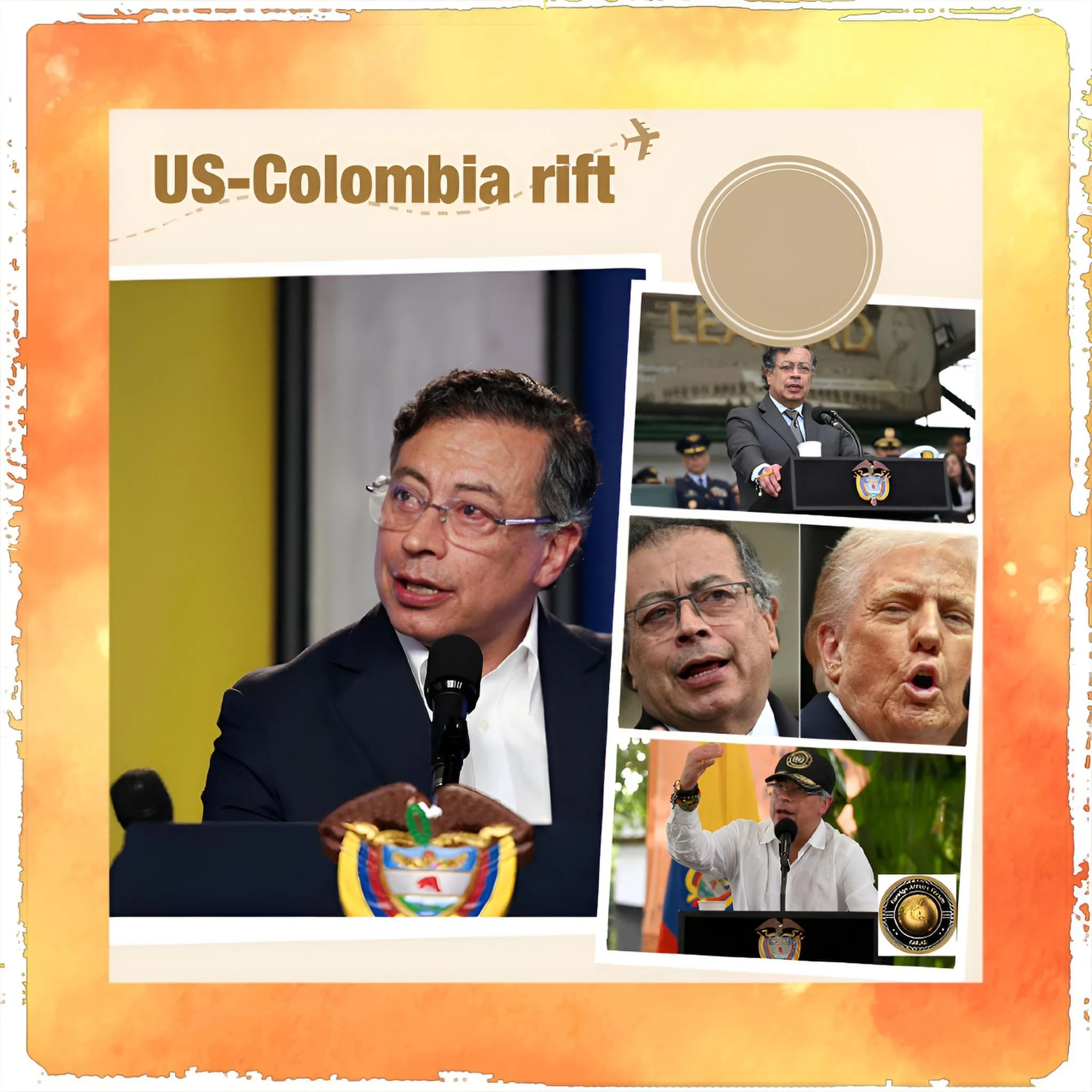
U.S.-Colombia rift- developing story : “Awakening the Jaguar”
Introduction
Executive Summary
The quote in question is verified as authentic and pertains to a rapidly escalating diplomatic crisis unfolding on December 2, 2025.
President Trump’s remarks ignited the exchange during a cabinet meeting earlier today, in which he threatened unilateral military operations against drug laboratories in countries involved in cocaine trafficking to the United States, explicitly mentioning Colombia.
President Gustavo Petro’s response—warning Trump not to “awaken the Jaguar”—serves as a direct invocation of Colombia’s national sovereignty and signals a threat of complete diplomatic rupture, potentially escalating to military conflict, should the U.S. proceed with unilateral military strikes on Colombian territory.
Trump’s perceived “plan” for Colombia appears to adopt a strategy of “Maximum Coercion,” employing a combination of economic tariffs, aid reductions, and the threat of direct military action to compel a change in Colombia’s drug interdiction policies.
The Incident: “Awakening the Jaguar”
The Trigger (Dec 2, 2025)
During a cabinet session this morning, President Trump expanded on his “War on Cartels” doctrine, emphasizing a more aggressive approach.
He authorized missile strikes targeting drug vessels in international waters within the Caribbean and Pacific regions and explicitly suggested that the U.S. might attack cocaine production facilities within Colombia.
He stated that any country knowingly exporting drugs to the U.S. is “subject to attack,” regardless of sovereignty considerations.
He reportedly expressed personal eagerness to personally destroy the labs, stating he would be “proud” to do so.
Petro’s Response
President Petro’s statement firmly rejects U.S. extraterritorial military intervention.
By inviting Trump to “come to Colombia” and witness manual eradication efforts firsthand, Petro contrasts his policy—focused on ground-based, police-led destruction—with Trump’s proposed strategy involving aerial bombardment and missile strikes.
The “Jaguar” Metaphor
This symbolizes Colombian nationalism and indigenous strength, serving as a potent rhetorical device.
Petro signals that a U.S. attack would not be seen as a “police action” but as an act of war, unifying the country against external aggression and ending two centuries of alliance with the United States.
The Data (18,400 Labs): Petro cites the destruction of approximately 18,400 drug laboratories during his administration—an increase from about 10,300 reported in November.
He underscores that this was achieved “without missiles,” emphasizing the effectiveness of current manual, intelligence-led interdiction efforts and arguing that U.S. kinetic force is both unnecessary and legally questionable.
President Trump’s Plan for Colombia
Based on actions taken late 2025 and the recent rhetoric, Trump’s strategy marks a shift from a partnership approach to one characterized by coercion.
The plan rests on three main pillars
Unilateral Military Interdiction (The “Shoot Down” Policy)
Kinetic Strikes: Trump has advanced from funding Colombian police efforts to threatening direct U.S. military intervention, including missile strikes on drug vessels and potentially on Colombian soil.
Disregard for Sovereignty:
The administration considers drug cartels as foreign terrorist organizations (FTOs), justifying military intervention without Colombia’s consent.
Economic Warfare (Tariffs & Aid Cuts)
Tariffs
In October 2025, Trump threatened tariffs on Colombian exports such as flowers, coffee, and textiles if drug flows continued, aiming to pressure Colombia by linking legitimate exports to drug trade activity.
Aid Termination
The U.S. has already begun slashing the approximately $230-$400 million annually provided in aid, arguing that funds are wasted as cocaine production rises.
Decertification
The U.S. has effectively decertified Colombia as a partner in drug enforcement, triggering sanctions and funding cuts under legal frameworks.
Delegitimization of the Petro Government
Rhetoric
Trump has publicly accused Petro of being an “illegal drug leader” and a “lunatic,” attempting to isolate him diplomatically.
Diplomatic Downgrade
Relations have deteriorated sharply, including the recall of ambassadors and the revocation of visas for Colombian officials, possibly including Petro himself, following his recent remarks at the UN.
Strategic Analysis: The Core Disconnect
The conflict arises from two fundamentally incompatible perspectives on how to fight the drug trade.
Strategic Divergence: The Ontological Breach in Counter-Narcotics Doctrine
The diplomatic rupture signifies not merely tactical disagreements but a deeper ontological divide regarding the origins and nature of the global narcotics trade.
This signals the breakdown of the long-standing “co-responsibility” framework governing U.S.-Colombia relations, which is being replaced by two mutually exclusive strategic paradigms.
Etiological Asymmetry: Socio-Economic vs. Security Pathologies
The Petro Doctrine (Structuralist/Holistic)
President Petro views the drug trade as a symptom of structural failures, notably the lack of agricultural industrialization in the Global South and the “virus of unregulated consumption” prevalent in the Global North.
He considers coca farmers victims of market exclusion rather than criminals, emphasizing the need for agrarian substitution—replacing illicit cultivation with sustainable legal agriculture—over forced eradication.
The Trump Doctrine (Kinetic/Neorealist)
This approach sees the drug trade as a security threat driven by state weakness or complicity. It dismisses socio-economic factors, favoring a “hard power” approach that views the supply chain as operable because of low costs.
The goal is maximum coercion—raising operational costs to collapse the market.
Operational Incongruence: Surgical Interdiction vs. Total Eradication
Manual vs. Aerial
Petro’s “Jaguar” strategy prioritizes targeting key nodes (labs, transit routes) through manual interdiction, opposing aerial spraying—especially glyphosate—on environmental and health grounds.
He argues that the destruction of 18,400 labs demonstrates the superiority of intelligence-led, targeted actions over brute force.
The Kinetic Escalation
Trump’s threat signifies a move toward militarized extraterritorial intervention.
By proposing missile strikes and lab destruction, the U.S. signals a shift from law enforcement cooperation to direct military engagement.
This doctrine suggests that sovereignty is conditional; if a host state fails to combat threats, U.S. intervention is justified.
The Sovereignty Paradox
The core disagreement hinges on definitions of sovereignty
Petro’s Westphalian Absolute
He views U.S. action as a violation of national sovereignty—any unauthorized military strike as an act of war (“awakening the Jaguar”).
He insists that U.S. drug demand doesn’t authorize turning Colombia into a battleground.
Trump’s Extraterritorial Security Sphere
Under a revived Monroe Doctrine, the U.S. considers narcoterrorism an existential threat extending its security perimeter to source zones, effectively nullifying Colombian sovereignty if Bogotá refuses U.S.-desired eradication methods.
Implication of “The Jaguar” Warning
Petro’s warning indicates that a U.S. strike on Colombian soil could provoke:
Diplomatic Rupture
Colombia might sever ties, expel U.S. agencies like DEA, CIA, and FBI, and possibly close strategic U.S. military bases.
Regional Realignment
Colombia could pivot toward China or Russia for security support, representing a significant geopolitical loss for the U.S. in its hemisphere.
Asymmetric Response
“Awakening the Jaguar” implies a fierce, unpredictable backlash—likely ending U.S.-Colombia security cooperation, including migration management at the Darién Gap, worsening U.S. border crises.
Conclusion
Strategic Conclusion: The End of the “Special Relationship”
The decades-long “special relationship” between Washington and Bogotá—built on the pillars of Plan Colombia, anti-communism, and the War on Drugs—has functionally collapsed.
It is being replaced by a hostile transactionalism where the U.S. views Colombia as a security threat and Colombia views the U.S. as an imperial aggressor.
The Geopolitical Pivot: A “Non-Aligned” Colombia
President Petro’s “Jaguar” warning is not merely rhetorical; it is a signal of strategic realignment.
The China Option
Faced with U.S. economic coercion (tariffs) and security threats, Colombia is accelerating its pivot toward Beijing.
Petro’s administration has already signaled intent to join China’s Belt and Road Initiative (BRI), a move that would likely trigger further U.S. retaliation but provide Colombia with alternative infrastructure funding and political cover.
Loss of Strategic Depth
For the U.S., the alienation of Colombia means the loss of its most reliable partner in South America.
This creates a “security vacuum” in the Andean region that adversaries (China, Russia, Iran) will likely exploit to establish a firmer foothold closer to the U.S. homeland.
The Migration Fallout: Weaponization of the Darién Gap
The most immediate and tangible consequence for the U.S. will likely be on its southern border.
The Leverage Point
Colombia controls the Darién Gap, the primary bottleneck for migration from South America to the U.S.
The Consequence
If Trump executes military strikes or crippling economic sanctions, Petro has the asymmetric capability to “weaponize” migration.
By ceasing interdiction efforts or ending cooperation with Panama and the U.S. (DHS), Colombia could allow—or even facilitate—a massive surge of migrants northward, overwhelming U.S. border defenses in a way that tariffs cannot fix.
The “War on Drugs” Paradox
Trump’s “Maximum Coercion” strategy is likely to be counterproductive due to the “Balloon Effect” and nationalist backlash.
Nationalist Unity
Just as U.S. sanctions often rally domestic support for targeted regimes (e.g., Cuba, Venezuela), a U.S. military attack on Colombian soil would likely bolster Petro’s domestic standing, framing him as a defender of sovereignty against foreign aggression.
Operational Failure
Without Colombian ground intelligence and police cooperation, U.S. aerial interdiction is significantly less effective.
“Blind” strikes on labs may disrupt production temporarily but will likely disperse it into smaller, harder-to-target units (the “cockroach effect”), while simultaneously destroying the political will for any future cooperation.
Final Analytical Verdict
The “Jaguar” quote serves as the epitaph for the era of U.S. hegemony in Colombia.
President Trump’s attempt to apply a “sovereignty-piercing” security doctrine has collided with a Colombian administration ideologically prepared to reject it.
The likely outcome is a lose-lose strategic failure
For the U.S
It loses its key regional ally, likely sees an increase in migration, and pushes Colombia into China’s orbit without significantly reducing cocaine flows (which are market-driven).
For Colombia
It faces economic isolation, capital flight, and potential pariah status in Western markets, forcing a painful economic transition.
In short, the “Jaguar” has been awakened, and its first act will likely be to tear up the map of U.S. influence in the Andes.