Friend or Foe? Why the U.S. Just Labeled Colombia a Failure in the Drug War
Executive Summary
Shadow of the Reaper: Will U.S. Strikes Move from the Sea to the Jungle?
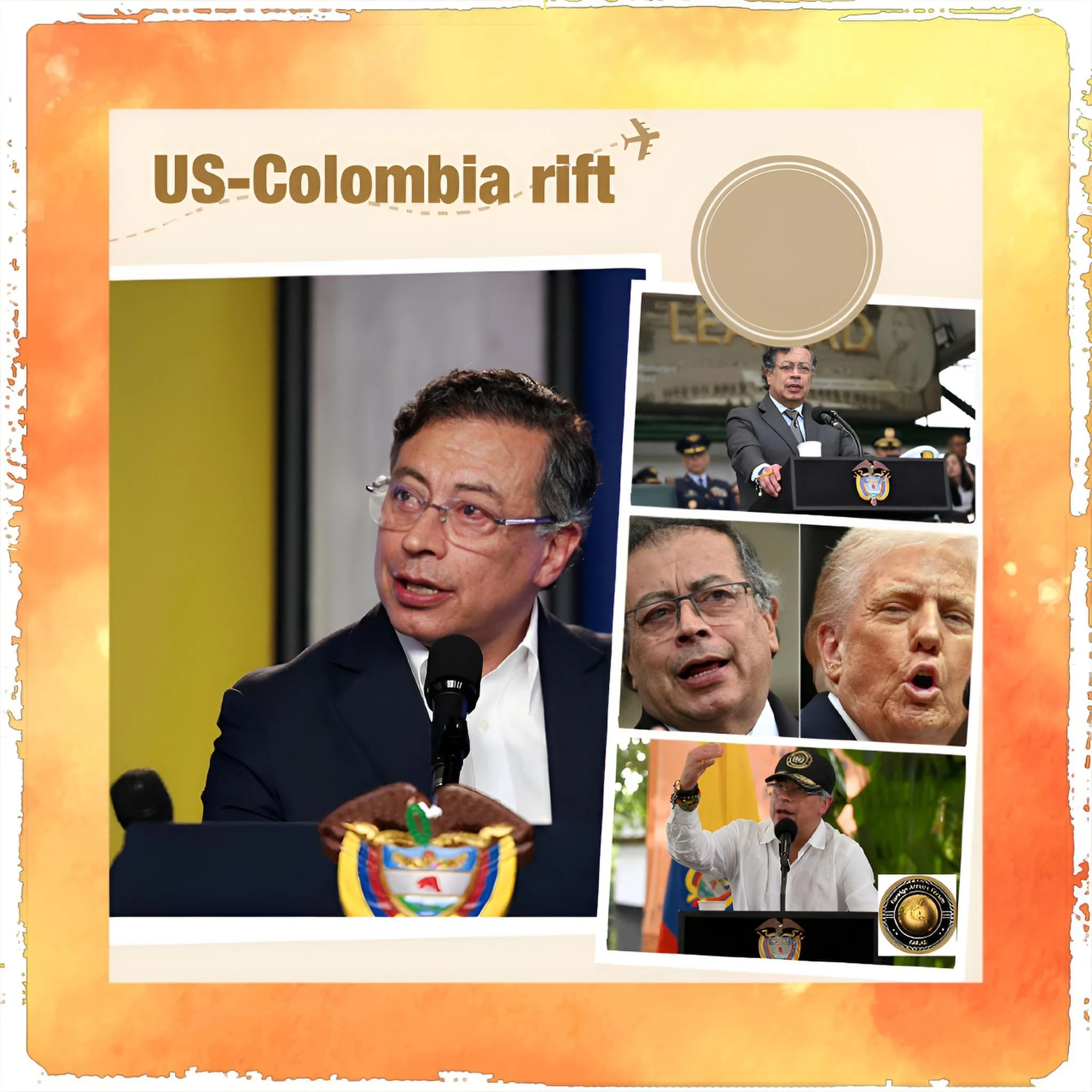
As 2025 draws to a close, the diplomatic chasm between Washington and Bogotá has widened to its most precarious point in decades.
Propelled by a historic 53 percent surge in potential cocaine production within Colombia, the United States has officially designated its longtime ally as a nation that has “failed demonstrably” in its counternarcotics obligations.
Decertified: The Collapse of the “Special Relationship” in the Andes
This decertification, coupled with the Trump administration’s increasingly kinetic posture in the Caribbean—evidenced by recent lethal maritime strikes—raises an urgent geopolitical question: Is Colombia drifting into the crosshairs of U.S. military aggression, risking a fate similar to the isolation and pressure campaigns leveled against Venezuela?
This analysis examines the colliding trajectories of President Gustavo Petro’s “Total Peace” drug policy and the United States’ militarized interdiction strategy, concluding that while a direct invasion remains unlikely, Colombia faces an imminent era of economic coercion and covert interventionism that could destabilize the region.
Introduction
After Venezuela: The Looming Shadow of U.S. Intervention Over Colombia
For nearly half a century, Colombia served as the linchpin of American security interests in South America, a reliable partner in the Western Hemisphere’s war on drugs.
That era of alignment appears to have shattered.
Under the administration of President Gustavo Petro, Colombia has fundamentally pivoted away from forced eradication of coca crops, viewing the drug trade as a socioeconomic symptom rather than a purely criminal enterprise.
Conversely, the White House, grappling with a domestic overdose crisis and emboldened by a hawkish defense doctrine, views this pivot as a betrayal.
The release of United Nations data confirming record-breaking cocaine output has acted as an accelerant, transforming a policy dispute into a full-blown diplomatic crisis.
With Defense Secretary Pete Hegseth already facing scrutiny for aggressive rules of engagement in the Caribbean, the spotlight has swung toward Colombia’s jungle laboratories, prompting fears that the “War on Drugs” is shifting from a law enforcement operation to a theater of kinetic warfare.
Key Developments
Coca & Kinetic Diplomacy: Assessing the collision of Petro’s Peace and Trump’s Trident
The deteriorating relationship is underscored by three pivotal developments in late 2025.
(1) First, the United Nations Office on Drugs and Crime (UNODC) released a landmark survey revealing that potential cocaine production in Colombia skyrocketed to an unprecedented 2,664 metric tons in the prior year, a 53 percent increase.
This volume fundamentally overwhelms global interdiction capacity.
(2) Second, in a move not seen since 1997, the United States decertified Colombia, grouping it with pariah states such as Venezuela and Myanmar.
The Trump administration cited Petro’s refusal to reinstate aerial fumigation and his “unsuccessful attempts to negotiate with narco-terrorist groups” as the primary drivers of this failure.
(3) Third, in a direct retaliation to the decertification and the perceived insult to national sovereignty, the Colombian government announced a suspension of U.S. arms purchases, signaling a potential realignment of its defense procurement and a profound rupture in security cooperation.
Facts and Concerns
The Andean Rupture: When the War on Drugs Became a War on Diplomacy
The statistical reality on the ground presents a grim picture for prohibitionists. Coca cultivation has expanded to over 253,000 hectares, with the density and yield of these crops improving through agricultural innovation.
The expansion is heavily concentrated in the departments of Cauca and Nariño, territories where state presence is weak and armed groups exercise de facto control.
While the Petro administration argues that it has prioritized the destruction of processing laboratories—claiming a 21 percent increase in infrastructure demolition and an 8 percent rise in seizures—these tactical victories have failed to dent the strategic supply.
The sheer volume of cocaine flooding the market suggests that for every lab destroyed, the increased acreage of raw coca leaf ensures replacement capacity is readily available.
Of particular concern to Washington is the ideological defense offered by Bogotá.
President Petro has repeatedly characterized the illicit trade as a market dynamic driven by Northern demand, controversially stating that “cocaine is not worse than whiskey” and calling for a global regulatory framework rather than prohibition.
To a U.S. administration that has recently authorized lethal strikes against drug vessels in the Caribbean, such rhetoric is viewed not merely as a policy disagreement but as complicity.
The disconnect is absolute: Bogotá sees the destruction of labs as the metric of success, while Washington views the uncontrolled expansion of coca fields as a deliberate abdication of state responsibility.
Cause and Effect Analysis
The Narco-State Standoff: Why Washington is Turning its Guns on Colombia
The current crisis is the result of a collision between two incompatible philosophies.
The cause of the production surge can be traced to Petro’s “oxygen for the future, asphyxiation for the past” strategy, which halted the forced manual eradication and aerial spraying that previously kept acreage in check.
By focusing on targeting the “owners” of the trade rather than the impoverished farmers, the state inadvertently removed the primary deterrent to cultivation, incentivizing farmers to plant more coca with lower risk.
The effect has been a market saturation that has lowered the wholesale price of coca leaf within Colombia while maintaining high street prices abroad, enriching the transnational cartels controlling the logistics.
Simultaneously, the U.S. response—driven by a domestic imperative to show strength against cartels labeled as foreign terrorist organizations—has escalated from diplomatic pressure to unilateral action.
The recent boat strikes in the Caribbean demonstrate that the U.S. is willing to bypass partner nation sovereignty to interdict shipments.
The decertification of Colombia is the bureaucratic precursor to this kinetic approach; it legally clears the path for the U.S. to withhold aid, block international loans, and potentially authorize covert operations within Colombian territory without Bogotá’s consent.
Future Steps
Can Petro Hold the Line? Sovereignty vs. Superpower in the Fight Against Cocaine
In the near term, the United States is likely to leverage the decertification to impose economic sanctions on specific Colombian officials or sectors deemed complicit in the drug trade.
We may expect the Trump administration to redirect security aid from the Colombian military to vetted, independent units or to withhold it entirely, crippling Colombia’s maintenance of its U.S.-supplied air fleet.
This could force Colombia to seek maintenance and new armaments from non-traditional partners, potentially opening the door to Chinese or Russian influence in a country once considered NATO’s only Latin American partner.
For Colombia, the path forward involves a desperate diplomatic offensive to rally European support for its “holistic” drug policy, attempting to isolate the U.S. position.
However, if the “Caribbean campaign” of boat strikes expands closer to Colombian territorial waters, the risk of an accidental clash between U.S. naval assets and the Colombian Navy increases significantly.
President Petro will face immense internal pressure to demonstrate sovereignty, potentially leading to the expulsion of remaining U.S. law enforcement personnel from the country.
Conclusion
The Narco-State Standoff: Why Washington is Turning its Guns on Colombia
While Colombia is not yet “the next Venezuela” in terms of economic collapse or authoritarian consolidation, it is rapidly becoming the next primary target of U.S. coercive statecraft in the Western Hemisphere.
The designation of Colombia as a demonstrably failing state in the drug war effectively ends the era of the “special relationship” and inaugurates a period of hostility.
The U.S. aggression mentioned in the query is already manifesting, not as a full-scale invasion, but as a hybrid campaign of economic strangulation, reputational delegitimization, and unilateral military interdiction in shared waters.
Unless there is a dramatic reversal in production trends or a change in leadership in either capital, the two nations are on a collision course that could see Colombia treated not as a wayward ally, but as a regional security threat.