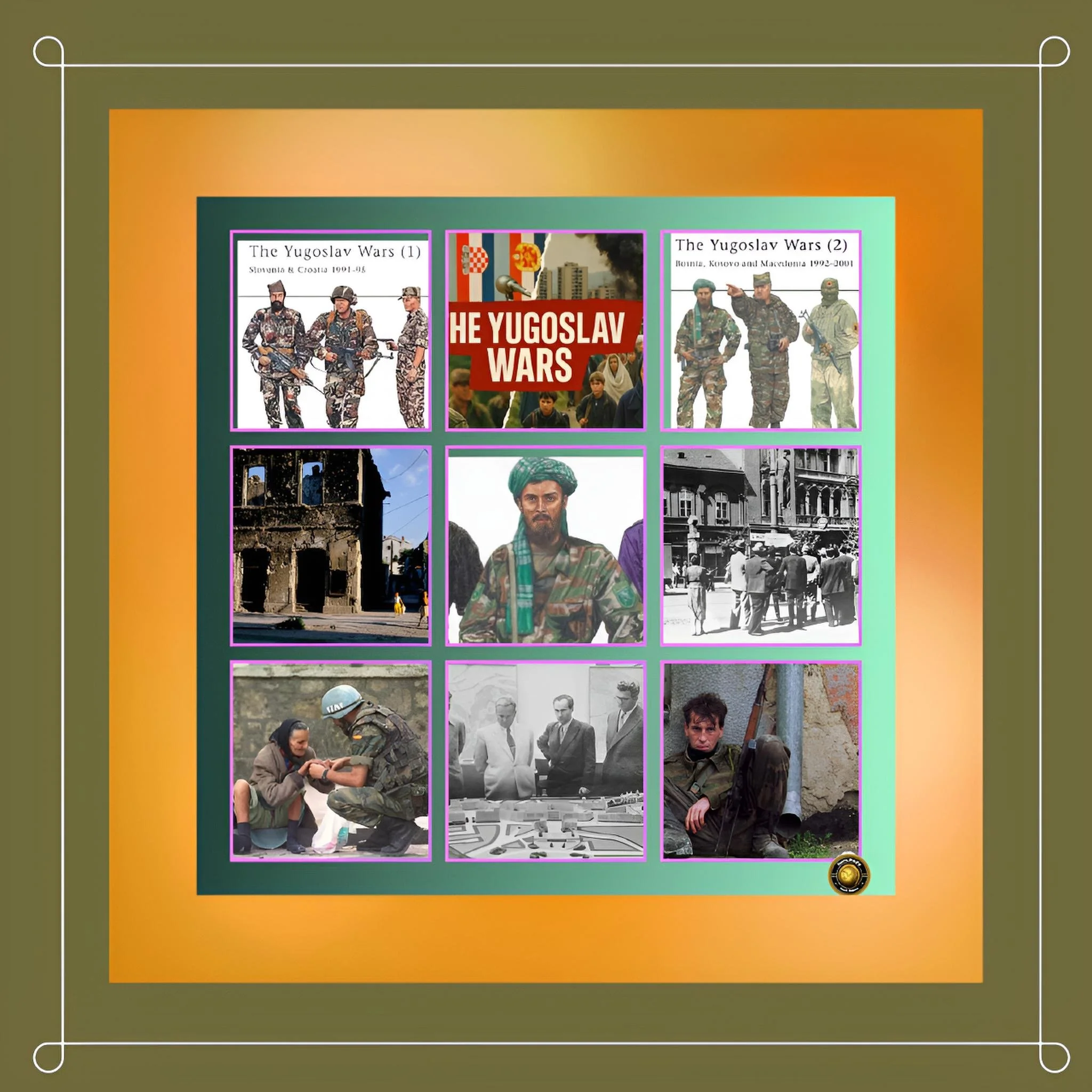
The Yugoslav Paradigm: Anatomy of a Geopolitical Failure and Lessons for the Modern World - Part I
Executive Summary
The Kingdom of Yugoslavia, established initially as the Kingdom of Serbs, Croats, and Slovenes in 1918, represents one of the most complex political experiments of the twentieth century.
Born from the vacuum of collapsed empires and driven by a mix of Pan-Slavic idealism and security pragmatism, the state was formed by a coalition of Serbian monarchists and intellectual elites from the Austro-Hungarian territories. Its trajectory—from a fragile monarchy to a non-aligned socialist federation and finally to violent dissolution—offers an indispensable case study for contemporary statecraft.
The history of Yugoslavia is not merely a regional chronicle but a masterclass in the fragility of multi-ethnic federalism, the perils of sovereign debt, and the volatility of buffer states in a shifting global order.
For twenty-first-century analysts, understanding the Yugoslav lifecycle is essential to recognizing how quickly economic integration can unravel in the face of dormant nationalism and external geopolitical pressure.
Introduction
The concept of a unified South Slavic state began as an intellectual current in the nineteenth century before manifesting as a political reality in the aftermath of World War I.
This union attempted to bridge the profound civilizational fault lines between the Catholic West, the Orthodox East, and the Ottoman Islamic heritage. The entity that emerged was formed twice and destroyed twice, creating a unique historical laboratory.
The initial formation was driven by the urgent need to protect Slavic populations from Italian expansionism and to fulfill the Serbian goal of unifying all Serbs in one state. However, the foundational tension between a centralized Serbian monarchy and the federalist aspirations of Croats and Slovenes created a structural defect that plagued the state until its final days.
Analyzing this era from beginning to end reveals that state viability relies not just on shared linguistic or cultural heritage, but on functional economic distribution and a unified political narrative that supersedes ethnic tribalism.
Key Developments and Formation
The Kingdom was forged through the collaboration of two distinct political forces: the Serbian government-in-exile, led by Prime Minister Nikola Pašić, and the Yugoslav Committee, a group of Croat, Slovene, and Serb intellectuals from Austria-Hungary led by Ante Trumbić.
Their negotiations culminated in the Corfu Declaration of 1917, the birth certificate of the new state.
The actual unification was spearheaded by Prince Regent Alexander Karadjordjević, who sought to project Serbian military power into a broader administrative framework.
The initial years were marked by immediate paralysis rather than unity.
The Vidovdan Constitution of 1921 enforced a highly centralized unitary system that alienated non-Serb populations, leading to a decade of parliamentary obstructionism.
This era of instability reached a breaking point with the assassination of Croatian politician Stjepan Radić in the parliament building in 1928.
In response, King Alexander I abolished the constitution in 1929, established a royal dictatorship, and officially renamed the state “Yugoslavia” in a desperate bid to impose a singular national identity from the top down.
Following the devastation of World War II and the Nazi occupation, the state was reconstituted under the communist leadership of Josip Broz Tito.
This second iteration, the Socialist Federal Republic of Yugoslavia, suppressed the ethnic tensions of the monarchy through a unique blend of federalism and authoritarian control.
Tito positioned the country as a geopolitical bridge, balancing between the Western and Eastern blocs as a founder of the Non-Aligned Movement.
However, the decentralization process initiated in the 1960s culminated in the 1974 Constitution, which effectively transformed the federation into a loose confederation of republics, setting the stage for the eventual dissolution of the central authority.
Facts and Concerns: The Structural Flaws
A deep analysis of the Yugoslav timeline uncovers critical structural flaws that have renewed relevance for modern governance.
The primary concern was the unresolved asymmetry of the state. To the Serbian Karadjordjević dynasty and later political elites in Belgrade, Yugoslavia was often viewed as an expansion of the Serbian state structure.
Conversely, for Zagreb and Ljubljana, the union was intended as a contractual partnership of equals to escape Austrian and Hungarian dominance. This misalignment in expectations meant that the state lacked a universally accepted source of legitimacy.
Economic disparity served as a constant accelerant for these political grievances. The profound wealth gap between the industrialized north (Slovenia and Croatia) and the agrarian south (Macedonia, Kosovo, and parts of Serbia) necessitated massive fiscal transfers.
Over time, the wealthier republics grew resentful of subsidizing the poorer regions, viewing the federal taxation system as exploitation. This dynamic closely mirrors contemporary tensions within the Eurozone, where fiscal transfers between member states remain a source of fierce political contention.
Furthermore, the socialist era was sustained by a fragile social contract financed by Western loans. When access to cheap capital evaporated, the illusion of brotherhood dissolved, revealing that the state’s unity was largely transactional.
Cause-and-Effect Analysis
The dissolution of Yugoslavia was not an abrupt accident but the result of a clear causal chain rooted in institutional design and economic management. The most significant legislative catalyst was the 1974 Constitution. By granting the six republics and two autonomous provinces near-total sovereignty, including veto power over federal decisions, the constitution rendered the central government impotent.
The effect was a collective presidency that paralyzed decision-making immediately following Tito’s death in 1980, creating a power vacuum that nationalist leaders were eager to fill.
This political gridlock was exacerbated by a catastrophic economic collapse. In the late 1970s, global interest rates spiked, causing Yugoslavia’s foreign debt to balloon unmanageably. The subsequent intervention by the International Monetary Fund imposed strict austerity measures during the 1980s.
The direct effect of this financial strangulation was the destruction of the Yugoslav middle class and a plummet in living standards. As hyperinflation eroded savings, the legitimacy of the federal government vanished. Populist leaders, most notably Slobodan Milošević, exploited this misery by redirecting public anger toward ethnic rivals. Thus, the economic crisis was the cause that weaponized ethnic identity, transforming political disagreements into existential conflicts.
Future Steps and Geopolitical Lessons
The study of Yugoslavia provides a critical roadmap for navigating the geopolitical challenges of the twenty-first century. The first major lesson concerns the precarious nature of buffer states.
Yugoslavia thrived strategically when it sat between two hostile superpowers, extracting concessions from both. Once the Cold War ended, that strategic value evaporated, leaving the country exposed.
Modern nations attempting to maintain neutrality between great powers, such as those caught between the West and Russia or China, face similar existential risks if they fail to secure binding security guarantees or genuine economic independence.
Secondly, the Yugoslav experience demonstrates that federalism without a strong binding agent is a prelude to disintegration. Attempting to manage diversity through complex ethnic quotas and veto powers, as seen in the 1974 Constitution, often hardens tribal identities rather than softening them.
This is a vital warning for the European Union and post-conflict states where governance is frequently held hostage by the need for unanimous consensus.
Finally, the era highlights the importance of economic sovereignty. A nation that relies on foreign-denominated debt to purchase social peace is vulnerable to external shocks that can rapidly delegitimize the state. Future policymakers must prioritize fiscal resilience to ensure that inevitable economic downturns do not trigger state collapse.
Conclusion
The Kingdom of Yugoslavia was an ambitious attempt to reverse centuries of imperial fragmentation, yet it ultimately fell victim to the very forces it sought to contain. It was formed by visionaries who underestimated the resilience of ethnic nationalism and the necessity of unified economic interests.
Studying its history from inception to erasure is crucial because it strips away the illusion that states are permanent fixtures of the international order.
It reveals that without a continuously reinforced civic identity and economic equity, even the most strategically important nations can disintegrate. In a twenty-first century defined by renewed great power competition and the fracturing of global norms, the ghost of Yugoslavia serves as a stark reminder that the path from stability to chaos is often shorter than anticipated.