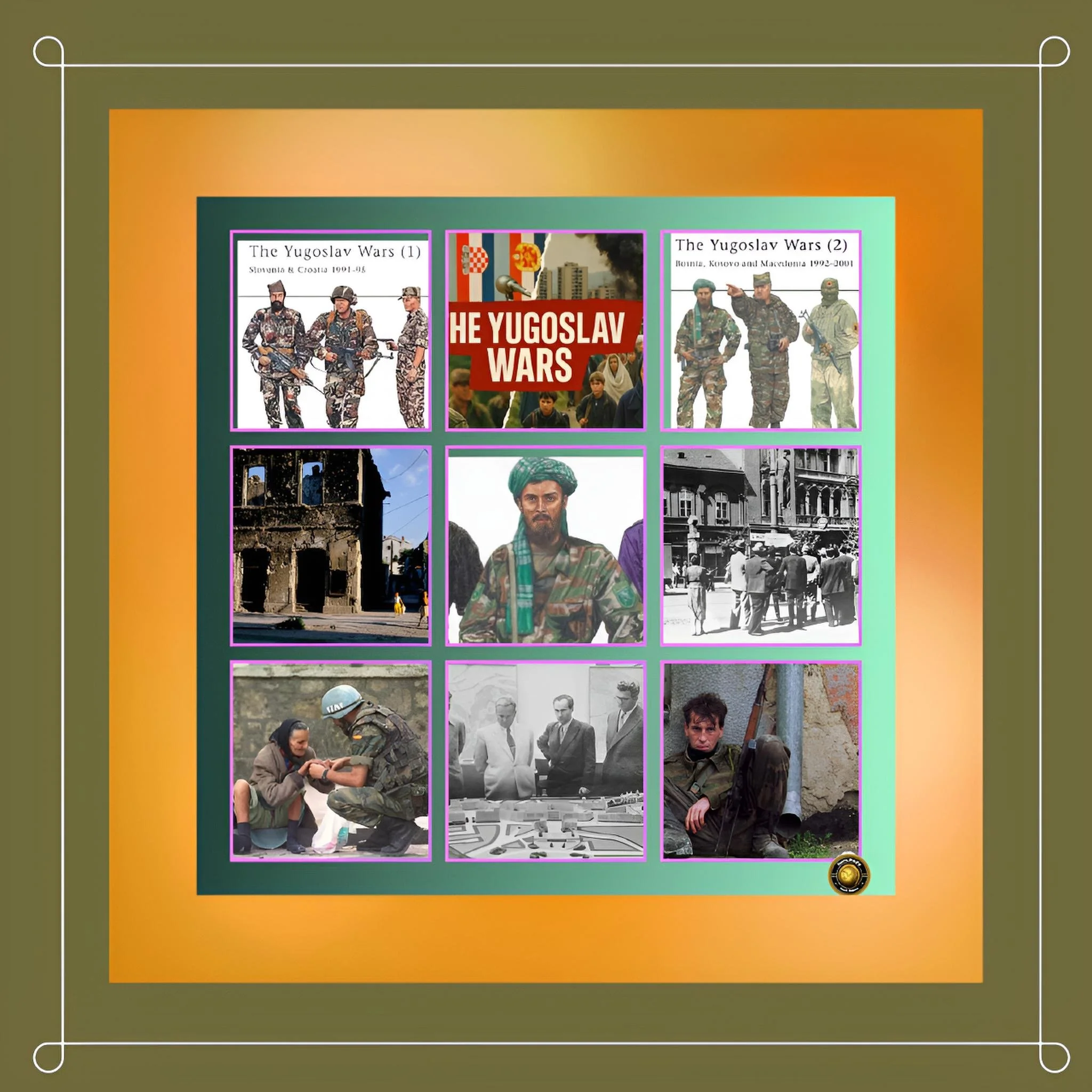
Yugoslavia’s 2.0 Nightmare Replay: Is Ukraine, Africa, South America, and the Middle East Teetering on the Edge of a Bloody Breakup? - Part I
Executive Summary
A Quarter Century Later: How Yugoslavia’s Collapse Reshaped Europe’s Future and Left Millions Behind
Yugoslavia’s bloody breakup in the 1990s serves as a stark cautionary tale for today’s flashpoints, where ethnic fractures, external interventions, and economic coercion threaten to unravel multi-ethnic states from Ukraine to Gaza.
The dissolution of the Socialist Federal Republic of *Yugoslavia (SFRY) remains one of the most consequential geopolitical transformations of the post-Cold War era, yet contemporary assessments reveal a deeply fractured legacy across its successor states.
Although Slovenia and Croatia initially positioned themselves as beneficiaries of independence, longitudinal analysis demonstrates that Yugoslavia’s breakup produced measurably worse outcomes for the majority of the federation’s population, notwithstanding the brief period when some northern republics appeared to gain from resource reallocation.
The confluence of structural adjustment programmes imposed by international financial institutions, NATO’s post-Cold War expansion, and the strategic recalibration of Western powers fundamentally reshaped the regional economic architecture.
Survey data from 2016 demonstrates that approximately 81 percent of Serbians, 77 percent of Bosnians, and majorities across Montenegro and North Macedonia perceive the dissolution as fundamentally harmful to their national development.
The primary beneficiaries of Yugoslavia’s dismantling were not the newly independent states themselves, but rather external actors: Western multinational corporations that acquired assets through privatisation at substantially reduced valuations, international financial institutions that expanded their leverage over formerly socialist economies, and NATO’s strategic positioning in Southeast Europe.
This analysis examines the complex causality between late-Yugoslav economic decline, the destabilising role of international institutions, regional geopolitical competition, and the catastrophic consequences of state fragmentation.
Introduction
Yugoslavia’s Ghost: Why Former Citizens Say Independence Was a Devastating Mistake
Yugoslavia under Josip Broz Tito represented a distinctive geopolitical entity straddling Eastern and Western spheres during the Cold War, a non-aligned nation that paradoxically maintained significant economic integration with Western markets while claiming socialist credentials.
The federation’s economic position in the late 1980s commanded regional prominence, with a gross national product of approximately $129.5 billion and a per capita income of $5,464 in 1990—metrics positioning Yugoslavia alongside Belgium, Austria, and Switzerland as a developed industrial economy.
Yet this apparent stability concealed profound structural vulnerabilities precipitated by a decade of policy missteps, external conditionality, and accumulating macroeconomic distortions.
The period from 1980 onwards witnessed a dramatic transformation: industrial growth decelerated from 7.1 percent per annum during 1966-1979 to merely 2.8 percent between 1980 and 1987.
This deceleration coincided with the emergence of hyperinflation—consumer prices rose 1,255.7 percent in 1989 alone—and unemployment climbed to double-digit levels as real wages stagnated.
The narrative of Yugoslavia’s breakup has conventionally emphasised ethnic nationalism and authoritarian leadership, particularly the role of Slobodan Milošević in orchestrating Serbian dominance through the recentralisation of federal institutions.
Yet this interpretation obscures the structural economic forces and external pressures that undermined the federation’s viability.
The story of Yugoslavia’s dissolution is fundamentally a story of how international economic policy, geopolitical repositioning, and the contradictions inherent in market socialism converged to render federation-building unsustainable and partition attractive to regional elites.
Key Developments: The Economic Deterioration and External Pressures
Yugoslavia’s post-war trajectory represented one of Southeast Europe’s most impressive development achievements.
Between 1947 and 1949, approximately one-third of national income was invested in heavy industry, with industrial employment quadrupling to two million workers.
From 1953 to 1960, industrial production expanded at 13.83 percent annually, surpassing Japan’s contemporaneous industrialisation rate despite starting from a much lower base.
This distinctive workers’ self-management system, introduced in June 1950, created a hybrid between socialist planning and market mechanisms that distinguished Yugoslavia from Soviet-bloc economies and earned significant Western support.
However, the trajectory reversed catastrophically during the 1980s.
The period from 1980 to 1989 witnessed zero growth in per capita income, contrasting sharply with the expansion of the 1960s and 1970s. This stagnation emerged from multiple converging pressures.
The federation’s external debt burdens increased substantially, requiring increased capital exports to service obligations.
Simultaneously, Yugoslavia’s strategic value to Western powers diminished as Cold War confrontation receded.
Tito’s death in 1980 deprived the federation of a unifying figure whose diplomatic acumen had navigated successfully between the Soviet bloc and the West, extracting benefits from both economic systems.
The International Monetary Fund and World Bank interventions during the early 1980s proved particularly consequential.
These institutions imposed structural adjustment programmes requiring the dismantling of Yugoslavia’s industrial protection, liberalisation of credit markets, and reduction of state enterprise support.
The impact was immediate and severe. Industrial growth collapsed; hundreds of firms filed for bankruptcy as import competition intensified.
Consumer price indexes increased 2,700 percent. Between 1989 and September 1990, more than one thousand public companies went bankrupt and GDP growth rate declined by 7.5 percent.
By 1990, the IMF and World Bank delivered a new “financial aid package” that mandated extensive federal government expenditure cuts.
Belgrade suspended transfer payments to constituent republics, precipitating a fiscal crisis at the republic level.
Real wages collapsed by 41 percent; half a million workers had their wages suspended. Industrial growth plummeted to negative 10.6 percent.
The banking system began dismantling under World Bank supervision.
This artificially induced economic contraction—distinct from the structural decline of the preceding decade—created the immediate conditions for state disintegration.
The regional distribution of economic burden proved pivotal in shaping political responses.
The 1974 Yugoslav Constitution had established an elaborate equalization mechanism whereby the more developed northern republics (Slovenia and Croatia) contributed approximately one-third of federal funds dedicated to regional development, while less developed areas including Kosovo, Bosnia, and Macedonia received redistributive transfers.
Although these transfers amounted to only 8 percent of total GDP, political elites in the wealthier republics increasingly portrayed redistribution as “lost resources” that could be retained through independence.
Slovenia and Croatia possessed per capita incomes roughly double those of Serbia and nearly triple those of Macedonia.
This narrative of fiscal exploitation, amplified through emerging nationalist rhetoric, gained traction particularly after IMF-imposed austerity began constraining all republican budgets.
The dissolution process itself accelerated following Germany’s unilateral recognition of Slovenia and Croatian independence on December 23, 1991.
This diplomatic action fundamentally altered the calculus of federal preservation, signalling to other republics that international recognition of secession would be forthcoming and simultaneously demonstrating that Western powers were prepared to abandon Yugoslavia as a coherent entity.
Germany’s position reflected both historical affinities with Slovenia and Croatia and the strategic realignment of European power following the Soviet Union’s collapse.
Facts and Concerns: The Asymmetric Consequences of Dissolution
The aftermath of Yugoslavia’s dissolution revealed deeply uneven outcomes across successor states.
Slovenia, having engaged the briefest conflict and maintaining the highest level of prior economic development, benefitted substantially from independence.
The republic retained resources previously transferred to the federation and capitalised on geographic proximity to Austria and Italy, securing early integration into European economic structures and eventually the European Union.
Slovenian GDP grew 56 percent in real terms following independence, with capital formation accounting for 25 percent of this expansion.
The state managed its transition relatively successfully, and by contemporary standards constitutes the most economically successful former Yugoslav entity.
Croatia presented a more complicated trajectory.
Although initially harmed by war devastation, the republic similarly benefitted from redirecting federal transfers to regional development.
By retaining resources previously sent to Belgrade, Croatia accumulated investment capital that—once war destruction was repaired and international recognition restored—facilitated economic recovery.
However, this recovery occurred gradually; the wars of the 1990s caused substantial infrastructure damage and population displacement that constrained development for years.
The experience of North Macedonia encapsulates the dissolution’s catastrophic consequences for less developed regions.
Macedonia received substantial federal support throughout the Yugoslav period but lacked the economic diversification or industrial base to sustain development independently.
Upon dissolution, the immediate termination of federal transfers precipitated severe economic contraction.
Despite experiencing no military conflict—unlike Bosnia, Croatia, and Serbia—Macedonia nonetheless suffered dramatic economic deterioration.
Unemployment exceeded 24 percent in 1991; GDP contracted by 6 percent that year. Contemporary assessments describe Macedonia as having become “the poorest of the new republics (excluding Kosovo),” dependent upon external support and beset by chronic unemployment, limited industrial capacity, and persistent fiscal challenges.
Bosnia and Herzegovina presents perhaps the starkest illustration of dissolution’s destructive potential.
The republic’s multinational composition—with Bosniak Muslims, Bosnian Serbs, and Bosnian Croats comprising substantial populations—rendered political negotiation across ethnic lines essential for maintaining republican coherence.
The dissolution of the federal framework, however, unleashed centrifugal forces that produced one of Europe’s most devastating conflicts since World War II.
War casualties exceeded 100,000; entire regions experienced depopulation through ethnic cleansing; infrastructure deterioration was comprehensive.
The Dayton Accords of 1995 technically ended hostilities but institutionalised ethnic partitioning through a complex constitutional structure that critics argue rendered effective governance nearly impossible.
Contemporary polling data reveals the profound disillusionment accompanying independence across much of the former Yugoslavia.
The 2016 Gallup survey found that 81 percent of Serbians viewed the breakup as harmful to their nation, 77 percent of Bosnians shared this perspective, 65 percent of Montenegrins expressed regret, and 61 percent of North Macedonians perceived dissolution as damaging.
Even in Slovenia, 45 percent harboured nostalgia for Yugoslavia, while in Croatia only 23 percent viewed the breakup as clearly beneficial.
Kosovo represented an exception, with only 10 percent expressing regret—a reflection partly of the province’s particular status and the security guarantees that NATO’s military presence provided.
The surveys further revealed that nostalgia for Yugoslavia correlated particularly with perceptions of lost economic security and the comprehensive welfare state that the socialist period had provided.
Middle-aged and elderly populations, who had experienced Yugoslavia’s prosperous decades and possessed vivid memories of employment security and social services, expressed the strongest regret.
The breaking of the integrated economic space severed trade relationships, disrupted supply chains, and eliminated the economies of scale that had sustained Yugoslav industrial production.
Cause-and-Effect Analysis: Structural Adjustment, Geopolitical Transition, and Fragmentation
Understanding who benefitted from Yugoslavia’s dissolution requires distinguishing between immediate political beneficiaries and longer-term systemic gainers.
The immediate beneficiaries at the moment of independence were regional political elites, particularly in Slovenia and Croatia, who successfully repositioned themselves as heads of newly independent states and who retained control over state assets undergoing privatisation.
Serbia’s leadership, initially seeming to benefit from control of the federation’s military apparatus and most populous republic, ultimately experienced catastrophic outcomes when NATO bombing campaigns of 1999 reduced GDP further and when international sanctions constrained economic activity.
However, the deeper beneficiaries of Yugoslavia’s destruction were Western multinational corporations and international financial institutions.
The privatisation processes launched across successor states transferred hundreds of millions of dollars’ worth of productive assets to foreign ownership at historically depressed valuations.
Yugoslav firms—even those possessing substantial technological capability and market position—were sold at a fraction of their replacement cost to foreign investors who recognised opportunities to extract value from demoralised economies.
Foreign direct investment into successor states concentrated overwhelmingly in Slovenia, Croatia, and Serbia, with companies from Germany, Italy, the Netherlands, and Luxembourg acquiring significant assets.
The industrial sectors of former Yugoslavia—including shipbuilding, aircraft production, heavy machinery manufacture, and defence industries—largely ceased independent operation and were either dismantled or absorbed into foreign corporate structures.
The IMF and World Bank, having imposed structural adjustment programmes that precipitated Yugoslavia’s economic collapse, subsequently positioned themselves as essential supervisory institutions overseeing transition to market economies.
The conditions attached to post-dissolution loans further reinforced privatisation requirements, deindustrialisation, and the elimination of enterprises deemed “inefficient” by market fundamentalist criteria.
The consequence was comprehensive deindustrialisation.
Serbia, which had maintained significant arms manufacturing, vehicle production, and heavy industry, experienced systematic dismantling of its industrial base during the 2000s. Unemployment reached 25.5 percent at its historic peak.
By 2016, Serbia had not recovered to its 1990 GDP levels, notwithstanding more than two decades of post-war reconstruction.
NATO’s eastward expansion represents another dimension of dissolution’s strategic beneficiaries.
Yugoslavia had constituted a buffer state between NATO and Soviet spheres during the Cold War. The federation’s dissolution removed this constraint on NATO expansion.
Slovenia, Croatia, and Bosnia-Herzegovina successively integrated into NATO, positioning the alliance’s boundaries substantially further eastward and establishing military infrastructure throughout the Balkans.
This strategic repositioning served NATO’s geopolitical interests but entailed no economic benefit to the successor states themselves; indeed, NATO membership often required expensive military modernisation and commitment to alliance military operations.
Germany’s particular role in recognising Slovenian and Croatian independence reflected not humanitarian concern but strategic interest in expanding European Union and Western influence into the Balkans.
The German government’s unilateral recognition decision, taken on December 23, 1991, violated the European Community’s consensus process and precipitated the federation’s disintegration by signalling that secession would receive international support.
Germany simultaneously benefitted from expanded markets for its corporations and reduced competition from Yugoslav manufacturers, many of which ceased production following dissolution.
The contrast between Yugoslavia’s industrial capacity and the post-dissolution reality illuminates the scale of the loss.
The Yugoslav shipbuilding industry had constructed modern oceangoing vessels for international markets; the aircraft industry maintained design and manufacturing capabilities; heavy machinery production served regional and international customers; chemical and textile industries sustained employment across multiple republics.
By 2010, most of these industries had ceased independent operation. Former Yugoslav enterprises either existed as subsidiary operations within foreign corporate structures or had liquidated entirely.
Future Trajectory and Potential Pathways
The successor states of Yugoslavia currently face divergent trajectories reflecting their initial economic positions and international positioning.
Slovenia, now a European Union and Eurozone member, has achieved convergence with Central European income levels and represents the regional success story.
Croatia similarly achieved EU and NATO membership and has benefitted from tourism and gradual economic recovery, though significant regional disparities persist.
The remaining successor states confront substantially more constrained futures. Serbia remains burdened by external debt incurred during the 1990s, incomplete industrial restructuring, and political instability resulting from NATO bombing and international intervention.
North Macedonia faces chronic unemployment, modest growth rates, and fiscal constraints limiting public investment in education and infrastructure—the very investments that might enable future productivity growth.
Bosnia and Herzegovina continues navigating the complex constitutional arrangements imposed by the Dayton Accords while attempting to rebuild infrastructure and attract foreign investment.
Montenegro, having achieved independence in 2006, remains highly vulnerable to external shocks given its diminutive economic base.
Meaningful economic recovery across the region would require regional reintegration and reconstruction of the integrated economic space that existed under Yugoslavia—a politically impossible proposition given nationalist sentiment and institutional fragmentation.
Current trade relationships among successor states remain constrained; regional supply chains have not recovered their pre-1991 density and integration.
The World Bank’s recent assessment of North Macedonia warns that without significant fiscal discipline and structural reform, the region risks “prolonged mediocrity.”
The European Union’s enlargement to incorporate Slovenia and Croatia created a border separating EU members from non-member Balkan states, further fragmenting regional economic integration.
The prospect of eventual EU membership for remaining successor states provides some incentive for institutional reform and economic convergence with EU standards, but this process unfolds at glacial pace.
Bosnia and Herzegovina remains a EU candidate rather than member; Serbia, Montenegro, and North Macedonia similarly maintain candidate status rather than membership trajectory.
The dissolution of Yugoslavia exemplifies how the abrupt removal of a charismatic unifying figure, such as Josip Broz Tito in 1980, can precipitate the fragmentation of a multi-ethnic federation already strained by economic malaise and ideological erosion amid the waning Cold War.
Exacerbated by resurgent ethno-nationalisms—manifest in Serbian hegemonism under Slobodan Milošević, Croatian separatism, and Slovenian parochialism—the federation unravelled through a cascade of secessions commencing in 1991, culminating in sanguinary conflicts that birthed seven successor states.
This paradigm underscores the fragility of supranational constructs predicated on personalist authority rather than robust institutional federalism, a cautionary precept for contemporary polities.
Echoes of Yugoslavia: Fractured States in Modern Geopolitics
Will Ukraine Become Europe’s Yugoslavia? Gaza, Syria, Africa Say Yes – And Tomorrow’s Next
The dissolution of Yugoslavia from 1991 to 2001 exemplifies how latent ethnic fissures, economic stagnation, and authoritarian mismanagement under Slobodan Milošević catalysed inexorable fragmentation amid superpower disinterest post-Cold War.
This Balkan cataclysm reveals a cardinal geopolitical verity: multi-ethnic polities devoid of resilient federal mechanisms inevitably yield to irredentist nationalisms, as Slovenia and Croatia’s secessions precipitated Bosnia’s carnage and Kosovo’s contested independence.
Today’s Ukraine imitates this script, with Russian revanchism echoing Serb maximalism, underscoring the perils of equivocal Western deterrence in protracted attritional wars.
Yugoslavia’s dénouement furnishes stark precepts for contemporary flashpoints—from Taiwan’s precarious equilibrium to Middle Eastern sectarian schisms—wherein external interventions, akin to NATO’s 1999 Kosovo bombing, engender blowback and strategic vacuums exploited by revisionists like China’s inroads into Serbia.
It cautions against overreliance on liberal enlargement paradigms; the EU’s halting Balkan integration faltered against primordial identities, presaging risks in a Trump-era multipolarity where U.S. retrenchment intensifies proxy rivalries. Prudence thus mandates fortified deterrence to avert mimetic implosions in vulnerable federations.
Yugoslavia’s Bloody Breakup: The Hidden Lessons That Could Doom Ukraine, Ethiopia, Gaza and Beyond
Yugoslavia’s trajectory mirrors Ethiopia’s alarming descent toward dissolution, where ethnic insurgencies in Amhara, Oromo, Somali, and Tigray regions echo Balkan centrifugal forces, fueled by historical grievances and a weakening central authority.
Abiy Ahmed’s regime, once hailed for reforms, now confronts Fano militias and Ogaden rebels amid economic collapse and Eritrean meddling, risking a “mosaic of warring states” as federal bonds erode.
Similarly, Syria’s post-Assad fragmentation risks “balkanization” along ethnic and sectarian lines, with external actors exploiting divisions much as NATO and Germany accelerated Yugoslavia’s split.
Ukraine’s war with Russia evokes Yugoslavia’s NATO bombing over Kosovo, which convinced Moscow and Beijing of Western willingness to dismantle multi-ethnic states via humanitarian pretexts.
Russian territorial gains and stalled peace plans—mirroring Dayton’s ethnic partition—signal to China that aggression may proceed with impunity if sovereignty norms weaken, potentially emboldening action over Taiwan.
Gaza evokes Srebrenica and Sarajevo sieges: over 65,000 homes destroyed, warnings of ethnic cleansing via “voluntary migration” proposals, and genocide scholars noting Bosnian parallels in trapped populations facing bombardment and displacement.
Israel’s Gaza operations, like NATO’s 1999 bombing, risk normalizing partition precedents that embolden revisionists from Moscow to Tehran.
Conclusion
The Yugoslav Disintegration: How International Finance and Geopolitics Destroyed a Regional Powerhouse
Yugoslavia’s dissolution paradigmatically elucidates the cataclysmic sequelae of superimposing neoliberal economic coercions upon polyethnic federations bereft of supranational institutional sinews, a dialectic wherein IMF-mandated retrenchments catalysed fiscal secessionism in Slovenia and Croatia, precipitating Bosnia’s Srebrenica genocide and Kosovo’s contested vivisection.
This exegesis imparts an ineluctable precept for Eurasia’s maelstroms: Ukraine’s NATO-adjacent schisms recapitulate the 1999 aerial onslaught, calcifying revanchist irredentisms that imperil Daytonian partitions subordinating sovereignty to hegemonic cartographies, whilst Gaza’s Sarajevo-esque strangulation—entailing 1.9 million displacements and cultural effacement deemed genocidal by Bosnian comparativists—admonishes against humanitarian casuistry legitimating balkanization amid Sino-Russian arbitrage.
Yugoslavia 2.0: Gaza’s Siege, Africa’s Insurgencies, Venezuela’s Chaos – Who’s Safe?
Africa’s tectonics, from Sudan’s Darfur redux with el-Fasher’s immolations to Ethiopia’s Amhara-Oromo-Tigrayan convulsions auguring warring enclaves, and Asia’s Rohingya extermination juxtaposed with Middle Eastern proxy infernos in Syria, Yemen, and Lebanon, corroborate this verity: exogenous instrumentalities exacerbate endogenous cleavages, spawning neobalkanizations absent fortified federal prophylactics.
The Americas’ suppurations—Haiti’s narco-anarchies extirpating thousands amid indigenous legacies, Colombia’s ELN-FARC recrudescence, Venezuela’s Bolivarian exodus—echo Yugoslav deindustrialization’s pauperization birthing cartel satrapies from martial detritus, underscoring a continental sine qua non: multipolar volatilities beget perennial fragmentations unless sovereignty is buttressed against coercive paradigms that privilege asset predation over syncretic reconstruction.
Antarctica and Oceania’s insulation from such paroxysms nonetheless affirms the universal prophylaxis derivable from Yugoslavia’s specters: the federation’s evisceration, wherein Western multinationals appropriated shipyards and armouries at fire-sale valuations whilst NATO annexed the Balkans, reveals how post-Cold War realignments engender dependency rather than autonomy, a caution resounding from Taiwan Strait frissons to hemispheric gang wars.
Scholarly rigour thus mandates eschewing precipitous recognitions—Germany’s 1991 gambit foremost—as these rupture federal equilibria, perpetuating vetoistic stasis over resilient confederations.
Pathways to amplified pax mundi necessitate supranational federal revivifications predicated on economic symbiosis and neutral mediation, obviating Yugoslavia’s errors through intra-regional pacts reconstructing integrated supply chains à la pre-1991 Yugoslavia, fortified by IMF reforms penalizing austerity as aggressively as aggression.
For Ukraine, hybrid autonomies with neutrality buffers preempt Russian maximalism sans territorial cessions; Gaza demands inclusive power-sharing transcending partition precedents, safeguarding heritage amid ceasefires; Ethiopia and Sudan require impartial arbitration quarantining insurgencies, whilst Myanmar, Syria, and Yemen’s proxies yield to Sinospheric-Abrahamic stabilizations paralleling eschewed Balkan cordons.
Multipolar prudence enjoins universal genocide prophylaxis via enforceably neutral mechanisms, lest recidivist neobalkanizations—avertible through institutional federalism over personalist charismas—engender a world of Yugo-fragments, supplanting fragmentation’s detritus with resilient polities harnessing scale for perennial concord.
Those republics were:
1. Bosnia and Herzegovina
2. Croatia
3. Macedonia (today North Macedonia)
4. Montenegro
5. Serbia
6. Slovenia
Within the Republic of Serbia, there were also two autonomous provinces that had a high degree of self-government: Kosovo and Vojvodina.