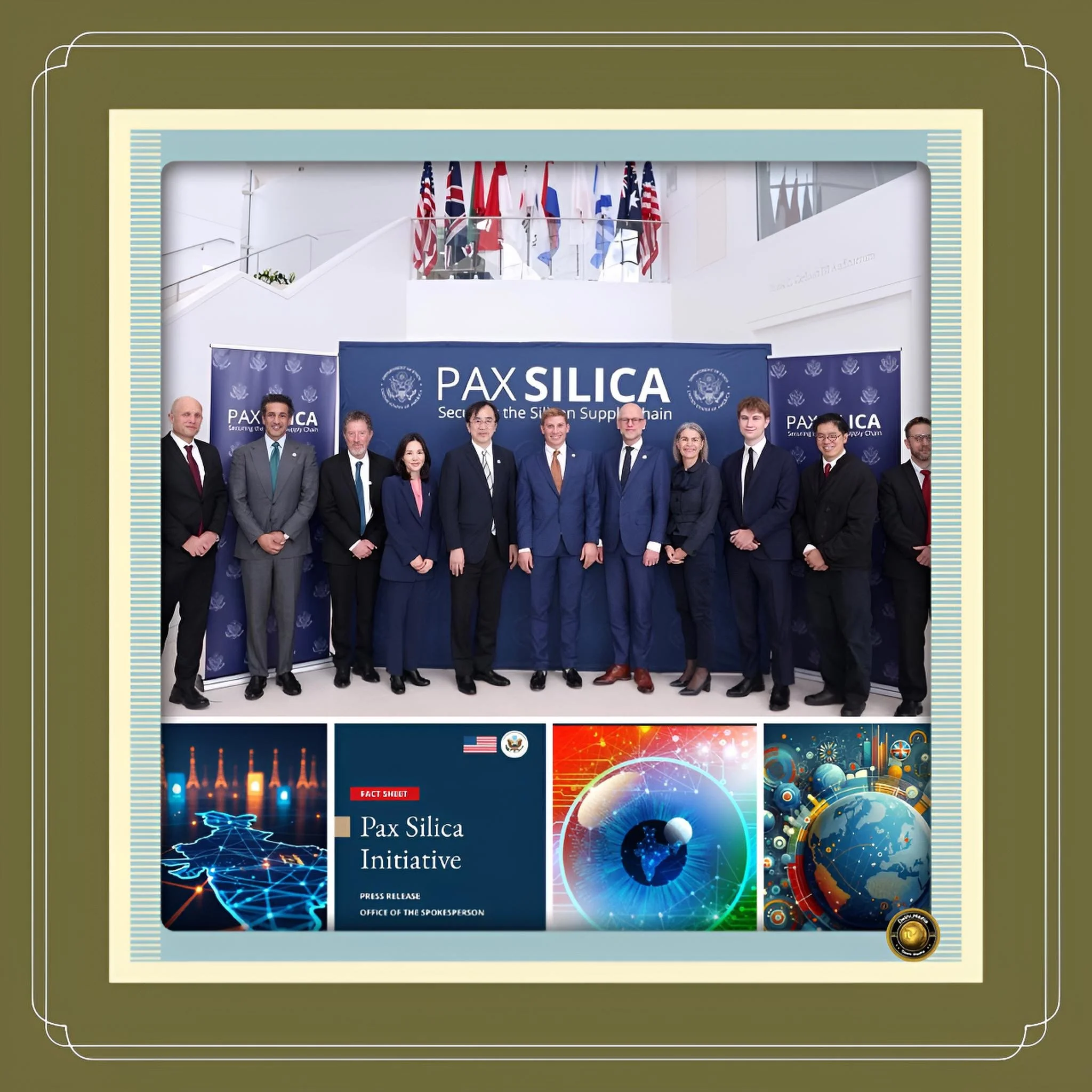
Silicon Curtain Rising: Why India Is Being Left Behind in the Great Power Technology Race
Executive Summary
India’s Strategic Isolation in the Pax Silica Era
The United States-led Pax Silica initiative, unveiled at the Washington summit on December 12, 2025, represents a watershed moment in global technological governance and economic security architecture.
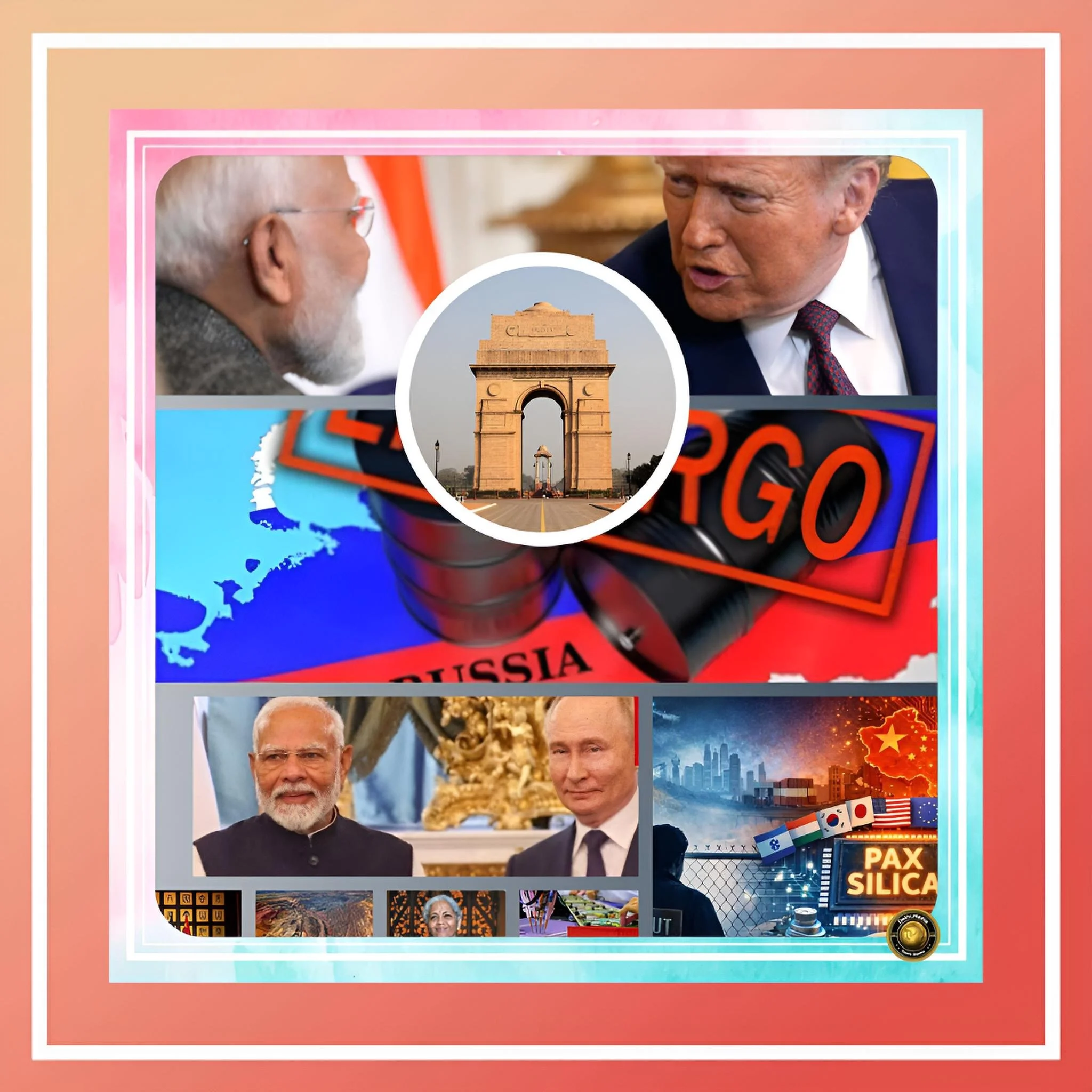
This strategic alliance, comprising nine nations—the United States, Japan, South Korea, Singapore, the United Kingdom, Israel, Australia, the Netherlands, and the United Arab Emirates—seeks to establish a secure, innovation-driven silicon supply chain that serves as an explicit counterweight to China’s technological dominance and its Pax Sinica Belt and Road framework.
India’s conspicuous exclusion from this coalition, despite being the world’s largest democracy and a supposed pillar of Washington’s Indo-Pacific strategy, constitutes a definitive geopolitical reckoning with Prime Minister Narendra Modi’s foreign policy architecture.
The exclusion reflects not merely technical capability gaps, though these are significant, but rather the cumulative consequences of a diplomatic strategy predicated on hedging, ambiguity, and symbolic gestures over sustained strategic engagement.
The Modi administration’s simultaneous cultivation of partnerships with the United States, Russia, and China—combined with its failure to maintain diplomatic momentum during critical junctures—has left India isolated at precisely the moment when global alignments are crystallizing around the technologies that will define the twenty-first century economy.
Introduction
India’s AI Ambitions Hit a Barrier: What Pax Silica Exclusion Really Means for Tech
The concept of Pax Silica itself carries profound strategic implications, deliberately invoking the Roman Pax Romana and the post-Cold War Pax Americana whilst anchoring its nomenclature in silicon—the foundational material of semiconductors and artificial intelligence infrastructure.
This linguistic choice is neither accidental nor decorative; it signals Washington’s determination to establish a techno-economic order organized around allied nations hosting the world’s most advanced technology companies and investors.
The initiative explicitly aims to reduce coercive dependencies, protect critical materials and capabilities foundational to artificial intelligence, and ensure aligned nations can develop and deploy transformative technologies at scale.
At its core, Pax Silica represents an attempt to build redundancy and resilience into global semiconductor, critical minerals, and AI infrastructure supply chains—domains in which China currently exercises overwhelming dominance, controlling approximately eighty-five to ninety percent of rare earth processing and downstream magnet production capabilities.
India’s conspicuous absence from this coalition demands explanation beyond the formulaic assurances offered by US State Department officials.
When Jacob Helberg, the United States Under Secretary of State for Economic Affairs, declared that India remained a “highly strategic potential partner” whilst simultaneously excluding New Delhi from the core alliance, he effectively articulated a paradox that encapsulates the broader catastrophe of Modi’s foreign policy.
India is simultaneously viewed as strategically important yet functionally unreliable, economically crucial yet insufficiently integrated into advanced technology ecosystems, and diplomatically engaged yet diplomatically expendable.
This contradiction did not emerge instantaneously; rather, it accumulated across years of strategic misjudgment, hedging tactics that sacrificed alliance cohesion for the illusion of autonomy, and a pattern of diplomatic theater divorced from substantive statecraft.
Key Developments: The Construction and Implications of Pax Silica
Modi’s Foreign Policy is Failing India When It Matters Most—The Pax Silica Moment
The Pax Silica initiative was formally announced following intensive coordination among advanced industrial democracies grappling with shared vulnerabilities in technology supply chains.
The declaration signed in Washington specifies that member countries commit to building and deploying reliable information networks, coordinating investment in semiconductor fabrication plants, data centers, mineral refining operations, and establishing mechanisms to prevent Chinese acquisition of critical infrastructure through its Belt and Road Initiative mechanisms.
This represents far more than rhetorical consensus; it constitutes a binding commitment to align export controls, investment screening, technology transfer regulations, and long-term infrastructure development around a shared model of trusted technological partnership.
The membership composition itself reveals strategic thinking about which nations possess the requisite combination of technological capacity, geopolitical alignment, and supply chain integration to constitute a genuine alternative to China-centric networks.
(1) Japan and South Korea bring semiconductor fabrication prowess and advanced manufacturing expertise
(2) Australia provides critical minerals and rare earth element sources
(3) Israel contributes dual-use technology innovation and cybersecurity depth
(4) Singapore anchors advanced manufacturing and regional trade logistics
(5) United Kingdom provides regulatory expertise and financial architecture.
(6) Netherlands controls crucial chokepoints in semiconductor equipment and production technology.
Each member occupies a distinct position within the global technology stack—from extraction through processing, design, fabrication, deployment, and logistics—creating a self-reinforcing ecosystem that becomes increasingly valuable and resilient as members deepen integration.
China’s response to this initiative has been calculated restraint coupled with accelerated investment in alternative technology pathways.
The Pax Sinica alternative, built through the Belt and Road Initiative and strategic investments in African and Southeast Asian resource extraction, represents Beijing’s counter-offer: a technology supply chain organized around Chinese dominance and dependent nations rather than trusted partners.
India’s absence from Pax Silica effectively cedes to China any potential advantage from New Delhi’s vast critical mineral reserves, substantial semiconductr design talent, and growing manufacturing ambitions.
Rather than India functioning as a node in a Western-aligned technology network, it may instead become a pressure point through which China could exercise leverage or a potential acquisition target for Chinese technology investments seeking to circumvent Western supply chain coordination.
Exposing the Capability Gap: Why India Was Excluded
The United States government’s official explanation for India’s exclusion—that member nations were selected based on their specific roles within advanced technology supply chains—possesses a surface plausibility that conceals a more fundamental reality.
India does indeed face substantial capacity constraints in semiconductor fabrication, advanced manufacturing, and critical mineral processing.
The country’s semiconductor sector, despite government initiatives and substantial investment commitments, remains overwhelmingly focused on fabless design and backend services rather than leading-edge manufacturing.
India contributes approximately twenty percent of global semiconductor design talent, maintaining a thriving ecosystem of design houses and IP development centers, yet this advantage becomes diminished when coupled with complete dependence on advanced nodes manufactured in Taiwan, South Korea, and increasingly, the United States.
The government’s India Semiconductor Mission, launched in December 2021 and targeting a one-hundred-ten billion dollar semiconductor market by 2030, represents ambitious aspiration constrained by substantial implementation challenges.
By September 2025, commercial chip production was beginning with indigenous designs such as the Vikram processor developed by ISRO’s Semiconductor Laboratory, yet these early-stage efforts target legacy nodes and embedded systems rather than the frontier AI chips that constitute the primary focus of Pax Silica.
Critical minerals present another dimension of India’s capability gap; whilst the country possesses substantial rare earth reserves, its processing and separation capabilities remain nascent.
China’s dominance in rare earth separation—the technologically demanding step that transforms raw minerals into functional materials—means that India’s mineral endowments provide leverage only when coupled with access to processing capacity, which remains geographically concentrated outside India’s borders.
However, attributing India’s exclusion solely to technical and manufacturing capacity gaps would constitute an incomplete analysis masking deeper diplomatic and strategic failures.
Multiple countries at similar levels of technological development have successfully positioned themselves as strategic partners in advanced technology ecosystems through demonstrated commitment, institutional alignment, and diplomatic reliability.
India’s exclusion reflects not merely where the country stands technologically, but rather which nations possess the institutional and political reliability necessary to function as genuine partners in a strategic technology ecosystem.
A technology partnership among advanced democracies requires not just capability, but predictability, institutional capacity for implementation, and demonstrated willingness to subordinate narrower national interests to collective security objectives.
The Failed Gambit: Modi’s Hedging Strategy and Its Consequences
Prime Minister Narendra Modi’s foreign policy doctrine has, since his first election in 2014 and intensifying through his second term, been organized around the principle of strategic autonomy—a concept that, in practice, has functioned as strategic ambiguity and hedging among multiple great powers rather than coherent strategic alignment.
Modi’s government signed foundational defense agreements with the United States, including
(1) Logistics Exchange Memorandum of Agreement (LEMOA)
(2) Communications Compatibility and Security Agreement (COMCASA)
(3) Basic Exchange and Cooperation Agreement (BECA), establishing the institutional architecture for deep strategic partnership.
Simultaneously, the Modi administration deepened ties with Russia through
(1) Nuclear submarine cooperation
(2) Advanced technology partnerships, and massive increases in Russian energy imports , whilst maintaining studied neutrality toward Beijing despite border tensions along the Line of Actual Control.
This hedging strategy functioned adequately during the Biden administration’s relatively patient approach to India-U.S. relations and during a period when Washington prioritized access to Indian markets and strategic geography more heavily than behavioral alignment on key issues.
The arrival of the Trump administration in January 2025, however, exposed the fragility of an approach predicated on ambiguity and selective engagement without deep institutional commitment.
The May 2025 India-Pakistan conflict (Operation Sindoor) constituted the inflection point at which Modi’s hedging strategy catastrophically failed.
Following India’s initiation of military strikes on Pakistani airbases on May 10, 2025, subsequent military escalation, and a ceasefire reached after four days of intense combat, Trump publicly claimed credit for mediation in a conflict in which the United States had played no meaningful role.
Modi’s immediate and forceful rejection of this narrative—through statements by India’s Defense Minister Rajnath Singh asserting that Trump’s claims were “completely incorrect”—was diplomatically necessary but politically devastating.
What followed was an escalation that none of the hedging diplomacy had anticipated or prepared to counter.
Between August and November 2025, the Trump administration imposed unprecedented tariffs on India.
(1) Implementing a 25 % percent duty on Indian exports to the United States (August 7, 2025)
(2) Additional twenty-five percent tariff specifically targeting India’s continued imports of Russian oil (August 27, 2025), bringing the combined rate to 50% —among the highest imposed by Trump on any trading partner globally.
This economic punishment was explicitly framed as retaliation for India’s failure to acknowledge Trump’s role in the May ceasefire, coupled with Washington’s frustration over India’s continued reliance on Russian energy despite United States pressure regarding Ukraine sanctions.
The tariff escalation occurred whilst trade negotiations between India and the United States, which both sides had committed to completing by autumn 2025, stalled completely due to disagreements over agricultural market access, intellectual property protections, and investment screening mechanisms.
The consequence of Modi’s hedging strategy was that India found itself isolated at precisely the moment when Western alignment became most valuable.
During the May 2025 Pakistan crisis, the United States and European allies offered India no diplomatic support, signaling through their studied neutrality that India’s claims and security interests did not command automatic alliance backing.
Russia, despite decades of proclaimed “all-weather” friendship, demonstrated no willingness to check Pakistan through its own diplomatic influence or to provide meaningful support to India during the crisis.
China, unsurprisingly, remained neutral whilst likely leveraging the moment to strengthen ties with Pakistan. India’s attempt to maintain equidistant relations with all great powers resulted in isolation from all of them when alliance cohesion became most critical.
The Bangladesh Catastrophe: Intelligence Failure and Diplomatic Bankruptcy
India’s foreign policy failures extended far beyond the Pakistan crisis and the resulting tariff devastation.
The collapse of the Sheikh Hasina government in Bangladesh in August 2024—and its subsequent implosion following Hasina’s flight to India—constituted a strategic intelligence and diplomatic catastrophe that exposed the fundamental bankruptcy of Modi’s South Asian strategy.
The Modi administration had constructed an elaborate patron-client relationship with Hasina’s government, providing security backing, intelligence support, and diplomatic cover for increasingly authoritarian governance whilst extracting enormous concessions in return: preferential port access, railway usage, infrastructure contracts benefiting Modi-aligned business interests, and de facto vassal-state status in Bangladesh’s foreign policy.
This relationship, predicated entirely on control rather than genuine partnership, generated accumulating resentment among the Bangladeshi population.
When mass student protests erupted in July 2024, India’s security establishment entirely misread the magnitude of popular discontent, providing faulty intelligence assessments that led to continued support for Hasina even as her political position became untenable.
The subsequent collapse occurred with stunning rapidity, leaving India’s entire South Asian diplomatic architecture in ruins.
Rather than maintaining influence through genuine partnership with successor governments in Bangladesh, India found itself isolated and viewed with suspicion as a foreign power that had propped up an increasingly repressive regime.
The Bangladesh disaster exemplified Modi’s broader South Asian failures: his “Neighborhood First” policy collapsed due to excessive reliance on control mechanisms, intelligence assessments divorced from ground-level political realities, and absence of genuine institutional relationships with broader political actors and civil society.
Nepal’s challenges to India’s territorial claims, the Maldives’ deepening alignment with China, and Sri Lanka’s continued political instability all reflected India’s inability to construct sustainable partnerships predicated on mutual benefit rather than coercive control or transactional extraction.
Cause and Effect: The Structure of Strategic Failure
The Modi Verdict: India’s Exclusion from Pax Silica Marks End of Hedging-Era Foreign Policy
Modi’s foreign policy failures cannot be attributed to a single decision or moment of miscalculation; rather, they emerged from a fundamental structural contradiction in his strategic approach.
The Modi administration simultaneously pursued strategic partnership with the United States whilst maintaining substantial autonomy—which in practice meant preserving the option to defy Washington on issues ranging from Russian energy purchases to BRICS membership to neutrality on Ukraine.
This approach reflected a genuine conviction that India’s vast size, economic potential, and geopolitical location provided sufficient leverage to maintain equidistant relations with competing great powers.
The error lay in systematically underestimating the degree to which the emerging global order would crystallize around exclusive technology blocs and supply chain alliances that demanded unambiguous commitment rather than hedging flexibility.
The rise of artificial intelligence and advanced semiconductor manufacturing as the defining technologies of the twenty-first century economy accelerated the timeline for this crystallization.
Where earlier great power competition had permitted ambiguous alignment, the emerging technology order required unambiguous institutional commitment.
A nation could not simultaneously be inside a trusted semiconductor supply chain ecosystem and maintain strategic autonomy to engage alternative sources of advanced technology.
The Pax Silica initiative represented not merely another alliance framework, but rather a structural reorganization of global technology supply chains around trusted partnerships.
By excluding India, it effectively declared that New Delhi’s strategic autonomy came at the price of exclusion from the institutions that would define the emerging economy.
Modi’s hedging strategy specifically failed because it mistakenly assumed that bilateral relationships with powerful states could substitute for institutional integration into coalitions.
The United States Under Secretary’s assertion that India remained a “strategic partner” despite exclusion from Pax Silica reflected precisely this misunderstanding: bilateral partnerships exist in a different category than participation in coordinated supply chain governance.
India could be invited to bilateral discussions about technology cooperation and semiconductor development while simultaneously being excluded from the collective decision-making forum that determines how global supply chains organize themselves.
This distinction, fine in formal diplomatic terms, was catastrophic in strategic consequence.
The tariff escalation stemming from Trump’s personal grievance over the May ceasefire represented a secondary failure layered atop these structural problems.
Had India maintained robust institutional relationships with the United States, had the alliance possessed deeper mutual investment, and had Modi demonstrated consistent reliability as a partner, the personal dispute with Trump might have been contained through institutional channels.
Instead, the relationship possessed insufficient institutional resilience to absorb the disruption caused by Modi’s public rejection of Trump’s ceasefire claims.
The fifty percent tariffs reflected not calculated strategy by the Trump administration but rather personal pique combined with fundamental frustration that India continued purchasing Russian oil whilst claiming strategic partnership with Washington.
The Fracturing Order: Pax Silica as Economic Security Architecture
The exclusion from Pax Silica carries implications extending far beyond bilateral relations between India and the United States or even India’s position within the Indo-Pacific strategic framework.
The initiative represents a deliberate decision by advanced technology democracies to organize global semiconductor, AI, and critical minerals supply chains around explicitly trusted partnerships rather than integrating all willing partners into shared ecosystems.
This represents a fundamental departure from the post-Cold War economic order, which was predicated on rules-based multilateralism and assumed that all nations following established trading rules would participate in expanding networks of economic integration.
Pax Silica instead operates on the assumption that technological leadership and supply chain security constitute non-negotiable priorities that supersede free trade commitments, neutral positioning, or hedging flexibility.
Member nations commit to coordinating investment in fabrication plants, screening foreign investment in sensitive technology sectors, aligning export control regimes, and deliberately channeling supply chain infrastructure toward trusted partners rather than permitting purely market-driven allocation.
This represents state-directed economic organization on a scale not seen since the Cold War, yet justified through the lens of economic security and technological competition with China.
India Left Out of U.S.-Led Pax Silica Alliance
For India, the implications are severe and multifaceted.
(1) India will find itself excluded from coordinated investment in the advanced semiconductor fabrication plants and AI infrastructure data centers that will constitute the foundation of twenty-first century economies.
Where Japan, South Korea, and potentially Singapore receive Pax Silica-coordinated investment and technology transfer, India will remain dependent on bilateral relationships and global market mechanisms—neither of which provide comparable access to frontier technology.
(2) The organization of supply chains around trusted partners means that Indian companies seeking to integrate into advanced technology ecosystems will face systematic disadvantages compared to competitors based in Pax Silica nations.
(3) India’s critical minerals reserves, potentially valuable in the context of a coordinated Western supply chain, become marginalized when India remains outside the coordination framework.
Rather than India’s minerals being integrated into Pax Silica supply chains as part of a trusted partnership, India becomes instead a potential acquisition target for Chinese technology investments seeking alternative supply chains independent of Western coordination.
Most fundamentally, Pax Silica represents a verdict that India’s hedging strategy has rendered it unreliable as a strategic partner for the most advanced technology initiatives.
This verdict carries consequences extending far beyond the immediate exclusion from Pax Silica.
As additional technology coalitions form, as investment coordination mechanisms crystallize around trusted partnerships, and as advanced technology companies choose between integration into Western or Chinese-aligned ecosystems, India’s default position will be exclusion unless it demonstrates convincing recommitment to Western partnerships and abandonment of hedging strategies.
Future Steps: The Path Forward for India’s Technology Integration
India’s AI Ambitions Hit a Barrier: What Pax Silica Exclusion Really Means for Tech
India’s pathway to re-integration into advanced technology ecosystems, should Modi’s government recognize the strategic imperative, would require fundamental reorientation of foreign policy priorities.
The symbolic gestures and institutional frameworks that characterized Modi’s approach—state visits to multiple great powers, announcements of high-level dialogues, activation of bilateral mechanisms—would require replacement with substantive commitments and demonstrated reliability.
Jacob Helberg’s announcement that he would attend India’s AI Impact Summit in February 2026 potentially signals opportunity for strategic recalibration, yet only if India’s government articulates genuinely different strategic choices.[business-standard]
Four concrete policy reorientations would be necessary for India to reconstruct strategic credibility and establish pathways toward participation in coordinated technology supply chain initiatives.
(1) India would require clearly articulated energy policy changes reducing reliance on Russian oil imports and demonstrating commitment to international sanctions regimes.
The fifty percent tariffs imposed by the Trump administration specifically targeted Russian energy purchases, making clear that continued major reliance on Moscow energy whilst claiming strategic partnership with Washington constitutes an unacceptable contradiction.
Transition to alternative energy sourcing, including accelerated renewable development and expanded LNG imports from non-Russian sources, would constitute a credible signal of reoriented priorities.
(2) India would need to reformulate its relationship with BRICS and other non-aligned mechanisms to clarify that participation in these forums does not constitute equidistant positioning between Washington and Beijing.
The current approach—simultaneous participation in BRICS, the Shanghai Cooperation Organization, and Quad-aligned initiatives—is perceived by the Trump administration as calculated hedging rather than strategic clarity.
Making explicit choices about which forums constitute primary commitments and which represent secondary engagement would restore clarity regarding India’s strategic orientation.
(3) Substantive institutional integration into technology development and supply chain governance would require India to move beyond bilateral arrangements toward participation in coordinated multilateral frameworks.
The existing US-India Initiative on Critical and Emerging Technology (iCET) and the Transforming the Relationship Utilizing Strategic Technology (TRUST) initiative provide frameworks within which deeper cooperation could develop, yet these would require elevation in priority and investment compared to parallel technology dialogues with Russia and China.
(4) India would require sustained diplomatic and political commitment to alliance relationships extending across multiple administrations and political transitions.
The Modi government’s expectation that bilateral relationships could function as substitutes for institutional integration, or that personal relationships with individual leaders could provide security against policy shifts, has proven catastrophically mistaken.
Recommitment to alliance relationships would require confidence-building measures demonstrating that India’s strategy will persist regardless of domestic political transitions in either the United States or India.
The window for strategic recalibration remains open but narrowing.
The technologies that Pax Silica seeks to coordinate—semiconductor manufacturing, AI infrastructure, critical minerals processing—constitute the foundation of twenty-first century economic and military power.
India’s exclusion from coordination on these technologies, if it extends over years rather than months, will calcify into structural disadvantage.
Competitors based in Pax Silica nations will progressively integrate into global supply chains in ways that create path dependencies rendering subsequent integration of Indian firms increasingly difficult.
Each year of exclusion makes re-integration more costly and more technically challenging.
Conclusion
The Strategic Reckoning
The Real Cost of India’s Geopolitical Ambiguity: Irrelevance in the AI Era”
India’s exclusion from the Pax Silica initiative delivers a clear strategic verdict on Modi’s foreign policy: the hedging approach that prioritized symbolic visits, bilateral mechanisms, and maintained equidistance among great powers has failed at precisely the moment when such strategies become most costly.
The emerging global technological order will not accommodate ambiguous positioning or maintained optionality across competing blocs. Instead, it demands explicit commitment, institutional integration, and demonstrated reliability as a strategic partner.
The Modi administration’s failures were not inevitable consequences of India’s size, development level, or geopolitical position.
Multiple countries at comparable levels of technological development have successfully positioned themselves within advanced technology ecosystems through clear strategic choice and sustained commitment.
Australia, despite geographic proximity to China and substantial trade exposure, has emerged as a core Pax Silica member because it made unambiguous strategic choices regarding technology partnership and supply chain integration.
The Netherlands, a far smaller country than India, possesses outsized influence in Pax Silica because it controls critical chokepoints in semiconductor equipment supply chains and has demonstrated institutional commitment to technology coordination.
Singapore, facing comparable hedging temptations given its geographic location and trade exposure to China, has instead chosen clear institutional commitments whilst maintaining commercial engagement.
India possessed—and theoretically still possesses—greater strategic assets than any of these nations: a billion-person market, abundant critical mineral reserves, twenty percent of global semiconductor design talent, and a thriving innovation ecosystem.
These assets have proven insufficient to overcome the fatal liability of strategic unreliability and alliance ambiguity.
The Modi government’s simultaneous cultivation of partnerships with the United States, Russia, and China; its hedging approach to security commitments; and its prioritization of symbolic diplomacy over substantive institutional integration have created a situation in which India’s strategic potential remains unrealized whilst its geopolitical isolation deepens.
The broader tragedy transcends Modi’s tenure as Prime Minister or the specific failures of particular decisions.
It reflects a fundamental misunderstanding of how power functions in a technological age. In an era when global supply chains for advanced technologies constitute the foundation of national power and prosperity, the ability to operate reliably within coordinated partnerships emerges as more valuable than the pursuit of formal autonomy.
India’s hedging strategy, predicated on maximizing optionality, achieved instead the worst possible outcome: exclusion from the partnerships that matter most.
The Pax Silica initiative will continue developing, deepening investment coordination, aligning export controls, and building redundancy into the supply chains for the technologies that will define the twenty-first century.
India will observe this process from outside, attempting bilateral arrangements to compensate for institutional exclusion, whilst the strategic gap widens progressively.
This represents not an immutable outcome—India remains capable of strategic recalibration—but rather a verdict that the current approach has failed fundamentally.
Unless Modi’s government or its successors demonstrate capacity for strategic reorientation, India risks solidifying into permanent peripherality within the emerging technological order, despite possessing the resources and talent that could have secured a central role.