Trump issues a bold ultimatum to Maduro amid conflicting U.S. diplomatic strategies.
Executive Summary
Trump’s real intent for regime change in Venezuela appears to be driven by multiple interrelated motives rather than a single factor.
(1) The largest and most critical factor is control over Venezuela’s vast oil reserves—the world’s largest proven crude oil deposits.
Securing access to these energy resources aligns with broader U.S. strategic and economic interests, including influencing global oil markets and weakening Venezuela’s alliance with geopolitical rivals such as China and Russia.
(2) Drug trafficking is cited by Trump and his administration as a justification, focusing on Maduro’s alleged links to cartels like Cartel de los Soles.
However, this rationale is widely regarded as more rhetoric than substantiated cause, since Venezuelan narcotics represent a relatively small fraction of drugs entering U.S. markets. Analysts suggest this narrative serves to build domestic political support and justify military pressure.
(3) There are personal and ideological dimensions as well. Trump has long expressed disdain for Maduro’s socialist regime and framed the confrontation as part of a broader struggle against leftist governments in Latin America.
Some analysts highlight a personal vendetta element given Trump’s repeated public condemnations of Maduro and frustration over diplomatic stalemates.
(4) Regarding political ratings, Trump’s approval ratings currently hover around 36%, reflecting significant domestic dissatisfaction.
Available polling data indicate that the war or military escalation in Venezuela is broadly unpopular among Americans, with 70% opposing military action and skepticism about the president’s handling of the economy and inflation persisting.
Historically, foreign conflicts do not guarantee improved presidential ratings; in fact, ill-advised or unpopular military engagements tend to depress approval.
Thus, the prospects for a significant ratings boost from the Venezuela conflict seem low at best.
Trump’s Venezuela policy likely combines geopolitical-economic goals centered on oil dominance, anti-drug trafficking rhetoric to justify action, ideological opposition to Maduro’s government, and a hope—though uncertain—for a rally-around-the-flag effect domestically.
However, current indicators suggest the conflict is unlikely to meaningfully improve his approval ratings and may even deepen political challenges ahead of key elections.
Introduction
The Trump administration’s Venezuela policy in late 2025 reflects internal strategic contradictions characterized by competing approaches.
On one hand, President Trump delivered a stark ultimatum to Nicolás Maduro to leave Venezuela immediately or face intensified military pressure, underscoring the administration’s hardline stance.
On the other, there were attempts from other factions within the administration to negotiate limited agreements with Maduro, indicating a dual-track strategy rooted in competing objectives and internal tensions.
Questionable US foreign policy
Trump's ultimatum?
Trump’s explicit ultimatum, issued in late November during a phone call with Maduro, offered safe passage for Maduro and his family if he resigned immediately, but Maduro rejected the terms, demanding global amnesty for himself and his circle, control of the armed forces akin to Nicaragua’s 1991 transition, and insisted on immediate resignation.
Following failure to negotiate, Trump escalated by closing Venezuelan airspace and increasing military deployments in the Caribbean, including sending the USS Gerald R. Ford and 15,000 troops.
The U.S. designation of the Cartel de los Soles as a foreign terrorist organization further justified military action.
Maduro responded with defiant rhetoric asserting sovereignty and readiness to resist imperialist aggression.
Divergence on US policy contradiction
Ric Grenell verses Marco Rubio
This divergence in U.S. policy mirrors a struggle between Secretary of State Marco Rubio’s maximalist regime-change faction, which embraces military escalation and zero tolerance for Maduro, and Ric Grenell’s diplomatic wing, which favored pragmatic negotiations over oil exports, migration, and sanctions relief.
Grenell’s efforts, previously resulting in Maduro offers for phased resignation and resource access deals, were superseded by Rubio’s harder line, reflecting a shift in administration strategy towards confrontation versus negotiation.
This internal competition illustrates a fragmented approach without coherent public clarity on end goals.
Trump's strategy
Trump’s overarching strategy appears motivated more by geopolitical dominance and natural resource access than pure ideological regime change.
Analyses suggest he employs a “sword of Damocles” tactic—melding public threats with backchannel negotiations to maintain leverage over outcomes.
The administration’s inconsistent messaging, reluctance to clarify objectives publicly, and unresolved constitutional questions about authorizing military strikes contribute to strategic ambiguity.
This has raised legal and political concerns domestically, including bipartisan congressional oversight of military actions, complicating prospects for a clear policy pathway.
International law violation on strike on Venezula
A U.S. military strike on Venezuela would violate Article 2(4) of the UN Charter, which prohibits the threat or use of force against the territorial integrity or political independence of any state, absent Security Council authorization or self-defense under Article 51.
No UN Security Council resolution authorizes force against Venezuela, and drug trafficking by groups like the Cartel de los Soles does not qualify as an “armed attack” triggering self-defense rights, as the causal link to U.S. harm is too attenuated per ICJ precedents such as Nicaragua v. United States.
Even if framed as counterterrorism post-designation of Venezuelan cartels, strikes inside sovereign territory exceed lawful bounds without host-state consent.
Yet, the UNSC is likely to remain deadlocked, with Russia and China vetoing any resolutions endorsing or legitimizing U.S. strikes on Venezuelan vessels, while the U.S. and allies continue to push their narratives in favor of intervention to counter drug trafficking and promote democratic transition in Venezuela.
The Council’s role will be largely confined to diplomatic discussion and calls for de-escalation, without ability to authorize or condemn military action definitively.
Jus in Bello Concerns
Strikes would trigger international humanitarian law obligations, requiring distinction, proportionality, and necessity, but recent U.S. actions against Venezuelan-linked drug boats—killing over 80 people in 21 incidents—have drawn UN condemnation as extrajudicial killings violating human rights law outside armed conflict contexts.
A broader campaign risks civilian casualties in populated areas, potentially amounting to war crimes if not strictly limited to military objectives.
Regional Frameworks
The Organization of American States (OAS) and Rio Treaty (TIAR) offer no viable basis, as Venezuela withdrew from the latter in 2013 and briefly rejoined under disputed opposition claims in 2019; domestic unrest does not trigger collective defense absent consensus.
Responsibility to Protect (R2P) does not apply, lacking Security Council endorsement and facing vetoes from Russia and China, despite Venezuela’s human rights crisis.
Domestic U.S. Constraints
Under the U.S. Constitution and War Powers Resolution, strikes require congressional authorization, which Congress has not provided; existing post-9/11 AUMFs do not cover Venezuela.
Bipartisan lawmakers demand oversight, viewing unilateral action as unconstitutional.
However, Trump is relying on an expansive executive interpretation of commander-in-chief powers combined with evasive reporting and congressional gridlock to execute and expand strikes on Venezuela without explicit legislative authorization, setting the stage for contentious legal and political confrontations with Congress.
Potential Repercussions
Such strikes could invite ICJ proceedings akin to Nicaragua (1986), sanctions from allies, and escalation with Venezuelan backers like Russia, eroding U.S. credibility on sovereignty norms.
Even threats alone may breach Article 2(4) due to coercive rhetoric and deployments like the USS Gerald R. Ford near Venezuelan waters.
Venezuela ally Support
Maduro’s military survival depends primarily on asymmetrical defense mechanisms and diplomatic backing from allies rather than overt military intervention.
While allies like Russia, China, and Iran supply weapons and technical support, the likelihood of direct military deployment to counter U.S. strikes is low given their strategic priorities and the risks of direct confrontation with the United States.
OPEC’s role is limited to political and economic support rather than military involvement.
Contradictions on failures and rewards
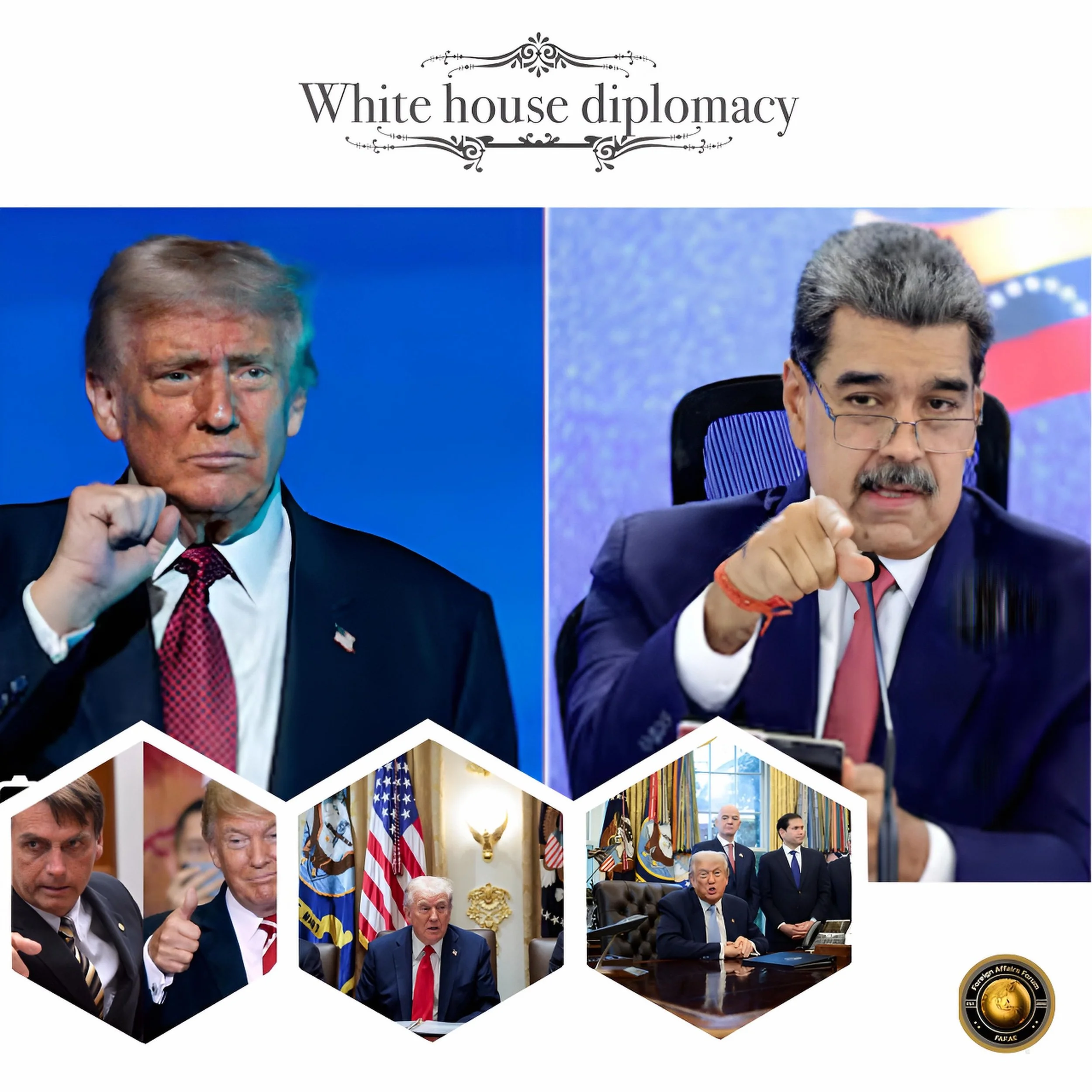
Trump stance on Bolsonaro, Brazil
On one side, US wants to punish Maduro for corruption and crime and then reward Bolsonaro for the same?
Regarding Brazil, Trump’s stance reflects transactional pressure rather than a straightforward push to distance Bolsonaro from Brazil.
The imposition of 50% tariffs in mid-2025 targeted Brazil’s judicial prosecution of Bolsonaro, aiming to compel a drop in charges, with Bolsonaro’s allies claiming credit for influencing U.S. measures.
Recently, Trump has softened his posture toward Brazil’s current president, Lula, signaling tactical adjustments rather than a unified strategy concerning Bolsonaro’s political fate.
Conclusion
Ultimately, the contradictions in the Trump administration’s approach to Venezuela and Brazil stem from factional policy divisions, mixed negotiation tactics, and unclear strategic priorities.
This ambiguity undermines coherent diplomatic efforts and reflects internal political dynamics that complicate U.S. objectives in Latin America.
The administration’s lack of a defined post-Maduro vision for Venezuela, coupled with legal and constitutional questions about military intervention, underscores profound strategic uncertainty in U.S. policy toward the region.