Europe’s Perception of Abandonment and the Codification of U.S. Realignment
Executive Summary
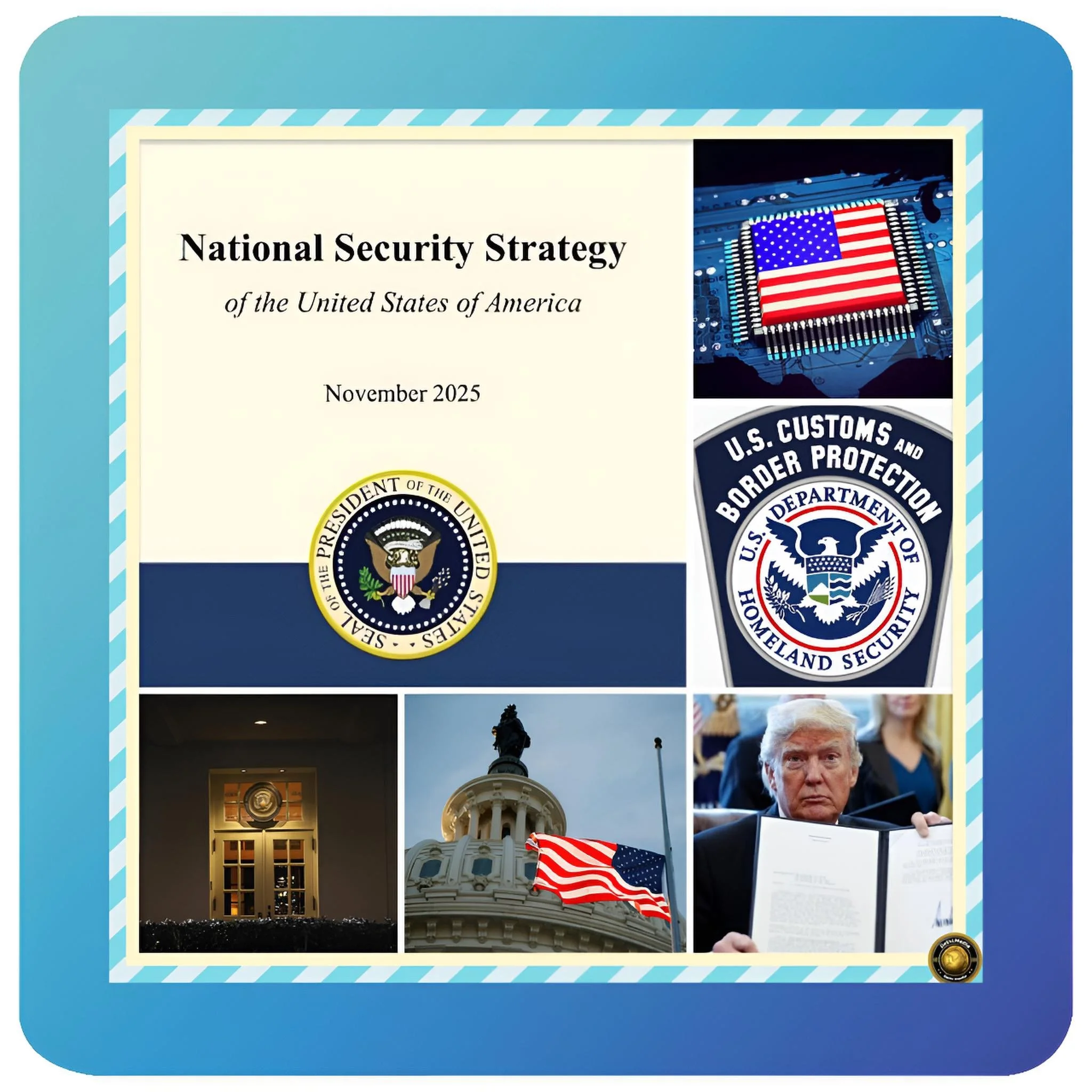
Washington’s 2025 National Security Strategy, released on December 4, marks a decisive recalibration of American foreign policy that effectively abandons the post-Cold War consensus of transatlantic partnership.
Rather than a strategic withdrawal from Europe, the document reveals something more troubling: a deliberate reorientation toward stabilizing relationships with Russia while simultaneously working to undermine the political foundations of the European Union.
The strategy frames Europe’s primary challenge not as Russian aggression but as “civilizational erasure,” code language for the continent’s liberal democratic institutions. For the first time since 1945, European nations face the prospect of managing their security in the absence of meaningful American security guarantees, while simultaneously confronting a United States that increasingly views them as ideological adversaries.
This transformation represents a strategic inflection point that demands Europe abandon decades of defensive posturing and embrace genuine strategic autonomy not as an aspiration but as an immediate necessity.
Introduction
A New Iron Curtain—This Time Across the Atlantic?
The Trump administration’s 2025 National Security Strategy represents far more than a routine policy adjustment or a reassessment of burden-sharing arrangements within the transatlantic alliance.
The document, released just six days ago, codifies what has been implicit in months of rhetoric from Washington: the United States no longer perceives Europe as an integral component of American security strategy but rather as a secondary concern destined for managed decline.
This shift would be noteworthy enough if it merely signaled American disengagement from European affairs. Instead, the strategy articulates an active, ideologically driven agenda to reshape European politics, undermine the European Union, and normalize relations with Russia at Europe’s expense.
The implications extend far beyond questions of defense budgets or the future of NATO. They strike at the heart of Europe’s political identity, its security arrangements, and its ability to maintain democratic institutions in the face of coordinated pressures from Moscow and Washington.
The continental response has evolved from initial shock to urgent recognition of a fundamental reordering of international relationships.
What European leaders initially approached with cautious optimism—the possibility that Trump’s emphasis on burden-sharing might simply demand greater European investment in defense—has transformed into something far more consequential: the realization that the United States now views the European project itself as a civilizational threat.
This development forces Europe to confront a question it has avoided for eight decades: can the continent defend itself not only against external aggression but also against the strategic interests of the power that has hitherto guaranteed its security?
Key Developments and Strategic Context
The End of the Illusion: Washington No Longer Sees Europe as a Partner
The transformation of American strategy toward Europe represents the culmination of a year-long campaign of criticism and reframing that began with Vice President JD Vance’s speech at the Munich Security Conference in February 2025.
At that event, Vance articulated what has now become official doctrine: that Europe faces an existential threat not primarily from Russia but from its own institutional arrangements, immigration policies, and alleged rejection of traditional values.
The February address generated controversy among European leaders, but many dismissed it as the ideological positioning of a particularly vocal administration official.
The subsequent release of the National Security Strategy reveals that Vance’s intervention was not an outlier but rather an announcement of coordinated policy.
The document mentions Europe explicitly forty-eight times, demonstrating an intensity of focus that contradicts the administration’s stated Monroe Doctrine orientation toward the Western Hemisphere.
The strategy’s treatment of Russia represents an equally dramatic departure from prior American doctrine.
Unlike Trump’s 2017 National Security Strategy, which identified Russia as a “revisionist power” seeking to weaken American influence globally, the 2025 version treats Russia primarily as a challenge to be managed through diplomatic engagement and efforts to “reestablish strategic stability.”
This formulation contains several troubling implications for European security.
First, it deprioritizes the deterrence framework that has anchored NATO strategy since the 1950s, replacing it with a stabilization logic oriented toward freezing conflicts rather than resolving them in ways that address underlying Russian strategic objectives.
Second, it elevates stabilization above decisive military outcomes in Ukraine, framing the conflict as “an unpleasant issue to be resolved and set aside, allowing them to move on to other priorities.”
Third, it implicitly treats Russia’s strategic ambitions as negotiable rather than examining how Moscow’s decades-long pattern of coercive behavior suggests otherwise.
The European Union’s response to this shift has crystallized with uncommon rapidity.
Within forty-eight hours of the strategy’s release, European Council President António Costa publicly identified the United States as a potential adversary, warning that the Trump administration’s explicit support for far-right political parties represented interference in European domestic affairs.
More significantly, the strategy has accelerated Europe’s long-delayed recognition that strategic autonomy cannot remain an aspiration but must become the organizing principle of continental security policy.
The European Commission’s October 2025 rollout of the “Preserving Peace – Defence Readiness Roadmap 2030” has acquired new urgency, transformed from an aspirational framework into a survival necessity.
Facts and Concerns: The Architecture of Strategic Divergence
Europe’s Moment of Clarity: America Has Moved On
The most immediate concern animating European policymakers centers on the fundamental divergence in threat perception between Washington and the continent.
The Trump administration’s National Security Strategy situates Russia stabilization within a global context where the primary American strategic focus has shifted to the Western Hemisphere and Indo-Pacific competition.
For European frontline states, particularly the Baltic nations and Poland, this reorientation creates an intolerable situation: Russia is simultaneously more dangerous—investing heavily in military modernization and expanding its defense-industrial base—and less central to American strategic calculations. Intelligence assessments shared within NATO confidential channels indicate that Russian forces could initiate new operations within three to five years, yet the strategy explicitly calls for reducing tensions rather than strengthening deterrence.
The strategy’s identification of Europe’s internal political arrangements as a greater threat than Russian military capabilities reflects an ideological rather than strategic assessment.
The document’s claim that Europe faces “civilizational erasure” stemming from immigration and secular governance serves to justify an explicit American policy of supporting right-wing political movements across the continent.
Administration officials have publicly endorsed parties including Germany’s Alternative for Germany, France’s National Rally, Hungary’s Fidesz, and the United Kingdom’s Reform Party. The February 2025 meeting between Vice President Vance and AfD representatives generated sufficient controversy that it privately angered Germany’s incoming Chancellor Friedrich Merz, who won the election without Trump administration backing.
This coordination between Washington and European far-right movements has become so explicit that the strategy itself names “patriotic European parties” as America’s preferred partners on the continent.
The Pentagon has simultaneously established a December 2027 deadline for Europe to assume the majority of NATO’s conventional defense responsibilities, from intelligence operations to long-range strike capabilities.
This timeline strikes European military planners as simultaneously impossible and deliberately humiliating.
Europe’s fragmented defense-industrial base, the need for coordinated procurement across twenty-seven EU member states, and the fundamental requirement to build redundant capabilities outside the American technological architecture cannot be accomplished in two years.
The deadline appears designed less to create achievable targets than to establish metrics by which the Trump administration can declare European failure and justify further disengagement.
The strategy’s elevation of burden-shifting language—in contrast to the earlier framework of burden-sharing—signals a transactional view of alliances that rejects the bargain sustaining NATO since its inception: American security guarantees in exchange for European alignment.
This represents a profound break with seven decades of bipartisan American consensus that European security served fundamental American interests. The strategy instead treats European security commitments as financial obligations owed to the United States rather than as mutual investments in collective stability.
Cause and Effect Analysis: How Strategic Interests Collided
Europe Wakes Up to Its Loneliness as Washington Turns Inward
The divergence between American and European strategic assessments cannot be attributed to misunderstanding or communication failures. Rather, it reflects the collision of fundamentally different geopolitical circumstances and threat horizons.
The Trump administration has explicitly prioritized the Indo-Pacific as the arena of great power competition most consequential for American interests, viewing China rather than Russia as the challenge requiring sustained focus and resources.
From this perspective, European fixation on Russian threats represents parochial distraction from the central strategic contest.
The strategy’s call for “rebalancing” the American economic relationship with China and reestablishing strategic stability with Russia represents a bid to simplify the American strategic landscape by resolving peripheral conflicts through diplomacy so that Washington can concentrate on Asia.
For Europe, by contrast, the present moment represents the closest brush with existential military threat since 1945.
Russia’s full-scale invasion of Ukraine in February 2022 shattered the post-Cold War assumption that major territorial conquest through military force had become impossible in Europe.
The Kremlin’s demonstrated willingness to accept colossal casualties, mobilize its entire society for prolonged conflict, and explicitly threaten nuclear escalation has created a security environment where the continent cannot afford the luxury of American distraction.
European leaders recognize that any American-brokered settlement prioritizing speed over sustainability risks merely deferring the conflict until conditions favoring renewed Russian expansion reemerge.
The American emphasis on Europe’s internal vulnerabilities—declining birth rates, regulatory burden, loss of civilizational confidence—reflects a judgment that Europe’s trajectory toward irrelevance is irreversible.
This assessment permits Washington to write off the continent as incapable of defending itself and therefore unworthy of sustained American commitment.
The strategy’s explicit support for right-wing parties opposed to immigration and EU integration emerges logically from this conclusion: if Europe is destined to decline, American interests are better served by supporting forces that accelerate European fragmentation, thereby eliminating the possibility of European strategic autonomy that might eventually compete with American global leadership.
The consequence of these colliding assessments has been to shatter the fundamental assumptions underlying European security policy for eight decades. Europe has consistently acted as though American military power and commitment were permanent fixtures of the continental security landscape.
This assumption enabled successive European governments to maintain defense spending at historically low levels, channel resources toward social expenditures and economic development, and focus diplomatic efforts on cooperation rather than deterrence.
The 2025 National Security Strategy eliminates this assumption entirely. It announces that American commitment is conditional, contingent, and increasingly at odds with European interests.
The Emerging Response: Europe’s Forced Awakening
Left on the Sidelines: Europe Faces a Post-American Security Order
The European reaction to Washington’s strategic reorientation has unfolded across multiple registers simultaneously. At the political level, European leaders have moved with unusual unanimity toward accepting that strategic autonomy is no longer an aspiration but an immediate necessity.
German Chancellor Friedrich Merz has articulated that Europe must become capable of defending its democratic values and security interests without expectation of American support.
The European Commission has accelerated implementation of the Defence Readiness Roadmap 2030, which commits the bloc to mobilizing approximately €800 billion in additional defense spending through 2030 and establishing four flagship defense initiatives: the Eastern Flank Watch, the European Drone Defence Initiative, the European Air Shield, and the European Space Shield.
The financial architecture supporting this rearmament represents an unprecedented mobilization of European resources. The European Union has activated the national escape clause of the Stability and Growth Pact, effectively suspending fiscal constraints on defense spending.
A new funding instrument called SAFE will provide up to €150 billion in loans to member states for defense and security investments guaranteed by the EU budget.
NATO has simultaneously established a new defense spending target of 5 percent of GDP by 2035, up from the previous 2 percent benchmark, with interim targets of 3.5 percent for core defense and 1.5 percent for broader security by 2030.
This represents an additional €900 billion in European military spending, including approximately €270 billion for Germany alone.
The strategic imperative underlying these investments extends beyond numerical capability targets. Europe has begun serious discussion of developing independent nuclear deterrent capabilities to complement those of France and the United Kingdom.
France and Britain’s combined submarine-based arsenals possess sufficient destructive capacity to inflict unacceptable damage on Russia and serve as an effective deterrent against large-scale nuclear attacks on Europe.
Several European defense specialists argue that supplementing these capabilities with robust air-delivered systems would provide the flexibility necessary to deter Russian non-strategic nuclear weapon use, the most likely scenario in any future European conflict.
This discussion, unthinkable five years ago, has become mainstream European strategic debate.
Ukraine has emerged as the critical test case for European strategic autonomy. Rather than viewing the war as a separate problem to be managed, European leaders increasingly recognize it as the centerpiece of European security architecture.
The European commitment to providing Ukraine with at least two million artillery shells annually by 2030—a dramatic increase from the continent’s previous capacity—reflects recognition that Ukraine’s defeat would constitute catastrophic European defeat, while Ukraine’s integration into European security architecture represents the foundation of long-term continental stability.
For the first time, European security commitments to Ukraine are being framed not as humanitarian gestures or temporary support but as core investments in European self-defense.
Concerns and Structural Challenges: The Reality of European Constraints
Transatlantic Decoupling: Europe’s Strategic Isolation in the Wake of the U.S. National Security Strategy
The enthusiasm with which European leaders have embraced strategic autonomy cannot obscure significant structural obstacles to its realization.
Europe’s fragmented defense-industrial base remains substantially underdeveloped compared to American capabilities, with particular vulnerabilities in nuclear deterrence, long-range strike, intelligence-surveillance-reconnaissance, logistics depth, and missile defense.
The requirement to move from this fragmented structure to an integrated European defense ecosystem capable of functioning independently from American technological support within two to three decades represents a transformation of extraordinary complexity and cost.
The political obstacles prove equally formidable. European defense procurement has historically operated through national frameworks optimized for domestic political benefit rather than strategic efficiency.
Overcoming these institutional incentives to create genuinely integrated European procurement, standards, and industrial coordination demands political will that member states have thus far failed to demonstrate.
The European Commission’s frustration with member state resistance to centralized ammunition procurement and weapons system standardization suggests that even in a moment of acute strategic threat, parochial interests continue to undermine collective action.
The implicit nuclear dimension of European strategic autonomy contains particular complications. An independent European nuclear deterrent would necessarily rely on French and British capabilities operating under a political framework ensuring that their use would not occur without some form of European consensus.
Creating such frameworks challenges fundamental questions of European governance, triggering debates about national sovereignty that could easily fracture European unity. Russia would likely interpret European moves toward nuclear deterrent independence as escalatory provocations justifying further Russian nuclear saber-rattling and coercive nuclear diplomacy.
The temporal dimension of European rearmament creates perhaps the most acute vulnerability. Intelligence assessments suggest that Russia could launch new military operations within three to five years, yet meaningful European deterrent capabilities require at least a decade to develop and deploy.
This gap between Europe’s current vulnerability and its future capability creates an acute danger window during which Russia might conclude that European deterrence is sufficiently weak to permit further territorial aggression.
The American announcement of a 2027 deadline for European defense responsibility assumption appears calibrated to humiliate Europe rather than create realistic capability development timelines.
The Political Dimension: Weaponizing European Divisions
Europe’s Moment of Clarity: America Has Moved On
The Trump administration’s explicit support for European far-right parties introduces a dimension to the strategic challenge that extends beyond traditional military concerns. The strategy’s stated objective to “cultivate resistance to Europe’s current trajectory within European nations” represents an explicit commitment to destabilizing European democratic governments.
This effort proceeds along multiple vectors simultaneously. Administration officials have publicly endorsed right-wing parties, violated diplomatic norms by meeting with opposition figures, and used social media platforms controlled by administration allies to amplify Euroskeptic messaging. The coordination between American far-right movements and European nationalist parties has created an ideological coalition explicitly dedicated to dismantling European integration.
The strategy document’s framing of European decline as inevitable and rooted in civilizational rather than policy factors creates perverse incentives for European far-right movements. If Europe’s future is irreversibly dark, as the strategy suggests, then the mission of patriotic parties becomes not to revitalize the continent but to accelerate its fragmentation and ensure that national strongmen can maximize short-term advantages before general collapse.
This messaging has already begun generating traction among increasingly radicalized European constituencies concerned about immigration and skeptical of European institutions.
The greatest danger lies in the possibility that this American intervention could become self-fulfilling. If European far-right parties gain power through mobilization enabled by American support, their Euroskeptic and nationalist agendas would almost certainly degrade European defense coordination precisely at the moment when such coordination becomes existentially necessary.
A fragmented Europe, incapable of unified response to Russian aggression, would vindicate the Trump administration’s assessment of European incapacity. Alternatively, sustained European resistance to American political interference could generate unprecedented unity in defense of democratic institutions and European sovereignty.
Early indications suggest that European publics recognize the stakes with greater clarity than their leaders anticipated.
Future Steps
Pathways to Strategic Autonomy and Resistance
Europe confronts a narrow window within which to construct credible deterrent capabilities, defend its democratic institutions against American interference, and maintain sufficient unity to coordinate defense and security policy across the continent. This task requires action across multiple simultaneous dimensions.
(1) First, Europe must accelerate defense-industrial transformation from fragmented national champions to an integrated strategic ecosystem capable of sustaining the continent through prolonged confrontation with Russia while operating with minimal American technological dependency.
This demands not merely budgetary increases but fundamental reorganization of European defense procurement, creating unified standards, shared production facilities, and coordinated R&D investments focused on capabilities where Europe can achieve relative advantage.
(2) Second, European nations must move decisively toward deterrence by denial—the capability to make Russian territorial conquest militarily impossible without resort to escalation above the conventional threshold.
This requires unprecedented investment in air and missile defense, land forces capable of rapid mobilization and deployment, and logistics depth sufficient to sustain operations for extended duration. The Nordic and Baltic states have begun this transition, but the broader European commitment remains insufficient to the scale of the challenge.
(3) Third, Ukraine’s relationship to European security architecture must transition from an external conflict to be managed toward integration as a core component of European deterrence.
This demands that Europe guarantee Ukraine’s long-term security and territorial restoration not as humanitarian gesture but as essential investment in European stability.
Such guarantees must be independent of American involvement and credible enough to survive potential American withdrawal from NATO or European support.
Fourth, Europeans must build societal resilience as a core strategic capability, treating information security, cyber defense, energy security, and critical infrastructure protection with the same urgency currently devoted to military procurement.
Russia’s demonstrated capabilities in these domains represent an existential threat to European society independent of conventional military capabilities. Resilience against these threats requires both technical investment and coordinated governmental response to foreign interference in European democratic processes.
Finally, Europe must treat Russia as the long-term adversary that Russian behavior demonstrates—a revisionist power committed to reducing European autonomy and reversing the post-Cold War order—regardless of whether American policy framings acknowledge this reality.
This means maintaining deterrent capabilities, defense investments, and strategic unity even if the Trump administration negotiates settlements that create temporary respite. Russia will interpret any American-brokered accommodation not as permanent peace but as window of opportunity for reconsolidation and preparation for renewed expansion.
Geopolitical Implications: Reordering the West
The strategic shift embedded in the 2025 National Security Strategy carries implications extending far beyond Europe.
The document signals to allies and competitors globally that American security commitments are contingent, conditional upon ideological alignment, and subject to abrupt reversal.
This message reaches Asia particularly acutely, where allies including Japan, South Korea, and the Philippines have long based security planning on assumptions of sustained American commitment. If the Trump administration is willing to reconsider decades-long commitments to Europe, the world’s wealthiest and most militarily capable region, what confidence can Asian allies place in American guarantees?
The strategy’s apparent offer of strategic accommodation to Russia creates particular complications in Asia, where Russia and China increasingly coordinate opposition to American interests.
An American approach permitting Russian sphere of influence expansion in Europe could establish precedent that Washington will eventually accept Chinese sphere of influence expansion in Asia.
The competitive dynamics this would unleash could accelerate the pace of Chinese regional dominance far beyond the incremental changes visible in recent years.
Within Europe, the explicit American preference for fragmentary nationalist movements over unified liberal institutions threatens to shatter the political consensus that has underpinned European stability since 1945.
A Europe of competing nationalist autocracies would prove incapable of coordinating defense against Russia, incapable of maintaining integrated economies, and incapable of preserving the democratic institutions that constitute the continent’s most valuable long-term asset.
The Trump administration’s strategic bet appears to be that European collapse would benefit American interests by eliminating any potential peer competitor and reducing American responsibility for continental stability. This calculation reverses eight decades of bipartisan American strategy based on the conviction that prosperous, democratic Europe served fundamental American interests.
Conclusion
Europe Confronts Its Isolation: The U.S. National Security Strategy Formalizes Strategic Divergence
The Trump administration’s 2025 National Security Strategy ultimately ratifies what many European observers have long suspected but few wished to acknowledge: the United States views European security, prosperity, and democratic institutions as secondary to American interests, contingent upon European ideological alignment with the Trump administration, and potentially in tension with American great power competition elsewhere.
This represents not merely a recalibration of burden-sharing within the alliance but a rupture of the fundamental bargain sustaining postwar transatlantic relations.
Europe’s response to this rupture will determine not only the continent’s security trajectory but potentially the viability of democratic governance itself on the continent.
A European response characterized by panic and fragmentation, by capitulation to the Trump administration’s ideological demands, or by uncoordinated national defensive efforts would likely prove sufficient to validate American assessments of European irrelevance.
Conversely, a European response characterized by serious investment in strategic autonomy, by resistance to American political interference, and by unprecedented coordination across European institutions could transform the crisis into opportunity—an occasion to finally construct the independent Europe that generations of political leaders have discussed but never accomplished.
The question posed in the title—Does Europe Finally Realize It’s Alone?—may ultimately be less significant than the correlative question that follows: What will Europe do with the clarity that isolation can bring?
The 2025 National Security Strategy has answered the first question with devastating finality. The continent’s response to the second question will determine not merely its security trajectory but the character of the international order emerging from the present moment of strategic reorientation.