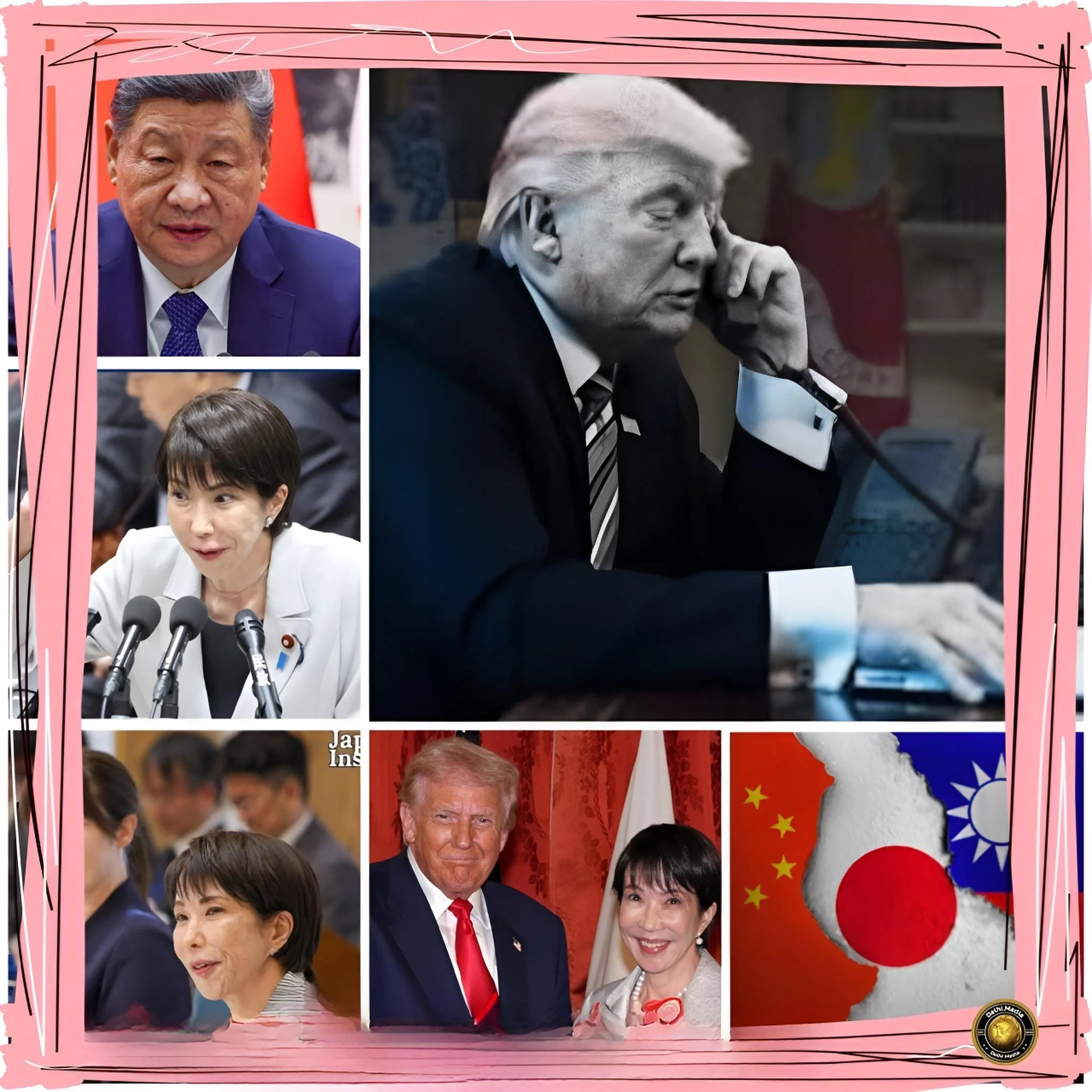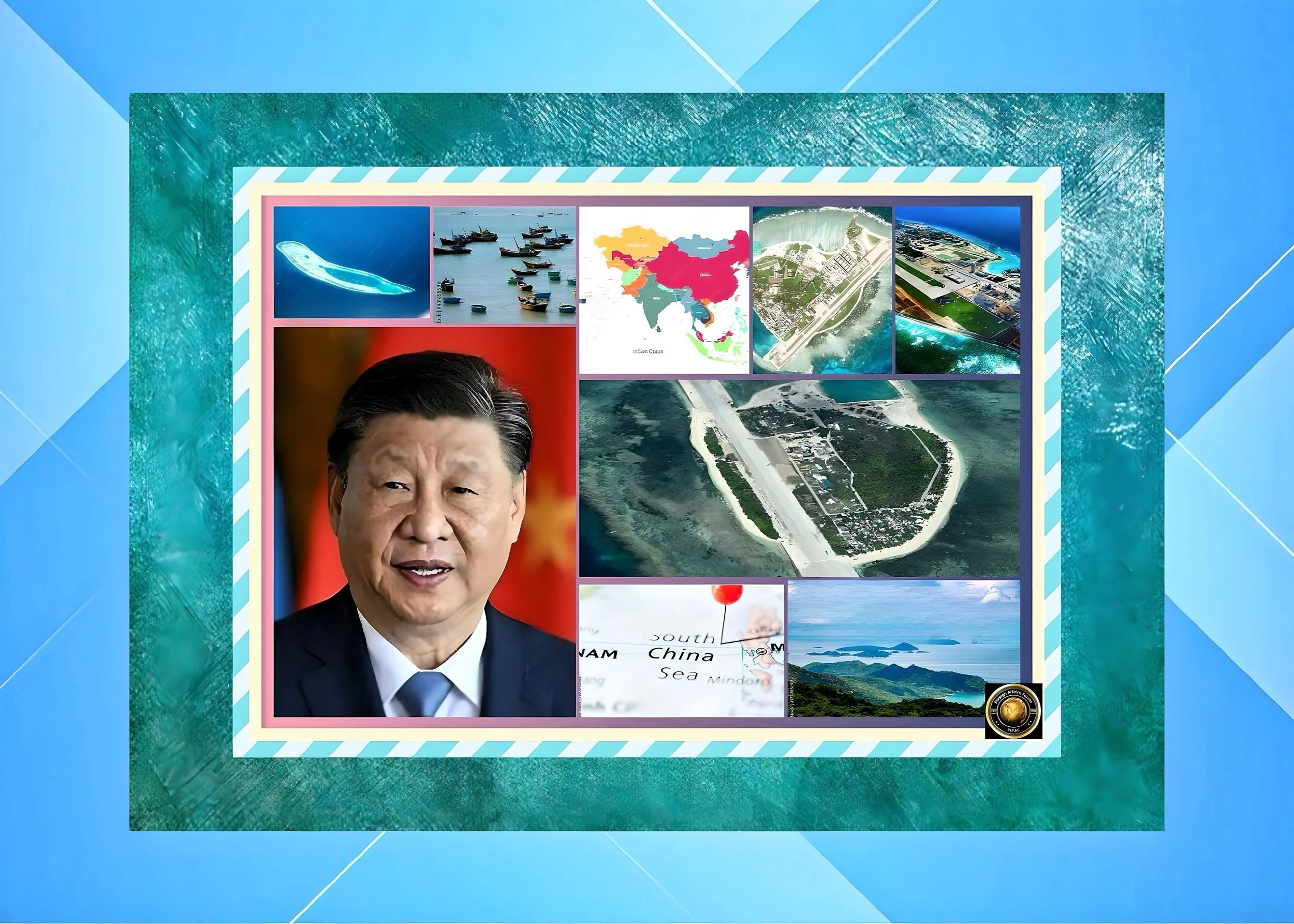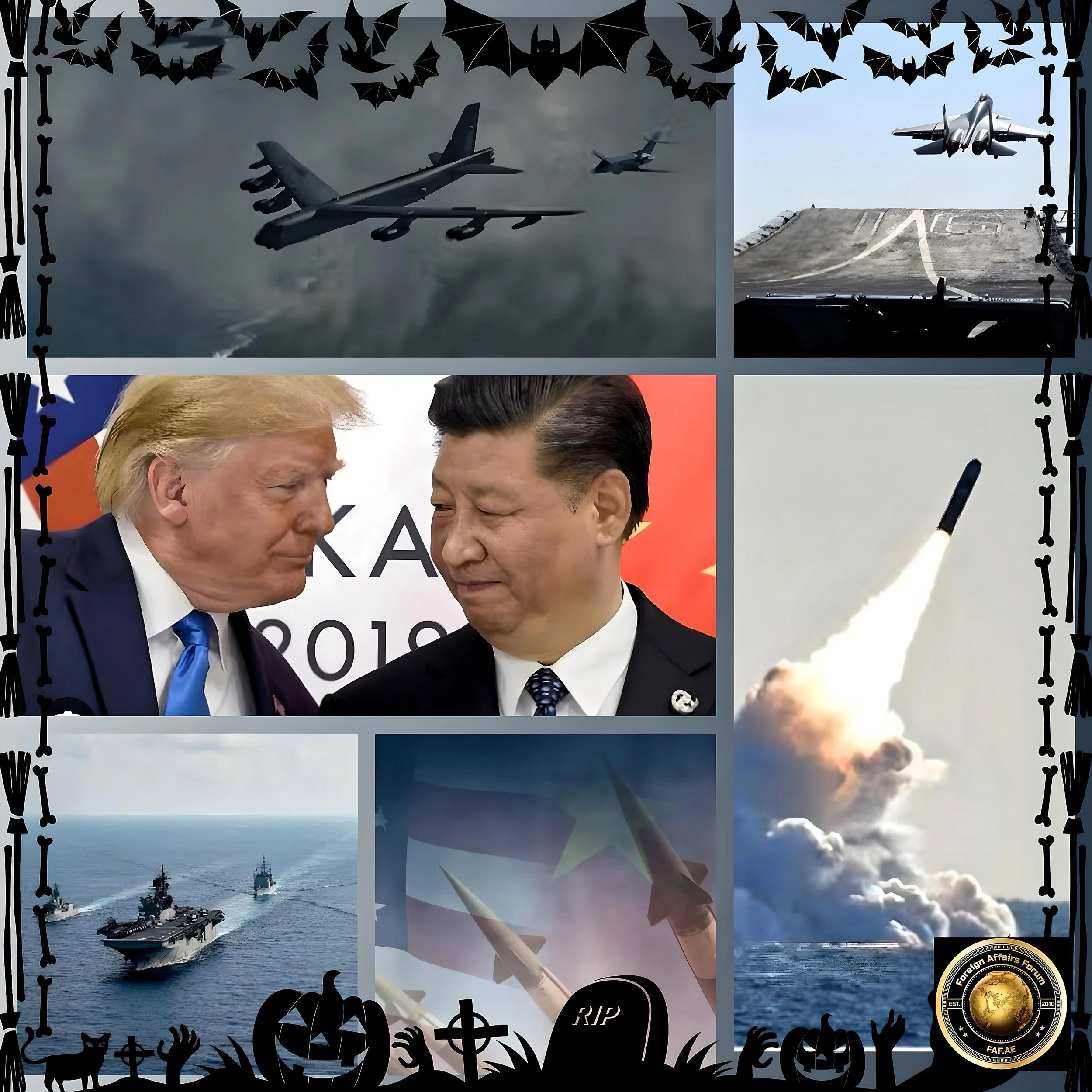
Drift at South China Sea: The Erosion of U.S. Commitment and China’s Quiet Triumph
Executive Summary
Waters of Memory: Identity, Pride, and Concession in the South China Sea
The South China Sea territorial disputes, once a central pillar of American strategic policy in Asia under President Barack Obama’s “Pivot to Asia,” have effectively faded from prominence under the Trump administration’s transactional approach to China relations.
Rather than continuing Obama-era commitments to freedom of navigation operations and alliance-based deterrence, Trump has systematically accommodated Beijing’s interests through a series of concessions on technology exports, agricultural purchases, and strategic positioning.
Deals Over Doctrine: Trump’s Redefinition of U.S. Strategy in Asia
The appointment of self-styled China hawks Marco Rubio and Mike Waltz to positions of Secretary of State and National Security Advisor suggested a hardline stance toward Beijing would characterize the second Trump administration.
Yet these appointments have proven largely symbolic; Trump himself operates as “his own China desk officer,” pursuing deals and accommodations with Xi Jinping that frequently contradict the stated positions of his nominally hawkish cabinet officers.
The Nvidia H200 advanced artificial intelligence chip approval, granted in exchange for 25 percent revenue sharing, exemplifies the administration’s willingness to sacrifice strategic security concerns for immediate economic gain.
Meanwhile, the Philippines—the critical Southeast Asian ally seeking American deterrence against Chinese maritime coercion—has witnessed Trump prioritize trade discussions over security commitments, leaving Manila to navigate Chinese pressure with diminishing American strategic support.
The South China Sea dispute appears destined not for resolution through enforcement of international law or strengthening of allied capabilities, but rather for gradual erosion as American commitment to regional order recedes and regional states incrementally accommodate Chinese preferences.
Introduction
The Flashpoint Returns: Racing Against Escalation in the South China Sea
The South China Sea represents one of the most consequential geopolitical flashpoints in the contemporary international system, with implications that extend far beyond immediate maritime disputes to encompass the future architecture of Asian regional order, the viability of international maritime law, and the credibility of American security commitments throughout the Indo-Pacific.
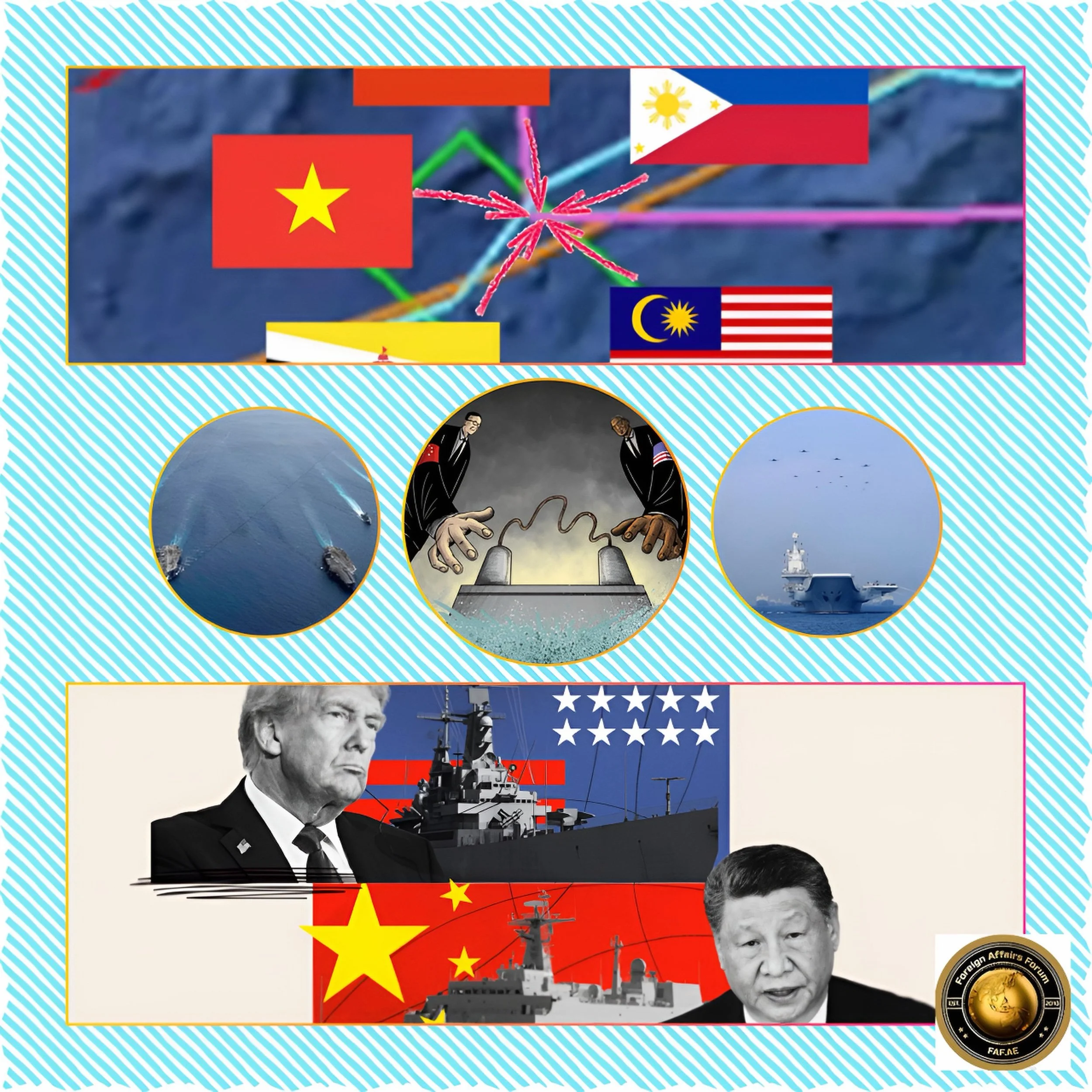
The waterway contains approximately $3.4 trillion in annual maritime trade, serving as the conduit for roughly one-third of global maritime commerce and representing essential commercial passage for Japan, South Korea, Taiwan, and the Philippines. Beneath its surface lie contested claims to hydrocarbon reserves, fishing grounds, and territorial features asserted by China, the Philippines, Vietnam, Malaysia, Brunei, and Taiwan.
From Power Projection to Pragmatism: The U.S. Retreat at Sea
The dispute has persisted in various forms for decades.
Still, its contemporary urgency emerged from China’s massive artificial island construction program beginning in 2013, which transformed underwater rocks and shoals into installations capable of supporting military facilities, airstrips, and permanent garrisons.
President Barack Obama’s administration elevated the South China Sea to strategic prominence through what became known as the “Pivot to Asia,” articulated most clearly in a 2011 Foreign Policy article by Secretary of State Hillary Clinton.
This strategy rested on the conviction that American interests in a stable, rules-based Asian order required sustained American engagement, military presence, and explicit commitment to enforcing international maritime law against Chinese territorial overreach.
The Obama administration conducted six freedom-of-navigation operations in the South China Sea, directly challenging what the United States characterized as excessive Chinese territorial claims.
The first such operation, conducted by USS Lassen on October 27, 2015, deliberately transited within 12 nautical miles of Subi Reef and Mischief Reef in defiance of Chinese claims, sending a powerful signal that the United States would contest Beijing’s assertion of control over areas outside its legitimate maritime boundaries.
The Trump administration’s approach to the South China Sea has proven fundamentally different, characterized less by strategic commitment to regional order than by transactional willingness to accommodate Chinese interests in exchange for immediate economic benefits.
Rather than continuing Freedom of Navigation Operations as routine assertions of American strategic commitment, the Trump administration has substantially de-emphasized this aspect of Asia-Pacific policy.
Trading Strategy for Stability: The U.S. Recalibration in the South China Sea
Meanwhile, Trump himself has pursued direct negotiations with Xi Jinping, resulting in comprehensive concessions on technology exports, agricultural markets, and strategic positioning that have effectively repositioned American policy from resistance to accommodation regarding Chinese interests.
The result has been a strategic vacuum in which regional allies, particularly the Philippines, confront Chinese maritime coercion with diminishing American support, and in which the South China Sea dispute appears destined to resolve not through enforcement of international law but through gradual accommodation to Chinese preferences born of American strategic reorientation.
Key Developments: The Evolution from Strategic Commitment to Transactional Accommodation
Sliding Toward Standoff: The Urgent Recalibration of the South China Sea Order
The Trump administration’s approach to China policy has unfolded through several distinct phases, each marked by greater accommodation toward Beijing than the previous phase.
Erosion at Sea: The Decline of U.S. Strategic Commitment in Asia
When Trump took office in January 2025, his cabinet appointments initially suggested that a hardline stance toward China would characterize his approach.
Senator Marco Rubio, nominated as Secretary of State, had established himself as among the most assertive critics of Chinese government policies, including China’s persecution of Uyghur minorities in Xinjiang and its military adventurism in the South China Sea.
Representative Mike Waltz, nominated as National Security Advisor, had similarly demonstrated consistent opposition to Chinese strategic expansion and had advocated for strengthened deterrence in the Indo-Pacific.
Their appointments generated concern in Beijing that the Trump administration would perpetuate or intensify the Biden administration’s approach of containing Chinese influence through technology restrictions, alliance strengthening, and enforcement of a rules-based international order.
These expectations proved rapidly inconsistent with Trump’s own strategic inclinations. As one Washington Post analysis noted in February 2025, Trump appeared to hold views diverging fundamentally from both the hawkish Republican foreign policy establishment represented by figures like Rubio and the more accommodationist approach of the Biden administration.
Rather than pursuing either hardline containment or defensive stabilization, Trump preferred direct engagement with Xi Jinping to broker personal agreements that would advance American interests through transactional exchanges.
From Assertion to Accommodation: Washington’s Changing Maritime Playbook
The same analysis observed that Trump appeared to view the conflict in Ukraine not as a geopolitical test of American credibility but as an “unpleasant issue to be resolved and set aside,” suggesting that Trump’s vision extended to other regional conflicts—including the South China Sea disputes—as issues to be managed through deals rather than strategic competition.
This strategic orientation manifested concretely in Trump’s October 2025 meeting with Xi Jinping in Busan, South Korea, where the two leaders reached what Trump characterized as a significant trade and economic agreement.
Rather than using this summit to reinforce American commitment to freedom of navigation in the South China Sea or to strengthen allied deterrence capabilities, Trump negotiated substantive concessions on technology exports and agricultural markets.
China agreed to lift restrictions on rare-earth mineral exports and to purchase at least 25 million metric tons of American soybeans in each of 2026, 2027, and 2028, as well as 12 million metric tons in the final two months of 2025.
In return, the United States agreed to extend reduced tariff rates of 10 percent on Chinese imports and decided to reduce fentanyl-related tariffs from 20 percent to 10 percent.
Most significantly, Trump agreed to allow Nvidia to sell H20 artificial intelligence chips to China—a direct reversal of Biden-era technology export restrictions imposed on national security grounds.
The evolution of the Nvidia chip export issue exemplifies the Trump administration’s transactional approach to strategic concerns. In April 2025, the Trump administration initially blocked Nvidia’s proposed sales of H20 chips to China, justifying the restriction on national security grounds.
The H20 chip, explicitly developed for the Chinese market, offered 15 percent of the performance of the more advanced H100 chip and had been designed to comply with Biden-era export controls that restricted advanced artificial intelligence computing to the United States and allied nations.
Power Meets Profit: Trump’s Transactional Turn on China
By July 2025, Trump reversed this decision, permitting Nvidia to sell H20 chips to China in exchange for Nvidia agreeing to share 15 percent of revenue from such sales with the United States government.
In December 2025, Trump escalated this accommodation further by announcing that Nvidia would be permitted to sell the substantially more advanced H200 chips to “approved customers” in China and elsewhere, with the United States taking 25 percent of revenues.
The strategic implications of this arrangement became apparent when critics noted that Trump had personally disclosed substantial Nvidia investments, with filings indicating ownership of shares valued between $615,000 and $1.1 million as of the previous year.
This created the appearance—if not the legal reality—that Trump had a personal financial incentive to permit Nvidia's exports, which benefited the company’s profitability and share value.
Whether or not personal financial interests motivated the decision, the substantive effect was identical: the United States had sacrificed control over technology exports that Pentagon officials had previously identified as essential to national security, in exchange for immediate revenue-sharing arrangements characterized as supporting “American jobs” and “manufacturing.”
Within this broader context of technology export accommodation and agricultural market openings, Trump’s approach to the South China Sea has remained notably passive.
Shoals of Conflict: The Slow-Burning Crisis in Maritime Asia
When Philippine President Ferdinand Marcos Jr. visited the White House in August 2025, Trump responded with what multiple analysts characterized as a notable step back from security commitment.
Rather than reaffirming the Mutual Defense Treaty or pledging enhanced military deterrence against Chinese coercion, Trump focused predominantly on trade discussions and appeared “eager to downplay any militarized rivalry with China.”
Secretary of State Rubio had reaffirmed the United States-Philippines Mutual Defense Treaty in January, and Defense Secretary Pete Hegseth echoed this message during a March visit to Manila. Yet Trump’s own engagement with the Philippines suggested considerably less enthusiasm for security confrontation with Beijing.
This disconnect between the stated positions of supposedly hawkish cabinet officials and Trump’s own strategic inclinations points to what multiple analysts have identified as a fundamental incoherence in the Trump administration's China policy.
As one Reuters commentary noted in September 2025, “aside from tariffs, there is almost no coherent foreign policy regarding China, as both hawkish and dovish factions compete for the president’s attention, while lower-ranking officials are hesitant to take actions that might contradict him.”
The same analysis observed that “Trump is his own China desk officer,” suggesting that traditional State Department and National Security Council processes for developing and implementing strategy have been substantially bypassed in favor of Trump’s direct negotiation with Xi Jinping.
This approach has created conditions in which cabinet officials nominally responsible for Asia policy operate without clear direction from the president. At the same time, Trump himself negotiates fundamental strategic arrangements without a formal interagency process.
The Strategic Paradox
Hawks in Positions of Influence, Yet Strategic Accommodation Prevails
The paradox animating Trump’s approach to China policy centers on the simultaneous appointment of known China critics to positions of substantial formal authority, combined with Trump’s own operational control over strategic decision-making and his inclination toward accommodation with Beijing.
Marco Rubio and Mike Waltz have both built political careers on opposition to Chinese government policies. Rubio was sanctioned for his human rights advocacy regarding Uyghur persecution, and Waltz has consistently advocated for strengthened deterrence against Chinese military expansion.
Their appointments appeared to signal that a hardline China policy would characterize the administration.
Yet both officials have discovered that formal cabinet positions do not necessarily translate into effective influence over presidential decision-making.
Trump’s tendency to operate as his own strategist—particularly in direct negotiations with foreign leaders—has substantially reduced the ability of even nominally powerful cabinet officials to shape outcomes.
When Rubio or Waltz advocate for positions on the South China Sea, technology exports, or other China policy matters, they encounter a president who has already negotiated or decided positions independently through direct communications with Xi Jinping.
The result has been, as one analysis described, a situation in which “China policy in Trump II will essentially be a beefed-up version of Biden administration policy,” in stated strategic terms. At the same time, the actual implementation has involved greater accommodation to Chinese interests than either the Biden administration or the publicly stated positions of Trump’s cabinet officials would suggest.
This dynamic has created particular frustration for America’s Indo-Pacific allies. The Philippines, Japan, South Korea, and Vietnam all invested diplomatic effort in welcoming the Trump administration and seeking to engage its nominally hawkish officials.
These nations hoped that Trump’s second term would generate more robust American commitment to regional deterrence and freedom of navigation than the Biden administration had provided.
From Deterrence to Deal-Making: Trump’s South China Sea Calculus
Instead, nations have witnessed Trump prioritize direct negotiations with Xi Jinping that appear to sacrifice regional interests—including South China Sea freedom of navigation and deterrence against Chinese coercion—in exchange for economic accommodations that primarily benefit Trump’s preferred domestic constituencies: farmers seeking Chinese agricultural markets and technology companies like Nvidia seeking access to Chinese markets.
The contrast with the Obama administration’s approach could hardly be more striking. Obama’s Pivot to Asia represented a sustained, multi-year strategic commitment to Southeast Asian engagement, democracy promotion, and the enforcement of the rules-based order.
The Freedom of Navigation Operations conducted during the Obama administration served as explicit challenges to Chinese territorial claims, conducted in ways specifically designed to demonstrate American commitment to international maritime law.
Obama administration officials engaged extensively with ASEAN nations through multilateral institutions and bilateral relationships, signaling that American interests in the region extended beyond immediate great power competition to encompass regional development, democratic governance, and economic prosperity.
The Trump approach abandons this framework in favor of what one analysis described as a “transactional foreign policy” that “leaves countries vulnerable to Chinese pressure in the South China Sea.”
Facts and Concerns
The State of the South China Sea Disputes in 2025
The South China Sea territorial disputes remain fundamentally unresolved in 2025, with the underlying legal and political questions that animated the 2016 Permanent Court of Arbitration decision still contested and unsettled.
The arbitral tribunal’s July 2016 ruling on the Philippines’ case against China clarified that China’s historic rights claims over maritime areas within the “nine-dash line” lack lawful effect under international law and that China’s construction of artificial islands does not generate territorial or maritime entitlements beyond what would apply to naturally occurring features.
Yet China has systematically rejected this ruling, with President Xi Jinping dismissing the arbitration as illegitimate and asserting China’s claims regardless of international legal determinations.
Tides of Tension: China and the Philippines in a Dangerous Dance
In 2025, the central flashpoints continue to involve Second Thomas Shoal (known to China as Zengmu Ansha), Scarborough Shoal, and surrounding features where Philippine vessels and Chinese paramilitary forces engage in ongoing confrontation.
The pattern of Chinese behavior has evolved toward incremental control assertion combined with calculated use of force sufficient to coerce without triggering formal military escalation.
Floating barriers installed at Scarborough Shoal prevent Philippine fishing boats from accessing traditional fishing grounds. Chinese paramilitary coast guard vessels conduct aggressive interceptions of Philippine scientific missions and supply operations.
Low-flying military helicopters have been deployed in ways designed to intimidate Philippine personnel without formally initiating military attacks.
The Philippines has responded with increasingly assertive documentation and publicization of these incidents, bringing international attention to Chinese coercive activities.
This combination of Philippine assertiveness and international publicity creates conditions for serious military incidents that could inadvertently escalate beyond either side’s intentions.
Multiple analysts have noted that “the combination of brinkmanship and publicity creates conditions for a serious incident that could put U.S. regional credibility to the test.”
The critical question animating Philippine strategic calculations is whether the United States will support Manila in the event of a serious incident, or whether Trump’s apparent prioritization of accommodation with Beijing means that American security guarantees are conditional or negotiable.
Silent Escalation: How Routine Confrontations Risk a Regional Crisis
Vietnam has simultaneously pursued island-building projects that the 2025 South China Sea assessment characterizes as entering “a critical phase.”
As land reclamations proceed in stages, Vietnam is expanding its military equipment and troop deployments on newly reclaimed land. However, China has not responded to Vietnamese expansion with the same degree of coercive pressure it directs toward the Philippines.
Malaysia remains “attentive to China’s concerns” while continuing to push forward with oil and gas development in disputed areas, attempting to balance Chinese objections with energy security imperatives.
This differentiated Chinese treatment of different claimant states reflects Beijing’s calculation that the Philippines, as a direct American alliance partner with the most excellent access to American security guarantees, represents the primary strategic obstacle to Chinese control of the South China Sea.
Vietnam and Malaysia, lacking equivalent alliances with the United States, face less intensive Chinese pressure.
The fundamental concern animating American strategists has evolved from preventing Chinese dominance of the South China Sea toward simply managing the decline in American influence.
Coercion Without War: China’s New Playbook in the South China Sea
One Perry World House analysis noted that “the second Trump administration seems likely to continue the policies of its predecessor in the South China Sea,” referring to the Biden administration’s emphasis on freedom of navigation and alliance support.
Yet the facts on the ground suggest otherwise. The Trump administration's emphasis on accommodation with Beijing, combined with reduced focus on multilateral cooperation and freedom of navigation operations, suggests that American policy has shifted substantially from asserting a rules-based order toward accepting Chinese incremental dominance as an inevitable fact of regional reorganization.
Cause and Effect
Understanding the Strategic Logic Behind Trump’s Accommodation
The fundamental cause of Trump’s accommodation toward China regarding the South China Sea and broader Asia policy lies not in analytical judgment regarding optimal American strategy, but rather in Trump’s personal preference for direct negotiation with major powers combined with his susceptibility to arguments emphasizing immediate economic returns over long-term strategic positioning.
Trump has demonstrated throughout his political career a conviction that negotiation between influential leaders can resolve disputes that institutional frameworks cannot.
He has also shown a consistent preference for transactional outcomes that generate visible, immediate benefits (such as agricultural sales or revenue-sharing arrangements) over outcomes that operate through deterrence, alliance strengthening, or rules enforcement—all of which generate less visible benefits, occur over longer timeframes, and cannot be easily attributed to Trump’s personal negotiating skill.
The Trump approach to China reflects a fundamentally different theory of international order than either the Obama administration’s rules-based approach or the Biden administration’s alliance-centered deterrence.
The Edge of Credibility: U.S. Stakes in the South China Sea Standoff
Rather than viewing the South China Sea disputes as tests of whether international law and regional order can constrain Chinese behavior, Trump views them as negotiable issues that might be resolved through personal diplomacy or accepted as part of a broader accommodation with Beijing.
This perspective reduces the South China Sea from a strategic concern to a manageable irritant that can be addressed through other means—such as allowing American technology companies to profit from Chinese markets, or allowing American farmers to access Chinese agricultural purchases—that Trump can credibly claim as personal diplomatic victories.
The effect of this accommodation has been to substantially reduce American strategic presence in the region even before formal policy changes have been officially announced.
Philippine officials have already begun questioning the reliability of American security commitments, noting that Trump’s focus on trade rather than security during the Marcos visit suggested that immediate economic benefit supersedes long-term strategic commitment.
Vietnam has similarly recalibrated its strategy in light of the apparent American retreat, potentially accelerating Vietnam’s own accommodation to Chinese preferences rather than betting on American willingness to contest Chinese dominance.
Japan has explicitly begun pursuing independent military capabilities and security arrangements outside the American alliance framework, reasoning that sustained reliance on American commitment has become unreliable.
Indonesia and Malaysia, meanwhile, have begun to seek more explicitly to incorporate China into regional institutions and frameworks rather than maintaining the Cold War-era approach of managing Chinese influence through an American counterweight.
The longer-term effect of Trump’s accommodation regarding the South China Sea may prove to be acceleration of regional order transformation that would have occurred gradually but will now occur more rapidly.
Rather than Chinese dominance of the South China Sea emerging through a decades-long process of incremental coercion and alliance erosion, the American strategic retreat under Trump may compress this timeline into years.
The result would be a South China Sea characterized by explicit Chinese control, with regional states adjusting their positioning accordingly and international maritime law effectively superseded by Chinese enforcement capacity.
Historical Context
Obama’s Pivot and Biden’s De-risking, Versus Trump’s Transactionalism
Understanding Trump’s approach requires historical comparison with the strategic frameworks that preceded it. The Obama administration’s Pivot to Asia emerged from the conviction that American interests in the 21st century would be fundamentally shaped by competition for influence in the Asia-Pacific region.
Hillary Clinton articulated this in her 2011 Foreign Policy essay, stating that “the future of politics will be largely written in Asia, not in Europe or in the Middle East. And the future of the global economy increasingly will be determined by what happens in the Asia-Pacific region.”
This analysis led to strategic emphasis on deepening relationships with Southeast Asian nations, strengthening alliance relationships with Japan, South Korea, and Australia, and asserting American commitment to rules-based maritime order through freedom of navigation operations.
Three Presidents, One Sea: How U.S. Strategy Drifted from Deterrence to Deals
The Obama approach to the South China Sea specifically reflected this broader framework. Freedom of Navigation Operations were conducted not as isolated tactical exercises but as components of a broader strategy to demonstrate American commitment to international law and to reassure regional allies that the United States would sustain its traditional role as guarantor of regional maritime order.
The operations were deliberately visible, deliberately contested China’s claims, and deliberately signaled American willingness to bear the diplomatic and military costs of asserting international law against Chinese territorial overreach.
The Biden administration maintained much of the rhetorical commitment to rules-based order but operated within a framework increasingly constrained by recognition of Chinese military modernization and the limits of American ability to sustain absolute military dominance throughout the Indo-Pacific.
Biden’s approach, sometimes described as “de-risking” rather than decoupling, attempted to reduce American vulnerability to Chinese economic coercion and technology dependence while maintaining alliance relationships and general commitment to international maritime law.
Yet the Biden approach operated within parameters of declining American relative capability, acknowledged the reality that Chinese military modernization had substantially improved Beijing’s ability to contest American freedom of navigation claims, and accepted that regional states would increasingly need to develop independent capabilities rather than relying entirely on American military guarantees.
Trump’s transactional approach abandons the strategic framework entirely in favor of direct deals with Beijing that prioritize immediate economic benefit over long-term strategic positioning.
Trading Strategy for Short-Term Gain: The Trump Approach to China
Rather than viewing China as a competitor whose behavior must be constrained through alliance networks and rules enforcement, Trump views China as a negotiating partner with whom accommodation is possible on favorable terms.
Conclusively, Rather than maintaining explicit commitment to freedom of navigation as a strategic principle, Trump emphasizes economic arrangements and trade accommodations that—from his perspective—generate tangible American benefit without requiring sustained military or diplomatic presence in the region.
Future Trajectories
Will the South China Sea Dispute Ever Be Resolved?
The question posed in the query—will the South China Sea dispute ever be resolved or simply fade into history—admits of a somewhat pessimistic answer under the current trajectory. Traditional models of dispute resolution suggest that sustained disputes might eventually be resolved through
(1) military victory by one side
(2) negotiated settlement enforced through international institutions
(3) evolution toward shared management frameworks
(4) gradual accommodation to the status quo imposed by the militarily dominant power.
The South China Sea dispute appears increasingly destined to follow the fourth trajectory: gradual accommodation to Chinese dominance without formal resolution, without enforcement of international law, and without the institutional frameworks that might have constrained Chinese behavior had American political will existed to support them.
From Provocation to Prudence: Learning to Share the South China Sea
Under Trump’s framework, the conditions for traditional resolution mechanisms have substantially deteriorated.
International law enforcement through institutions like the Permanent Court of Arbitration has proven ineffective because China refuses to acknowledge the arbitral tribunal’s authority.
Negotiated settlement through multilateral frameworks appears unlikely given American abandonment of multilateral institutional engagement in favor of bilateral deal-making. Alliance-based deterrence has become unreliable as Trump signals that American security commitments are conditional and negotiable rather than firm.
Acceptance Over Resolution: China’s New Maritime Reality
Military victory by the Philippines or other claimant states remains implausible given Chinese military superiority.
What remains is the gradual accommodation scenario in which regional states incrementally adjust to Chinese dominance, accept constraints on their maritime activities within areas China claims, and structure their relationships accordingly.
Vietnam may continue island-building but will likely avoid confrontational tactics.
The Philippines will continue provocative assertions of sovereignty but may eventually negotiate arrangements similar to agreements reached regarding Second Thomas Shoal and Sabina Shoal in 2024, whereby both sides agreed to reduce provocations through diplomatic channels.
Malaysia and Brunei will continue development activities but will increasingly coordinate with Beijing to avoid confrontation.
Thailand, Indonesia, and Singapore will increasingly manage their maritime positions to accommodate Chinese preferences while maintaining sufficient independence to preserve leverage with other powers.
For the Trump administration specifically, the South China Sea is likely to fade in policy priority beyond the transactional arrangements Trump pursues with Xi Jinping.
Trump has shown no sustained interest in the region beyond what immediate negotiations can produce.
His cabinet officials nominally responsible for Asia policy will continue to advocate for more robust commitment, but lacking Trump’s personal attention or directive, their efforts will prove ineffectual.
The Philippines will receive continued military aid as part of Trump’s effort to maintain the alliance sufficiently to preserve American military basing rights, but strategic commitment to Philippine deterrence against Chinese coercion will remain subordinate to broader accommodation goals.
The Sea That Forgot to Fight Back
The longer-term trajectory suggests that American withdrawal from South China Sea commitment will accelerate regional accommodation to Chinese preferences.
Within five to ten years, it is conceivable that the South China Sea disputes resolve not through formal resolution but through acceptance by all regional states that China exercises effective control over contested areas and that international maritime law applies only insofar as China permits.
Finally. South China Sea dispute will not be resolved in the traditional sense, but it will effectively fade from history not because the underlying issues have been addressed but because regional states will have accommodated themselves to Chinese dominance and will have ceased asserting claims that China will not tolerate.
The Role of Chinese Hawks in the Trump Administration
Nominal Influence, Limited Effect
The presence of Marco Rubio and Mike Waltz in positions of formal authority over China policy raises the question of why nominally hawkish officials have been unable to prevent Trump’s accommodation toward Beijing.
The answer lies partly in Trump’s operational style and partly in the structural reality that formal cabinet positions do not necessarily translate into effective control over presidential decision-making when the president operates as his own strategist.
After the Bluff: A Realist’s Reflection on Compromise in the South China Sea
(1) Rubio’s tenure as Secretary of State has been notable primarily for public reaffirmations of alliance commitments while substantive policy has moved toward accommodation.
(2) Waltz’s role as National Security Advisor similarly appears to involve generating strategic analyses and recommendations that Trump receives but does not necessarily follow.
(3) Multiple analysts have observed that Trump maintains personal control over China policy to a degree that excludes normal interagency processes and cabinet deliberation.
The Washington Post noted in February that Trump’s perspective on China “diverges significantly from the established views of both mainstream Republicans and Democrats” and that Trump has “considered and dismissed the hawkish stance of Republicans on his right.”
This suggests that Trump is aware of the arguments that officials like Rubio and Waltz present but has chosen to pursue a different strategy based on his personal conviction that direct negotiation with Xi produces better outcomes.
The effect has been to substantially reduce the influence of traditional China hawks in policy implementation. Rubio and Waltz have proven unable to prevent technology export accommodations that they have publicly criticized or to sustain policies they believe necessary for security.
Their appointments, which initially suggested a hardline turn in American China policy, have instead become symbols of the gap between stated positions and actual policy implementation.
In some respects, their presence in the Trump administration actually provides political cover for accommodationist policies—when Trump implements technology exports or agricultural accommodations, he can note that even his hawkish officials support the arrangement as balanced against other national interests.
This dynamic may prove consequential for future American China policy regardless of who occupies the presidency.
If a hardline approach to China is unable to resist accommodation even when explicitly advocated by cabinet officials in position to influence policy, then the barriers to further accommodation in subsequent administrations may prove weaker than previously assumed.
The Trump approach establishes precedent that American security concerns can be set aside in exchange for economic arrangements beneficial to particular constituencies, and that direct great power negotiation can supersede institutional policy processes.
Conclusion
The Fading of Strategic Vision and the Triumph of Transactionalism
The South China Sea dispute appears destined not for resolution through enforcement of international law, alliance-based deterrence, or negotiated settlement, but rather for gradual fading into historical acceptance of Chinese dominance.
This outcome represents a fundamental departure from the strategic vision that animated both the Obama administration’s Pivot to Asia and the Biden administration’s alliance-centered deterrence.
Rather than viewing the South China Sea as a test of whether rules-based international order can constrain great power behavior, the Trump administration views it as a negotiable element within broader accommodations with Beijing that prioritize immediate American economic benefit.
The appointment of China hawks to positions of formal responsibility for Asia policy has proven largely symbolic, generating little influence over actual strategic outcomes.
Trump operates as his own China strategist, negotiating directly with Xi Jinping without substantial constraint from cabinet officials or interagency process.
The result has been accommodation on technology exports, agricultural markets, and strategic positioning that sacrifice long-term American interests for immediate economic returns.
The Nvidia H200 chip approval, structured to generate revenue sharing that benefits American government budgets and American technology companies, exemplifies this approach: American security concerns regarding advanced technology proliferation are subordinated to immediate financial gain.
For regional allies like the Philippines, Japan, and Vietnam, this American strategic retreat creates profound challenges.
These nations invested in relationships with the Trump administration anticipating that nominal China hawks in cabinet positions would translate into robust American support for regional deterrence.
Instead, they have witnessed Trump prioritize trade negotiations and direct deals with Beijing over security commitments.
The Philippines’ assertive stance toward Chinese maritime coercion is increasingly isolated, with American support becoming conditional and negotiable rather than firm.
Vietnam and other regional states are recalibrating their strategies accordingly, seeking to accommodate Chinese preferences rather than betting on American willingness to contest Chinese dominance.
The comparison with Obama’s Pivot to Asia could not be more stark. Obama viewed the South China Sea as a central arena of American strategic competition with China, where rules-based order enforcement and regional alliance strengthening served critical American interests.
Empires, Islands, and Illusions: A Struggle Reimagined in the South China Sea
Trump views the South China Sea primarily as a location where American technology companies and agricultural interests might profit from accommodation with Beijing.
The Freedom of Navigation Operations that Obama conducted as explicit challenges to Chinese territorial claims appear increasingly unlikely under Trump, replaced instead by a strategic approach focused on negotiated arrangements that Trump can characterize as victories in direct engagement with the Chinese leader.
Whether the South China Sea dispute will ultimately be resolved remains fundamentally uncertain.
What appears increasingly certain is that resolution—or fading—of the dispute will occur not through triumph of international law or strengthening of regional deterrence, but through gradual accommodation to Chinese dominance by regional states operating in an environment of diminished American strategic commitment.
The Chinese hawks nominally positioned to influence Trump’s approach have proven unable to prevent this accommodation.
The transactional logic animating Trump’s approach has proven more potent than the strategic vision of his cabinet officials.
The South China Sea will likely fade from prominence not because the underlying disputes have been addressed but because all parties have adapted to a new regional order in which Chinese preferences largely prevail and American commitment is no longer reliably available to contest that dominance.