Russia Ignites BRICS Gold Revolution: 33 Nations Target Dollar Throne
Executive Summary
BRICS’ Gold Gambit: 33 Nations Rally Behind Russia’s Anti-Dollar Drive
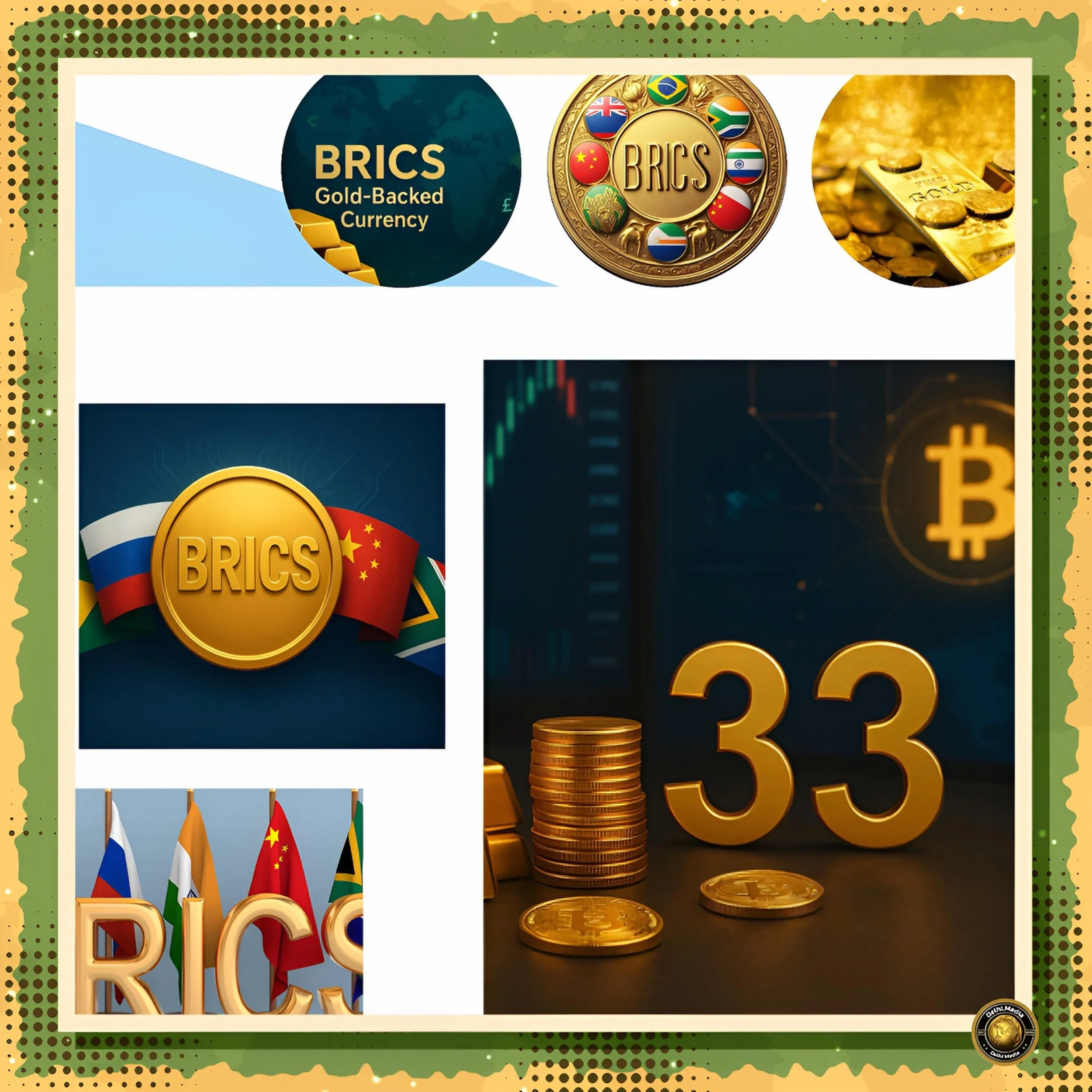
The BRICS alliance has substantially expanded its gold-backed trading infrastructure to encompass 33 nations, with Russia serving as the primary architect of an alternative precious metals exchange designed to circumvent Western-dominated financial systems.
The initiative includes eleven full participant countries alongside twenty-two nations in the application process, collectively commanding approximately 6,000 tonnes of gold—equivalent to 20% of all global central bank reserves.
The centerpiece of this endeavor is a digital trade instrument called the “Unit,” a blockchain-verified settlement mechanism backed 40% by physical gold and 60% by an equally weighted basket of BRICS national currencies.
This framework represents a fundamental structural shift in international commerce, enabling trade in gold, platinum, and rare earth minerals outside dollar-dependent infrastructure.
With operational status targeted for 2030 and vault infrastructure already established in Saudi Arabia, Singapore, and Malaysia, the pact signals an accelerating transition toward commodity-backed settlement systems that challenge decades of dollar hegemony in global trade.
Introduction
Breaking Bretton Woods: The BRICS Gold Pact and the Rise of a Post-Dollar Order
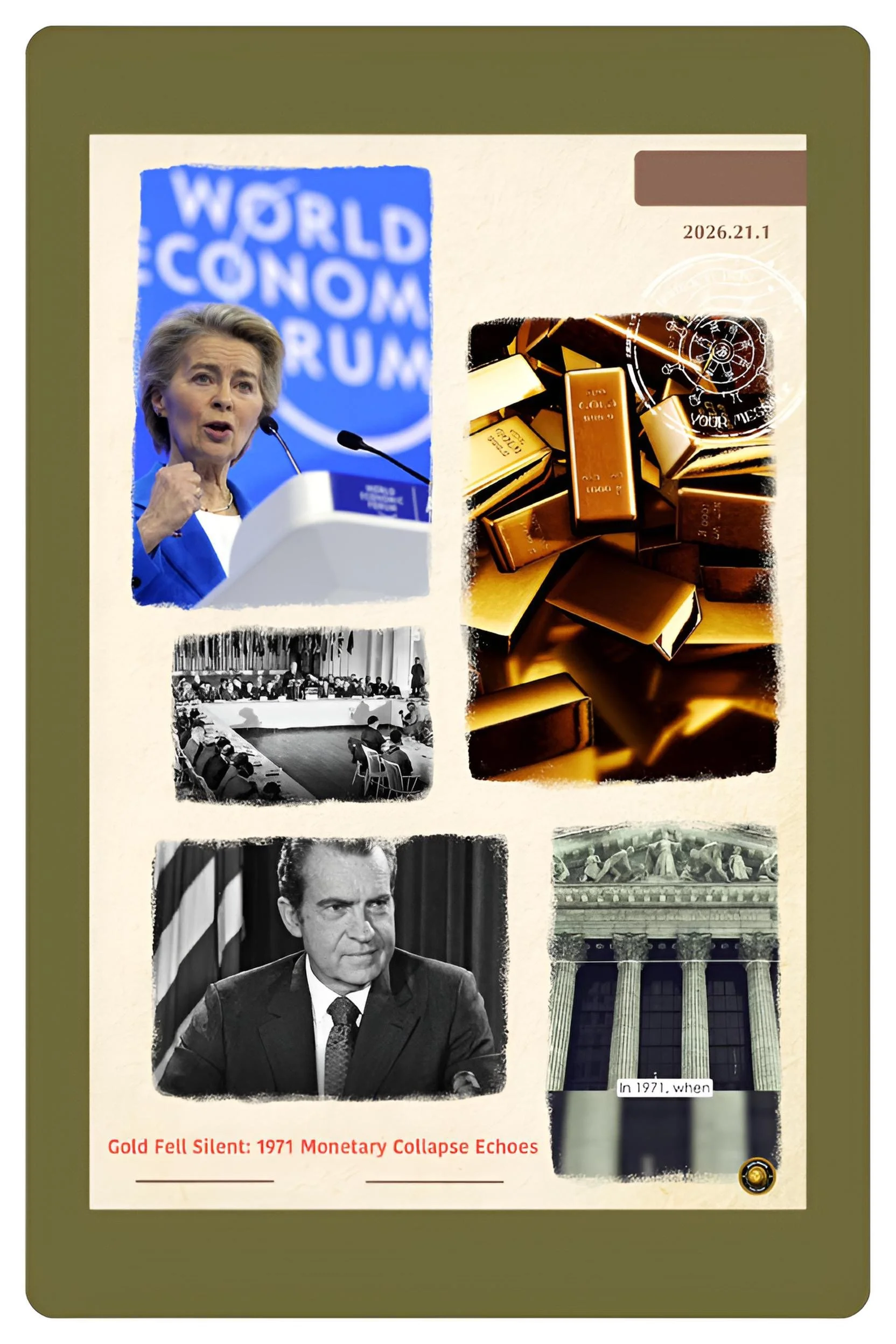
The international financial architecture, established in the aftermath of World War II through the Bretton Woods system and subsequently reinforced through institutions such as SWIFT, the International Monetary Fund, and various Western-controlled commodity exchanges, has long functioned as a mechanism whereby the United States dollar serves as the primary medium of international settlement.
For nearly eighty years, this arrangement has granted significant structural advantages to the United States, permitting the expansion of dollar-denominated debt and facilitating the projection of economic power through financial sanctions and capital controls.
From Sanctions to Sovereignty: How BRICS Is Rewiring the Global Financial Architecture
However, the emergence of BRICS—a coalition of Brazil, Russia, India, China, and South Africa, latterly expanded to include countries such as Iran, the United Arab Emirates, Egypt, and Ethiopia—has begun to construct alternative infrastructure that deliberately circumvents this established system.
The most consequential recent development within this realignment is the crystallization of the BRICS gold pact, an initiative that transforms precious metals from mere stores of value into the operational foundation of international commerce.
Russia, under the leadership of Finance Minister Anton Siluanov and Foreign Minister Sergey Lavrov, has positioned itself at the forefront of this transformation, overseeing the design and promotion of an independent precious metals exchange that would establish pricing mechanisms liberated from Western control.
This development assumes particular significance given that Russia itself has been subjected to unprecedented financial sanctions following its invasion of Ukraine in 2022, thereby creating an immediate strategic imperative to develop settlement mechanisms that operate outside dollar-denominated channels.
Key Developments and Current Architecture
The Birth of the Unit: Inside BRICS’ Bid to Rewrite the Rules of Global Finance
The BRICS gold pact has evolved considerably over the past several years, though its most tangible manifestation emerged with the introduction of the “Unit,” a working prototype of a gold-backed trade currency unveiled by the Institute for Economic Strategies of the Russian Academy of Sciences on December 4, 2025.
The Unit represents the first operational prototype of a financial instrument designed specifically to facilitate trade settlement outside dollar infrastructure.
Each Unit is initially pegged to one gram of gold, with the instrument’s value derived from a composite basket comprising 40% physical gold and 60% national currencies from the five BRICS core members, weighted equally across the Brazilian real, Chinese yuan, Indian rupee, Russian ruble, and South African rand.
From Concept to Currency: The BRICS Unit and the Mechanics of a Gold-Backed Trade System
The operational pilot began on October 31, 2025, with the initial issuance of 100 Units, establishing proof of concept for a settlement mechanism capable of functioning within blockchain-verified infrastructure.
By December 4, 2025, market fluctuations had adjusted the Unit’s value to 0.9823 grams of gold per Unit, demonstrating the instrument’s capacity to respond to currency movements while maintaining its commodity backing.
This technological foundation emerges from the Shanghai Gold Exchange International, which has directed the development of the system’s underlying architecture and continues to serve as the operational nexus for the gold-backed settlement framework.
The geographic scope of the pact has expanded substantially beyond the original five BRICS member nations.
The alliance now encompasses eleven full participant countries alongside twenty-two additional nations in various stages of application, bringing the total to 33 participating entities.
Forging a New Standard: The BRICS Unit and the Global Contest for Monetary Power
This expansion reflects growing interest among developing nations and emerging markets in establishing trade relationships that do not depend upon dollar intermediation.
The physical infrastructure to support this system is likewise advancing, with secure vault facilities established in geopolitically significant locations including Saudi Arabia, Singapore, and Malaysia.
These facilities enable member nations to store gold pledges locally while utilizing them as collateral for credit lines, thereby reducing the necessity for long-distance physical transfers of precious metals and enhancing the liquidity available for international commerce.
Russian Deputy Finance Minister Aleksey Moiseev has articulated the temporal roadmap for this initiative, with full operational status targeted for 2030.
This timeline permits existing infrastructure to develop while allowing additional nations to integrate into the framework, thereby creating a sufficiently robust network effect to ensure the system’s viability and utility for genuine commercial transactions rather than serving as a symbolic gesture toward de-dollarization.
Facts and Foundational Elements
Weaponizing Weight: BRICS’ Gold Leverage and the Strategic Logic of De-Dollarization
The BRICS coalition possesses extraordinary material advantages with respect to precious metals reserves. Collectively, the alliance commands approximately 6,000 tonnes of gold, representing roughly one-fifth of all gold held by central banks worldwide.
Russia maintains the largest share within this pool, possessing 2,335.85 tonnes of gold in official reserves. China follows closely with 2,298.53 tonnes, while India, Brazil, and South Africa collectively maintain additional significant holdings.
This concentration of precious metal wealth provides the BRICS alliance with formidable leverage in constructing credible settlement mechanisms, as the physical asset backing the Unit and other proposed instruments rests upon a tangible foundation rather than institutional reputation or debt obligations.
The de-dollarization impulse animating these developments reflects both immediate strategic concerns and longer-term structural anxieties.
According to analyses conducted by geopolitical observers, approximately 68% of trade conducted among BRICS member nations currently bypasses the United States dollar, while nearly 90% of bilateral trade between Russia and China alone is executed in the respective national currencies.
Gold as Governance: The BRICS Advantage in Building a Credible Settlement Framework
This substantial existing deviation from dollar settlement demonstrates that the proposed gold-backed infrastructure would formalize and extend patterns of commerce that have already emerged in response to sanctions pressure and the weaponization of dollar-denominated financial infrastructure against strategic adversaries.
The historical precedent for this approach exists within Russia’s own recent practice.
In 2017, Russia implemented a preliminary version of the gold-backed settlement model by accepting Chinese yuan in exchange for oil exports, with blockchain-verified mechanisms permitting the conversion of yuan holdings into physical gold.
This operational proof of concept established that the technical infrastructure necessary to facilitate such transactions could be constructed, tested, and implemented without reliance upon Western financial institutions or oversight mechanisms.
Cause and Effect Analysis: The Structural Logic of Gold-Backed Settlement
The causal chain underlying the emergence of the BRICS gold pact originates in the weaponization of the dollar-denominated financial system against nations perceived as strategic threats by the United States and its Western allies.
The imposition of sanctions upon Russia, Iran, and other BRICS-affiliated entities through mechanisms such as SWIFT exclusion and the freezing of dollar-denominated assets created an immediate practical necessity for alternative settlement mechanisms.
When a nation cannot reliably access the primary medium of international commerce, it must either retreat from international trade or construct alternative infrastructure capable of facilitating commerce outside those constrained channels.
This necessity catalyzed a broader recognition among developing nations that reliance upon dollar-denominated systems renders them vulnerable to economic coercion administered through Western-controlled financial infrastructure.
From Dollars to Bullion: The Strategic Logic Behind Central Banks’ Race for Gold
Central banks worldwide, particularly among the Global South, have responded to this recognition by accumulating gold at unprecedented rates.
During 2024 alone, central banks globally added 1,045 metric tons to their gold reserves, marking the third consecutive year in which annual purchases exceeded 1,000 metric tons.
This accumulation pattern reflects deliberate portfolio diversification away from dollar exposure and toward commodity-backed assets perceived as resistant to the political manipulation that has increasingly characterized modern economic statecraft.
The strategic effect of the BRICS gold pact is to establish settlement mechanisms whereby the value proposition of trade goods is decoupled from the issuing authority and credibility of any particular national currency.
In traditional dollar-based settlement, the value of a barrel of oil or a container of manufactured goods is converted into a dollar-denominated quantity, which the recipient nation must then either utilize for dollar-denominated transactions or convert into a national currency at prevailing exchange rates.
This process subjects trading partners to currency risk and confers upon the issuer of the currency—the Federal Reserve and the United States government—substantial seigniorage benefits and structural leverage over international commerce.
From Credit to Collateral: The BRICS Blueprint for a Post-Dollar World
Under the proposed BRICS gold-backed system, an Indian purchaser seeking to acquire oil from Russia might remit payment not in dollars or even in rupees, but in gold-backed digital Units.
The Russian recipient of such payment could subsequently utilize these Units to acquire electronics from China or agricultural products from Brazil without requiring dollar intermediation.
This arrangement eliminates what one analyst has termed “the disintermediation of the dollar”—the removal of the dollar as the necessary medium through which international commerce must flow.
The deeper implication of this structural shift represents a transition from what might be characterized as a credit-based system, wherein trust in the borrowing capacity and creditworthiness of particular nations determines the utility of their currencies, toward a collateral-based system wherein a tangible asset—physical gold—determines the value proposition.
Such a transition suggests a fundamental movement away from the architecture of modern monetary systems generally, which have depended upon institutional confidence in fiat currencies, toward an older paradigm wherein precious metals provide the ultimate store of value and medium of settlement.
Concerns and Contradictions
Dollar’s Doom? Russia’s BRICS Gold Alliance Enlists 33 Powerhouses
The initiative confronts several substantial obstacles and theoretical criticisms that merit analytical consideration.
(1) First concern is the question of whether gold-backed settlement mechanisms can operate at the scale required for genuinely significant international commerce.
Gold possesses inherent limitations as a medium of exchange compared to fiat currencies
(1) its supply is geologically constrained
(2) its divisibility is poor for small transactions
(3) its transportation and storage impose material costs.
The Unit mechanism, by restricting its composition to 40% gold backing, partially addresses this constraint by incorporating national currencies, yet this compromise somewhat undermines the entire theoretical basis for the initiative, which posits that reliance upon fiat currencies represents the fundamental vulnerability of existing systems.
(2) A second concern involves the potential for political fragmentation within the BRICS coalition itself.
The five core members possess divergent strategic interests, and the expansion to 33 participating nations introduces a multiplicity of potential disagreements regarding governance, operational protocols, and the distribution of benefits derived from participation.
Russia and China, despite their contemporary cooperation, remain potential strategic competitors, particularly with respect to influence over Central Asia and the former Soviet periphery.
India maintains distinct strategic perspectives from both Russia and China, and Brazil and South Africa occupy positions considerably more ambiguous with respect to alignment with either Western or non-Western blocs.
(3) A third analytical concern pertains to the sustainability of gold’s role as a settlement instrument in the context of advancing technological change.
Cryptocurrencies and blockchain-based settlement mechanisms introduce possibilities for programmable money that gold cannot replicate, yet these same technologies render gold’s physical form somewhat archaic from a purely technical perspective.
Collision Course: How Technology, Sanctions, and Power Politics Threaten the BRICS Settlement System
The BRICS proposal’s hybridization—combining gold with digital currencies and blockchain infrastructure—may prove unstable if technological development proceeds rapidly or if cryptocurrency protocols prove more efficient than commodity-backed settlement at particular scales.
Additionally, Western-dominated financial institutions and regulatory bodies may respond to the emergence of alternative settlement systems through either preventive action or gradual marginalization.
The historical record suggests that established power structures demonstrate considerable capacity to adapt to challenges rather than merely acquiescing to their displacement.
The capacity of the United States and allied economies to restrict BRICS members’ access to critical technologies, to impose additional sanctions targeting the infrastructure supporting the gold-backed system, or to construct their own digital currency infrastructure capable of competing with the Unit represents a non-negligible threat to the initiative’s viability.
Furthermore, the operational practicality of transferring substantial quantities of physical gold across borders and maintaining secure storage in the proposed vault locations introduces logistical complexities and security vulnerabilities that extend beyond the purely financial domain.
Geopolitical instability, natural disasters, or administrative failure could compromise the physical assets supporting the system, whereas traditional dollar-based settlement depends upon electronic transfers that, while politically vulnerable, prove more operationally resilient.
Future Steps and Implementation Trajectories
The BRICS gold pact operates according to a deliberate temporal roadmap extending toward 2030, with intermediate milestones that will determine whether the initiative progresses toward becoming a genuinely significant component of global trade settlement or remains a marginal alternative utilized primarily by sanctions-constrained actors with limited alternatives.
Scaling the Unit: From Experimental Trials to Full Commercial Integration
The immediate priority involves expanding the pilot phase of the Unit beyond its current experimental status toward genuine operational deployment among commercial entities.
This transition requires development of the technological infrastructure necessary to permit corporations and financial institutions to conduct genuine commercial transactions utilizing Units rather than conducting test transactions among central banks.
The expansion of vault infrastructure into additional geographic locations represents a critical second-order priority.
Building the Gold Grid: The Geopolitical Stakes of the Unit System’s Expansion
While facilities have been established in Saudi Arabia, Singapore, and Malaysia, the system will require additional storage capacity if the volume of gold pledged as backing for the Units and associated settlement mechanisms increases substantially.
The selection of additional vault locations will itself carry geopolitical significance, as each new facility extends the geographic footprint of the system and potentially incorporates additional nations into the governance and operational structure of the pact.
The integration of additional nations remains ongoing, with the twenty-two applicant countries proceeding through vetting processes that will determine whether they satisfy the criteria established by existing participants.
The Decade of Convergence: Advancing the Unit Across Technology, Finance, and Geopolitics
This expansion dynamics will likely continue throughout the remainder of the decade, with particular emphasis upon incorporating major developing economies that command significant gold reserves or occupy important positions within regional trade networks.
Technological development concerning the Unit and associated digital infrastructure will require substantial investment and operational refinement.
The prototype launched in 2025 necessarily represents an early-stage iteration, and the maturation of the system will depend upon resolving technical challenges relating to transaction verification, settlement speed, custody protocols, and integration with existing banking infrastructure within participating nations.
Finally, the political dimension of the initiative’s evolution will prove equally consequential as its technical and logistical aspects.
The capacity of BRICS members to maintain consensus regarding the governance of the system, to allocate benefits equitably among participants, and to present a united front against Western pressure campaigns will substantially determine whether the gold pact progresses toward viability or gradually fragmentizes as member interests diverge.
Conclusion
BRICS Gold Pact Ends Dollar’s Reign: Russia’s 33-Nation Revolution Reshapes Global Finance
The BRICS gold pact, now encompassing 33 nations and operationalized through the Unit—a gold-backed digital settlement instrument—represents the most substantial institutional challenge to dollar hegemony in international commerce since the collapse of the Bretton Woods system in 1971.
Russia’s leadership in constructing this alternative infrastructure reflects the strategic imperatives created by sanctions pressure, yet the pact’s broader appeal among developing nations and emerging markets suggests that discontent with dollar-dependent settlement systems extends well beyond Russia’s particular circumstances.
The initiative’s theoretical foundation rests upon the proposition that commodity-backed settlement mechanisms can replace credit-based systems dependent upon the monetary authority and institutional credibility of any particular nation.
The physical asset foundation of the proposed system—the 6,000 tonnes of gold commanded by the BRICS coalition—provides formidable backing for this claim, while the blockchain infrastructure and digital currency mechanisms enable operational scalability that pure commodity settlement would preclude.
The trajectory of this initiative toward 2030 and beyond will substantially influence the future architecture of international financial systems.
If the gold-backed settlement mechanism achieves genuine operational maturity and incorporates a sufficient volume of international commerce to become self-sustaining, it would represent a structural shift as consequential as the post-World War II establishment of dollar-denominated settlement.
Conversely, if political fragmentation, technical obstacles, or Western countermeasures impede the system’s development, it may persist as a marginal alternative serving primarily sanctions-constrained economies rather than achieving broader systemic significance.
Dollar’s Unchallenged Era Ends: The Dawn of Contested Global Settlements
What appears certain is that the era of uncontested dollar dominance in international settlement has concluded.
Whether the BRICS gold pact or some successor system ultimately displaces the dollar, or whether hybrid arrangements accommodating both traditional and alternative settlement mechanisms emerge, the international monetary architecture is undergoing fundamental reconfiguration.
For policymakers, central bankers, and investors oriented toward the long-term evolution of global finance, this transition merits sustained analytical attention.