Trump’s National Security Strategy: A Blueprint for the Dismantling of the Western Liberal Order
Executive Summary
America Abandons the West: Trump’s Strategy Signals End of 80-Year Alliance
The Trump administration’s 2025 National Security Strategy represents not merely a tactical recalibration of American foreign policy, but rather a fundamental repudiation of the institutional architecture and philosophical premises that have undergirded the postwar Western order since 1945.
By situating “civilizational erasure” as Europe’s paramount threat, subordinating collective security arrangements to transactional burden-shifting mechanisms, abandoning the rhetoric of international law and rules-based governance, and explicitly endorsing far-right political movements across the continent, the document articulates a vision of American power predicated upon the dissolution of liberal democratic alliance structures in favour of spheres of influence, nationalist particularism, and—paradoxically—the accommodation of revisionist powers.
The strategy’s internal contradictions, ideological framing, and geopolitical implications collectively suggest that Western institutional cohesion faces an existential challenge not from external adversaries, but from the unravelling of commitment mechanisms within the alliance itself.
Introduction
The Unravelling: Inside Trump’s Blueprint to Dismantle NATO and Embolden Russia
In an era when the structural foundations of transatlantic security appear increasingly fragile, the release of the 2025 National Security Strategy has catalysed an intellectual reckoning regarding the future viability of the post-1945 Western order.
The document does not engage in the customary diplomatic obfuscation that has characterised previous national security frameworks; rather, it articulates with remarkable clarity an ideological worldview fundamentally incompatible with the institutional logic that has sustained American-European alliance structures for eight decades.
Where earlier strategic documents—even those issued by the first Trump administration in 2017—emphasised shared commitments to democracy, individual liberty, and rules-based international order, the 2025 iteration abandons such language entirely, replacing it with an ethno-civilizational framework that privileges nationalist conservative values as the criterion for alliance membership.
The implications of this strategic reorientation extend far beyond the realm of diplomatic niceties.
By explicitly calling for American engagement in cultivating political resistance to European Union governance structures, endorsing nationalist and far-right political movements, casting doubt upon the reliability of longstanding NATO allies, and signalling a substantial weakening of security guarantees to the continent, the Trump administration has precipitated a fundamental crisis of confidence within the transatlantic relationship.
This crisis manifests not merely as a disagreement over policy preferences or resource allocation, but rather as a deliberate attempt to reshape European political trajectories in accordance with an American ideological template profoundly at odds with the pluralistic democratic commitments upon which European integration has historically rested.
Key Developments and Strategic Orientation
The “Civilizational Erasure” Framing and Its Ideological Implications
The centrepiece of the strategy’s European section rests upon an assertion of such extraordinary bleakness that it merits careful analysis.
The document claims that Europe faces the “prospect of civilizational erasure” within twenty years, attributing this purported crisis to mass migration, alleged suppression of free speech by European Union institutions, declining birth rates, and a generalised loss of national identity and self-confidence.
This framing constitutes a remarkable departure from previous American strategic documents, which typically addressed European challenges through the lens of economic performance, military capacity, or technological innovation.
Instead, the 2025 strategy engages in what scholars have identified as language resonant with far-right conspiracy theories, specifically invoking tropes associated with “great replacement” ideology—the notion that European civilisational traditions face obliteration through demographic displacement.
The strategic significance of this reframing cannot be overstated. By identifying existential civilisational threat not as external military aggression or economic disruption, but rather as the inevitable outcome of European liberalism’s purported failure to maintain cultural and demographic continuity, the strategy establishes ideological grounds for American intervention in European domestic political affairs.
This conceptual move represents a categorical inversion of the stated commitment to national sovereignty that pervades other sections of the document.
Whereas the strategy elsewhere emphasises American respect for national autonomy and resistance to transnational organisations, its treatment of Europe transforms the continent into an appropriate domain for American political engineering aimed at supporting movements explicitly opposed to the European Union’s institutional framework.
Burden-Shifting, NATO Transformation, and Alliance Architecture
The strategy signals a dramatic reconfiguration of the NATO alliance through a mechanism superficially presented as burden-sharing but more accurately characterised as burden-shifting.
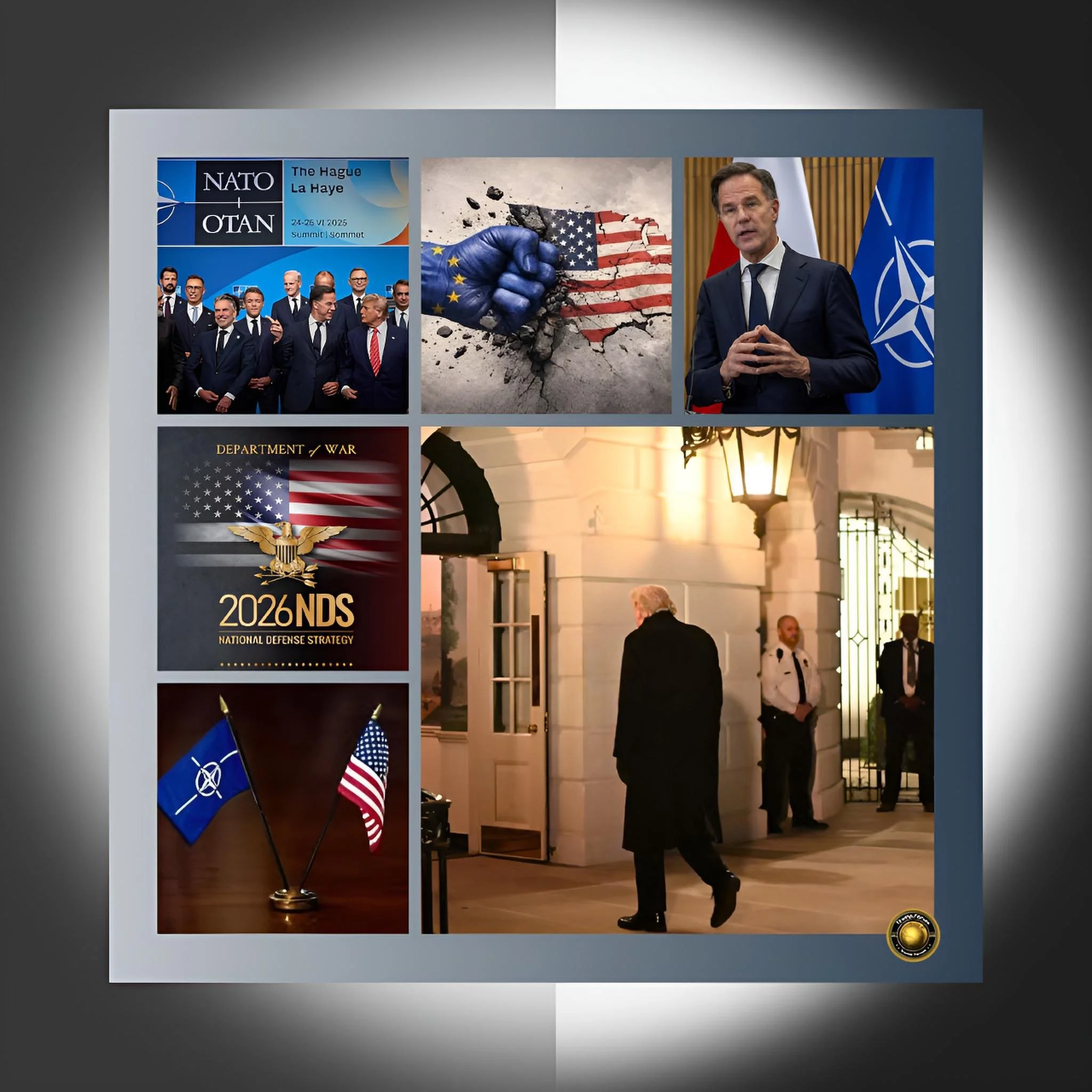
The administration has announced a “Hague Commitment” requiring NATO allies to expend 5 percent of GDP on defence—a substantial escalation from the previously established 2 percent benchmark.
Simultaneously, the document explicitly forecloses the possibility of further NATO expansion, explicitly preventing Ukrainian membership and signalling an American unwillingness to extend security guarantees to additional European applicants.
This combination of enhanced defence spending requirements coupled with diminished American security commitment represents a fundamental reconceptualisation of the NATO bargain.
The postwar alliance structure rested upon a grand bargain: Western European nations accepted American military hegemony and strategic leadership in exchange for credible American security guarantees underwrit by the U.S. nuclear arsenal.
The 2025 strategy explicitly rejects this framework, substituting a transactional model in which alliance membership becomes conditional upon material contributions to defence capacity and ideological alignment with American administrative preferences.
The document makes explicit that the “days of the United States propping up the entire world order like Atlas are over,” thereby dismantling the theoretical justification for American alliance leadership rooted in hegemonic stability theory.
Most concerning from the perspective of alliance cohesion is the strategy’s implicit signal that American security guarantees have become fundamentally unreliable.
By systematically disparaging European military and economic capacity, dismissing European leadership across the political spectrum as fundamentally incompetent, and withholding from the document any categorical reassurance regarding American commitment to collective defence obligations, the Trump administration has effectively signalled to potential adversaries—most notably Russia—that the United States may no longer view European security as central to American national interests.
The Abandonment of Institutional Frameworks and International Law
A striking lacuna pervades the 2025 National Security Strategy: the complete disappearance of language regarding international law, rules-based international order, and the institutions through which such order is instantiated.
Where Biden-era strategic documents emphasised the “rules-based international order” as foundational to both American and global prosperity, and where even Trump’s 2017 National Security Strategy referenced democratic commitments and individual liberty as shared transatlantic values, the 2025 iteration contains no such references.
The deliberate excision of this terminology signals an ideological shift toward what scholars have characterised as a realist approach premised upon spheres of influence, great power prerogatives, and the subordination of smaller states to regional hegemons.
This institutional abandonment carries profound implications for states occupying geopolitically contested zones.
The Indo-Pacific region, where the strategy theoretically commits the United States to opposing “unilateral changes” to existing arrangements, becomes conceptually incoherent when the document simultaneously rejects the rules-based frameworks that provide the vocabulary for articulating and enforcing such prohibitions.
Taiwan, Ukraine, and other states situated between or within acknowledged spheres of influence lose the formal institutional protections that rules-based frameworks ostensibly provided.
The Russia Question and Strategic Stability
Perhaps the most revealing aspect of the strategy concerns its treatment of Russia and the ongoing conflict in Ukraine.
Remarkably for a document purporting to address American national security, the strategy does not designate Russia as a threat to the United States. Instead, the document emphasises the achievement of “strategic stability with Russia” and criticises European nations for maintaining what it characterises as an exaggerated threat perception regarding Russian aggression.
The approach reflects a conception of interstate relations in which military aggression against third parties—specifically Ukraine—constitutes a problem for European management rather than an American concern warranting sustained engagement or commitment of resources.
The Kremlin has itself endorsed the strategy, characterising it as “largely consistent” with Moscow’s own strategic vision.
This approbation should occasion little surprise, given that the document explicitly abandons criticism of Russian actions in Ukraine, prevents NATO expansion that Moscow views as threatening, and signals American indifference to the preservation of Ukraine’s territorial integrity.
By contrast, Russia’s extensive mobilisation for a conflict of existential significance receives minimal attention, and the strategy’s call for “expeditious cessation of hostilities” carries implicit acknowledgment that any negotiated settlement would necessarily involve Ukrainian territorial concessions.
Facts, Concerns, and Theoretical Implications
Civilization at Crossroads: How Washington’s New Strategy Could Reshape Global Order
Scholars across multiple institutions have identified profound contradictions embedded within the strategy’s foundational logic.
The document simultaneously emphasises American sovereignty and non-interventionism while explicitly calling for U.S. engagement in European domestic political affairs to support nationalist movements opposed to the European Union. The document confirms following.
(1) It repeatedly invokes the principle of national sovereignty whilst signalling American acquiescence to Russia’s sovereign violations in Ukraine.
(2) It celebrates competence and merit as civilisational virtues whilst staffing the administration with ideological appointees lacking substantive expertise in their respective domains.
(3) It claims to pursue “peace through strength” whilst simultaneously undermining the deterrent structures—particularly NATO cohesion—upon which such peace must necessarily rest.
These contradictions are not merely rhetorical inconsistencies; rather, they reflect a fundamental tension between the document’s stated commitment to “America First” pragmatism and its underlying ideological orientation toward civilisational nationalism.
The strategy attempts to marry transactional cost-benefit analysis with a deeply normative vision of acceptable political systems and cultural trajectories.
Where these commitments conflict—as they inevitably do—the ideological commitment manifestly supersedes the pragmatic claim.
The Mechanics of Alliance Dissolution
Beyond its formal provisions, the strategy articulates specific mechanisms through which alliance cohesion might be deliberately undermined.
The concept of “cultivating resistance to Europe’s current trajectory within European nations” represents, in essence, a policy framework for supporting political movements explicitly opposed to European Union integration, NATO membership conditions, and liberal democratic institutional arrangements.
The strategy’s positive reference to the “growing influence of patriotic European parties”—terminology that scholars identify as euphemistic reference to far-right, ethno-nationalist, and anti-immigration movements—establishes an explicit American preference for European political actors whose fundamental commitment to liberal democracy remains questionable.
This approach constitutes a categorical inversion of American Cold War strategy, which explicitly aimed at strengthening democratic institutions and liberal governance structures throughout Western Europe.
Instead, the 2025 strategy envisions American power deployed in service of movements explicitly hostile to the institutional frameworks that European democratic development has historically required.
The strategic objective appears to involve fragmenting European political cohesion, reducing the European Union’s institutional capacity, and creating a multiplicity of nationalist governments more susceptible to bilateral American pressure and less capable of coordinated resistance to American policy preferences.
Economic Security and Strategic Vulnerability
The strategy’s elevation of economic security to the status of fundamental national interest represents perhaps its most coherent dimension, yet this coherence masks profound vulnerabilities in its underlying logic.
By emphasising tariffs, supply chain protection, and “re-shoring” of critical manufacturing capacity, the administration articulates a vision of American economic autonomy fundamentally at odds with the integrated global supply chains upon which modern economies—including the American economy—fundamentally depend.
For European allies, the economic implications of this strategic reorientation are particularly acute.
The strategy explicitly calls for “open European markets to American goods and services” whilst simultaneously warning of the need to counter “mercantilist overcapacity” and predatory economic practices.
This framing establishes the conditions for sustained and escalating trade conflicts between the United States and Europe, conflicts that will inevitably undermine the economic interdependence that has historically constrained military escalation and sustained alliance cohesion.
The signal to European capitals is unambiguous: economic relationships remain contingent upon political alignment with American preferences, and economic coercion will be deployed against those deemed insufficiently compliant.
Geopolitical Cascading and Regional Conflict Proliferation
The institutional abandonment evident in the strategy generates cascading effects throughout the global security architecture.
By signalling American withdrawal from commitment to rules-based frameworks that have constrained regional powers, the strategy creates incentive structures favourable to territorial revisionism.
Taiwan’s strategic position becomes exponentially more vulnerable when the United States explicitly abandons the rhetoric of international law and rules-based resolution of disputes.
Ukraine’s negotiating position deteriorates when American guarantees become manifestly unreliable.
States throughout the Indo-Pacific confronting Chinese pressure lose the institutional vocabulary through which they might appeal to American support based upon principles rather than mere transactional calculation.
Furthermore, the strategy’s emphasis upon spheres of influence—manifested most explicitly in the “Trump Corollary” to the Monroe Doctrine asserting American preeminence throughout the Western Hemisphere—establishes philosophical and practical precedent for great power assertion of regional dominance elsewhere.
If the United States claims the right to exclude non-hemispheric powers from the Americas, the strategic logic permits China to claim equivalent prerogatives in East Asia and Russia in Eastern Europe.
The framework of international relations that emerges from consistent application of this principle is one in which smaller states possess no protection from regional hegemons and in which international institutions cease to function as restraints upon power.
Cause-and-Effect Analysis
Institutional Architecture Collapse and Liberal Order Dissolution
The proximate cause of the strategy’s potential to generate alliance dissolution rests in its explicit abandonment of the shared value commitments that have constituted the philosophical foundation of transatlantic cooperation.
The postwar Western order was constructed not merely upon mutual security interests—though such interests manifestly existed—but rather upon a shared commitment to liberal democratic governance, market-based economic organisation, and rule of law as the appropriate framework for international relations.
The effect of the strategy’s ideological reorientation toward ethno-civilizational nationalism is to remove liberal democracy from its position as a defining characteristic of alliance membership.
Instead, the strategy establishes alignment with American-defined cultural conservatism and nationalist particularism as the operative criterion.
For European democracies that have defined themselves through liberal institutional commitments—most notably Germany, France, and the Benelux countries—this reorientation constitutes an explicit rejection of the political arrangements through which these societies have organised themselves.
The consequent effect manifests in multiple registers.
First, European governments face a choice between capitulation to American political pressures—involving implicit acceptance of American backing for opposition political movements and dilution of commitment to liberal democratic institutions—or explicit rejection of American leadership and recourse to alternative security arrangements.
Second, the emergence of American backing for far-right movements across Europe will generate either the triumph of those movements, producing European governments fundamentally hostile to American interests once power is achieved, or the emergence of intensified political polarisation and institutional instability within European democracies.
Third, the diminution of American security guarantees creates incentive structures for European nations to pursue independent nuclear capabilities, military-industrial autarky, and potentially even accommodations with Russia—outcomes manifestly contrary to American long-term strategic interests.
Deterrence Erosion and Revisionist Opportunity
The strategy’s systematic deprecation of European military capacity and reliability, coupled with explicit signals of reduced American commitment to European defence, generates immediate erosion of deterrent structures restraining Russian revisionism.
When the Kremlin receives explicit American messaging that Europe possesses only insufficient military capacity relative to Russian capabilities (the strategy notes Russia’s nuclear arsenal as the decisive asymmetry), and when American commitment to collective defence becomes manifestly conditional and potentially ephemeral, the rational strategic calculation from Moscow’s perspective shifts dramatically toward opportunities for revision.
The effect of this shift appears already evident. Russia’s diplomatic posture regarding Ukraine reflects explicit confidence that American and European support for Ukrainian resistance will prove transitory.
Chinese strategic assessments regarding Taiwan’s vulnerability similarly reflect calculations that American security guarantees have become fundamentally unreliable.
The practical consequence is an expansion of the temporal window within which revisionist powers calculate that military action against valued American partners becomes feasible.
Economic Fragmentation and Supply Chain Vulnerability
The strategy’s emphasis upon economic nationalism and trade protectionism generates a second-order cascade of effects undermining American economic preeminence.
By initiating sustained trade conflicts with European allies and by pursuing a “re-shoring” agenda predicated upon reducing integrated global supply chains, the strategy accelerates the very processes—alternative supply chain development, reduction of dollar dependence, construction of payment systems independent of American financial infrastructure—that constitute the fundamental foundations of American economic leverage.
The effect from the perspective of European economies is severe intensification of trade conflicts, disruption of established supply chain relationships, and pressure to identify alternative sources for goods and services previously procured from American suppliers.
The European response—already evident in preliminary form—involves acceleration of autonomous European industrial capacity development and enhanced engagement with non-American economic partners, including through mechanisms potentially designed to circumvent American economic coercion.
The irony is acute: by deploying economic pressure intended to enhance American leverage, the strategy generates precisely the diversification of economic relationships that diminishes such leverage over time.
Future Steps and Systemic Evolution
From Hegemony to Withdrawal: The Strategic Logic Behind America’s European Reorientation
The Fragmentation of Western Strategic Unity
The most immediate consequence of the strategy’s implementation will involve accelerated European efforts to develop autonomous military and strategic capacity independent of American guarantees.
Germany has already initiated substantial rearmament; France has explicitly articulated a vision of European strategic autonomy; and the broader European Union has begun to conceptualise collective defence frameworks that might function in the absence of credible American commitment.
These developments, whilst individually rational responses to American strategic withdrawal, collectively constitute the fragmentation of the integrated Western security architecture that has subsisted since 1945.
The emergence of autonomous European military and strategic capacity, though necessary from a European perspective, will generate its own complications.
European defence industrialisation will inevitably involve development of military-technological capacity that duplicates American capabilities, creating inefficiencies and redundancies.
More significantly, the absence of integrated command structures and unified strategic doctrine will reduce the military-operational effectiveness of European forces relative to the integrated NATO apparatus.
The practical consequence is likely to involve diminished total Western military capacity relative to the resources committed, a degradation of military effectiveness, and enhanced vulnerability to determined adversaries.
The Realignment Toward Nationalist and Illiberal Governance
Should the strategy be implemented as articulated, the explicit American support for far-right and nationalist political movements across Europe will likely generate their electoral and political ascendancy.
The effect of such ascendancy will involve replacement of liberal democratic governance structures with explicitly illiberal alternatives committed to ethno-nationalist principles, immigration restriction, and EU institutional dismantling.
Alliance in Collapse: The Kremlin’s and Triumph and Europe’s Reckoning
The paradoxical consequence of American support for such movements is likely to involve the emergence of European governments fundamentally hostile to American interests once consolidated in power—governments that, having achieved power with American backing, will no longer feel constrained by American expectations and may pursue independent relationships with Russia, China, or other powers previously regarded as adversaries.
This realignment constitutes, in essence, a reversal of Cold War outcomes. During the Cold War, American security commitment was explicitly extended to newly liberated Central and Eastern European nations with the express purpose of consolidating liberal democratic governance and preventing reversion to authoritarian regimes.
The contemporary strategy suggests American indifference to liberal governance outcomes and explicit preference for nationalist alternatives—a policy orientation that will inevitably generate less reliable allies less constrained by shared value commitments and more susceptible to adversary manipulation.
The Emergence of Alternative Security Architectures
The acceleration of American withdrawal from European security commitment will generate corresponding intensification of European efforts to develop autonomous security institutions.
Such institutions—whether formally constructed through European Union mechanisms or informally through enhanced cooperation among France, Germany, Poland, and other major European powers—will necessarily develop strategic doctrines, intelligence relationships, and military operational procedures independent of American guidance.
The consequence will involve creation of multiple, insufficiently coordinated security architectures where previously existed a unified, if hierarchical, command structure.
The longer-term implication of this fragmentation is particularly concerning from the perspective of Western military effectiveness.
The integrated NATO apparatus represents perhaps the most sophisticated multinational military command structure ever developed; its replacement with multiple autonomous or semi-autonomous European forces will inevitably involve substantial loss of operational effectiveness, interoperability, and strategic coherence.
The practical consequence is likely to manifest in European military vulnerability to determined adversaries despite ostensibly enhanced European defence spending.
The Global Extension of Spheres-of-Influence Logic
Should the American strategy’s foundational premises regarding spheres of influence, diminished commitment to rules-based international order, and implicit acceptance of great power prerogatives prove durable across multiple American administrations, the consequence will involve extension of spheres-of-influence logic to other regions.
China will escalate its claims to regional preeminence throughout the Indo-Pacific; Russia will intensify pressure upon post-Soviet space; regional powers throughout the Middle East, South Asia, and Africa will pursue autonomous military capabilities and alternative security partnerships.
The net effect will be global fragmentation of security architectures, proliferation of conflicts, and substantial reduction of American capacity to shape outcomes in regions no longer encompassed within explicit American security guarantees.
The strategic consequence of such fragmentation is to undermine American global preeminence by converting American military power into an instrument of diminished utility.
An America capable of projecting overwhelming force but confronting multiple simultaneous security challenges in fragmented alliance contexts will find its power substantially degraded relative to the resources committed.
The irony inherent in the strategy is that the pursuit of American preeminence through withdrawal from alliance commitments is likely to generate precisely the outcome the strategy purports to avert: American diminishment relative to rising competitors pursuing unified strategies within coherent regional frameworks.
Conclusion
The Great Realignment: Trump’s National Security Strategy and the End of Liberal Internationalism
The Trump administration’s 2025 National Security Strategy represents a document of remarkable intellectual clarity regarding its underlying commitments, even as those commitments contain substantial internal contradictions.
The strategy articulates with explicit honesty the administration’s conviction that American alliance leadership has constituted a net drain upon American resources and that American interests are better served through transactional relationships with individual states pursued within a framework of regional spheres of influence rather than through institutional commitments to collective security and rules-based international order.
The execution of this strategy will undoubtedly generate substantial short-term advantages for American unilateral power in select regions—most notably the Western Hemisphere.
However, the longer-term strategic consequences appear decidedly adverse.
The deliberate erosion of alliance commitments, the explicit support for political movements hostile to liberal democracy, the abandonment of rules-based international frameworks, and the implicit acceptance of revisionist territorial alteration will collectively generate a global security architecture substantially more fragmented, volatile, and resistant to American influence than the postwar order it replaces.
The states likely to benefit from this reorientation are those—Russia, China, and various regional powers—capable of pursuing strategies of territorial expansion, economic coercion, and political domination within their respective spheres of influence.
For Europe and the broader Western alliance, the strategic implications are sobering.
The transatlantic relationship that has constituted the foundation of Western power for eight decades faces genuinely existential challenge not from external adversaries but from deliberate American disengagement from the institutional and ideological commitments that have sustained that relationship.
European responses—whether involving accelerated military rearmament, autonomous strategic development, or potentially even accommodation with Russia—will be rational adaptations to changed American strategic posture.
Yet such adaptations, however individually rational, will collectively generate a Western alliance substantially weaker, more fragmented, and less capable of addressing the security challenges confronting its constituent members.
The strategy’s designation as a “blueprint for the demise of the West” reflects neither hyperbole nor ideological exaggeration but rather sober assessment of the documented strategic consequences of systematic alliance dissolution, institutional abandonment, and great-power accommodation to revisionist ambitions.
Whether such consequences fully manifest will depend substantially upon the durability of the strategy across time and upon the response of America’s allies to explicit signals that American security commitment has become fundamentally conditional and potentially ephemeral.
What appears certain is that the postwar Western order—with all its substantial achievements and persistent limitations—has entered its terminal phase, and that the architecture destined to replace it remains as yet substantially unformed and fraught with strategic uncertainty.