Historical Appeasement and Territorial Concessions: The Munich Agreement and Current U.S.-Russia Negotiations Over Ukraine
Executive Summary
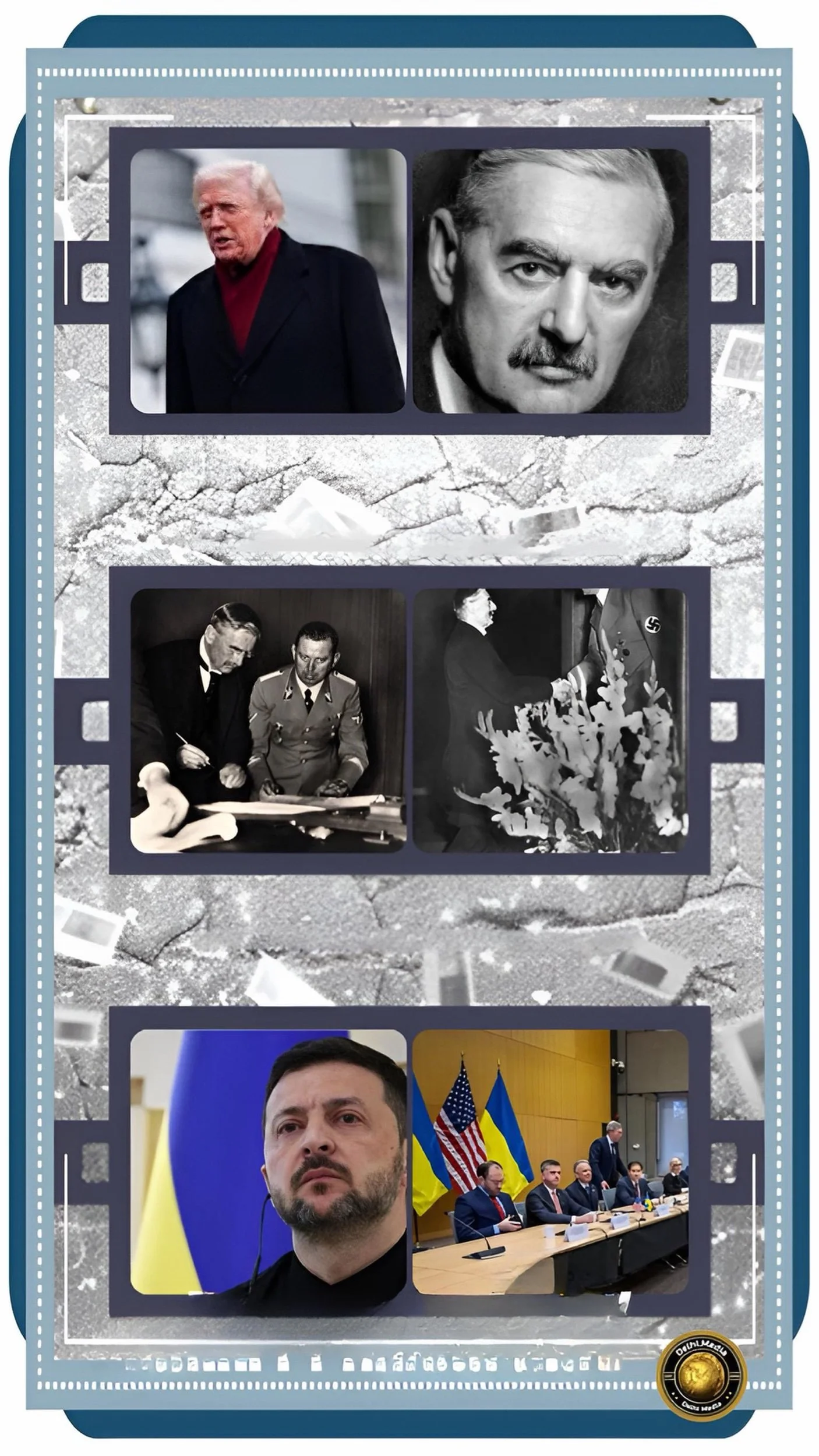
Neville Chamberlain and Donald Trump share a historical and geopolitical legacy defined by attempts to achieve peace through conciliatory diplomacy with aggressive authoritarian regimes, marked by significant territorial concessions.
Both leaders aimed to avoid large-scale conflict by negotiating with powerful adversaries—Chamberlain with Nazi Germany in the 1930s and Trump with Russia in the 2020s—yet their strategies have been widely criticized for emboldening their counterparts and weakening security guarantees for smaller allied states.
Their approaches involved sidelining the directly affected nations—Czechoslovakia and Ukraine—resulting in agreements perceived as imposed rather than mutually consented.
These acts of appeasement were framed as pragmatic peace efforts but ultimately raised doubts about their effectiveness and morality, as both regimes subsequently acted aggressively beyond the concessions granted.
Chamberlain’s Munich Agreement failed to prevent World War II and came to symbolize diplomatic naïveté, while Trump’s peace plan risks undermining Ukraine’s sovereignty and international norms against territorial conquest.
The legacy of these leaders endures because their policies embody critical lessons about the risks of appeasement in international relations: namely, that concessions under pressure may encourage rather than deter revisionist powers.
Chamberlain’s legacy remains a cautionary tale against underestimating threats and sacrificing the autonomy of smaller states, while Trump’s plan prompts renewed debate over balancing peace efforts with credibility in security commitments.
Both leaders are remembered as pivotal figures whose decisions shaped not only their countries’ fates but also the broader framework of 20th- and 21st-century global order.
Introduction
Neville Chamberlain was a British Conservative politician who served as prime minister of the United Kingdom from May 1937 to May 1940, and his name is now most closely associated with the policy of appeasement toward Adolf Hitler’s Germany.
He came from a prominent political family, held a series of senior domestic posts (especially as minister of health and chancellor of the Exchequer), and became prime minister after Stanley Baldwin, seeking to avoid another catastrophic European war.
Role as prime minister
As prime minister, Chamberlain tried to stabilize Europe through negotiated concessions, culminating in the Munich Agreement of September 1938, in which he accepted Hitler’s demands for the Sudetenland region of Czechoslovakia.
This agreement briefly made him popular at home, as many Britons believed he had secured peace, but it quickly unraveled when Germany occupied the rest of Czechoslovakia in March 1939.
World War II and resignation
After Hitler invaded Poland on 1 September 1939, Chamberlain honored British guarantees and declared war on Germany two days later, leading Britain through the initial “Phoney War” period.
Military setbacks, especially the failed Norwegian campaign, eroded confidence in his leadership, and he resigned in May 1940, being succeeded by Winston Churchill, while remaining briefly in the war cabinet.
Legacy
Chamberlain died of cancer in November 1940, only months after leaving office.
Munich and appeasement have dominated his historical reputation: long condemned as naïve and dangerously conciliatory, but more recently reassessed by some historians as a leader constrained by public opinion, military unreadiness, and traumatic memories of World War I.
The comparison between the Trump administration’s proposed peace plan for Ukraine and Neville Chamberlain’s 1938 Munich Agreement constitutes a substantive historical analogy that warrants rigorous scholarly examination.
Both cases involve democratic powers negotiating territorial concessions from a weaker state to placate an aggressive authoritarian regime.
Yet, the specific mechanisms, ideological drivers, and international consequences differ in essential ways that demand careful analysis.
The Munich Agreement: Historical Framework and Immediate Consequences
The Munich Agreement of September 29-30, 1938, represents perhaps the most infamous instance of appeasement diplomacy in modern history.
Chamberlain, French Prime Minister Édouard Daladier, Italian dictator Benito Mussolini, and Adolf Hitler negotiated the agreement without Czechoslovak participation—a deliberate exclusion that demonstrated contempt for Czech sovereignty.
The accord permitted Nazi Germany to annex the Sudetenland, a predominantly German-speaking border region containing approximately 3 million inhabitants and significant military fortifications.
Chamberlain returned to London brandishing a signed agreement, declaring to waiting photographers and the nation that he had secured “peace for our time.”
The territorial concessions were deliberately calibrated to Hitler’s escalating demands. Initially, Hitler claimed he merely wanted German-speaking territory; after Chamberlain’s first meeting at Berchtesgaden on September 15, 1938, Hitler stiffened his demands at Bad Godesberg on September 22, insisting that German troops occupy the Sudetenland immediately and that Czechoslovak forces evacuate by September 28.
Britain and France, unprepared militarily and lacking public support for war, capitulated.
Critically, historians document that Czechoslovakia possessed one of Europe’s most advanced military-industrial complexes and sophisticated defensive fortifications in the Sudetenland that might have enabled effective resistance with Western support.
The ceding of this territory eliminated not only defensive capabilities but also psychological deterrence—Hitler interpreted the Western capitulation as evidence of fundamental weakness rather than rational calculation.
The sequel to Munich demonstrates the mechanism by which appeasement emboldened rather than restrained aggressive expansion.
Within months of the Munich Agreement’s ratification, Hitler’s military planners began preparing fresh invasion plans.
By March 1939, German troops marched into the remainder of Czechoslovakia, dismantling the Czech state entirely and establishing a German protectorate over Bohemia and Moravia.
Poland received territorial compensation from dismembered Czechoslovakia, while Hungary obtained southern Slovakian lands—a calculated strategy to neutralize potential opposition and prevent Soviet intervention, precisely because Poland’s refusal to allow Soviet forces passage eliminated Moscow’s capacity to defend its Czech ally.
Winston Churchill’s response to Munich proved historically prescient.
On October 5, 1938, he condemned the agreement as a “total and unmitigated defeat” for Britain and Europe, arguing that British appeasement policy “deeply compromised, and perhaps fatally endangered, the safety and even the independence of Great Britain and France.”
The Mechanism of Appeasement Failure: Moral Hazard and Escalation
Scholarly analysis identifies several interconnected mechanisms through which appeasement invited further aggression rather than satisfying revisionist demands.
The most significant involves what contemporary international relations scholars term “moral hazard”—Hitler’s interpretation of Western capitulation as evidence that demonstrated force would consistently achieve territorial objectives without incurring high costs.
Hitler himself articulated this interpretation to his military commanders in August 1939, declaring: “Our enemies are little worms. I saw them at Munich.”
This assessment directly shaped his decision to invade Poland, confident that despite British guarantees to Polish independence, the Western powers would again prove unwilling to wage war.
The absence of a credible “red line” communicated in Munich meant Hitler had rational grounds to believe that Chamberlain’s threats lacked the enforcement capability.
The policy also weakened the anti-German coalition by undermining trust among smaller nations that had relied upon British and French security commitments.
Stalin, observing Chamberlain’s betrayal of Czechoslovakia, concluded that Britain could not be trusted and subsequently negotiated the Nazi-Soviet Pact explicitly to protect Soviet interests against potential Western betrayal.
This alliance, which provided Germany with access to Soviet raw materials and eliminated the two-front war dilemma, proved crucial to German strategic calculations throughout the 1939-1941 period.
Furthermore, appeasement occurred against a background of deliberate German deception and provocation.
Historians have documented that Hitler instructed the Sudeten German Party to formulate demands “absolutely unacceptable to the Czech government” and to “always demand so much that we can never be satisfied”—ensuring that even substantial concessions could never satisfy Hitler’s negotiating position.
This strategy exploited Western leaders’ belief that reasonable accommodation could address legitimate grievances, when in fact Hitler sought not negotiation but the elimination of Czechoslovakia as an independent state.
Contemporary Parallels: The Trump Administration’s 28-Point Ukraine Proposal
The Trump administration’s November 2025 draft proposal for Ukraine exhibits structural similarities to the Munich precedent that merit scholarly scrutiny, while also containing significant divergences warranting careful analysis.
The 28-point plan, as reported by the Associated Press and other news organizations, proposes that Ukraine formally cede Crimea, Donetsk, and Luhansk to Russian control, with additional Ukrainian-held territory in these regions converted to a “demilitarized zone” recognized internationally as part of Russia.
Ukraine would simultaneously accept constitutional prohibitions on NATO membership and face reductions in its military from approximately 880,000 to 600,000 personnel.
Like the Munich Agreement, the Trump proposal was negotiated primarily between Washington and Moscow, with minimal Ukrainian participation until the late stages, despite directly determining Ukraine's territorial fate.
Ukraine was presented with a de facto ultimatum, with Trump reportedly imposing a Thanksgiving deadline (November 27, 2025) for acceptance.
Ukrainian Deputy Representative Khryna Hayshyn’s response to the United Nations Security Council echoed Czech sentiments from 1938: “There will never be recognition, or otherwise, of Ukrainian territory occupied by the Russian Federation… Our land is not for sale.”
The security guarantees offered to Ukraine bear comparison with Chamberlain’s post-Munich assurances.
The Trump proposal includes vague commitments that American intervention would occur only if Russia mounted what it characterizes as “significant, deliberate, and sustained armed attacks” against Ukraine—language providing substantial interpretive flexibility without binding legal obligation.
Critically, the guarantee does not obligate NATO to intervene, nor does it explicitly extend to NATO-member Ukrainian territory, creating what international relations theorists term an “ambiguity trap” in which the defending power cannot credibly communicate its commitment to potential aggressors.
Distinguishing Putin’s Ideology from Hitler’s: Reversionism Versus Lebensraum
While the structural comparison possesses validity, scholarly analysis must distinguish the ideological drivers and strategic objectives of Putin’s Russia from those of Hitler’s Germany to avoid crude historical parallelism.
Putin’s foundational ideology, articulated through numerous speeches and policy documents, emphasizes imperial restoration rather than racial or ideological domination.
Putin has explicitly compared himself to Peter the Great, stating with reference to Ukraine: “Clearly, it has fallen to us to return and consolidate as well.”
This framework posits a civilizational hierarchy in which Russia must reestablish dominance over territories historically within Russian or Soviet spheres of influence—not through ideological conversion or racial conquest, but through reassertion of geopolitical hierarchy.
Ukrainian political advisor Mykhailo Podolyak correctly identified Putin’s position as fundamentally one of territorial seizure masked by invented grievances concerning the treatment of Russian-speaking populations.
The “Late-Stage Putinism” framework developed by European scholars identifies three core ideological narratives that increasingly structure Russian policy: the “state-civilization” narrative positioning Russia as a unique civilizational force; the “citizen serves the state” narrative radically redefining patriotism; and the “new anti-colonialism” narrative attempting to recast Russia as defender of traditional values against Western universalism.
This ideological scaffolding, while authoritarian and aggressive, operates within different parameters than Nazi Germany’s lebensraum ideology, with its embedded racial hierarchies and civilizational apocalypticism.
Nevertheless, both ideologies share a critical strategic commonality: they are fundamentally insatiable in their territorial ambitions.
Putin’s comparison with Peter the Great—who engaged in perpetual territorial expansion—suggests that securing Ukrainian territory would not end Russian revisionist ambitions but merely set a new baseline from which further demands might emerge.
The trajectory of Putin’s aggression—from the 2008 Georgia intervention, to the 2014 Crimea annexation, to the 2022 full-scale Ukraine invasion—demonstrates escalating rather than stabilizing patterns.
International Law and the Precedent for Territorial Conquest
A critical dimension of scholarly analysis concerns the international law implications of recognizing territorial acquisition through military force.
The Verfassungsblog’s legal analysis notes that, while international law does not prohibit peace agreements that include territorial transfers, Article 52 of the Vienna Convention on the Law of Treaties (VCLT) addresses treaties negotiated under threat of force.
The question becomes whether peace agreements that legitimize territorial acquisition obtained through military aggression violate the foundational principle that states cannot acquire territory through force.
Contemporary state practice suggests ambiguity—the 1999 Lusaka Ceasefire Agreement between Uganda and the DRC was accepted despite authorizing Ugandan military presence in Congolese territory, and Ukraine itself accepted certain concessions in the 2015 Minsk II agreement.
However, the Lansing Institute identifies that U.S. recognition of Russian territorial occupation directly contradicts decades of American doctrine prohibiting acquisition of territory by force—established most prominently through the 1990 Desert Storm response to Iraq’s Kuwait invasion.
Most significantly, American recognition of Russian territorial conquest would communicate to revisionist powers globally—particularly China regarding Taiwan and the South China Sea—that the international order no longer prohibits territorial acquisition through military aggression.
This precedent-setting function distinguishes the Ukraine case from prior appeasement episodes by expanding the moral hazard beyond bilateral Russian-Ukrainian dynamics to the entire architecture of international order.
The Weak Security Architecture of Proposed Guarantees
The security guarantees proposed under the Trump framework present substantial credibility deficits compared even to failed Munich-era assurances. Chamberlain’s October 1938 guarantee of Czech territorial integrity, while ultimately worthless, at least legally bound Britain to potential military intervention.
By contrast, the Trump proposal’s language regarding “significant, deliberate, and sustained armed attacks” creates multiple interpretive ambiguities: Who determines significance? What temporal duration constitutes “sustained”?
Does the guarantee apply only to Russian actions, or to actions by Russian-backed insurgent forces?
The exclusion of NATO troops from Ukrainian territory directly undermines credible deterrence. NATO deterrence in Central and Eastern Europe functions through forward-stationed forces whose presence commits member states to immediate collective defense without requiring deliberation or consensus-building.
By contrast, the Trump proposal’s ambiguous guarantees and troop exclusions eliminate the automaticity that makes deterrence credible.
Potential Russian decision-makers would assess—correctly—that Ukrainian deterrence rests upon Trump’s subjective judgment regarding attack significance rather than upon binding alliance commitments.
Furthermore, Trump’s stated preference for negotiating directly with Putin over subsequent years, combined with his skepticism regarding NATO’s value, communicates to Moscow that security guarantees might be renegotiated unilaterally if American geopolitical priorities shift.
This contrasts sharply with NATO’s Article 5 collective defense commitment, which binds all member states regardless of leadership transition.
The result resembles Chamberlain’s personal diplomacy with Hitler—dependent upon individual actors rather than institutional structures capable of surviving political transitions.
Critical Divergences: Context and Consequences
Scholarly rigor requires acknowledgment of significant differences distinguishing the contemporary situation from 1938. Most importantly, Ukraine in 2025 actively participates in the conflict alongside Western allies rather than facing diplomatic exclusion like Czechoslovakia.
Ukraine’s armed forces have demonstrated remarkable resilience and capability, and Western military support has proven substantially effective in degrading Russian offensive capacity—a situation utterly unlike Czechoslovakia’s military weakness relative to Germany.
Second, the international alignment differs fundamentally. In 1938, Britain and France were unprepared militarily and lacked public support for war, conditions that rational leaders might have assessed justified accepting temporary territorial loss.
Contemporary NATO possesses overwhelming military superiority relative to Russia; the constraint upon Western support derives from risk aversion regarding nuclear-armed adversary escalation rather than from capability deficits.
The strategic rationale for appeasement—buying time to build military capability—does not apply when Western militaries already possess decisive advantages.
Third, the proposed Ukrainian security guarantees, while weak, are not entirely nonexistent.
The Trump proposal explicitly mentions “reliable security guarantees” including potential reconstruction funding from frozen Russian assets. While these fall far short of NATO’s binding commitments, they represent more concrete undertakings than Chamberlain’s post-Munich assurances.
The durability of these guarantees remains questionable given Trump’s demonstrated volatility, but their existence distinguishes this case from pure abandonment.
The Fundamental Problem: Rewarding Aggression and Establishing Precedent
Despite these contextual differences, the core scholarly concern remains: territorial concessions that reward military conquest establish precedents in international practice that undermine the postwar liberal order’s foundational principle prohibiting territorial acquisition through force.
Whether termed Chamberlain-like appeasement or pragmatic realism, recognizing Russian conquest of Ukrainian territory communicates to all revisionist powers that military aggression succeeds when the aggressor state is sufficiently powerful to resist opposing coalitions.
The historical record clearly demonstrates that concessions to Hitler did not satisfy his ambitions but instead emboldened escalation.
While Putin’s ideology differs from Hitler’s, the structural logic remains: an actor rewarded for territorial conquest through military force gains rational incentive to pursue further territorial objectives, particularly if initial concessions provoke only limited international cost.
The Munich precedent’s most enduring lesson does not concern the specific agreement’s terms but rather the mechanism through which perceived weakness invites escalation.
Chamberlain’s personal diplomacy, combined with communication to Hitler that Britain lacked resolve to wage war, convinced Hitler that Poland could be attacked without triggering Western intervention.
The Munich Agreement itself was not primarily responsible for World War II—the war would have occurred in some form regardless—but rather the agreement’s failure to establish deterrent credibility accelerated the timeline and raised the ultimate war’s destructiveness.
Applied to Ukraine, the critical concern is whether the Trump proposal’s weak security guarantees and de facto recognition of Russian conquest communicate to Putin that further aggression would incur minimal cost.
If Ukraine accepts territorial loss without firm NATO membership guarantees and subsequently faces renewed Russian pressure, the precedent would be established that military conquest succeeds and that Western security commitments prove unreliable.
Such an outcome would indeed justify comparison to Chamberlain’s strategic failure—not because the specific agreement terms are identical, but because the mechanism through which appeasement invites escalation remains operant.
Conclusion
Historical Analogy and Strategic Assessment
The comparison between the Trump administration’s proposed Ukraine peace plan and Chamberlain’s Munich Agreement possesses substantial scholarly validity, though responsible analysis requires acknowledging both parallels and divergences.
Both involve democratic powers negotiating territorial concessions from weaker states to satisfy aggressive authoritarian regimes while offering weak security guarantees in exchange for peace.
Both risk establishing precedents that reward territorial conquest and undermine the international legal order’s core principle prohibiting force as legitimate instrument of territorial acquisition.
However, the analogy’s imperfect fit—Ukraine’s demonstrated military capability, contemporary NATO’s overwhelming force advantage, and the existence of at least formal security guarantees—prevents treating the situations as historically identical.
The crucial distinction concerns mechanism rather than form: if the Trump proposal genuinely strengthens Ukraine through robust security guarantees and NATO integration, the analogy loses force.
If instead it constitutes genuine appeasement—sacrificing Ukrainian interests to secure Russian agreement to terms fundamentally favorable to Moscow—then the historical comparison becomes apt as warning rather than as description of predetermined outcomes.
The scholar’s task is not to predict whether Trump will be “remembered as the Neville Chamberlain of the 21st century,” which conflates historical judgment with contemporary political rhetoric.
Rather, the scholarly obligation is to identify that territorial concessions rewarding military conquest, combined with weak security guarantees and great power bilateral diplomacy that excludes Ukrainian voice, follow precisely the strategic logic that transformed Munich from diplomatic episode into symbol of catastrophic miscalculation.
History does not repeat itself, but as Mark Twain (apocryphally) observed, it often rhymes.
The Ukraine situation constitutes a test of whether contemporary statecraft has absorbed the Munich precedent’s lessons or whether structural incentives toward appeasement remain sufficient to overcome historical memory.