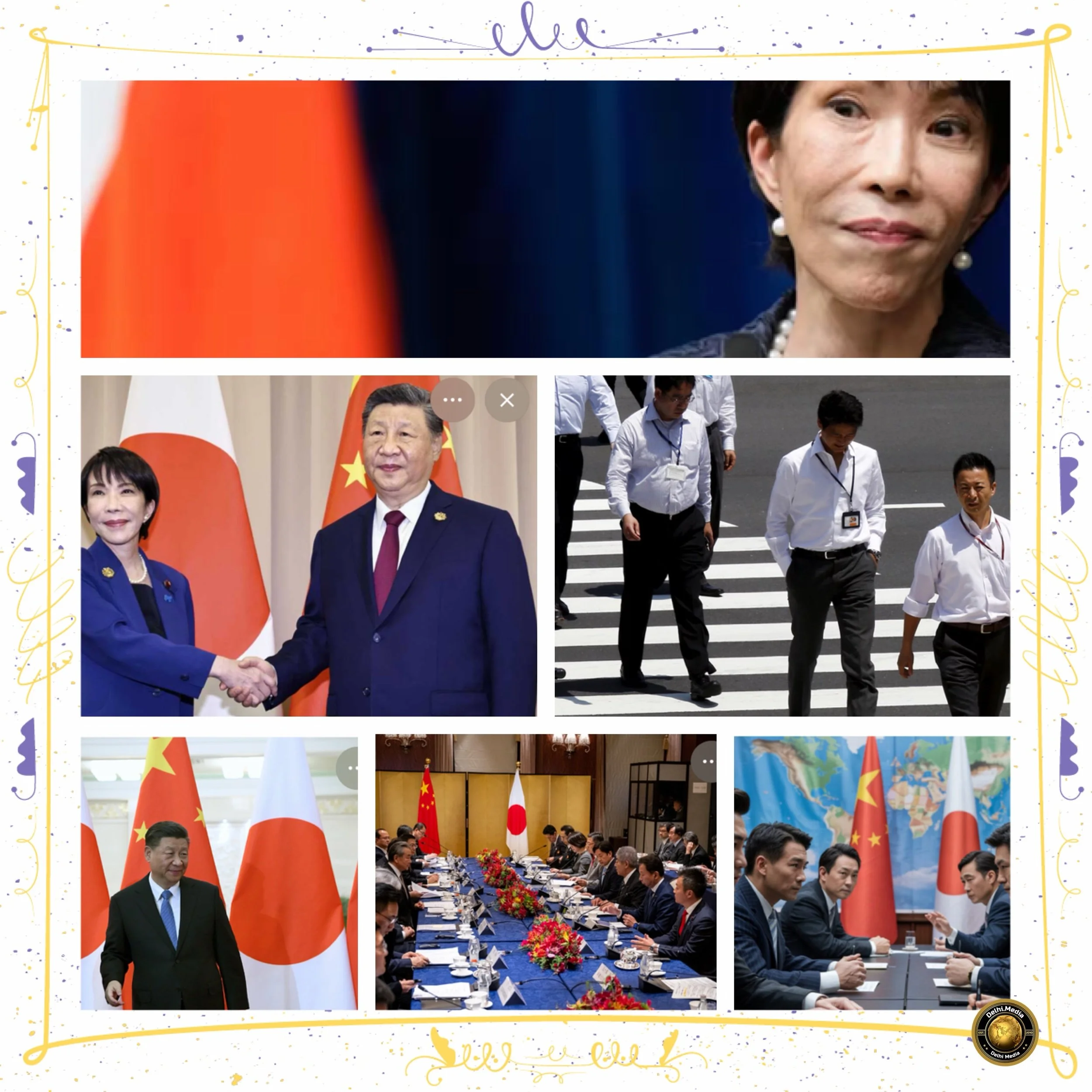
Rising China-Japan Tensions: Political Instability, Social Pressures, and Shared Challenges
Introduction
The relationship between China and Japan deteriorated sharply in November 2025, sparked by controversial remarks from Japan’s new Prime Minister, Sanae Takaichi, regarding Taiwan.
This diplomatic crisis unfolds against a backdrop of domestic political instability in Japan and significant social challenges affecting both nations—particularly demographic decline, youth unemployment, and economic anxieties.
The Taiwan Flashpoint and Escalating Tensions
The current crisis erupted on November 7, 2025, when Prime Minister Takaichi told Japan’s parliament that a Chinese military attack on Taiwan could constitute “a situation threatening Japan’s survival,” potentially justifying Japan’s military intervention under its collective self-defense doctrine.
This marked a significant departure from Japan’s long-standing policy of strategic ambiguity regarding Taiwan, prompting an immediate backlash from Beijing.
China’s response has been multi-pronged and forceful.
A Chinese diplomat stationed in Japan threatened to “cut off that dirty neck,” apparently referring to Takaichi, while Beijing summoned Japan’s ambassador in formal protest.
More substantively, China deployed four armed coast guard vessels to patrol the disputed Senkaku/Diaoyu Islands on November 16, 2025—a territorial flashpoint that both nations claim.
Additionally, Chinese military aircraft scrambled after detecting a suspected Chinese drone near Japan’s southern island of Yonaguni, close to Taiwan.
Beijing has also wielded economic pressure, issuing travel advisories warning Chinese citizens against visiting Japan and advising the roughly 100,000 Chinese students in the country of alleged safety risks.
Major Chinese airlines, including Air China, China Eastern, and China Southern, offered full refunds or free ticket changes for Japan travel through year-end.
China has further cancelled a planned leaders’ meeting at the G20 summit in South Africa, with Premier Li Qiang declining to meet with Takaichi.
Japan Under New Leadership: Political Fragility
Sanae Takaichi, who took office on October 21, 2025, made history as Japan’s first female prime minister.
However, her ascension occurred amid significant political turmoil.
The ruling Liberal Democratic Party (LDP) suffered electoral setbacks and lost its 26-year coalition partnership with Komeito just days after Takaichi’s selection as party leader.
Komeito withdrew due to concerns over Takaichi’s ultraconservative views—including visits to the controversial Yasukuni Shrine—and the LDP’s inadequate response to political funding scandals.
To secure parliamentary approval, Takaichi forged a new coalition with the right-wing Japan Innovation Party (Ishin).
Still, this arrangement leaves her governing with a minority government, with only 231 of 465 seats in the Lower House.
This fragile political foundation constrains her ability to pass legislation and implement policy, requiring her to rely on opposition parties on key issues.
Political analysts predict Takaichi’s government may not endure long, with some anticipating early elections.
Despite these challenges, Takaichi has moved aggressively on defense policy.
She pledged to increase Japan’s defense spending to 2% of GDP by March 2026—two years ahead of the original schedule—and ordered early revision of Japan’s three key national security documents.
This hawkish stance reflects her conservative ideology and efforts to align with U.S. pressure for allied defense commitments, but it has heightened regional tensions with China and South Korea.
Critical Domestic Challenges in Japan
Beyond political instability, Japan faces severe social and economic pressures that shape the context of Takaichi’s leadership:
Demographic Crisis and Labor Shortage
Japan’s aging population crisis has reached unprecedented levels, with individuals aged 65 and older now comprising 29.3% of the total population—the highest proportion globally.
The country lost 900,000 people in 2024, the most significant annual decline on record.
Projections suggest Japan’s population will shrink from 125 million to 87 million by 2070, with 40% of the population aged 65 or older.
The working-age population is declining rapidly, creating acute labor shortages—51% of Japanese companies report difficulty finding full-time employees.
Inflation and Stagnant Real Wages
While Japan has experienced wage growth in nominal terms (around 3.5-5.3% in recent years), persistent inflation has eroded purchasing power.
As of mid-2025, real wages have declined for eight consecutive months, with consumer inflation at 3.5%—well above the Bank of Japan’s 2% target. Food prices have surged particularly sharply, with rice prices up 49.1% year-over-year.
Despite some improvement in July 2025 when real wages edged up 0.5% due to summer bonuses, the overall trend shows Japanese workers losing purchasing power.
Youth Mental Health Crisis
Suicide remains the leading cause of death among Japanese youth—unique among G7 nations.
In 2024, suicides among elementary through high school students reached a record 529 cases, with female student suicides surpassing male for the first time.
The suicide rate for those aged 15-29 has exceeded 3,000 annually for five consecutive years.
Contributing factors include educational stress, bullying that extends through social media, anxiety about future employment, and family economic pressures.
For university students, the peak suicide age is 21, reflecting anxiety about post-graduation prospects.
Economic Uncertainty
Japan’s economy is experiencing modest growth (around 1% of GDP) amid massive government debt (230% of GDP).
Takaichi’s administration must address public concerns about inflation, declining real wages, and the cost of living while navigating the constraints of minority government and calls for fiscal expansion.
China’s Parallel Social Challenges
While China projects strength externally, it confronts its own significant domestic pressures:
Record Youth Unemployment
China’s youth unemployment rate (ages 16-24, excluding students) hit a record 18.9% in August 2025, the highest since the government began tracking the indicator in December 2023.
A record 12.22 million new graduates entered the job market in 2025, but job postings for graduates dropped 22% in the first half of the year while job seekers rose 8%.
Many young Chinese are turning to civil service positions, but with only 39,700 planned hires and 3.4 million applicants, competition is fierce.
The phenomenon of “rat people”—unemployed Gen Z individuals—has emerged as a social identity.
Property Market Collapse
China’s real estate sector, which accounts for about 25% of GDP and represents 70% of household wealth, is in severe crisis.
In July 2025, Beijing led with a 1.1% month-on-month decline in second-hand home prices, followed by Shanghai, Guangzhou, and Shenzhen. Transaction volumes plummeted by 28-35% in major cities.
The collapse of Evergrande Group and widespread construction unemployment signal a fracturing social order.
New home prices fell at the fastest pace in a year in October 2025, while housing starts declined by over 20% year-on-year.
The crisis has eroded middle-class wealth and dampened consumer confidence.
Rapid Demographic Aging
China faces its own demographic time bomb—aging faster than it can grow wealthy.
The proportion of Chinese citizens aged 65 and older rose from 8.9% in 2010 to 15.6% in 2024, and is projected to reach over 30% by 2050—comparable to Japan today.
China’s working-age population is expected to fall 11% over the next 30 years.
The government has begun gradually raising the retirement age to 63 for men and 55-58 for women by 2045.
Shared Concerns and Divergent Responses
Despite their geopolitical rivalry, China and Japan face remarkably similar structural challenges.
Aging Societies
Both nations confront shrinking, aging populations that strain pension and healthcare systems while shrinking the workforce. Japan has a more pronounced aging crisis today (29.3% elderly), but China is catching up rapidly, with the elderly share expected to reach 38.8% by 2050.
Both countries have attempted to boost fertility rates, raise retirement ages, and increase women’s labor force participation, though with limited success.
Economic Pressures on Youth
Young people in both countries face difficult employment prospects, high living costs, and anxiety about the future.
In China, this manifests as record youth unemployment and millions of graduates competing for shrinking opportunities.
In Japan, there are persistent suicide rates among young people, driven by educational stress, economic uncertainty, and social pressures.
Cost of Living Concerns
Inflation and stagnant real wages affect populations in both countries, though manifested differently.
Japan faces persistent inflation outpacing wage growth, eroding household purchasing power. China’s property crisis and economic slowdown have dampened consumption and increased financial insecurity.
Economic Interdependence Amid Political Friction
Despite escalating tensions, China and Japan remain deeply economically intertwined. Bilateral trade reached $292.6 billion in 2024, with China serving as Japan’s largest trading partner since 2005.
Japan primarily exports high-tech goods, such as integrated circuits and machinery, to China, while importing consumer electronics and office equipment. China accounts for 22.2% of Japan’s total export value and 22.3% of imports.
This economic interdependence creates mutual vulnerabilities. Analysts warn that a “full-blown trade spat” could see China restrict exports of rare earth minerals critical to Japanese manufacturing.
Chinese travel restrictions could significantly impact Japan’s tourism sector, which had seen Chinese visitors reach near-pre-pandemic levels, with 7.5 million in the first nine months of 2025.
Conversely, Japanese investment and technology remain essential to Chinese industries.
Despite recent political tensions, people-to-people exchanges continue at some level.
Youth exchange programs between Chinese and Japanese universities took place in 2025, including the “Hundred Japanese University Students Visit China” program and various academic conferences aimed at fostering understanding.
Currently, around 130,000 Chinese students study in Japan, while over 600 Japanese high schools offer Chinese language courses.
However, China’s recent travel advisories and warnings to students threaten these exchanges.
The Path Forward: Uncertainty and Risk
The current crisis shows no clear off-ramp. China has made clear that it expects Japan to retract Takaichi’s Taiwan remarks and honor commitments in the four political documents between the two nations regarding Taiwan’s status.
However, Takaichi—while noting her comments were “hypothetical”—has refused to retract them.
Japan has sent senior foreign ministry officials to China seeking to “not escalate the situation,” but diplomatic efforts have yielded limited results.
The cancellation of a planned Japan-China joint opinion poll and Tokyo-Beijing Forum, at China’s request, indicates deteriorating public sentiment and diplomatic atmosphere.
Both nations find themselves “riding a tiger”—domestic political pressures constrain their ability to de-escalate. Takaichi’s weak political position and conservative base limit her flexibility to make concessions to China.
Meanwhile, Chinese leadership under Xi Jinping faces domestic pressures from nationalism and economic challenges that make appearing weak toward Japan politically costly.
The historical context adds layers of complexity. The Senkaku/Diaoyu Islands dispute has roots in the First Sino-Japanese War and remains a persistent flashpoint.
Wartime history—particularly regarding the Yasukuni Shrine and Japan’s imperial past—continues to inflame tensions.
These deep historical grievances, combined with contemporary geopolitical competition, create a volatile mix.
China travel advisory
China has issued a travel advisory warning its citizens against traveling to Japan due to diplomatic tensions over Taiwan.
This has led to a sharp decline in Japanese tourism and retail stocks, with major companies experiencing significant losses.
The boycott could cost Japan up to ¥2.2 trillion ($14.2 billion) annually, or about 0.36% of its GDP, if sustained.
The advisory has also halted travel sales and affected related industries, highlighting the vulnerability of Japan’s economy to geopolitical tensions.
Conclusion
The current China-Japan crisis reflects more than a single diplomatic misstep. It emerges from the intersection of Takaichi’s domestic political weakness, her conservative ideology on security issues, China’s determination to maintain its position on Taiwan, and the broader U.S.-China strategic competition in which Japan plays a pivotal role.
Both nations face profound domestic challenges—demographic decline, youth unemployment, economic uncertainty, and social pressures—that complicate their ability to manage external relations.
These shared struggles might, in theory, provide common ground for cooperation, but geopolitical rivalry and historical animosity currently override such possibilities.
The outcome of this crisis will depend on several factors: whether Takaichi’s fragile government survives, how the U.S. under President Trump approaches regional security, China’s economic trajectory, domestic stability, and whether both sides can find face-saving compromises that prevent further escalation.
For now, the relationship between Asia’s two largest economies remains dangerously strained, with significant implications for regional stability and the global economy.