Supreme Court Tariff Challenge: Legal, Economic, and Strategic Implications
Introduction
Current Supreme Court Case and Legal Status
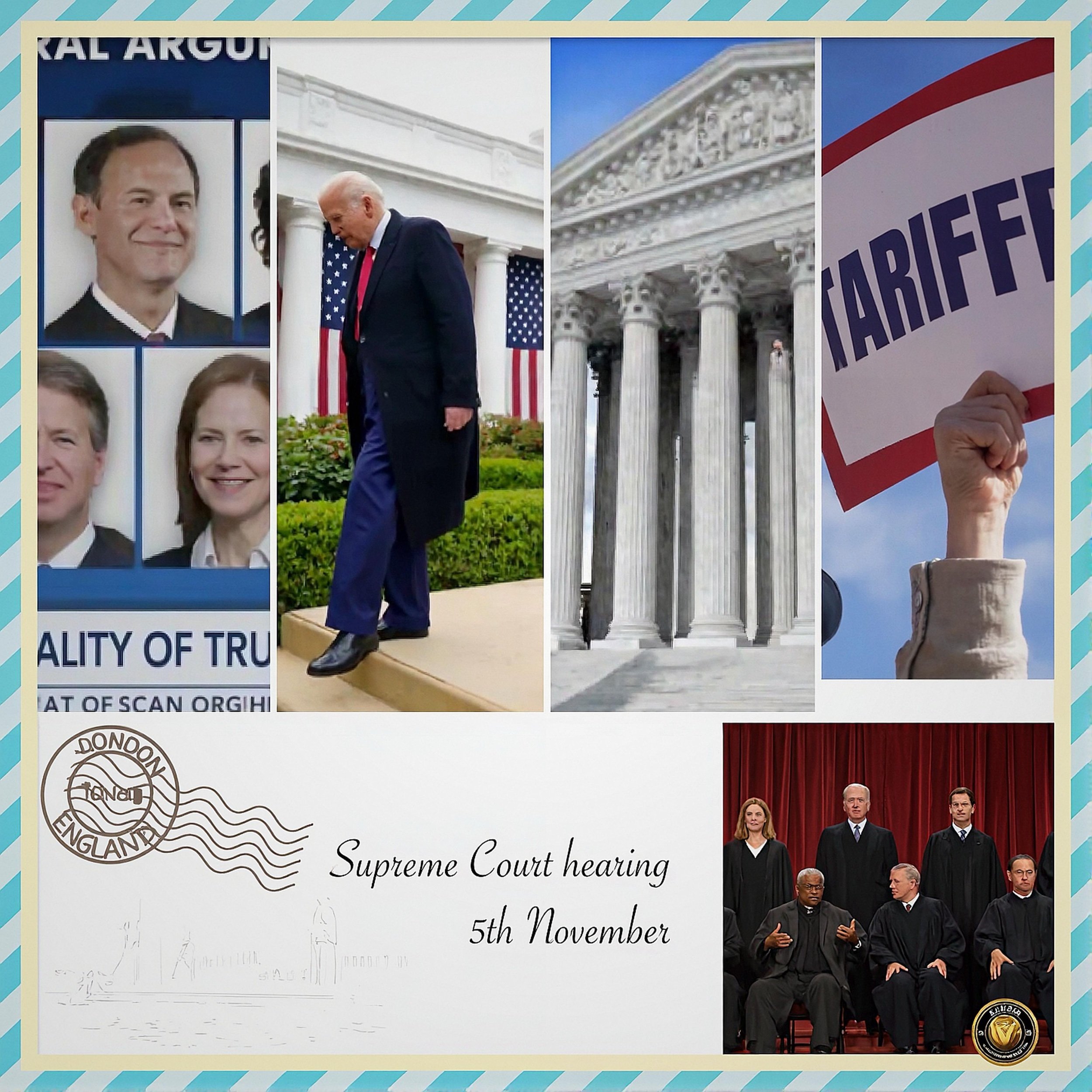
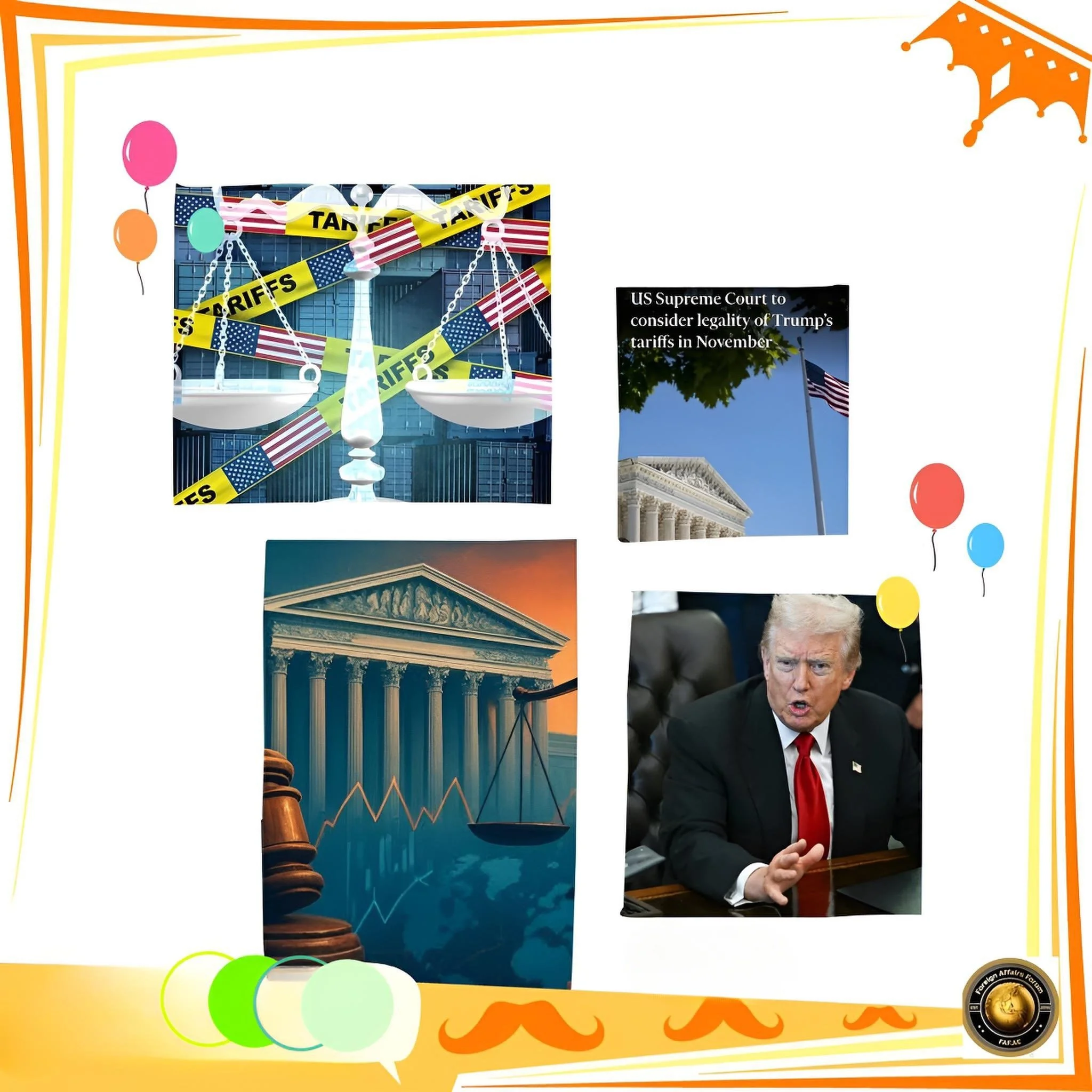
The Supreme Court is currently weighing the constitutionality of Trump’s tariffs imposed under the International Emergency Economic Powers Act (IEEPA).
Oral arguments occurred on November 5, 2025, and the justices across the ideological spectrum appeared skeptical of Trump’s authority to impose sweeping tariffs without congressional approval.
Both lower courts—the U.S. Court of International Trade and the U.S. District Court for the District of Columbia—had already ruled against the administration, finding that IEEPA does not grant the president such broad tariff authority.
Tariff Revenue Claims and Actual Collections
Regarding Trump’s claim of $250 billion in tariffs collected since 2018, the actual figures are more nuanced.
In his second term alone (2025), the U.S. collected approximately $195 billion in tariff revenue in fiscal year 2025—more than 250% increase over fiscal year 2024.
Through late September 2025, total tariff collections under the current administration exceeded $213 billion.
If we include collections from Trump’s first term (2018-2020), the cumulative figure could approach or exceed the $250 billion threshold, though the exact accounting depends on the specific time period referenced.
Economic Impact of a Supreme Court Ruling Against Trump’s Tariffs
A Supreme Court ruling against Trump would trigger substantial economic disruptions, though the exact magnitude remains contested among economists.
Macro-level impacts
According to the Wharton Budget Model, Trump’s tariffs are projected to reduce long-run U.S. GDP by approximately 6 percent and wages by 5 percent, with middle-income households facing a $22,000 lifetime loss.
The Federal Reserve estimates that higher U.S. tariffs reduce global GDP by 0.8 percent in a broad tariff scenario, with the U.S. and China experiencing the largest losses (2.7% and 2.1% respectively for China-specific scenarios).
The International Monetary Fund projects global economic growth to decelerate to 3.2 percent in 2025 (from 3.3% in 2024), with the U.S. economy projected to grow at only 2.0 percent (down from earlier estimates of 2.2%).
Critically, the IMF warns that the full inflationary effects of tariffs have not yet materialized, suggesting that inflation could rise in the latter half of 2025 and remain elevated through 2027.
A ruling overturning the tariffs could paradoxically create short-term economic disruption.
Trump’s warning of a $3 trillion “unwind” reflects potential losses across multiple dimensions: actual tariff revenue ($213 billion collected to date), projected future revenue ($300+ billion annually), losses from business investments made under the tariff regime, and supply chain reallocations.
Inflation and price dynamics
Academic analysis from the Center for Economic and Policy Research identifies a critical problem: tariffs function as hidden taxes on American consumers and businesses while failing to generate the promised manufacturing renaissance.
The Yale Budget Lab notes that while import prices have not risen dramatically yet (suggesting foreign producers have absorbed some costs), goods prices have accelerated since 2025 began, with core goods prices rising 1.5% in the first six months of 2025 compared to 0.3% in the first six months of 2024.
If tariffs were reversed, prices for imported goods would likely decline gradually, potentially reducing consumer inflation by 0.5-0.7 percentage points over time, though this would occur unevenly across sectors.
Trump’s Alternative Mechanisms for Imposing Tariffs
This question directly addresses Trump’s potential “game two plan” after a Supreme Court loss.
Multiple legal scholars and trade experts confirm that Trump would not lose all tariff authority, though the remaining tools are more constrained.
Section 232 (Trade Expansion Act of 1962)
Authorizes the president to impose tariffs up to 25% when there is an identified “national security threat.”
Trump used this extensively in his first term for steel and aluminum.
However, this mechanism is subject to tighter procedural requirements, requires a Department of Commerce investigation, and faces greater judicial scrutiny. Implementation takes months rather than weeks.[gibsondunn
Section 301 (Trade Act of 1974)
Grants the U.S. Trade Representative authority to impose retaliatory tariffs in response to “unfair trade practices” identified through formal investigation.
During Trump’s first term, the USTR used this aggressively against China.
Like Section 232, this authority involves more procedural safeguards and judicial review mechanisms.
Section 338 (Tariff Act of 1930)
Allows the president to raise tariffs up to 50% of product value based on findings of foreign discrimination against U.S. commerce, though this mechanism is rarely used and has limited scope.
Section 122 (Trade Act of 1974)
Permits tariffs up to 15% for 150 days to address balance-of-payments deficits, though this requires congressional approval after the initial period and is highly constrained.
Goldman Sachs’ assessment
Even under these alternative authorities, Trump could maintain “substantially similar tariffs” on large trading partners, though the process would be more cumbersome and subject to greater legal challenges.
However, legal scholar analysis indicates that Section 232 and 301 are “fundamentally less subject to challenge” than IEEPA-based tariffs because they rest on express congressional delegation.
Political Economy and Trump’s Strategic Calculations
Trump’s framing of the $3 trillion potential loss as a “national security” issue reflects a strategic gambit to pressure the Court.
However, several dynamics undermine this argument from an economic standpoint:
Tariff revenue as insufficient deficit reduction
Treasury projections estimate $300+ billion annually from tariffs, yet the U.S. federal deficit exceeds $1.3 trillion annually.
Even if sustained, tariff revenues could offset only a fraction of spending and would need to be paired with spending cuts or tax increases.
Economic growth effects
The consensus among academic economists is that tariffs reduce economic growth more severely than comparable revenue-raising mechanisms.
The Wharton analysis demonstrates that tariffs produce twice the GDP harm of an equivalent corporate tax increase from 21% to 36%, making them an economically inefficient revenue tool.
Export retaliation
Trade partners have already retaliated (notably affecting U.S. agricultural exports), which academic models show partially offsets tariff revenue gains and amplifies GDP losses.
Refund Mechanics and Administrative Complexity
If the Court rules against Trump, the refund process would be complex but technically manageable, contrary to Justice Barrett’s concerns.
Liquidation and protest procedures
Only the “importer of record” can claim refunds through formal protest procedures after entry liquidation, not through automatic CBP refunds.
Timeline
The refund process typically takes months to years, during which affected businesses must file individual protests and navigate contract reconciliation disputes over who retains refunds (the importer, the exporter, or intermediate distributors).
Scale and processing
While processing $100+ billion in refunds would overwhelm normal CBP capacity, existing administrative law provides established frameworks that courts could implement prospectively or through phased relief.
Legal counsel emphasize that businesses should begin documentation and protest filings immediately to preserve claims, as failing to file within statutory deadlines may forfeit refund rights.
Scholarly Consensus on Economic Outcomes
The academic consensus, drawing on research from the Wharton Budget Model, Federal Reserve, Peterson Institute for International Economics, CEPR, and IMF, indicates.
If tariffs are overturned
Short-term disruption but medium-term economic improvement as capital reallocates efficiently, inflation moderates (with a lag), and supply chains stabilize. GDP growth would likely accelerate by 0.3-0.5 percentage points within 18-24 months.
If Trump shifts to Section 232/301
Substantial tariffs would persist on targeted countries, but the reduced scope would limit the damage.
Comprehensive economic impact would decline by roughly 40-50% compared to current IEEPA-based regime.
Long-term considerations
The tariff regime—under IEEPA or alternatives—creates persistent economic inefficiency through reduced capital investment, lower productivity growth, and supply chain fragmentation, costing $16.4 trillion over 30 years in forgone output even accounting for tariff revenue.
Conclusion
Political Realities and Executive Authority Evolution
Trump’s challenge reflects a broader constitutional question about executive power during national emergencies.
The Court’s skepticism during oral arguments suggests justices across ideological lines worry that approving broad IEEPA tariff authority would establish dangerous precedent—as Justice Gorsuch noted, it could theoretically allow a future president to declare a climate emergency and impose massive tariffs unilaterally.
This separation-of-powers concern may prove decisive.
Rather than a simple economic calculation, the Court is wrestling with whether Congress retains meaningful control over tax policy—and tariffs are fundamentally taxes under constitutional law, as Justice Sotomayor emphasized during arguments.