Trump’s Tariffs and the Challenge to Swiss Neutrality: An Analysis of Economic Coercion in the Contemporary International Order
Executive Summary
Switzerland is not a member of the European Union (EU), but it maintains close economic relations through a series of bilateral agreements and has recently neared a new package of agreements to stabilize and deepen its ties with the EU.
Regarding tariffs, President Trump imposed a 39% tariff on Swiss exports to the United States, effective August 7, 2025.
Trade negotiations between the US and Switzerland have been ongoing, with reports as of November 2025 indicating that they are close to finalizing a deal that would reduce this rate to 15%, aligning with the rate applied to EU exports.
This proposed reduction is not yet finalized, but Swiss businesses and markets are reacting positively to the prospect.
The current President of the Swiss Confederation for 2025 is Karin Keller-Sutter, who was elected on 11 December 2024 and is serving her first term as president.
Switzerland does not have a Prime Minister; instead, the government is led by the seven-member Federal Council, with the president acting as “first among equals” and chairing the council. The vice president for 2025 is Guy Parmelin.
Introduction
Switzerland’s experience with Trump’s 39 percent tariffs represents a critical inflection point in international relations, exposing the vulnerability of small, wealthy states in a system increasingly dominated by economic coercion rather than conventional diplomacy or military power.
The Unprecedented Scale of Economic Pressure
When the Trump administration announced a 39 percent tariff on Swiss goods in August 2025, the measure immediately became one of the most punitive trade barriers imposed globally.
This rate dwarfed the tariff facing the European Union at 15 percent and surpassed rates applied to nearly every other developed economy, with only Brazil and India receiving the same 50 percent ceiling.
The asymmetry proved particularly striking given Switzerland’s historical privileged position as a trusted economic partner and financial hub.
The economic consequences have been severe. Swiss GDP growth projections dropped from 1.3 percent to a forecasted 0.9 percent for 2026, with economists estimating direct tariff impacts equivalent to 0.86 percent of GDP over two years. Swiss watch exports to the United States—historically the world’s largest market for Swiss timepieces—collapsed by 55.6 percent year-over-year in September 2025.
This wasn’t merely an economic statistic; it represented existential pressure on entire industrial sectors that had built their global competitiveness around unimpeded access to American consumers.
The Paradox of Neutrality Without Leverage
Switzerland’s fundamental predicament lies in what might be termed the “neutrality trap.”
For centuries, Switzerland maintained its status as a non-aligned, militarily independent nation through what scholars call “armed neutrality”—a doctrine enshrined in international law since 1815 when the Congress of Vienna formally recognized its perpetual neutrality.
This status provided Switzerland protection during both World Wars and the Cold War, allowing it to thrive as a neutral financial arbiter and haven for international diplomacy.
However, Trump’s tariff regime exposed a critical vulnerability in this model.
Switzerland has essentially no conventional diplomatic leverage against the United States. Unlike the European Union, which negotiated a 15 percent tariff deal with trade concessions and energy commitments, or Canada, which could threaten cross-border supply chains, Switzerland had limited carrots to offer.
The country’s tariff barriers are already near zero, its currency cannot be substantially manipulated, and it cannot credibly threaten economic retaliation without devastating its own export-dependent economy.
Neutrality proved irrelevant as a protective mechanism when the tariffs were explicitly designed as a “balancing package” to address perceived trade deficits rather than geopolitical alignment.
Forced Alignment with Europe
The political response from Switzerland’s government and civil society revealed how Trump’s tariffs are fundamentally reshaping strategic calculations.
President Karin Keller-Sutter, who had traditionally positioned Switzerland as a successful middle-ground between U.S. and European interests, found herself forced into closer alignment with the EU as a strategic imperative.
This shift was already underway before the tariffs through the new EU-Switzerland bilateral agreements negotiated in December 2024 and formally signed in November 2025.
The package extends beyond traditional trade arrangements to include Swiss participation in EU research programs (Horizon Europe, Euratom), harmonized product standards, and coordinated energy policies.
While Swiss officials framed this as a continuation of their bilateral approach rather than a fundamental foreign policy shift, the timing and context suggested otherwise.
Damian Müller, a Swiss Liberal politician, articulated the underlying logic bluntly: “Anyone who believes that one can permanently stay out of geopolitical blocs and negotiate as equals with all as a small state will sooner or later be confronted with reality.”
The Trump tariffs essentially validated that reality. Swiss politicians from the center-left, including Social Democrats, noted that U.S. tariffs had provided “political momentum” for the EU agreements in ways that previously seemed impossible given domestic resistance.
Economic Coercion and International Law
The tariffs represent a particular form of weaponized economic power that scholars and policymakers increasingly recognize as fundamentally destabilizing to the international system.
Economic coercion—the use of trade barriers or financial pressure to compel policy changes—exists in a legal gray zone within international law.
Unlike military intervention, which faces explicit prohibitions in the UN Charter, unilateral economic sanctions and tariffs have generally been treated as permissible exercises of state sovereignty.
However, this legal permissiveness masks a troubling reality for smaller states. When economically powerful nations deploy tariffs as coercive instruments, they exploit fundamental asymmetries in bargaining power.
Switzerland had no recourse at the World Trade Organization, no military deterrent, and no ability to impose meaningful counter-measures without crippling its own economy.
The tariffs worked precisely because Switzerland was vulnerable and could not retaliate without self-harm.
This dynamic resembles what China has deployed against countries like Lithuania (which saw 80 percent of its exports to China blocked after allowing a Taiwan trade office) and represents a profound challenge to the post-1945 international legal order, which presumed that smaller states could rely on rules-based institutions rather than raw power.
The Fragmentation of the Liberal International Order
The Swiss case exemplifies a broader unraveling of the liberal international order that has governed great-power relations since 1945.
That order, despite its many hypocrisies and limitations, was premised on the idea that nations could settle disputes through multilateral institutions rather than through bilateral coercion by the strong against the weak.
The Trump administration’s approach abandons this pretense.
Rather than multilateral tariff negotiations through the WTO, Trump has pursued a series of highly personalized bilateral deals in which countries negotiate individually with Washington from vastly unequal positions. Switzerland’s situation—positioned between accepting punitive tariffs indefinitely or aligning more closely with Europe—represents the choice facing dozens of smaller and mid-sized nations.
As one analysis notes, when economically dominant states shift from defending a rules-based order to weaponizing their market access, they fundamentally alter the calculus for all other nations.
Japan, Australia, New Zealand, Canada, and the European Union have all felt this pressure and have responded by reconsidering their strategic autonomy, investing more in defense capabilities, and diversifying trade partnerships away from the United States.
The Negotiations and Potential Resolution
As of November 2025, Switzerland was reportedly nearing a deal to reduce tariffs to 15 percent, matching the rate applied to most allied nations.
While this would provide substantial relief from the initial 39 percent blow, the very fact that Switzerland must negotiate for such treatment demonstrates how thoroughly economic coercion has replaced traditional diplomacy as the mechanism for resolving trade disputes.
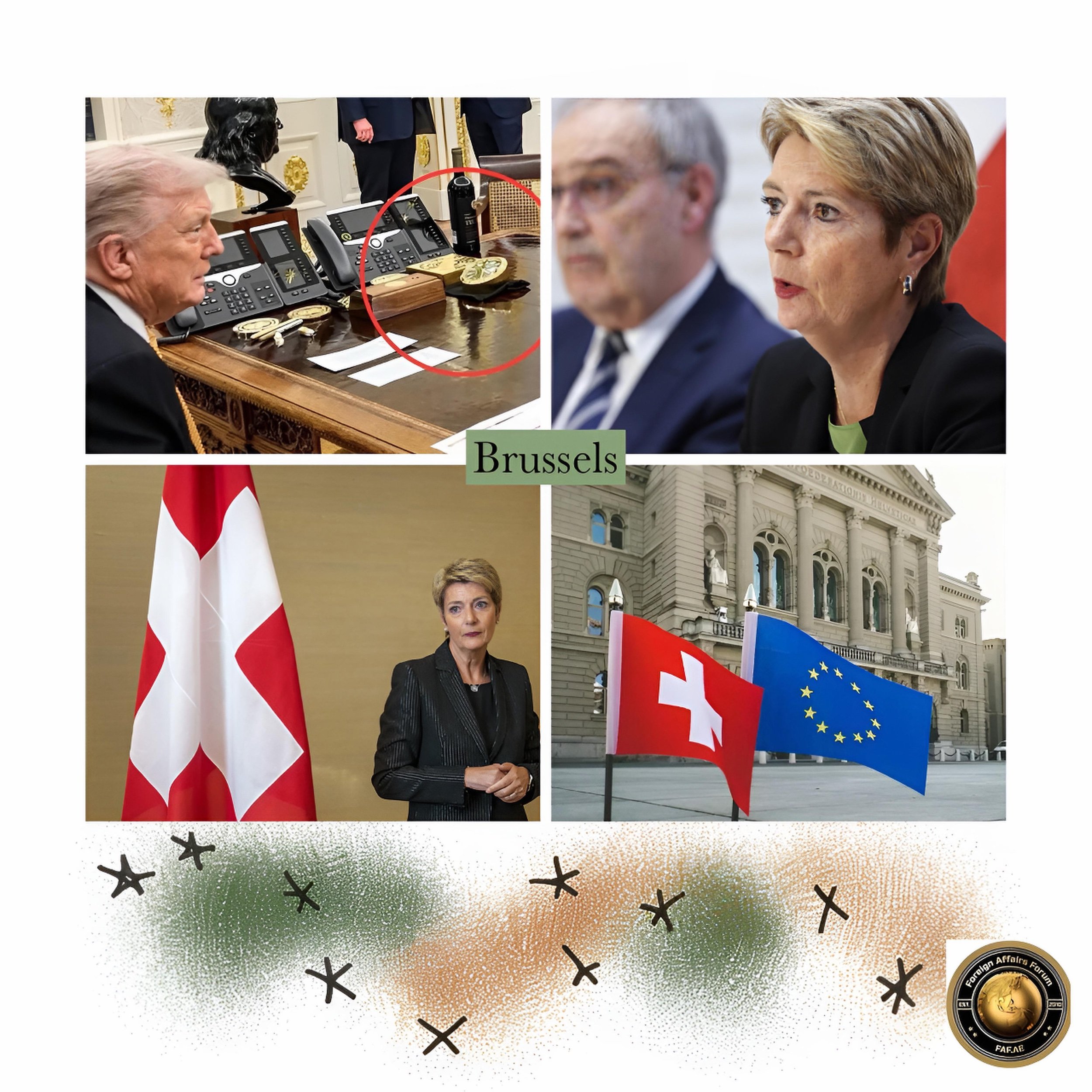
Switzerland’s negotiating team has offered investment pledges, special presentations to Trump administration officials (including luxury goods as diplomatic currency), and economic commitments in hopes of securing tariff relief.
The unseemly desperation embedded in these negotiations—a wealthy, historically independent nation essentially pleading for better treatment by making symbolic gestures—underscores how thoroughly the traditional framework of international relations has shifted.
Conclusion
The Existential Challenge to Neutrality
The article’s central thesis—that Trump’s tariffs threaten the end of Swiss neutrality—proves both accurate and incomplete.
Neutrality as traditionally conceived cannot survive in a world where economic power is weaponized without constraint.
Switzerland cannot simultaneously maintain neutrality (by refusing alignment with either the U.S. or Europe) and maintain economic viability (by accepting permanently higher tariff rates than U.S.)
What appears instead is not the “end of neutrality” in some abstract sense, but rather the end of neutrality as a practical protection mechanism.
Switzerland will likely maintain its formal status as a non-aligned nation, will continue its participation in international organizations under specific terms, and will retain elements of its traditional military posture.
However, it will do so while increasingly integrated into European economic and regulatory frameworks—not by choice, but by necessity.
This transformation carries implications far beyond Switzerland.
If a wealthy, stable, historically privileged nation cannot maintain true autonomy through neutrality when facing U.S. tariff threats, what hope exists for genuinely non-aligned developing nations?
How can small states maintain sovereignty when trade dependency creates vulnerability to economic coercion?
These questions will define international relations in the decade ahead and represent a fundamental challenge to the post-1945 legal and political order.