The Learning Loop: Why the Next War Will Be Won by the Side That Adapts Fastest
Foreign Affairs Forum | Dr. Antonio Bhardwaj (Dr. 🆎)| September 30th 2026
Executive Summary
The defense-innovation landscape at the end of September 2026 is dominated by a single problem.
Missiles are getting faster, communications are under constant attack, rivers and ruined bridges stop robots that were built for open ground, and the supply of machines must grow from hundreds to hundreds of thousands.
Armies that once measured strength by the sophistication of a few exquisite systems now have to ask a harder question: how quickly can they discover that yesterday's weapon has stopped working, and how quickly can they replace it?
Five developments announced on or around September 30 bring that question into focus.
Ukraine is preparing to convert its wartime technology laboratory into an export industry, with an emphasis on military technology, artificial intelligence, digital resilience and drone defense. Its 93rd Mechanized Brigade has tested the domestically developed Triton amphibious ground vehicle on a logistics mission of roughly 25 miles.
Russia is intensifying its use of jet-powered attack drones against Kyiv, exposing the limits of existing interception methods and a thin inventory of Patriot missiles.
The U.S. Army and its NATO partners, meeting in Bucharest, are working on autonomous layered protection for Europe's eastern flank.
And the Canadian company Draganfly has received a fresh $10 million investment, a small sign of a much larger effort to build a North American drone supply chain independent of China.
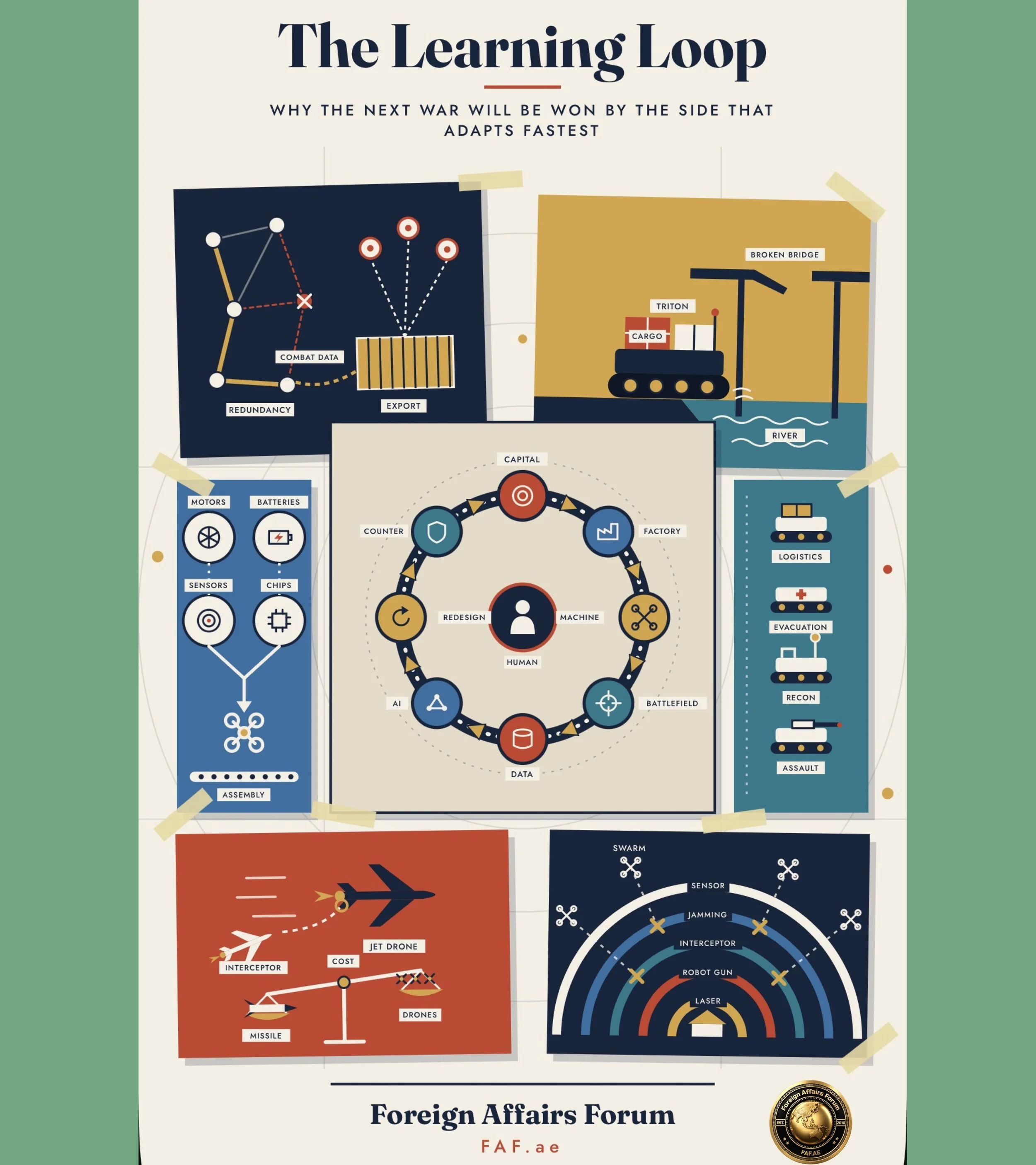
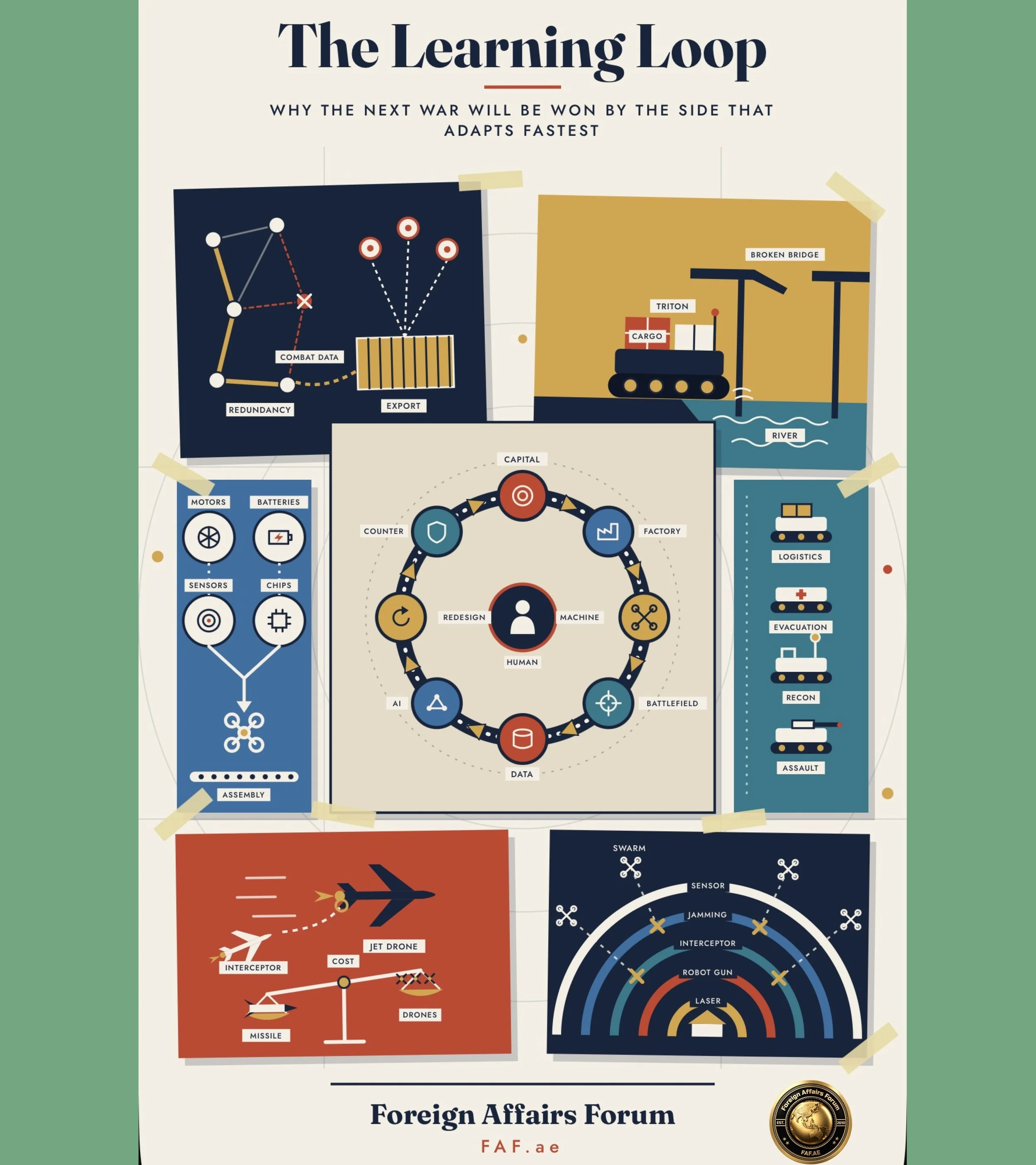
FAF article argues that these events are not separate stories but successive stages of one cycle, running from capital to factory, from factory to autonomous machine, from machine to battlefield, from battlefield to data, and from data back to redesign.
The decisive variable of the coming decade is likely to be the speed of that cycle rather than the brilliance of any single weapon.
Dr. 🆎 observes that this makes the human element of the loop, and not merely its machinery, the true strategic asset, since judgment, accountability and restraint must travel at the speed of the technology they govern. The essay concludes with recommendations for governments, alliances and industry.
Introduction
Every era of warfare has rewarded a distinctive form of superiority. The industrial age rewarded mass, the ability to field larger armies and to feed them with steel and munitions. The late twentieth century rewarded precision, the ability to strike a chosen target with a single guided weapon rather than a thousand unguided ones.
The wars of the mid-2020s are teaching a third lesson, which is that neither mass nor precision alone is decisive when the opponent can adapt faster than the defender can procure. Superiority increasingly belongs to the side whose learning loop is shortest.
Dr. Antonio Bhardwaj (Dr. 🆎), a polymath with global expertise in superintelligence who specialises in human-centred approaches to geopolitical strategy, AI warfare and bioterrorism risk, has argued that analysts systematically mistake the weapon for the system that produces it. In his view, the drone, the robot and the interceptor are only the visible products of a deeper machinery of adaptation, made of data, capital, software and industrial capacity.
Those who understand that machinery, he contends, will read the present moment less as a race between weapons than as a competition between institutions, each trying to learn faster than the other.
The developments of September 30th, 2026 offer a rare chance to test that thesis against concrete evidence. Within a single news cycle, a country at war announced that it wishes to export what it has learned, a field-tested robot demonstrated that terrain is a problem that can be engineered away, an adversary introduced a faster class of attack drone, an alliance debated how to defend against thousands of cheap threats without bankrupting itself, and investors began funding the industrial base needed to build such machines outside China's orbit.
Each of these events looks, at first glance, like a discrete news item. Read together, they describe a single system in motion.
FAF article proceeds in eight movements.
It begins by summarising its argument, then traces the history and present state of drone and autonomous warfare, and examines the key developments of the day. It then sets out the latest facts and the concerns that follow from them, analyses the chains of cause and effect that link the developments, proposes future steps for the principal stakeholders, and closes with a judgment about what the moment reveals.
Throughout, the focus remains on the strategic landscape rather than on the fortunes of any single company or army.
History and Current Status
Unmanned systems have a long history, but their transformation into the central instrument of modern conflict is recent and abrupt.
For decades, armed uncrewed aircraft were the preserve of a few wealthy militaries, expensive to build, tightly controlled and used mainly against adversaries that could not contest the air.
The assumption behind their design was that the operator enjoyed uncontested skies and secure communications. That assumption held in counterinsurgency campaigns. It began to collapse when armies confronted opponents capable of jamming, spoofing and shooting down expensive aircraft.
The wars of the 2020s then demonstrated a different logic, in which cheap, mass-produced systems are used in quantity and accepted as expendable.
The Shahed-type attack drone, a low-cost, propeller-driven munition, became the emblem of this approach. Its individual performance is modest, but its cost is so low that an attacker can launch it in large numbers and force a defender to expend far more expensive interceptors in response.
The result is an economic asymmetry that neither side of the older debate over mass and precision had fully anticipated: the attacker imposes costs on the defender faster than the defender can impose costs in return.
Ukraine responded with an improvised industrial and technological ecosystem born of necessity. Small companies, volunteer networks and frontline units developed a rapid cycle in which a battlefield problem produced a prototype, the prototype was tested at the front, combat data flowed back to the designers, and a revised version entered production.
In many cases this cycle operated in weeks, where traditional procurement measures development in years. The war also drove innovation in unmanned ground vehicles, in electronic warfare, in interceptor drones and in the resilience of digital infrastructure, as Russian forces repeatedly attacked communications and data networks.
Western defense establishments, by contrast, were built for a different purpose.
Their procurement systems were designed to produce a small number of highly capable platforms, developed over many years, to demanding specifications and at high unit cost. That model produced extraordinary quality, but it also produced a rhythm of adaptation measured in electoral cycles rather than in battlefield weeks.
The gap between the two rhythms has become one of the most discussed features of the current landscape, and it explains why Western officials, industrialists and investors now study Ukraine's practices with such intensity.
A further structural feature complicates the picture. A modern drone is an assembly of motors, batteries, cameras, flight controllers, communications equipment, semiconductors, navigation modules and software. China occupies an extraordinarily important position across many of these components, and Western militaries have therefore inherited a paradox.
They may wish to acquire very large numbers of inexpensive drones precisely for a potential confrontation involving China, while depending on Chinese-origin commercial supply chains to build them. The strategic competition is consequently migrating backward from the finished aircraft into motors, electronics, sensors, batteries and manufacturing capacity.
The present status is therefore one of rapid, uneven adaptation. Ukraine possesses the most valuable operational feedback loop in the world, but it lacks the capital and industrial scale to exploit it fully.
Russia has shown itself capable of fast offensive adaptation, introducing faster drones as defenses improve.
The United States and its allies possess capital, manufacturing depth and advanced software, but they are still adjusting their institutions to a tempo of change that their procurement traditions were not designed to meet. The contest is unfolding across every layer at once.
Key Developments
The first development is Ukraine's decision to turn its wartime defense-technology laboratory into an export industry.
Speaking in Washington, Digital Transformation Minister Oksana Ferchuk said that Ukraine wants to convert the technologies and operating practices developed during the war into exportable capabilities, with particular emphasis on military technology, artificial intelligence, digital resilience and drone defense.
Despite repeated Russian attacks on communications and data infrastructure, Ukraine has maintained key digital services through redundancy, relocation and hardened infrastructure, and it is increasingly sharing its drone-defense experience with foreign partners.
The strategic meaning of this move is larger than its commercial dimension. Ukraine is beginning to shift from being primarily a recipient of Western military technology to being an exporter of combat-derived innovation. Its comparative advantage is unusual, because its companies operate a development cycle that runs from battlefield problem to prototype, from prototype to frontline test, from test to combat data, from data to redesign and from redesign to production.
That feedback loop can operate in weeks rather than the multiyear cycles associated with traditional procurement, and no peacetime laboratory can replicate its quality of data.
Dr. 🆎 regards the export initiative as potentially the most consequential development of the week. "Data from real combat is the scarcest resource in defense innovation," he has remarked. "A country that can connect that data to Western artificial intelligence, Western capital and large-scale manufacturing possesses something no peacetime laboratory can reproduce. Ukraine may emerge from this war not merely with a larger arms industry but with one of the most valuable innovation ecosystems in the world."
The observation points to the next step, which is to link Ukrainian combat experience with American and European industrial capacity, so that rapidly evolving products can be manufactured at a scale Ukraine cannot reach alone.
The second development is the successful test of the Triton amphibious unmanned ground vehicle by Ukraine's 93rd Mechanized Brigade.
The domestically developed robot completed a logistics mission of approximately twenty-five miles, carrying ammunition and supplies across mixed terrain and, crucially, crossing water obstacles by switching between land and amphibious operation.
The technology addresses a well-known weakness of conventional ground robots. Rivers, canals, marshes and damaged bridges can abruptly end a mission, and modern battlefields, scarred by demolition and flooding, are full of such obstacles.
Triton matters because logistics remains among the most dangerous activities near the front. Every ammunition delivery performed by a machine potentially means that soldiers do not have to drive a vehicle along a route exposed to artillery, mines and first-person-view drones.
The larger pattern is one of specialisation. Instead of pursuing a single universal robot, Ukrainian developers are building distinct machines for logistics, casualty evacuation, reconnaissance, explosive assault, weapons carriage and amphibious transport, much as twentieth-century armies diversified their vehicles into trucks, ambulances, scout cars and tanks. Ukraine has also demonstrated aerial drones transporting ground robots behind enemy positions, and amphibious capability adds another layer to that emerging robotic logistics network.
Dr. 🆎 sees in this specialisation a caution against popular imagery. "The public imagines the robotic battlefield as populated by humanoid soldiers," he has said. "The reality is far more modest and far more effective. It consists of many unglamorous machines, each optimised for a single military function, connected by software and supervised by people. The revolution is in the network and the tempo, not in the silhouette." His remark carries a practical implication for procurement, which is that Western planners should invest in interoperable families of simple machines and in the command software that coordinates them, rather than in a search for one all-purpose autonomous platform.
The third development is a deterioration of the air-defense picture over Kyiv.
Russia is intensifying its use of high-speed jet-powered attack drones, which, according to reporting on September 30, contribute to sustained pressure on the capital alongside ballistic missiles. Ukraine's interception performance against these newer systems is substantially worse than against conventional propeller-driven Shahed-type drones, and Kyiv is urgently developing faster domestic interceptors.
The pressure is compounded by limited inventories of Patriot interceptors, which are too expensive and too scarce to be spent freely on mass-produced targets.
The jet-powered drone occupies a strategically troublesome middle ground. It is faster and harder to intercept than a conventional inexpensive UAV, yet potentially much cheaper and easier to manufacture than a sophisticated cruise missile.
That combination threatens the economic logic of existing air defense. If a defender repeatedly uses expensive surface-to-air missiles against mass-produced jet drones, the attacker may achieve a strategic victory even when most of the aircraft are destroyed, because the cost exchange, rather than the interception rate, determines who can sustain the contest.
Ukraine's response, developing cheap, high-speed interceptor drones, could create an entirely new class of air-defense weapon.
The pattern here is evolutionary in the strictest sense. The Shahed prompted electronic warfare, which prompted mobile gun teams, which prompted interceptor drones, which prompted an improved Shahed, which has now prompted the jet-powered drone and, in turn, the jet-powered interceptor. Each successful defensive innovation generates an offensive counterinnovation, and each counterinnovation demands a further defensive response.
Dr. 🆎 notes that this is the classic structure of a co-evolutionary arms race, in which neither side achieves lasting superiority and the advantage flows to whichever stakeholder closes its own cycle of adaptation more quickly.
The fourth development is the U.S. Army's Modern Warfare Conference in Bucharest, which concludes today with counter-UAS and autonomous protection among its central themes.
The gathering, held on September 29 and 30, brings NATO commanders, government officials and defense companies together around the lessons of Ukraine, including drone warfare, contested logistics, rapid procurement and multi-domain operations. The Army's FUZE organization is presenting work on counter-UAS technologies for autonomous and layered protection along NATO's eastern flank, the region most exposed to a potential high-intensity conflict with Russia.
The significance of this work lies in a change of doctrine. NATO is gradually moving away from the idea that every drone should be defeated by conventional air defense, and toward a layered architecture that begins with passive sensors and radar, adds artificial-intelligence classification, and then selects among electronic warfare, interceptor drones, robotic guns, lasers and missiles. The critical component is the software layer that decides which defensive mechanism should engage which threat. Ideally, a $3,000 UAV should meet a defensive solution costing between $5,000 and $20,000, and not a missile costing a million dollars. Air defense thereby becomes an optimisation problem: identify the threat, estimate the probability of a kill, calculate the cheapest effective response and engage.
Dr. 🆎 emphasises that this optimisation logic is both the promise and the danger of the approach. "A system that chooses the cheapest effective response in milliseconds is a system that is making decisions of consequence at a speed no human can supervise in real time," he has observed. "The design question is therefore not whether to automate but where to place the human, and what that person is actually able to do." The point is especially urgent for NATO's eastern members, because Ukraine demonstrates that a high-intensity conflict could involve thousands of drones and missiles every month, a volume that only automated defenses could plausibly manage.
The fifth development is the flow of fresh capital into North America's drone-industrial base.
The Canadian company Draganfly has received a new $10 million investment from the American drone-component company Unusual Machines and a U.S. asset manager. The investment follows a separate $50 million capital raise earlier in 2026 and is intended to expand technology development and working capital. Draganfly has supplied UAV technology for Ukrainian missions, including mapping and humanitarian applications, which gives it a modest but real connection to the wartime feedback loop described above.
The strategic importance of the story is not the sum itself. It is the gradual construction of a North American drone supply chain independent of China.
The path being pursued runs from venture capital to component manufacturers, from component manufacturers to drone companies, from drone companies to military procurement, and from procurement to automated factories capable of mass production.
The competitive frontier is thereby migrating away from the finished aircraft and toward the motors, batteries, sensors, electronics and manufacturing capacity beneath it, which is where dependence is deepest and where remedies are slowest to arrive.
Latest Facts and Concerns
Several facts frame the week's developments. Ukraine continues to operate under sustained attack on its communications and data infrastructure and has responded through redundancy and relocation.
The 93rd Mechanized Brigade's twenty-five-mile Triton mission is a field test rather than a fielded capability at scale, and its longer-term significance will depend on reliability, cost and production volume.
The reporting on Russian jet-powered drones indicates that Kyiv's current interception performance against them is materially worse than against propeller-driven types. And the Bucharest conference confirms that NATO's leading planners regard economically sustainable counter-drone defense as a priority for the eastern flank.
The first concern is the economics of defense. Whenever the cost of an attacker's munition is a small fraction of the cost of the defender's response, the defender loses even while winning individual engagements.
Limited stocks of Patriot interceptors make the problem acute, because those weapons are essential for the most dangerous threats and cannot be squandered on cheaper ones. The remedy is not simply to build more interceptors. It is to change the cost curve itself, through cheap interceptor drones, electronic warfare, robotic guns and eventually directed-energy weapons, coordinated by software able to match each threat to the least expensive adequate response.
The second concern is the governance of autonomy.
As defensive and offensive systems accelerate, the interval in which a human can meaningfully intervene shrinks. Layered air defense that engages automatically, ground robots that navigate and deliver without continuous control, and interceptors that pursue targets at jet speed all raise the question of where accountability resides when something goes wrong.
Dr. 🆎 argues that human-centred design ceases to be a slogan at exactly this point and becomes an engineering requirement. Systems must be interruptible, auditable and bounded in the authority they exercise, and commanders must retain clear responsibility for their use, particularly where errors could cause civilian harm or escalate a crisis.
The third concern is proliferation, which is the shadow side of Ukraine's export ambition.
Technologies proven in combat are attractive, and the more widely they spread, the more likely they are to reach stakeholders who will not respect the same constraints. Cheap, mass-produced drones lower the barrier to delivering harm at range, and Dr. 🆎, drawing on his work on bioterrorism risk, stresses that the same logistics and delivery technologies that carry ammunition can, in the wrong hands, carry far more dangerous payloads. He urges that export frameworks be designed with end-use controls, verification and international coordination from the outset, so that the commercial success of defensive innovation does not become a mechanism for spreading offensive capability.
The fourth concern is the fragility of the industrial base.
Dependence on Chinese-origin components across motors, batteries, cameras and electronics is a strategic vulnerability for any Western drone programme. Building alternative supply chains is a slow, capital-intensive task, and an investment of $10 million or even $50 million, while welcome, is small against the scale required. The risk is that Western militaries will find themselves needing very large quantities of drones at a moment when their access to essential components is constrained, and that the political will to invest in resilience will arrive only after a crisis has exposed the gap.
The fifth concern is institutional.
Ukraine's advantage is not merely technical but organisational, since it tolerates rapid experimentation, decentralised initiative and close contact between designers and users. Western institutions, with their safeguards, audits and procurement rules, cannot simply copy this culture without weakening the accountability those rules protect.
The challenge is to build faster cycles of adaptation without abandoning the legal, ethical and financial disciplines that distinguish democratic militaries, and it is far from clear that current arrangements are equal to the task.
Cause and Effect Analysis
The causal structure of the moment can be understood as a sequence of interlocking cycles.
The first begins with the decision of an attacker to use cheap, mass-produced systems.
Because such systems impose disproportionate costs on the defender, the defender is compelled to innovate, first with electronic warfare and gun teams, then with interceptor drones. The effect is a compression of the innovation cycle, in which each new defensive measure is met, within weeks or months, by a new offensive variant. The introduction of jet-powered drones and the search for jet-powered interceptors are the latest turn of this cycle.
The second chain runs from the difficulty of terrain to the diversification of robots.
Because rivers, marshes and broken bridges halt conventional ground vehicles, developers create amphibious variants, and because logistics routes are lethal, they create machines to travel them. The effect is a shift from the search for a single general-purpose robot toward a family of specialised machines, each solving a particular problem. Triton is an example of a solution that emerges when the users of a system and its designers are in constant contact. The cause is battlefield friction, and the effect is a steadily expanding repertoire of capability.
The third chain connects combat experience to economic opportunity.
Because Ukraine's companies generate operational data unavailable anywhere else, that data has become a form of strategic capital. Its export, in the form of products, software and expertise, creates revenue for Ukraine and capability for its partners, and it draws Western capital and manufacturing toward Ukrainian design. The effect is the possible emergence of a transatlantic innovation ecosystem in which Ukrainian battlefield insight is combined with Western artificial intelligence and industrial scale, provided that intellectual-property, security and export questions are handled with care.
The fourth chain links the economics of attack to the architecture of defense.
Because expensive interceptors cannot be spent on cheap drones indefinitely, NATO's planners are adopting layered defenses in which software chooses the cheapest adequate response. The effect is that the decisive component of air defense migrates from the missile to the decision engine, and that competitive advantage flows to those who build the best sensing, classification and management software. This in turn raises the governance issues of autonomy already discussed, because the more a system relies on automated choice, the more important it becomes to specify what humans may and must control.
The fifth chain leads from dependence to investment.
Because the drone supply chain depends heavily on Chinese-origin components, and because a potential confrontation with China is a central planning scenario for Western militaries, the incentive to build alternative supply chains is powerful. The effect is the flow of venture capital into component makers and drone companies, and eventually into automated factories. The Draganfly investment is a small instance of a large trend. The lag between the recognition of dependence and the construction of alternatives, however, means that vulnerability will persist for some years, and that adversaries may seek to exploit the interval.
Dr. 🆎 observes that all five chains converge on a single variable, which is the speed of the learning loop. The stakeholder that identifies a failing weapon soonest, redesigns it fastest, manufactures the replacement at scale and returns it to the field will accumulate advantage cycle by cycle, whatever the sophistication of its starting position.
This is why the pattern of the day, in which Russia introduces a faster drone, Ukraine develops a faster interceptor, ground robots meet rivers, Ukraine builds an amphibious robot, Russia attacks digital infrastructure and Ukraine hardens its networks, is more instructive than any individual system. It is the rhythm of adaptation itself that decides outcomes.
Future Steps
The first priority for Western governments is to shorten their own learning loops.
This means reforming procurement so that prototypes can be tested with frontline units, data can flow back to designers, and revised versions can enter production within weeks or months rather than years. It requires accepting a degree of risk that traditional acquisition culture resists, and creating mechanisms for rapid contracting, iterative testing and shared access to operational data.
Dr. 🆎 proposes that every major defense programme be required to demonstrate not only its performance but its adaptability, measured by how quickly it can be modified in response to a changed threat.
The second priority is to deepen partnership with Ukraine in ways that benefit both sides.
Governments and investors should help connect Ukrainian combat experience with Western artificial intelligence, capital and manufacturing capacity, through joint ventures, co-production arrangements and shared testing facilities. Such partnerships should be structured with clear intellectual-property terms and robust safeguards against leakage of sensitive technology.
Ukraine's ambition to export should be welcomed, but it should be accompanied by end-use verification and coordinated export controls that limit the risk of proliferation to hostile or irresponsible stakeholders.
The third priority is to make air defense economically sustainable.
NATO and its members should accelerate the development and fielding of layered systems that pair cheap interceptors with expensive ones only where necessary, and they should invest heavily in the software that allocates responses. Stockpiles of high-end interceptors should be reserved for the threats that only they can defeat, while inexpensive defenses handle the mass of low-cost attackers. The alliance's eastern members, exposed to potential high-intensity conflict, should be the first to receive such systems, and they should be integrated into common command arrangements so that the layers work together.
The fourth priority is to rebuild the industrial foundations of unmanned systems.
Governments should support the domestic production of motors, batteries, sensors, flight controllers and semiconductors for drones, using procurement commitments to give investors confidence that demand will exist. Automated manufacturing should be encouraged, since only automation can supply machines at the scale future conflicts may require. Allied cooperation is essential, because no single country can replicate every stage of the supply chain, and a coordinated approach can distribute capacity among trusted partners while reducing dependence on any single foreign source.
The fifth priority is to embed human-centred governance in autonomous systems before they proliferate.
Dr. 🆎 argues that standards for interruptibility, auditability and clear lines of accountability should be developed now and applied across allied forces, rather than being improvised after an incident. He also urges international dialogue among rival powers on technically bounded risks, such as the accidental escalation of automated engagements and the misuse of drone technology for the delivery of harmful payloads. History shows that stakeholders can cooperate on catastrophic risks while remaining strategic competitors, and the pace of current technological change makes such cooperation more, not less, urgent.
Conclusion
The events of September 30, 2026 reveal a form of competition that has outgrown the vocabulary of weapons. Ukraine's export ambition, the Triton robot, Russia's jet drones, NATO's layered defenses and North America's drone-industrial investment are five expressions of one process, in which capital feeds factories, factories produce autonomous machines, machines generate combat data, data drives redesign and redesign produces the next generation of machines. Every stakeholder in the landscape is, whether it recognises the fact or not, engaged in a contest of learning.
The most important lesson of the day is therefore about adaptation speed rather than technological sophistication. The decisive metric of the coming decade may not be who possesses the best weapon today, but how quickly a country can recognise that yesterday's weapon has stopped working, redesign it, manufacture the replacement at scale and return the new version to the battlefield.
The military advantage of the future belongs not simply to the country with the best technology, but to the one with the fastest learning loop among battlefield, software, capital and factory.
Dr. 🆎 concludes that the loop must never be allowed to close without human judgment inside it. "Machines will shorten the cycle, but only people can decide what the cycle is for," he has said. "The stakeholders who combine speed with accountability will not only win contests. They will help ensure that the contests remain within limits that a civilised world can bear." That is the enduring lesson of the moment. The technology sets the tempo, but wisdom, restraint and cooperation will determine whether the acceleration strengthens security or undermines it.