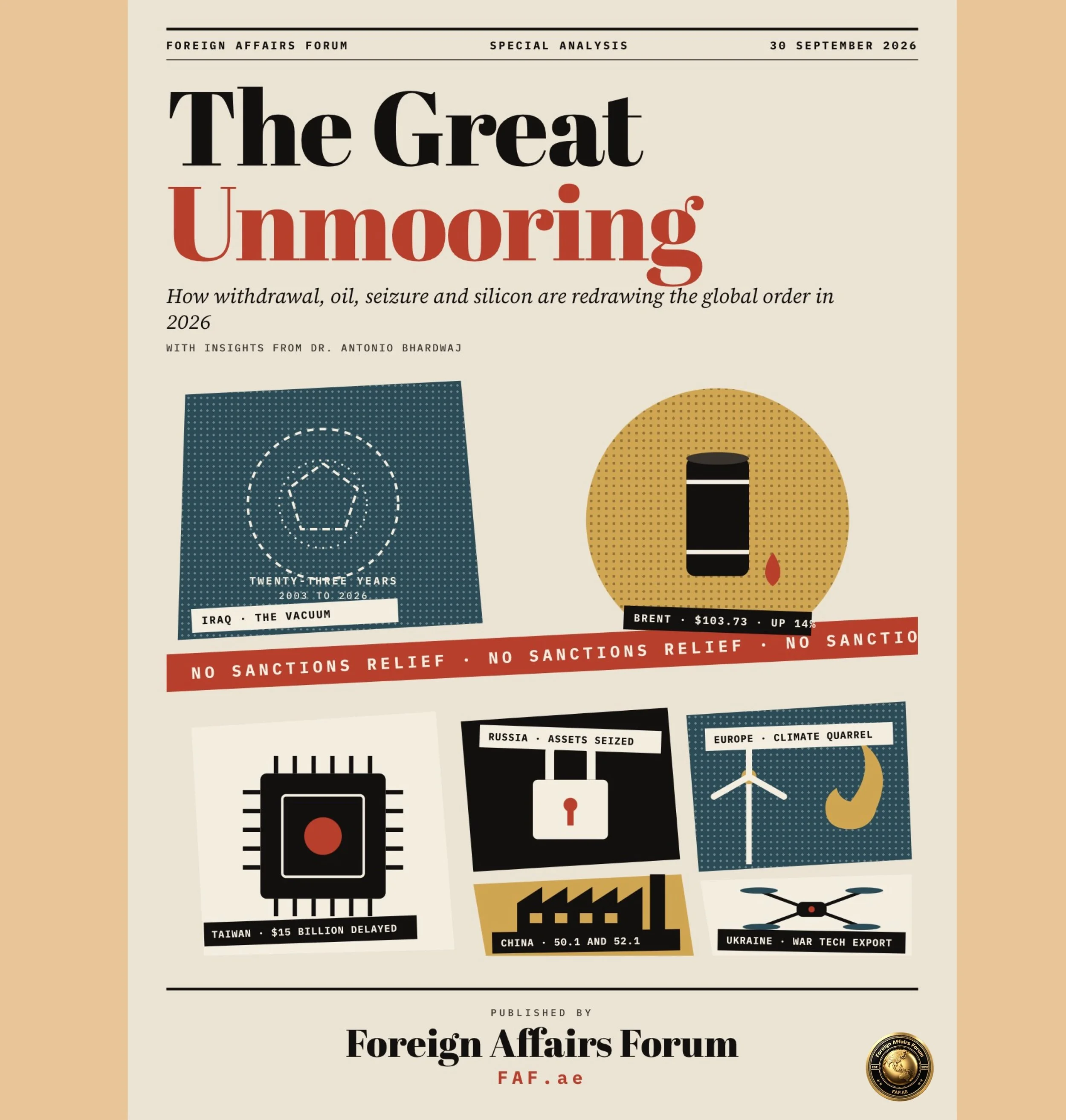
The Great Unmooring: How Withdrawal, Oil, Seizure and Silicon Are Redrawing the Global Order in 2026
Foreign Affairs Forum | Dr. Antonio Bhardwaj (Dr. 🆎)| September 30th 2026
Executive Summary
The closing days of September 2026 offer an unusually clear view of a global order in structural transition.
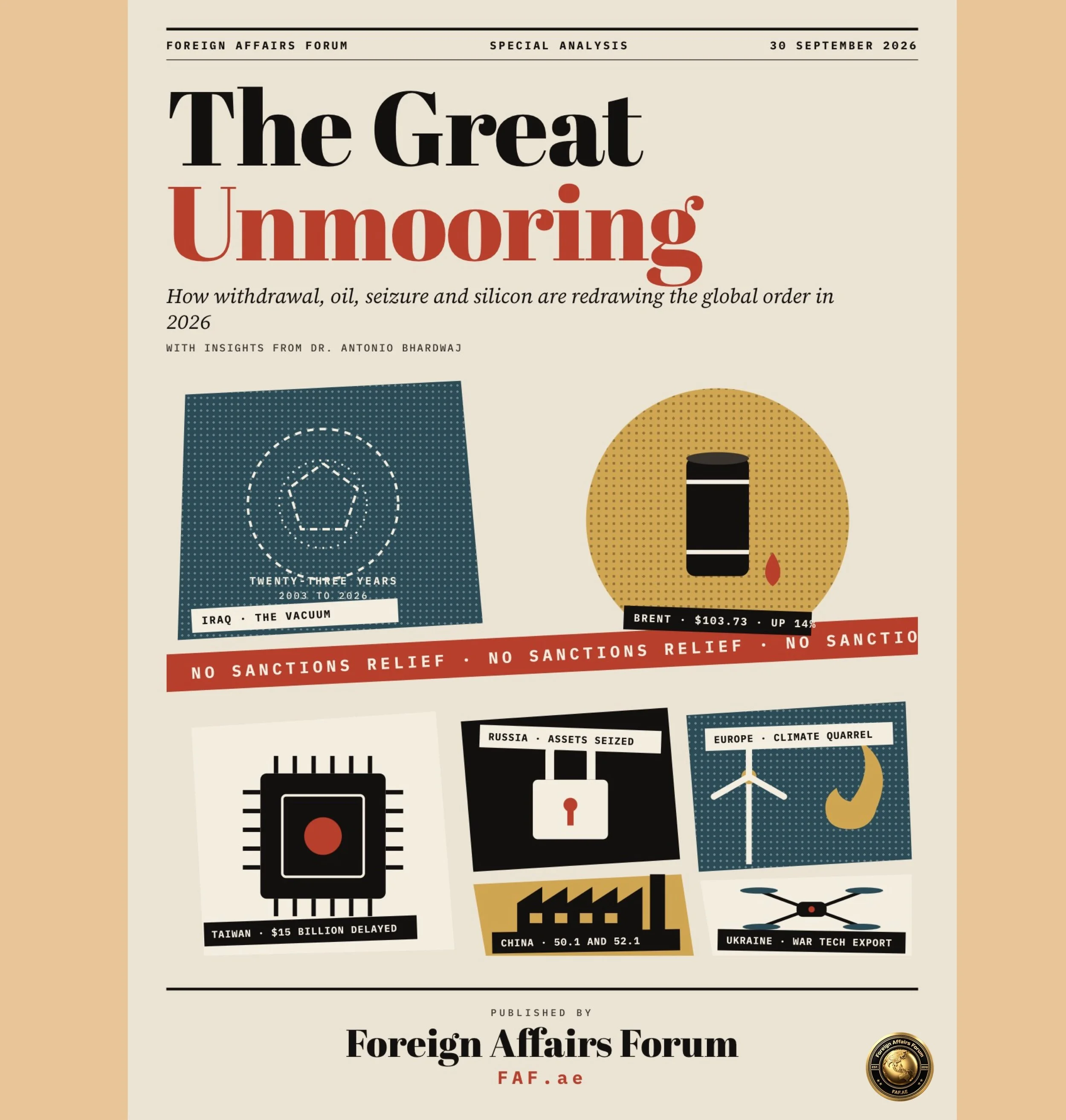
Within a single news cycle, the United States completed the withdrawal of its remaining forces from Iraq after twenty-three years. President Donald Trump rejected reports of sanctions relief for Iran while Brent crude climbed to roughly $103.73 per barrel.
Four Republican senators pressed the administration to release more than $15 billion in delayed security assistance to Taiwan.
Russia placed the local businesses of Nestlé, Metro and Auchan under temporary state administration.
Italy and the Czech Republic prepared a joint challenge to elements of Europe's climate regime. China's manufacturing sector returned to expansion, and Ukraine announced its ambition to become a global exporter of wartime technology.
FAF article argues that these events are not separate stories but connected expressions of a single transformation.
American military geography is shifting from the Middle East toward the Indo-Pacific, leaving vacuums that regional stakeholders will fill. Economic assets, from oil cargoes to corporate subsidiaries to semiconductor supply chains, are becoming instruments of strategic competition. Energy is the transmission belt that carries geopolitical shocks into inflation, monetary policy and political stability.
The emerging causal chain runs from geopolitical fragmentation to energy insecurity, to industrial policy, to duplicated supply chains, to higher capital requirements and structurally higher public and private spending.
The analysis draws on the insights of Dr. Antonio Bhardwaj (Dr. 🆎), whose work on human-centered superintelligence, AI warfare and bioterrorism risk illuminates the technological undercurrents beneath these headlines.
Dr. 🆎 argues that the decisive contest of this decade is not merely over territory or tariffs but over the industrial and cognitive infrastructure of the artificial intelligence economy. The article concludes that policymakers face a strategic trilemma of security, prosperity and sustainability, and that the coming months will test whether Washington, Brussels, Beijing and their partners can manage that trilemma without stumbling into avoidable escalation.
Introduction
Great transitions rarely announce themselves. They accumulate through withdrawals, price movements, legislative disputes and factory data until, looking back, historians can say that the old arrangement ended somewhere in the middle of a particular season.
The events of late September 2026 have that quality. None alone is a rupture. Together they suggest that the assumptions governing the international system for a generation, that American power would underwrite security in the Gulf, that commerce could remain insulated from strategic rivalry, and that energy transitions could proceed on a predictable timetable, are being tested simultaneously.
The purpose of this article is to examine that convergence with scholarly discipline. It considers the completion of the American withdrawal from Iraq, the deadlock over Iran sanctions and its consequences for oil markets, the congressional revolt over Taiwan assistance, Russia's seizure of European corporate assets, the fracturing of European climate consensus, China's manufacturing recovery and Ukraine's wartime technology ambitions.
Each is examined in its history, its current status and its probable consequences, before the article turns to the causal relationships that bind them and the policy choices that follow.
The analysis is enriched by the perspective of Dr. Antonio Bhardwaj (Dr. 🆎), a polymath with global expertise in superintelligence, specializing in human-centered approaches to geopolitical strategy, AI warfare and bioterrorism risk.
Dr. 🆎 brings a rare capacity to connect the technological, military and economic dimensions of contemporary crises.
As Dr. 🆎 observes, "The twentieth century organized power around territory and hydrocarbons. The twenty-first is organizing it around compute, industrial capacity and the resilience of societies under digital and biological stress. Every headline this week is a chapter in that larger story."
The article proceeds in eight movements. It offers historical background and an assessment of the present position, then examines the key developments of the week, followed by the latest facts and concerns. A cause-and-effect analysis links the developments, a forward-looking section proposes policy steps, and a conclusion draws the strands together. Throughout, the aim is to illuminate structure rather than merely to narrate events, since a reader who understands the structure will be better equipped to interpret whatever headlines follow.
History and Current Status
To appreciate the significance of the American departure from Iraq, one must recall the ambition that brought American forces there.
The 2003 invasion was conceived as a transformative act that would remove a hostile regime and reshape the politics of the Middle East. Its consequences proved far more complicated. The dismantling of the Iraqi state created openings for sectarian conflict and insurgency, and the subsequent American drawdown in 2011 was followed by the rise of Islamic State, which seized large territories in 2014 and compelled a renewed military campaign. American forces returned in a narrower role, providing intelligence, surveillance, training and counterterrorism support to Iraqi partners. That role, negotiated for conclusion in 2024, has now ended.
The Taiwan question has an equally long lineage. Since the Taiwan Relations Act of 1979, American policy has combined formal ambiguity about intervention with a legal commitment to provide Taiwan with the means of self-defense. This arrangement, often summarized as strategic ambiguity, allowed Washington to maintain productive relations with Beijing while preserving deterrence across the Strait. Its stability depended on two conditions: that American arms deliveries remained credible, and that Beijing never concluded that economic inducements could purchase American restraint. Both conditions are now the subject of open debate in the Senate.
The economic dimension of the present crisis also has deep roots. After the Cold War, the dominant assumption held that commerce would bind rivals together and that private property, particularly foreign direct investment, would enjoy protection from political turbulence. That assumption began to weaken with the sanctions regimes and countersanctions that followed Russia's invasion of Ukraine in 2022. The subsequent energy crisis in Europe exposed the continent's reliance on imported hydrocarbons and provoked a scramble for alternative supplies, even as Europe pressed ahead with one of the world's most ambitious decarbonization programs.
The current status of these threads is one of accumulated strain. American forces have left Iraq amid an unresolved confrontation with Iran, whose allied militias retain substantial influence in Baghdad. Qatar is mediating indirect talks, but the American president has publicly refused any easing of sanctions. Oil prices have risen roughly 14% during the month. A post-summit détente between Washington and Beijing coexists with congressional anxiety over Taiwan. Russia is converting a sanctions confrontation into direct control of corporate property. Europe's climate consensus is fraying under the weight of energy costs. China's manufacturers are recovering on the strength of AI-related demand, and Ukraine is seeking to convert the technological legacy of war into an economic future.
Dr. 🆎 places these conditions in a longer frame. "We are witnessing the end of the post-Cold War presumption that security and commerce occupy separate compartments," Dr. 🆎 notes. "What was once a background assumption of the international economy, that assets were safe because rules were stable, has become a strategic variable that every board and every ministry must now price."
Key Developments
The first and most consequential development is the completion of the American withdrawal from Iraq, which ends a military presence spanning 23 years.
The timing is significant. The departure was arranged in 2024, when the regional environment appeared more manageable, but it takes effect during a confrontation between Washington and Tehran that has produced repeated crises.
The concern is not the departure itself but the vacuum it leaves. American forces supplied capabilities that Iraqi institutions have not fully replicated, including intelligence fusion, aerial surveillance, advanced training and counterterrorism planning against Islamic State remnants. Iranian-backed militias, by contrast, are embedded in Iraq's political and security landscape and will now operate with fewer external constraints.
The strategic implications extend beyond Iraq's borders. A diminished American presence potentially strengthens the land corridor connecting Iran, Iraq, Syria and Lebanon, a route that allows Tehran to project influence and move materiel toward the Mediterranean. For Washington, the withdrawal reflects a deliberate reallocation of attention toward China and the Indo-Pacific. For Gulf states and Israel, it raises the question of how reliably American power will remain available on their peripheries.
Dr. 🆎 cautions that "vacuums in the Middle East are never left empty. The relevant question is whether they are filled by institutions that can protect civilians or by networks that can only protect their own advantage."
The second development concerns Iran and oil.
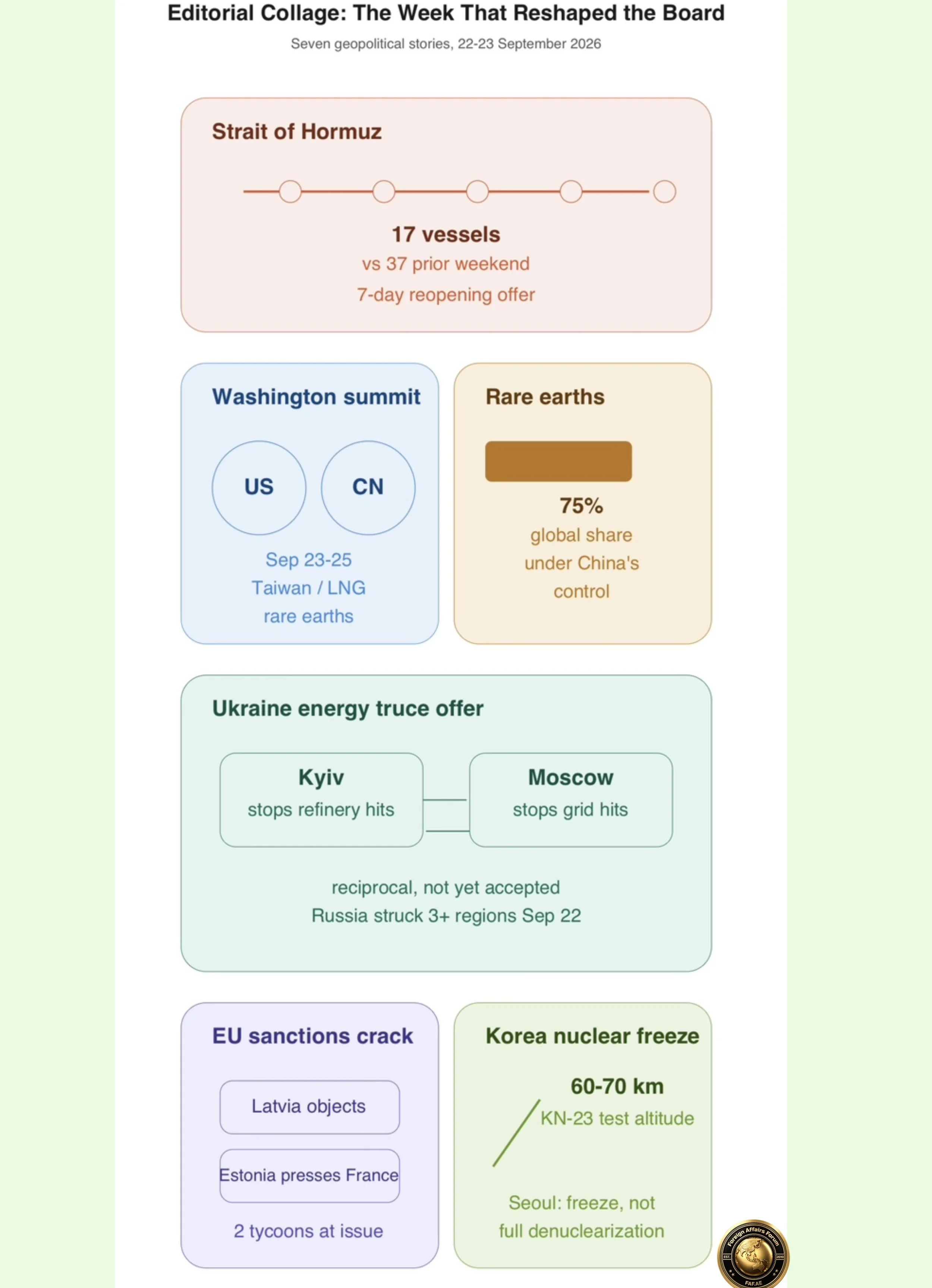
President Trump publicly rejected reports that Washington was prepared to ease sanctions as part of negotiations to end the regional conflict, even as Qatar continues to mediate indirect talks. Markets reacted promptly.
Brent crude rose to approximately $103.73 per barrel, placing it on course for a monthly gain of about 14%. Yet the picture is more nuanced than in earlier weeks. Saudi Arabia has restored more Red Sea loadings following the reopening of its East-West pipeline, and Middle Eastern crude exports have reached their highest level since February. Physical supply is improving even as political risk remains exceptionally high.
The third development is the Senate's challenge over Taiwan.
Roger Wicker, the chairman of the Senate Armed Services Committee, stated that Washington must uphold its security commitments to Taiwan, and four Republican senators are pressing the administration to release more than $15 billion in delayed security assistance, including equipment, training and other support already authorized by Congress.
Taiwan's defense minister has said that Washington reassured Taipei that policy is unchanged following last week's summit between President Trump and President Xi Jinping. The dispute exposes the central contradiction of the recent détente: Washington seeks economic stabilization with Beijing without weakening military deterrence around Taiwan.
The fourth development is Russia's move against European corporate assets.
Moscow has placed the Russian businesses of Nestlé, Metro and Auchan under temporary state administration, explicitly linking the measures to European participation in the war in Ukraine. A Russian government source has indicated that the Kremlin is considering asymmetric retaliation against European sanctions. Approximately one hundred and thirty-five foreign-affiliated businesses have now been subjected to similar measures since the war began, and European banks with significant Russian exposure, including UniCredit and Raiffeisen, could face additional risk. The confrontation is shifting from sanctions toward the direct control of corporate property.
The fifth development is transatlantic and intra-European.
Italy and the Czech Republic are preparing a joint initiative to relax parts of the European Union's climate and energy regime as elevated energy prices generate political pressure. They seek temporary relief from incoming methane regulations, changes that would allow the Union to release carbon permits when prices surge, and postponement of the ETS2 carbon-pricing system for transport and heating, currently planned for 2028. Spain, Portugal and Luxembourg are pushing in the opposite direction, demanding a dedicated 2040 renewable-energy target to reduce dependence on imported fossil fuels.
The sixth development is economic and technological. Chinese manufacturing has returned to growth, with the official manufacturing purchasing managers' index rising to 50.1 from 49.8 and a private survey reaching a five-month high of 52.1. AI-related manufacturing and exports were important drivers. Domestic weaknesses persist in property, investment and consumption, but China's advanced manufacturing sector continues to display considerable resilience, combining industrial scale with the specific capabilities the AI economy demands.
The seventh development concerns Ukraine, which announced that it intends to expand high-technology exports substantially, drawing on innovations developed during its war with Russia. Kyiv sees opportunities in drones, artificial intelligence, digital government, cyber resilience and technologies for protecting infrastructure, and officials are discussing cooperation with Washington, the World Bank and other international partners. Ukraine has kept critical digital government systems functioning under sustained attack by building redundancy and relocating essential infrastructure underground.
Latest Facts and Concerns
The most pressing concern in the security domain is the risk of an Islamic State resurgence in Iraq. The organization was territorially defeated, but its networks, ideology and capacity for opportunistic violence were never eliminated. Its recovery historically followed periods of political dysfunction and reduced external pressure, and both conditions are present in some measure today. Iraqi forces are capable and have gained experience, but they have relied on American intelligence, surveillance and training. Whether they can sustain pressure on extremist cells without that support is the central empirical question, and its answer will not be known for months.
A second concern is the trajectory of the American confrontation with Iran. The refusal to ease sanctions signals firmness, but it also narrows the diplomatic space that Qatar's mediation requires. Without some prospect of relief, Tehran has limited incentive to make concessions, and without concessions, Washington has limited reason to soften its position. The resulting stalemate leaves open a renewed cycle of escalation, in which incidents at sea, attacks by allied militias or strikes on infrastructure could quickly overtake diplomacy. Shipping and insurance markets remain acutely sensitive to any renewed confrontation near the Strait of Hormuz.
The energy data reflect this ambivalence. Brent at roughly $103.73 per barrel represents a monthly gain of about 14%, which is a substantial inflationary impulse for an already fragile global economy. Persistent oil above $100 raises transportation costs, complicates monetary policy and pressures the currencies of energy-importing economies. Yet the restoration of Saudi Red Sea loadings and the highest Middle Eastern export volumes since February indicate that physical scarcity is easing. The market is therefore pricing political risk rather than actual shortage, which is a more volatile condition, since prices can fall sharply on diplomatic progress or spike on a single incident.
On Taiwan, the concern is perceptual as much as material. Delayed deliveries of more than $15 billion in already authorized assistance may not alter the military balance immediately, but deterrence rests on belief. Beijing will scrutinize whether trade concessions or summit diplomacy are influencing American conduct, and any evidence of hesitation could embolden coercive behavior. Taiwan's central role in advanced semiconductor manufacturing raises the stakes beyond Asian security, since a deterioration in deterrence would ripple through AI development, electronics production and global technology valuations.
Dr. 🆎 emphasizes the technological dimension of this vulnerability. "Taiwan is not only a territorial question," Dr. 🆎 observes. "It is the geographic chokepoint of the cognitive economy. The chips manufactured there train the models that will shape intelligence analysis, logistics and autonomous systems for decades. To weaken deterrence around Taiwan is to place the foundations of the AI era at risk, and that is a matter of collective security, not regional preference."
In Europe, the concern is the precedent set by Russian seizures. Placing the subsidiaries of Nestlé, Metro and Auchan under state administration is a direct assault on the assumption that foreign direct investment enjoys legal protection. Companies with residual exposure to Russia now face the prospect that further assets will be taken, and banks such as UniCredit and Raiffeisen must consider whether their remaining operations are at risk. The broader lesson concerns every firm operating inside a rival political bloc: assets there can no longer be treated as secure private property during crises.
The climate dispute raises a different kind of concern, about the durability of political consensus. High energy prices are converting a technocratic policy debate into an electoral one. Governments that once competed to lead on decarbonization now weigh the political cost of measures that raise fuel and heating bills. Yet the opposite camp argues, with considerable logic, that faster renewable deployment is the surest path to energy sovereignty. Both positions are defensible, and the tension between them will shape carbon markets, utilities, natural gas and energy-intensive industries throughout Europe.
China's recovery carries its own concerns. Stronger production may enlarge exports and revive accusations of industrial overcapacity, particularly at a moment when the United States and China are attempting to stabilize their commercial relationship. The divergence between weak domestic demand and powerful high-technology manufacturing creates opportunities in technology sectors while leaving risks in property, consumption and local-government debt. For trading partners, the question is whether Chinese industrial strength will be experienced as opportunity or as pressure on their own manufacturers.
Ukraine's aspirations raise concerns of a more delicate kind. The proliferation of battlefield artificial intelligence, autonomous drones and counter-drone systems is economically attractive, but it also multiplies the pathways by which such technologies reach unintended users. Dr. 🆎 offers a sober warning. "Whenever lethal autonomy becomes an export industry, governance must travel with the product," Dr. 🆎 argues. "The same design principles that make a system cheap, scalable and resilient can make it dangerous in the hands of non-state groups. Human-centered control, auditability and export discipline are not obstacles to innovation. They are the conditions under which innovation remains safe."
Cause-and-Effect Analysis
The most useful way to understand this week's events is to trace the causal relationships among them.
The first chain begins with American strategic reprioritization.
Washington's decision to concentrate resources on China and the Indo-Pacific caused a reduction of the American footprint in the Middle East, of which the Iraq withdrawal is the most visible instance. The effect is a relative increase in the influence of local stakeholders, particularly Iran and its allied networks, in the land corridor stretching toward the Mediterranean. That increase, in turn, heightens the risk perceptions of Gulf states and Israel and makes any settlement with Tehran more consequential and more contested.
The second chain runs from the Iran confrontation to energy markets and then to the global economy.
Unresolved conflict raises the probability of disruption to Gulf exports and shipping lanes. That probability is priced into Brent crude, which at $103.73 per barrel transmits an inflationary shock into transportation, manufacturing and household costs. Elevated inflation constrains central banks, which cannot easily ease monetary policy without risking further price pressure, and this places particular burdens on energy-importing economies whose currencies weaken as import bills rise. Political risk thus becomes macroeconomic risk within days.
The third chain connects energy prices to European political economy.
High energy costs reduce the competitiveness of chemicals, steel, fertilizers, automobiles and other energy-intensive industries. Reduced competitiveness generates political pressure on governments, which respond in divergent ways. Italy and the Czech Republic seek relief from climate regulation, while Spain, Portugal and Luxembourg seek to accelerate renewable deployment as a shield against import dependence. The shock therefore does not produce a single European response but exposes a structural disagreement about whether decarbonization is a burden or a solution to insecurity.
The fourth chain links sanctions to asset seizure.
European sanctions on Russia caused Moscow to search for instruments of retaliation. Having exhausted the symbolic options, it is turning to the direct control of foreign corporate property, an instrument that imposes concrete costs on European firms and banks. The effect is a rise in the risk premium attached to operating inside adversarial blocs. That premium, in turn, encourages companies to relocate production and investment toward politically aligned jurisdictions, which accelerates the fragmentation that produced the seizures in the first place.
The fifth chain concerns great-power détente and its internal tensions.
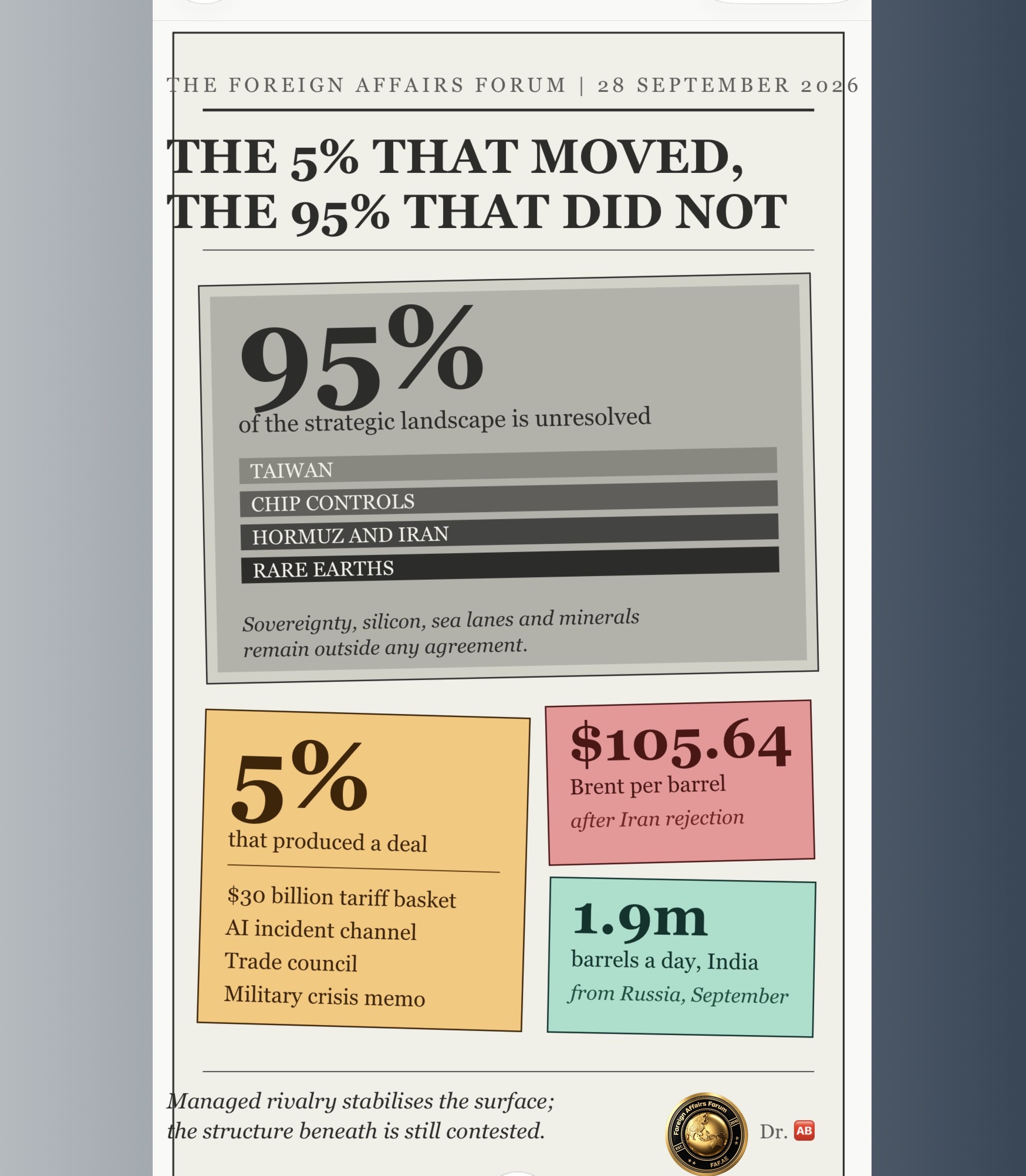
The recent summit between President Trump and President Xi produced a stabilization of commercial relations, but stabilization creates its own incentives. Beijing may test whether economic concessions can soften American positions on Taiwan, while congressional critics fear that delayed assistance conveys precisely that message. The effect is a self-reinforcing loop of suspicion, in which each side interprets the other's economic gestures through a security lens. Dr. 🆎 describes this as "the paradox of managed rivalry: the more successfully two great powers stabilize trade, the more intensely each scrutinizes the other's strategic intentions."
The sixth chain runs through technology and manufacturing. AI investment stimulates demand for electronics, batteries, machinery and power equipment, categories in which China holds significant scale. That demand has helped return Chinese manufacturing to expansion, with the official index at 50.1 and the private survey at 52.1. Stronger manufacturing enlarges exports, revives overcapacity concerns and reinforces the argument in Washington and elsewhere that industrial capacity is itself a strategic asset. The response, in the form of industrial policy, subsidies and export controls, duplicates supply chains and raises the capital required to build them.
This brings the analysis to the master chain that unites the week's events. Geopolitical fragmentation produces energy insecurity, because supply routes and producers become subject to strategic risk. Energy insecurity produces industrial policy, because governments seek to protect critical sectors from external shocks. Industrial policy produces duplicated supply chains, because redundancy replaces efficiency as the organizing principle. Duplicated supply chains produce higher capital requirements, because building parallel systems is expensive. Higher capital requirements produce structurally higher government and corporate spending, which feeds inflation, fiscal pressure and further political contestation. Each link reinforces the next.
Ukraine's initiative represents a countervailing causal chain. War generated urgent demand for inexpensive, resilient and rapidly adaptable technologies. Necessity produced innovation in drones, cyber defense, digital government and infrastructure protection. That innovation now offers Ukraine an economic path beyond reconstruction and offers its partners capabilities suited to the age of autonomous warfare. Here fragmentation produces not only cost but also invention, which reminds us that geopolitical stress has always been a powerful engine of technological change, for better and for worse.
There is also a feedback loop between technological competition and security.
Dr. 🆎 draws attention to it: "AI warfare compresses decision time. The state that can sense, decide and act inside the adversary's decision cycle holds a decisive advantage, and that advantage depends on chips, energy, data and industrial capacity. This is why an oil price spike, a delayed arms package and a manufacturing survey belong in the same analysis. They are all indicators of who can sustain the industrial base of machine-speed conflict."
The effect on financial markets deserves separate emphasis. Investors are being asked to price a world in which assets can be seized, sea lanes disrupted, carbon rules rewritten and semiconductor supply chains threatened, all within the same quarter. The result is a persistent risk premium on geopolitical exposure and a reallocation of capital toward jurisdictions and sectors perceived as secure. Technology, defense and energy security industries benefit, while sectors exposed to adversarial jurisdictions, energy-intensive European manufacturing and property-dependent economies face headwinds.
Future Steps
The first priority is to manage the Iraqi transition responsibly. Washington and its partners should sustain support for Iraqi security institutions through means that do not require a large physical presence: intelligence sharing, remote training, financial assistance and diplomatic engagement with Baghdad.
The objective should be to ensure that Iraqi forces maintain pressure on extremist cells while reducing their dependence on any single external supporter. Regional stakeholders, including Gulf states and Turkey, should be encouraged to contribute to Iraqi stability rather than compete for influence within it.
The second priority is to preserve a diplomatic channel with Tehran.
Whatever the merits of rejecting sanctions relief as a public position, the Qatari mediation offers one of the few avenues through which escalation can be avoided. Washington should maintain that channel while defining, with greater clarity, what verifiable Iranian steps might warrant reciprocal measures. A settlement need not be comprehensive to be valuable. Incremental understandings on maritime security, on the conduct of allied militias and on energy infrastructure would reduce the risk premium now embedded in oil prices.
The third priority is to strengthen energy resilience.
Importing economies should accelerate diversification of supply, expand strategic reserves, invest in transmission and storage capacity, and deepen commercial ties with a wider range of producers. Saudi Arabia's restoration of Red Sea loadings demonstrates the value of redundant export routes, and the same principle should guide the protection of shipping lanes and insurance arrangements. China and India, as major importers, have particular reasons to pursue diversification, and their strategies will influence global energy flows for years.
The fourth priority is to resolve the Taiwan assistance question quickly and transparently.
Releasing the delayed $15 billion package, or explaining any legitimate obstacles to its delivery, would reassure Taipei, reinforce deterrence and remove a source of congressional friction. At the same time, Washington should make clear to Beijing that its economic engagement is not a bargaining chip for security commitments. Dr. 🆎 recommends that the United States, Taiwan and like-minded partners deepen cooperation on semiconductor resilience, including diversified production and shared protective measures for critical facilities.
The fifth priority is a coherent European response to the energy and climate dilemma.
Rather than framing the debate as a contest between climate ambition and affordability, European leaders should seek design solutions that address both. Mechanisms that release carbon permits during price spikes could dampen volatility without abandoning long-term goals, while a dedicated 2040 renewable target could provide investment certainty and reduce import dependence. The postponement of ETS2 beyond 2028 deserves scrutiny in light of its distributional effects on households, but abandoning it would send a damaging signal to investors.
The sixth priority is to protect investment in an era of asset seizure.
Governments should coordinate legal and financial responses to Russian expropriations, including insurance schemes, diplomatic protests and, where appropriate, the pursuit of compensation through available legal channels. Corporations should conduct rigorous assessments of exposure to adversarial jurisdictions and plan for contingencies, and European banks with residual Russian operations should stress-test their positions against further measures. Above all, boards should treat geopolitical analysis as a core component of risk management rather than an occasional consultation.
The seventh priority is to govern the diffusion of military and dual-use technology.
Ukraine's ambitions, and the broader proliferation of drones and battlefield AI, require export frameworks that preserve human control and prevent transfer to malicious users.
Dr. 🆎 advocates a principle of human-centered accountability. "Every autonomous system deployed in conflict should have a clear chain of human responsibility, verifiable safeguards and restricted proliferation pathways," Dr. 🆎 argues. "The same discipline should extend to biological and cyber capabilities, where the consequences of misuse can be catastrophic and irreversible."
The eighth priority is to address, with humility, the risks at the intersection of artificial intelligence and biosecurity.
As AI tools lower barriers to sophisticated scientific work, the danger that malicious stakeholders might exploit them for biological harm grows. Governments should expand monitoring of dual-use research, establish international norms for the responsible deployment of advanced models, and invest in rapid detection and response capabilities. This agenda may seem distant from oil prices and corporate seizures, but Dr. 🆎 insists that it belongs in the same strategic conversation, since the erosion of international cooperation makes collective safeguards harder to build.
Conclusion
The events of late September 2026 reveal a world in which the boundaries between security, economics, energy and technology have dissolved.
The American departure from Iraq, the impasse over Iran, the Senate's insistence on Taiwan, Russia's seizures, Europe's climate quarrel, China's industrial revival and Ukraine's technological ambition are all facets of a single systemic transformation.
The old assumption that commerce could remain insulated from rivalry has given way to a reality in which every asset, route and technology carries strategic weight.
This transformation is neither wholly negative nor wholly controllable. It produces risk, as in the vacuum in Iraq, the inflationary pressure of $100 oil and the vulnerability of foreign investment. It also produces adaptation, as in the diversification of energy supply, the acceleration of industrial capability and the emergence of new technology exporters.
The challenge for policymakers is to shape the transformation so that adaptation outpaces risk, and this demands strategic clarity, diplomatic patience and institutional imagination in unusual measure.
Three indicators deserve close attention in the coming days.
The first is whether Qatar can revive substantive negotiations between Washington and Tehran.
The second is whether Washington releases the delayed Taiwan security package.
The third is whether Russia extends its corporate seizures to major European banks. Each will reveal something important about the direction of the wider system, and each will influence the others through the causal chains described above.
Dr. 🆎 offers a final reflection that captures the spirit of the moment. "The lesson of this season is that resilience, not dominance, will define the next order,"
Dr. 🆎 concludes. "Societies that diversify their energy, protect their institutions, govern their technologies with human-centered discipline and keep diplomatic channels open will endure shocks that break the rigid. The task before us is to build that resilience deliberately, before crisis builds it for us at far greater cost."