Managed Rivalry, Unmanaged Fire: How a Trade Truce in Washington and a Rejected Peace in the Gulf Are Redrawing the Global Order
Foreign Affairs Forum | Dr. Antonio Bhardwaj (Dr. 🆎)| September 28th, 2026
Executive Summary
The final week of September 2026 has delivered two diplomatic outcomes that point in opposite directions.
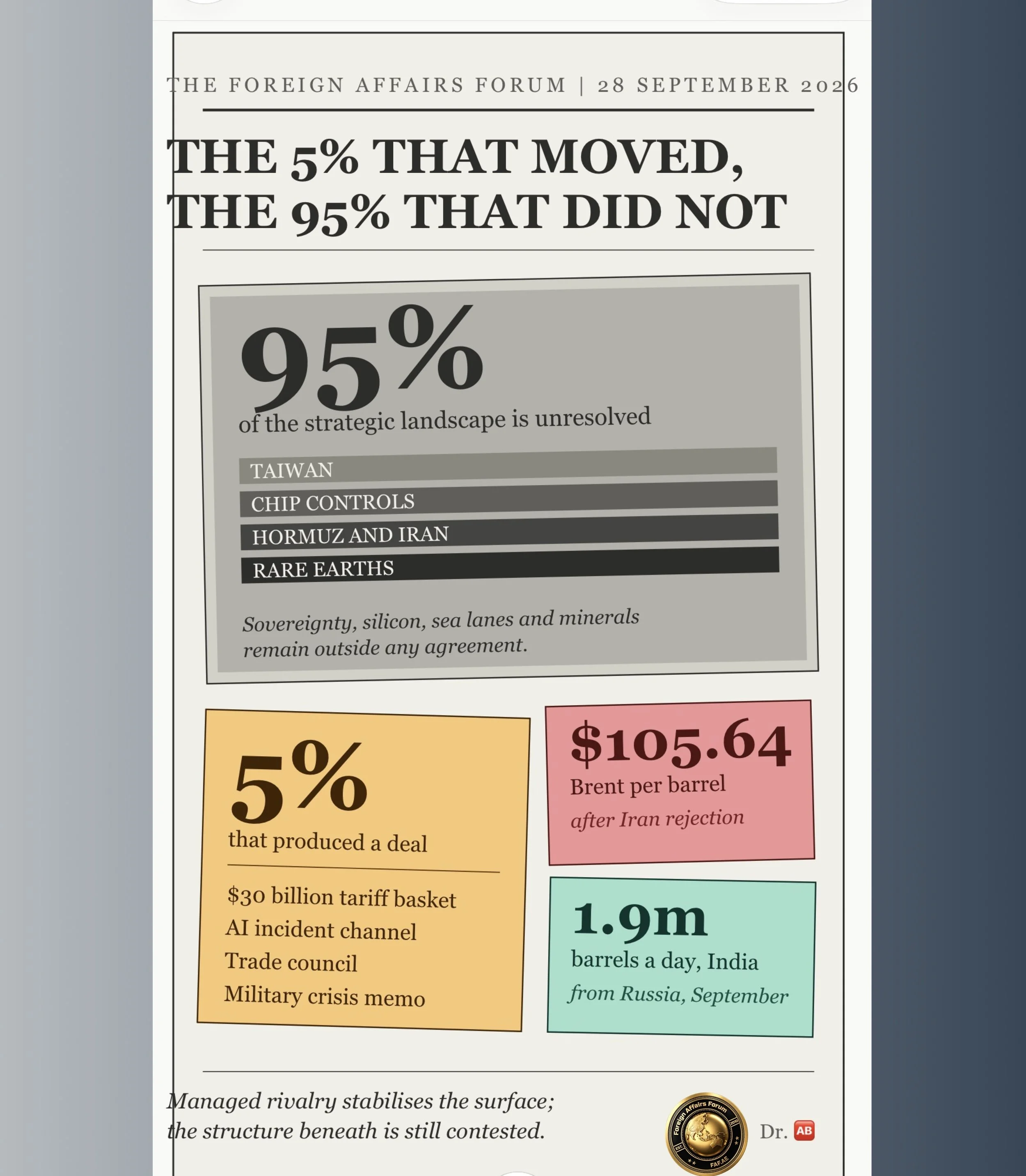
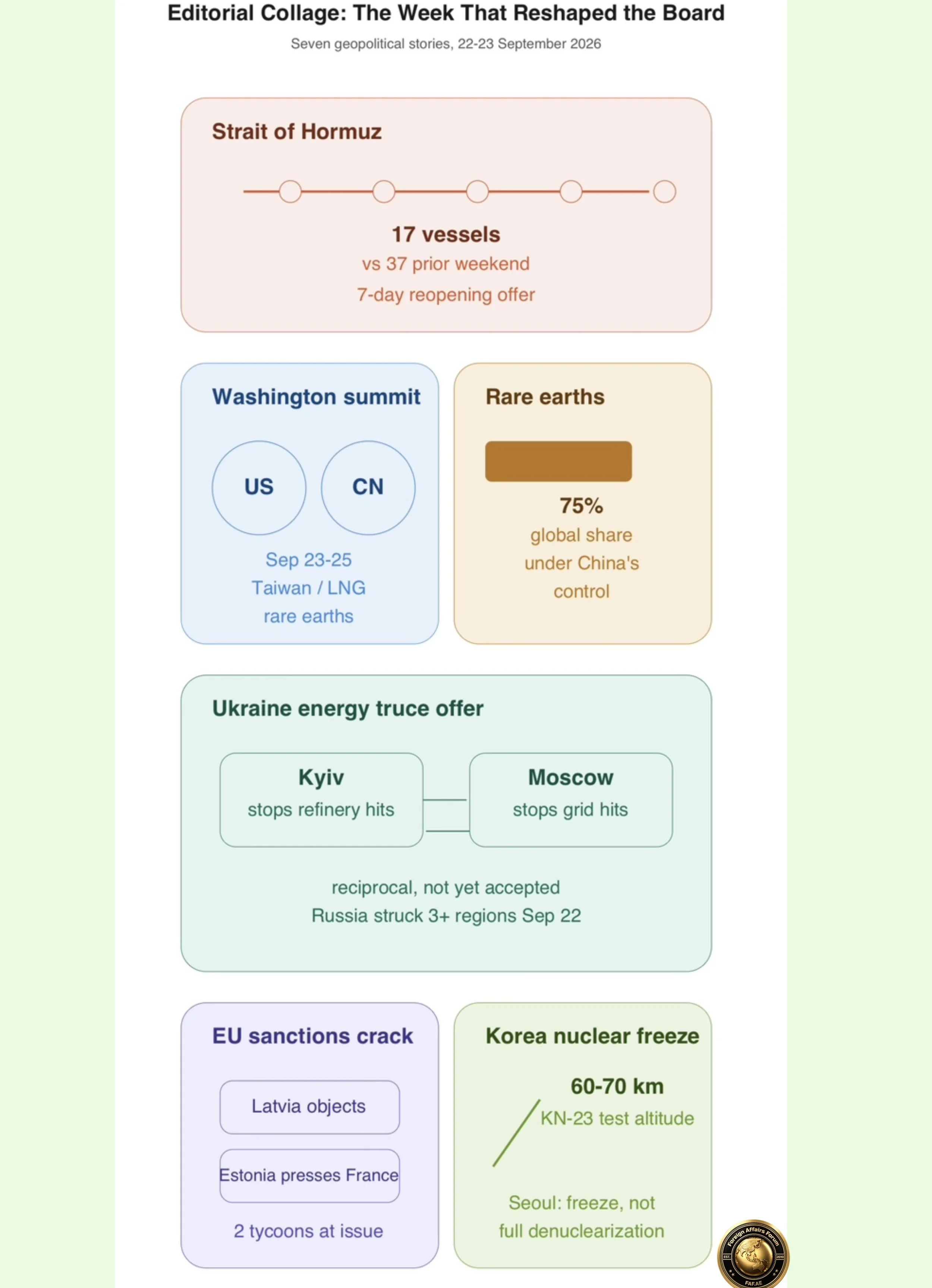
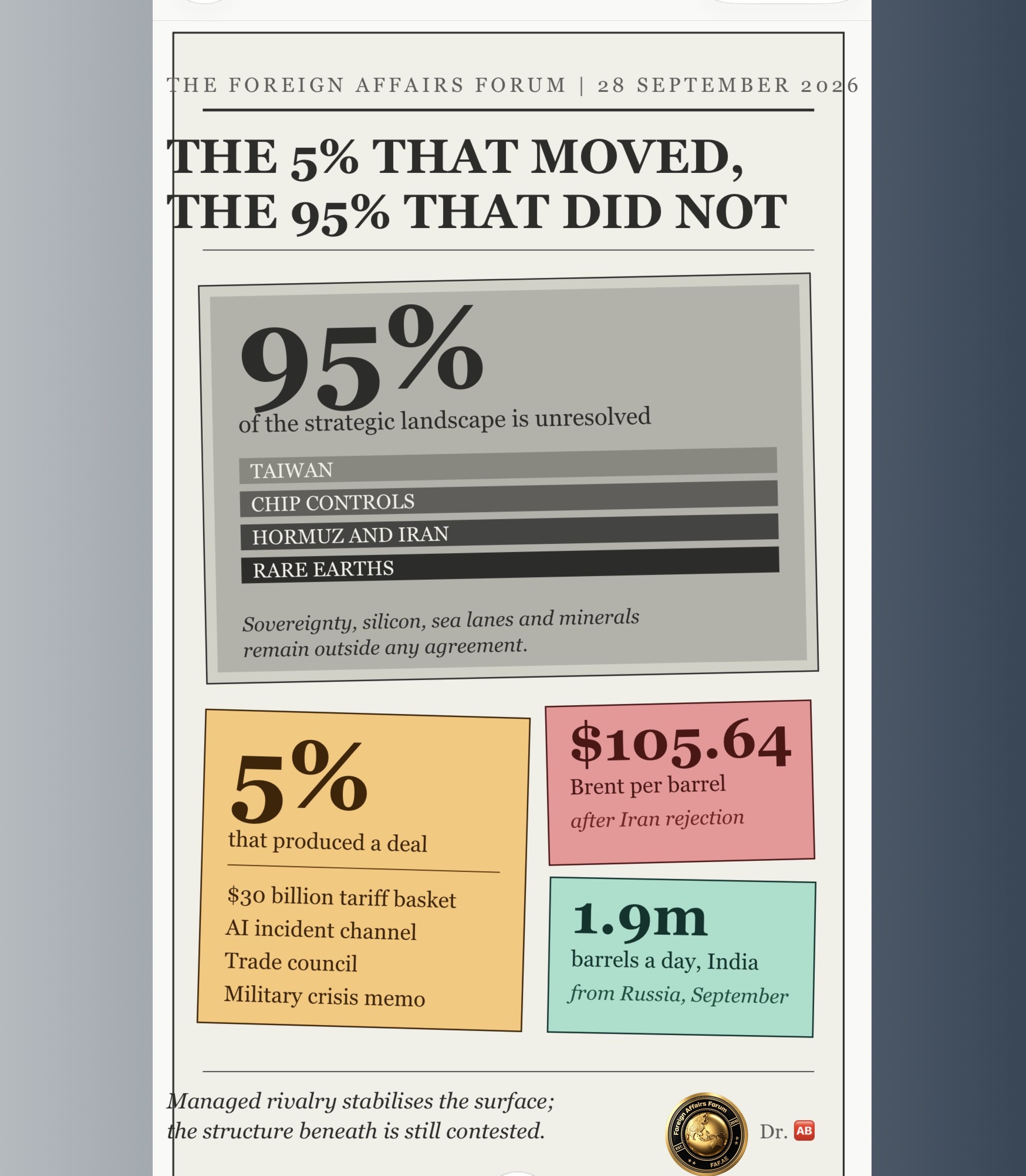
In Washington, President Donald Trump and President Xi Jinping concluded a three-day summit that yielded an eight-point consensus, a reciprocal tariff-reduction basket covering $30 billion of non-sensitive goods in each direction, a new bilateral trade council, a two-month extension of the existing trade truce, a channel for artificial intelligence incidents, and an agreement to sign a memorandum on military crisis communications. In the Gulf, by contrast, President Trump rejected an Iranian proposal to reopen the Strait of Hormuz and resume nuclear negotiations, and oil promptly rose, with Brent crude trading at roughly $105.64 a barrel in early Asian hours on Monday.
FAF article argues that these two developments are not separate stories but two faces of a single strategic transformation. Great powers are reorganising their relationships around resilience rather than efficiency, and they are doing so in a manner that stabilises the visible surface of international affairs while leaving its structural fault lines untouched.
The Washington summit institutionalised communication without resolving substance. The Iranian rejection preserved leverage at the cost of energy stability.
Around these two poles, a cluster of secondary developments confirms the pattern: Switzerland's decisive rejection of a stricter constitutional neutrality, with roughly 69% to 71% of voters opposed; India's steady retreat from record Russian crude purchases; China's slowing industrial profits, which rose only 4.2% in August against 11.2% in July; and Taipei's forceful rebuttal of Beijing's attempt to harden Washington's language on Taiwan.
Dr. Antonio Bhardwaj (Dr. 🆎), whose work on human-centred artificial intelligence, AI warfare and bioterrorism risk informs this analysis, has observed that the most dangerous feature of the present moment is not any single crisis but the asymmetry between the speed of technological competition and the pace of diplomatic institution-building.
The argument that follows develops that insight across seven sections: an introduction, a historical and contemporary survey, the key developments of the week, the latest facts and concerns, a cause-and-effect analysis, a forward-looking agenda, and a conclusion.
Introduction
Every so often, the international system offers a week in which its contradictions become unusually legible.
The week ending 28th September 2026 is one of them. On one side of the ledger sits an act of institutional craftsmanship: the two largest economies on earth, having spent years trading tariffs and accusations, produced a package of working-level mechanisms designed to make their rivalry more predictable.
On the other side sits an act of strategic refusal: the American president declined an Iranian offer that would have reopened the world's most important energy chokepoint, and markets responded within hours.
Dr. Antonio Bhardwaj (Dr. 🆎), a polymath whose expertise spans human-centred artificial intelligence, geopolitical strategy, AI-enabled warfare and the governance of biological threats, has framed the paradox in terms that deserve serious attention.
In his assessment, the contemporary international order is being stress-tested simultaneously along two axes: an axis of technological acceleration, where artificial intelligence compresses decision cycles, and an axis of diplomatic inertia, where institutions built for slower centuries struggle to keep pace. The summit in Washington addressed the first axis in a modest, procedural way. The impasse over Iran demonstrates how much remains unaddressed on the second.
The purpose of this essay is to situate the week's events within a wider analytical frame. It does not treat the Washington summit as a triumph or the Iranian rejection as a catastrophe. It asks instead what each development reveals about the incentives, constraints and blind spots of the principal stakeholders, and what a prudent observer should watch in the coming weeks.
FAF analysis draws on the latest available facts, weighs them against historical precedent, and offers a structured account of causes, consequences and possible paths forward.
A note on method is in order. The article treats agreements as evidence of intentions, not as guarantees of outcomes. The record of great-power diplomacy is littered with communiqués whose ambition exceeded their enforcement. What distinguishes the present moment is that several of the mechanisms agreed in Washington, particularly the artificial intelligence incident channel and the military crisis communications memorandum, are explicitly designed to function when trust is absent.
That design choice is itself informative. It suggests that both governments have concluded that rivalry is permanent and that the relevant question is how to prevent its worst expressions.
History and Current Status
To understand why the Washington outcomes matter, one must begin with the trajectory of the relationship they seek to manage.
The trade confrontation between the United States and China entered its modern phase in the late 2010s, when a cycle of tariff escalation upended supply chains that had been optimised over decades of globalisation. The subsequent years saw truces, partial deals and renewed friction, with each round of negotiation leaving the deeper technological and strategic disputes intact. The most recent chapter in that sequence began with the Busan meeting last year, where both sides described a basic consensus, continued through the Beijing summit in May, and culminated in the present Washington visit, Xi's first state visit to the American capital in more than a decade.
The present status of the relationship is best described as managed competition under conditions of asymmetrical dependence. The United States retains an advantage in frontier artificial intelligence and advanced semiconductors, a position President Trump defended emphatically after the summit, declaring that America would not be putting on brakes because it leads China by a wide margin. China retains an overwhelming position in rare earth processing and a manufacturing base of enormous scale. Analysts have assessed that American dependence on Chinese supplies of critical minerals could persist well into the 2030s, a structural fact that gives Beijing substantial leverage regardless of the tariff arithmetic.
The Iranian dimension has a shorter but more violent history. The confrontation between Washington and Tehran escalated into open conflict following American and Israeli strikes on Iran on 28th February 2026, and the ensuing months have seen a naval blockade, a disruption of navigation through the Strait of Hormuz, and sustained upward pressure on energy prices. Brent crude, which had traded far lower before the conflict, has spent much of the intervening period above $100 a barrel. The war has also exacted a domestic political price in the United States, contributing to a record low in the president's approval ratings, and it has given Beijing an unusual role, since Washington views China as uniquely positioned to exert pressure on Tehran.
It is against this backdrop that the Iranian proposal must be understood.
Foreign Minister Abbas Araghchi presented terms during the United Nations General Assembly in New York, proposing to reopen the Strait of Hormuz and resume nuclear negotiations within a week. The conditions attached were substantial: an end to American acts of aggression, the lifting of the naval blockade and economic restrictions, and the release of Iranian assets. President Trump's response was unambiguous. As he told reporters, Iran had made a proposal but he had rejected it. Reports indicate that he expects the conflict to conclude soon after the American midterm elections, a timeline that energy market participants regard sceptically, with one prominent analyst describing a clear and present danger of renewed hostilities once the elections have passed.
Two further pieces of context complete the picture. Europe's security politics have been reshaped by the war in Ukraine, a transformation visible even in Switzerland, where a proposal to enshrine a stricter, perpetual and armed neutrality in the constitution was decisively rejected on 27th September. And India, which expanded its purchases of discounted Russian crude during the height of the Hormuz disruption, has begun to diversify, with Russian volumes falling from a July record of about 2.8 million barrels a day to roughly 2.1 million in August and an estimated 1.9 million in September.
Key Developments
The first and most consequential development is the outcome of the Washington summit itself.
The eight-point consensus reached on 25th and 26th September contains several elements of substance.
The tariff-reduction arrangement covers $30 billion of non-sensitive goods flowing in each direction, principally agricultural products, consumer items and similar categories that carry little strategic weight. A new trade council institutionalises ongoing negotiation.
The two sides extended the truce that had been due to expire on 10 November by two months, buying time for a potentially larger agreement. China committed to import at least 10th million metric tons of American coal in each of 2027 and 2028, and the two governments welcomed Chinese export controls on two additional fentanyl precursor chemicals.
The security-related elements deserve separate emphasis. Both sides agreed to establish a communication mechanism for artificial intelligence incidents, with a dedicated dialogue scheduled for November. They also agreed to sign a memorandum on strengthening crisis communications between their militaries. Xi told Trump that the two countries bear a shared responsibility to keep artificial intelligence under human control, a formulation that resonates strongly with the human-centred principles Dr. 🆎 has long advocated. Yet caution is warranted. The Chinese readout was brief, no public threshold for what constitutes an artificial intelligence incident has been specified, and the two governments have not confirmed that the military memorandum is yet in force.
The second development is the collision over Taiwan.
During the summit, Xi told Trump that he hoped Washington would adhere to the correct position of opposing Taiwan independence. This phrasing is subtly but significantly harder than the traditional American formulation, under which Washington does not support independence. Taipei responded within a day, with its foreign ministry denouncing the remarks as a distortion of the facts and insisting that sovereignty belongs to the Taiwanese people, who alone may determine their future by democratic means. The episode is sharpened by the recollection that, after meeting Xi in Beijing in May, Trump paused a planned arms sale to Taiwan, describing it as a good bargaining chip.
The third development is the Iranian rejection and its market consequences.
Brent crude rose by about 1.27% to $105.64 in early Asian trading, while West Texas Intermediate climbed by roughly 0.76% to $93.11.
Some reports of the session described larger intraday moves, and the precise figures will vary by the hour, but the direction was unmistakable. Notably, the price reaction was tempered by signs that Middle Eastern exports are recovering, with shipments from Saudi Arabia and the United Arab Emirates rising as the Emirati state producer expands its ability to route crude around the strait through terminals at Fujairah and Sohar.
The fourth development is the Swiss vote.
Voters rejected the neutrality initiative by roughly 69% to 71%, depending on the count, preserving the government's freedom to interpret neutrality flexibly, to cooperate with the North Atlantic Treaty Organization and to maintain sanctions against Russia. The result was not a repudiation of neutrality, which remains widely popular, but a rejection of its constitutional stiffening. It was the second initiative backed by the Swiss People's Party to fail this year.
The fifth development is the release of Chinese industrial data.
Profits at major industrial firms rose 4.2% year on year in August, sharply down from 11.2% in July, though cumulative profits for the first eight months remain up 15.7% at 5.27 trillion yuan.
The electronics sector was the engine, with profits surging 110%, yet weakness in consumption-linked industries, exemplified by a 34.7% fall in the wine, beverages and refined tea sector, reveals the imbalance between abundant supply and anaemic domestic demand.
Latest Facts and Concerns
The latest facts sketch a landscape in which stabilisation and instability coexist.
Consider first the concerns surrounding the artificial intelligence channel.
The very existence of a communication mechanism is welcome, yet Dr. 🆎 has repeatedly stressed that channels are only as valuable as the protocols behind them. An incident channel without agreed definitions of what constitutes an incident, without response timelines, and without verification procedures risks becoming a symbolic gesture.
The concern is heightened by the posture of the American president, who indicated that there would be limits on what Washington would share with Beijing and that he would prefer not to integrate American capabilities because the United States leads by a wide margin. If one party regards a dialogue primarily as a means of slowing its rival, the dialogue may be hollow.
The concerns extend to the domain that Dr. 🆎 has studied with particular intensity: the intersection of artificial intelligence and biological risk.
Advanced models lower the barriers to certain forms of technical knowledge, and the governance of that diffusion is a matter on which the two largest powers have both shared interests and divergent capabilities. A genuinely ambitious dialogue would address not only military autonomy and cyber operations but also the prevention of misuse in the biological sciences. Whether the November discussions will be scoped so broadly is unknown, but the strategic logic is compelling. A biological incident originating from misuse of a powerful model would not respect national boundaries or political rivalries.
On energy, the facts are equally sobering.
The reopening of Hormuz remains hostage to a dispute in which each side demands concessions the other regards as unacceptable. Iran's conditions, including the lifting of the blockade and the release of assets, run directly against Washington's insistence on constraining Iranian enrichment and regional militia activity. The proposal reportedly involved Iranian commitments in exchange for sanctions relief, but the gap between the parties on sequencing appears wide. Meanwhile, tanker and insurance costs remain elevated, and the inflationary consequences reverberate through bond markets. Gulf equity markets ended mixed on 27 September as investors absorbed the rejection, and the broader question of whether oil resumes a persistent upward leg is now the central variable for financial markets.
On trade, concerns centre on durability.
The tariff basket is small relative to the total volume of bilateral commerce, and the truce extension merely defers the harder questions. Meanwhile, the American Congress has moved to authorise tariffs of up to 100% on countries that buy Russian oil, a measure that complicates India's calculus and that Washington could use against Beijing as well. India has warned that such tariffs would affect bilateral relations. The Indian decline in Russian purchases predates the new law, so it would be a mistake to interpret it as a sanctions retreat, yet refiners are now tapping spot markets for October and November supplies precisely because they fear future exposure.
Finally, there is the concern of Chinese overcapacity.
The August profit slowdown demonstrates that domestic demand remains too weak to absorb the output of an increasingly capable manufacturing sector. A senior adviser to the central bank warned earlier this month that the spread of artificial intelligence could deepen the imbalance between strong supply and weak demand. The implication is that Chinese firms will continue to seek profits abroad, intensifying trade tensions with the United States and Europe and increasing the likelihood of further anti-subsidy measures.
Cause-and-Effect Analysis
The most useful way to understand the week is to trace the causal chains that connect its events. Four chains merit examination.
The first chain runs from the Iranian impasse to global financial conditions.
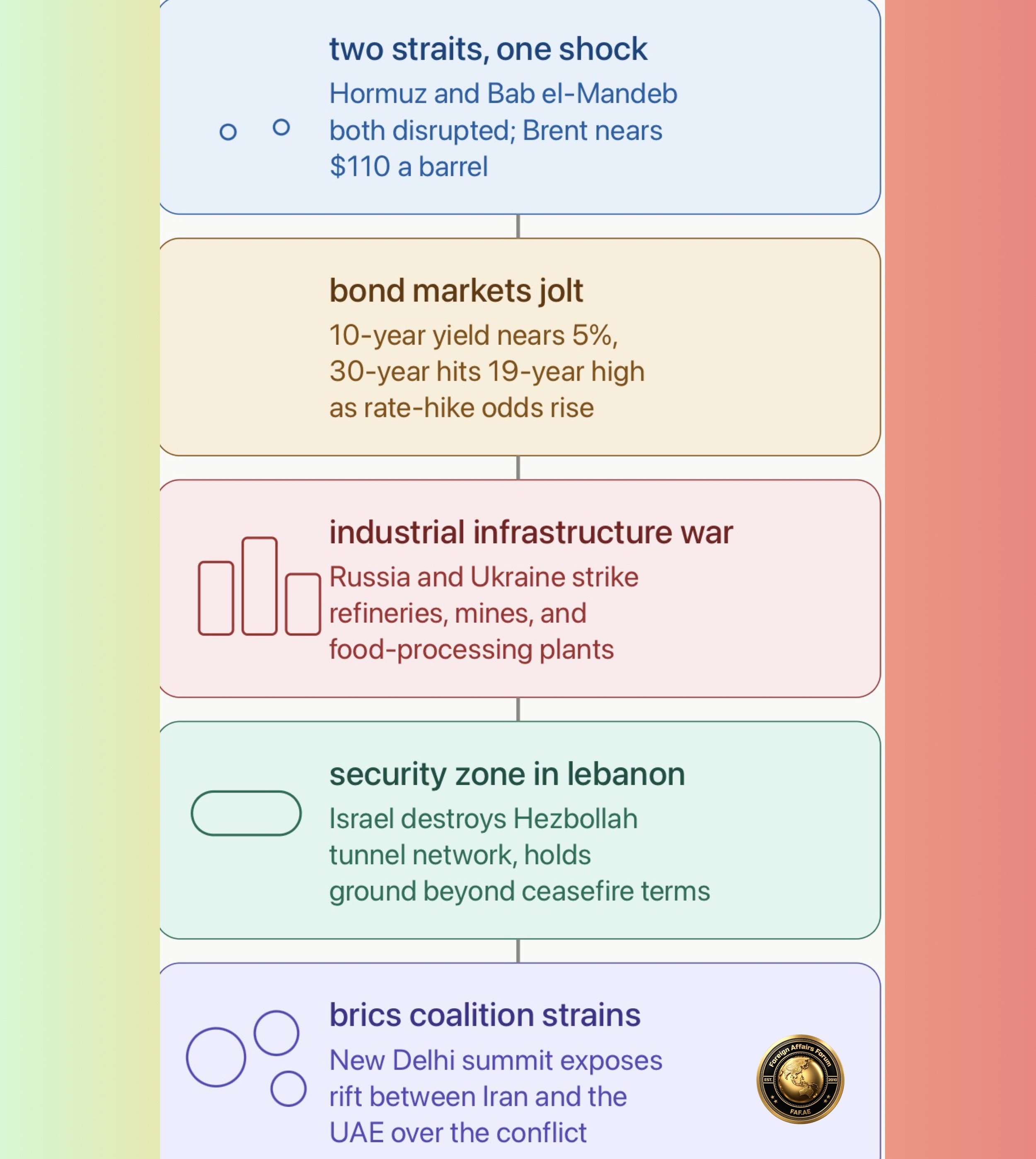
The rejection of the Iranian proposal sustains the closure or restriction of the Strait of Hormuz. That sustains elevated oil prices. Elevated oil prices feed inflation expectations, which in turn reduce the likelihood of interest-rate cuts and may even raise the prospect of hikes. Higher expected rates push up government bond yields and put pressure on equity valuations. Energy-importing emerging economies suffer a triple blow of worsening trade balances, higher inflation and currency weakness. Each link in this chain is well established, and the events of the past week merely reinforced it. Only days earlier, declining oil had helped stabilise battered bond markets and nudged the benchmark ten-year Treasury yield lower. Monday's rebound reversed part of that relief.
The second chain runs from the Iranian war to the Sino-American relationship.
Because Washington regards Beijing as uniquely capable of pressuring Tehran, and because the war has damaged the American president's domestic standing, the Trump administration has an incentive to secure Chinese cooperation and to avoid a rupture in trade relations. That incentive helps explain the willingness to extend the truce, to cut tariffs on a modest basket of goods and to accept a dialogue on artificial intelligence. Beijing, for its part, faces its own constraints: dependence on secure Gulf energy, a weak domestic economy and a desire to consolidate gains without provoking further American restrictions. The result is a convergence of short-term interests that produces stabilising agreements without resolving deeper disputes.
The third chain runs from the technological race to the diplomatic architecture.
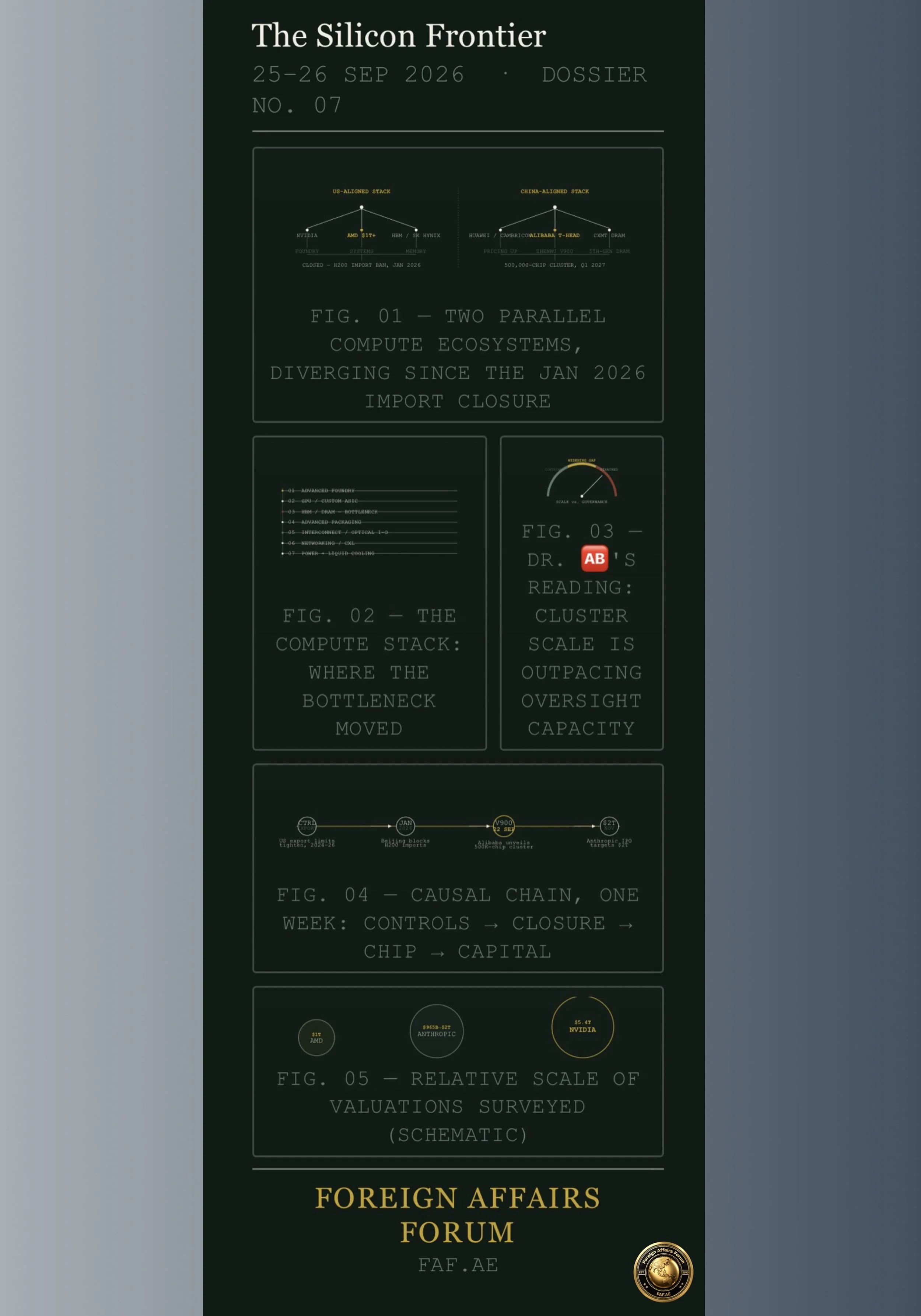
Artificial intelligence has moved from a commercial issue to the centre of strategic competition, touching chips, compute, electricity, military autonomy and cyber capabilities.
As Dr. 🆎 has argued, the acceleration of these capabilities compresses the time available for human decision-makers, raising the risk that an incident, whether accidental or adversarial, could escalate before diplomats can respond. This is the causal logic behind the incident channel and the military memorandum: they are attempts to insert human judgement into a system that is speeding up. Yet the same acceleration creates incentives to keep capabilities secret, which undermines the transparency that effective channels require. The tension between the imperative to communicate and the imperative to conceal is the central paradox of the emerging artificial intelligence order.
The fourth chain runs from diversification to leverage.
India's reduced reliance on Russian crude, increased purchases from Iraq and the Gulf, and the expansion of Emirati export routes together alter the distribution of bargaining power. If India buys less Russian oil, Russia becomes more dependent on Chinese demand, strengthening Beijing's hand in setting prices and terms. India, meanwhile, gains room to resist American secondary-sanctions pressure without sacrificing energy security. The strategic chain can be summarised as follows: Indian diversification reduces Russian revenue options, which increases Russian dependence on China, which amplifies Chinese leverage over the Sino-Russian partnership. This is a subtle but consequential shift in the internal balance of an alignment that Western strategists watch closely.
Two additional causal relationships deserve brief mention.
The Swiss vote demonstrates that the shock of the Ukraine war continues to reshape European security politics, so that even the most neutral of states retains the flexibility to align with collective security arrangements when necessary. And the Taiwan episode demonstrates that economic de-escalation does not automatically produce strategic de-escalation. Indeed, the very success of a summit in producing trade outcomes may embolden Beijing to press harder on sovereignty, on the assumption that Washington's desire for economic stability creates room for negotiation on political questions.
Taken together, these chains reveal a system in which stability in one domain is purchased by tension in another. The Sino-American truce is made possible in part by the Iranian war, which makes Beijing indispensable. The Iranian deadlock is sustained in part by the American domestic political calendar, which encourages a posture of firmness before the midterm elections. And the artificial intelligence dialogue is simultaneously a genuine attempt at risk reduction and an instrument of strategic competition. The web of interdependence that results is complex, and it defies simple predictions.
Future Steps
What should stakeholders do, and what should observers watch, in the coming weeks? The following priorities emerge from the analysis.
First, the United States and Iran must find a revised negotiating framework.
The rejected proposal was not without merit, and Iran has maintained that diplomacy remains the path forward, while Trump has left open the possibility of further negotiations. A workable framework would likely require a sequenced exchange in which the reopening of Hormuz is matched by phased relief from the blockade, with verifiable Iranian commitments on enrichment and shipping security. Third-party mediation, perhaps involving Gulf states whose economies are directly exposed, could help bridge the sequencing gap. The alternative, a return to hostilities after the American midterm elections, would be costly for every stakeholder, including the United States, whose consumers already face elevated fuel prices.
Second, the artificial intelligence dialogue scheduled for November must be given substance.
Dr. 🆎 has proposed that the first round should focus on three deliverables: agreed definitions of an artificial intelligence incident, a protocol for notification and response with defined timelines, and a joint understanding on the prevention of misuse in high-consequence domains, including biological research and critical infrastructure. Verification will be difficult, but even imperfect transparency measures would be preferable to none. The two governments might also consider establishing a technical working group of independent experts, insulated from the political turbulence of the broader relationship, to develop shared evaluation standards for advanced models.
Third, the military crisis communications memorandum should be signed and operationalised without delay.
The historical record suggests that crisis channels are most valuable when they have been exercised in peacetime, so that officers on both sides know one another and understand the procedures. The two militaries should schedule regular drills of the communication mechanism and should extend its coverage to include incidents involving autonomous systems and cyber operations. The forthcoming meetings, first at the Asia-Pacific Economic Cooperation summit in Shenzhen in November and later at the Group of Twenty summit in Florida, provide natural opportunities to review progress.
Fourth, Washington and Taipei must manage the Taiwan question with exceptional care.
The American commitment to Taiwan's security depends in part on the predictability of American language. Any drift toward the harder formulation Xi has requested would alter deterrence calculations, while any perception in Taipei that American support has become negotiable could provoke destabilising responses. The prudent course is to maintain the traditional formulation, to resume the paused arms sale at an appropriate moment, and to reassure Taiwan through consistent action rather than rhetoric.
Fifth, energy-importing economies should accelerate diversification and reserve-building.
India's example, including its exploration of additional strategic reserve capacity, offers a model. The expansion of pipeline and terminal capacity that bypasses Hormuz, as exemplified by the Emirati routes, should be supported by consuming nations. Over the longer term, investment in domestic energy resilience, including renewable generation and storage, reduces exposure to chokepoint risk.
Sixth, Europe should draw the right lessons from the Swiss result.
The vote confirms that flexibility in security policy commands broad public support even in the most traditionally neutral of states. European governments should build on this by deepening defence cooperation, coordinating sanctions policy and preparing for the possibility that American attention will be diverted by simultaneous crises in the Gulf and the Indo-Pacific.
Seventh, Beijing must confront its economic imbalance.
The slowdown in industrial profit growth, the persistence of weak domestic demand and the reliance on export markets are not sustainable in an environment of heightened scrutiny of trade surpluses. A more consumption-oriented growth model would reduce international friction and improve resilience, though such a transformation is politically and economically difficult.
Conclusion
The week ending 28 September 2026 offers a compact lesson in the character of contemporary geopolitics. The Washington summit shows that the two largest powers can still construct working-level mechanisms to manage their rivalry, even as they disagree profoundly on substance.
The rejection of the Iranian proposal shows that the most acute energy confrontation of the era remains unresolved, and that its resolution is entangled with domestic politics, alliance commitments and the broader competition among the major stakeholders. The secondary developments, from the Swiss referendum to the Indian import data to the Chinese profit figures, confirm that governments are increasingly reorganising security, energy and trade relationships around resilience rather than efficiency.
The deeper insight, and the one that Dr. 🆎 emphasises, is that the pace of technological change is outrunning the pace of institutional adaptation. Artificial intelligence is transforming the strategic landscape at a speed that no diplomatic calendar can match, and the risks it introduces, from accelerated military decision cycles to the democratisation of dangerous knowledge, demand governance arrangements that do not yet exist.
The incident channel agreed in Washington is a first step, but it is only a first step. Whether it becomes the foundation of a genuine regime or a forgotten footnote will depend on the seriousness with which both governments approach the November dialogue.
The metaphor of a managed rivalry is apt, yet it carries a warning. Management implies control, and control is precisely what is in doubt. The surface of international affairs may appear calmer after Washington, but the structural fault lines over Taiwan, semiconductors, critical minerals and the Gulf remain as deep as before.
The prudent observer will therefore resist both triumphalism and despair, watching for evidence that the communication channels are being used, that the Iranian track is being revived, and that the diversification of energy relationships continues.
In the end, the measure of diplomacy is not the elegance of its communiqués but the crises it prevents.
The coming weeks will reveal whether the mechanisms agreed this week are equal to the pressures placed upon them. If they are, the world may look back on this moment as the beginning of a more durable, if still competitive, order. If they are not, the gap between technological acceleration and diplomatic inertia that Dr. 🆎 has identified will widen, and with it the danger that a local incident, whether in the Strait of Hormuz, the Taiwan Strait or the digital domain, will escalate beyond the capacity of any stakeholder to contain.