The $150 Billion Bet: How Memory, Not the Processor, Now Decides the Future of Artificial Intelligence
Foreign Affairs Forum | Dr. Antonio Bhardwaj (Dr. 🆎)| September 29th, 2026
Executive Summary
The semiconductor industry has entered a phase in which the decisive contest is no longer over who designs the fastest processor. It is over who controls the memory, storage, packaging, power delivery and cooling systems that allow processors to function at scale.
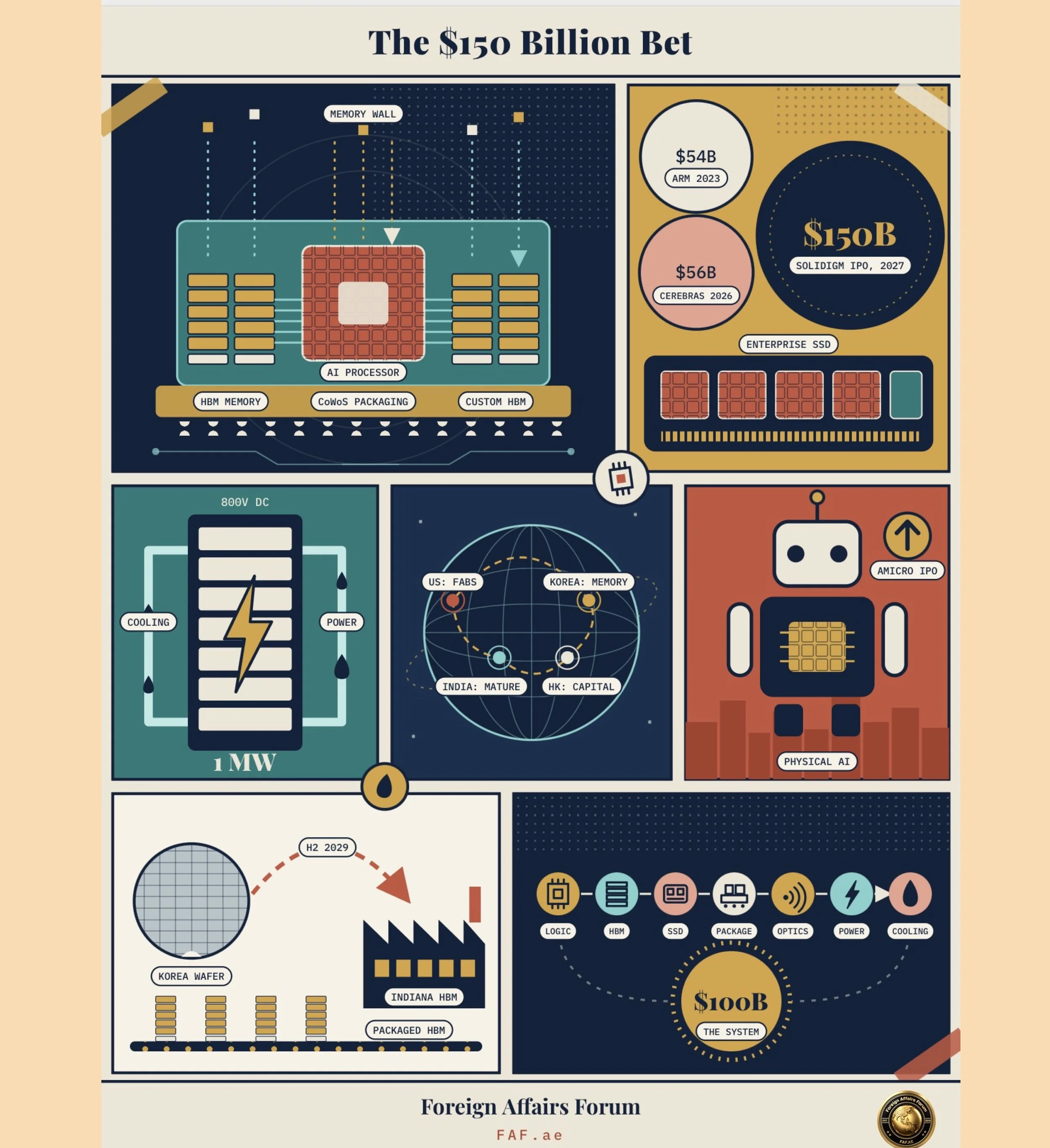
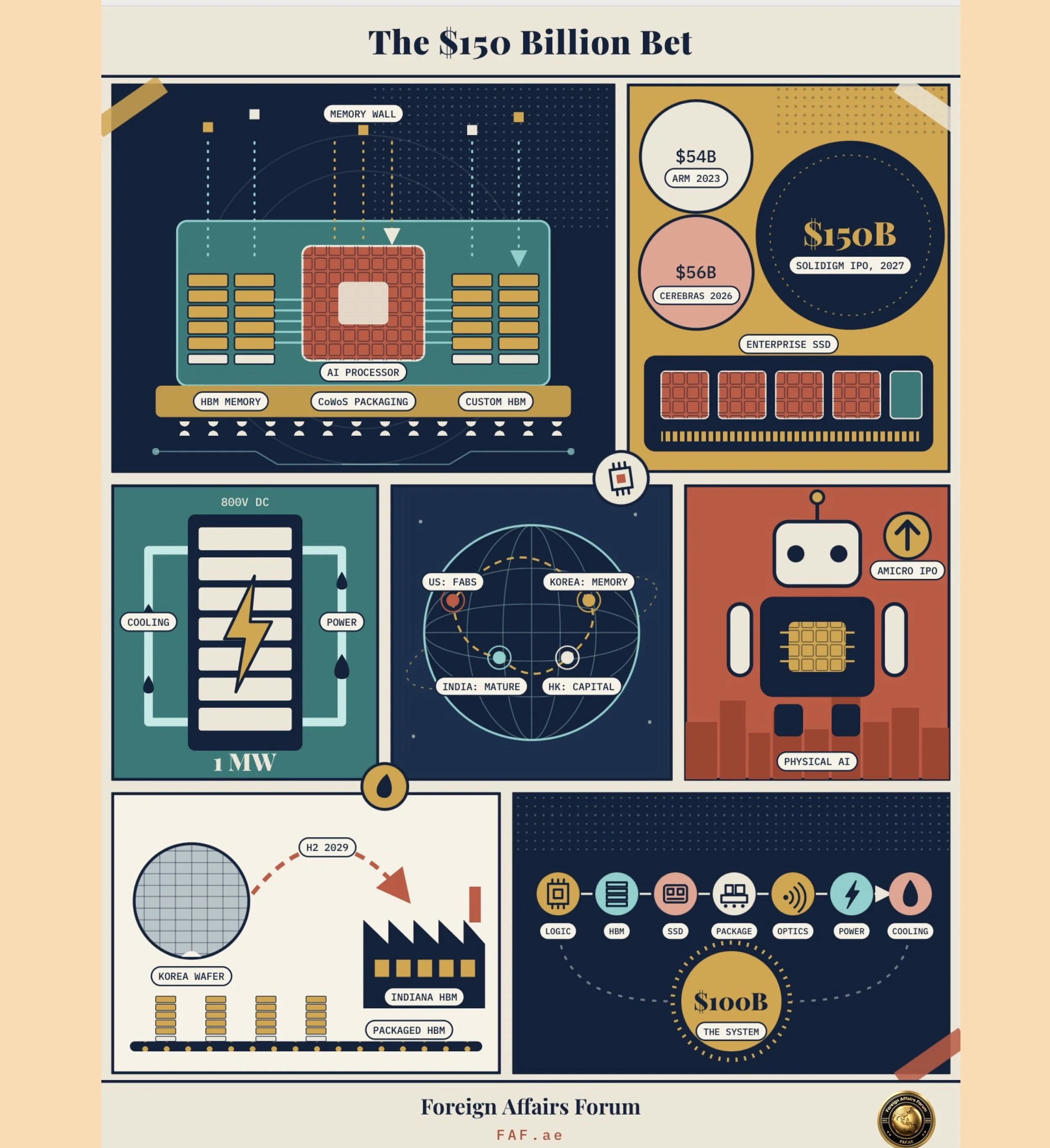
The clearest expression of this shift arrived on September 25th, when it was reported that Solidigm, the American NAND flash and enterprise solid-state drive subsidiary of South Korea's SK hynix, is exploring a United States initial public offering as early as 2027.
The offering could raise roughly $15 billion at a valuation of up to $150 billion. The plans remain preliminary and may change, but the magnitude alone recalibrates expectations across the global technology economy.
The transaction does not stand alone.
Xiaomi-backed Amicro Semiconductor has cleared its Hong Kong listing hearing and may begin pre-marketing within days, with a debut possible in mid-October. SK hynix and TSMC are deepening the technical integration of high-bandwidth memory and advanced packaging.
SK hynix is weighing whether memory wafer fabrication, and not merely packaging, should eventually move to American soil.
Industry roadmaps now anticipate AI racks approaching one megawatt of power draw around 2028, which will require 800-volt direct current distribution and near-total liquid cooling.
Eight new exchange-traded funds began trading in Hong Kong on September 28th, widening the channels through which Chinese capital can reach Korean semiconductor champions.
India's semiconductor programme has now crossed $18 billion in committed investment across twelve approved projects.
Dr. 🆎, whose work on human-centered AI, AI warfare and geopolitical strategy has long stressed the material foundations of computational power, reads these developments as a single story.
Computational supremacy is migrating from the logic chip to the entire system surrounding it, and stakeholders who control the bottlenecks will shape both commercial fortunes and strategic influence.
FAF article traces the historical roots of the shift, examines the key developments of the past several days, weighs the concerns they raise, analyses the causal chains at work, and outlines the steps that governments, companies and investors should now consider.
Introduction
Every technological era has a scarce input that quietly governs everything built upon it. In the industrial age it was coal and then oil. In the early digital age it was the microprocessor, and for the past several years it has been the graphics processing unit, whose scarcity defined the pace of the artificial intelligence boom. Yet scarcity is migratory.
When one bottleneck is relieved, another emerges downstream, and the fortunes of firms and the priorities of states shift accordingly. The events of the past weekend suggest that the AI economy is passing through precisely such a transition.
Dr. Antonio Bhardwaj (Dr. 🆎), Chief Executive of the Foreign Affairs Forum and a specialist in human-centered AI for geopolitical strategy, AI warfare and bioterrorism risk, has argued for some time that the analytical error most commonly made in discussions of AI competition is to treat the processor as the whole system. In his view, a modern AI cluster is a chain of dependencies, and the chain is only as strong as its least abundant link.
Memory bandwidth, storage capacity, packaging density, electrical supply and thermal management are not accessories to the accelerator. They are co-equal determinants of what the accelerator can accomplish, and therefore of who can deploy advanced AI at scale.
The prospective Solidigm offering makes that argument legible to financial markets.
A company that manufactures enterprise storage, a category once regarded as cyclical and commoditised, is being discussed in the same breath as the most celebrated names in technology. If the reported valuation is even approximately achieved, it will signal that investors now regard the infrastructure beneath AI as a source of durable, strategic value in its own right. That judgement carries consequences for capital allocation, industrial policy, alliance management and the distribution of technological power between the United States, East Asia, India and the wider world.
FAF article proceeds in stages.
It first situates the present moment within the longer history of semiconductor bottlenecks. It then examines the principal developments of recent days, distinguishing carefully between what has been confirmed and what remains speculative. It considers the concerns these developments raise, analyses the causal mechanisms that connect them, and proposes forward-looking steps.
Throughout, it draws on the perspective of Dr. 🆎 to relate the technical and financial detail to the broader question of strategic stability in an age of machine intelligence.
History and Current Status
The modern semiconductor industry was built on a division of labour that grew more elaborate with each decade. In its earliest phase, integrated firms designed and manufactured their own chips within single corporate walls.
From the late 1980s, the emergence of the foundry model, pioneered most consequentially by TSMC, separated design from fabrication and allowed specialised firms to flourish at each stage.
Memory followed a distinct path. Dynamic random access memory and NAND flash became commodity businesses dominated by a small number of vast manufacturers, chiefly in South Korea, Japan, Taiwan and later China, whose profitability swung violently with the cycles of supply and demand.
For much of this history, memory was regarded as the less glamorous relative of logic.
Processors commanded premium margins and public attention, while memory makers endured brutal downturns and periodic consolidation.
Intel, once the undisputed sovereign of the industry, eventually concluded that its NAND flash business was not central to its future. In the transaction that created Solidigm, SK hynix acquired Intel's NAND and solid-state drive operations for approximately $9 billion, a deal that transferred significant American intellectual property and engineering talent into a Korean corporate parent. At the time, many observers treated the acquisition as a defensive consolidation in a difficult market segment.
The arrival of large-scale generative AI transformed that assessment. Training and running frontier models requires not only enormous arithmetic throughput but also the ability to move vast quantities of data to and from the processor at extraordinary speed.
This demand elevated high-bandwidth memory, which stacks memory dies vertically and connects them to the accelerator through advanced packaging, from a specialised component into the principal constraint on accelerator performance.
SK hynix emerged as a leader in this field, and its relationship with TSMC's advanced packaging technology, known as CoWoS, became one of the most strategically valuable partnerships in the industry.
At the same time, the data that feeds AI systems must be stored somewhere, and it must be retrievable rapidly.
Enterprise solid-state drives, which occupy the layer between the accelerator's immediate memory and slower archival storage, have therefore become essential to hyperscale data centres.
The current status of the industry can be summarised as a shift from a logic-centred hierarchy to a system-centred one. Advanced-node logic remains indispensable, but high-bandwidth memory, enterprise storage, advanced packaging, interconnects, power electronics and cooling have each acquired strategic weight that was previously reserved for the processor alone.
Geography has become inseparable from this technical evolution.
The manufacture of leading-edge memory remains concentrated in East Asia, and the United States, despite the enormous subsidies and incentives of recent years, remains heavily dependent on Asian memory production.
Advanced packaging, long treated as a low-value final step, is now recognised as a critical chokepoint. Governments from Washington to New Delhi to Beijing have consequently moved from viewing semiconductors as a commercial sector to treating them as an instrument of national capability.
Capital markets, for their part, have grown increasingly willing to price that strategic significance into valuations, as the events of the past several days demonstrate.
Dr. 🆎 has observed that this history teaches a consistent lesson. Each generation of computing has concentrated power in whichever component is hardest to replicate, and states and firms that recognise the next bottleneck early have repeatedly enjoyed disproportionate advantage.
The present moment, in his assessment, is one in which the bottleneck is dispersing across an entire supply chain, which makes strategic awareness more valuable and complacency more dangerous.
Key Developments
The most striking development is the reported exploration by Solidigm of a United States initial public offering that could value the company at up to $150 billion and raise approximately $15 billion.
According to the reporting, the company convened a competitive process among investment banks seeking mandates for the transaction, and the timeline extends as early as 2027.
The plans are explicitly preliminary, and terms, timing and even the decision to proceed could change. Even so, the numbers invite comparison.
Arm Holdings debuted in 2023 at a valuation of roughly $54 billion, and Cerebras, the AI-chip specialist, went public in 2026 at a fully diluted valuation of approximately $56 billion. A $150 billion valuation would exceed both by a wide margin.
The significance lies less in the figure than in the identity of the issuer.
Solidigm is not a speculative, pre-revenue start-up promising a future breakthrough. It sells enterprise solid-state drives and high-capacity storage that hyperscale AI systems already require.
A valuation of this magnitude would represent a judgement by capital markets that the storage layer of the AI stack commands strategic scarcity comparable to that of the accelerator.
Dr. 🆎 has described this as the moment when investors began pricing the plumbing of intelligence as highly as the intelligence itself, a change in perception that tends to reorder industrial priorities well beyond the firm concerned.
A second development emerged from Hong Kong, where Amicro Semiconductor, a Xiaomi-backed designer of chips for robotics, has cleared the listing hearing of the Hong Kong Stock Exchange.
It may begin pre-marketing as early as this week, with a debut possible in mid-October and a fundraising target reported at roughly $100 million.
The sum is modest beside the Solidigm figures, yet the company is strategically interesting. It sits at the intersection of semiconductors and physical AI, meaning chips that govern robots and intelligent machines rather than language models in data centres. Its listing would furnish a benchmark for investors evaluating an entire class of embodied-intelligence silicon and would demonstrate that China's semiconductor capital-raising pipeline extends beyond graphics processors and memory.
A third development is the deepening technical alliance between SK hynix and TSMC.
SK hynix has showcased HBM4, the SOCAMM2 memory module, high-performance enterprise solid-state drives and a next-generation product known as High Bandwidth Flash. It has also emphasised customised high-bandwidth memory designed to integrate with TSMC's CoWoS advanced packaging, and it was named a TSMC Open Innovation Platform Partner of the Year for the second consecutive year.
The award is a courtesy, but the direction it reflects is substantive. The old architecture was a processor connected to memory. The emerging architecture is a processor, custom memory and advanced packaging engineered together as a single system from the earliest design stage.
A fourth development concerns the location of production.
SK hynix is constructing a facility in Indiana, valued at more than $4 billion, which broke ground in August and is intended to convert Korean-manufactured DRAM wafers into American-packaged high-bandwidth memory beginning in the second half of 2029.
Earlier this month it was reported that the company has also explored options involving Intel's Ohio complex, and that Solidigm is separately considering an American NAND fabrication plant. No final decision has been announced.
The distinction is critical, for packaging high-bandwidth memory in America is not the same as fabricating the underlying memory wafers there. The former adds value at the end of a foreign-dependent chain, while the latter would reduce the dependency itself.
A fifth development is technical and concerns physics rather than finance.
Industry presentations around Nvidia's supercomputing roadmap point toward AI racks approaching one megawatt around 2028, accompanied by a transition to 800 volt direct current power distribution and effectively complete liquid cooling.
The implication is that the principal engineering challenge of future AI systems is no longer solely the manufacture of the chip. It is the delivery of enormous quantities of electricity into a very small volume and the continuous removal of the resulting heat.
This creates a second semiconductor ecosystem around the accelerator, comprising power semiconductors, voltage conversion, distribution, liquid cooling, thermal interface materials, and monitoring and control systems.
A sixth development, on September 28th, was the launch in Hong Kong of eight new exchange-traded funds offering exposure to overseas markets, including South Korean semiconductor companies and American technology stocks.
Although secondary in appearance, the launch carries a capital-flow implication. China's vast pool of institutional capital, including insurers, is seeking additional channels into overseas assets, and Korean memory leaders are natural beneficiaries given their dominance in high-bandwidth and advanced memory.
The seventh development is structural rather than sudden. India now counts twelve approved semiconductor projects with more than $18 billion committed, and domestic demand is projected to exceed $117 billion by 2030.
The emphasis of the national conversation is shifting from policy announcements to physical capacity in fabrication, assembly, packaging and supplier ecosystems.
Tata Electronics' planned fabrication plant at Dholera, developed with Taiwan's PSMC, is intended to manufacture mature-node chips in the range of twenty-eight to fifty-five nanometres for automotive, industrial, telecommunications and Internet-of-Things applications.
Taken together, these developments describe a landscape in which capital, technology and geography are being reorganised around the memory-centric, system-level view of AI infrastructure.
Dr. 🆎 emphasises that the coincidence of timing should not be mistaken for coordination. The convergence reflects independent stakeholders responding rationally to the same underlying signal, namely that the constraint on AI progress has moved.
Latest Facts and Concerns
The established facts deserve careful separation from conjecture.
What is confirmed is that Solidigm is reported to be exploring an offering, that banks have competed for mandates, and that valuation and proceeds figures of up to $150 billion and around $15 billion have circulated. What is not confirmed is any final decision, timetable or price.
A valuation figure attached to a preliminary process is an aspiration and a negotiating anchor, not an outcome. Markets in 2027 may look very different from those of today, and the enthusiasm that underpins the present estimate could diminish long before any prospectus is filed.
This caution introduces the first concern, which is valuation risk.
The semiconductor sector has a long record of cyclical extremes, and memory in particular has historically alternated between shortage and glut. A valuation that presumes permanent scarcity in AI-related storage risks ignoring the sector's own history. If AI capital expenditure slows, if model efficiency improves faster than expected, or if new storage architectures reduce demand for conventional enterprise drives, the multiples now contemplated could prove precarious.
Dr. 🆎 has warned that periods in which infrastructure suppliers are valued as though a boom were permanent are precisely those in which strategic misallocation is most likely.
The second concern is concentration.
The AI hardware supply chain depends on a strikingly small number of firms and locations. High-bandwidth memory is dominated by a handful of manufacturers, advanced packaging capacity is concentrated at a single foundry leader, and leading-edge fabrication is heavily clustered in East Asia.
A disruption arising from natural disaster, industrial accident, cyber intrusion or military conflict could ripple through the entire global AI economy.
The deepening SK hynix and TSMC alliance, while technically admirable, intensifies rather than relieves this concentration, since tightly co-designed systems are harder to substitute.
The third concern is the strategic ambiguity surrounding American memory manufacturing.
The Indiana facility is a meaningful step, yet its function is packaging, and it depends on wafers produced in Korea. Genuine resilience would require wafer fabrication on American soil, and that decision remains unmade.
The reported exploration of Intel's Ohio complex and a possible Solidigm NAND fabrication plant show that the option is being weighed, but weighing is not committing. A fabrication plant represents a multi-year, multi-billion-dollar wager, and the fear that the window for meaningful onshoring could close before decisions are taken is well founded.
The fourth concern is physical and environmental.
One-megawatt racks imply a scale of electricity consumption and heat rejection that will strain regional grids, water resources and permitting systems.
The transition to 800 volt direct current distribution and comprehensive liquid cooling requires new components, new safety standards and new technical workforces. If grid capacity and power electronics supply cannot keep pace, the most advanced accelerators may sit underutilised, and the strategic advantage of possessing them would erode accordingly.
The fifth concern is geopolitical and financial.
The launch of Hong Kong exchange-traded funds that channel Chinese capital toward Korean semiconductor champions illustrates how deeply capital markets are becoming entangled with strategic technology.
Such flows can support investment in extraordinarily capital-intensive capacity, but they also create new channels of exposure and potential leverage.
Export-control regimes, sanctions and investment screening mechanisms were designed for an earlier configuration of trade and finance, and their adequacy in this environment is uncertain.
Dr. 🆎 has cautioned that financial integration in strategic sectors can produce dependence as readily as it produces prosperity, and that policymakers ought to model both outcomes.
The sixth concern, less discussed but no less serious, is the security dimension of the AI infrastructure itself.
In his work on AI warfare and bioterrorism risk, Dr. 🆎 has stressed that the concentration of advanced compute in the hands of a few stakeholders shapes who can develop powerful models and who cannot. Abundant, cheap and widely distributed compute lowers barriers for beneficial innovation and for malicious use alike, including the misuse of biological design tools.
Conversely, excessive concentration invites strategic brittleness and geopolitical rivalry. The physical supply chain, in this reading, is not merely an economic matter. It is a governance variable that determines the distribution of dangerous capabilities.
Finally, there is the concern of India's ambition meeting reality.
Twelve approved projects and more than $18 billion in commitments are substantial, but delivering functioning fabrication and packaging capacity requires reliable power, water, skilled labour and supplier ecosystems that take years to mature.
The choice to begin with mature-node chips is prudent, since these remain essential to automobiles, industrial systems, defence electronics and infrastructure, yet execution risk remains considerable.
Cause-and-Effect Analysis
The relationships among these developments can be understood as a chain of causes and effects that begins with a change in the nature of AI workloads.
As models have grown larger and their deployment more pervasive, the ratio of data movement to arithmetic has increased.
The immediate effect is that memory bandwidth and capacity, rather than raw computational throughput, increasingly determine accelerator performance.
The consequence is a rise in the strategic value of high-bandwidth memory, and with it the firms that produce it, most notably SK hynix.
That rise in value produces a second-order effect on packaging. Because high-bandwidth memory must be integrated physically with the accelerator, the technologies that stack and connect dies become critical.
TSMC's CoWoS capability therefore becomes a shared dependency for both logic and memory suppliers, which explains why the relationship between SK hynix and TSMC has intensified.
The effect is a shift from modular design, in which components are chosen independently, to co-design, in which processor, memory and packaging are conceived together.
Co-design raises performance, but it also raises switching costs, and switching costs concentrate power in the hands of the incumbent partners.
A third causal thread runs from workload growth to storage.
As AI systems ingest and generate ever larger datasets, the enterprise storage layer expands. Solidigm's products sit at this layer, and the growth in demand transforms what was once a cyclical business into one perceived as structurally advantaged.
The effect on capital markets is the reported prospect of a valuation far above earlier benchmarks.
Dr. 🆎 notes that this is a familiar pattern, in which the market re-rates an entire category once a single flagship transaction provides a reference point. A successful Solidigm offering would therefore raise the perceived worth of controllers, computational storage, memory pooling and storage software companies, and it would encourage venture investment in each.
A fourth thread connects valuation to industrial policy and geography.
Large valuations, and the capital they can raise, make expensive fabrication projects financially conceivable. The reported possibility that proceeds from a Solidigm offering could finance next-generation NAND and additional American manufacturing illustrates the mechanism.
Capital raised in public markets can fund plants that governments alone might hesitate to underwrite, and the location of those plants determines which countries hold resilient positions in the AI stack. The effect on American strategy is to make memory fabrication, and not merely packaging, an object of serious deliberation.
A fifth thread runs from computational density to physical infrastructure.
As accelerators become more powerful, racks draw more electricity, and the approach to one megawatt per rack forces a redesign of power distribution and cooling. The effect is the creation of a secondary semiconductor and materials ecosystem in power devices, including silicon carbide and gallium nitride, along with liquid cooling and thermal interfaces. Because these businesses supply the AI buildout without competing directly against the dominant accelerator vendor, they offer a distinct route to participation in the boom.
This is the reasoning behind the view that the next company to create $100 billion of value need not build a better graphics processor. It may become indispensable by solving the problem of feeding, storing, connecting, packaging, powering or cooling the processors that already exist.
A sixth thread concerns capital flows. Abundant global liquidity, seeking exposure to the AI theme, finds channels through public listings, exchange-traded funds and cross-border investment vehicles.
The launch of eight new Hong Kong funds and the pending Amicro listing are effects of this liquidity, but they are also causes.
Easier capital access lowers the cost of funding for suppliers and start-ups, which encourages new entrants, which in turn expands the range of investable opportunities. Physical-AI silicon, exemplified by Amicro, shows the mechanism extending from cloud infrastructure to edge and robotic applications as investor attention broadens.
A seventh thread relates to national strategy.
The concentration of critical capability in a few locations prompts states to diversify. India's programme is a direct response to this incentive, and its choice of mature nodes reflects the logic that a valuable ecosystem need not begin at the technological frontier.
The effect, if execution succeeds, is a gradual diversification of the global supply chain that reduces single-point vulnerability. If execution fails, the effect is wasted capital and continued dependence, which is why the quality of delivery matters as much as the scale of commitment.
The feedback among these threads is reinforcing.
Higher valuations fund more capacity, which supports more advanced AI systems, which increases demand for memory, storage and power, which raises valuations further.
Such virtuous cycles are powerful and inherently vulnerable to reversal.
Dr. 🆎 has argued that the analytical task is to identify the points at which the reinforcing loop could break, whether through a demand shock, a technological substitution, a geopolitical rupture or a financing squeeze, and to design resilience accordingly. The greatest strategic error, in his phrase, would be to plan as though a virtuous cycle were a law of nature.
Future Steps
For governments, the first task is to recognise that AI competitiveness is a whole-system property and to design policy accordingly.
Subsidies and incentives directed solely at leading-edge logic fabrication will leave gaps in memory, packaging, power electronics and cooling. Policymakers in the United States should consider whether incentives are calibrated to encourage memory wafer fabrication and not merely final-stage packaging, since the latter leaves the deeper dependency intact.
Dr. 🆎 advocates a systemic map of dependencies, updated regularly, that identifies which components, materials and locations constitute single points of failure for national AI capacity.
Second, allied coordination requires deepening.
The relationships among American, Korean, Taiwanese and Japanese firms are the backbone of the advanced supply chain, and their governments share an interest in preventing disruption.
Coordinated planning of capacity, stockpiles, contingency arrangements and workforce development would reduce the risk that a shock to one node cascades across the whole. Such coordination should extend to emerging partners, including India, whose growing manufacturing base offers diversification value.
Dr. 🆎 stresses that partnership with India in mature-node and assembly capacity could be as strategically valuable as competition at the frontier.
Third, energy and infrastructure planning must be integrated with semiconductor strategy.
Racks approaching one megawatt will not be deployable without grid upgrades, faster permitting, advanced cooling supply chains and trained technicians. Governments and utilities should treat AI data-centre demand as an infrastructure planning problem of the first order.
Standards for eight-hundred-volt direct current distribution and liquid cooling safety should be developed collaboratively to avoid fragmentation. Investment in power semiconductors, including silicon carbide and gallium nitride devices, deserves priority commensurate with its role in enabling deployment.
Fourth, financial regulators and investors should apply disciplined scrutiny to valuations in strategic technology.
Preliminary reports of valuations near $150 billion should be interpreted as signals of sentiment, not as verified measures of intrinsic worth. Institutional investors would be prudent to stress-test their exposure against scenarios of AI capital-expenditure slowdown and memory oversupply.
Venture investors, for their part, may find that the most attractive opportunities lie in the ecosystem surrounding the dominant firms, including memory controllers, bonding and substrate technologies, thermal management, packaging inspection, photonic interconnects and power electronics.
Dr. 🆎 suggests that the highest-conviction categories after this cycle are memory-centric computing, silicon photonics and optical input and output, advanced packaging and three-dimensional integration, power semiconductors and liquid cooling, and physical-AI silicon.
Fifth, companies must invest in resilience as deliberately as in performance.
Firms deeply co-designed with a single partner should maintain qualified alternatives where feasible, and should conduct realistic exercises simulating supply disruption.
Diversified geographic footprints, resilient logistics and cybersecurity hardening of fabrication and packaging facilities should be treated as core strategic investments and not as overhead.
For Solidigm and SK hynix specifically, the decision on American NAND and DRAM fabrication will define their strategic profile for a generation, and it should be informed by both commercial and geopolitical analysis.
Sixth, the governance of compute deserves renewed attention.
Dr. 🆎 has repeatedly urged that discussions of AI safety and security incorporate the physical supply chain, since the distribution of advanced compute determines who can build and deploy powerful systems. Policies that track, and where appropriate condition, access to the largest concentrations of compute can help mitigate risks associated with AI-enabled warfare and biological misuse without stifling legitimate innovation. Human-centered design principles, which place human oversight, accountability and welfare at the centre of AI deployment, should inform both infrastructure policy and corporate governance. In his assessment, the infrastructure layer is the most tractable point at which to embed responsible practice, because it is physical, measurable and comparatively concentrated.
Seventh, emerging economies and middle powers should pursue realistic sequencing.
India's decision to begin with mature-node manufacturing while developing supplier ecosystems in materials, automation, testing and packaging is a sound template. The lesson for other states is that credible semiconductor strategy builds capabilities in layers, aligned with domestic demand and existing strengths, and that ecosystem depth often matters more than headline fabrication prestige.
Conclusion
The prospective Solidigm offering is worth attention not because a single company may command a large valuation, but because of what that valuation would reveal about the direction of the AI economy.
If capital markets are indeed prepared to assign extraordinary worth to enterprise storage, they are acknowledging that the constraints on AI have migrated from the processor to the system, and that value now accrues to whichever stakeholders can solve the problems of feeding, storing, connecting, packaging, powering and cooling computation.
The developments of recent days, from Hong Kong to Indiana, from Dholera to the engineering discussions around megawatt racks, all point to the same conclusion.
That conclusion carries opportunity and peril in equal measure.
The opportunity lies in a widening field of investable and strategically valuable capabilities, in the diversification of manufacturing geography and in the possibility that innovation in infrastructure could yield large performance gains without radical changes in transistor technology.
The peril lies in valuation excess, supply-chain concentration, grid and resource strain, financial entanglement and the uneven distribution of the most powerful computational capabilities.
Dr. 🆎 offers a fitting closing perspective. Technology, he contends, is never merely a matter of engineering, since every architecture embeds choices about who holds power, who bears risk and who is protected.
The task facing governments, firms and investors is to make those choices deliberately, with a clear understanding of the chain of dependencies on which advanced AI rests and with a commitment to human-centered outcomes.
The next great semiconductor fortune may indeed be built by a company that never designs a better GPU.
The next great strategic advantage will belong to those who understand, before their competitors do, that the entire system is the prize.