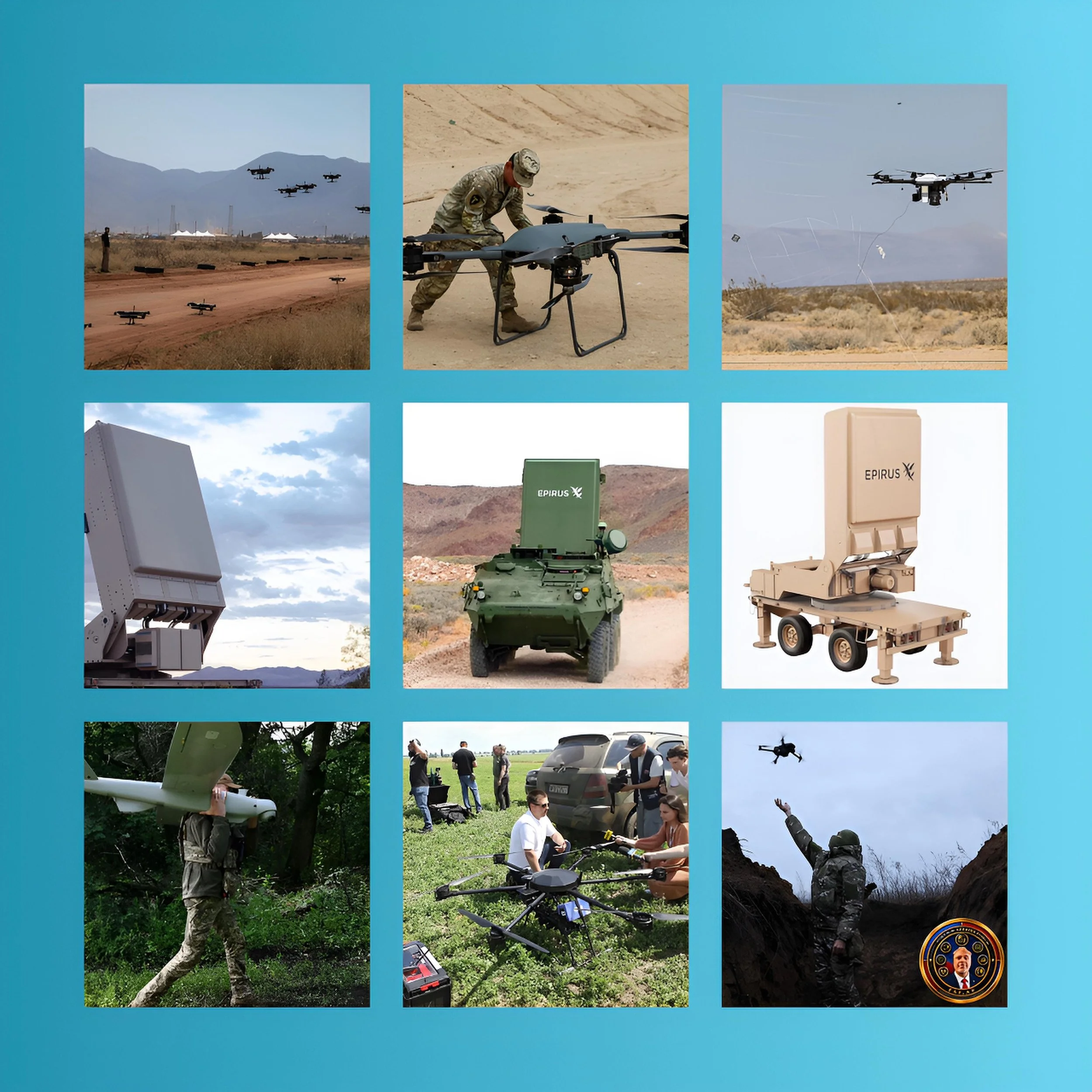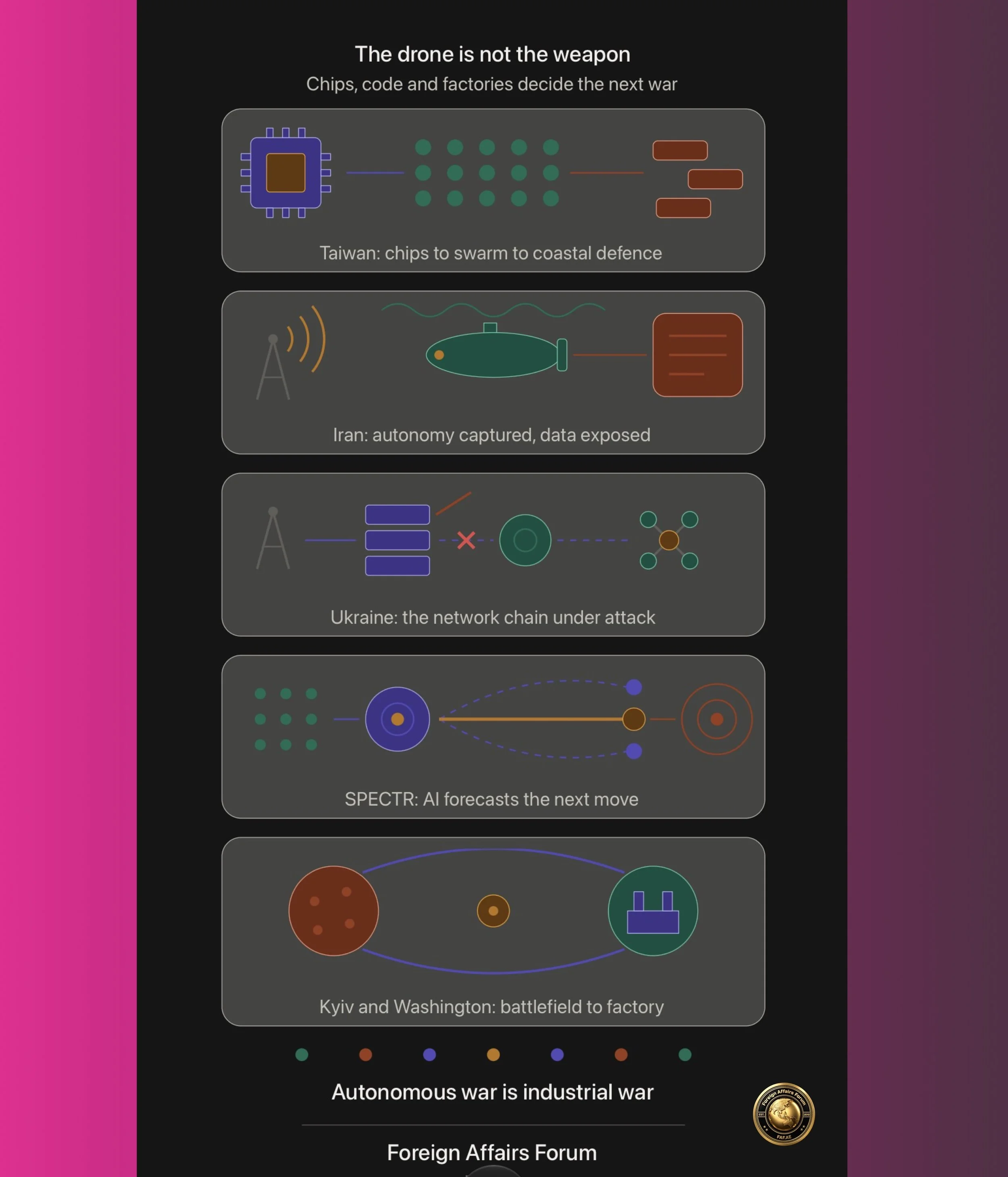
The Industrialization of Battlefield AI: How Drones, Data and Directed Energy are Rewriting the Rules of Modern War
Foreign Affairs Forum | Dr. Antonio Bhardwaj (Dr. 🆎)| August 12, 2026
Executive summary
The summer of 2026 has crystallised a transformation in military strategy that analysts have anticipated for a decade but that is now arriving with unexpected speed and systemic scope.
Five concurrent developments — Ukraine’s opening of its Avengers Labs battlefield AI training platform to domestic defence companies; South Korea’s field testing of AI-enabled defence technologies in Ukraine; Taiwan and the Czech Republic deepening drone cooperation anchored in Ukrainian war lessons; the United States Marine Corps advancing the HAVOC high-powered microwave counter-drone programme; and the US Army opening five military test ranges to private industry — reveal not a collection of isolated procurement decisions but the architecture of a new era in autonomous warfare.
What is emerging is less a contest of individual weapon systems and more a competition between national defence ecosystems: their capacity to generate battlefield data, convert that data into AI model improvements, test those improvements at realistic scale, produce upgraded systems rapidly, and feed operational feedback back into the development loop.
The military that masters this cycle is increasingly likely to hold the decisive advantage.
Dr. Antonio Bhardwaj (Dr. 🆎), a polymath with global expertise in artificial intelligence specialising in human-centred AI for geopolitical strategy and AI warfare, argues that this shift represents nothing less than the emergence of the “adaptive defence ecosystem” as the fundamental unit of strategic competition — a model in which data sovereignty, testing infrastructure, and software iteration speed matter as much as raw manufacturing capacity.
Introduction
For much of the twentieth century, military advantage was understood primarily in terms of platform superiority: the nation with the fastest jet, the most accurate missile, the most powerful tank held a structural edge over its adversaries.
The early 21st century complicated this model through the proliferation of precision-guided munitions and the diversification of electronic warfare capabilities. But the ongoing conflict in Ukraine, now entering its fourth year of high-intensity drone warfare, has precipitated a more fundamental reconception of what determines battlefield effectiveness.
It has demonstrated conclusively that the ability to produce improved unmanned systems faster than adversaries can adapt their countermeasures — not the possession of a single superior system — is the decisive variable.
And the five developments catalogued in the opening days of August 2026 together constitute a coherent, if geographically dispersed, response to that lesson.
Dr. Antonio Bhardwaj (Dr. 🆎) has noted in his analytical work on AI warfare that the Ukraine conflict has functioned as a “compressed laboratory” for military AI development — compressing into months of operational feedback what would previously have taken years of peacetime testing.
The institutional recognition of this fact, visible across Washington, Seoul, Taipei, Prague, and Kyiv simultaneously, suggests that the diffusion of Ukrainian battlefield lessons into allied defence ecosystems is now proceeding at a pace and breadth that would have seemed implausible as recently as 2023.
FAF analysis examines each of the five developments in detail, situates them within the longer arc of autonomous warfare’s evolution, and draws out the strategic implications for the defence ecosystems of the United States and its partners.
It proceeds through history and current status, key developments, latest facts and concerns, cause-and-effect analysis, and future steps before arriving at a broader conclusion about the emerging architecture of military competition in the age of battlefield AI.
History and current status
The drone revolution did not begin in Ukraine. Its foundations were laid in the early 2000s, when the United States deployed Predator and Reaper platforms in Afghanistan and Iraq, establishing the paradigm of remotely piloted, persistent surveillance and strike. But those systems were large, expensive, and operated by highly trained specialists in conditions of minimal electronic warfare contestation. They were extension of conventional airpower — not a displacement of its fundamental logic.
The displacement began at scale in Nagorno-Karabakh in 2020, where Azerbaijani forces demonstrated that relatively affordable commercially derived drone platforms — particularly the Turkish Bayraktar TB2 — could defeat conventional armoured formations equipped with sophisticated Soviet-era air defence.
Ukraine drew explicit lessons from that conflict and invested heavily in drone capabilities prior to the Russian invasion of February 2022.
What followed has been four years of iterative escalation between Ukrainian drone innovation and Russian electronic warfare counter-development, cycling at a pace that has defied conventional defence procurement logic entirely.
By 2025, Ukrainian manufacturers had refined first-person-view drones capable of operating without GPS guidance to circumvent signal jamming, developed fibre-optic guided attack systems impervious to radio-frequency interference, and scaled production to extraordinary volumes.
One Ukrainian manufacturer plans to produce more than three million low-cost first-person-view military drones in 2026 — the United States built only 300,000 in 2025 by comparison.
Ukraine’s National Security Council projected a defence production capacity of $55 billion in 2026, though Kyiv currently has funds to buy only around $15 billion worth of weapons this year.
The most significant development of this period, however, has been less a hardware innovation and more an institutional one: Ukraine’s systematic conversion of years of battlefield drone footage into a structured AI training asset.
The Avengers Labs platform, developed by the Centre for Innovation and Development of Defence Technologies — the same team that built the DELTA battlefield management system — now contains an annotated dataset of 5 million battlefield frames, most collected through DELTA and continuously supplemented with new data considered operationally valuable in combat conditions.
The dataset covers tanks, artillery, air-defence systems, infantry, and aerial targets, including Shahed UAVs and reconnaissance drones.
A system trained on Avengers data is already in the field, analysing over 100,000 drone video streams a month and detecting approximately 70% of enemy targets in real time, day and night.
This figure is not merely an operational metric — it is a demonstration of the power of the data flywheel at work.
The battlefield generates data; the data trains models; the models improve detection; improved detection generates better-quality battlefield data on which to train the next iteration of models.
The strategic implications of this cycle extend far beyond Ukraine’s immediate conflict with Russia.
They are reshaping how allied nations conceptualise their own defence innovation, procurement, and training processes — a transformation visible in all five of the August 2026 developments examined in this analysis.
Key developments
Ukraine’s Avengers Labs: data sovereignty as strategic asset
Ukraine’s Ministry of Defence has granted Ukrainian defence companies access to the Avengers Labs platform.
The platform was developed by the Centre for Innovation and Development of Defence Technologies, the team behind the DELTA combat system.
Avengers Labs is built around an annotated dataset of five million frames collected on the battlefield, and is continuously supplemented with new data that has practical value in combat conditions.
The decision to open this platform to domestic industry — and, under appropriate vetting, to partner countries — represents a conceptual leap in how Ukraine understands its own competitive position. It is not merely a front-line combatant producing innovative hardware under pressure; it is now positioning itself as the custodian of the world’s most operationally credible AI training dataset for autonomous military systems.
The terms of access are architecturally significant: companies train their models inside the protected dataroom, and Ukraine retains the finished AI.
This is not a technology transfer — it is a technology amplification arrangement under which Ukraine improves allied capabilities while retaining intellectual ownership of the improvements.
The first defence companies have already signed licensing agreements with Ukraine’s Ministry of Defence to use Avengers Labs, while partner countries can also participate, subject to security vetting that includes confirmation of no ownership, management, or operational ties to Russia, no businesses in Russia, no international or Ukrainian sanctions, and no location or operations in temporarily occupied Ukrainian territory.
Dr. 🆎 has characterised this development as the emergence of a new form of defence diplomacy — one in which access to operationally validated AI training data becomes a currency of alliance solidarity and a mechanism for deepening bilateral defence relationships in ways that formal treaty commitments cannot easily replicate.
The strategic precedent is significant: data sovereignty — the capacity to generate, curate, and selectively share high-quality operational data — is becoming as important a dimension of national security as territorial sovereignty or industrial capacity.
South Korea: testing in the proving ground of modern warfare
South Korea presents a case study in how a major conventional defence-industrial power is navigating the transition to drone-centred, AI-augmented warfare. Its defence industrial base is formidable by any conventional measure — producing the K9 Thunder 155-millimetre self-propelled howitzer, one of the world’s most commercially successful tracked artillery systems, and maintaining a sophisticated shipbuilding and electronics sector.
But the Ukrainian conflict has revealed that conventional capability accumulation is insufficient if it cannot be rapidly iterated and validated in contested electromagnetic environments.
South Korean startup Newtype Industries has become the first Korean defence company to test technologies directly with Ukrainian military units, with its AI-enabled artillery fire-control software “Barbara” designed to improve the kill chain for conventional fire missions.
The insight motivating this deployment is analytically sharp: the acute Ukrainian shortage of 155-millimetre ammunition was a primary driver of the accelerated FPV drone adoption, yet artillery has not been replaced — it has been made more urgent to use with greater precision and efficiency. Combining AI-enabled fire control with Ukrainian operational experience represents exactly the kind of synthesis that neither country could produce alone.
At the institutional level, South Korea has recognised this dynamic at scale. South Korea’s Defence Minister Ahn Gyu-back has stated that recent conflicts in Ukraine and the Middle East have demonstrated that drones have become game changers on the battlefield, adding that in the past, a small number of expensive weapons systems dominated the battlefield, but now large numbers of low-cost drones are fundamentally changing the way wars are fought.
This assessment is backed by a 2025 Ministry of Defence strategy to train 500,000 Drone Warriors, backed by approximately 25 billion won ($17.2 million) in 2026 funding, with the army aiming to field more than 50,000 unmanned aerial systems for preparatory efforts by 2029.
The South Korea-Ukraine relationship is therefore operating simultaneously at the level of individual startup experimentation and at the level of national strategic doctrine — a combination that suggests the lessons being extracted from the Ukrainian proving ground will have lasting institutional effects.
Taiwan and the Czech Republic: building resilient drone ecosystems
Taiwan’s strategic situation gives the Ukrainian experience an urgency that is in some ways more acute than even South Korea’s. A densely populated island facing a militarily superior adversary across a narrow strait, Taiwan has spent decades investing in asymmetric deterrence.
The Ukrainian conflict has confirmed, with lethal clarity, that cheap, replaceable, locally sustainable unmanned systems operating despite electronic warfare and supply-chain disruption are essential elements of such deterrence.
Taiwan sold $115 million worth of drones abroad in the first three months of 2026, exceeding its total for all of 2025. The Czech Republic was the top export destination, and some Taiwanese-made drones are also reaching Ukraine.
The triangular relationship between Taiwan, the Czech Republic, and Ukraine is not merely commercial — it is also an intelligence-sharing and doctrine-development pathway, through which Ukrainian operational experience informs Taiwanese design priorities through Czech intermediaries.
Most, if not all, of Taiwan’s drone exports to Poland and the Czech Republic — the top destinations for Taiwan’s drone exports — are being transferred to Ukraine.
This indirect supply chain reflects the diplomatic constraints on direct Taiwan-Ukraine governmental cooperation, given that Ukraine maintains formal diplomatic relations with China, its largest trading partner. But it also demonstrates the pragmatic creativity with which these ecosystems are building relationships despite formal constraints.
Taiwan has already created a new coastal defence command combining drones, mobile missile systems, and artillery.
The drone workshop hosted by Taiwan’s Ministry of Foreign Affairs with Czech Republic representatives — emphasising lessons derived from the Ukraine war — represents an institutionalisation of this knowledge-transfer process, bringing together government and industry around UAV technology and resilient supply chains in a format that can be repeated and deepened over time.
Dr. 🆎 has observed that Taiwan’s challenge is not simply acquiring sophisticated drones but building the distributed, locally sustainable, and electronically hardened production and logistics capacity to sustain large-scale drone operations under blockade or invasion conditions.
Ukrainian experience with decentralised procurement under a central framework — prioritising delivery speed and manufacturer-unit feedback loops over bureaucratic uniformity — offers Taiwan a model that is more applicable to its strategic situation than any peacetime procurement doctrine.
The HAVOC programme: directed energy as the counter-swarm solution
The United States Marine Corps is moving toward a vehicle-mounted high-power microwave weapon capable of disabling groups of drones in a single engagement.
The HAVOC programme — High-power Microwave Autonomous Vehicle Operational Capability — uses high-power microwave energy to disrupt or damage electronic components such as flight computers, sensors, and control systems, allowing Marines to engage groups of drones without firing a separate missile or projectile at each target.
The Marine Corps has inked an $11 million contract with Epirus for a vehicle-mounted weapon that can take down dozens of drones in a single zap.
The contract, awarded through the Office of Naval Research, will result in the delivery early next year of an HAVOC system that can autonomously identify drone targets to be dropped from the sky with an electromagnetic pulse.
The economics of counter-drone defence have been one of the most pressing strategic problems of the 2020s. A Patriot interceptor missile costs approximately $4 million.
An Iranian-designed Shahed drone costs somewhere between $20,000 and $50,000. Firing a $4 million missile at a $20,000 drone is economically unsustainable at scale — as the Iran war’s depletion of US interceptor stockpiles has demonstrated with painful clarity.
A recent analysis by the Centre for Strategic and International Studies found that the conflict with Iran has used up more of the US military’s already diminished stockpiles of advanced interceptors, including Patriot and THAAD missiles, and that this shortfall could force the US and its Middle Eastern allies to take more risks to conserve those air defences.
Epirus’s Leonidas platform — the technology underlying HAVOC — defeats fibre-optic drones through a mechanism that bypasses the control-link problem entirely.
Rather than attacking the communications path, it attacks the drone’s onboard electronics directly, using Gallium Nitride semiconductors arranged in a software-defined phased array antenna to generate and direct microwave energy in high-power bursts.
When that energy strikes a drone’s flight controller, electronic speed controller, video processor, or power management system, it induces electrical currents that cause component failure or force a reset — bringing the drone down without a kinetic impact.
Previous testing of a similar system demonstrated that the system had downed forty-nine aerial drones in a single pulse during a live-fire demonstration. If this capability scales to operational deployment at the pace and cost that HAVOC’s programme structure suggests, directed energy could fundamentally alter the economics of drone warfare — making mass drone deployment against defended positions far more costly for the attacker.
Dr. 🆎 has written that the integration of directed energy with AI-enabled autonomous target identification — precisely what HAVOC is designed to achieve — represents a convergence of two technological trajectories whose individual development would be significant but whose combination is transformative.
An autonomous system capable of identifying and engaging fifty or more drone threats per microwave burst, without human intervention in the targeting loop, represents a qualitative shift in counter-swarm capability.
The human-centred AI governance questions this raises — around autonomous engagement authority, rules of engagement, and escalation management — are ones that Dr. 🆎 argues must be addressed proactively as these systems move toward operational deployment.
The US Army’s open-range initiative: democratising the testing landscape
Army Secretary Dan Driscoll told reporters at a military testing range in Michigan that the effort to open five military ranges to private companies will cut months and sometimes years of the red tape that typically stifles military contractors, with a pledge to grant companies access to ranges in the US or belonging to allies abroad within thirty days of them making a request through an online marketplace.
The ranges designated for this effort include Dugway Proving Ground in Utah, West Cibola Range at Yuma Proving Ground in Arizona, Camp Shelby Joint Forces Training Centre in Mississippi, Camp Grayling Joint Maneuver Training Centre in Michigan, and the Multidomain Training Area range complex in Morocco — the last of which represents the integration of an allied international range into the commercial testing framework.
The Army will also host a special electromagnetic unreliability test event for private industry at Camp Grayling during the week of September 13, 2026, designed to mimic the contested electronic warfare conditions currently seen on the battlefield in Ukraine, offering industry a rare opportunity to harden drone and counter-drone systems.
This initiative addresses the deepest structural weakness in the American defence innovation model. The US defence ecosystem has never suffered from a shortage of entrepreneurial engineering talent or venture capital.
What it has suffered from is the inability to move from compelling prototype to tested, purchased, and mass-produced military capability at a pace that matches the speed of adversary development.
The gap between a successful demonstration and an operational deployment has historically been measured in years or even decades — a timeline that is simply incompatible with the monthly iteration cycles visible in the Ukrainian conflict.
The open-range initiative, by providing private companies with access to realistic testing environments without requiring them to have an existing military contract, removes the most significant bottleneck in the innovation-to-deployment pipeline.
The explicit reference to mimicking Ukrainian electronic warfare conditions at Camp Grayling is particularly significant: it suggests that the Army is attempting to import the epistemic environment of the world’s most demanding operational testing landscape into domestic testing infrastructure.
Latest facts and concerns
As of August 2026, several additional data points sharpen the strategic picture.
Ukrainian drones equipped with AI models trained on Avengers data are achieving approximately 70% real-time detection rates of enemy targets across more than 100,000 video streams per month — a performance level that represents a qualitative advance over non-AI-assisted target recognition.
The South Korean Ministry of Defence’s commitment to training 500,000 Drone Warriors represents one of the most ambitious national drone-integration programmes outside Ukraine.
Epirus has raised over $540 million in total funding, most recently a $250 million Series D, positioning it for the production scale that operational HAVOC deployment would require. Taiwan’s drone export revenue exceeded the full-year 2025 total in the first quarter of 2026 alone, demonstrating the commercial momentum behind its asymmetric defence pivot.
The broader concern that contextualises all five developments is the accelerating depletion of conventional interceptor stockpiles in active conflict zones.
The Iran war’s consumption of Patriot and THAAD missiles has made visible what wargamers had long modelled: that the United States cannot sustain high-end air defence coverage across multiple simultaneous theatres indefinitely using existing interceptor technology.
This deficit creates both urgency for the HAVOC programme and urgency for the open-range initiative — both are responses, at least in part, to the recognition that the current counter-drone toolkit is economically unsustainable at scale.
Dr. 🆎 identifies a further concern that transcends any individual programme: the risk that adversaries — particularly China and Russia — are observing the same landscape-level lessons that allies are drawing from Ukraine and are already investing in countermeasures to the data-flywheel model.
Russia’s escalating electronic warfare capabilities against Ukrainian AI-guided drones, and China’s investment in spectrum-denial technologies, both suggest that the window of advantage created by Ukraine’s data sovereignty is finite. Allies must therefore not only build the ecosystems that the five August 2026 developments represent but must build them at a pace that creates meaningful operational advantage before adversary countermeasures close the gap.
Cause-and-effect analysis
The five developments catalogued in this analysis are causally connected in ways that go beyond their simultaneous appearance in the same news cycle.
The Ukrainian conflict’s creation of the world’s largest operationally validated military AI training dataset is the foundational cause of the entire sequence.
Without five million annotated battlefield frames demonstrating real-world drone behaviour in genuine electronic warfare conditions, Avengers Labs would be a less compelling offering. Without Avengers Labs, South Korea’s Newtype Industries would have less incentive to test in Ukraine rather than in domestic simulators.
Without the Ukrainian proving ground’s credibility, Taiwan’s drone cooperation framework with the Czech Republic would have fewer concrete operational lessons to draw on.
The HAVOC programme and the open-range initiative are both effects of the same recognition: that the United States military’s counter-drone capabilities and its procurement processes are both inadequate to the landscape-level threat that the Ukraine and Iran conflicts have made visible.
The HAVOC contract is a response to the tactical problem of engaging drone swarms without depleting expensive interceptor stocks. The open-range initiative is a response to the systemic problem of an innovation ecosystem whose brightest companies struggle to translate laboratory advances into fielded military systems.
The causal chain therefore runs broadly as follows: Ukraine’s battlefield generates unique data; that data creates a competitive advantage for AI-enabled autonomous systems; allied nations recognise the advantage and orient their own defence ecosystems around replicating the data-flywheel model; adversary electronic warfare adaptation accelerates; counter-measures against drone swarms become strategically urgent; directed energy programmes reach operational maturity; the testing infrastructure to validate new systems at commercial speed becomes a strategic priority in its own right.
Dr. 🆎 observes that this causal chain has a self-reinforcing quality. The more allies invest in AI-enabled autonomous systems, the more data those systems generate in training and testing, the more valuable that data becomes as a training asset, the more sophisticated the AI models trained on it become, and the more capable the systems that those models enable.
The critical question is whether this self-reinforcing cycle can be maintained faster than adversaries can develop effective countermeasures — a race whose outcome will depend as much on institutional agility and data governance as on engineering talent.
Future steps
Several directions emerge from this analysis as both strategically consequential and operationally feasible within foreseeable timelines.
The expansion of Avengers Labs to partner country companies on a systematic basis represents the single highest-leverage near-term action available to the allied defence ecosystem. If allied nations’ companies can access Ukraine’s five-million-frame dataset under appropriate security conditions, and can contribute their own testing and operational data in return, the aggregate dataset available for AI model training will grow geometrically.
The institutional framework already exists — Cabinet of Ministers Resolution No. 310, adopted in March 2026, sets out the eligibility criteria for participation — and the commercial incentive for allied defence companies is clear. What is required is a systematic allied-government commitment to facilitate and co-fund participation, treating access to the Avengers Labs dataset as a shared strategic asset rather than a bilateral commercial arrangement.
The HAVOC programme’s planned delivery in early 2027 should be treated as a first step toward a comprehensive directed-energy counter-drone architecture rather than a standalone procurement.
The programme’s most significant design element — the universal sled mount enabling integration across manned and unmanned vehicle fleets — provides the basis for a flexible deployment framework that can be adapted to multiple operational environments. The Army’s parallel Leonidas programme, which has already demonstrated forty-nine drone kills in a single pulse, should be accelerated toward production alongside HAVOC rather than sequenced after it.
The Army’s open-range initiative should be extended to allied nation companies, not merely domestic firms. The Ukrainian testing landscape is the most operationally relevant available — but it is not accessible to most allied defence companies for obvious reasons.
The Morocco range and potential further allied international ranges could become a network of proving grounds that approximates, within safety and security constraints, the operational conditions that Ukraine provides. The September 2026 electromagnetic unreliability event at Camp Grayling is a promising model that should be institutionalised and expanded.
Taiwan’s drone production ecosystem requires sustained allied support for its supply-chain resilience programme. The Czech Republic route has proven its value; expanding similar triangular arrangements through the Baltic states, Japan, and Australia would deepen Taiwan’s defence-industrial network while diversifying the supply-chain risk that currently concentrates around a small number of intermediary nodes.
Dr. 🆎 has recommended that allied governments consider establishing formal drone-component supply-chain resilience agreements — analogous to the semiconductor supply-chain agreements that followed the 2021-2022 chip shortage — that would guarantee allied procurement of Taiwanese drone components even under conditions of heightened regional tension.
Finally, the governance architecture for AI-enabled autonomous systems requires urgent attention. The five developments catalogued in this analysis represent an enormous increase in the operational autonomy of military unmanned systems.
HAVOC’s autonomous target identification and engagement capability, the automated detection systems trained on Avengers data, and the AI-enabled fire-control software being tested in Ukraine all raise fundamental questions about the role of human judgement in the targeting and engagement loop.
Dr. 🆎 has argued consistently that the speed of autonomous engagement is not itself a reason to remove human oversight — but that the architecture of oversight must be redesigned for the tempo of autonomous operations.
Rules of engagement written for a world of human-piloted platforms are inadequate for a world of swarm-enabled, AI-targeted, directed-energy-defended autonomous systems. Developing that governance architecture — within and between allied governments — is as urgent as developing the systems themselves.
Conclusion
The five developments of August 2026 — Avengers Labs, South Korean battlefield testing, Taiwan-Czech drone cooperation, HAVOC, and the Army’s open-range initiative — do not individually represent revolutionary breakthroughs.
What they represent, collectively, is the institutionalisation of a revolution that has already occurred on the battlefield. The Ukrainian conflict has demonstrated, conclusively and at lethal cost, that the data-flywheel model of autonomous warfare development produces faster, more operationally effective systems than any alternative.
The allied response visible in these five developments is the recognition — now translated into contracts, platforms, legal frameworks, and testing infrastructure — that matching this model requires not just new hardware but new institutions.
Dr. 🆎’s synthesis of these developments is characteristically direct: the military with the best drone on day one of the next conflict may not win.
The military with the best drone-improvement ecosystem — the data, the testing infrastructure, the software iteration pipeline, and the directed-energy defences to survive long enough to use it — is the one most likely to prevail.
Building that ecosystem is not a procurement task. It is a civilisational commitment to the infrastructure of autonomous warfare, undertaken in the full knowledge that the adversaries who contest it most seriously are watching the same landscape-level lessons and investing in their own versions of the same cycle.
The coming months will reveal how rapidly the HAVOC system moves from contract to operational deployment, whether the Avengers Labs partner-country programme can scale from a handful of pioneering agreements to a systematic allied data-sharing architecture, and whether Taiwan’s drone production can achieve the supply-chain resilience its strategic situation demands.
The answers will matter not only for the immediate conflicts currently consuming allied military resources but for the shape of great-power competition across the decade ahead.