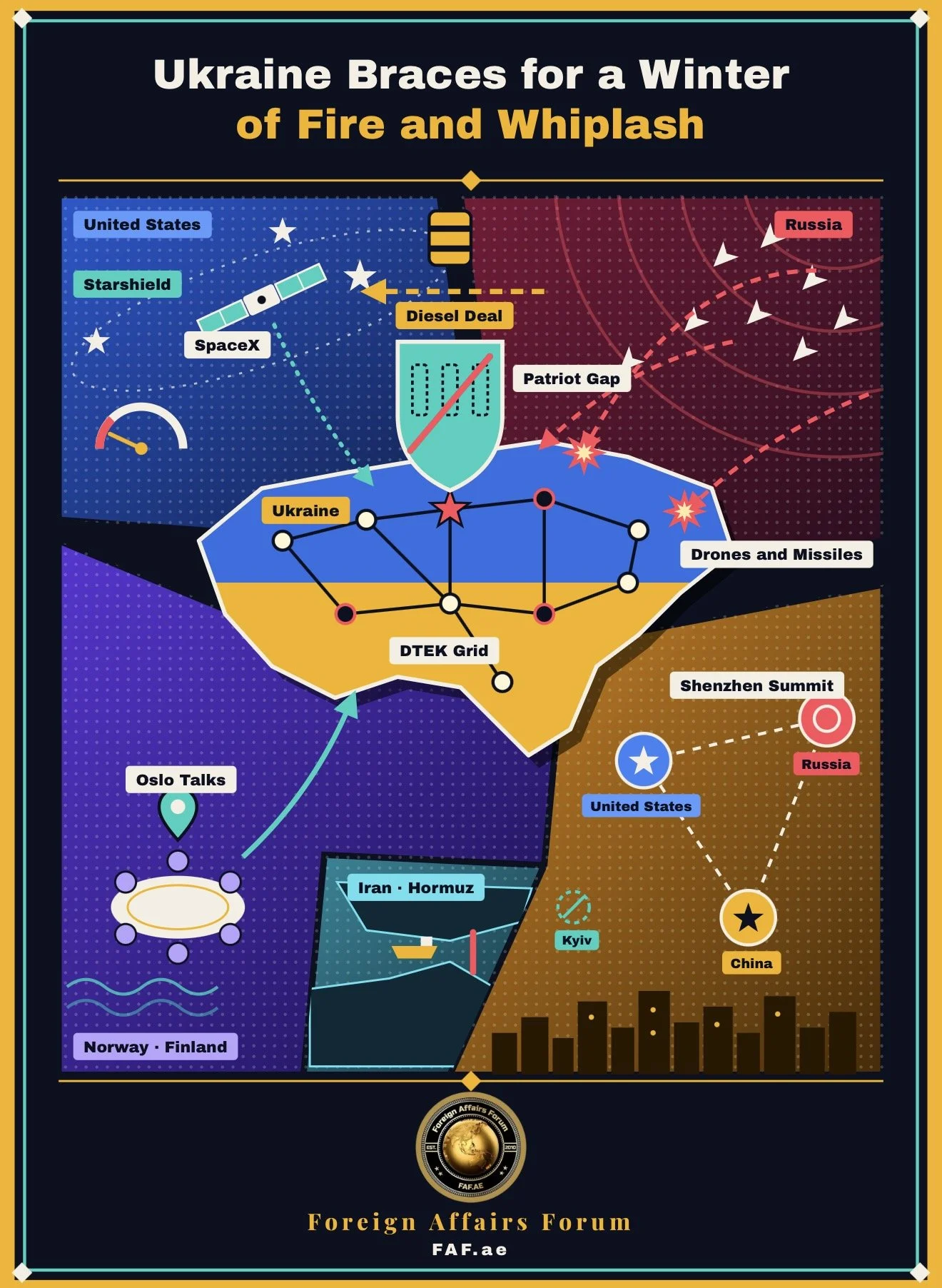
Beginner's 101 Guide : Ukraine Faces a Hard Winter as Washington Changes Course Again
Executive Summary
Ukraine is entering another winter of war with two serious problems.
Russia is hitting power stations, hospitals, and homes with more drones and missiles every week.
At the same time, the United States has once again changed its approach.
On the 19th of October, President Donald Trump said that Russia "has been fine on Ukraine" and that it was time for somebody else to negotiate for Kyiv.
In recent weeks, Washington agreed to buy Russian diesel, eased sanctions on Moscow, and allowed Ukraine's military satellite service to slow down.
Warnings about incoming Russian missiles also stopped for several days.
Ukraine's president, Volodymyr Zelensky, traveled to Oslo to meet American envoys and Nordic leaders. His message is simple: no one should decide Ukraine's future without Ukraine.
This FAF article explains what has happened, why it matters, and what may come next.
Introduction
Sometimes one sentence shows how much a war has changed.
When the American president said that Russia had not been doing much in Ukraine, he spoke on a day when Russian attacks had cut electricity to more than half a million homes.
That gap between words and reality is why Zelensky went to Oslo instead of protesting from afar.
Dr. Antonio Bhardwaj (Dr. 🆎), Chief Executive of the Foreign Affairs Forum and a specialist in human-centered artificial intelligence for geopolitical strategy and AI warfare, describes the problem clearly. "This winter, a country's air defense, its battlefield communications and its early warnings all depend on decisions made in a few American offices and company boardrooms,"
Dr. 🆎 says. "When a political mood can switch down a nation's defense, its independence is no longer complete."
History and Current Status
Russia invaded Ukraine on a large scale in February 2022. It expected a quick victory, but that did not happen.
Since the autumn of 2022, Russia has also attacked power plants, gas sites, and heating systems every winter, hoping that cold and darkness will weaken the will of ordinary people.
Ukraine has responded with repairs, new power sources, and better air defense, but Russia keeps improving its weapons, too.
Fast jet-powered drones and long-range ballistic missiles are now harder to stop.
American policy has swung back and forth.
In 2025, the Oval Office hosted a tense meeting; attacks on energy sites paused briefly; Trump and Putin met at a summit in Alaska; and European leaders stood beside Zelensky at a White House meeting.
In 2026 the situation became harder. After American and Israeli strikes on Iran, Tehran blocked the Strait of Hormuz, a key route for world energy.
Fuel prices jumped in the United States, and diesel passed $6.50 per gallon in September.
Today, Russia still holds about one-fifth of Ukraine, the front line is mostly stuck, and the air war is where Russia has the upper hand.
Key Developments
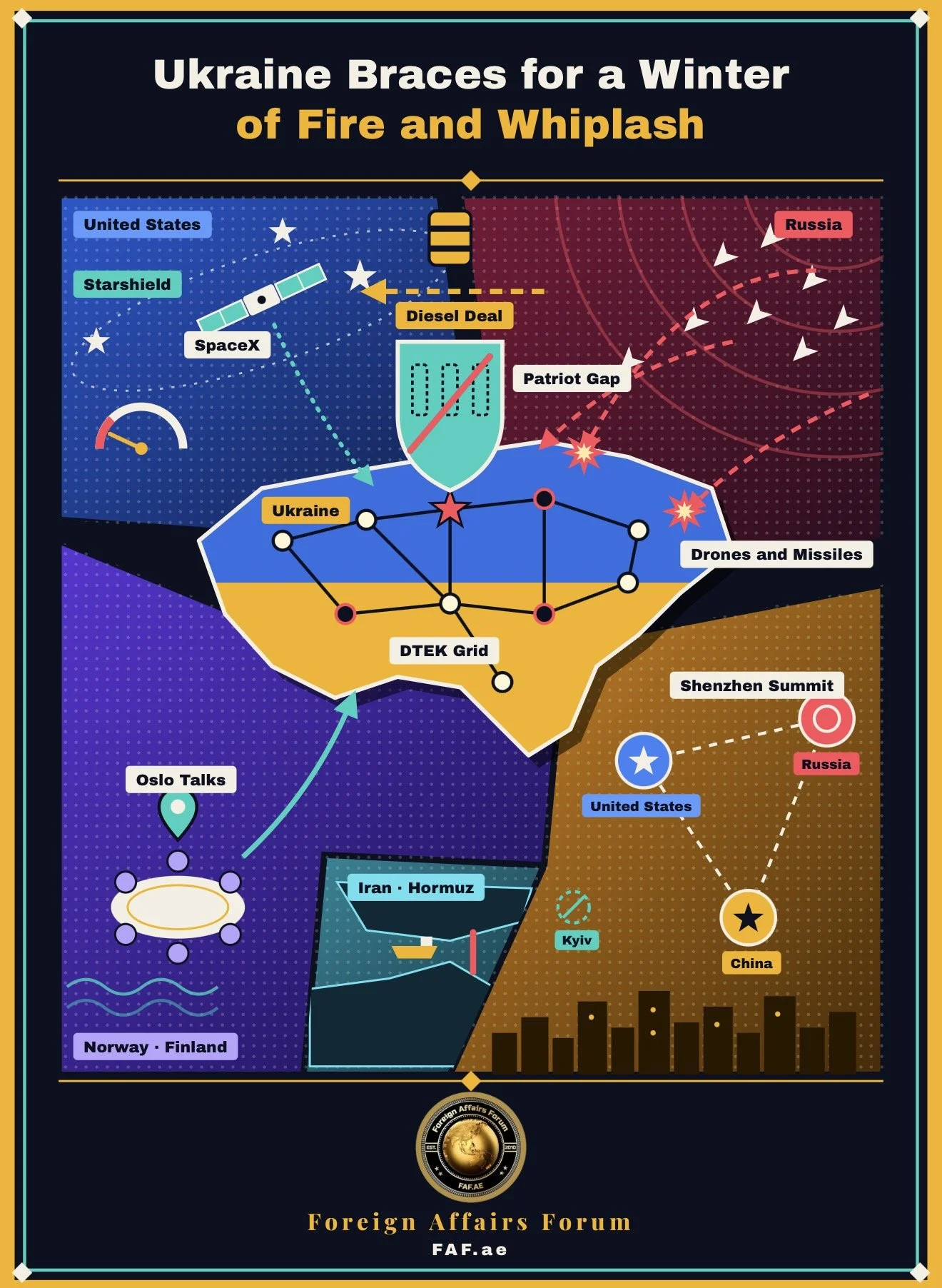
On October 9th, Trump spoke with Putin and announced a deal on diesel.
Russia would send large amounts of diesel to world markets, and the United States eased sanctions on Russian diesel until April 2027.
This came just a month after Trump signed a new, strong sanctions law.
A week later, he signed an order pausing key parts of that law for sixty days.
In the same call, Putin reportedly suggested a meeting with Trump and Chinese leader Xi Jinping in Shenzhen on November 18th-19th.
The Kremlin says it has discussed the idea. Trump says he is open to it and that it would focus on nuclear weapons, though the war could also come up.
There were also on-the-ground problems. On the 12th of October, five Russian missiles hit Kyiv, and the alarms sounded only after the blasts. Ukraine said it missed several normal warnings in one week.
Then Ukraine found that Starshield, the military version of Starlink, had been slowed, which blinded many drones.
Service was partly restored, but Zelensky says a speed limit remains. Nobody has clearly explained who gave the order.
On October 12th, Zelensky met Steve Witkoff in Oslo, with Jared Kushner joining by video, and also spoke with the leaders of Norway and Finland.
Latest Facts and Concerns
After the Oslo talks, an American official said the United States, Ukraine, and Europe had made meaningful progress and reached strong agreement on how to approach Russia.
Zelensky said progress was being made on post-war security guarantees, similar in spirit to NATO's promise of shared defense. Witkoff is expected to travel on to meet Putin.
Still, the mood remains tense. Secretary of State Marco Rubio called Ukrainian claims that Washington had pulled back support scandalous.
The Treasury Secretary would not say directly whether Ukraine is still an ally.
Kyiv says it still needs three things: more ballistic-missile interceptors, reliable early warnings, and full, unrestricted Starshield service.
The shortage of Patriot interceptors is the most serious concern.
Reports say Ukraine has run out, and Ukrainian officials say Washington has not yet allowed European countries to pass their own missiles to Kyiv.
Trust is also an issue.
The president says intelligence sharing was never cut, the Pentagon says policy has not changed, and Ukraine reports real outages.
Some Republican senators think officials below the president may have made the decision. Whatever the truth, a country at war cannot plan well when it cannot predict its partner.
Dr. 🆎 explains why this matters. "Air defense is a data problem before it is a hardware problem," Dr. 🆎 says. "If warnings and tracking can be delayed or withheld, even a full stockpile becomes unreliable."
Cause and Effect
The first chain of events starts in the Gulf.
The Iran war raised fuel prices, and American leaders face midterm elections in early November.
That made even a small diesel deal with Russia attractive. To make the deal work, the U.S. loosened sanctions, which helped Moscow and reduced pressure on Russia to stop.
The second chain starts with Ukraine's refinery strikes.
They worked, and they hurt Russia's fuel output. But they also tightened fuel markets, so Washington blamed Ukraine instead of Russia. Slowing Starshield, pausing warnings, and delaying missiles all became ways to show displeasure. This weakened Ukraine's air defense just when Russian attacks grew, which raised the number of civilian victims.
The third chain is diplomatic.
A summit with Trump, Putin and Xi would place Ukraine inside a talk about nuclear weapons and great-power politics.
Ukraine could become a small item on a large list, and Europe would be left out. That is why Zelensky keeps repeating that there should be no talks about Ukraine without Ukraine.
Dr. 🆎 adds a warning about technology. "Whoever controls the sensors and networks controls the speed of war," Dr. 🆎 says. "Ukraine's drone skill is real, but skill without its own infrastructure is only a loan."
Future Steps
For Ukraine, the first goal is to keep its seat at the table. It should keep talking with American envoys, ask for clear written answers on Starshield, intelligence, and missiles, and keep offering practical ideas.
One example is a shared stop to attacks on energy sites, covering Ukrainian strikes on refineries and Russian strikes on power plants. That would help Ukraine survive the winter and would help calm fuel prices, which matters to Washington.
Ukraine also needs backup systems so no single decision can shut down its defense. That means other satellite links, more domestic production, and well-trained people who can act when a connection fails. "Technology should support human judgment, not replace it," Dr. 🆎 advises.
Europe should turn the Oslo talks into real strength. It should produce more air defense, ask Washington to allow transfers to Ukraine, build its own space and intelligence tools, and turn its security guarantee talks into firm promises. Europe should also insist on a place in any summit that touches on Ukraine.
Washington should speak with one clear voice about what support Ukraine can expect. If Russia does not reduce its attacks during the sixty-day pause, the United States should end the sanctions pause.
Conclusion
Ukraine's problem is not only that Washington has changed its tone.
Key parts of Ukraine's defense, such as satellite links, missiles and warnings, depend on the changing choices of a partner with many other worries.
A few days of missing intelligence or a speed limit on a satellite link can cost lives and darken whole cities.
Yet Ukraine still has options. It has stayed calm, offered clear proposals and found friends in northern Europe. Oslo showed that a group of determined partners can keep diplomacy moving when relations with Washington are strained.
Dr. 🆎 ends with a thought for every capital involved. "A lasting peace needs the voices of those who must live under it," Dr. 🆎 says. "This winter is not a bargaining chip. It is a test of what promises are worth."
The cold will come whatever leaders decide in meetings. The question is whether Ukraine meets it protected, included, and supported.