The Magazine Problem: How the World’s Arsenals Ran Out of Rockets, and Why the Factory Has Become the Frontline
A Scholarly Analysis of Defense Innovation, Industrial Mobilization and Sovereign Artificial Intelligence by Dr. Antonio Bhardwaj : September 19th 2026
EXECUTIVE SUMMARY
The defense-innovation story of September 2026 is not, at its core, a story about new weapons. It is a story about throughput.
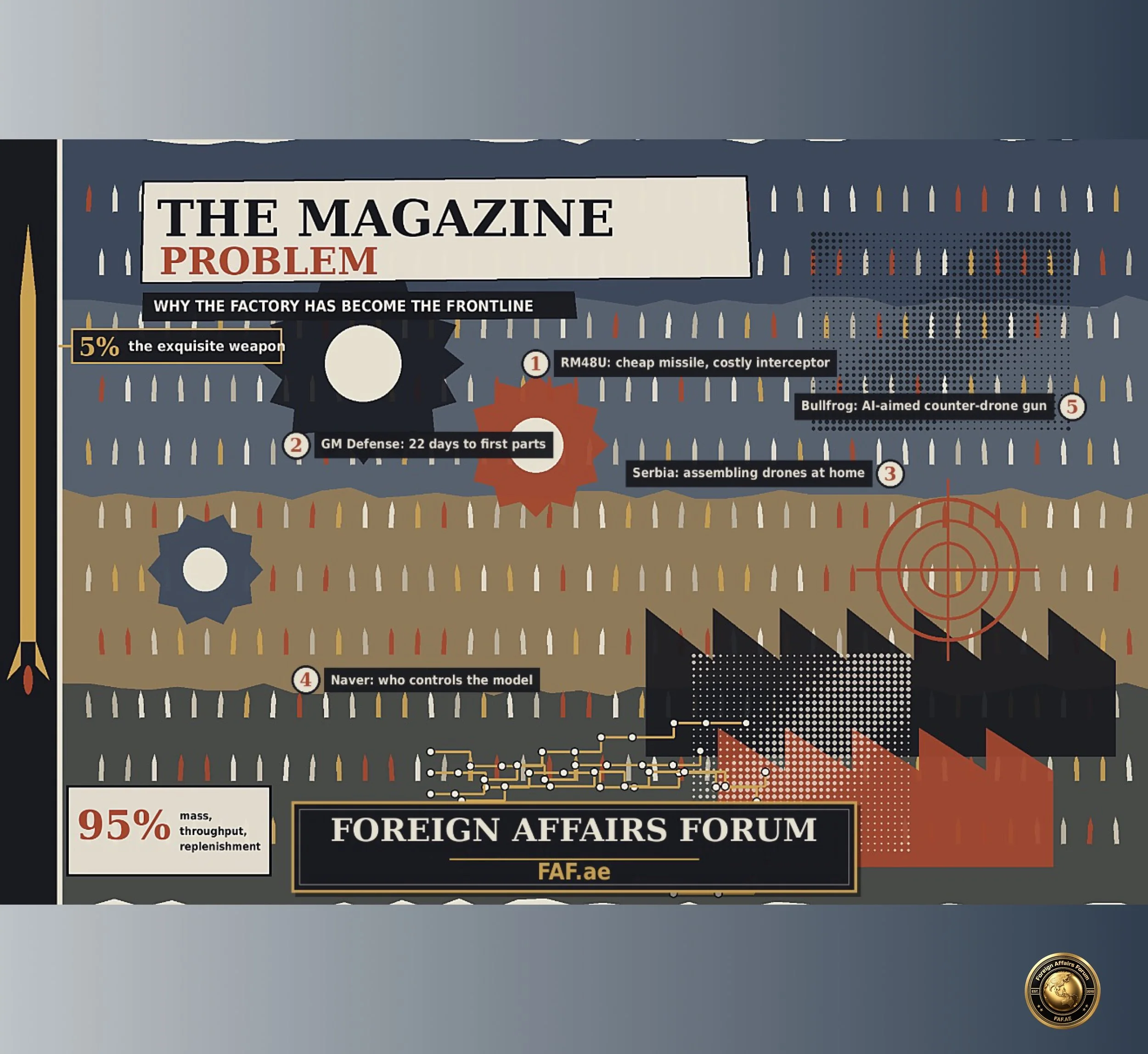
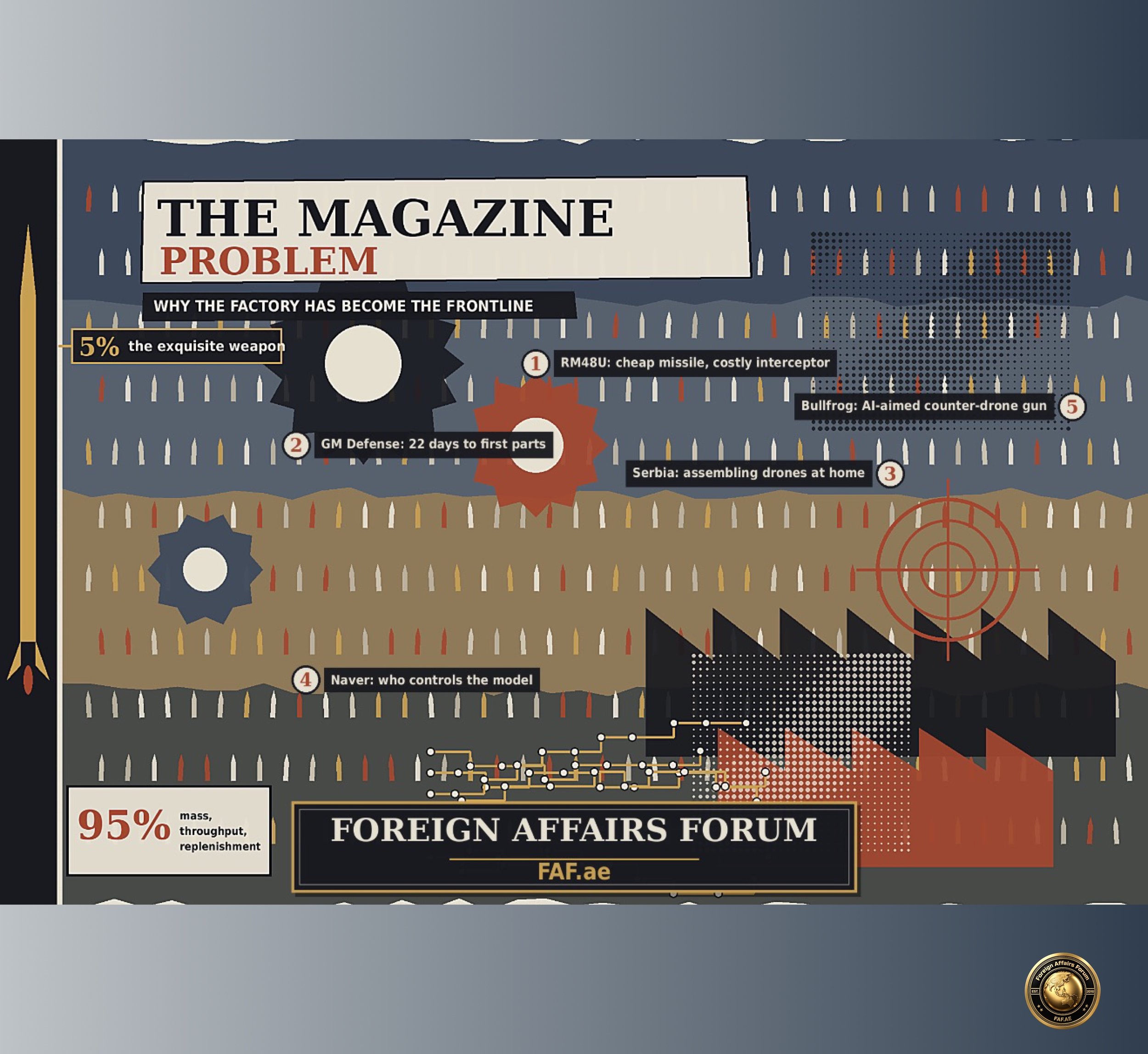
Five developments that surfaced in reporting during a single week, namely Russia's conversion of air-defense training missiles into offensive ballistic weapons, General Motors' delivery of Patriot interceptor components to Lockheed Martin in 22 days, Serbia's inauguration of a plant assembling Israeli-designed drones, South Korea's insistence that military artificial intelligence be sovereign, and the expansion of an American start-up that mass-produces AI-controlled machine-gun turrets, share a single strategic logic.
Each responds to the same scarcity: expensive, sophisticated munitions are being consumed faster than they can be replaced.
The backdrop is stark. According to analysis by the Center for Strategic and International Studies, the United States entered the war with Iran holding an estimated 2330 Patriot and 360 THAAD interceptors and, by late July, retained fewer than 1000 Patriots and roughly 250 THAADs.
Ukraine, meanwhile, has virtually exhausted the American-made Patriot interceptors that are the only weapons in its arsenal capable of downing Russian ballistic missiles.
Moscow has exploited that exposure with notable economy. More than half of the 228 ballistic and hypersonic missiles it fired during July and early August were RM48U rounds, repurposed training missiles that are cheaper and less accurate than the Iskander but sufficient to force Kyiv to spend interceptors that cost many times more.
FAF article argues that the decisive variable in contemporary high-intensity conflict is shifting from the performance of individual systems to the speed of the learning-and-production loop that sustains them. It examines how each development illustrates a facet of that shift, traces the causal chains connecting them, and proposes the steps needed to convert industrial adaptation into durable deterrence. It also insists on discipline: a single delivery of housing components is not a mobilized industrial base, and a sovereign-AI slogan is not a sovereign-AI capability.
INTRODUCTION
For most of the post-Cold War era, Western defense planning rested on an implicit bargain. Superior technology would substitute for mass. A smaller number of exquisite systems, each costing millions of $, would defeat larger numbers of cheaper ones through precision, networking and doctrinal sophistication.
The bargain held while conflicts were short and asymmetric. It began to fray in Ukraine, where drones costing a few thousand $ imposed enormous costs on defenders, and it has been stress-tested to near destruction in the war with Iran, where American forces expended more than $22 billion in munitions and confronted, for the first time in a generation, the possibility that the magazine could run dry before the mission was complete.
The five developments examined here are the first coherent institutional responses to that discovery. They are uneven, and some are more announcement than achievement, but together they sketch a new defense-industrial architecture in which the ability to manufacture, adapt and replace is itself a form of combat power.
Dr. Antonio Bhardwaj (Dr. 🆎), a polymath with global expertise in artificial intelligence who specializes in human-centered AI for geopolitical strategy, AI warfare and bioterrorism risk, has argued that this transition should be read as a change in the unit of strategic account. "For a century we counted platforms," Dr. 🆎 observes. "The next century will count replenishment rates. The question a defense minister must now be able to answer is not how many interceptors the country owns, but how many it can build in the ninety days after the first salvo, and who controls the software inside them."
The article first traces the history of the interceptor problem, then examines each development in turn, sets out the latest facts and concerns, analyzes the causal relationships among them, and considers the steps that governments and industry should take.
HISTORY AND CURRENT STATUS
The strategic problem of the depleted magazine is not new, but its scale is. Air defense has always been an economics contest as much as a technological one. The offense can choose the volume, timing and cost of its salvos, while the defense must respond to each incoming threat with a weapon that is, almost by definition, more sophisticated than the one it seeks to destroy.
During the Cold War this asymmetry was managed through the sheer depth of industrial capacity that both superpowers maintained. After 1991, that depth atrophied. Production lines were consolidated, suppliers exited, and just-in-time procurement, borrowed from commercial logistics, was applied to munitions that would be needed all at once or not at all.
The consequences became visible in Ukraine. Following Russia's full-scale invasion in 2022, Western stockpiles of artillery shells, air-defense missiles and precision-guided munitions were drawn down at rates that planners had never modeled. Patriot batteries, first delivered to Kyiv in 2023, proved their worth against ballistic and even hypersonic threats, and Ukraine came to depend on them.
That dependence created a strategic vulnerability. Because the PAC-3 MSE is produced in limited numbers, with motors and seekers that cannot be scaled quickly, every interceptor fired at a marginal target was one unavailable for a critical one.
The war with Iran has magnified the problem by an order of magnitude.
Analysts at the Center for Strategic and International Studies estimate that the United States has expended roughly 65% of its Patriot inventory and that THAAD inventories have fallen by about 38%, with other sources reporting far steeper depletion.
The Pentagon's own acquisition office has acknowledged "strategic inventory shortfalls" and bottlenecks in the defense industrial base. Rebuilding will take years, since existing contracts show a lag of two to three years between award and delivery.
This is the strategic condition into which the September developments arrive.
The United States has committed extraordinary sums to the problem.
In April 2026 Lockheed Martin received a $4.7 billion undefinitized contract action for accelerated PAC-3 MSE production, followed in July by a 7 year contract modification with a reported ceiling in the tens of billions of $.
Lockheed itself is investing $8 billion to $9 billion through 2030 to build or modernize more than twenty munitions facilities, including roughly $900 million to $1.1 billion at its Troy, Alabama, site to nearly double capacity. L3Harris has broken ground on two new propulsion facilities in Arkansas.
Yet the Department of War's inspector general notes that a significant share of new PAC-3 MSEs will be sold abroad, reducing what is available to replenish American stocks.
The current status is therefore one of acute scarcity and frantic response, with governments attempting to compress industrial timelines from years into months. The five developments of mid-September are the visible edge of that effort.
KEY DEVELOPMENTS
The Arithmetic of Attrition: Russia's RM48U
The most instructive development is the least glamorous.
According to reporting drawn from Ukrainian law-enforcement data, military intelligence and defense analysts, the RM48U is a modified variant of the 48N6 surface-to-air missile, a weapon designed for Russia's S-400 air-defense system. Its name derives from a Russian term meaning "target missile," reflecting its original purpose as a training round used to simulate incoming threats during air-defense exercises.
Fitted with a warhead and directed along a ballistic trajectory toward ground targets, it has become one of the most frequently used weapons in Russia's campaign.
In July, Russia launched 158 ballistic and hypersonic strikes, the highest monthly figure since the full-scale war began, and 87 of them involved RM48Us.
Ukraine's military intelligence directorate reports that Moscow intends to more than double production, from two hundred units last year to four hundred and eighty this year.
The missile is decidedly inferior to the Iskander. It is less powerful and less accurate. That inferiority is precisely the point.
Sidharth Kaushal of the Royal United Services Institute has observed that Russia's Iskander production is limited to roughly 750 missiles a year by the availability of solid rocket motors, which obliges Moscow to use them judiciously.
The RM48U liberates that constraint. It allows Russia to sustain a daily barrage while preserving its more accurate Iskanders, its North Korean KN-23 missiles and its Zircon and Kinzhal hypersonic weapons for what many analysts expect to be an intensified winter campaign.
In July, Iskander launches fell to 38 from more than 100 the previous month, even as total ballistic launches reached a record.
The strategic logic is one of cost imposition.
Ukraine cannot afford to treat an RM48U as a lesser threat, because it follows a ballistic trajectory and can only be intercepted by a Patriot.
Each launch therefore presents Kyiv with a dilemma: spend an interceptor that costs millions of $ against a weapon that costs a fraction of that, or accept the impact. Because Ukraine has virtually exhausted its Patriot stocks, the dilemma is acute.
Kaushal notes that the cheaper missile can also be directed at lower-value targets, such as the food warehouses that Ukrainian officials say have been systematically damaged in recent weeks, permitting Russia to degrade Ukraine's resilience without spending premium ordnance.
Dr. 🆎 draws a wider lesson from the case. "The RM48U is the ballistic equivalent of drone saturation, and its significance is not technical but doctrinal," Dr. 🆎 argues. "Russia has understood that a defender's magazine is a strategic resource with a finite depth, and that the cheapest way to defeat a great defense is to make it fire at nothing important. Every democracy that has invested in a few hundred exquisite interceptors should be asking who else has noticed."
The Civilian Reserve: General Motors and the Patriot
The second development concerns the manufacturing model rather than the weapon.
Lockheed Martin announced on September 17 that it had received the first batch of PAC-3 MSE interceptor components from GM Defense on August 28th, twenty-two days after the two companies signed a formal contract on August 6th.
The components were interceptor housing parts, produced through casting and machining adapted to defense specifications. Tim Cahill, president of Lockheed Martin Missiles and Fire Control, described the turnaround as extraordinary, and the company noted that such components can traditionally take months or years to produce. The arrangement builds on a broader collaboration announced in June.
The significance lies in what the arrangement implies about the structure of the defense industrial base. Commercial manufacturers can produce suitable structures while Lockheed and its specialist suppliers concentrate on propulsion, guidance, seekers and integration.
Automotive firms possess competencies that munitions production lacks in abundance: high-volume casting, precision machining, statistical quality control and complex supply-chain management.
The model is not to convert car factories into missile plants but to relieve bottlenecks that do not require specialized defense expertise, freeing scarce capacity for the parts that do.
This distinction deserves emphasis because much commentary has run ahead of the evidence. Housing components are not seekers, and seekers are not solid rocket motors.
The genuinely binding constraints on Patriot output, propulsion and guidance in particular, are not yet relieved by this arrangement, although the Pentagon has separately agreed deals to boost Patriot and THAAD rocket-motor manufacturing.
A cautious reading is that the GM delivery is a proof of concept demonstrating that a commercial manufacturer can be integrated into a defense production chain on a short timeline, not proof that the entire chain can be accelerated.
Dr. 🆎 frames the point in terms of strategic reserve. "A nation's civilian manufacturing base is a latent arsenal, but a latent arsenal is only useful if it has been rehearsed," Dr. 🆎 says. "The 22 days matter less as a number than as evidence that the paperwork, the qualification standards and the trust between a prime contractor and a commercial supplier can be built in advance. That is the part of mobilization that cannot be improvised in a crisis."
Sovereignty by Assembly: Serbia's Drone Factory
Serbian President Aleksandar Vučić announced on September 17th that Serbia had opened a factory to assemble advanced Israeli-designed drones, which will supply the Serbian armed forces and those of other countries. He said the facility would employ about one hundred workers and that he and his Israeli partners expect to open at least three more factories across the country.
Journalists were excluded from the opening, which Vučić attributed to the confidentiality of the production process, and he did not disclose the location of the plant or the name of the Israeli firm. Earlier reporting by the investigative network BIRN and the Israeli newspaper Haaretz identified Elbit Systems as the partner.
The episode illustrates a wider pattern. States that cannot design a sophisticated drone can nonetheless secure resilience by localizing assembly, and, in time, components, maintenance and design.
The sequence runs from foreign technology to domestic assembly, to a local workforce, to component localization, to maintenance capability, and eventually to indigenous design. A country that depends entirely on imports cannot replace consumable drones at the rate combat demands.
Serbia's case, however, carries complications that the enthusiastic version of the sovereignty narrative overlooks.
Serbia is one of the few Western Balkan states outside NATO and has invested heavily in its military while professing neutrality. Its arms exports to Israel, according to BIRN and Haaretz, rose from €1.4 million in 2023 to €42.3 million in 2024.
A plant of one hundred employees is a modest thing, and its secrecy limits any independent assessment. Whether it constitutes the seed of an indigenous industry or merely an assembly outpost that keeps the intellectual property, and the strategic leverage, offshore is the question that will determine its significance.
Dr. 🆎 places the case within the broader diffusion of military capability. "The drone revolution democratizes the ability to inflict damage and simultaneously globalizes the ability to manufacture the means," Dr. 🆎 notes. "That is a genuinely new condition for arms control. You can no longer regulate a handful of factories in a handful of capitals. Every assembly line in every mid-sized state is now a node in the proliferation network, and the intellectual property inside it is the real strategic asset."
The Kill Switch Question: South Korea's Sovereign Military AI
On September 18th, Naver Cloud presented its defense AI strategy at a seminar in Seoul attended by about five hundred and fifty officials from the Ministry of National Defense, the Joint Chiefs of Staff and the armed services.
The company's chief executive, Kim Yu-won, argued that defense AI must extend beyond adopting technology to defining the military's problems, validating solutions in the field and deploying them as capabilities. A senior executive declared that sovereignty in defense is a condition for survival.
Naver plans to prepare models and tools using open and unclassified data, and then send field deployment engineers into the military's closed network to improve them with real operational data. The company stressed that final operational decisions would remain in human hands.
The strategic argument is that military AI creates a uniquely dangerous dependency chain.
Battlefield data flows to cloud and edge compute, to a foundation model, to AI agents, to target recognition, to command recommendation, and finally to an autonomous platform. If a foreign provider controls any layer, the military may face restrictions, software updates, export controls or service interruptions in the very crisis when the capability matters most. That is the "kill switch" concern in the South Korean debate.
Here too, the record demands qualification. Naver was eliminated earlier this year from the South Korean government's flagship sovereign AI competition, a setback that casts some doubt on its sovereign credentials, and industry observers have explicitly linked its defense push to a need to convert AI technology into revenue. Its cloud arm has since partnered with Korea Aerospace Industries to develop a defense-specific foundation model intended to serve as the backbone for military AI, with applications including unmanned aircraft and AI pilot development.
The commercial motive and the strategic motive coincide, which is not a criticism but is a reason for analytical care. Sovereign AI is simultaneously a genuine security requirement and a lucrative market.
Dr. 🆎 regards the South Korean debate as the most consequential of the five. "The contest over who controls the model may prove more decisive than the contest over who builds the missile," Dr. 🆎 states. "But sovereignty is not merely a matter of ownership. A sovereign model that no officer can interrogate, audit or override is a different kind of dependency. Human-centered design is not a courtesy added to military AI; it is the mechanism by which sovereignty is actually exercised."
Software-Defined Counter-Drone: Allen Control Systems
The fifth development concerns a domestic American answer to the cost-exchange problem.
Allen Control Systems is opening a manufacturing facility of one hundred and 91,000 square feet on Long Vista Drive in Austin, Texas, and an engineering office in Mountain View, California, to expand production of its Bullfrog autonomous weapon station.
Bullfrog combines cameras, computer vision, robotics and autonomous control to enable widely available weapons, including the M240, M2, M230 and M134, to detect, track and engage small, fast-moving drones.
The company describes it as executing the full kill chain against unmanned systems up to Group 3.
The company has raised $200 million at a $2.2 billion valuation, increased its headcount by 95% over the past year, and deployed Bullfrog with the United States Army and Navy, with further agreements covering the Marine Corps, South Korea and the United Arab Emirates.
The appeal of the approach is plain. Against a drone that may cost a few thousand $, the traditional response has been a missile costing hundreds of thousands.
Bullfrog inverts the ratio by pairing inexpensive ammunition with an AI-driven targeting solution. The artificial intelligence performs the arduous task of tracking a small maneuvering aircraft and computing a firing solution, converting a conventional machine gun into a software-defined counter-drone system.
Dr. 🆎 welcomes the economics while cautioning about the governance. "Automating the firing solution for a machine gun is a sensible response to a volume problem," Dr. 🆎 argues. "But every increment of autonomy moves a decision from a human's judgment to a machine's confidence score, and drones are not the only objects that fly. The engineering challenge is impressive; the harder challenge is to guarantee that the system's definition of a legitimate target stays narrow, auditable and overridable, particularly as these systems proliferate to allied forces operating in crowded civilian airspace."
LATEST FACTS AND CONCERNS
Several facts established in recent weeks frame every judgment about the five developments.
The first is the depth of the interceptor shortfall. Estimates of THAAD depletion range from about half to nearly four-fifths, depending on the source, but a United States official has described both Patriot and THAAD stockpiles as extremely low.
The Pentagon's inspector general has reported that the war had cost $33.4 billion as of June 29, excluding infrastructure repair, and that the conflict exposed bottlenecks in the industrial base. American commanders have reportedly declined to intercept some Iranian projectiles headed for unpopulated sections of bases, reflecting the pressure to conserve interceptors.
The second fact is that replenishment is slow and partially diverted. Rebuilding high-end interceptor stocks will take years, whereas less complex inventories such as the Precision Strike Missile may recover by mid-to-late 2027. Much PAC-3 MSE output is destined for foreign customers, so American and allied recovery compete for the same scarce production. Washington has also retreated from earlier pledges to enable Ukrainian domestic production.
The third fact is that the governance of autonomous weapons has not kept pace with their proliferation. The Group of Governmental Experts under the Convention on Certain Conventional Weapons met in Geneva from August 31 to September 4 with a mandate to formulate elements of an instrument by consensus, and the mandate concludes this year ahead of the treaty's review conference.
The Secretary-General and the President of the International Committee of the Red Cross have renewed their appeal for a legally binding instrument, warning that the world is dangerously close to crossing a moral red line: the autonomous targeting of humans by machines. The timing reflects concern that increasingly sophisticated weapons are being fielded at ever greater speed and scale.
These facts generate five distinct concerns.The first is strategic exposure.
If a great power fought a second major contingency before interceptor inventories were rebuilt, the risk that Patriot and THAAD stocks could not support it becomes acute, and analysts have specifically warned of the effect on readiness against China or North Korea.
The second is a temptation to substitute announcement for capacity, since a delivery of housing components, a factory closed to the press and a sovereignty seminar can all be reported as milestones without relaxing the binding constraints of propulsion, seekers and validated software.
The third is proliferation, because technology transferred to a local industrial base is rarely controlled by the exporting state once embedded.
The fourth is automation bias. As decision-support systems accelerate, the humans nominally in the loop may be reduced to rubber-stamping recommendations they cannot evaluate.
The fifth is dependency by design. Sovereign AI programs may replace reliance on a foreign vendor with reliance on a domestic champion whose commercial incentives are not identical to the state's security interests.
Dr. 🆎 emphasizes that these concerns compound rather than merely coexist. "The dangerous scenario is not any one of these failures but their interaction," Dr. 🆎 warns. "A magazine that is nearly empty, a decision loop compressed to seconds, and a targeting model that cannot be audited is a recipe for escalation by inertia. In a crisis, scarcity pushes commanders toward automation, and automation pushes decisions beyond the reach of political control."
CAUSE-AND-EFFECT ANALYSIS
The five developments are less a coincidence than a feedback system.
The initial cause is the collision between an aging inventory model and a surge in demand. Two concurrent wars consumed interceptors at rates that peacetime procurement was never designed to support, producing a scarcity of high-end air-defense missiles with consequences for both attacker and defender.
For the attacker, scarcity revealed an opportunity. If the defender's magazine is thin, then the cost of forcing it to fire is the decisive variable, and the attacker's task is to generate threats as cheaply as possible.
Russia's response was the RM48U. Because Iskander production is limited by rocket motors, the conversion of an existing air-defense round into a ballistic weapon allowed Moscow to expand its salvo without touching its scarce premium stock. The effect was a further drawdown of Ukrainian and coalition interceptors, which in turn deepened the scarcity that had enabled the tactic in the first place. This is a reinforcing loop, the mechanism by which attritional advantages compound.
For the defender, scarcity created a demand for production. The American response was to widen the supplier base through the GM Defense arrangement and the large-scale investments by Lockheed Martin and L3Harris. The effect, if it succeeds, is a shorter path between contract and component, and therefore a higher replenishment rate. But this effect is delayed by the binding constraints of propulsion and guidance, and it is partly offset by foreign sales. Delay is the crucial variable, because attrition operates at the speed of the battlefield while industrial expansion operates at the speed of construction.
A parallel chain runs through drones.
The demonstrated lethality and cheapness of unmanned systems generates demand from states that cannot design them, and the response is localized assembly, as in Serbia. The effect is proliferation of production capacity, which increases the global supply of drones and therefore the threat that defenders must counter.
That threat generates demand for cheap counter-drone systems, and the response is the Bullfrog model, in which artificial intelligence turns a legacy weapon into a low-cost interceptor. The effect is an expansion of autonomy in weapons systems, which raises the governance stakes and intensifies the demand for sovereign control of the underlying models.
This last step connects the drone chain to the South Korean debate. As militaries embed foundation models in targeting and command systems, dependence on a foreign provider becomes a strategic vulnerability, and the response is the drive for sovereign AI. The effect is a fragmentation of the AI stack into national ecosystems, which may enhance resilience but complicates allied interoperability and weakens common standards for human control.
Taken together, the system has a discernible shape. Scarcity drives asymmetric cost imposition, which drives industrial expansion and localization, which drives proliferation and autonomy, which drives demand for sovereignty and governance. Each stage is both an effect of the preceding one and a cause of the next, and the loop closes when the new capabilities are used in conflict and consume scarce stocks once more.
Dr. 🆎 describes this as the central insight of the moment. "We have built a machine that learns from every conflict and accelerates the next one," Dr. 🆎 reflects. "The question is whether our governance can learn at the same rate. At present it cannot, and that asymmetry is the real vulnerability."
FUTURE STEPS
The analysis points toward several categories of action, each addressing a stage in the causal loop.
The first concerns industrial depth. Governments should treat the ability to replenish as a measurable strategic capability and publish, at an appropriate level of classification, replenishment targets in interceptors per month rather than platforms in inventory.
The GM Defense model should be extended deliberately, but with candor about which constraints it relieves. The priority must be the true bottlenecks: solid rocket motors, seekers and the specialized materials on which they depend. Investment in these areas should be pre-negotiated, standing and rehearsed, so that surge capacity does not have to be improvised. Allies should coordinate allocation so that competition for scarce PAC-3 MSE output does not become a source of friction.
The second concerns cost-exchange.Air-defense planning should be redesigned around cost-per-intercept and magazine depth rather than single-shot probability of kill. That implies a layered architecture in which expensive interceptors are reserved for genuinely high-value threats, while lower-cost systems, including gun-based, directed-energy and interceptor-drone solutions, handle the mass of cheap threats. Bullfrog-type systems are one component, but they should be judged on validated performance rather than company claims. Doctrine must also accept some impacts on low-value targets, because a defender who intercepts everything will be exhausted by an attacker who threatens everything.
The third concerns proliferation governance. Technology-transfer agreements that create assembly capacity abroad should carry enforceable end-use, re-export and transparency provisions, and the states hosting such plants should be encouraged to adopt export-control regimes that match their capabilities. The Serbian case illustrates the need. A plant whose location, partner and output are confidential offers little assurance that its products will not migrate.
The fourth concerns the governance of military AI, and here the steps are the most urgent and the least developed. The international community should convert the current Geneva discussions into a legally binding instrument that prohibits autonomous systems that cannot be used in compliance with international humanitarian law and strictly regulates the remainder, an approach that has attracted growing support without yet commanding consensus. Nationally, sovereign AI programs should embed auditability, human override and documented accountability from the outset.
Dr. 🆎 offers a concrete standard. "A sovereign military model should be able to answer three questions at any moment," Dr. 🆎 proposes. "Who authorized this recommendation, on what data was it derived, and how can a human being stop it. If a system cannot answer those questions in real time, it is not sovereign; it is merely opaque."
The fifth concerns the coupling of these domains to catastrophic-risk management. The same manufacturing agility that can produce interceptors can, if unmanaged, be turned to more dangerous ends, and the same AI models that accelerate targeting can accelerate the design of biological threats.
Dr. 🆎, who has long warned about bioterrorism risk, urges that defense-industrial expansion be accompanied by security screening of dual-use capabilities. "Every efficiency we build into the arsenal of defense is an efficiency available to those who would attack it," Dr. 🆎 cautions. "We should assume that any capability we industrialize will eventually be studied by an adversary, and design the safeguards accordingly."
CONCLUSION
The lesson of September 2026 is not that the world has discovered a revolutionary weapon. It is that the world has discovered the limits of the weapons it already has.
A military can possess the most capable interceptor, drone or AI model in existence and still be defeated if it cannot make enough of them, replace those it loses, retrain the software that guides them and secure the components on which they depend. Russia's repurposed training missile and America's automotive supplier belong to the same story, since both convert existing industrial capacity into military mass. Yet this article has also sought to resist the seductions of the throughput thesis.
Speed of production is necessary but not sufficient. The RM48U exploits a vulnerability that layered defense can mitigate.
The GM delivery has not yet touched the hardest bottlenecks. The Serbian plant may prove a modest outpost, and the sovereign AI slogan a commercial pitch. The strategic reality lies in the gap between announcement and capacity, and closing it will require sustained investment and honest measurement.
The deeper challenge is one of governance.
A system that learns from every battle and feeds that learning into faster production, more autonomous weapons and more consolidated national AI stacks is a system whose speed threatens to outrun human control.
The emerging era will reward the country that can build the fastest learning-and-production loop, running from battlefield to data, to redesign, to factory, to deployment and back to the battlefield. It will punish the country that builds that loop without embedding within it the human judgment, legal accountability and democratic oversight that make the use of force legitimate.
As Dr. 🆎 puts it, "The nations that win the next decade will not be those with the largest arsenals or the cleverest algorithms, but those that keep a human being meaningfully in charge of the loop that connects them." The factory has become the frontline, and whether the human hand remains on the lever is the question on which the rest depends.