Beginners 101 Guide: The Empty Magazine: Why the Next War Will Be Won in a Factory
Summary
In mid-September 2026, five news stories appeared within a few days: one about Russian missiles, one about an American car company, one about a factory in Serbia, one about artificial intelligence in South Korea, and one about a start-up in Texas. Read together, they tell one story. Modern armies are running short of the expensive weapons they depend on, and the race is now about who can make more of them, faster.
Dr. Antonio Bhardwaj (Dr. 🆎), an expert in human-centered AI, geopolitical strategy, AI warfare and bioterrorism risk, puts it simply. "For a hundred years, countries counted the weapons they owned," Dr. 🆎 says. "Now they must count how quickly they can replace them."
THE BIG PROBLEM: RUNNING OUT OF INTERCEPTORS
An interceptor is a missile fired to shoot down another missile. The most famous is the Patriot, made by Lockheed Martin. Patriots are very good, but they cost millions of $ each and take a long time to build.
Two wars have used up huge numbers of them: Russia's war in Ukraine and the war between the United States and Iran. According to a Washington think tank, the United States started the Iran war with about two thousand three hundred Patriots and three hundred and sixty of a related system called THAAD.
By late July it had fewer than one thousand Patriots and about two hundred and fifty THAADs left. Ukraine has almost run out of the Patriots it needs to stop Russian ballistic missiles.
Each of the five stories is a different answer to the same question: what do you do when you cannot make enough weapons to keep up?
STORY ONE: RUSSIA TURNS A TRAINING MISSILE INTO A WEAPON
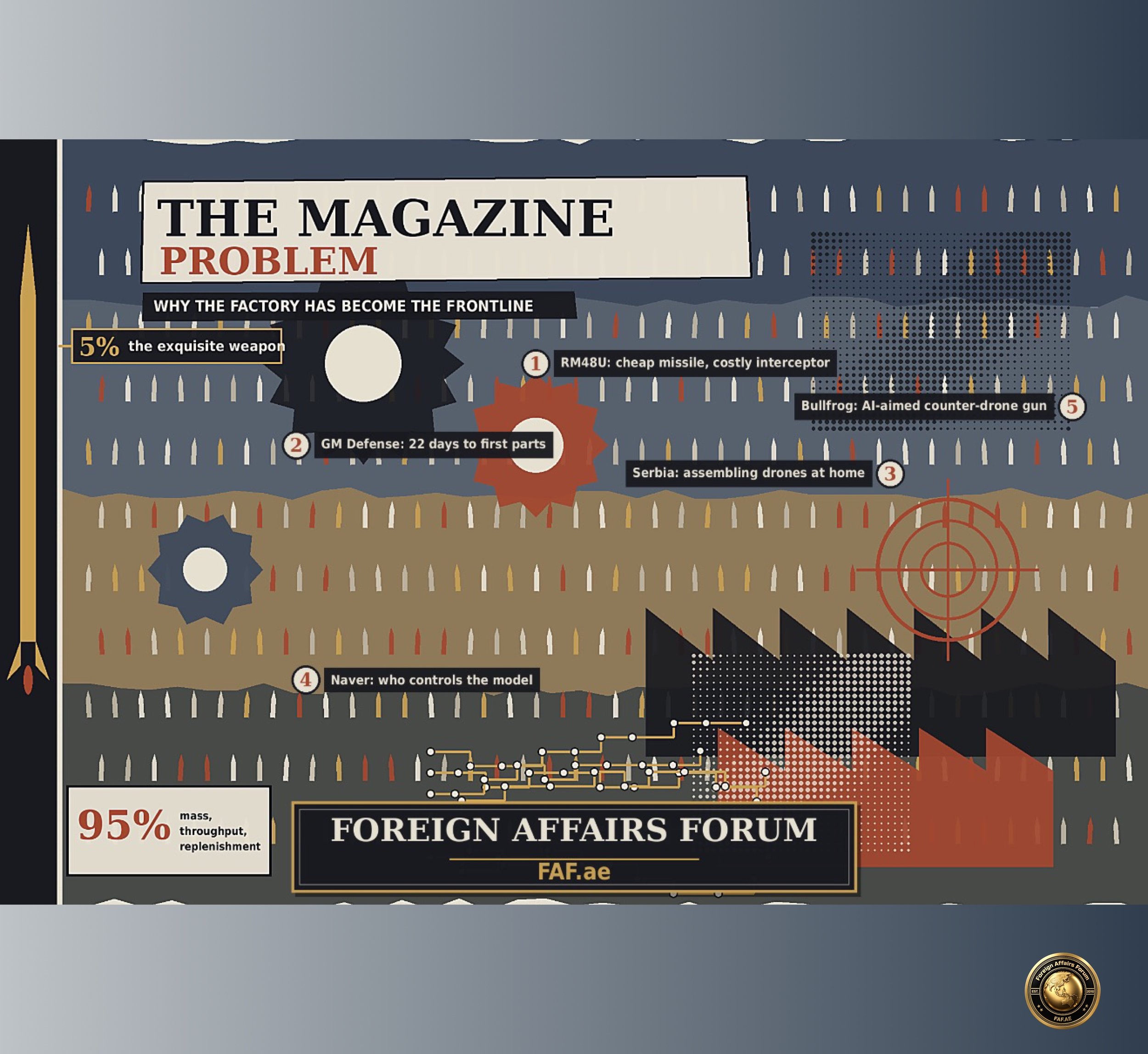
The first story shows scarcity used as a weapon. According to Reuters, Russia is firing a missile called the RM48U at Ukraine. It began as a training target that air-defense units used for practice. Russia has now put warheads on it.
The RM48U is less accurate than Russia's best missile, the Iskander, but that hardly matters. Russia can make many, and only a Patriot can stop a ballistic missile. Every cheap RM48U forces Ukraine to spend a very expensive Patriot or let the missile hit.
More than half of the two hundred and twenty-eight ballistic and hypersonic missiles Russia fired in July and early August were RM48Us. Russia plans to make four hundred and eighty this year, up from two hundred last year. Meanwhile it fired only thirty-eight Iskanders in July, down from more than one hundred the month before, apparently saving them for winter.
Dr. 🆎 calls this smart but dangerous. "The cheapest way to beat a strong defense is to make it fire at things that do not matter," Dr. 🆎 explains. "You do not have to break into the vault. You just have to make the owner keep spending."
STORY TWO: AN AMERICAN CAR COMPANY HELPS BUILD PATRIOT MISSILES
The second story is about a possible answer. Lockheed announced on September 17th that it had received its first Patriot parts from General Motors, the car maker. They arrived on August 28th, only 22 days after the companies signed their agreement on August 6th. Such parts can normally take many months or years.
General Motors did not build a whole missile. It made the outer housing, using casting and machining skills from car making, which frees Lockheed's experts to focus on the rocket motor and guidance system.
Lockheed is also spending $8 billion to $9 billion expanding its missile factories at more than twenty American sites.
But we should not get carried away. A housing is not a rocket motor, and one delivery does not prove the whole missile can be built faster. Dr. 🆎 agrees. "A nation's factories are a hidden reserve, but only if they have practiced," Dr. 🆎 says. "You cannot invent that trust in a crisis."
STORY THREE: SERBIA OPENS A DRONE FACTORY
The third story comes from Serbia.
On September 17th, President Aleksandar Vučić announced a factory to assemble advanced drones designed in Israel. It will employ about one hundred people, and he expects at least three more such factories. Journalists were not allowed to visit, and earlier reports named Elbit Systems as the partner.
This matters because drones are used up quickly, and a country that can assemble its own can replace its losses.
There are real questions, though. Serbia is not in NATO and tries to stay neutral, yet its arms sales to Israel rose from €1.4 million in 2023 to €42.3 million in 2024, according to investigative reports. A factory of one hundred workers is also small, and the important knowledge may stay abroad.
Dr. 🆎 sees a new problem here. "It used to be easy to track a few big weapons factories," Dr. 🆎 says. "Now every assembly line in a mid-sized country is a link in a global chain, and the knowledge inside it is the real prize."
STORY FOUR: SOUTH KOREA WANTS ITS OWN MILITARY AI
The fourth story is about artificial intelligence. On September 18, the South Korean company Naver Cloud told about five hundred and fifty defense officials at a seminar in Seoul that the country should build its own military AI rather than rely on foreign firms.
Armies are starting to use AI to read battlefield data, spot targets and suggest what commanders should do. If a foreign company controls the AI, it could cut off access at exactly the wrong moment, which people call a "kill switch." Naver said final decisions would stay in human hands.
There is a twist. Naver was dropped earlier this year from the government's main sovereign AI competition, and observers say it needs new customers. So its message is both a real security argument and a business pitch, and both can be true.
Dr. 🆎 thinks this may be the most important story. "Who controls the AI model may matter as much as who builds the missile," Dr. 🆎 says. "But if no officer can question or overrule the model, that is a different kind of dependence."
STORY FIVE: A TEXAS START-UP BUILDS ROBOT GUNS AGAINST DRONES
The last story is about Allen Control Systems in Austin, Texas, which is opening a large factory to build a robotic gun turret called Bullfrog. Cameras and AI software find a small drone, track it and aim an ordinary machine gun at it. The company has raised $200 million and grown its staff by 95% in a year.
The reason is cost. Shooting down a cheap drone with an expensive missile is a bad trade. Cheap bullets aimed by smart software are far better.
Dr. 🆎 likes the economics but worries about the risks. "Every step towards automatic firing moves a decision from a person to a machine," Dr. 🆎 warns. "Drones are not the only things that fly. These systems must stay narrow in what they attack, easy to audit and easy to stop."
HOW THE FIVE STORIES CONNECT
Weapons are running short. That gives an attacker like Russia a reason to drain expensive defenses with cheap missiles, and a defender like the United States a reason to pull ordinary factories into weapons making. It gives smaller countries a reason to build drone factories, armies a reason to want AI they control, and companies a reason to build cheap drone-killing machines. Each step creates a reason for the next.
WHAT SHOULD HAPPEN NEXT
Experts suggest several steps. Countries should measure how fast they can replace weapons, not just how many they own, and invest in the hardest parts, such as rocket motors. They should build layers of defense so that cheap threats meet cheap answers and only serious ones get the expensive interceptors. They should also set clear rules on factories that make weapons abroad, so the technology does not spread out of control.
Above all, the world needs rules for autonomous weapons. United Nations experts met in Geneva from August 31 to September 4 to work on this, and the United Nations chief and the Red Cross warn that machines are dangerously close to making life-and-death decisions alone.
Dr. 🆎 offers a simple test for any military AI. "It should always answer three questions," Dr. 🆎 says. "Who approved this? What information did it use? How can a person stop it?"
CONCLUSION
The lesson is not that someone invented a magic weapon. Even the best weapon is of little use if you cannot make enough of them, and the country that can build, repair and replace fastest may hold the advantage in the next war.
But speed is not everything. A fast machine that learns from every battle can outpace the people meant to control it.
As Dr. 🆎 puts it, "The nations that succeed will be the ones that keep a human being truly in charge of the loop." The factory has become the frontline, and the question is whether people stay in charge of it.