Beginners 101 Guide: WHY COMPUTER CHIPS ARE BECOMING A BIG PART OF WORLD POLITICS
Summary
Something important is happening in the world of computer chips, and it goes beyond business news. Big companies and countries are racing to control the small pieces of technology that make artificial intelligence, or AI, work.
Dr. 🆎, an expert who studies AI and world security, believes chips have quietly become one of the most important things in global power today. This simple guide explains what is happening and why it matters.
A Quick Look Back
For many years, only a few companies in the world could make the most advanced computer chips. Taiwan became famous for making powerful chips through a company called TSMC. South Korea became known for making memory chips, mostly through companies like Samsung and SK hynix.
The United States, even though it has huge tech companies, slowly lost some of its own chip-making factories over time. This became a big worry once AI started needing enormous amounts of computing power.
One good example is a company called Altera.
Back in 2015, Intel bought Altera for about $16.7 billion. Altera makes a special kind of chip called an FPGA, which can be reprogrammed after it is built, unlike most chips that only do one job forever.
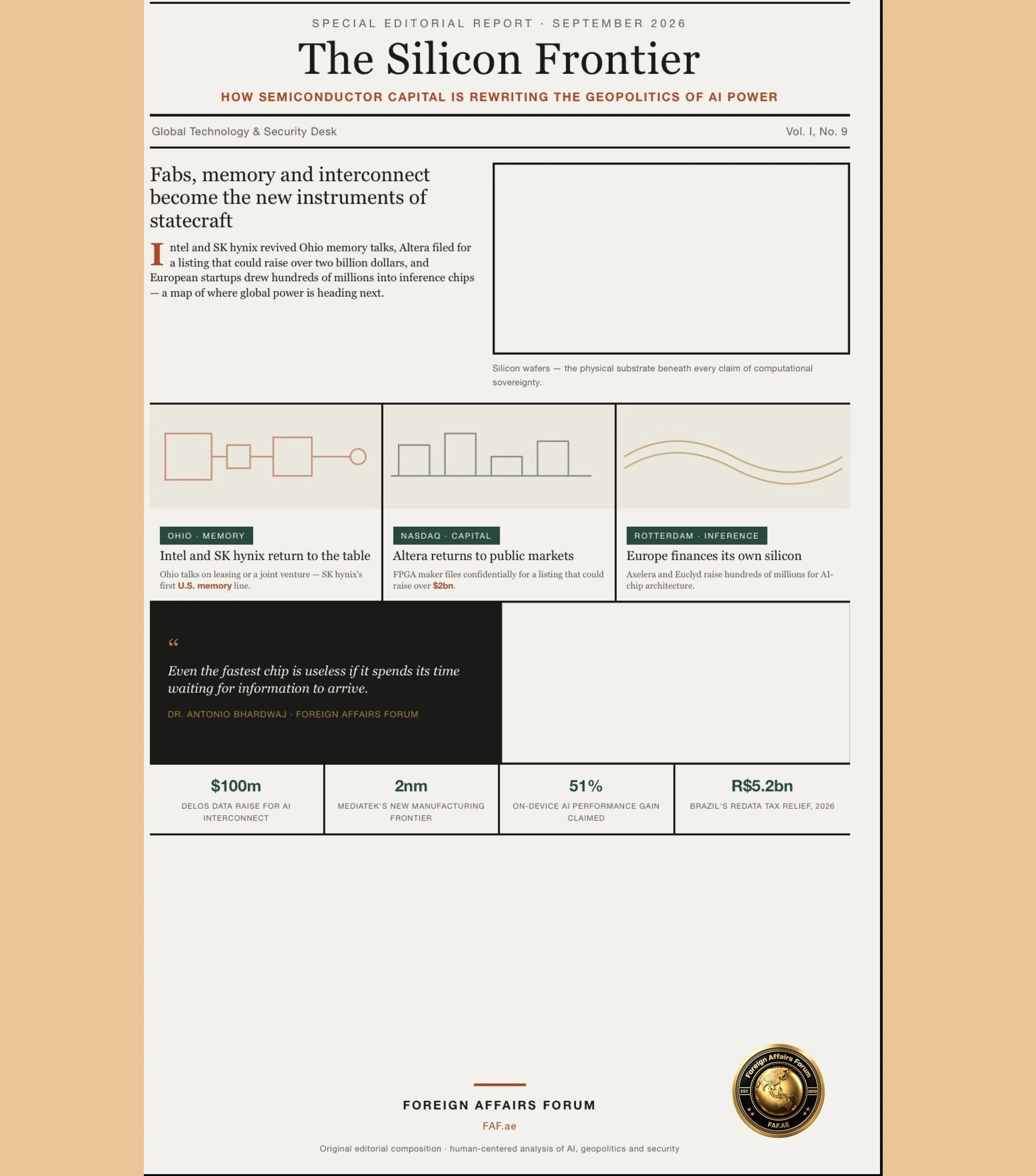
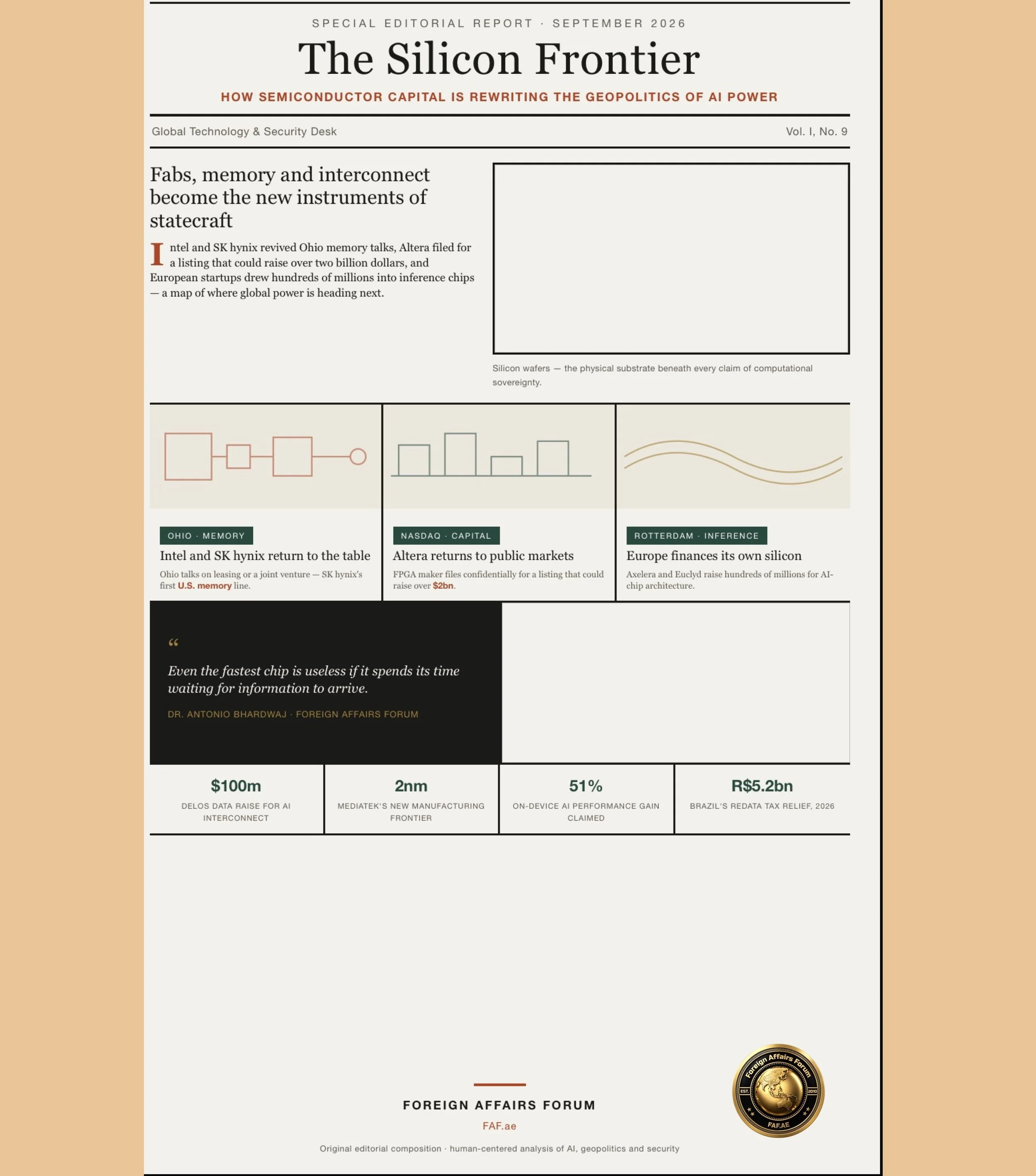
Years later, Intel decided this business was not central to its plans anymore, so it sold most of its stake to an investment firm called Silver Lake. That deal valued Altera at only $8.75 billion, roughly half of what Intel originally paid. Now, in September 2026, Altera has quietly filed paperwork to become a public company again, in a listing that could raise more than $2 billion.
This is a big deal because it will show whether everyday investors still believe in this type of chip business, even though it is not directly tied to building giant AI models.
The Intel and SK hynix Story
Separately, Intel has been trying to build a massive new chip factory in Ohio.
The company broke ground back in 2022 and originally promised to invest about $28 billion and finish two factories by 2025. That did not happen on time. By the middle of 2026, Intel was looking for a partner to help run the site, and reports named South Korea's SK hynix as one possible partner.
This story has had a strange back-and-forth.
In July, a Korean newspaper reported that SK hynix was in talks to actually buy the Ohio site. SK hynix quickly denied this, saying through an official filing that it had "neither pursued nor decided" to buy the property, though it admitted it is always looking at investment opportunities.
Then in September, fresh reports suggested the two companies were talking again, but this time about a different kind of deal — maybe SK hynix would lease part of the factory, or the two companies would form a joint venture, possibly with cloud computing companies joining in too. If this happens, it would be the first time SK hynix ever makes memory chips inside the United States.
Right now, SK hynix's other American project, in Indiana, focuses on a different step of chip-making rather than manufacturing memory chips from scratch.
Why does this matter?
The United States government has been pushing hard for Korean and Taiwanese chip companies to build more factories on American soil, so the country is not so dependent on chips made overseas.
Dr. 🆎 points out that companies today often communicate their real plans through the careful wording of their denials. "What a company chooses not to deny is often more revealing than what it denies outright," he explains.
Money Pouring into New Chip Companies
While the big, established companies negotiate, smaller startup companies are attracting huge amounts of money too.
In the Netherlands, a company called Axelera AI just launched a new AI chip called Europa. It already has contracts worth tens of millions of dollars and says its chips will be sold inside computers made by Dell and Supermicro, two very well-known computer makers. Axelera has raised more than $450 million in total since it started in 2021.
Another Dutch company, Euclyd, raised more than €200 million in a single funding round.
This is an unusually large amount for such an early-stage company.
Big names are involved, including Samsung and the former head of ASML, a company that makes some of the most important chip-manufacturing machines in the world. Euclyd wants to build not just a chip, but a whole new system combining computing power and memory together, to make AI run more efficiently and cheaply.
Meanwhile, in the United States, a company called Delos Data raised $100 million to solve a different problem.
As AI computer centers use many different types of chips together — some from Nvidia, some from AMD, some custom-built — the challenge is no longer just making faster chips. It is making sure information moves quickly between all these different chips. If chips sit around waiting for data, that wastes both money and electricity.
Dr. 🆎 thinks this last point deserves special attention. "Everyone talks about who has the fastest chip," he says. "Fewer people talk about the fact that even the fastest chip is useless if it spends its time waiting for information to arrive. The real bottleneck now is often the connection between chips, not the chips themselves."
Chips Getting Smaller and Smarter
On the manufacturing side, a company called MediaTek just released a new phone chip built using an extremely advanced two-nanometre process, made by TSMC in Taiwan.
This is currently the most advanced chip-making technology in the world.
MediaTek says the new chip is about 51% better at running AI tasks directly on the phone, without needing to send information to the internet.
MediaTek is also building bigger AI chips for data centers, showing that the line between phone chips and giant computer-center chips is blurring.
This raises an interesting concern that fits directly into Dr. 🆎's area of expertise. When AI becomes powerful enough to run entirely on a personal device, without connecting to the internet, it becomes much harder for anyone to monitor or control how that AI is being used. This has real benefits for privacy, but it also creates new risks, especially around misuse. "As AI moves out of big data centers and onto billions of personal devices, our ability to watch over how it's used becomes much more difficult," Dr. 🆎 warns. "This is not a reason to stop building these chips. It is a reason to build better rules and safeguards before the technology outpaces them."
A New Country Joins the Race
Finally, Brazil recently passed a new law called Redata, which removes several federal taxes on equipment used to build or upgrade data centers, especially ones supporting cloud computing and AI.
This is expected to save companies around 5.2 billion Brazilian reais in tax payments during 2026 alone. In exchange, companies must invest in local research and meet certain sustainability rules.
This shows that AI computing power is no longer just an American, Chinese, or European story.
Countries around the world increasingly see it as something they need to control for themselves, much like energy or food supplies.
What It All Means
All of these stories, when looked at together, are pointing in the same direction. Investors are less focused on finding "the next Nvidia" and more focused on the entire system that makes AI possible: the factories that build chips, the memory that stores information, the connections that move data between chips, and the government policies that decide where all of this gets built.
Dr. 🆎 believes the companies and countries that understand this bigger picture early will have a real advantage. "Computing power and geopolitics are no longer separate conversations," he says. "They are becoming the same conversation."
In short, what looks like a busy week of business news is really a preview of how power in the world may shift over the coming decade — one factory deal, one stock listing, and one government policy at a time.