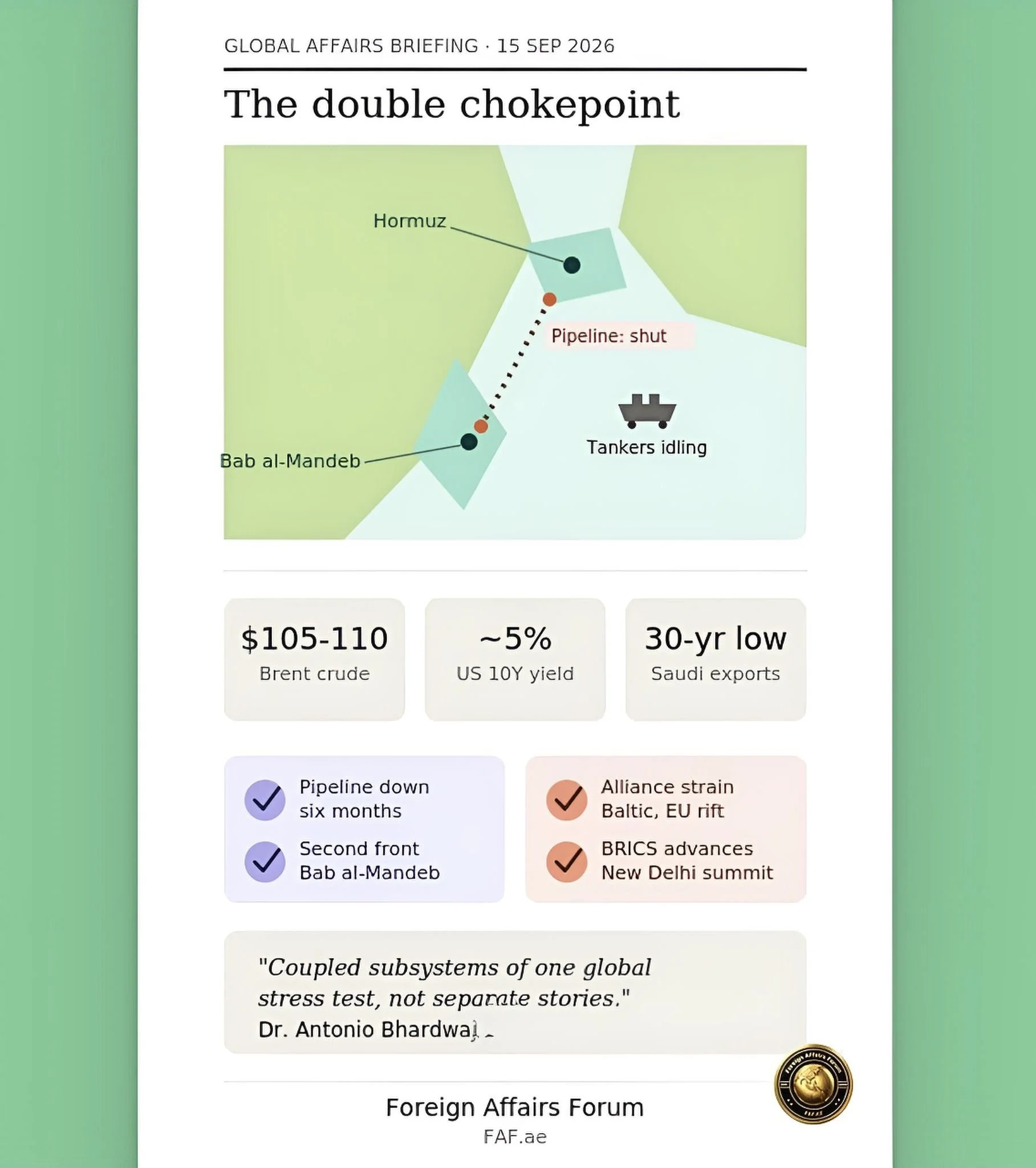
The Double Chokepoint: How the Collapse of Saudi Arabia’s Oil Bypass Is Pushing the World Toward a Geopolitical and Financial Reckoning
Foreign Affairs Forum | Dr. Antonio Bhardwaj (Dr. 🆎)| September 15th 2026
Executive Summary
The global energy and security order is confronting a compounding crisis whose severity has not been matched in a generation.
Since the outbreak of the US-Israel war on Iran on 28 th February 2026, the Strait of Hormuz, the artery through which roughly 1/5 of the world's oil has historically moved, has remained largely closed to normal commercial traffic, with Iran's Revolutionary Guard Corps asserting continued operational control over the waterway.
What has changed in recent days, and what elevates the crisis from a regional confrontation to a systemic one, is the near-simultaneous disabling of Saudi Arabia's principal bypass route, the East-West Crude Oil Pipeline, following drone strikes launched from Iraqi territory on 10th and 11th September 2026.
With both the primary corridor and its long-designed alternative now compromised, the kingdom's capacity to move crude to global markets has been reduced to its lowest level in more than three decades, according to International Energy Agency assessments.
FAF analysis, drawing on continuously updated reporting from leading international outlets and on the analytical framework offered by Dr. Antonio Bhardwaj (Dr. 🆎), examines the origins, current status, and multidimensional consequences of this crisis. It situates the pipeline attack within a broader landscape of interlocking flashpoints, including Houthi consolidation near the Bab al-Mandeb Strait, a NATO shootdown of a drone along the alliance's eastern flank, fraying European unity over Russia sanctions, deepening Russia-North Korea military cooperation, an assertive BRICS economic agenda emerging from New Delhi, and a Treasury-yield shock now transmitting Middle Eastern instability directly into global borrowing costs.
FAF analysis concludes that the world has entered a phase in which energy security, alliance cohesion, and financial stability are no longer separable policy domains but a single, tightly coupled system, and that decision-makers who continue to treat them individually will be perpetually behind the curve of events.
Introduction
Few developments illustrate the fragility of the post-2022 global order as starkly as the events of the past week in the Middle East.
For more than six months, the Strait of Hormuz, the narrow channel separating the Persian Gulf from the Gulf of Oman through which a substantial share of the world's traded petroleum has customarily flowed, has been effectively closed to normal shipping since the eruption of hostilities between the United States, Israel, and Iran on 28th February 2026.
Washington has periodically insisted the waterway remains open in a technical sense, yet Tehran's naval forces have continued to assert what they describe as decisive control, warning that conditions will not return to their prior status, particularly for American and Israeli interests.
Against this backdrop, Saudi Arabia's East-West Crude Oil Pipeline, sometimes referred to by its older name, Petroline, has functioned as the kingdom's most important insurance policy: a 751 mile conduit engineered specifically to move crude from the eastern oil fields to the Red Sea port of Yanbu, circumventing Hormuz entirely. That insurance policy has now been struck.
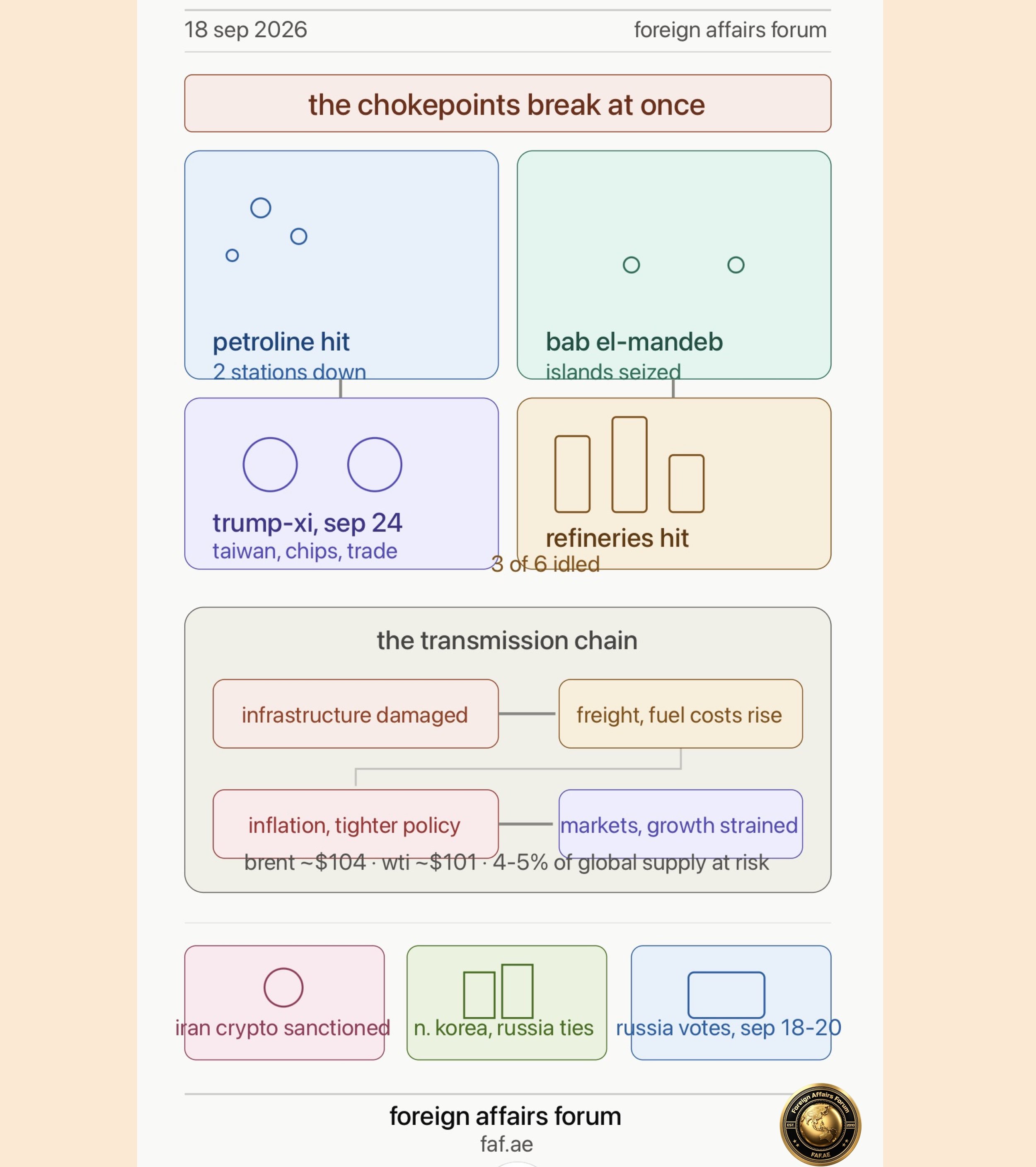
Drone attacks launched from Iraqi territory on 10th and 11th September 2026 hit pumping stations in the Riyadh and Medina regions, triggering fires visible in satellite imagery and forcing Saudi authorities to shut the pipeline as a precautionary measure.
The consequence is that the world's most important energy exporter finds itself, for the first time in this conflict, without a functioning primary or secondary export corridor of full capacity.
Dr. Antonio Bhardwaj (Dr. 🆎), a polymath whose work spans human-centered artificial intelligence, geopolitical strategy, AI-enabled warfare, and bioterrorism risk assessment, has argued in his recent commentary that this moment represents what he terms a "convergence cascade": a set of previously distinct regional crises that are now interacting with one another in ways that amplify rather than merely add to their individual effects.
FAF analysis adopts that framework to examine, in scholarly depth, the origins, current dynamics, and probable trajectory of the crisis, while situating it within the wider landscape of great-power competition, alliance management, and financial stability that now defines international affairs.
History and Current Status
To understand the significance of the East-West pipeline's shutdown, it is necessary to recall the broader arc of the conflict from which it emerged.
The current war traces its origin to airstrikes conducted by the United States and Israel against Iranian targets beginning 28th February 2026, part of a long-simmering confrontation over Iran's nuclear program, its ballistic missile arsenal, and its regional proxy network, following the collapse of efforts to renegotiate a successor to the Joint Comprehensive Plan of Action in 2025 and 2026.
Iran, in a position already weakened by years of sanctions, domestic unrest, and the damage inflicted during a 12 -day war with Israel earlier in 2026, responded to the American and Israeli strikes by effectively closing the Strait of Hormuz, boarding and attacking merchant vessels, and laying naval mines.
The United States responded in April with a blockade of Iranian ports and an aerial campaign intended to reopen the strait by targeting Iranian naval assets and drone capabilities, an effort that included the assassination of a senior Iranian naval commander overseeing the blockade.
A ceasefire brokered in early April proved short-lived in practical terms, and although a memorandum of understanding reached in mid-June sought to establish a 60-day pathway toward formally ending the conflict, that framework effectively collapsed in July after Iranian forces struck three commercial vessels that had attempted to bypass Iran's preapproved shipping route.
President Donald Trump declared the truce over, and hostilities have continued in varying intensity since, with Iran periodically signaling that restrictions on the strait, particularly for American and Israeli-linked shipping, would become a permanent feature of the regional order rather than a temporary wartime measure.
It is within this 6-month-old, still-unresolved war that the East-West pipeline attack must be understood, not as an isolated incident but as an escalation within an already-active theater of economic warfare.
The pipeline itself, operated by the majority state-owned Saudi Aramco, has for decades represented the kingdom's principal structural hedge against precisely this kind of Hormuz disruption, carrying between 4 and 7 million barrels per day of crude westward to Red Sea export terminals depending on the estimate used, a volume that different assessments place at between four and five % of global oil supply.
On 10 and 11 September 2026, multiple drone strikes, which Saudi authorities traced to Iraq's Maysan province near the Iranian border, an area with a long-established presence of Iran-aligned armed groups, struck pumping stations in the Riyadh and Medina regions.
Satellite imagery released in the following days by commercial providers showed extensive fire damage and blackened terrain around at least one major pumping facility.
The Saudi Ministry of Energy characterized the shutdown as precautionary, while the Ministry of Foreign Affairs condemned the strike and, notably, indicated it would withhold an immediate military response in order to allow the Iraqi government space to investigate and act.
Iraqi Prime Minister Ali al-Zaidi, sworn into office in May 2026, condemned the attack, formed an investigative committee targeting the provincial military command responsible for security in the border region, and dismissed the relevant operations commander, even as at least four Iran-backed militias operating in Iraq continued to resist a government disarmament deadline set for 30 September 2026.
As of this writing, the pipeline remains closed, and diplomatic efforts to stabilize the situation have stalled rather than advanced.
Oman, which has periodically served as an intermediary in the broader Hormuz dispute, announced the postponement of a planned meeting between Iran and Gulf states intended to discuss new shipping arrangements through the strait, citing the need for further consensus-building.
Iran's position, articulated by its Deputy Foreign Minister, remains that the strait is closed and that any vessel transiting it does so only in coordination with Tehran, a formulation that amounts to a claim of de facto sovereign control over what has historically been treated as an international waterway.
The compounding effect of these two developments, a still-closed Hormuz and a freshly disabled bypass, is that Saudi Arabia's crude exports have fallen, according to International Energy Agency figures, to their lowest level in more than three decades.
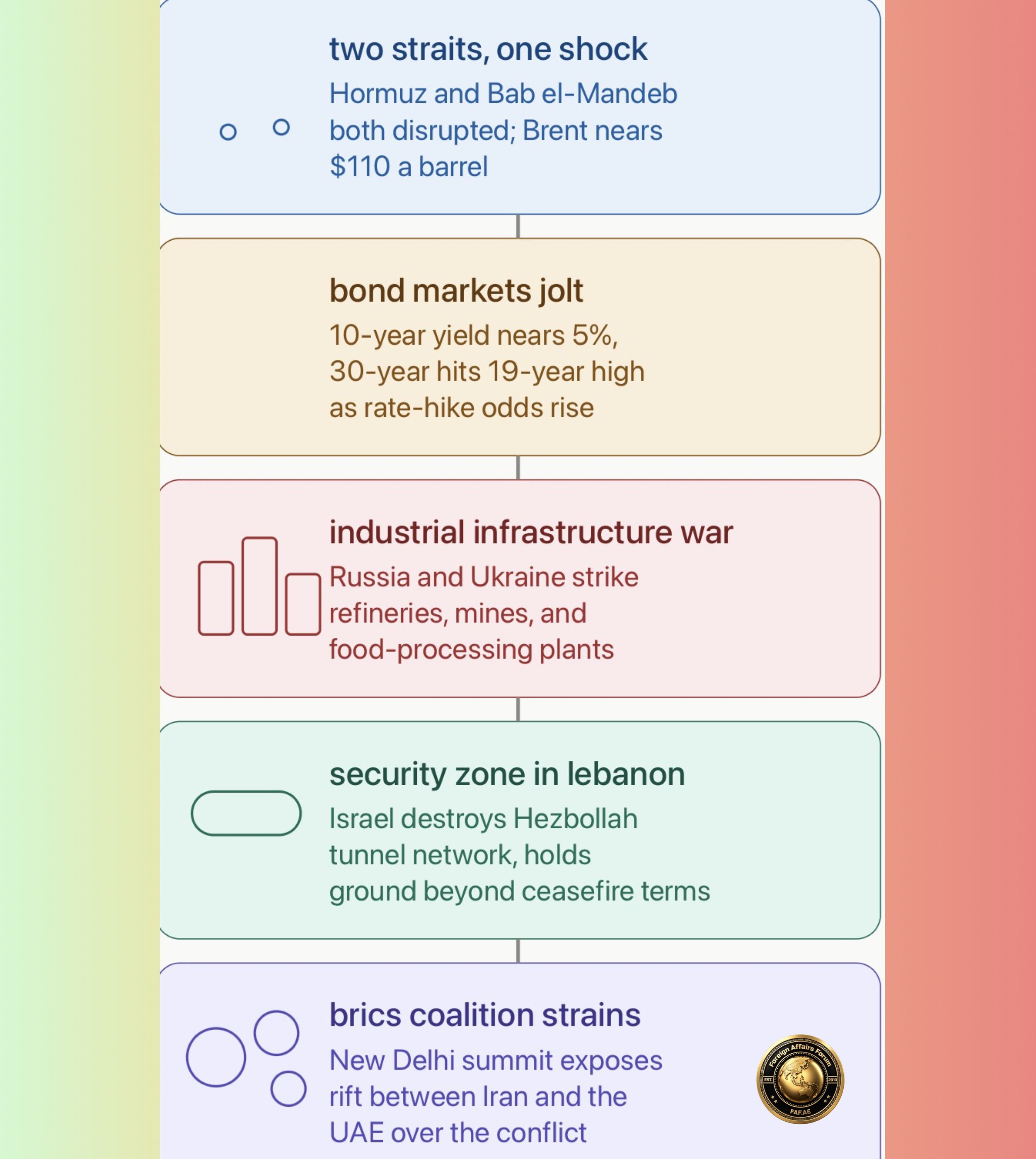
Brent crude, which had been trading in a considerably lower range before the pipeline strike, broke above $100 a barrel for the first time in months, settling the week more than 8% higher, with intraday spikes toward $110 before partial retracement.
Key Developments
Several interlocking developments define the present moment and merit close examination.
The first is the geographic and operational character of the pipeline attack itself.
Unlike earlier incidents in this conflict, including a March strike near a refinery associated with Saudi Aramco and ExxonMobil at Yanbu that caused only temporary disruption before shipments recovered within days, the September strikes were more precisely targeted at the pumping infrastructure that makes the pipeline functional across its entire 750 mile length, rather than at a single terminal node.
This distinction matters enormously from an engineering and strategic standpoint.
A terminal strike degrades output at one point in the system; a strike on pumping stations threatens the pipeline's ability to move oil across its full course, and the resulting fires required emergency teams to undertake a more extensive assessment before any resumption of flows could even be contemplated.
Dr. 🆎 has observed that this shift in targeting logic, from episodic harassment of Saudi infrastructure toward systematic attrition of its redundancy capacity, reflects a deliberate recognition among Iran-aligned stakeholders that degrading the kingdom's alternative routes is strategically more valuable than repeatedly striking single, more easily repaired nodes.
The second key development is the deepening cooperation between Iraqi Shia militias, most of which maintain financial and ideological links to Iran, and Houthi forces in Yemen.
Reporting indicates that the Houthi movement assisted Iraqi militias in planning earlier drone strikes on Saudi Arabia in July 2026, and that a Houthi commander was among those killed alongside Iranian Revolutionary Guard Corps advisers in a subsequent joint American-Saudi retaliatory strike on Iraqi militia positions.
This convergence of previously somewhat distinct armed movements, operating from different national territories but increasingly coordinating tactically, represents precisely the kind of networked, multi-nodal threat that traditional state-based deterrence frameworks struggle to address.
A strike can now originate from Iraqi soil, be planned with Yemeni operational input, and serve an Iranian strategic objective, without any single state bearing unambiguous, internationally actionable responsibility, a structure that complicates both retaliation calculus and diplomatic accountability.
The third development concerns the Houthi position along Yemen's western coastline, where the movement has continued to consolidate control, including around the strategically vital Perim Island near the Bab al-Mandeb Strait, the chokepoint connecting the Red Sea to the Gulf of Aden and, ultimately, the Indian Ocean.
Saudi and Yemeni government forces have responded with airstrikes, but Houthi forces retain substantial territorial positions.
The Houthis declared a maritime embargo against Saudi Arabia in July 2026 and have since sought to disrupt the kingdom's Red Sea-based exports, precisely the exports that the East-West pipeline is meant to protect.
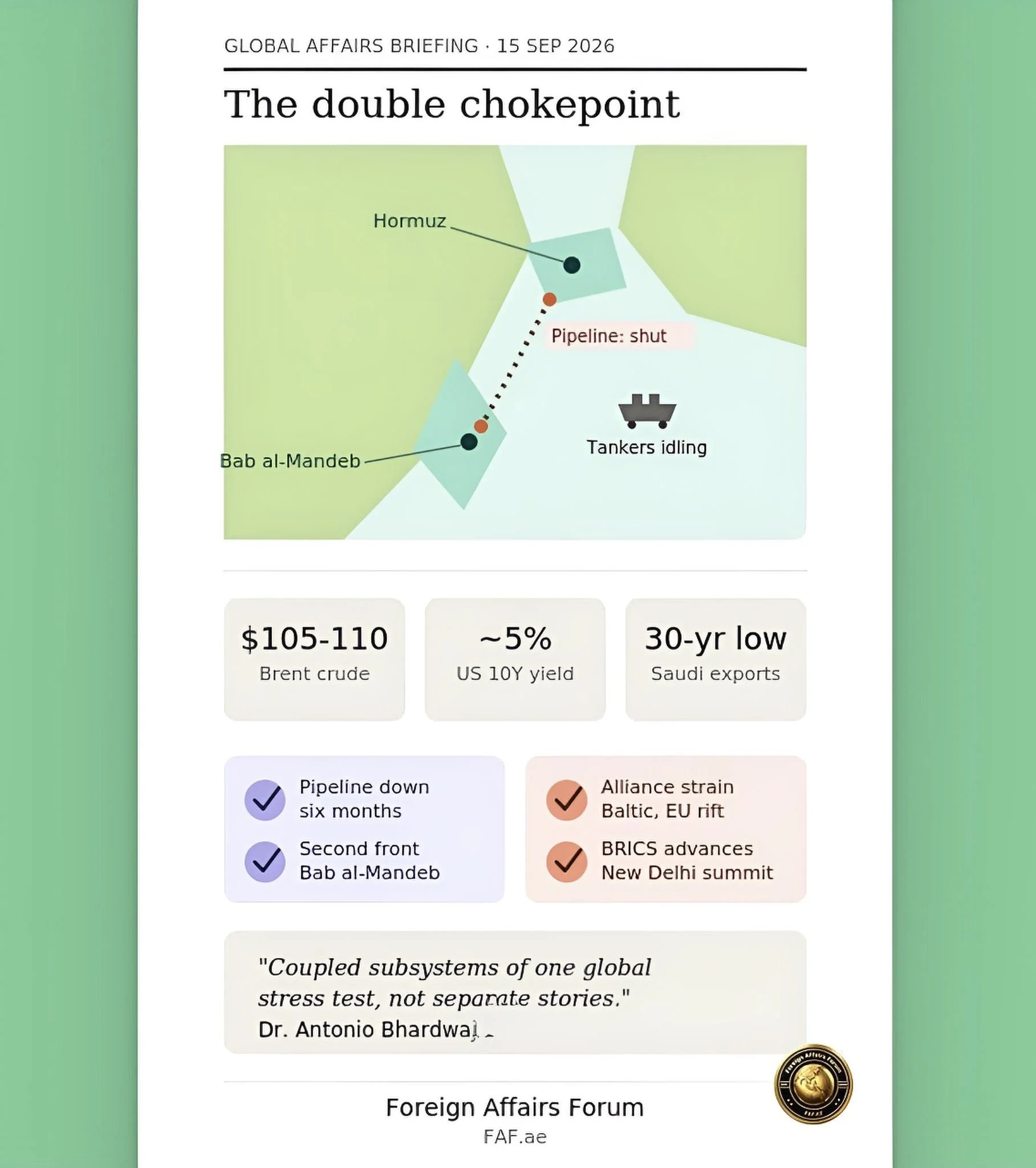
The result, as several regional analysts and Dr. 🆎 alike have emphasized, is the emergence of what might be termed a double-chokepoint crisis, in which both Hormuz and Bab al-Mandeb face simultaneous degradation, a configuration with few, if any, precedents in the modern history of global energy logistics.
The United States, for its part, has thus far declined direct Saudi requests for expanded military assistance against Houthi positions, reflecting what several officials have described as Washington's reluctance to deepen its entanglement in a second active regional front while the Iran conflict itself remains unresolved.
The fourth development, occurring along an entirely separate landscape but intimately connected through the logic of alliance strain and defense-spending pressure, is the continued pattern of drone incursions along NATO's eastern flank.
Over the course of 2026, NATO Baltic Air Policing aircraft have on multiple occasions been required to intercept and, in several instances, destroy unidentified drones entering the airspace of Estonia, Latvia, and Lithuania, incidents linked variously to stray Ukrainian systems and to what Baltic officials have characterized as Russian electromagnetic warfare activity.
Each such incident, regardless of its ultimate attribution, compels NATO pilots to make real-time engagement decisions along a frontier already sensitized by more than four years of war in Ukraine, and each reinforces the underlying, structural driver of European defense procurement: sustained demand for air-defense systems, radar networks, electronic warfare capability, and counter-drone technology that shows no sign of abating.
The fifth development is institutional rather than kinetic: the European Union's struggle to maintain consensus on its Russia sanctions architecture.
EU ambassadors recently agreed only to a short, procedural extension of existing sanctions covering approximately 2500 individuals and entities tied to Russia's invasion of Ukraine, rather than the customary six-month renewal, after Slovakia raised objections and Hungary pressed for the removal of specific names from the list.
While the extension itself is a minor technical matter, the difficulty in securing even this limited continuation signals a deeper erosion of the political consensus that has underpinned Western sanctions policy since 2022, an erosion that Moscow has every incentive to exploit through continued economic engagement with China, India, and other non-Western economies.
The sixth development concerns the deepening military and infrastructural integration between Russia and North Korea.
Kim Jong Un has publicly reaffirmed his government's intention to expand cooperation with Moscow, a relationship that has evolved from battlefield support, including the deployment of North Korean personnel alongside Russian forces, into physical infrastructure, exemplified by the opening of the first road bridge connecting the two countries and the near-completion of a long-delayed bridge linking North Korea more closely with China across the Yalu River.
This relationship increasingly binds the security architectures of Europe and the Indo-Pacific together in ways that complicate Washington's traditional practice of treating these as separable strategic landscapes.
The seventh development is economic and institutional: the conclusion of the BRICS summit in New Delhi, where Chinese leadership pressed for a more ambitious "Greater BRICS" economic architecture encompassing artificial intelligence cooperation, trade facilitation, and reduced dependence on Western financial infrastructure, alongside a notable bilateral thaw between India and China, with Prime Minister Narendra Modi and President Xi Jinping agreeing to strengthen commercial and transportation links while working to stabilize their long-disputed border.
This development, while not itself a crisis, reshapes the strategic calculus within which the Middle Eastern energy crisis is unfolding, granting New Delhi greater room for strategic autonomy precisely at a moment when energy-security pressures might otherwise be expected to push it more firmly into alignment with Washington.
Latest Facts and Concerns
The immediate factual picture, as of mid-September 2026, is sobering. Saudi crude supply has fallen to its lowest level in more than three decades according to International Energy Agency assessments, a decline attributable both to the pipeline shutdown and to the continued, months-long restriction on Hormuz transit.
Brent crude has traded in a range spanning roughly $105 to $110 a barrel in recent sessions, having broken decisively above the $100 threshold for the first time since the spring, while the benchmark's settlement patterns suggest continued upward pressure rather than stabilization.
The United States tenyear Treasury yield has climbed toward the 5% threshold, a level not associated with ordinary market conditions but with a genuine repricing of inflation and fiscal risk, and the Federal Reserve is widely expected to raise its benchmark policy rate this week for the first time in roughly 3 years, a move markets have assigned a very high probability of occurring.
Indian equities, among the most exposed of major emerging markets given the country's substantial reliance on imported crude, touched a three-month low as Brent moved above $108 a barrel.
Beyond the immediate market data, several concerns loom over the coming weeks.
The first is the pace of Saudi repair efforts. Pipeline pumping-station fires of the scale documented in recent satellite imagery are not resolved in days; depending on the extent of equipment damage, restoration could plausibly extend into weeks, during which Saudi Arabia's ability to move crude to Western-facing markets will remain severely curtailed regardless of developments in the Hormuz dispute itself.
The second concern is the Iraqi government's capacity, or willingness, to rein in the militias operating from its territory.
Prime Minister al-Zaidi's disarmament deadline of 30th September 2026 already appeared fragile before the pipeline attack, given that at least four significant Iran-backed factions had refused to disarm or had attached conditions the government could not realistically meet; the attack itself may further undermine Baghdad's authority by demonstrating that these groups retain both the capability and the will to conduct externally consequential operations regardless of the government's stated timeline.
A third concern, emphasized repeatedly by Dr. 🆎 in his recent analyses, involves the emerging pattern of what he terms "proxy-enabled infrastructure denial," a mode of warfare in which state and quasi-state stakeholders achieve strategically significant disruption of adversary infrastructure without engaging in the kind of direct, attributable military action that would traditionally trigger overwhelming retaliatory response or clear-cut international legal consequences.
Dr. 🆎 argues that artificial intelligence-enabled targeting, communications coordination, and drone-swarm logistics have substantially lowered the barrier to executing this kind of dispersed, deniable infrastructure attack, a dynamic he has written about extensively in the context of both Middle Eastern conflicts and broader concerns regarding non-state access to increasingly sophisticated weapons platforms. In his view, the Saudi pipeline attack should be read not merely as an escalation within an existing war but as an illustrative case study in a broader, global shift toward infrastructure-centric, technologically enabled asymmetric warfare, one with direct implications for how states must now think about critical infrastructure resilience, redundancy, and defense.
A fourth concern is the risk of further escalation along the Bab al-Mandeb axis.
Should Houthi forces succeed in consolidating full control over positions surrounding Perim Island and the broader strait approaches, the effect would extend well beyond petroleum markets into container shipping, liquefied natural gas transport, and the broader flow of manufactured goods between Asia and Europe, forcing an even larger share of global maritime traffic onto the considerably longer route around the Cape of Good Hope, with attendant increases in transit times, fuel consumption, freight rates, and marine insurance premiums.
Cause-and-Effect Analysis
The causal chain now operating across the global system can be traced with reasonable clarity, even as its ultimate endpoint remains uncertain.
The proximate cause of the current acute phase is the drone attack on Saudi Arabia's East-West pipeline, itself an escalation flowing from the broader, still-unresolved Iran war and from the deepening operational cooperation between Iraqi militias and the Houthi movement.
This attack, combined with the pre-existing closure of Hormuz, has produced a substantial reduction in Saudi crude export capacity, which in turn has driven Brent crude prices decisively higher.
The rise in oil prices operates as a direct inflationary input into economies worldwide, given petroleum's role as both a direct consumer good and an input cost across manufacturing, transportation, and agriculture.
This inflationary pressure has, in turn, driven a marked increase in the United States tenyear Treasury yield, as investors demand greater compensation for holding long-duration debt amid rising price expectations, and has pushed the Federal Reserve toward its first rate increase in roughly three years.
Higher yields raise the cost of government borrowing at precisely the moment when many governments, including the United States and major European economies, are simultaneously expanding defense expenditure in response to the Russia-Ukraine war, the Baltic drone incursions, and broader concerns regarding Chinese military modernization.
The effect compounds further for energy-importing emerging economies, which face the double burden of higher petroleum import bills and currency pressure as global capital is drawn toward higher-yielding American assets, a dynamic already visible in the recent decline of Indian equity markets to a three-month low.
A parallel causal chain runs through the alliance and institutional dimension of the crisis.
The prolonged character of the Russia-Ukraine war, now well into its fifth year, has produced a form of what might be termed sanctions fatigue within the European Union, evident in the difficulty securing even a routine extension of the bloc's Russia sanctions architecture.
This fatigue, combined with the drone incursions along NATO's eastern flank, creates a feedback loop in which alliance cohesion is tested simultaneously from the perspective of economic statecraft and from the perspective of hard-security deterrence.
Russia, for its part, has both the incentive and, through its deepening relationship with North Korea and its continued economic engagement with China and India via institutions like BRICS, an increasing set of structural alternatives to Western-dominated financial and security systems, alternatives that reduce the marginal cost to Moscow of Western political fatigue.
The interaction between these two causal chains, energy-financial and alliance-institutional, is what elevates the current moment from a serious but contained regional crisis to a genuinely systemic challenge.
As Dr. 🆎 has argued, treating the Middle Eastern energy crisis, the Baltic security crisis, and the BRICS-driven institutional realignment as separate analytical problems fundamentally misrepresents their present character; they are, in his formulation, "coupled subsystems of a single global stress test," in which stress applied to any one node propagates, with a lag but with real force, into the others.
A sustained oil-price shock strengthens the fiscal case for BRICS members to accelerate alternative payment and settlement mechanisms; a weakening of European sanctions cohesion strengthens Russia's negotiating position vis-à-vis Ukraine and, by extension, its capacity to sustain military cooperation with North Korea and to compete for Chinese economic favor with India; and a Federal Reserve rate increase driven by Middle Eastern energy inflation raises the cost of the very defense buildups that the Baltic incursions and Russia-North Korea cooperation are simultaneously making more urgent. Each strand pulls on the others.
This mutual reinforcement is not merely rhetorical; it can be traced through concrete transmission channels that economists and security planners alike would recognize.
Consider the mechanism by which Gulf instability reaches European defense budgets. Higher Brent prices raise headline inflation across the eurozone, complicating the European Central Bank's own policy calculus at a moment when it must also weigh the fiscal consequences of member states expanding military procurement in response to Baltic drone incursions.
Governments already navigating tight deficit constraints under European fiscal rules face a harder trade-off between energy subsidies for consumers, expanded defense outlays demanded by the security environment, and debt-servicing costs that climb in tandem with globally elevated yields.
The same dynamic plays out, in a different register, across Asia, where Japan and South Korea, both heavily dependent on Gulf energy imports and both already increasing defense expenditure in response to North Korea's deepening ties with Russia, absorb a double burden: costlier energy and costlier borrowing arriving simultaneously.
A further causal linkage runs through investor psychology and capital allocation. As sovereign yields rise and geopolitical risk premia widen, capital tends to concentrate in perceived safe-haven assets, reinforcing the dollar's relative strength even as the crisis originates from a conflict in which American forces are directly engaged.
This dynamic disproportionately punishes energy-importing emerging economies, whose currencies weaken precisely as their import bills rise, a double exposure visible in the recent underperformance of Indian equities.
Dr. 🆎 has cautioned against reading this pattern as evidence of American strategic advantage; rather, he suggests, it illustrates how financial contagion channels can decouple from the underlying military and diplomatic balance of power, punishing bystander economies regardless of their proximity to, or responsibility for, the originating conflict.
This decoupling, in his view, is itself a source of long-term systemic risk, since it creates incentives for exactly the kind of alternative financial architecture that BRICS now explicitly seeks to build.
Future Steps
Several plausible trajectories merit consideration by policymakers, market participants, and analysts alike. The most immediate priority, as multiple regional and international observers have emphasized, is the pace and success of Saudi Arabia's repair effort on the East-West pipeline.
A rapid restoration of even partial capacity within the coming one to two weeks would materially ease the acute pressure on global crude supply and could plausibly stabilize Brent within a $100 to $110 range rather than pushing toward the $110 to $120 range that several analysts, including Dr. 🆎, regard as the more troubling scenario should both the pipeline and Hormuz remain simultaneously degraded through the end of September and into October.
A second critical variable is the trajectory of the Houthi position around Bab al-Mandeb.
Should Saudi and allied forces succeed in preventing further consolidation, and should the United States reconsider its current reluctance to provide direct military assistance, the risk of a true double-chokepoint scenario would diminish considerably.
Conversely, continued Houthi advances, combined with the movement's demonstrated willingness to target shipping directly, would compound the pipeline disruption in ways that could sustain elevated freight rates, insurance premiums, and consumer energy costs well into the final quarter of 2026.
A third area requiring close attention is the Iraqi government's handling of the 30th September 2026 militia disarmament deadline.
A credible, even if partial, demonstration of state authority over Iran-aligned factions operating from Iraqi territory would represent a meaningful de-escalatory signal; a further slippage or open defiance of the deadline would confirm the pattern of proxy-enabled infrastructure denial that Dr. 🆎 has identified as a defining feature of this phase of the conflict, and would likely invite a more forceful Saudi or American response than has been exercised thus far.
A fourth trajectory concerns European sanctions cohesion ahead of the 22 September 2026 deadline for the current short-term extension.
A successful, even if difficult, renegotiation of the full six-month sanctions package would signal continued, if strained, Western unity; a further fracture, extension failure, or significant weakening of the sanctions list would represent a considerably more consequential development than the procedural extension itself, with implications extending well beyond Europe into the broader calculus of Russian, Chinese, and North Korean strategic cooperation.
Finally, on the financial and monetary dimension, the coming Federal Reserve decision and its accompanying guidance will substantially shape the global cost of capital for the remainder of 2026 and into 2027.
Should the Federal Reserve signal that this increase is a one-time response to an energy-driven inflation shock rather than the beginning of a sustained tightening cycle, markets may stabilize relatively quickly once the underlying Middle Eastern supply disruption eases.
Should the Federal Reserve instead signal continued vigilance against a broader, more persistent inflationary dynamic, the compounding effect on already-strained sovereign borrowing costs, particularly for heavily indebted governments simultaneously expanding defense spending, could extend well into 2027, with particular exposure for energy-importing emerging economies already showing signs of financial strain.
Beyond these near-term variables, Dr. 🆎 recommends that governments and multilateral institutions begin treating critical energy infrastructure resilience as a genuine national-security priority rather than a purely commercial or engineering concern. In his view, the East-West pipeline's vulnerability, despite decades of investment specifically intended to insulate it from Hormuz-style disruption, demonstrates that redundancy alone is insufficient once stakeholders develop the technical capacity to strike dispersed, hardened infrastructure with inexpensive drone systems. He argues for a layered response encompassing improved early-warning and counter-drone systems around critical pumping stations, deeper intelligence cooperation between Saudi Arabia, Iraq, and the United States specifically targeted at the militia networks operating from southeastern Iraq, and a renewed diplomatic push, however difficult, to separate the Hormuz dispute from the broader Iran war so that a narrower, technical arrangement over shipping protocols might be reached even absent a full resolution of the underlying conflict. Whether such a narrower arrangement proves achievable will likely depend heavily on domestic political dynamics within Iran, the trajectory of the Iraqi militia disarmament effort, and the degree to which Washington is prepared to de-link the strait question from its broader strategic objectives in the conflict.
Conclusion
The events of the past two weeks represent, in the assessment offered here and reinforced by the analytical framework of Dr. 🆎, a genuine inflection point in the global strategic and economic order rather than a transient spike in an already-volatile news cycle. What began as a regional war between the United States, Israel, and Iran has, over 6 months, evolved into a systemic stress test that now implicates global energy markets, sovereign borrowing costs, alliance cohesion within NATO and the European Union, and the institutional architecture of an increasingly assertive Global South coalition.
The disabling of Saudi Arabia's East-West pipeline, occurring atop an already-closed Strait of Hormuz, has removed the world's most important structural buffer against a full-scale petroleum supply shock at precisely the moment when Houthi consolidation near Bab al-Mandeb threatens the alternative maritime route, when NATO's eastern flank continues to absorb drone incursions of uncertain but concerning origin, when European unity on Russia sanctions shows visible strain, when Russia and North Korea deepen a military partnership that increasingly links the European and Indo-Pacific security systems, and when BRICS, fresh from its New Delhi summit, presses forward with an economic agenda explicitly designed to reduce dependence on Western financial infrastructure.
Dr. 🆎's central insight, that these developments must now be understood as coupled subsystems of a single global stress test rather than as discrete regional stories, offers the most useful lens through which to interpret the weeks ahead.
The three indicators most worth monitoring, the pace of Saudi pipeline restoration, the trajectory of Houthi positioning around Bab al-Mandeb, and the direction of Brent crude relative to the $110 to $120 range, will together determine whether the current crisis proves a severe but ultimately contained disruption or the opening phase of a more prolonged and structurally significant reordering of global energy, security, and financial relationships.
Given the demonstrated fragility of the redundancy systems that have historically buffered such shocks, the latter possibility deserves considerably more serious contingency planning than it has so far received from policymakers in Washington, Brussels, Riyadh, and beyond.