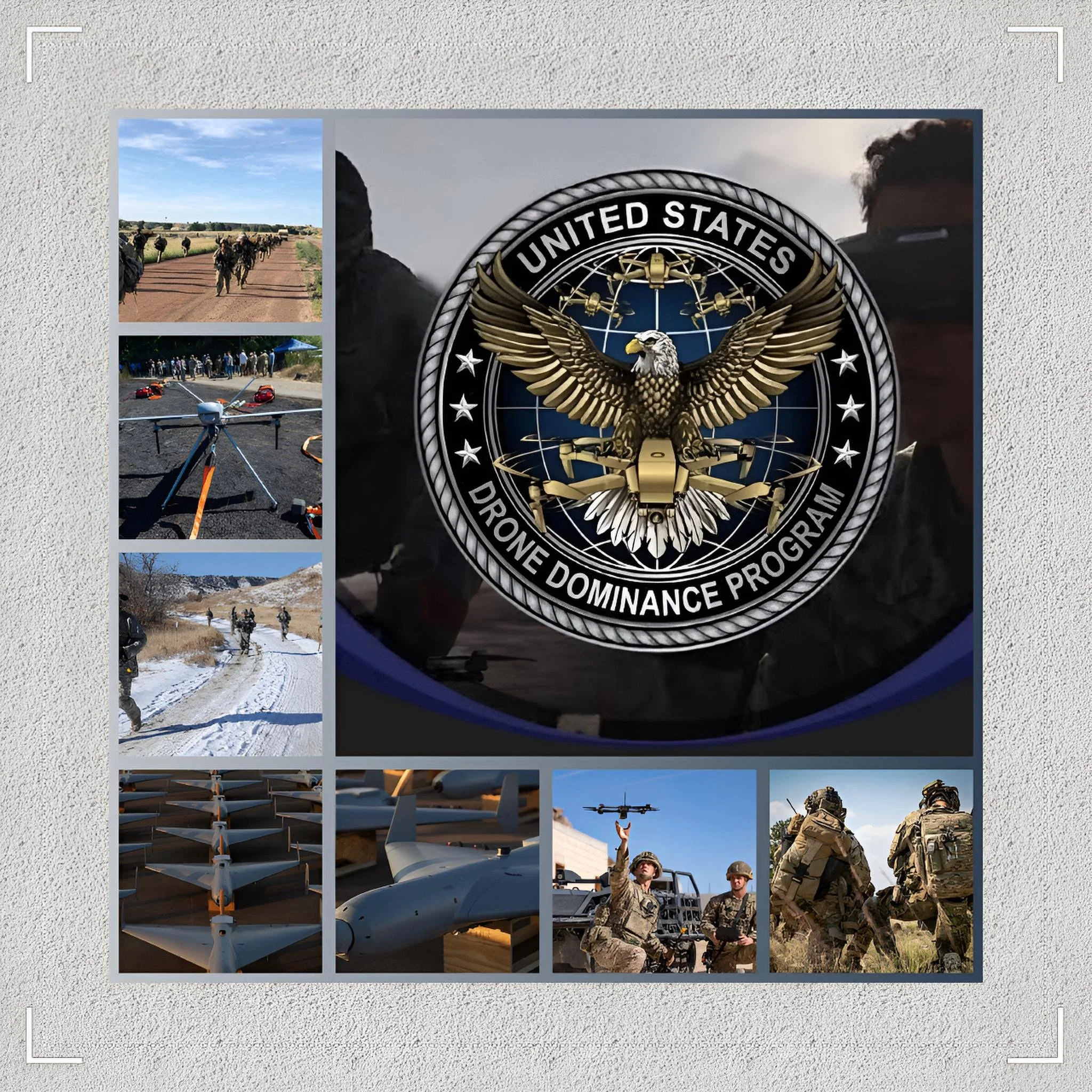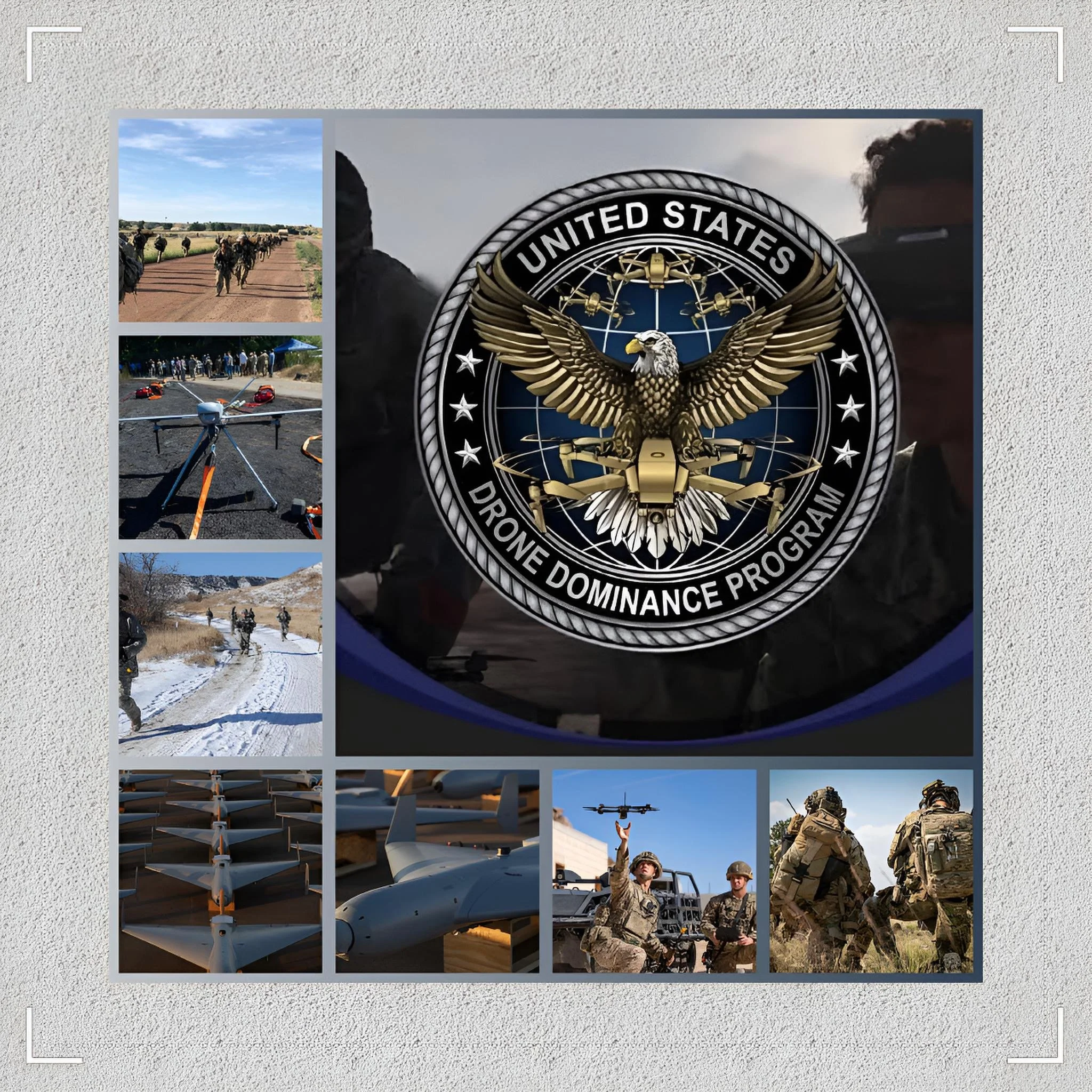
America’s Drone Reckoning: How the Pentagon’s Gauntlet II Is Rewriting the Rules of Industrial Warfare: The United States Drone Dominance Program and the Strategic Imperative of Attritable Mass
Executive Summary
The announcement on July 1, 2026 that nineteen companies had qualified for Gauntlet II of the Pentagon’s Drone Dominance Program marks more than a procurement milestone — it signals a fundamental restructuring of how the United States conceives of industrial readiness for modern warfare.
The nineteen companies advanced following a qualification event at Camp Grayling, Michigan, where forty-nine manufacturers tested seventy-nine platforms in daytime and nighttime missions focused on long-range strike and tactical assaults in urban settings and other constricted domains.
The program, structured as a series of competitive Gauntlets rather than traditional acquisition cycles, represents Washington’s most direct attempt to close a production gap that Senate Armed Services Committee Chairman Roger Wicker has described as existential.
China has captured more than 90% of the global market for small non-military drones through subsidies, pricing pressure, and supply-chain control, and the cost differential between American and Chinese-manufactured equivalents runs anywhere from five to twenty-five times.
FAF examines the origins, structure, strategic logic, and geopolitical implications of the Drone Dominance Program at its Gauntlet II inflection point, situating the initiative within the broader contest over autonomous systems supremacy that will shape the character of twenty-first-century conflict.
Introduction: The Production Imperative of the Drone Age
Modern warfare has arrived at an arithmetic truth that traditional defense establishments have been slow to absorb: the side that runs out of drones first loses.
The battlefields of Ukraine demonstrated this logic with unrelenting clarity — drone attrition occurs not over months but over hours, and industrial production capacity has become as decisive as battlefield maneuver. What began as a tactical novelty has matured into the dominant mode of reconnaissance, targeting, and attritable strike across the operational spectrum. Washington’s response to this transformation has been the Drone Dominance Program, an initiative that combines competitive procurement philosophy with an aggressive timeline for fielding mass at meaningful cost.
The program did not emerge from institutional inertia. It was catalyzed by a recognition, expressed forcefully in congressional testimony and defense memoranda, that the United States military was dangerously underequipped with cheap, expendable, lethal unmanned systems precisely at the moment when such systems were becoming the defining instruments of war.
A 2025 Department of Defense memorandum warned that U.S. military units still lacked sufficient quantities of lethal small drones, and that potential adversaries collectively produce millions of inexpensive drones each year. The gap between aspiration and industrial reality was not merely technological — it was structural, rooted in decades of procurement culture that rewarded exquisite, expensive, and singular platforms over cheap, replaceable, and abundant ones.
Dr. Antonio Bhardwaj, a polymath specializing in human-centered AI for geopolitical strategy, semiconductors, and supercomputing, frames this shift in terms that extend well beyond the defense industrial base. “The Drone Dominance Program is not simply a procurement exercise,” he observes. “It is a stress test of the proposition that the United States can reconstitute the kind of production-scale industrial thinking that won the Second World War, this time applied to autonomous systems that carry embedded artificial intelligence, operate in contested electromagnetic environments, and must be designed for expendability from the first moment of their conception. The question is not whether America can build a better drone. The question is whether it can build enough of them, fast enough, at a price point that allows commanders to treat them as ammunition rather than assets.”
History and Current Status: From Executive Order to Gauntlet
The Drone Dominance Program traces its formal origins to Executive Order 14307, signed by President Trump on June 6, 2025, titled “Unleashing American Drone Dominance,” which provided a whole-of-government strategy to strengthen U.S. global leadership in unmanned aerial systems technology and adoption.
Secretary of Defense Pete Hegseth followed with a July 2025 implementation memorandum that set out three pillars: bolstering a nascent U.S. drone manufacturing base, enabling a technological leapfrog through fielding a variety of low-cost drones to warfighters, and integrating drone capabilities into all relevant combat training.
The program was capitalized through what Hegseth described as the “One Big Beautiful Bill,” with Drone Dominance explicitly framed as purpose-built on a philosophy of stable demand signals to expand the U.S. drone industrial base by leveraging private capital, paired with flexible contracting designed for commercial companies founded by engineers and entrepreneurs.
The departure from traditional acquisition philosophy was deliberate and explicit: instead of multi-year development contracts that reward incumbents and penalize newcomers, the program would use competitive events to generate real purchase orders for real hardware to be delivered immediately.
The Drone Dominance Program is structured across multiple phases, each beginning with a Gauntlet challenge and ending with completed delivery of production-quality small unmanned aerial systems from winners of the Gauntlet event, with all systems flown by military operators and evaluated on their ability to complete various mission scenarios.
Phase I’s Gauntlet I was held at Fort Benning, Georgia in February and March 2026.
That first round produced roughly $150 million in orders for 30,000 one-way attack drones split among the top performers, with a London-based company called Skycutter topping the leaderboard and a Ukrainian firm called UDD — Ukrainian Defense Drones — finishing sixth. The model had proven itself at meaningful scale almost immediately. Those thirty thousand drones began flowing to military units while the program simultaneously launched its second phase, expanding the competitor pool and raising both the performance bar and the volume of anticipated orders.
By June 2026, 49 companies had assembled at Camp Grayling, Michigan for the Phase II qualifier.
A total of forty-nine drone manufacturers from around the world participated in the Phase 2 Qualifier, which took place from June 8 to June 19, 2026, testing systems in both daytime and nighttime conditions across two mission categories.
The nineteen survivors were announced on July 1, 2026, and are now required to demonstrate manufacturing readiness before they can compete in Gauntlet II itself — a production sprint that filters aspiration from capability with brutal efficiency.
Key Developments: The Nineteen and the Architecture of Competition
The list of nineteen companies advancing to Gauntlet II is itself a geopolitical document.
The companies invited to compete at Fort Carson, Colorado are Ascent Aerosystems, Auterion Government Solutions, Griffon Aerospace, Grim Tech, Hyperscale, ModalAI, a team of Mountain Horse Solutions and AG3 Labs, Neros Technologies, ORQA US LLC, Perennial Autonomy, Renegade UxS, Skycutter, Stellarion, Swarm Defense, Teal Drones, Ukrainian Defense Drones, Vector, Wilcox Cherry Defense, and XTEND Reality. The roster includes companies of Ukrainian, Israeli, and British origin alongside American-headquartered startups and established defense contractors, reflecting the Pentagon’s pragmatic acknowledgment that innovation does not follow a flag.
XTEND is the only Israeli company to reach Gauntlet II, joined by firms with Ukrainian and European roots, and the message is clear: the Pentagon wants manufacturing to take place in the United States but is willing to source innovation from anywhere. This distinction matters enormously for supply chain policy — foreign intellectual property is acceptable, but foreign production increasingly is not.
The structure of Gauntlet II itself is worth examining in detail, because it represents a departure from how defense competitions have traditionally operated.
All selected companies must complete a production challenge: manufacture and deliver one hundred twenty drones equipped with lethality payloads within five weeks. Each manufacturer is paired with one or more lethality-module providers selected through the separate DDP Lethality Prize Challenge.
The lethality providers are Bravo Ordnance, Kela Defense US Inc., Kraken Kinetics, Mountain Horse LLC, and Northrop Grumman Systems Corp. This pairing architecture is strategically significant — it allows smaller, more agile airframe manufacturers to focus on flight performance and software while established weapons integrators handle the terminal effects systems that must function reliably under operational conditions.
At Fort Carson, the drones will be put through operational testing in mission-relevant scenarios that occur in contested electromagnetic environments. The top performer in each mission area will receive an order for eight thousand prototype drones, with second through fifth place receiving orders of seven thousand, six thousand, five thousand, and four thousand drones respectively.
The total order volume therefore reaches approximately 30,000 drones per mission area — a substantial commitment that provides the demand signal manufacturers need to justify investment in expanded production infrastructure.
The prize structure also functions as a forcing function for innovation. Unlike traditional defense competitions, the Pentagon is no longer selecting only the best-performing drone.
Participants must also demonstrate rapid manufacturing capability, resilient supply chains, scalable serial production, and the ability to evolve from innovative startups into reliable industrial suppliers. The competition is simultaneously an evaluation of technology and an audit of industrial maturity.
Latest Facts and Concerns: The China Problem and the Component Ban
No analysis of the Drone Dominance Program is complete without reckoning with the structural challenge against which it is racing. China controls an estimated 80% to 90% of the global drone market and dominates the supply of critical minerals and raw materials, as well as the production of drone components. Even a limited disruption in the Chinese supply chain — through export controls or conflict involving Taiwan — could severely disrupt Western drone manufacturing.
This dependency is not merely commercial inconvenience. It carries direct national security implications. Chinese drones potentially allow Beijing to collect data that could remain accessible under China’s National Intelligence Law, potentially mapping infrastructure, personnel patterns, and operational environments. The same supply chains that make Chinese drones inexpensive also create surveillance and data exfiltration vectors that render them unsuitable for military use regardless of their flight performance.
The Pentagon has responded with an escalating series of component sourcing requirements.
The DDP framework is organized around thirteen component areas, each with requirements at four levels: Phase 2 minimum in August 2026, Phase 2 preferred in August 2026, Phase 3 minimum in February 2027, and Phase 4 minimum in August 2027. The structure is deliberate: what is “preferred” in one phase becomes the “minimum” in the next. This ratcheting mechanism creates a roadmap for de-Sinification of the drone supply chain, with the program’s procurement commitments intended to generate enough demand to make non-Chinese alternatives economically viable.
Phase II will ban systems that use motors or batteries from “covered countries” — meaning Chinese components — a door that closes starting in August. Any company in the top eleven currently relying on Chinese motors or batteries has had roughly five months to find alternative suppliers before the next Gauntlet. This requirement has real consequences for several companies that performed well in Gauntlet I but built their systems around Chinese-sourced components that were available, affordable, and technically superior to available alternatives.
Batteries present a particular problem. The statutory battery restrictions — the FY24 NDAA Section 805 direct contracting bar effective June 30, 2026, and the FY24 NDAA Section 154 direct CATL battery procurement ban effective October 1, 2027 — set a floor that the DDP framework exceeds at every phase. Phase 2 minimum already requires non-covered-country pack assembly and exclusion of Section 1260H-listed entities including CATL.
The cost gap between Chinese and American-manufactured drones remains severe. American-made drones currently cost anywhere from five to twenty-five times more than Chinese equivalents, a gap the Pentagon is trying to close through direct competition rather than a traditional, slow-moving acquisition process.
The Drone Dominance Program’s price trajectory — targeting approximately $5,000 per drone in the near term and pushing toward $2,000 per unit as the program matures — represents an ambitious compression of this differential, but one that depends on volume commitments sustaining manufacturer investment across multiple production cycles.
The Federal Communications Commission has moved in parallel to expand the addressable market for American drone makers.
In December 2025, the FCC moved to ban all foreign-made drones and critical drone components on national-security grounds, a ruling that positions domestic manufacturers to capture civilian and government procurement markets simultaneously, accelerating the commercial scale that reduces per-unit cost over time.
Dr. Bhardwaj sees the component ban as a necessary but insufficient intervention. “The supply chain problem in drones is structurally analogous to what we observed in semiconductors following the CHIPS Act debates,” he notes. “Mandating domestic sourcing creates demand but does not automatically create supply. The United States is asking companies to build non-Chinese battery and motor supply chains in a matter of months when China has spent fifteen years constructing vertically integrated ecosystems with massive commercial scale. The program’s ratcheting requirements are the right architecture — but the timeline is aggressive, and the risk of disqualifying high-performing companies that simply could not find compliant suppliers fast enough is real and should not be underestimated.”
Cause-and-Effect Analysis: From Ukraine to Fort Carson
The analytical thread connecting Ukraine’s drone-saturated battlefields to a competitive evaluation at Fort Carson, Colorado is direct and causal, not merely rhetorical.
The war in Ukraine provided the first sustained demonstration that small, cheap, one-way attack drones could serve as the primary means of reconnaissance and strike at operational scale, and that the side capable of sustaining higher rates of drone production would hold a decisive asymmetric advantage over time. This lesson was absorbed by every major military establishment, but none with the institutional urgency visible in American defense policy from mid-2025 onward.
The LUCAS deployment — the first use of an American one-way attack drone in combat, when Task Force Scorpion fired the Low-Cost Uncrewed Combat Attack System during operations against Iranian targets in February 2026 — came as the Pentagon was simultaneously pushing to expand American industrial capacity for producing inexpensive, attritable drones under the Drone Dominance Program.
The LUCAS drone, built by Arizona-based SpektreWorks, is itself a reverse-engineered version of Iran’s Shahed-136, a design lineage that underscores the bitter irony of American forces deploying a system modeled on an adversary’s weapon because no comparable domestic alternative existed at the required price point and readiness timeline.
At approximately $35,000 per unit, LUCAS is far cheaper than the MQ-9 Reaper, which costs roughly $20 million to $40 million but is reusable and far more sophisticated. Yet even $35,000 per expendable munition is an order of magnitude above what modern attritable warfare economics demand.
The Drone Dominance Program’s cost trajectory — from $5,000 to $2,000 per unit — is calibrated against this reality. A commander who must authorize the destruction of a $35,000 system to neutralize a target is making a fundamentally different battlefield calculus than one who can approve the expenditure of a $2,000 system. Mass at low cost changes tactical behavior, operational tempo, and strategic risk tolerance simultaneously.
The effect flows in the other direction as well. The existence of the Drone Dominance Program, with its structured Gauntlet competitions and guaranteed purchase orders, has created the demand signal that the defense industrial base requires to justify investment in domestic production capacity. If successful, Drone Dominance could provide a sustained demand signal that encourages manufacturers to invest in domestic production capacity and supply chains.
The competitive structure is designed to produce this outcome by removing the uncertainty that has historically prevented smaller companies from committing capital to defense manufacturing. When top place at Gauntlet II yields an order for eight thousand drones, that is not a prototype contract — it is an industrial commitment.
The geopolitical dimension of the cause-and-effect chain extends to allied relationships. Ukraine’s inclusion through UDD — Ukrainian Defense Drones — is not incidental.
The United States has pursued regulatory reforms allowing domestic drone manufacturers to access secure supply chains, building on progress secured through trade and investment deals with both Taiwan and Ukraine. Taiwan’s role in semiconductor supply chains and Ukraine’s battlefield-hardened drone design experience represent complementary inputs into the American program’s long-term architecture, even as both relationships carry independent geopolitical risks that complicate long-term dependency planning.
The electromagnetic contest dimension adds a further layer of strategic complexity. Gauntlet II involves dynamic, unscripted scenarios piloted exclusively by trained warfighters, with systems evaluated on flight performance, military operator feedback, and production capabilities — all in contested electromagnetic environments.
The requirement to operate under electronic warfare pressure is not merely a technical specification. It reflects the operational reality that a drone which works perfectly in benign conditions but fails in a degraded electromagnetic environment provides no battlefield value whatsoever, and that Chinese and Russian adversaries have invested heavily in precisely the jamming and spoofing technologies that would be deployed against these systems in any real conflict.
Future Steps: The Roadmap to Two Hundred Thousand Drones
The Drone Dominance Program’s future architecture is already visible in its current phase structure. The program anticipates four phases, with Phase 3 estimated for October 2026 and subsequent phases following approximately six months after each preceding Gauntlet, a cadence that projects continuous competitive pressure and continuous production commitment through at least mid-2027. The Department of Defense intends to purchase more than two hundred thousand drones through the program by early 2028.
The scale of this ambition requires acknowledging the structural constraints that could prevent its realization. The program is straining American suppliers as startups snap up limited supplies of the chips used to control drones, and while homegrown suppliers may ramp up to meet the demand, some in the industry worry that the military will not continue buying enough drones to sustain the expansion after the program ends, likely in late 2027. The demand signal problem in defense procurement is chronic — companies invest in capacity responding to government commitments, and then face existential contraction when those commitments shift or expire.
The U.S. Department of Defense’s Drone Dominance Program aims to produce one hundred fifty thousand drones by 2028, and the Army’s SkyFoundry initiative seeks to expand U.S. production beyond boutique manufacturing. Battery firms including Amprius and Lyten are exploring alternative chemistries and domestic sourcing strategies to reduce reliance on Chinese lithium-ion materials.
The ecosystem around the program is beginning to form the industrial infrastructure that could sustain it beyond its initial budget window — but the pace of that formation against the pace of the program’s requirements represents the central execution risk.
Artificial intelligence integration constitutes the most consequential long-term dimension of the program’s future trajectory.
By 2027, the Pentagon says it wants more than two hundred thousand AI-enabled attack drones fielded across the force, and the modifier “AI-enabled” carries enormous implications for both capability and governance. Drones that navigate autonomously, identify targets through computer vision, and coordinate in swarms represent a qualitatively different category of weapon system than remotely piloted aircraft — one that raises questions about the role of human judgment in the use of lethal force that the program’s current structure has not yet fully addressed.
Dr. Antomio Bhardwaj emphasizes that the integration of AI into attritable munitions is where the program’s human-centered imperatives become most acute. “We are approaching a threshold where the computational layer embedded in a drone determines not merely how it flies but what it decides to destroy,” he cautions. “The Gauntlet competitions evaluate flight performance and production capability, but they do not yet rigorously evaluate the alignment between the AI’s targeting logic and the legal and ethical frameworks that govern the use of force. As these systems move from operator-directed to increasingly autonomous operation, the governance architecture must mature in parallel with the technology. The danger is not that the drones will fail in battle — the danger is that they will succeed in ways we did not intend.”
The international industrial dimension will intensify across subsequent phases. The program’s selection of Israeli, Ukrainian, and British-rooted companies alongside American ones reflects a broader strategic calculus: innovation can be multinational, but production must be domestic. As phase requirements tighten supply chain compliance standards, the program will increasingly function as a mechanism for restructuring allied relationships around shared defense industrial commitments, with access to American procurement markets serving as leverage for supply chain alignment and technology-sharing arrangements.
The regulatory and export control framework around the program will also evolve. The FCC ban on foreign-made drones in the national market, the NDAA battery sourcing restrictions, and the DDP’s own escalating component requirements together form a layered policy architecture that will reshape American commercial drone markets as much as military procurement. The forty-nine companies that competed at Camp Grayling represent a nascent industrial ecosystem whose commercial viability depends significantly on the persistence of this regulatory alignment beyond the program’s initial budget window.
A Broader Geopolitical Reading: Drones as Industrial Strategy
The Drone Dominance Program exists within a larger contest over who controls the foundational technologies of twenty-first-century warfare. Semiconductors, batteries, autonomous systems software, and the manufacturing infrastructure capable of producing them at scale are not merely economic assets — they are the substrates of military power in an era when conflicts are decided by production capacity as much as by tactical brilliance.
China’s dominance in commercial drone production is not an accident of comparative advantage. It is the result of a deliberate industrial policy that has created vertically integrated supply chains and massive commercial scale that reduces cost while accelerating iteration, and this commercial drone dominance feeds direct military capability development. The learning effects accumulated through producing millions of commercial drones translate directly into the engineering sophistication, supply chain reliability, and manufacturing efficiency that produce effective military systems at wartime scale.
The United States is attempting to replicate this model through a combination of government demand signals, competitive procurement philosophy, and regulatory protection — in months rather than decades. A combination of geopolitical pressure, regulatory action, targeted government financing, and private investment is beginning to construct a domestic U.S. drone supply chain, though the gaps are real and the direction is still early.
The Gauntlet II competition at Fort Carson is therefore legible as a microcosm of a much larger strategic competition — one in which the ability to manufacture autonomous lethal systems at industrial scale, with domestic components, within a governance framework consistent with democratic values, is becoming a central determinant of geopolitical position.
The nineteen companies that survived Camp Grayling are not merely competing for procurement contracts. They are competing to define what American defense industry looks like in the decade ahead.
Conclusion: The Gauntlet as Governance
The Drone Dominance Program’s Gauntlet II represents a bet — large, urgent, and not without risk — that the United States can compress decades of industrial development into months through the disciplining mechanism of competitive procurement. The program has already demonstrated that the model can work: thirty thousand drones ordered, delivered, and flowing to military units within months of the first Gauntlet.
The scale ambition of Phase II — sixty thousand additional drones, from nineteen competitors, evaluated by warfighters in contested electromagnetic conditions — represents the next test of whether this compression can sustain itself.
The strategic stakes are not limited to drone counts. They encompass the question of whether the American defense industrial base can reconstitute the production-scale thinking that great-power competition demands, and whether it can do so within a governance architecture that preserves human judgment at the critical thresholds of lethal autonomous action. The Pentagon considers the question of whether American industry can build enough cheap, lethal drones fast enough to matter in a real war to be existential, and the evidence from recent battlefields suggests they are right to frame it that way.
The nineteen companies assembling for Fort Carson in August 2026 are carrying a weight that extends well beyond their order books. They are the leading edge of an industrial renaissance whose outcome will shape not only how the United States fights its next war, but whether it can credibly deter the wars it hopes never to fight. Dr. Bhardwaj’s summation is apt: “The Gauntlet is not just a competition — it is a diagnosis. And the prescription it writes will determine American military relevance for a generation.”