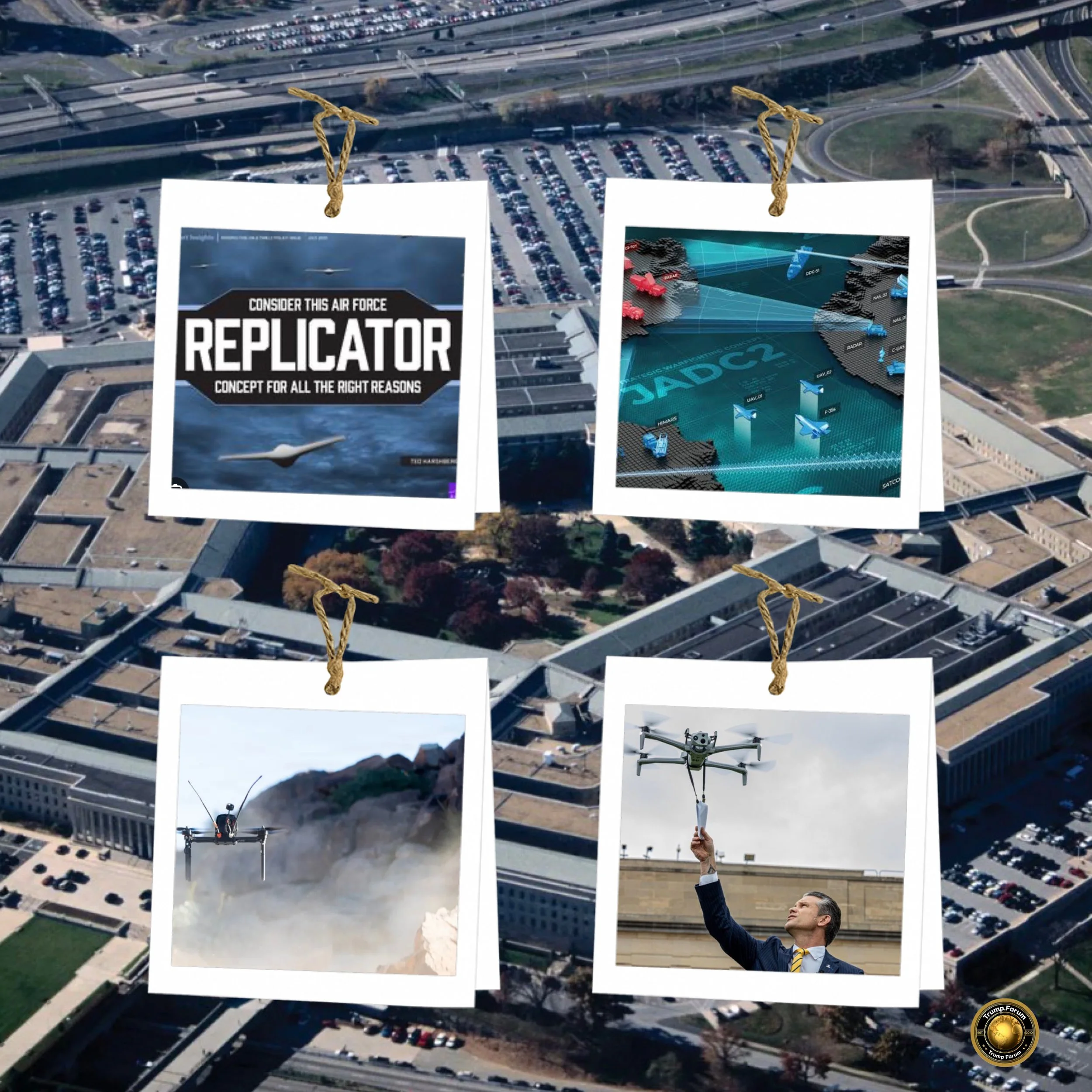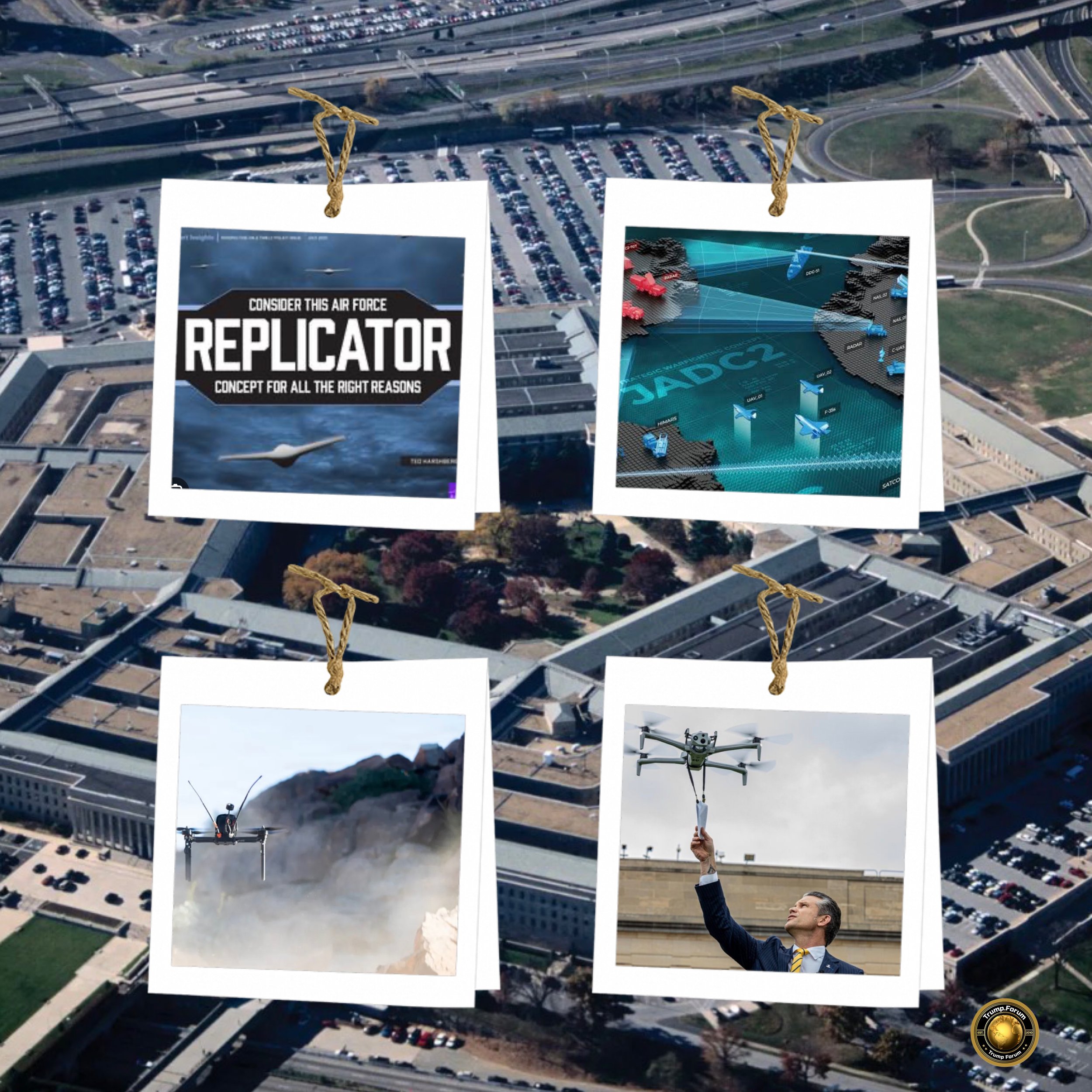
America's Algorithmic Arsenal: How Drone Dominance, Replicator, and JADC2 Are Rewriting the Rules of War
Executive Summary
America's Drone Army: How 340,000 Cheap Weapons Are Rewriting the Rules of Modern Warfare
The United States military is undergoing the most consequential doctrinal transformation since the introduction of nuclear weapons.
The convergence of three interconnected initiatives — the Drone Dominance Program, the Replicator Initiative, and Joint All-Domain Command and Control — represents a fundamental departure from the Cold War paradigm of exquisite platforms toward a new model built on mass, autonomy, and algorithmic coordination.
Together, these programs constitute what the Pentagon has begun calling Algorithmic Warfare: a warfighting concept that prioritizes the density and connectivity of unmanned systems over the singular lethality of expensive, low-volume hardware.
The Drone Dominance Program addresses the production deficit at the hardware level, deploying competitive market mechanisms to force rapid scaling of cheap, attritable unmanned systems.
The Replicator Initiative operates as an institutional accelerator, specifically designed to subvert the bureaucratic inertia that has historically strangled innovation in defense acquisition.
And JADC2 — together with its alliance-oriented extension, CJADC2 — provides the digital nervous system through which thousands of disparate sensors, shooters, and decision-makers are fused into a single coherent warfighting organism.
FAF analysis examines the historical imperatives, institutional architecture, operational mechanics, geopolitical implications, and inherent risks of this tripartite doctrine, drawing on the latest available evidence from 2025 and early 2026 to assess its trajectory and significance for the global strategic balance.
Introduction: The Inflection Point in Modern Warfare
The $1 Billion Gauntlet: Pentagon's Race to Mass-Produce Killer Drones Before China Does
The battlefields of Ukraine, the Red Sea, and Gaza have served as brutal laboratories, confirming what a generation of drone advocates had long argued: the age of the singular, irreplaceable platform is drawing to a close.
When a $500 commercial drone can disable a $10 million armored vehicle, and when Houthi forces in Yemen can threaten the entire architecture of global maritime commerce using Shahed-series unmanned aerial vehicles costing less than $50,000 each, the underlying logic of Western defense acquisition — concentrate enormous capability into a small number of exquisitely engineered systems — is exposed as strategically brittle.
The response emerging from the Pentagon in 2025 and 2026 is not merely tactical adaptation.
It represents a systemic reimagining of how American military power is organized, procured, deployed, and coordinated.
The Drone Dominance Program targets the production deficit at the hardware level.
The Replicator Initiative operates as an institutional wrecking ball, dismantling the procedural architecture that has allowed transformative technologies to die in the acquisition pipeline for decades.
And JADC2 provides the cognitive infrastructure that allows all of these systems to function as a unified organism rather than a collection of disconnected parts.
The convergence of these three programs is not accidental.
It reflects a deliberate, if still evolving, strategic theory: that future conflict will be decided not by the state that fields the most powerful individual platform, but by the state that can generate, coordinate, and sustain the greatest volume of connected, intelligent, attritable systems across all domains simultaneously.
The United States is betting that this theory is correct, and it is reorganizing its entire defense industrial and doctrinal architecture around that bet.
History and Current Status: The Road to Algorithmic Warfare
From Exquisite to Expendable: Why the Pentagon Is Betting on $2,300 Kamikaze Drones
The intellectual lineage of Algorithmic Warfare extends back at least to the Revolution in Military Affairs debates of the 1990s, when theorists at institutions including the National Defense University argued that information dominance — not firepower alone — would prove decisive in future conflict.
The network-centric warfare concept, championed under Defense Secretary Donald Rumsfeld, sought to connect disparate military nodes into a common operational picture.
The results in Iraq and Afghanistan were mixed: network connectivity improved, but adversaries adapted with improvised explosive devices and cellular networks, demonstrating that technological superiority alone does not resolve the political dimensions of war.
The more proximate catalyst for the current doctrine, however, is the conflict in Ukraine, which began in February 2022 and rapidly evolved into the world's first large-scale drone war.
Both Ukrainian and Russian forces adopted first-person view drones — low-cost, commercially derived platforms — as primary tactical weapons, inflicting catastrophic attrition on armored formations that would have been considered impregnable by Cold War standards.
Ukrainian drone units were consuming tens of thousands of systems per month by mid-2024, a consumption rate that exposed the existential inadequacy of American production planning.
The lesson absorbed by Pentagon planners was stark: in high-intensity peer conflict, drone consumption rates would vastly exceed anything the United States had ever planned or procured for.
The formal institutional response began in July 2025, when Defense Secretary Pete Hegseth issued a memorandum titled "Unleashing US Military Drone Dominance," directing that every Army squad be equipped with small, one-way attack drones by the end of fiscal year 2026.
This directive was not merely logistical; it signaled a cultural revolution within an acquisition system that had spent decades optimizing for quality rather than quantity.
Simultaneously, the Department of War's January 2026 Artificial Intelligence Acceleration Strategy formally codified the AI-first warfighting framework, mandating that artificial intelligence be integrated across all mission areas — from battlefield decision-making to intelligence processing to enterprise operations.
By early 2026, all 3 pillars of Algorithmic Warfare were in active operational development.
The Drone Dominance Program had selected 25 vendors for its inaugural Gauntlet competition, with Gauntlet I results published in March 2026 revealing a competitive leaderboard topped by U.K.-based Skycutter.
Replicator 2, managed by Joint Interagency Task Force 401, had made its first acquisition — the DroneHunter F700 counter-drone system — in January 2026, with the Amazon-style counter-drone marketplace achieving initial operational capability in February 2026.
And CJADC2, the allied-partner extension of JADC2, was advancing the integration of sensors and shooters across partner nations, extending the digital backbone beyond purely American formations.
Key Developments: The three Pillars in Detail
The Drone Dominance Program: Industrializing Attrition
The Drone Dominance Program represents a $1 billion, 4-phase acquisition initiative structured explicitly to invert the traditional Pentagon procurement model.
Where legacy acquisition has historically prioritized exhaustive testing, multi-year development cycles, and cost-plus contracts that incentivize expense rather than efficiency, the program substitutes competitive Gauntlet evaluations — rapid, operationally realistic fly-offs in which vendors demonstrate their systems under battlefield conditions, with winners receiving fixed-price production contracts.
Phase I of the program, which commenced at Fort Benning, Georgia, in February 2026, selected 25 vendors for evaluation.
The Gauntlet I results, released in March 2026, placed Skycutter at the top with a score of 99.3, followed by Neros at 87.5, Napatree Technology at 80.3, ModalAI at 77.7, and Auterion at 77.0.
Notably, Ukrainian Defense Drones — a company whose operational pedigree derives directly from active combat in eastern Ukraine — ranked 6th, reflecting the premium the program places on proven battlefield performance over laboratory specification.
The Pentagon announced that 12 top-tier vendors were selected for immediate production contracts following Gauntlet I, with an initial order of 30,000 one-way attack drones placed within days of the results being published.
The program's production targets are ambitious by any historical standard.
Phase I calls for the delivery of approximately 30,000 one-way attack drones at a unit cost of $5,000.
As the vendor pool contracts through subsequent phases and production volumes rise, unit costs are projected to fall to approximately $2,300 per system — a cost reduction that would place the American drone at rough price parity with the Iranian Shahed-series platforms whose proliferation has already reshaped naval warfare in the Red Sea.
The ultimate goal is to equip units with 300,000 to 340,000 drones by 2027, a scale that would make the United States the world's largest single consumer of attritable unmanned attack systems.
Supply chain security is an integral design consideration.
Beginning in Phase II, the Department of War will discontinue purchasing systems that incorporate motors or battery systems sourced from countries designated as covered foreign entities — a measure directly targeting Chinese component dominance in the global commercial drone industry.
This represents not merely a procurement policy but an industrial strategy: the explicit goal of reconstructing a domestic American drone manufacturing base capable of sustaining wartime attrition rates without dependence on adversary supply chains.
Chinese firms currently produce an estimated 70% of the world's commercial drone motors and a similarly dominant share of the lithium polymer batteries that power the vast majority of small unmanned aerial systems, meaning the Phase II restriction will force a wholesale restructuring of vendor supply chains in a compressed timeframe.
The Replicator Initiative: Bureaucracy as the Battlefield
Replicator's Revolution: The Pentagon Initiative That Is Killing Defense Bureaucracy Forever
If the Drone Dominance Program is the procurement engine, the Replicator Initiative is the institutional wrecking ball.
First announced in August 2023 by then-Deputy Defense Secretary Kathleen Hicks, Replicator was conceived as an explicit institutional intervention — a mechanism to bypass the layers of review, approval, and documentation that have historically allowed transformative technologies to die in the acquisition pipeline.
It is not, critically, a Program of Record in the traditional defense sense.
It is an accelerator: it identifies technologies that have already demonstrated promise in other programs, then uses concentrated senior leadership attention and rapid funding allocation to force those technologies into high-rate production within 18-24 months.
Replicator 1, which focused on offensive all-domain autonomous systems, was declared on track for fielding in summer 2025.
Its ambition was to deploy multiple thousands of autonomous systems across air, sea, and land domains — a concept directly inspired by the swarm tactics observed in Ukrainian drone operations and the Houthi campaign in the Red Sea.
Replicator 2 then emerged as the defensive counterpart, driven by a series of alarming drone incursion incidents over American military installations that revealed a dangerous gap in America's own defenses.
In late 2023, commercial unmanned systems were observed flying over Joint Base Langley-Eustis in Virginia; similar incidents followed over Air Force installations in Utah, Ohio, and Germany, and at 4 Royal Air Force bases in the United Kingdom.
In August 2025, the Pentagon established Joint Interagency Task Force 401 as the lead organization for Replicator 2.
The task force's first acquisition, announced in January 2026, was the DroneHunter F700 — an autonomous counter-UAS system designed to intercept small unmanned aerial vehicles with minimal collateral risk to surrounding infrastructure.
The counter-drone marketplace, which achieved initial operational capability in February 2026, represents perhaps the most radical institutional innovation within the initiative: a digital procurement portal modeled explicitly on commercial e-commerce platforms, through which battlefield commanders can identify, evaluate, and order approved counter-UAS systems with a speed and simplicity previously unimaginable within the defense acquisition landscape.
The marketplace model carries profound implications for defense industrial structure.
By enabling direct procurement at the command level, it effectively decentralizes acquisition authority, creating a real-time demand signal that forces manufacturers to maintain responsive production capacity rather than relying on slow-moving, centrally managed contracts.
The parallel to Amazon's fulfillment network — frequently cited by Pentagon officials — is not merely rhetorical.
It reflects a genuine ambition to apply the demand-responsiveness of consumer commerce to the resupply of lethal autonomous systems, transforming the defense industrial base from a slow-moving government contractor ecosystem into something closer to a commercially responsive marketplace.
JADC2 and CJADC2: The Cognitive Architecture of Algorithmic War
The Algorithmic Brain: How JADC2 Turns America's Entire Military Into one Smart Machine
The Drone Dominance Program and the Replicator Initiative address the supply of autonomous systems and the speed of their delivery.
JADC2, and its evolved form CJADC2, address the fundamental question of what those systems do when they arrive: how they sense the operational environment, how they communicate with one another and with human commanders, and how artificial intelligence translates that sensory flood into coherent, timely action.
JADC2 was formally codified as a strategy in March 2022 and is organized around five lines of effort: the data enterprise, the human enterprise, the technology enterprise, integration with nuclear command and control and communications, and modernization of mission partner information sharing.
Its operational concept is elegantly simple in articulation, though enormously complex in implementation: Sense, Make Sense, and Act. At the sensing layer, data flows from thousands of distributed nodes — satellites, unmanned aerial vehicles, ground sensors, surface combatants, and special operations forces — into a common data fabric.
At the Make Sense layer, AI algorithms process that data in real time, fusing disparate feeds into a coherent operational picture and generating probabilistic target assessments.
At the Act layer, those assessments are translated into weapons employment recommendations, delivered to the appropriate shooter — whether human, semi-autonomous, or fully autonomous — with a latency measured in seconds rather than hours.
The Chief Digital and Artificial Intelligence Office leads this effort and conducts monthly Global Information Dominance Experiments to stress-test the system's performance under conditions of information overload and adversarial interference.
These experiments serve a dual function: they validate technical performance under simulated combat conditions, and they cultivate a new generation of operators comfortable with AI-assisted decision-making — a cultural transformation that may prove as consequential as the technical architecture itself.
CJADC2 extends this framework beyond American formations to allied and partner nations, enabling real-time data sharing, seamless interoperability, and accelerated decision cycles across coalition forces.
The integration with key partners — including Israel, the United Kingdom, and Gulf Cooperation Council members — is particularly significant given the operational landscapes in which those partners are most likely to be co-engaged with American forces.
Israel's layered air defense architecture, encompassing Iron Dome, David's Sling, and the Arrow system, already provides a globally acknowledged model of sensor-to-shooter integration from which CJADC2 planners are actively drawing lessons.
The United Kingdom, meanwhile, has been deepening its aerial defense collaboration with Israel following the drone incursions over RAF bases, creating a triangular transatlantic-Middle Eastern network of interlocking command and control architectures that is gradually being formalized through ministerial-level engagement and professional military exchanges.
Latest Facts and Concerns: The Empirical Landscape in 2026
The Death of the $100 Million Fighter: Why America Is Flooding Battlefields With Swarm Intelligence
The pace of development in early 2026 has been remarkable, but the empirical record also surfaces a cluster of concerns that the official narrative has tended to minimize.
The Drone Dominance Program's Gauntlet I results, while demonstrating genuine competitive vitality, revealed the early-stage fragility of the American domestic drone industrial base.
Of the top-scoring vendors, several remain small startups with limited production capacity, and the top performer — Skycutter — is a U.K.-based company, raising substantive questions about whether the program is actually building the sovereign American manufacturing capacity its proponents claim.
The Phase II supply chain restrictions on Chinese components will test whether those vendors can sustain their performance metrics while sourcing motors and batteries from approved suppliers, a transition that will impose meaningful cost and lead-time increases during the critical initial scaling phase.
The Replicator marketplace model, while administratively innovative, carries its own structural tensions.
The acceleration of acquisition timelines creates pressure to field systems before they have been fully evaluated for cybersecurity vulnerabilities.
The very connectivity that makes JADC2 a force multiplier also creates an expansive attack surface: a sophisticated adversary capable of injecting false sensor data, degrading communications links, or spoofing GPS signals could, in principle, corrupt the AI decision layer and cause the system to engage incorrect targets, expose critical command nodes, or generate a catastrophic cascading failure across the entire connected architecture.
The ethical and legal dimensions of autonomous weapons employment remain deeply contested.
As the Chief Digital and Artificial Intelligence Office deploys AI tools that can identify targets and recommend weapons, the threshold at which recommendation becomes decision grows progressively harder to locate.
The Department of War's January 2026 AI Strategy explicitly embraces an AI-first posture and directs the aggressive elimination of bureaucratic barriers to AI deployment.
Critics within the international legal community and among AI ethics researchers argue that this posture is outrunning the development of accountability frameworks, creating conditions in which lethal autonomous action could occur without clear human authorization — a situation that existing international humanitarian law is entirely unprepared to adjudicate.
The geopolitical dimensions are equally complex.
China has observed American drone doctrine with acute attention and has been accelerating its own attritable drone production programs.
The People's Liberation Army's investment in loitering munitions, first-person view drones, and autonomous swarm systems has proceeded in parallel with — and in some respects ahead of — American programs.
March 2026 NATO report on algorithmic warfare integration noted that the race to autonomous systems is creating instability dynamics analogous to earlier arms race cycles, with each side's accelerated deployment incentivizing the other to lower its decision thresholds in order to maintain competitive response times.
This dynamic risk is compounded by the fact that the relevant technologies are largely commercially derived, meaning that production barriers are low for any state — or non-state organization — with access to global electronics markets.
Cause-and-Effect Analysis: The Strategic Logic and Its Consequences
The strategic logic of Algorithmic Warfare is internally coherent.
The high-attrition realities of modern peer conflict — demonstrated empirically in Ukraine and the Red Sea — create an unsustainable demand for expensive, exquisite platforms that cannot be replaced at operationally relevant timescales.
The production economics of advanced fighter aircraft or sophisticated surface-to-air missile interceptors mean that even a limited high-intensity conflict would rapidly exhaust American stocks.
Cheap, rapidly producible attritable drones address this structural vulnerability: their low unit cost means they can be produced and replaced at rates that match or exceed consumption, while their autonomous coordination through JADC2 means that their collective intelligence can approach or exceed that of more expensive systems in specific task domains.
The cause-and-effect chain, however, extends beyond this first-order logic in ways that deserve careful examination.
The proliferation of attritable drone systems globally — driven in part by American programs that validate the strategic model and in part by Chinese commercial production that has already democratized access to the underlying technology — means that American adversaries are acquiring equivalent capabilities at costs that their economies can sustain indefinitely.
Iran has already demonstrated with the Shahed series that a medium-power state can challenge American naval and military assets using cheap autonomous systems at scale.
Houthi forces in Yemen, operating with Iranian-supplied equipment costing a fraction of the American systems deployed against them, imposed sustained costs on international maritime commerce throughout 2024 and 2025, striking shipping with a frequency and accuracy that would have been unimaginable from a non-state organization as recently as 2020.
The proliferation effect extends to non-state stakeholders. The same technology that gives the Pentagon 340,000 attritable drones gives sophisticated non-state organizations access to comparable capabilities at commercially available prices.
As the Replicator marketplace lowers the procurement barrier for American commanders, it implicitly validates and accelerates a global trend toward the democratization of precision air attack capability — a trend that may prove strategically counterproductive if the net effect is to provide adversaries with capabilities that offset American advantages faster than American innovation can regenerate them.
The asymmetry that worked so powerfully in America's favor during the early drone era — when only nation-states with sophisticated programs could field effective unmanned systems — has been fundamentally and irreversibly eroded.
The JADC2 architecture, meanwhile, creates powerful strategic dependencies.
As the American military becomes reliant on AI-assisted decision-making at the tactical, operational, and strategic levels simultaneously, its performance advantage becomes contingent on the resilience and integrity of that digital infrastructure.
An adversary capable of sustained, sophisticated interference with American command and control networks — through electronic warfare, cyberattack, or kinetic strikes on key data nodes — could reduce the American force to a collection of individually capable but strategically uncoordinated platforms.
The very sophistication of the system creates a fragility that simpler, more redundant architectures do not share, and this fragility is compounded by the fact that the most capable potential adversaries — China and Russia — have invested heavily in precisely the electronic warfare and cyberattack capabilities designed to exploit it.
Future Steps: The Trajectory of the Algorithmic Arsenal
Drones, Data, and Dominance: How the U.S. Military Plans to Win Wars With Software, Not Steel
The immediate trajectory of all three programs is toward acceleration.
The Drone Dominance Program's Phase II is expected to intensify supply chain compliance requirements, progressively narrowing the vendor pool while ramping production volumes toward the 340,000-system target.
The introduction of harder restrictions on Chinese components will function as a market-shaping intervention, creating incentives for the development of new domestic and allied supply chains for motors, batteries, and electronic components — a supply chain realignment that will take years to mature and that will experience significant growing pains in the interim.
The fiscal year 2026 and 2027 defense budgets will face pressure to sustain and expand funding commitments at a time when competing priorities across the federal government are intense.
Replicator 2's counter-drone marketplace is expected to expand its catalog of approved systems significantly through 2026, moving from its initial DroneHunter F700 acquisition toward a comprehensive suite of directed energy, kinetic interceptor, and electronic warfare counter-UAS options.
The broader aspiration — to create a real-time, demand-responsive procurement system for lethal technologies — represents a potential model for defense acquisition reform that, if successful, could be extended to other capability categories.
The institutional implications are profound: if decentralized, command-level procurement can work for counter-drone systems, it challenges the entire logic of centralized defense acquisition and could trigger a fundamental restructuring of the relationship between the Pentagon and the defense industrial base.
For JADC2, the most significant near-term development is the deepening of the CJADC2 allied integration architecture.
The UK-Israel aerial defense collaboration paper published in April 2026 signals the political and strategic alignment necessary for that integration to proceed, recommending the formalization of a ministerial-level UK-Israel Defence Dialogue, expanded professional military exchanges, and a dedicated aerial defense dialogue between the Ministry of Defence and Israel's Missile Defence Organisation.
As American forces increasingly depend on CJADC2 for operational coordination, the interoperability of allied systems with the American command and control architecture becomes not merely a force multiplier but a strategic necessity — a dependency that gives the United States powerful incentives to deepen defense-industrial and intelligence-sharing relationships with key partners.
The longer-term horizon involves the progressive introduction of more autonomous decision-making at lower levels of the command hierarchy.
The Chief Digital and Artificial Intelligence Office's monthly Global Information Dominance Experiments are explicitly designed to accelerate this transition, testing the system's capacity for increasingly autonomous action across an expanding range of scenarios.
The institutional and doctrinal frameworks governing when, and under what conditions, AI systems are authorized to recommend or execute lethal action remain underdeveloped relative to the technical capabilities being deployed — a gap that represents perhaps the most significant strategic risk in the entire Algorithmic Warfare enterprise, and one that will require sustained engagement from legal scholars, ethicists, military commanders, and policymakers if it is to be addressed before a catastrophic incident forces the issue.
The Broader Strategic Canvas: Implications for the Global Balance
The emergence of the American Algorithmic Warfare doctrine is being closely watched by every major military power and by a growing number of middle powers and non-state organizations with the technical capacity to draw operational lessons.
Russia has been driven by battlefield necessity in Ukraine to rapidly develop and deploy its own drone swarm capabilities, with mixed results against Ukrainian electronic warfare defenses that have themselves been continuously upgraded with Western assistance.
Chinese military planners, whose People's Liberation Army has invested heavily in autonomous systems and whose commercial drone industry provides the global technology base from which military applications are rapidly derived, view American drone doctrine simultaneously as a threat to their own strategic position and as a validation of investments they have already made.
For American allies in Europe, the implications are ambivalent. NATO's March 2026 report on algorithmic warfare integration stressed the urgency of European adaptation to the new paradigm, noting that most European militaries retain acquisition processes incompatible with the rapid development and deployment cycles that Algorithmic Warfare demands.
The drone incursions over Royal Air Force bases that catalyzed Replicator 2 were a warning that European military infrastructure is already within the operational range of commercial drone technology available to hostile state and non-state stakeholders.
Germany's own defense procurement debates, intensified by the Zeitenwende rearmament drive, have increasingly focused on the counter-UAS gap, and Berlin has been exploring both national and NATO-level solutions.
For states in the Middle East — particularly Israel, Saudi Arabia, and the UAE — CJADC2 integration offers both protection and entanglement.
Access to American sensor networks, AI-assisted targeting systems, and drone swarm capabilities significantly enhances the defensive and offensive options of regional partners.
But it also deepens those partners' strategic dependence on American digital infrastructure and, by extension, on American political support — a dependency that carries its own strategic costs in periods of American domestic political volatility.
The Gulf states, which have been accelerating their own drone acquisition programs while simultaneously pursuing diplomatic normalization with Iran, face a complex balancing act between the military benefits of CJADC2 integration and the political constraints that deep American alliance dependency implies.
The financial dimensions deserve careful attention.
The $1 billion Drone Dominance Program, while headline-grabbing, is modest by defense program standards.
The real fiscal test will come in the scaling phases, when production commitments of hundreds of thousands of units require sustained industrial investment across a domestic supplier base that does not yet exist at the required scale.
The unit cost target of $2,300 per drone is achievable in optimized production conditions but will face sustained upward pressure from supply chain disruptions, component shortfalls, and the inevitable cost growth that accompanies the transition from prototype to mass production — a dynamic that has characterized virtually every major defense acquisition program in American history.
Institutional Resistance and Reform Imperatives
Perhaps the most underappreciated dimension of the Algorithmic Warfare enterprise is the institutional challenge it poses to the Pentagon's own deeply embedded bureaucratic culture.
The Department of War's AI Acceleration Strategy explicitly acknowledges that bureaucratic barriers are among the principal obstacles to effective AI deployment and directs aggressive action to eliminate them.
But the barriers in question are not merely procedural inconveniences.
They reflect deeply embedded risk-management cultures, legal accountability frameworks, and congressional oversight requirements that have accumulated over decades for reasons that were, in their original context, entirely rational.
The tension between acquisition speed and institutional accountability is not merely administrative — it is civilizational in its implications.
When a procurement decision concerns a fixed-price drone production contract, the risks of streamlining oversight are manageable and the efficiency gains real.
When the same streamlined process is applied to AI systems making real-time targeting recommendations in a contested electromagnetic environment, the risks of accountability gaps become potentially catastrophic.
The Gauntlet model, for all its competitive vigor, provides limited visibility into the long-term reliability, cybersecurity posture, and operational failure modes of the systems it selects — gaps that may not manifest until those systems are deployed under actual combat conditions against a sophisticated adversary specifically attempting to exploit them.
The reform imperative, therefore, is not simply to move faster.
It is to build new accountability architectures that are commensurate with the speed of the new paradigm: oversight mechanisms that are rapid without being absent, governance frameworks that are agile without being lawless, and ethical guidelines that are operationally realistic without being so permissive as to create conditions for atrocity.
That is a genuinely difficult intellectual and institutional challenge, and its resolution will require sustained effort from communities — legal, ethical, technical, operational — that have not historically engaged with each other at the depth or pace the moment demands.
Conclusion: The Paradigm Shift and Its Unresolved Tensions
Connected, Cheap, and Lethal: The 3-Pillar Strategy That Will Define 21st-Century American Warfare
The convergence of the Drone Dominance Program, the Replicator Initiative, and JADC2 into a coherent Algorithmic Warfare doctrine represents a genuine and consequential strategic revolution.
The United States military is, for the first time since the nuclear age, articulating a warfighting paradigm that does not center on the singular lethality of a small number of exquisitely engineered platforms but on the aggregate effect of thousands of cheap, networked, AI-coordinated autonomous systems operating simultaneously across all domains.
The empirical foundations of this paradigm — the operational lessons of Ukraine, the Red Sea, and Gaza — are real and the strategic logic compelling.
Yet the paradigm carries unresolved tensions that the official narrative has not fully confronted.
The supply chain vulnerabilities of a drone-dependent force, the ethical and legal ambiguities of AI-assisted targeting, the escalation dynamics of a world in which multiple state and non-state stakeholders simultaneously field attritable swarm capabilities, and the institutional risks of accelerated acquisition that outpaces accountability — these are not marginal concerns.
They are structural features of the new paradigm that will require sustained intellectual and institutional effort to address.
The strategic bottom line is not merely that the United States is moving from a few expensive platforms toward thousands of cheap connected systems.
It is that in doing so, it is reconstructing the entire architecture of modern warfare — its procurement logic, its command and control infrastructure, its ethical and legal frameworks, and its relationship with allied partners — on foundations that remain, in critical respects, unproven.
The Gauntlet has begun. The marketplace is open.
The algorithmic brain is being wired into every node of the American force.
Whether the full architecture will perform as designed when it matters most remains the defining strategic question of the coming decade.