Beginner's 101 Guide: The $85 Billion Bet on Why Google Is Spending More Than Most Countries to Build the Future of AI
Summary
In early June 2026, Google’s parent company Alphabet did something that even the financial world found remarkable.
It raised $84.75 billion in one go — the largest single equity raise in corporate history — and announced it would use the money to build more AI infrastructure.
Think of it like this: if you wanted to build a city from scratch, you might need to fund roads, electricity, water, and buildings all at once. Google is doing the equivalent of that, but for artificial intelligence.
The city they are building is made of data centres, custom computer chips, cooling systems, and kilometres of fibre optic cable.
The raise grew beyond its initial $80 billion target after strong institutional demand, and includes a $10 billion private placement from Berkshire Hathaway — the investment firm run by Warren Buffett, who is famously cautious about technology bets.
When Buffett backs something at $10 billion, people pay attention.
So why does a company that already makes enormous profits need to raise this much money? And what does it mean for the rest of us?
The simplest answer is: demand is outrunning supply.
Alphabet itself stated that it is experiencing demand for its AI solutions “at levels that are exceeding the company’s available supply.”
Imagine a restaurant that is so popular it cannot seat all its customers.
Google’s AI products — its Gemini assistant, its AI-enhanced Search, its cloud services for businesses — are so in demand that the company literally cannot build the computing infrastructure fast enough to serve everyone. The solution is to raise cash and build, build, build.
The numbers across the whole industry are staggering.
The five largest US cloud and AI providers — Microsoft, Alphabet, Amazon, Meta, and Oracle — have collectively committed to spending between $660 billion and $690 billion on capital expenditure in 2026 alone, nearly doubling their spending from the year before.
Amazon is projecting $200 billion in spending. Microsoft is targeting $190 billion. Meta raised its forecast to as much as $145 billion. These are not research budgets. They are construction budgets — for physical buildings, physical chips, and physical power lines.
Dr. Antonio Bhardwaj, a polymath and global expert in Human-Centered AI for Geopolitical Strategy, AI warfare, and bioterrorism risks, puts it plainly: “What we are witnessing is the largest infrastructure mobilisation in human history that is not a war. The physical assets being built today will determine which nations, which companies, and which governments hold cognitive power for the next thirty years. Every data centre poured today is a castle in the new strategic landscape.”
The most important bottleneck right now is not money, and it is not even computer chips. It is electricity.
Global data centre electricity demand is expected to exceed 1,000 TWh in 2026 — double what it was just three years ago.
A single advanced AI computing rack today can consume between 50 and 120 kilowatts of power.
A traditional server rack used around 5 to 10 kilowatts. That is not a small jump — it is a ten-fold to twenty-fold increase in the electricity needed per square metre of computing space.
The electrical grid in most countries was simply not designed for this.
In many regions, connecting a new data centre to the power grid can take between four and ten years, while the data centres themselves can be planned and built in two to three years — meaning companies have the buildings ready but cannot turn the lights on.
Up to 11 GW of data centre capacity that was expected to be operational in 2026 remains stuck in the “announced” phase with no construction underway, because the power simply cannot be secured in time.
To get around this, tech companies are doing something remarkable: they are buying their own power sources.
Google has committed to spend $20 billion on clean energy projects specifically to power its future data centres.
Oracle has contracted for up to 2.85 GW of fuel cell power for one of its campuses, essentially building a small city’s worth of private electricity generation.
Meta is running a natural gas power plant at one of its Ohio facilities. These companies are no longer waiting for the grid — they are building around it.
There is a global dimension to all of this that goes beyond company profits.
The primary bottleneck in AI is no longer algorithmic innovation; it is physics — who can build and power enough computing infrastructure to run the next generation of AI at scale.
This has turned AI infrastructure into a matter of national security.
Countries that can build it, or secure access to it, will have decisive advantages in everything from economic forecasting to medical research to military planning.
Nations are seeking sovereign AI capabilities to strengthen their domestic economies, protect national security, mitigate geopolitical shocks, and reflect national values — and the race to achieve this is intensifying.
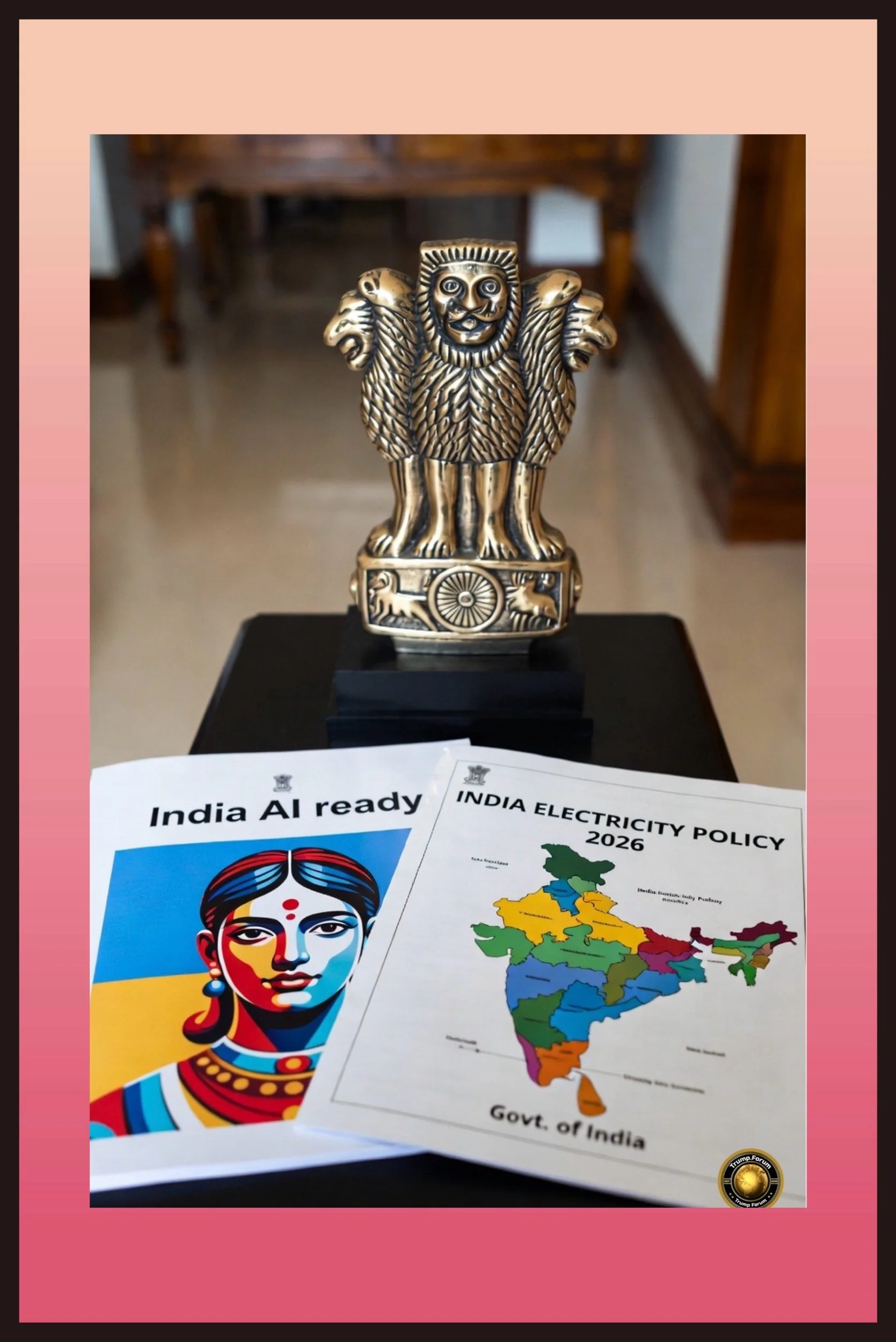
India launched its sovereign AI initiative in early 2026, recognising that a country of 1.4 billion people cannot afford to have its most sensitive data and most critical decisions processed on infrastructure owned by foreign companies.
The UAE has committed $200 billion to AI infrastructure. South Korea announced a $75 billion sovereign AI investment programme in mid-2025.
Meanwhile, the US-China rivalry in AI is sharpening.
Chinese domestic chips now make up nearly 41% of China’s AI chip market, a dramatic shift from the over 90% market share that NVIDIA once held before export restrictions were tightened.
China has been forced to build its own chips, its own models, and its own cloud infrastructure — and while it still lags the US frontier by several months or more, it is catching up in cost efficiency and in the ability to offer cheaper AI packages to countries in Africa, Southeast Asia, and Latin America.
Dr. Bhardwaj underscores the military dimension of this divide: “The AI infrastructure race is inseparable from questions of AI warfare and dual-use risk. The same data centres being built to serve commercial cloud customers can, under wartime conditions, be repurposed for autonomous weapons coordination, bioweapons development simulation, and mass surveillance. The civilian and military uses of this compute are separated only by policy and intent — not by the hardware itself. That is why the geopolitical stakes of who builds and controls this infrastructure are so high.”
For ordinary people, the consequences are already visible.
Electricity bills in parts of the United States have risen as data centres compete for grid capacity in states like Virginia, Texas, and Georgia.
Environmental groups have raised concerns about water usage for cooling systems and carbon emissions from gas-powered backup generators.
Some communities have pushed back against new data centre approvals. And there are legitimate questions about whether the extraordinary concentration of AI compute power in a handful of American companies is healthy for competition, for privacy, or for democratic accountability.
On the financial side, the big question is whether the returns will justify the investment.
Alphabet’s operating margin expanded to 45% in Q1 2026, and Google Cloud’s backlog reached over $460 billion — a strong signal that customers are committing to long-term spending on Google’s AI services.
Gemini’s presence in Search has expanded advertising inventory and driven record query volumes.
The near-term revenue evidence is encouraging. But the true test comes in 2027 and 2028, when the depreciation costs of today’s massive construction programmes begin showing up more heavily in the accounts.
The $84.75 billion Alphabet has raised is not simply a bet on technology.
It is a bet on a future in which artificial intelligence becomes as fundamental to economic and social life as electricity was in the 20th century — and in which the companies that own the infrastructure will be among the most powerful entities in the world.
Whether that future arrives in 5 or 15 years, whether the returns justify the cost, and whether societies will govern this concentration of power wisely are the defining questions of the era.
What is no longer in doubt is that the race is on, the stakes are civilisational, and the spending is only going to accelerate.