Beginners 101 Guide: Why AI Is Now About Bricks, Wires, and Billions — Not Just Smart Software: Four Biggest AI Stories Reshaping the World Today
Introduction: It Is Not Just About the Apps Anymore
When most people think about artificial intelligence, they picture a clever chatbot, a smart image generator, or a piece of software that writes emails. But the biggest AI battles being fought right now have almost nothing to do with software.
They are about buildings — enormous, power-hungry buildings filled with specialised computer chips, cooling systems, and high-speed cables. They are about who builds those buildings, who pays for them, and who gets to use them.
Think of it like this: in the early days of the internet, the companies that won were the ones that owned the cables under the ocean and the server farms in climate-controlled warehouses.
The software came later, but the physical infrastructure underneath it was what made everything possible. AI is going through exactly the same moment right now. Four major stories from the past week tell us a great deal about where this competition is heading — and why it matters to ordinary people, not just tech investors.
Story One: Europe Decides to Build Its Own AI Factories
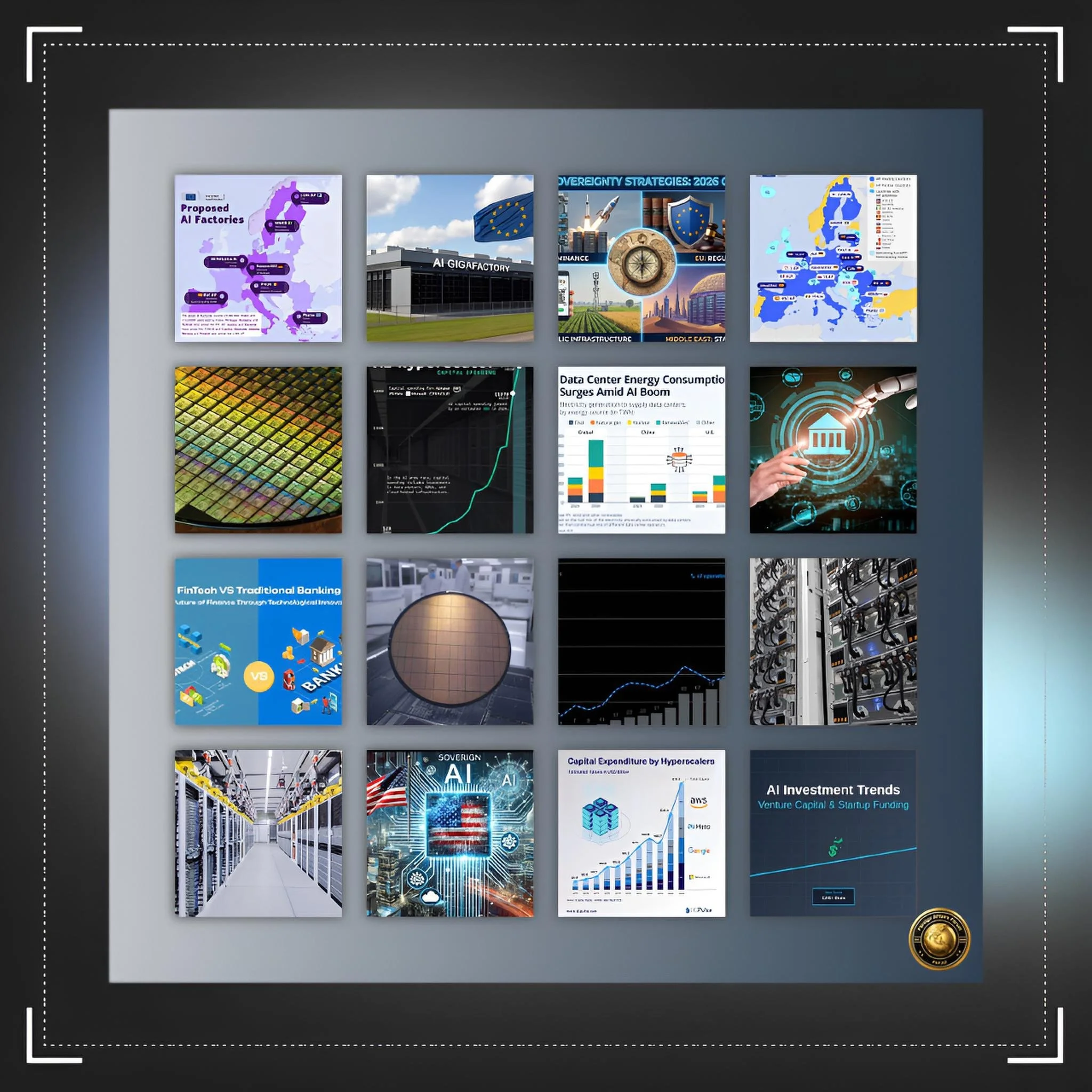
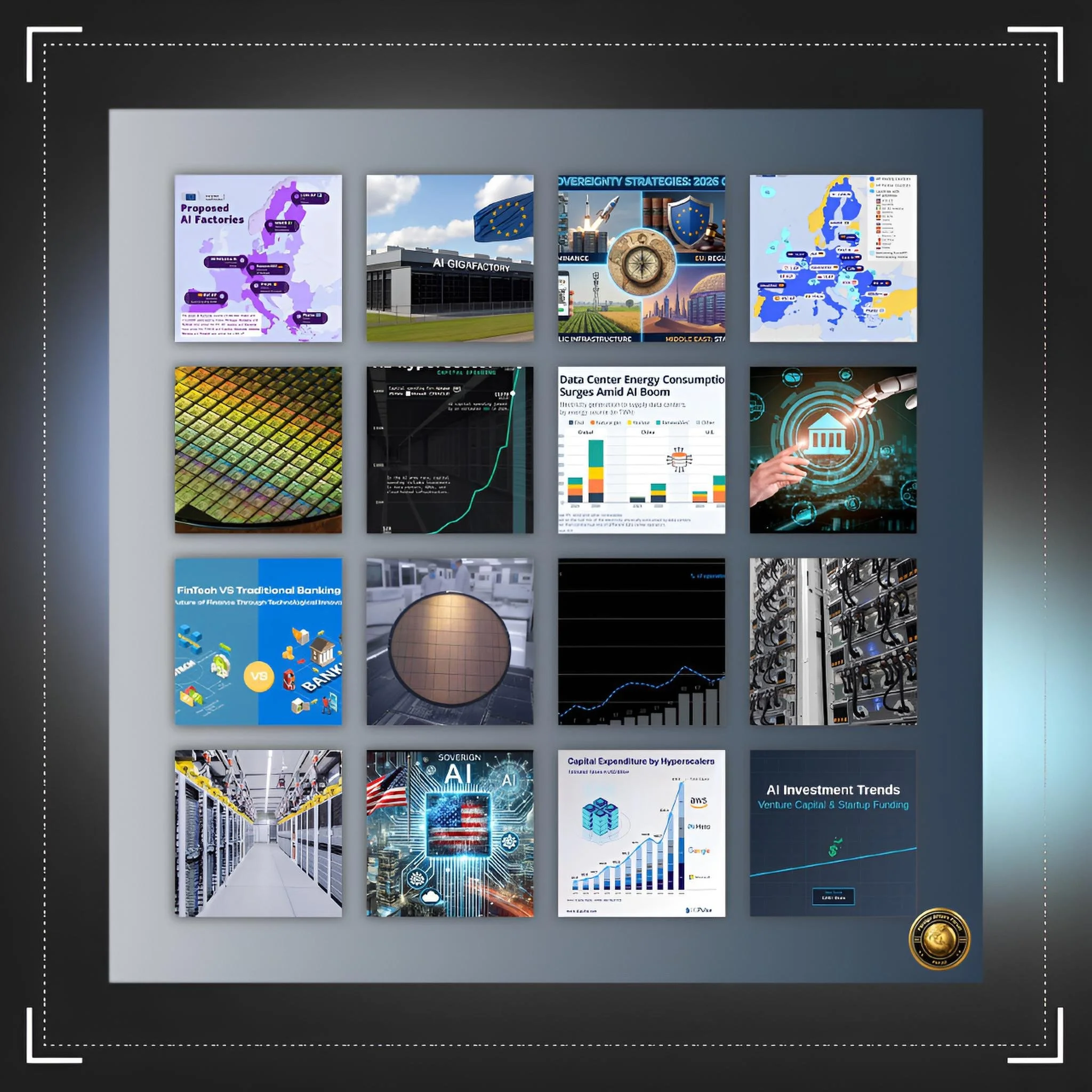
The European Union has announced plans to build seven enormous AI computing centres, called gigafactories, backed by €10 billion ($11.5 billion) in public funding. The plan is also intended to attract at least €20 billion in private investment from companies and investors who want to participate. The number of planned gigafactories was increased from five to seven after EU member states showed stronger-than-expected interest in the project.
What is a gigafactory in this context?
Think of it as a very large, very powerful supercomputer that many different organisations can use. Each gigafactory is expected to house at least one hundred thousand cutting-edge AI chips, making them roughly four times more powerful than the data centres currently operating across Europe. Researchers developing new medicines, companies building AI assistants, and government agencies processing sensitive data could all potentially use these facilities.
Why does Europe need its own? Right now, most European companies and researchers that need serious AI computing power rent it from American companies — mostly Amazon, Google, and Microsoft. That works fine in normal times. But imagine if those companies decided to increase their prices, or if political tensions between the United States and Europe made access to those systems unreliable or conditional. Europe would be in a very difficult position.
The aim of the gigafactory initiative is to give European start-ups, researchers, businesses, and public organisations access to infrastructure for training, running, and improving advanced AI models — infrastructure that operates under European rules on data protection, security, and ethics. In short, Europe wants to own its AI power plants, not just plug into someone else’s grid.
Applications for funding close in November 2026, with winning projects expected to be announced in early 2027 and the facilities themselves expected to be operational within eighteen months of contracts being signed. That is a long way off, and critics have noted that Europe has moved slowly while the United States and China have been building rapidly. But the initiative is a significant political commitment regardless.
Dr. Antonio Bhardwaj, a polymath with global expertise in AI specialising in human-centered AI for geopolitical strategy, semiconductors, and supercomputing, explains it simply: “Think of AI computing power the way your grandparents thought about having your own electricity supply versus depending on a neighbour’s generator. It works, until it does not. Europe is right to want its own power station.”
Story Two: America’s Tech Giants Are Spending More Than Most Countries Earn
The four largest American technology companies — Amazon, Microsoft, Google’s parent company Alphabet, and Meta — collectively plan to spend $725 billion on building AI infrastructure in 2026.
That is a 77% increase from last year’s already record-breaking $410 billion. To put that in context, $725 billion is larger than the entire annual output of most countries in the world.
What are they spending it on? Mainly on the physical buildings that house AI computers, the chips inside those buildings, and the enormous amounts of electricity needed to power and cool them. Microsoft alone spent $30.9 billion in a single quarter — roughly three months — on AI infrastructure, while Google Cloud’s list of signed contracts from customers reached approximately $460 billion, roughly double the previous year.
Why are they spending so much? Because in the AI world right now, the company with the most computing power can train the biggest and most capable AI models. Bigger models, trained on more data with more computing power, tend to perform better. Customers who want access to the best AI pay for cloud computing subscriptions that use these facilities. The more you build, the more customers you can serve.
But investors are starting to ask a question that used to be polite to ignore: when does all this spending actually turn into profit? Alphabet’s share price fell more than 7% in one day after the company raised its spending plans to as much as $205 billion for 2026 and reported that its free cash flow — the money left over after paying all costs — went negative in the second quarter for the first time since it first went public in 2004. Even strong results, including an 82% jump in cloud revenue, were not enough to calm investors.
The message from financial markets is becoming clearer: spending on AI is fine, but companies need to show that the spending is actually generating returns, not just growth projections.
Story Three: Big Banks Are Betting Heavily on AI
Lloyds Banking Group, one of Britain’s largest banks, reported that its profits had jumped by nearly a quarter — to £4.3 billion for the first six months of 2026 — and announced an ambitious new four-year strategy built on AI and digital transformation, with the goal of cutting a further £2 billion in costs. The strategy, called Accelerate 2030, will also involve investing more than £13 billion over the four-year period.
What does that mean for a regular banking customer? The bank’s chief executive says that new “agentic AI” — AI that can take actions on its own rather than just answering questions — could allow Lloyds to offer personalised investment advice to many more customers, including people who previously could not afford professional financial guidance. It could also help employees complete routine tasks more quickly and accurately.
Lloyds already uses AI to handle customer complaints and says the technology saved the bank £50 million in 2025, with £100 million in savings expected in 2026. The bank has also been closing physical branches — some two hundred and thirty-two branches are set to close in 2026 — as more customers manage their money digitally.
The bank example is important because it shows that AI has moved beyond the technology sector. It is now being used to redesign how some of the oldest and most conservative institutions in the world do their work. When a two-hundred-year-old bank in Britain makes AI the centrepiece of its growth strategy, it signals something genuine about how far the technology has matured.
Dr. Bhardwaj puts it this way: “Banks are not early adopters by nature. They move slowly and carefully, because they have to. When Lloyds builds an entire strategic plan around AI, it means the technology has passed a threshold that most consumer software never reaches: it has become reliable enough, measurable enough, and valuable enough to trust with real money and real customers.”
Story Four: The Market Starts Asking Hard Questions About Value
The final story is perhaps the most important for the long term.
Recent research shows that only 15% of business leaders reported a positive impact on profitability from AI in the past twelve months, and fewer than one-third could link AI spending to concrete business benefits. Meanwhile, companies that do manage to integrate AI effectively into specific workflows — not just dabbling with it — are seeing real gains.
Companies that have moved AI from experimental pilots into actual production processes report an average return on investment of 1.7 times what they spent, with cost savings of 26% to 31% in areas like supply chain management, finance, and customer service.
The pattern is consistent: AI works best when it is given a specific, measurable job to do — handling customer complaints, speeding up mortgage applications, sorting medical imaging results — rather than being deployed vaguely across an organisation in the hope that something valuable emerges. The companies that will thrive in the next phase of AI development are the ones that have learned this lesson.
Conclusion
The overall picture of 2026 is therefore one of a technology reaching a new level of maturity: still growing rapidly, still transforming industries, but now subject to the kind of discipline that every major technology eventually faces.
Building gigafactories, spending hundreds of billions of dollars, and redesigning two-hundred-year-old banks all makes sense — but only if the results justify the investment.
That test is now underway, and how the industry performs on it will determine the shape of the AI landscape for the next decade and beyond.