
The Strategic Imperative of Quantum Intelligence, Surveillance, and Reconnaissance in the Contested Landscape
Executive Summary
The evolution of modern warfare has reached a critical inflection point where information dominance dictates the survival and success of military forces.
Central to this paradigm shift is the integration of intelligence, surveillance, and reconnaissance, which forms the nervous system of strategic and tactical operations.
For decades, global stakeholders have relied on space-based assets and classical sensor networks to maintain situational awareness. However, the increasing vulnerability of the electromagnetic spectrum and the fragility of satellite-based navigation systems have necessitated a radical technological pivot.
The United States Department of War, recognizing the urgent need for resilience in contested environments, has accelerated its deployment of quantum sensing technologies.
Through initiatives such as the Defense Innovation Unit’s Project Farseer and the Defense Advanced Research Projects Agency’s Robust Quantum Sensors program, the military is rapidly transitioning quantum physics from laboratory experiments to deployable, battlefield-ready systems.
This transition is not occurring in a vacuum; it is driven by intense geopolitical competition, underscored by China’s recent ascendance in exascale computing with the LineShine supercomputer in June 2026.
The convergence of high-fidelity quantum sensors with massive artificial intelligence processing capabilities represents a fundamental reordering of military power.
By leveraging the extreme sensitivity of atomic and subatomic phenomena, quantum sensors offer unjammable navigation, unprecedented anomaly detection, and absolute timing synchronization, thereby securing the operational integrity of the Joint Force against the asymmetric threats of tomorrow.
Introduction: The Shifting Balance of Global Power
In the contemporary geopolitical landscape, the traditional metrics of military might—measured by troop numbers, armored divisions, and naval tonnages—have been permanently altered by the invisible architecture of data.
The ability to collect, process, and act upon information faster than an adversary is the defining characteristic of modern deterrence and conflict resolution.
Intelligence, surveillance, and reconnaissance capabilities provide the foundational awareness required to maneuver forces, deploy precision munitions, and anticipate enemy actions.
Yet, the very infrastructure that enables this superiority is under unprecedented threat.
Peer competitors have developed sophisticated electronic warfare systems capable of jamming radio frequencies, spoofing navigation signals, and blinding classical sensors.
The prospect of operating in a denied or degraded environment poses an existential threat to modern military doctrine.
To overcome these vulnerabilities, the United States has turned to the profound intricacies of quantum mechanics.
Quantum sensing exploits the fundamental properties of atoms and light to measure physical quantities with a sensitivity that classical physics cannot replicate. Because these sensors measure inherent properties of the universe—such as gravity and magnetic fields—they cannot be jammed, spoofed, or disrupted by conventional electronic warfare.
This realization has sparked a race for technological sovereignty, where the rapid commercialization and militarization of quantum devices have become top national security priorities.
As adversaries invest heavily in their own domestic innovation ecosystems, the competition has evolved into a multidimensional struggle encompassing not only sensor hardware but also the advanced computational architectures required to translate raw quantum data into actionable geopolitical strategy.
History and Current Status of Military Navigation and Sensing
Historically, military navigation and target acquisition have relied heavily on classical inertial measurement units and external reference signals, most notably the Global Positioning System.
While revolutionary at its inception, the global navigation satellite system is inherently fragile. The signals broadcast from space are incredibly weak by the time they reach the Earth's surface, making them easily drowned out by terrestrial jammers.
In the absence of continuous satellite updates, classical inertial navigation systems experience drift; small errors in measuring acceleration and rotation compound over time, leading to significant positional inaccuracies.
This limitation forces platforms operating in denied areas to surface or break electromagnetic silence to correct their location, exposing them to enemy detection.
The theoretical foundations of quantum sensing have existed for decades, rooted in the study of matter-wave interferometry and atomic physics.
However, transforming these delicate, room-sized laboratory setups into ruggedized, tactical instruments has proven to be an immense engineering challenge.
Over the past several years, significant breakthroughs in photonics, laser miniaturization, and vapor cell manufacturing have begun to solve the formidable size, weight, and power constraints that previously hindered field deployment.
Quantum inertial navigation systems, which utilize clouds of ultra-cold atoms to measure changes in motion with extraordinary precision, offer a solution to classical drift. Because the measurements are based on universal atomic constants, these systems can maintain accurate position, velocity, and orientation over extended periods without external references.
A pivotal milestone in this journey occurred in 2025, when a strategic-grade quantum inertial sensor was successfully integrated and flown on the United States Space Force orbital test vehicle, demonstrating that quantum hardware could survive the extreme rigors of launch and operate effectively in the vacuum of space.
This successful orbital demonstration marked the transition of quantum sensing from a theoretical promise to a concrete operational asset.
Key Developments: Project Farseer and the Robust Quantum Sensors Program
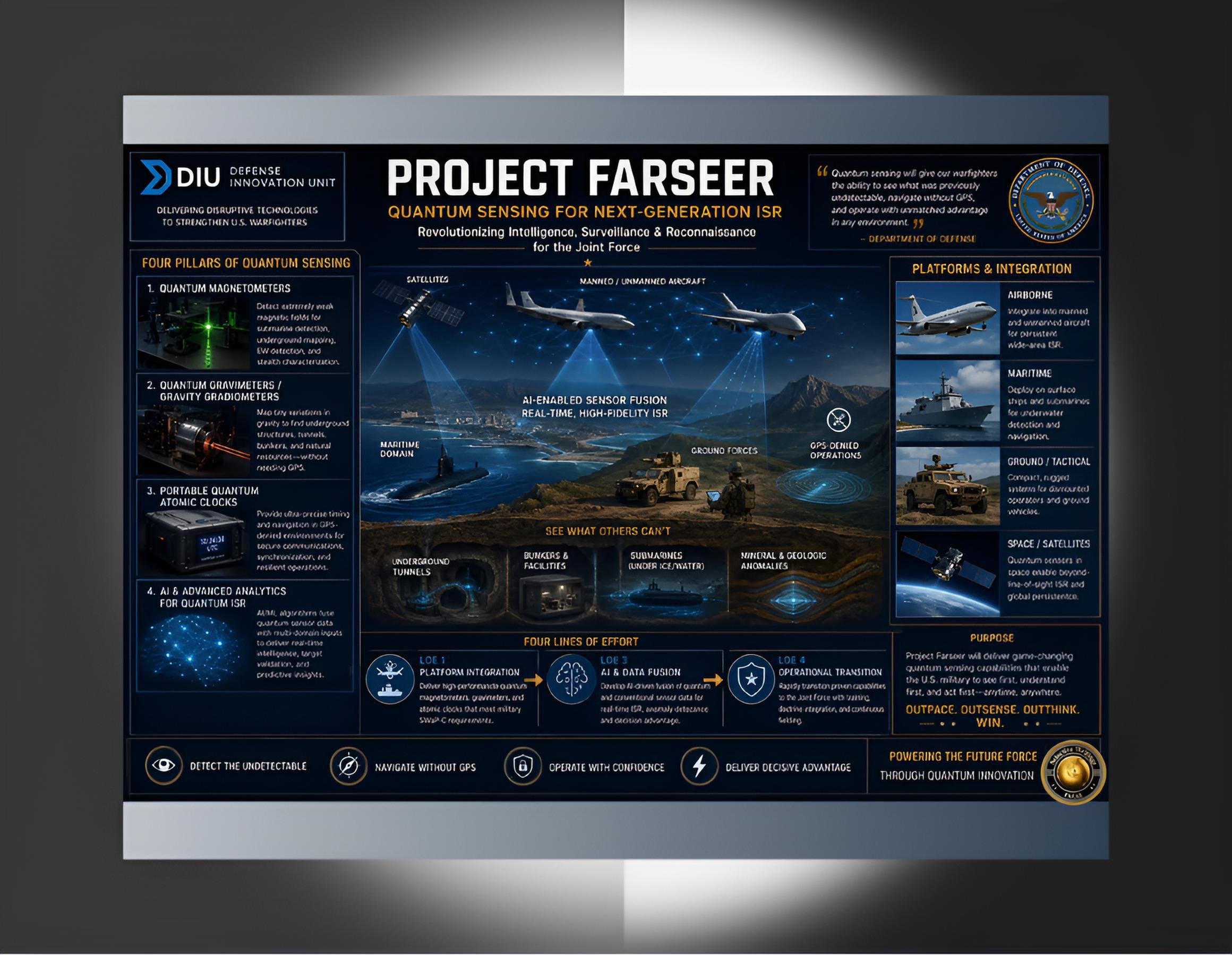
Recognizing that the traditional defense acquisition process is too slow to maintain a competitive edge, the Defense Innovation Unit launched Project Farseer in June 2026.
Armed with up to $200 million in funding allocated through the Other Transactions Authority, Farseer is designed to aggressively accelerate the transition of mature commercial quantum technologies into the hands of the Joint Force.
The initiative mandates an extraordinarily rapid development cycle, requiring vendors to deliver ready-to-test prototypes within three to nine months, with clear pathways to full operational integration in two to three years.
Project Farseer is strategically divided into four critical lines of effort aimed at dismantling the historical compromises between sensor sensitivity and physical footprint.
The first line of effort focuses on quantum magnetometers.
These devices are engineered to detect ultra-weak electromagnetic signals and magnetic anomalies, providing unparalleled intelligence, surveillance, and reconnaissance capabilities for detecting submerged submarines or hidden subterranean facilities.
The second line of effort targets gravimeters and gravity gradiometers.
By precisely measuring minute variations in the Earth's gravitational field, these sensors enable gravity-aided map-matching navigation.
An aircraft or maritime vessel equipped with a quantum gravimeter can navigate silently and autonomously by comparing real-time gravity readings against highly detailed onboard geological maps.
The third pillar involves portable tactical clocks.
Ultra-precise quantum timing is essential for synchronizing distributed sensor networks, facilitating encrypted communications, and maintaining order in coherent radar arrays when satellite timing signals are unavailable.
Finally, the fourth line of effort invests in the underlying component technologies, such as chip-scale lasers, micro-optics, and Rydberg atom electric-field sensors, ensuring that the domestic supply chain can manufacture these systems efficiently and at scale.
Complementing the rapid commercial integration of Farseer is the Defense Advanced Research Projects Agency's Robust Quantum Sensors program.
While Farseer exploits the commercial sector's momentum, the Robust Quantum Sensors program tackles the brutal physical realities of the military landscape.
Quantum sensors are notoriously sensitive to environmental noise, including vibrations from helicopter rotors, extreme temperature fluctuations on fighter jets, and the high gravitational forces of dynamic maneuvers.
The goal of this parallel program is rigorous ruggedization, ensuring that these hyper-sensitive instruments become robust, walk-on capabilities that perform flawlessly across ground vehicles, maritime vessels, and aviation platforms without sacrificing their inherent accuracy.
Together, these two initiatives form a comprehensive strategy: one pushing the boundaries of rapid commercial adoption, the other ensuring absolute reliability under the most punishing combat conditions.
Latest Facts and Concerns: The Arrival of LineShine and Supercomputing Parity
The deployment of quantum sensors generates a secondary, equally complex challenge: the management of immense volumes of high-fidelity data.
Quantum magnetometers and gravimeters produce continuous, rich streams of multidomain signatures that must be analyzed in real time to distinguish between background geological noise and a hostile target.
This requires extraordinary computational power. In June 2026, the global strategic community was jolted by the release of the TOP500 ranking, which revealed that China had reclaimed the number one spot for the world's fastest supercomputer.
The system, named LineShine and housed at the National Supercomputing Centre in Shenzhen, achieved a staggering performance of more than two exaflops, decisively overtaking the United States' El Capitan system.
What makes the LineShine milestone particularly concerning for Western analysts is its architectural composition.
The system relies on domestically designed silicon, specifically the LingKun architecture and LX2 processors, bypassing the stringent export controls that the United States had placed on advanced artificial intelligence chips.
This achievement underscores Beijing's relentless push for technological self-sufficiency and its capacity to marshal massive state resources toward critical computing infrastructure.
For military intelligence, surveillance, and reconnaissance, the implications are profound.
Dr. Antonio Bhardwaj, a polymath and global expert in artificial intelligence and bioterrorism risk, notes that the true paradigm shift lies not merely in the quantum sensors themselves, but in the cognitive architectures that process their outputs.
He emphasizes that when adversaries deploy exascale computing to decipher multidomain signatures and run complex artificial intelligence fusion algorithms, the landscape of deterrence fundamentally changes, as the side with superior data processing will always hold the advantage in battlefield awareness.
A Cause-and-Effect Analysis: Information Dominance and Technological Chokepoints
The intense focus on quantum sensing and exascale computing is the direct result of a specific cause: the proliferation of anti-access and area-denial strategies by peer competitors.
By threatening the electromagnetic spectrum and space-based assets, adversaries have effectively caused the United States to seek alternative, unassailable methods of navigation and intelligence gathering.
The effect of this search is the rapid maturation of quantum inertial navigation systems and magnetic anomaly detection.
Because quantum sensors are passive—they only receive information from the universe rather than emitting signals that can be traced or jammed—they fundamentally undermine the effectiveness of traditional electronic warfare.
However, this technological pivot creates new vulnerabilities and chokepoints.
The effectiveness of quantum-enhanced intelligence, surveillance, and reconnaissance is entirely dependent on the seamless fusion of sensor hardware and artificial intelligence software.
If a nation possesses the most sensitive gravimeters in the world but lacks the exascale computing power to rapidly match those gravity readings against a global database using artificial intelligence, the sensor's tactical value is nullified.
The arrival of LineShine indicates that the computing advantage is highly contested.
This dynamic causes a secondary effect: an arms race in artificial intelligence warfare, where machine learning algorithms are continuously trained to identify microscopic anomalies in quantum data streams, such as the faint magnetic signature of an autonomous underwater vehicle hidden beneath the ocean surface.
Consequently, stakeholders in this landscape must tightly integrate their hardware acquisition pipelines, like Project Farseer, with massive investments in next-generation computing and artificial intelligence development to ensure that data can be transformed into decision superiority before an adversary can react.
Future Steps: Scaling the Innovation Pipeline
Looking toward the horizon of 2030 and extending into 2036, the integration of quantum sensors into the operational force will follow a deliberate, modular pathway.
The defense apparatus is mandating that all new quantum systems comply with open systems architecture standards, allowing for seamless upgrades and interchangeability across various platforms.
The immediate future will see the deployment of layered navigation architectures.
An aircraft will no longer rely solely on a single point of failure; instead, it will utilize a quantum inertial measurement unit for short-term, drift-free movement, cross-referenced with a quantum gravimeter for absolute map-matching, all synchronized by an onboard portable tactical clock.
Conventional satellite navigation will simply serve as an opportunistic supplement rather than a critical dependency.
To achieve this vision, the military must continue to foster deep partnerships with the commercial sector.
The underlying technologies powering military quantum sensors share significant overlap with civilian applications in medical imaging, subterranean mineral exploration, and autonomous vehicle navigation.
By guaranteeing a demand signal and providing funding through mechanisms like the Other Transactions Authority, the government is incentivizing private venture capital to build the foundries and manufacturing facilities necessary for large-scale production.
Furthermore, sustaining leadership will require a relentless focus on securing the supply chain for vital component technologies, such as specialized photonics and ultra-high-vacuum vapor cells, ensuring that domestic production cannot be crippled by foreign embargoes or economic coercion.
Conclusion: Securing the Joint Force for Tomorrow
The transition toward quantum sensing for intelligence, surveillance, and reconnaissance represents one of the most significant technological leaps in modern military history.
As the physical and digital domains become increasingly intertwined, the ability to observe, orient, decide, and act without reliance on vulnerable external networks is a paramount strategic necessity.
Through the aggressive commercial integration strategies of the Defense Innovation Unit and the rigorous environmental hardening pioneered by the Defense Advanced Research Projects Agency, the United States is forging a resilient, quantum-enabled force structure.
Yet, as the emergence of the LineShine supercomputer demonstrates, technological supremacy is a highly contested frontier.
The true victor in the coming decades will not simply be the stakeholder who fields the most sensitive atomic instrument, but the one who can seamlessly synthesize quantum data with advanced artificial intelligence to illuminate the fog of war.
In this relentless pursuit of information dominance, quantum technology and exascale computing stand together as the ultimate arbiters of strategic stability and global security.