Why the First AI War Was Not About Algorithms but About Infrastructure Vulnerability
Executive summary
The War That Ground the Cloud and Exposed the Physical Fragility of Digital Power
The war involving Iran and its adversaries has revealed a profound transformation in the nature of conflict: the emergence of infrastructure-centric digital warfare.
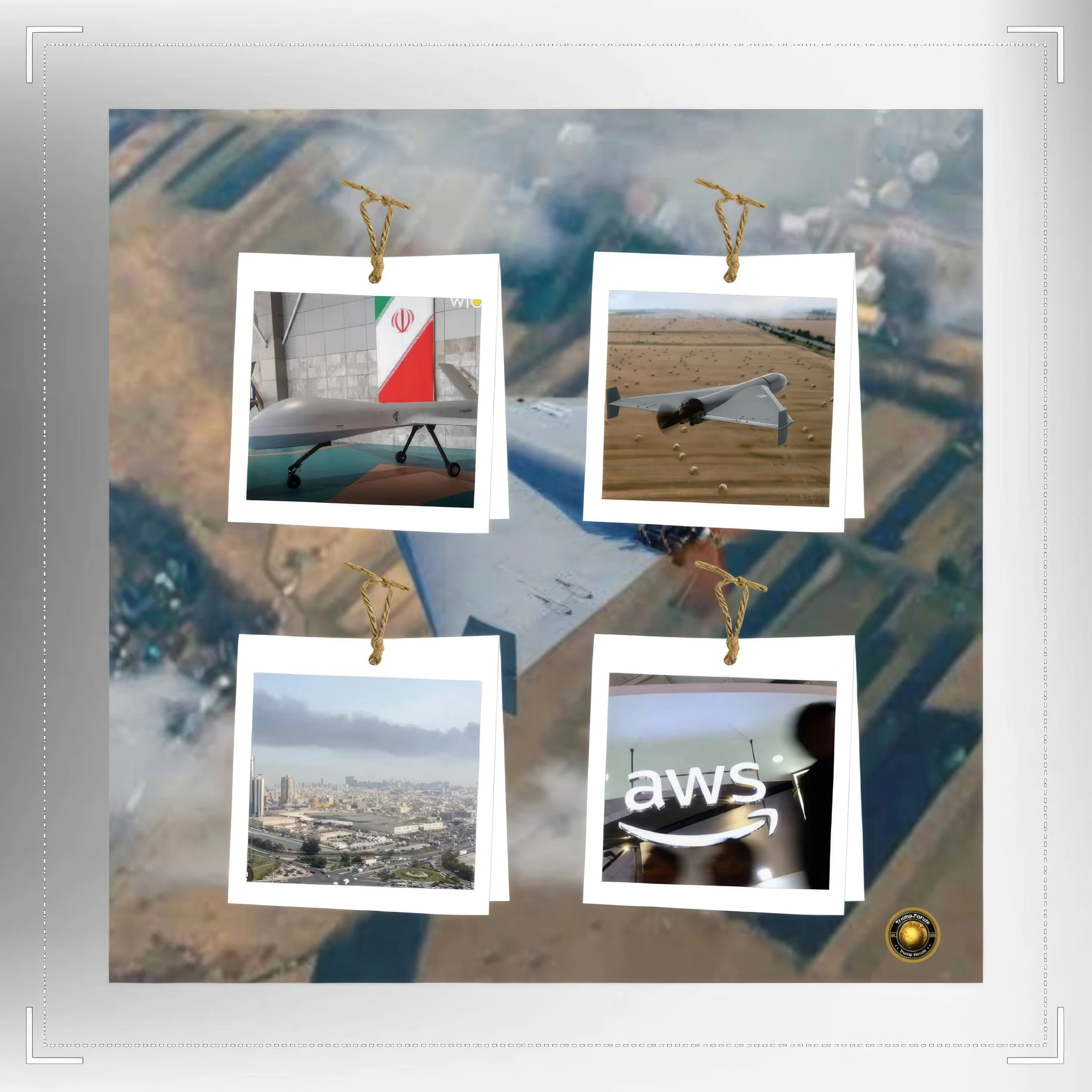
The strikes on data centers operated by Amazon Web Services in the United Arab Emirates and Bahrain were not merely tactical disruptions but strategic signals.
They demonstrated that the “cloud,” long imagined as intangible and resilient, is in fact geographically fixed, capital intensive, and militarily vulnerable.
This conflict marks the first war in which artificial intelligence systems, cloud infrastructure, and digital platforms were not only tools of war but targets in themselves.
The consequences were immediate: banking paralysis, financial system instability, and disruptions to civilian life across multiple states.
Yet the deeper implications are structural.
The global technology race—long driven by scale, efficiency, and centralization—has underestimated the geopolitical risks of concentration.
The war exposes a critical miscalculation. Technology stakeholders assumed redundancy and distribution would ensure resilience.
Instead, concentration of infrastructure in politically stable but geographically proximate hubs created systemic vulnerabilities.
The asymmetry between low-cost drone attacks and high-value digital infrastructure has further destabilized the security calculus.
This article argues that the conflict represents a turning point.
It signals the end of the myth of borderless technology and the beginning of a new era in which digital sovereignty, infrastructure dispersion, and geopolitical alignment will define technological power.
The future of AI and cloud computing will be shaped less by algorithms and more by geography, security, and statecraft.
Introduction
How Drones Redefined Digital Sovereignty and Shattered Illusions of Borderless Infrastructure
For decades, the technology sector cultivated a powerful narrative.
The cloud was presented as an abstraction, a seamless and distributed system that transcended geography.
Data could flow anywhere, computation could occur everywhere, and resilience was assumed to be built into the architecture itself.
The war has dismantled this narrative with startling clarity.
When drones struck data centers in the Gulf, they revealed that the cloud is not an ethereal construct but a network of physical assets: buildings, servers, cooling systems, and power supplies.
These assets exist in specific locations, under specific jurisdictions, and within reach of physical force.
This moment represents more than a technological disruption. It marks the convergence of digital infrastructure and geopolitical conflict.
Artificial intelligence systems, which rely heavily on centralized computing power, have become embedded in national economies and security architectures.
As a result, targeting these systems is no longer a secondary tactic but a primary strategy.
The implications extend far beyond the immediate landscape.
The war challenges fundamental assumptions about globalization, technological interdependence, and the nature of security in a digital age.
It forces policymakers, corporations, and societies to reconsider the relationship between technology and power.
History and current status
From Silicon to Shrapnel: The Day Data Centers Became Military Targets in Modern Conflict
The evolution of cloud computing over the past two decades has been defined by consolidation and scale.
Companies like Amazon Web Services, Microsoft, and Google built vast networks of data centers to support global demand for storage and computation.
These facilities were strategically located in regions with stable governance, reliable energy supplies, and favorable regulatory environments.
The Gulf region emerged as a critical hub in this network.
Its strategic location between Europe, Asia, and Africa made it an ideal node for global data flows.
Governments invested heavily in digital infrastructure, positioning themselves as leaders in technological modernization.
At the same time, the rise of artificial intelligence intensified the demand for centralized computing power.
Training large-scale models required immense resources, further concentrating infrastructure in a limited number of locations.
This concentration created efficiencies but also introduced vulnerabilities.
The current conflict has brought these vulnerabilities into sharp focus.
The targeting of data centers disrupted not only local services but also regional and global networks.
Financial systems were particularly affected, as many banking and payment platforms rely on centralized cloud services.
The outages highlighted the extent to which modern economies depend on digital infrastructure.
Key developments
The Hidden Battlefield Beneath the Cloud: Power, Servers, and Geopolitical Risk Collide
The strikes on data centers represent a significant escalation in the integration of technology and warfare.
Unlike traditional cyberattacks, which operate in the digital domain, these attacks combined physical and digital strategies.
They demonstrated that disrupting digital systems does not require sophisticated hacking techniques; it can be achieved through conventional means.
This development reflects a broader shift in military strategy.
Stakeholders are increasingly recognizing the strategic value of targeting infrastructure that supports digital systems.
This includes not only data centers but also undersea cables, satellite networks, and energy grids.
Another key development is the role of asymmetry.
The cost of deploying drones is relatively low, while the infrastructure they target represents billions in investment.
This imbalance creates a new form of strategic leverage, enabling smaller actors to challenge larger ones.
The conflict has also accelerated the militarization of technology policy.
Governments are reassessing their dependence on foreign cloud providers and exploring options for domestic or regional alternatives.
This shift is likely to reshape the global technology landscape in the coming years.
Latest facts and concerns
How Cheap Drones Challenged Expensive Clouds and Rewrote the Economics of Security
The immediate impact of the attacks has been significant.
Financial systems experienced prolonged disruptions, affecting businesses and consumers alike.
Critical services, including healthcare and logistics, faced operational challenges due to reliance on cloud-based systems.
Beyond these immediate effects, there are growing concerns about long-term stability.
The concentration of infrastructure in a limited number of locations makes it difficult to ensure redundancy in the face of sustained attacks.
Even temporary disruptions can have cascading effects across multiple sectors.
There is also concern about escalation.
If targeting digital infrastructure becomes a normalized tactic, it could lead to a cycle of retaliation and counter-retaliation.
This would increase the risk of broader conflict and further destabilize the global system.
Another critical issue is the lack of clear norms and regulations.
International law has not kept pace with the integration of technology and warfare.
The absence of established rules creates uncertainty and increases the likelihood of miscalculation.
Cause and effect analysis
The Strategic Miscalculation at the Heart of the Global Technology Race
The root cause of the current situation lies in the structural dynamics of the global technology race.
The pursuit of efficiency and scale led to the concentration of infrastructure, which in turn created vulnerabilities.
This concentration was driven by economic incentives.
Centralized systems are more cost-effective and easier to manage.
However, they also create single points of failure. In a geopolitical context, these points of failure become strategic targets.
The effect of this dynamic is a shift in the nature of conflict.
Warfare is no longer confined to traditional domains such as land, sea, and air.
It now extends into the digital domain, with physical infrastructure serving as the bridge between the two.
Another cause is the rapid integration of artificial intelligence into critical systems.
AI relies on data and computation, both of which are dependent on physical infrastructure.
As a result, targeting this infrastructure can have disproportionate effects on capabilities.
The effects are far-reaching.
They include not only immediate disruptions but also long-term changes in strategy and policy.
Stakeholders are likely to prioritize resilience and security over efficiency, leading to a reconfiguration of the technology landscape.
Future steps
The future of digital infrastructure will be shaped by the lessons of this conflict.
One likely development is the decentralization of data centers.
By distributing infrastructure across a wider range of locations, stakeholders can reduce vulnerability to targeted attacks.
Another important step is the integration of security considerations into technology design.
This includes both physical and digital measures, such as hardened facilities and advanced monitoring systems.
Governments will also play a crucial role.
They are likely to implement policies aimed at enhancing digital sovereignty and reducing dependence on foreign providers.
This could lead to the emergence of regional technology ecosystems.
At the international level, there is a need for new frameworks to govern the use of technology in conflict.
Establishing norms and regulations could help mitigate the risk of escalation and provide a basis for accountability.
Conclusion
When Data Became Territory: The Emergence of Digital Warfare as Physical Conflict
The war has revealed a fundamental truth about the digital age: technology is not separate from geopolitics but deeply embedded within it.
The cloud, once seen as a symbol of globalization and connectivity, has become a focal point of conflict.
This transformation marks the beginning of a new era.
The future of artificial intelligence and digital infrastructure will be defined not only by innovation but also by security and strategy.
Stakeholders must adapt to this reality, recognizing that the foundations of the digital world are both physical and vulnerable.
The first war against AI was not fought in code but in concrete and steel.
It has exposed the limits of existing assumptions and set the stage for a rethinking of technological power in a world where data has become territory.