Summary
Imagine spending hundreds of billions of dollars building the most powerful computer network in the world. Now imagine someone destroying part of it with a $25,000 flying bomb the size of a garden shed.
That is exactly what happened in the Gulf region in early 2026, and it is changing the way the world thinks about computers, money, and war at the same time.
The Gulf region — countries such as Saudi Arabia, the UAE, Qatar, and Bahrain — has been investing heavily in artificial intelligence.
AI is the technology that powers things like ChatGPT, self-driving cars, and the software that helps doctors detect cancer.
To run AI, you need massive data centers: giant buildings packed full of powerful computers, constant electricity, and incredibly fast internet connections.
The Gulf has been building these centers at breathtaking speed, hoping to turn its oil wealth into something more lasting, something that will still have value when the world's demand for fossil fuels eventually declines.
Saudi Arabia created a special $40 billion fund dedicated entirely to AI.
The UAE constructed a computer campus covering 10 square miles — larger than many towns in Europe or Asia.
Microsoft committed $15.2 billion to the UAE between 2023 and 2029.
American companies like Amazon, Google, and Nvidia were all setting up major operations across the Gulf.
Technology spending across the Middle East and North Africa was projected to reach $169 billion in 2026.
The Gulf was, by almost every measure, on a clear path to becoming one of the world's great AI hubs.
It had cheap energy, a lot of land, sovereign wealth funds willing to invest, and political leaders determined to make the transformation happen.
Then the war started.
In early 2026, a conflict involving the United States, Israel, and Iran escalated sharply and spread across the region.
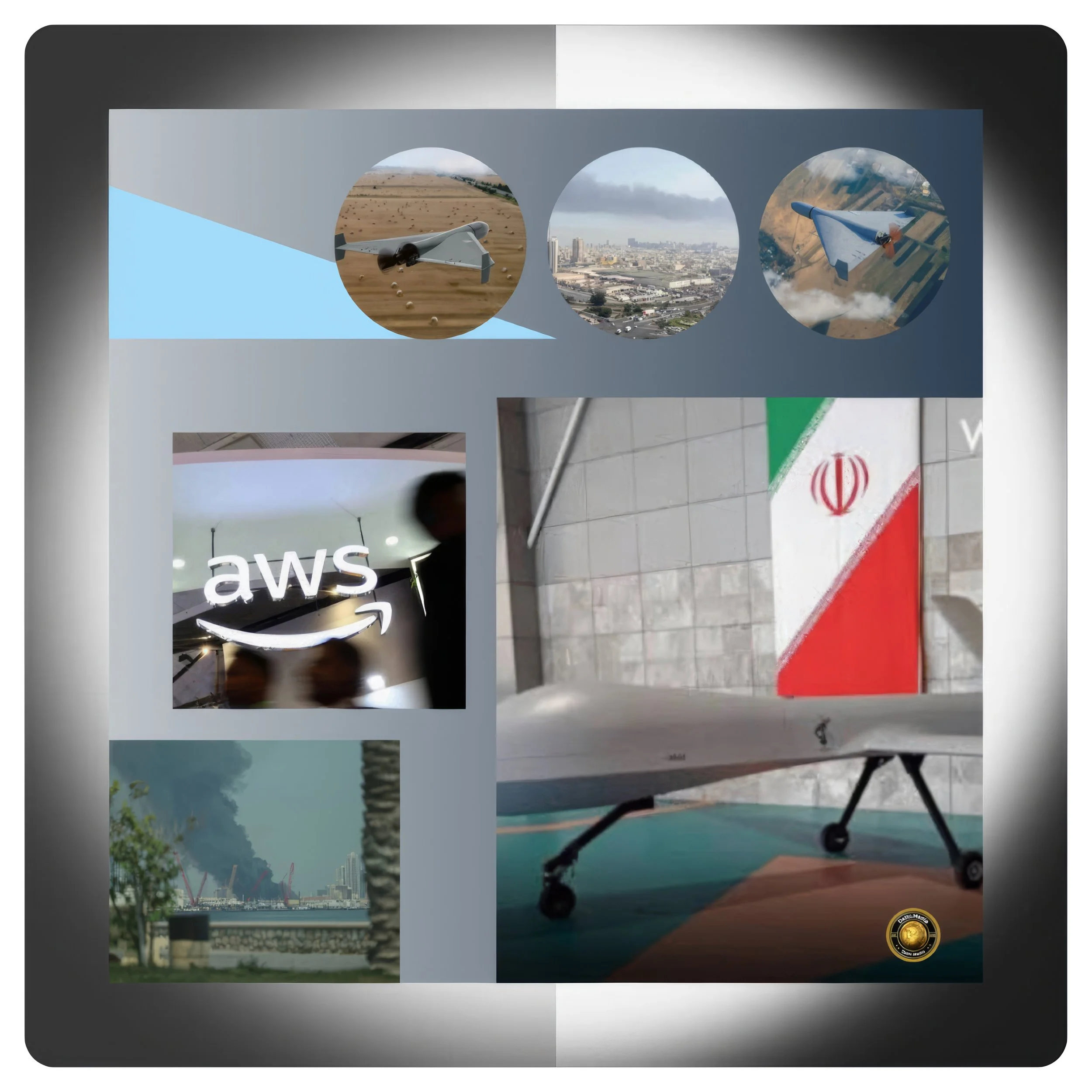
Iran began launching cheap drones called Shahed 136s into neighboring Gulf countries.
These drones are slow, loud, and not particularly advanced — think of a flying lawnmower that carries explosives.
They are, however, extremely cheap to make, and Iran produces them by the thousands.
The problem is that the defense systems used to shoot them down are extraordinarily expensive.
A single Patriot missile, which is the standard air defense tool across the Gulf, costs about $4 million.
The Shahed drone it destroys costs perhaps $20,000.
Think of it this way: imagine you owned a jewelry store and hired a security guard who charged you $4,000 each time he stopped a $20 thief at the door — and the thief kept sending 50 friends through every single night.
You would run out of money long before you ran out of thieves.
That arithmetic is exactly the problem Gulf governments are now facing, and it has become the central challenge for the entire AI investment story in the region.
On March 2nd, 2026, two Amazon Web Services data centers in the UAE were struck by drones.
A 3rd AWS facility in Bahrain was also damaged in the same wave of attacks.
These were not small office buildings or minor facilities.
They were among the most critical pieces of computer infrastructure in the entire Middle East.
Amazon confirmed the strikes and warned that recovery would take considerable time. Within hours of the attacks, banking apps stopped working across multiple Gulf countries.
People could not log into their bank accounts. Ride-hailing platforms like Careem went offline. Government websites crashed.
Online shopping, insurance systems, and business payment platforms all failed simultaneously, because so many of them relied on those same Amazon computers in the UAE to function. It was as if someone had pulled the power plug on the digital economy of an entire region.
A few days later, the IRGC — the Iranian Revolutionary Guard Corps, which is Iran's elite military force — published a formal list of 29 technology targets across Bahrain, Qatar, and the UAE.
The list named specific facilities linked to Amazon, Microsoft, Google, Nvidia, IBM, Oracle, and Palantir.
This was not a vague threat. It was a published, official warning that Iran considered these data centers to be legitimate targets in the conflict, the same way a military base or a weapons factory might be a target in a traditional war.
The IRGC later expanded its list to 18 additional American companies, including Apple, describing them as intelligence tools of the U.S. government.
This was a completely new development in the history of modern warfare.
Never before had the physical computer buildings of major global technology companies been struck during an active armed conflict.
The war had crossed a line that most investors, technology executives, and governments had assumed would never be crossed.
The consequences for the Gulf's AI ambitions are real and complicated.
On one hand, the money, the energy, and the political will behind the Gulf's AI plans have not disappeared. Saudi Arabia still has its $40 billion AI fund.
The UAE still has its 10-square-mile computer campus.
American technology companies still want access to the Gulf's cheap electricity and its enormous pools of investment capital.
The United States government still considers it a strategic priority to keep the Gulf inside an American-led technology system rather than allow Chinese companies like Huawei or Alibaba Cloud to build the foundations of the region's digital future. None of that has changed.
What has changed is the price. Building an AI data center in the Gulf used to be about 50% cheaper than building one in Western Europe or the United States.
That cost advantage was a huge part of the appeal.
Now, data centers in the Gulf also need physical protection: radar systems to detect incoming drones, interceptor drones to shoot them down, backup power systems in case of attack, and distributed architectures that spread computers across many locations instead of concentrating them in one place.
All of that costs money. The bargain is not as simple as it used to be.
The U.S. government responded quickly to the attacks by approving a $16.5 billion arms sale to Gulf states in March 2026 — including $8.4 billion to the UAE for drones, missiles, radar systems, and fighter jets.
This is significant because it shows how AI deals and defense deals are now being packaged together.
In the past, buying American cloud computing services and buying American missiles were two separate conversations.
Now they are one conversation. Access to American technology is increasingly tied to buying American weapons and accepting American military conditions.
This is what analysts mean when they say "protection has become inseparable from access."
Consider a simple example. Imagine a farmer who wants to buy a tractor from a machinery company.
The company says: we will sell you the tractor, but you must also hire our private security team to guard the field, and you must agree not to buy tractors from our competitors.
That is roughly the bargain that American AI companies and the U.S. government are now offering Gulf states.
The AI equipment comes with conditions: buy our defense systems, exclude Chinese competitors, and align your policies with ours.
The drone attacks have made those conditions explicit in a way they never were before.
Saudi Arabia's broader economic plan, known as Vision 2030, is also feeling the pressure.
The plan was designed to move the Saudi economy away from oil dependency by investing in tourism, entertainment, manufacturing, and technology.
It was a bold and expensive vision. But the war has cost Saudi Arabia more than $10 billion in lost revenues and extra expenses, and defense spending is rising sharply.
When the defense budget grows, the money available for AI campuses and smart cities shrinks.
Saudi Arabia has already scaled back several of its most ambitious megaprojects, including parts of NEOM, as financial reality forces difficult choices.
For ordinary people across the Gulf, the implications are both immediate and long-term.
In the immediate term, the outages caused by the March 2026 drone strikes demonstrated just how deeply daily life now depends on data centers.
A physical attack on a building in an industrial zone in Abu Dhabi can stop people in Riyadh from paying for groceries electronically within the same hour.
The digital economy is only as resilient as the physical buildings that support it.
In the long term, the question is whether the Gulf can build an AI future that is both ambitious and safe.
The answer is probably yes, but it will take longer and cost more than originally planned.
The region still has genuine advantages: enormous energy resources, sovereign wealth funds with patient capital, young populations interested in technology careers, and governments willing to make bold bets.
What the drone attacks have added to that picture is a requirement for serious security investment alongside every technology investment.
The Gulf's AI boom is not over. But it is no longer simply a story about computers, capital, and opportunity.
It is also a story about drones, missiles, and the uncomfortable truth that in the twenty-first century, building the future and defending it are exactly the same job.