The Economic Siege of Iran: How the U.S. Hormuz Blockade Reshapes Power, Revenue, and Survival Pathways
Executive Summary
U.S. naval blockade threatens Iran’s fragile oil lifeline and risks deepening global energy instability
The U.S. naval blockade targeting Iranian shipping represents a decisive escalation in economic warfare, aimed at constricting Tehran’s primary source of revenue: oil exports.
With Iran reportedly earning approximately $5bn in the past month despite wartime disruptions, the blockade directly threatens the financial foundation sustaining both the state and its military posture.
The move transforms the conflict from a primarily kinetic engagement into a systemic economic siege, leveraging control over the Strait of Hormuz to impose costs without immediate large-scale escalation.
While Iran has demonstrated resilience under sanctions regimes for decades, a naval blockade introduces qualitatively different pressures.
It targets physical export capabilities rather than merely financial transactions, potentially reducing export volumes, increasing transaction costs, and deterring buyers.
Yet Tehran retains potential escape pathways, including illicit shipping networks, alternative land routes, regional intermediaries, and strategic escalation designed to raise global costs.
Introduction
Washington escalates economic pressure by transforming maritime geography into a tool of strategic coercion
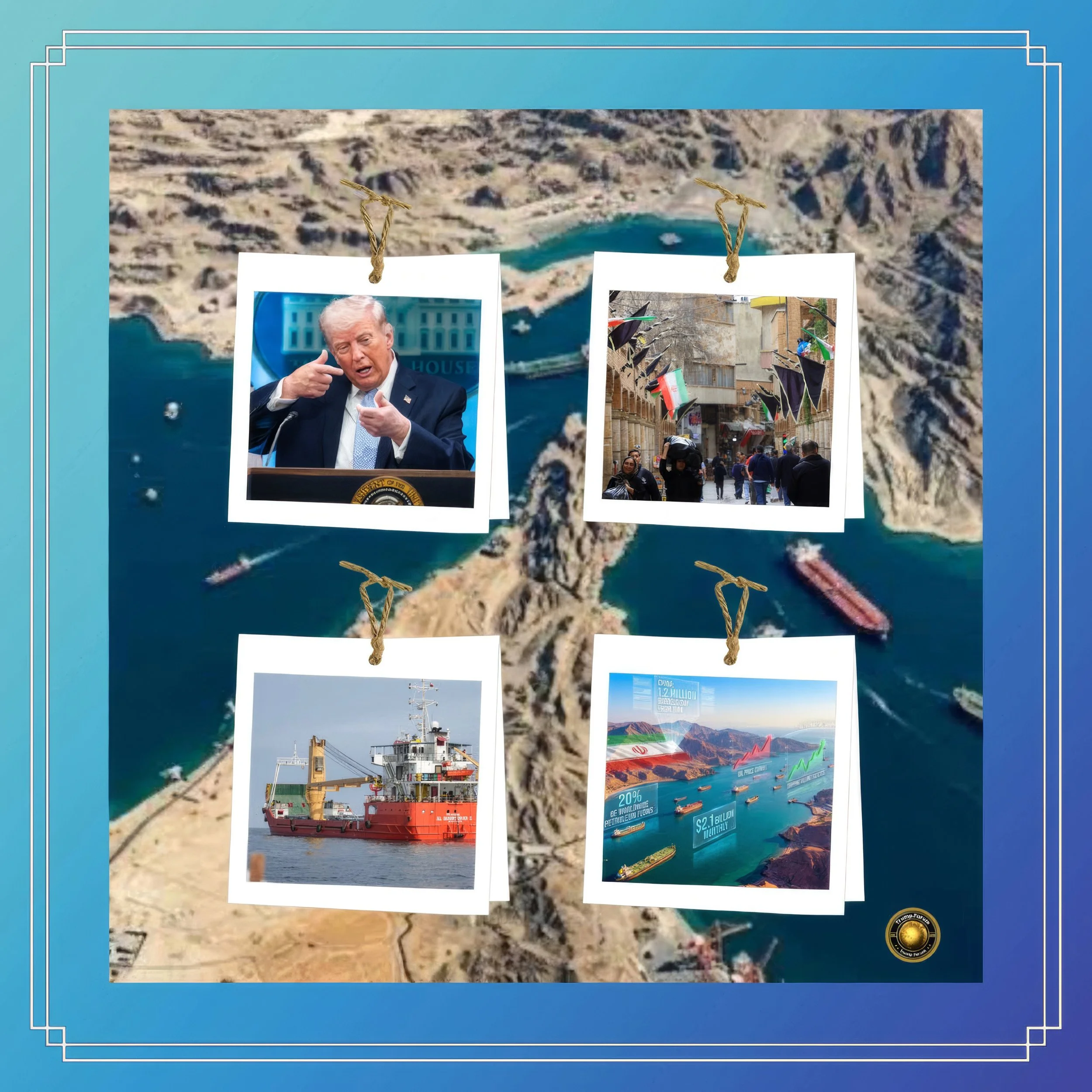
The decision by Donald Trump to impose a naval blockade on Iranian exports marks a strategic pivot in the ongoing conflict.
Rather than relying solely on airstrikes and military pressure, Washington has shifted toward controlling the economic arteries that sustain Iran’s state capacity.
The centrality of the Strait of Hormuz in global energy flows makes this blockade uniquely consequential, as roughly 20% of global oil and gas transit through this narrow passage during peacetime.
Iran’s ability to generate $5bn in oil revenue over the past month underscores both its resilience and its vulnerability.
That revenue is not merely economic; it underwrites domestic stability, military operations, and regional influence.
The blockade therefore seeks to sever the link between resource wealth and strategic autonomy, converting geography into leverage and logistics into coercion.
History and Current Status
Decades of sanctions prepared Iran for pressure but not for direct maritime economic strangulation
Since the 1979 revolution, Iran has faced successive waves of sanctions led by the United States.
These measures targeted banking systems, oil exports, and access to global financial networks, forcing Tehran to develop complex systems of evasion.
Over time, Iran built resilience through diversification of trading partners, development of informal markets, and cultivation of political relationships that could sustain limited flows even under pressure.
However, a naval blockade differs fundamentally from sanctions. Sanctions restrict legal transactions and financial channels; blockades physically impede movement and introduce direct operational risks to shipping.
Historically, such measures have been used sparingly due to their escalatory nature, often signaling a transition toward more direct confrontation.
The current situation reflects a hybrid conflict environment in which economic and military instruments are tightly intertwined.
Key Developments
Blockade enforcement begins as U.S. naval forces expand operational footprint across critical maritime routes
The implementation of the blockade at 14:00 GMT marked a formal shift toward maritime enforcement.
U.S. naval assets expanded patrol zones and increased scrutiny of vessels suspected of carrying Iranian oil, raising the likelihood of interception or deterrence.
Insurance premiums for shipping through the Gulf rose sharply, discouraging commercial operators from engaging in trade that could expose them to financial or legal penalties.
Buyers, particularly in Asia, faced increased uncertainty as the risk of secondary sanctions or cargo seizure complicated procurement decisions.
Iran’s leadership condemned the blockade as an illegal act amounting to piracy, signaling both legal opposition and a potential willingness to explore countermeasures.
This rhetorical escalation reflects the broader strategic tension, as both sides attempt to exert pressure without crossing thresholds that would trigger uncontrollable military escalation.
Latest Facts and Concerns
Iran’s $5bn monthly oil revenue now faces severe disruption under tightening blockade enforcement measures
The most immediate concern centers on the potential loss of Iran’s recent $5bn monthly oil revenue.
Even a partial disruption could significantly weaken fiscal capacity, particularly under wartime conditions that demand increased spending.
Oil revenue supports not only the government budget but also social stability, as subsidies and salaries depend on steady inflows.
A sustained reduction in exports could therefore generate domestic economic strain, increasing inflationary pressures and constraining policy options.
At the same time, global energy markets are closely monitoring developments, as even limited disruptions to supply can influence pricing dynamics.
Shipping risks, rising insurance costs, and uncertainty among buyers all contribute to a fragile environment in which economic decisions are shaped by geopolitical calculations.
Cause and Effect Analysis
Blockade reduces export capacity leading to revenue decline and fiscal pressure on Iranian state structures
The blockade’s primary effect is to constrain Iran’s ability to export oil, thereby reducing revenue and placing pressure on state finances.
This may limit Tehran’s ability to sustain military operations and regional influence, creating incentives for strategic recalibration.
However, secondary effects complicate this picture. Reduced Iranian exports can tighten global supply, potentially raising oil prices and offsetting some revenue losses for whatever exports continue.
Increased shipping risks deter buyers and amplify the blockade’s impact beyond direct enforcement.
At the same time, heightened economic pressure may either push Iran toward negotiation or harden resistance, depending on domestic political dynamics.
The interaction between coercion and resilience becomes the central determinant of outcomes, shaping both immediate and long-term trajectories.
Future Steps
Iran may expand illicit shipping networks using shadow fleets and intermediaries to bypass blockade enforcement
Iran retains several potential escape pathways despite the blockade.
One option is the expansion of illicit shipping networks, often referred to as shadow fleets, which operate through opaque ownership structures and deceptive practices such as disabling tracking systems.
Another pathway involves alternative land routes through neighboring countries, allowing for partial continuation of exports outside maritime channels.
Tehran may also deepen engagement with key buyers, particularly in Asia, seeking to maintain demand despite increased risks.
At a strategic level, Iran could pursue calibrated escalation, raising costs for enforcement stakeholders by threatening regional infrastructure or maritime traffic.
Diplomatic engagement remains another avenue, as external stakeholders may seek to stabilize markets and reduce tensions.
The effectiveness of the blockade will ultimately depend on enforcement capacity and the degree to which Iran can adapt to evolving constraints.
Conclusion
Hormuz blockade marks decisive shift toward economic warfare reshaping conflict dynamics between Washington and Tehran
The U.S. blockade represents a high-stakes attempt to leverage economic pressure as a decisive tool in conflict, targeting the core of Iran’s financial resilience.
While it has the potential to significantly disrupt oil revenues and strain the domestic economy, its ultimate effectiveness remains uncertain.
Iran’s history of adaptation, combined with the interconnected nature of global energy markets, ensures that the outcome will not be determined solely by enforcement measures.
Instead, it will emerge from the dynamic interaction between coercion and resistance, shaped by strategic choices on both sides.
The struggle over the Strait of Hormuz underscores the enduring importance of geography in global power dynamics, illustrating how control over critical chokepoints can redefine the balance between economic vulnerability and strategic autonomy.