Summary
Imagine you spend years building a state-of-the-art warehouse in what you believe is a safe neighborhood.
You fill it with the most expensive computers in the world. Billions of dollars.
Then one morning, a small remote-controlled aircraft — the kind that costs roughly as much as a used car — crashes into your roof and causes a massive blackout. Your computers go dark.
Your customers cannot access their files. And someone on the other side of the world announces they have a list of 28 more buildings just like yours, all ready to be targeted next.
This is not a hypothetical scenario. It is roughly what happened in the Gulf region in March 2026, and it has changed the way governments and tech companies think about building the digital infrastructure of the future.
What the Gulf Was Building
The countries of the Persian Gulf — Saudi Arabia, the United Arab Emirates, Qatar, and Bahrain — have been spending enormous amounts of money to build data centers.
Think of a data center as a giant building full of computers that store information and run programs for people and businesses all over the world.
When you use a banking app, book a flight, or access a company's internal files, you are often connecting to one of these buildings.
For years, Gulf states were considered perfect hosts for these buildings.
They have cheap electricity, available land, and enormous financial reserves — Saudi Arabia's Public Investment Fund and Abu Dhabi's sovereign wealth funds have combined assets in the trillions of dollars.
Microsoft committed $15.2 billion to the UAE.
Saudi Arabia signed a $2.7 billion deal for a single 480-megawatt AI computing facility.
The whole region expected tech spending to reach $169 billion in 2026 alone.
The plan was simple: build the infrastructure, attract American tech giants, and use AI to create new industries that would replace oil revenues as those revenues eventually declined.
What Went Wrong
In late February 2026, the United States and Israel launched military strikes on Iran that resulted in the death of Iran's Supreme Leader. Iran responded by firing waves of missiles and drones across the Gulf.
The UAE intercepted more than 537 ballistic missiles, over 2,000 drones, and dozens of cruise missiles in the weeks that followed.
Even though most of these were destroyed in the air, the debris and fragments that fell to the ground still caused damage across cities like Dubai and Abu Dhabi.
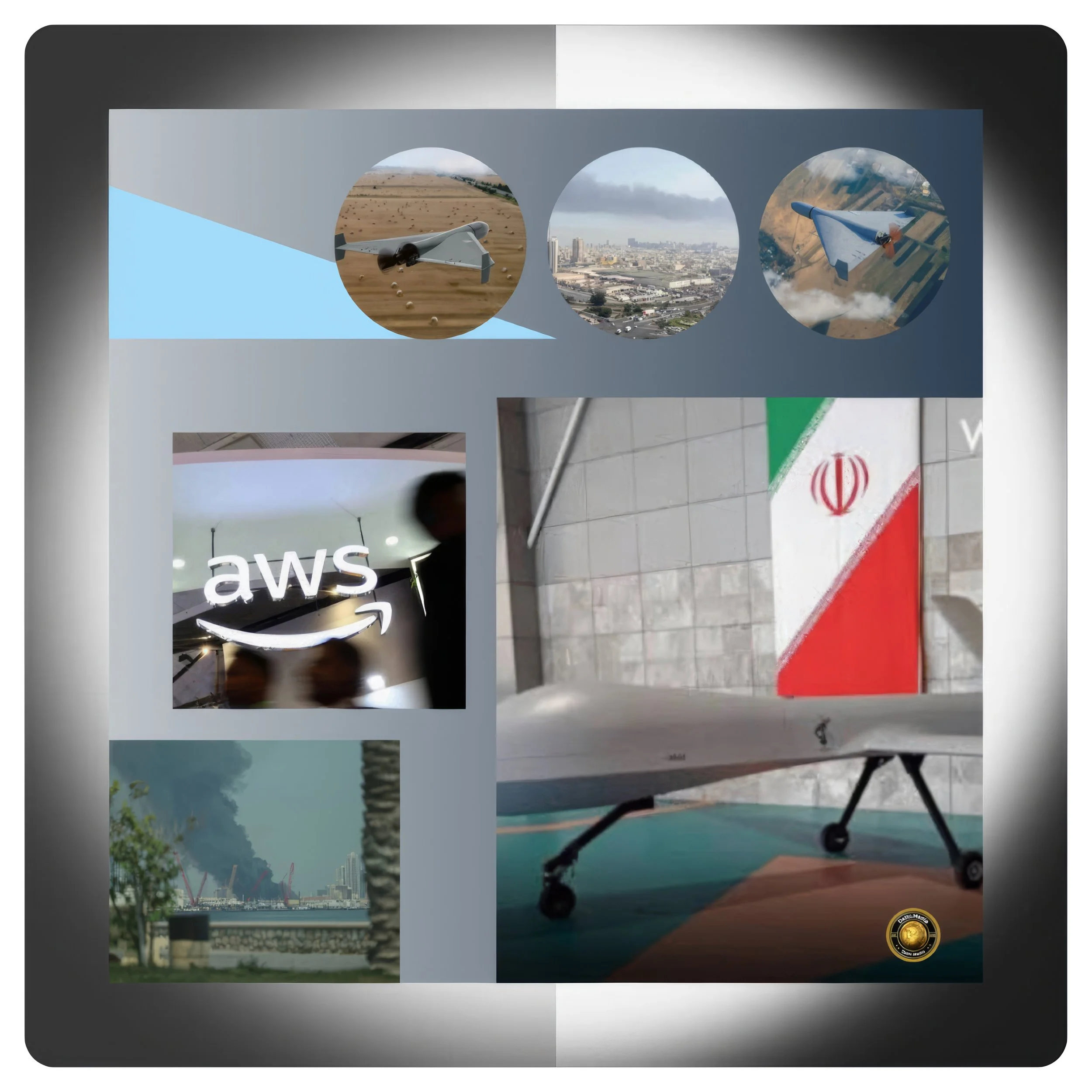
On March 1st, 2026, specifically, several Iranian-attributed drones struck three Amazon Web Services data centers — two in the UAE and one in Bahrain.
Banking systems went offline. Payment platforms stopped working. Ride-sharing apps failed. Delivery services collapsed. Millions of people could not access digital services for hours.
Iran's Revolutionary Guards then published a list of 29 tech buildings and companies they considered valid targets, including facilities linked to Google, Microsoft, Nvidia, and others.
Why a Cheap Drone Can Beat Expensive Defense
Here is the unsettling math. An American Patriot missile that shoots down a drone costs approximately $4 million.
The Iranian Shahed-136 drone that it is shooting down costs perhaps $30,000.
That means Iran can send roughly 133 drones for the price of each interceptor missile the Gulf uses to stop them. The attacker gets 133 shots for the price of 1 defense.
Think of it like a game where one side plays with marbles and the other side uses bowling balls to knock them out of the air.
The bowling balls are very effective, but they cost so much that you eventually run out of them, or can no longer afford to keep buying them at that rate.
This is precisely what military experts call "asymmetric warfare" — a weaker side uses cheap, simple tools to exhaust a stronger side's expensive defenses.
Gulf states are now urgently searching for cheaper ways to shoot down cheap drones.
They are exploring counter-drone systems that cost as little as $2,500 per unit, developed by teams in Japan and Ukraine, that can intercept incoming Shahed drones before they reach their targets.
But even these cheaper options require radar systems, trained operators, communication networks, and legal rules about where and when a machine can automatically shoot something down over a city. Building all of that is still very expensive.
Who Is Involved and What They Want
On one side sits the United States, which wants the Gulf's massive investment in AI infrastructure to remain inside an American-controlled technology system rather than drifting toward China.
Washington has been supplying advanced Nvidia chips to the UAE as part of a deal that includes security and supply-chain requirements.
In exchange, Gulf states like the UAE's G42 company agreed to stop using Chinese hardware suppliers.
On the other side sits China, which would like to sell its own AI technology — chips, software, cloud services — to the Gulf.
Before the conflict intensified, some Gulf states were quietly maintaining commercial relationships with Chinese firms despite American pressure.
The drone strikes have made that balancing act harder, since Gulf states now depend heavily on American military technology to protect themselves and their infrastructure.
Iran, meanwhile, has demonstrated that it can use relatively cheap weapons to cause disproportionate disruption to expensive Western and Gulf technology infrastructure.
By naming specific American tech companies as targets, the IRGC has also sent a message to those companies' shareholders, insurers, and boards of directors: operating in the Gulf comes with real physical risk.
The New Deal: Security Tied to Technology Access
Before March 2026, when a Gulf country wanted to build an AI data center with American technology, the deal was essentially commercial.
The country provided land, energy, and money; the American company provided computers, software, and engineers; and both sides made a profit.
That arrangement has not disappeared, but it now comes with extra conditions.
Gulf states that want access to American AI — the powerful chips made by Nvidia, the cloud platforms run by Amazon, Google, and Microsoft — increasingly need to prove they are politically aligned with Washington.
They need to commit to keeping Chinese technology out of their networks.
They need to accept security monitoring. And crucially, they need to provide the kind of physical protection that makes it safe for American companies to keep their servers on Gulf soil.
Steven A. Cook, a senior fellow at the Council on Foreign Relations, put it memorably when he described AI as "the mother of all insurance policies."
The Gulf states are betting that if they become deeply important to American tech companies, America will protect them.
It is a reasonable bet, but the drone strikes have shown that the protection is not free and not automatic.
What Comes Next
The companies that operate data centers will spend significantly more money on physical security.
Perimeter fences and guards are no longer enough — they now need layered drone-detection systems, electronic jamming equipment, and potentially AI-powered systems that can automatically intercept incoming threats.
This extra cost does not make Gulf data centers uncompetitive, but it does eat into the cost advantages that made the Gulf attractive in the first place.
Future technology deals in the region will increasingly look like security agreements bundled inside commercial contracts.
When Microsoft or Amazon signs an agreement to build a new data center in Riyadh or Abu Dhabi, that agreement will likely include explicit protections, redundancy requirements, and possibly co-location of defensive systems on the same site.
Governments will also push for data center resilience — the ability of a network to keep running even if one of its buildings is damaged.
Instead of concentrating all computing power in a single large facility, companies will distribute their infrastructure across multiple smaller sites in different locations, so that a strike on one location does not bring down the whole service.
Perhaps most significantly, the events of March 2026 have permanently changed how companies, governments, and investors think about building technology infrastructure in regions close to active conflicts.
The assumption that a data center is a neutral commercial asset, protected by its civilian character and its corporate identity, is finished. AI infrastructure is now a military target.
That reality will shape the decisions of every stakeholder in this industry for years to come.
The Gulf's ambitions for AI will survive this challenge — the money, the energy, and the political commitment are all still there.
But the age of building data centers as if they were shopping malls, and expecting the world to leave them alone, is over.