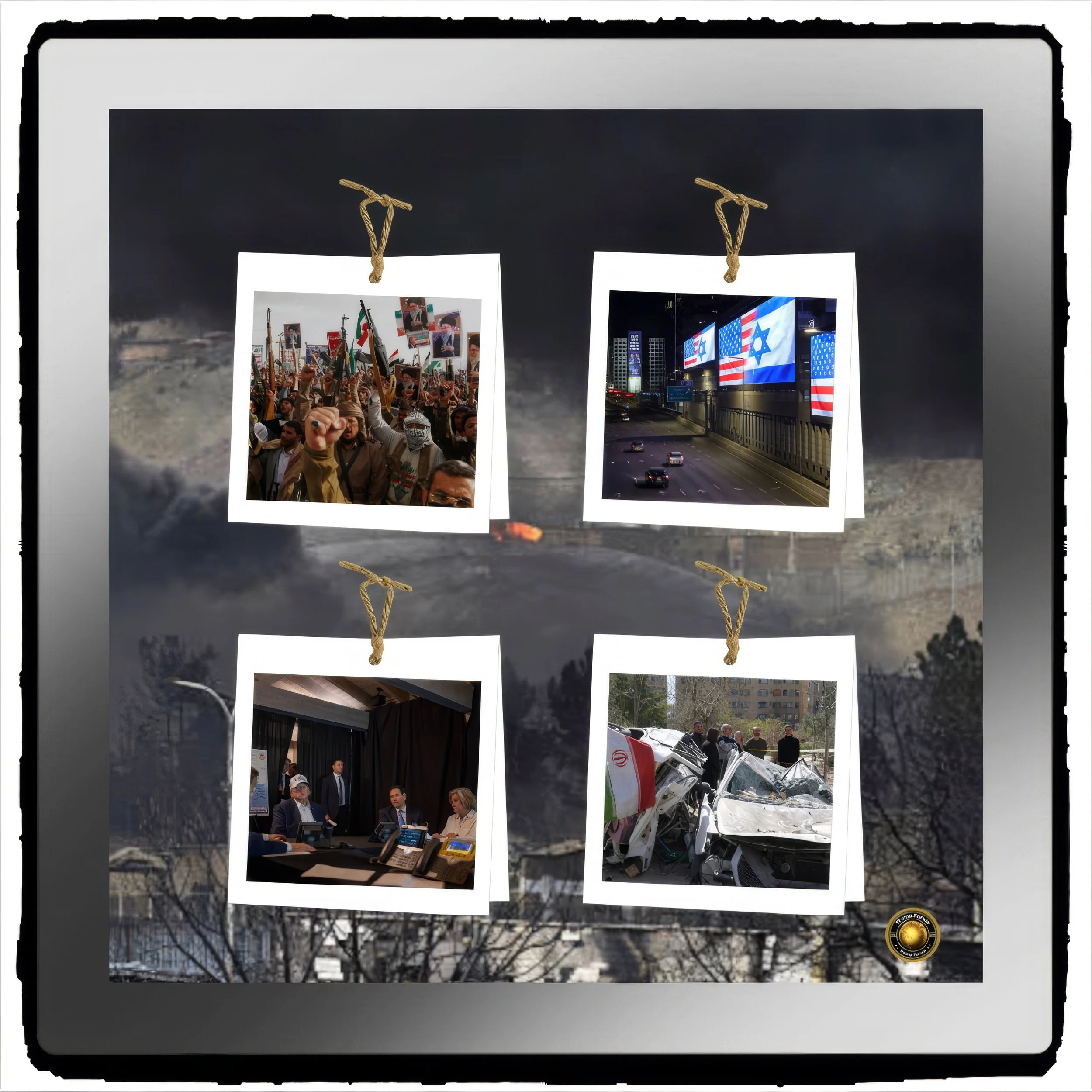
The Iran War Spirals Beyond Control as Escalation Shatters Strategic Assumptions in Washington and Tehran
Executive Summary
Illusions of Controlled Conflict Collapse as the Iran War Expands Into a Dangerous Regional Conflagration
The unfolding war involving the United States, Israel, and Iran represents a defining case study in the limits of modern strategic control.
Initiated as a limited campaign designed to impose calibrated costs and compel behavioral change, the conflict has instead expanded into a complex, multi-layered confrontation whose trajectory no longer aligns with the intentions of its initiating stakeholders.
The belief that escalation could be managed through precision strikes, signaling, and controlled coercion has proven fundamentally flawed.
At the core of this failure lies a structural mismatch between strategic theory and geopolitical reality.
The doctrines of deterrence and coercive diplomacy, developed during a period of bipolar stability, assume rational actors operating within predictable frameworks.
Yet the present conflict unfolds within a fragmented and interconnected landscape where state and non-state stakeholders interact in nonlinear and often unpredictable ways.
Iran’s strategic culture, emphasizing resilience, asymmetry, and distributed deterrence, has further complicated attempts at control.
Rather than yielding under pressure, Iran has responded with a combination of direct and indirect actions that expand the scope of the conflict.
These responses have not only undermined the initial objectives of the campaign but have also introduced new risks, including regional spillover, economic disruption, and the erosion of deterrence norms.
Each round of escalation reinforces the next, creating a self-sustaining cycle that is increasingly difficult to interrupt.
FAF article argues that the war has escaped its authors because it is governed less by deliberate strategy than by emergent dynamics inherent to complex conflict systems.
It examines the intellectual foundations of escalation management, traces the historical evolution of the Iran confrontation, analyzes current developments, and explores the mechanisms driving ongoing escalation.
It concludes that without a fundamental reassessment of strategic assumptions, the conflict will continue to evolve in ways that defy control and threaten broader instability.
Introduction: The Enduring Myth of Controlled War
Strategic Miscalculation and Escalation Drive the Iran War Beyond Its Original Political and Military Objectives
Modern strategic thought rests on a powerful but fragile assumption: that war can be controlled.
Policymakers often believe that violence can be applied with precision, calibrated to achieve specific objectives while avoiding unintended consequences.
This belief underpins doctrines ranging from limited war theory to precision strike strategies and coercive diplomacy.
In practice, however, war rarely conforms to such expectations.
Once initiated, it generates its own momentum, shaped by interactions between opposing stakeholders, shifting perceptions, and unforeseen events.
These dynamics are particularly pronounced in contemporary conflicts, where technological, political, and social factors create a highly complex operational landscape.
The Iran war exemplifies this reality.
The initial campaign was designed as a limited intervention, intended to impose costs without provoking a broader confrontation.
Yet within weeks, the conflict expanded beyond its original parameters, driven by reciprocal escalation and strategic miscalculation.
The failure to anticipate this outcome reflects a deeper problem within strategic thinking.
It reveals a persistent tendency to underestimate the autonomy of conflict dynamics and overestimate the ability of policymakers to control them.
Strategic Theory Under Strain: Deterrence, Coercion, and Escalation
The intellectual foundations of the campaign lie in the theories of deterrence and coercion. Deterrence seeks to prevent adversarial actions by threatening unacceptable costs.
Coercion aims to compel change by applying limited force. Both rely on the assumption that stakeholders respond rationally to incentives and signals.
During the Cold War, these theories appeared effective.
The relative symmetry between the United States and the Soviet Union allowed for stable deterrence relationships.
Communication channels were established, and escalation thresholds were broadly understood.
The Iran conflict challenges these assumptions. Iran’s strategic calculus is shaped by a different set of priorities, including regime survival, ideological commitment, and regional influence.
Its willingness to endure economic and military pressure complicates efforts to apply traditional coercive strategies.
The concept of escalation ladders further illustrates the limitations of existing frameworks.
These models conceptualize conflict as a sequence of steps, each representing a higher level of intensity. Policymakers are assumed to move deliberately between these steps, carefully controlling the pace and direction of escalation.
In reality, escalation is neither linear nor predictable.
Actions can produce disproportionate effects, and interactions between stakeholders can create feedback loops that accelerate conflict.
The Iran war demonstrates how quickly escalation can move beyond the control of its initiators.
Historical Foundations: From Managed Rivalry to Direct Confrontation
Washington’s Illusion of Control Crumbles as Iran War Escalation Redefines Modern Conflict Dynamics
The current conflict is rooted in a long history of rivalry between Iran and its adversaries.
Following the Iranian revolution, the United States adopted a strategy of containment, seeking to limit Iran’s influence through economic sanctions, diplomatic isolation, and regional alliances.
Israel pursued a parallel approach, focusing on disrupting Iran’s capabilities and preventing the development of strategic threats.
Over time, this led to a pattern of indirect confrontation, including covert operations, cyber attacks, and proxy conflicts.
Despite these tensions, direct war was avoided for decades.
Both sides recognized the risks of escalation and maintained a degree of restraint.
This equilibrium was sustained by a combination of deterrence and mutual caution.
The breakdown of this equilibrium reflects a convergence of factors.
The erosion of diplomatic agreements removed mechanisms for managing tensions. Regional conflicts created new opportunities for confrontation.
Domestic political dynamics encouraged more aggressive policies.
These developments set the stage for the current conflict, transforming a managed rivalry into a direct confrontation.
Current Status: A Conflict Without Clear Boundaries
The Iran War’s Uncontrolled Escalation Signals a Breakdown of Deterrence and Strategic Planning Frameworks
The present conflict is characterized by its fluidity and lack of clear boundaries.
Military operations extend across multiple domains, including air, cyber, and economic landscapes. Actions in one area produce effects in others, creating a highly interconnected conflict environment.
Iran has demonstrated a capacity for resilience and adaptation.
Rather than responding symmetrically, it has employed a combination of direct strikes and proxy actions, targeting vulnerabilities across the region.
This approach complicates efforts to achieve decisive outcomes.
At the same time, the United States and Israel continue to pursue their objectives, driven by the belief that increased pressure will yield results. This mutual persistence contributes to ongoing escalation.
The absence of effective communication channels exacerbates the situation.
Without mechanisms for de-escalation, misunderstandings and misperceptions can escalate into larger confrontations.
Key Developments: The Expansion of Conflict Dynamics
Limited War Becomes Unlimited Risk as Iran Conflict Expands Beyond Initial Strategic Calculations
Several developments have transformed the conflict. One is the increasing integration of different forms of warfare.
Cyber operations, economic measures, and conventional strikes are now part of a unified strategy, expanding the range of possible actions.
Another development is the growing role of regional stakeholders.
Countries across the Middle East are affected by the conflict, either directly or indirectly.
This creates additional pressures and complicates efforts to contain escalation.
The normalization of escalatory actions represents a further shift.
Activities that were once considered extreme are becoming routine, lowering the threshold for future escalation.
Latest Facts and Concerns: Escalation Without Limits
From Precision Strikes to Strategic Chaos: How the Iran War Escaped Its Architects Completely
The conflict raises several pressing concerns. One is the erosion of deterrence.
As thresholds are crossed, the ability to signal limits diminishes. This creates a situation in which escalation becomes self-reinforcing.
Another concern is the risk of miscalculation.
In a complex environment, even minor incidents can trigger significant escalation. The presence of multiple stakeholders increases this risk.
The economic impact of the conflict is also significant.
Disruptions to energy markets and trade routes affect global stability, extending the consequences beyond the immediate region.
Cause-and-Effect Analysis: Feedback Loops and Strategic Misperception
Escalation Without Exit: How the Iran War Defies Control and Reshapes Regional Power Structures
The conflict can be understood as a system of feedback loops. Each action produces a reaction, which in turn influences subsequent actions.
These loops can reinforce escalation, creating a cycle that is difficult to break.
Perception plays a critical role. Stakeholders interpret actions through their own frameworks, leading to divergent understandings. This misalignment contributes to continued escalation.
Domestic political pressures further complicate the situation. Leaders face incentives to demonstrate strength, limiting their willingness to compromise.
Proxy Networks and Asymmetric Strategies
Iran’s use of proxy networks is a defining feature of the conflict.
These networks extend its reach and create multiple points of engagement. By operating through partners, Iran can impose costs while reducing its own vulnerability.
Asymmetric strategies further complicate the conflict. By avoiding direct confrontation and exploiting weaknesses, Iran can challenge more powerful adversaries.
These approaches undermine traditional models of warfare and contribute to the conflict’s persistence.
Global Implications: Energy, Trade, and Systemic Stability
The conflict has significant global implications. Energy markets are affected by disruptions, influencing prices and economic stability.
Trade routes are also at risk, with potential consequences for global commerce.
These effects highlight the interconnected nature of modern conflicts.
Localized confrontations can have far-reaching consequences.
Future Trajectories
Uncertain Paths Forward
Several outcomes are possible.
Continued escalation could lead to a broader regional war. A prolonged stalemate is also likely, with ongoing low-intensity conflict. De-escalation remains possible but requires significant shifts in perception and policy.
Each scenario carries risks and uncertainties. The absence of effective mechanisms for managing escalation complicates efforts to achieve stability.
Conclusion
Strategic Control in an Uncontrollable War
The Iran war demonstrates the limits of strategic control. The belief that violence can be precisely managed is increasingly untenable in a complex world.
The conflict has escaped its authors because it is driven by dynamics that extend beyond their control. Recognizing this reality is essential for developing more effective strategies.
Without such recognition, the risk of further escalation remains high, with consequences that could reshape the regional and global landscape.