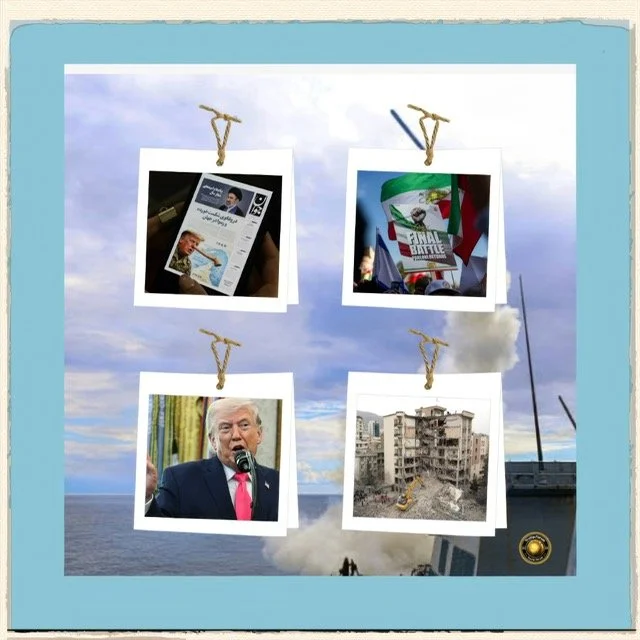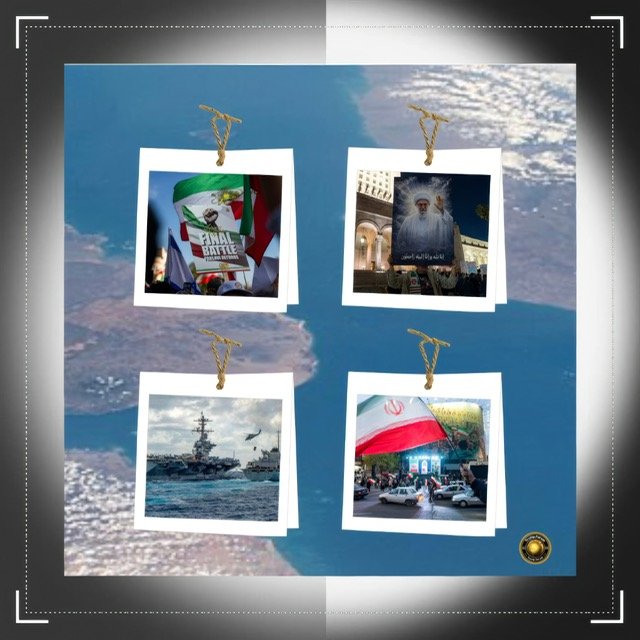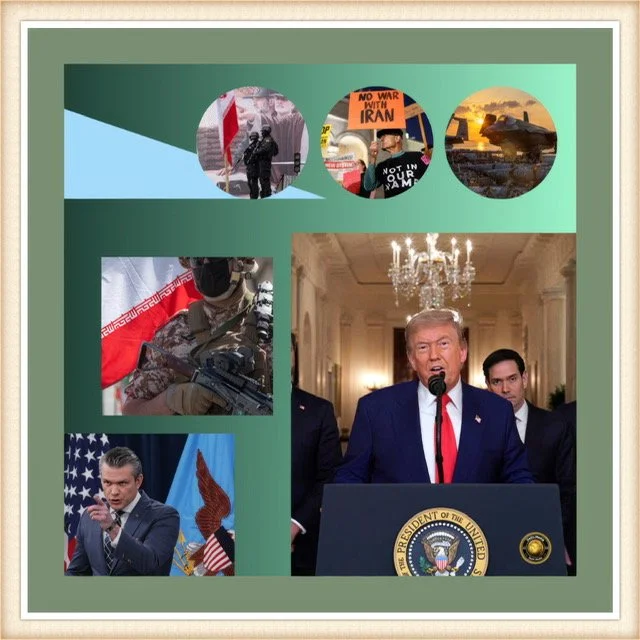
Governing by Announcement: The Trump Administration's Dangerous Gap Between Declaration and Action at Hormuz : Information Warfare
Executive Summary
Strait of Reckoning: How the Hormuz Crisis Exposed the Limits of American Strategic Communication
The war on Iran, now in its 4th week, has produced what the International Energy Agency describes as the largest oil supply disruption on record, with approximately 8 million barrels per day (bpd) lost in March 2026 alone and Middle East Gulf producers cutting output by at least 10 million bpd. Yet the crisis's most consequential front is not exclusively military or economic — it is epistemic.
The Trump administration's repeated pattern of governing by announcement, projecting outcomes before they exist and issuing conditional commitments in place of executed ones, has transformed the Strait of Hormuz into something more than a physical choke point. It has become a theater of contested credibility, where what is said carries immediate market consequences, and where the growing gap between declaration and action is itself a strategic liability.
From Energy Secretary Chris Wright's deleted post claiming a successful Navy escort to Treasury Secretary Scott Bessent's conditional promise that escorts would begin "as soon as it is militarily possible," Washington has repeatedly issued statements that markets believed, then corrected, often at enormous economic cost.
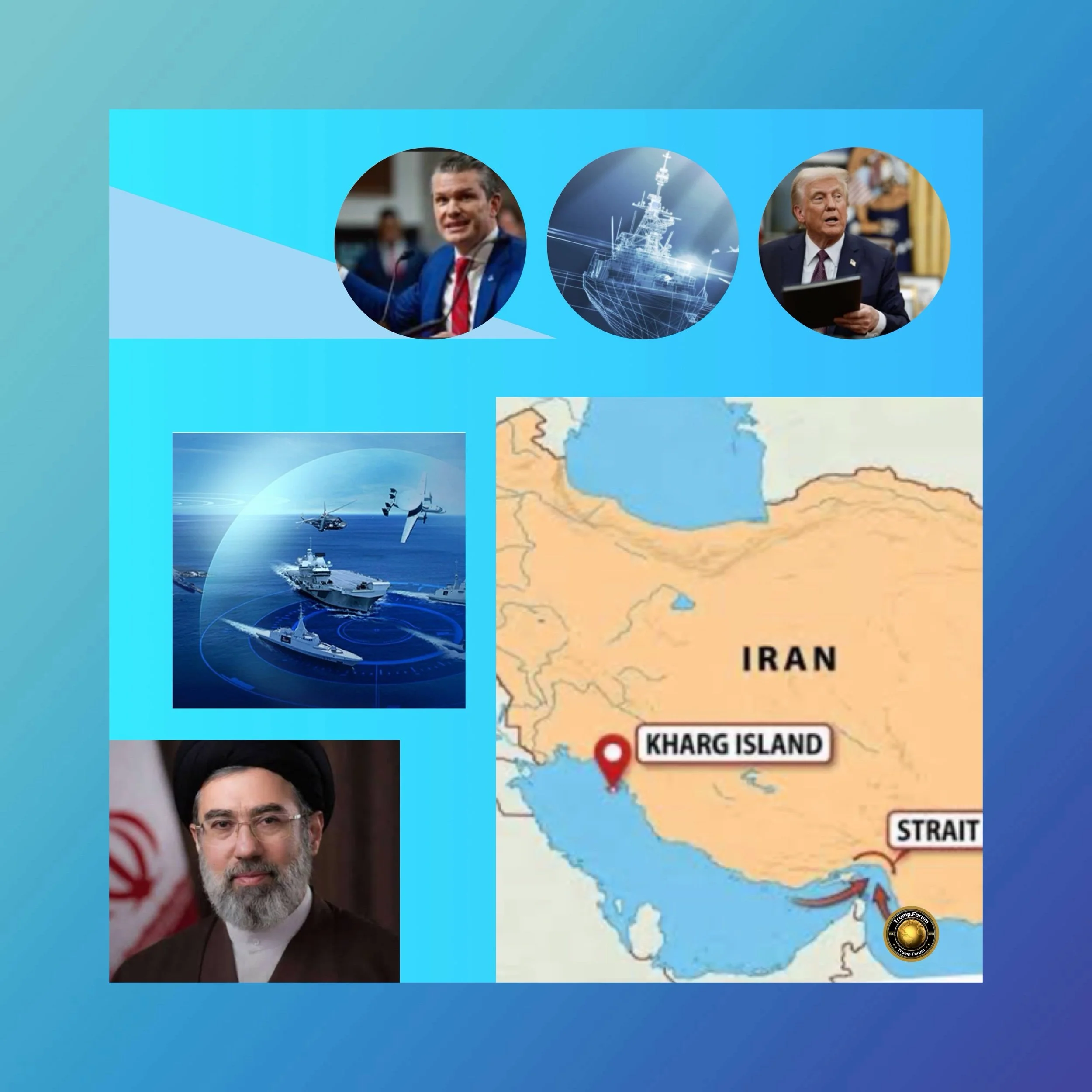
Meanwhile, Iran has reinforced Kharg Island against a potential U.S. ground operation, laying mines and deploying additional air defense systems, thousands of U.S. Marines are moving toward the Persian Gulf, and a 22-nation coalition led by NATO Secretary General Mark Rutte has begun forming to potentially secure safe passage through the strait — though operational timelines remain undefined.
FAF article argues that the gap between narrative and reality in the Hormuz crisis is not merely a communications failure.
It is a structural feature of the Trump administration's crisis management doctrine, with profound implications for energy security, allied cohesion, and the long-term credibility of American power projection.
Introduction
When Saying Becomes Doing: Information Warfare, Kharg Island, and the Crisis Washington Cannot Declare Away
There is a particular species of political risk that does not appear on any conventional threat matrix: the risk that a government's own declarations become more dangerous than its adversary's weapons.
The Strait of Hormuz crisis that followed the U.S.-Israeli military campaign launched against Iran on February 28th, 2026, has produced exactly this kind of risk.
Oil markets, shipping companies, and allied governments have all been subjected not merely to the kinetic disruption of a closed strait, but to a cascading sequence of official American statements that oscillated between assertion and retraction, commitment and qualification, resolve and conditionality.
The result has been a crisis of trust layered on top of a crisis of supply, each compounding the other.
The closure of the Strait of Hormuz is, by any historical measure, an event of enormous consequence.
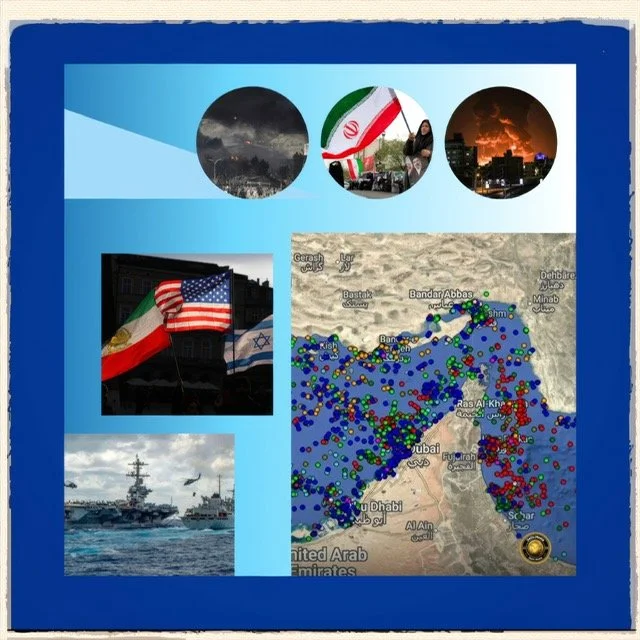
Roughly 20% of the world's oil and liquefied natural gas passes through this narrow waterway along the Iranian coast.
The IEA's designation of the current disruption as the largest oil supply shock on record is not rhetorical inflation — it reflects the arithmetic reality that the countries most dependent on Persian Gulf exports, from Japan and South Korea to India and the European Union, are now navigating a structural deficit that cannot be solved by tapping strategic reserves indefinitely.
The human cost of sustained elevated energy prices will be distributed most heavily among the world's poorest economies, and the broader macroeconomic consequences — inflation, reduced investment, slowed growth — will be felt well beyond any diplomatic resolution of the conflict itself.
What has made this crisis analytically distinctive, however, is not the oil shock alone. It is the degree to which the battle over perception has become inseparable from the battle over the waterway.
Both the United States and Iran have engaged in systematic information operations — issuing claims designed not to describe reality but to shape it.
Iran's state media has broadcast manipulated images of alleged battlefield victories, deployed old photographs relabeled as current, and circulated video game footage as genuine combat imagery.
The U.S. side has not been immune: the White House faced backlash over a video that mixed real footage with clips from video games, and senior officials have made public statements that were retracted within minutes.
The cumulative effect is an informational environment in which markets, allies, and the global public are operating with systematically degraded situational awareness.
Understanding this environment — its origins, its mechanics, and its consequences — is the central task of this analysis.
History and Current Status
The Strait of Hormuz has functioned as a strategic pressure point in U.S.-Iran relations for more than 4 decades.
The precedent most directly relevant to the current crisis is the Tanker War of 1984 to 1988, during which Iran and Iraq both attacked oil tankers in the Persian Gulf, eventually drawing the United States into Operation Earnest Will — the largest naval convoy operation since World War II — to re-flag Kuwaiti tankers and escort them through contested waters.
That operation was imperfect and costly, but it was operationally real: ships were flagged, escorts were dispatched, and the United States demonstrated the capacity to match its commitments with action. The current crisis has, so far, produced no comparable demonstration.
The U.S.-Israeli strikes on Iran began on February 28th, 2026. Within days, tanker movement through the Strait of Hormuz had nearly ceased.
Maritime analytics firm Windward described the withdrawal of shipping traffic not as "temporary hesitation" but as a "sustained withdrawal from corridor" — a deliberate, industry-wide decision to treat the strait as effectively closed.
Insurance markets concurred: war risk premiums for transit through the strait rose to levels that made the economics of passage prohibitive for most commercial operators, even in the absence of active interdiction.
By early March, the U.S. Navy was receiving near-daily requests from the shipping industry for military escorts and was declining all of them.
President Trump acknowledged the problem on March 3rd, announcing that "if necessary, the United States Navy will begin escorting tankers through the Strait of Hormuz, as soon as possible."
The Pentagon, however, clarified that same day that it had no escort plans.
This was the inaugural instance of what would become a recurring pattern: a presidential declaration outpacing military reality, followed by a quiet correction that markets had already priced in.
The administration dispatched an additional 2,500 Marines and the USS Tripoli to the Middle East, and later accelerated the deployment of thousands more Marines and Navy personnel, including the USS Boxer Amphibious Readiness Group.
These are not trivial deployments. But they are force-positioning movements — preparations for options — not the executed operations that official language has repeatedly implied.
On March 13th, the United States Air Force conducted a large bombing raid on Kharg Island, targeting more than 90 Iranian military sites including air defenses, a naval base, an airport control tower, and a helicopter hangar, while deliberately sparing oil and gas infrastructure.
Trump stated publicly that oil facilities had been spared "for reasons of decency."
The strategic logic was clear: Kharg Island handles approximately 90% of Iran's crude oil exports, and its destruction would remove Iran's principal economic leverage — but also potentially trigger a global supply catastrophe that would be politically unmanageable in Washington.
The strikes thus constituted a message of restraint as much as a message of force: the United States was demonstrating that it could destroy Iranian oil infrastructure but was choosing not to.
Iran received this message and responded in kind, by reinforcing rather than conceding.
Intelligence assessments by late March indicated that Tehran had been laying traps, deploying additional military personnel, and strengthening air defense systems on Kharg Island in anticipation of a possible U.S. ground operation to seize the island.
Iranian naval forces have also reportedly mined approaches to the island.
The Islamic Revolutionary Guard Corps has framed U.S. messaging as psychological operations and signaled continued military intent.
Iran's parliamentary speaker Mohammad Baqer Qalibaf denied any negotiations, characterizing American statements about diplomatic progress as deliberate manipulation of oil prices. This characterization is not without foundation.
Key Developments
The most dramatically consequential single event in the informational dimension of this crisis occurred on March 10th.
Energy Secretary Chris Wright posted on X that "the U.S. Navy successfully escorted an oil tanker through the Strait of Hormuz to ensure oil remains flowing to global markets."
Within minutes, U.S. crude oil futures fell nearly 17%, and Brent crude followed.
The post was deleted. The White House clarified that "the U.S. Navy has not escorted a tanker or a vessel at this time."
The Department of Energy attributed the error to a staffer who had "incorrectly captioned" the post. Crude oil closed down nearly 12% for the day — a loss that reflected the magnitude of the relief markets had momentarily felt, and the violence of the correction when reality reasserted itself.
This episode deserves more analytical attention than it has received.
The remarkable fact was not merely that the post was wrong. It was that markets believed it for approximately 10 minutes — and that belief moved prices by nearly 17%.
This tells us something important about the state of market psychology: traders and algorithms were so desperate for evidence that the crisis was being resolved that they accepted a deleted tweet as a credible signal.
The correction left prices significantly lower than pre-announcement levels even after the White House clarification, suggesting that the false signal had not been entirely disbelieved — that some market participants had revised their probability estimates of near-term resolution upward even after the retraction, or more likely that the sharp downward move had triggered stop-loss orders and momentum selling that took on a life independent of the underlying news.
Treasury Secretary Scott Bessent's statement to Sky News on March 12th extended the conditional grammar that had characterized administration messaging: "My belief is that as soon as it is militarily possible, the U.S. Navy, perhaps with an international coalition, will be escorting vessels through."
The operative phrases here — "my belief," "as soon as it is militarily possible," "perhaps with" — are each hedges that individually might be unremarkable but together constitute a statement that commits to almost nothing while projecting the appearance of commitment. This is not a failure of communication. It is a form of communication calibrated to buy time without incurring accountability.
On the alliance dimension, the administration's attempt to internationalize the response to the Hormuz crisis has produced results that are real but more limited and slower than public statements have implied.
European leaders, responding to Trump's demands for allied participation in securing freedom of navigation, were blunt in their rejection of direct military involvement.
German Chancellor Friedrich Merz's spokesperson stated that the conflict "does not pertain to NATO," emphasizing that the alliance's mandate covers territorial defense and does not extend to Middle East deployment.
British Prime Minister Keir Starmer reiterated that any Hormuz mission would not be a NATO operation, though he left open discussions about deploying mine-hunting drones already in the region.
These are not the responses of allies who see their interests as coextensive with Washington's objectives in this conflict.
By March 22, however, the picture had partially shifted. NATO Secretary General Mark Rutte announced that 22 countries — including NATO members and partners such as Japan, South Korea, Australia, and Gulf nations — were "coming together" to help secure the strait.
Rutte backed U.S. actions against Iran while warning that Tehran was "very close" to developing missile capabilities that could threaten Europe.
Yet even this announcement was carefully conditioned: Rutte's statement identified the "what," the "when," and the "where" as questions still "being worked through," with "operational timelines under discussion."
The formation of a 22-nation coalition is strategically significant.
The absence of a defined timeline for its deployment, and the persistence of European reluctance to translate political support into operational commitment, represent the alliance dimension of the same credibility problem that afflicts American domestic messaging.
Latest Facts and Concerns
As of late March 2026, the most urgent operational question concerns the future of Kharg Island.
The Trump administration has been communicating to Israeli and other allied counterparts that a ground operation to seize the island may be necessary if diplomatic and economic pressure fail to reopen the strait.
Thousands of U.S. Marines and Navy personnel are deploying to the region, including the USS Boxer Amphibious Readiness Group and its associated assault ships.
Former NATO Supreme Allied Commander Admiral James Stavridis has publicly floated an alternative — an offshore blockade of Kharg that would prevent Iran from exporting oil without requiring a contested amphibious landing.
The blockade option is operationally cleaner and diplomatically less explosive, but it raises its own complications: a blockade would further reduce Iranian oil exports, potentially deepening the global supply shock, while not directly reopening the strait to commercial shipping.
The IEA has estimated that the supply shock has reduced its projected global oil surplus for 2026 by more than a third — from a record projected surplus to approximately 2.4 million bpd.
The agency has simultaneously revised its 2026 global oil demand growth forecast downward by approximately 25%, to 640,000 bpd, its lowest projection since it began making forecasts for 2026.
These revisions reflect the secondary effects of elevated energy prices: flight cancellations, reduced industrial output, and consumer demand destruction.
They also represent a measurement of economic damage that compounds for every additional week the strait remains effectively closed.
The information warfare dimension of the crisis continues to intensify. Iran's state media, according to NewsGuard's analysis, had issued at least 18 false war-related claims since the start of hostilities, including manipulated battlefield imagery and fabricated reports of successful attacks on U.S. assets.
The U.S. Central Command corrected Iranian claims that the aircraft carrier USS Abraham Lincoln had been struck, noting that Iranian missiles had not come close.
On the American side, hundreds of posts on X were found by Wired to be spreading misleading content about the conflict, with some viewed millions of times.
One post viewed more than 4 million times purported to show ballistic missiles over Dubai but actually showed footage from an Iranian attack on Tel Aviv in 2024.
This is the informational substrate within which official government communications are being received — a fog of credibility in which distinguishing signal from noise has become a task of extraordinary difficulty.
Cause-and-Effect Analysis
The informational dysfunction surrounding the Hormuz crisis is not reducible to a single cause, but its proximate origins are identifiable.
The Trump administration entered the conflict with Iran operating from a strategic framework that privileges demonstration over deliberation — the projection of decisiveness as a substitute for the slower, messier work of building actual operational capacity and alliance consensus.
This framework performed adequately in scenarios where declarations could be converted into outcomes quickly, but the Hormuz crisis has exposed its structural limits.
The strait cannot be opened by announcement. The Navy cannot escort tankers it does not have assets to escort. Coalitions cannot be formed by tweet.
The Wright episode is a case study in how this framework fails. The deleted post was almost certainly not an act of deliberate deception — the Department of Energy's attribution to a staffer error is plausible.
But it was enabled by an informational environment in which the administration had been consistently projecting outcomes ahead of their realization, creating an ambient expectation that good news was imminent.
In that environment, a false signal of good news was readily believable. Markets did not believe Wright's post because they were naive; they believed it because the administration had been conditioning them to expect exactly that kind of news.
The effects cascade. Crude oil's 17% intraday plunge on a deleted tweet, followed by a 12% close, represents a transfer of wealth from those who sold on the false news to those who bought — and more broadly, a destruction of the price-discovery function that energy markets are supposed to perform.
If markets cannot reliably distinguish between real and false signals about Hormuz, the risk premium embedded in energy prices will structurally increase — not because the underlying risk has increased, but because the uncertainty about official statements has.
This is an iatrogenic consequence: a self-inflicted wound produced by the administration's own communications strategy.
The alliance management effects are equally consequential.
European governments that might have been persuadable toward limited operational involvement in a Hormuz coalition have been made more cautious, not less, by the pattern of American overstatement.
When Washington declares that escorts are imminent, allies have reason to wait and see whether the declaration proves accurate before committing resources.
When it does not, the credibility cost is borne not just by the United States but by the entire project of Western coordination.
The German government's insistence that the conflict does not pertain to NATO, and Britain's careful distinction between political sympathy and operational commitment, reflect a rational allied calculus: if Washington cannot reliably describe what it has done or what it is about to do, committing forces to a joint operation carries risks that cannot be properly assessed.
Iran's strategic behavior has similarly been shaped — and in ways that serve Tehran's interests — by the credibility gap.
The reinforcement of Kharg Island, the laying of mines, and the refusal to acknowledge any negotiations are the behaviors of a government that has concluded that American threats are more conditional than they appear.
If Iran's leadership believed that the United States would certainly seize Kharg Island, the rational response would be negotiation, not fortification.
The fact that Tehran is fortifying rather than negotiating suggests that it has assessed the administration's declarations as less than fully credible — a rational inference from the pattern of conditional and retracted statements.
The deeper structural cause of these dynamics is the fundamental tension between the administration's political incentives and the operational realities of the crisis.
Trump faces domestic political pressure to demonstrate that the war on Iran is being managed effectively, that energy prices are being controlled, and that American power is being asserted.
These pressures generate incentives to announce progress before it is achieved — to say "the Navy is escorting ships" before the escorts have been dispatched, to say "allies are joining" before coalition timelines have been set.
The announcements serve an immediate political function regardless of their accuracy.
But their medium-term effect is to erode the credibility of subsequent announcements, creating a spiral in which each correction requires a stronger declaration to restore confidence, which in turn requires a more embarrassing correction when it is not delivered.
Future Steps
The range of plausible developments over the coming weeks clusters around three broad scenarios, each with distinct implications for energy markets, regional security, and the credibility of American power.
The first scenario involves the successful operationalization of the 22-nation Hormuz coalition.
If the NATO-led effort translates from announcement into actual deployment of mine-hunting vessels, surface escorts, and aerial surveillance, it would represent a significant demonstration that collective action remains possible even when bilateral American commitments are doubted.
The UK's potential deployment of mine-hunting drones already positioned in the region could constitute a near-term, low-escalation first step.
The obstacles are real — European reluctance to be drawn into a broader conflict, the absence of defined timelines, and the difficulty of coordinating rules of engagement across 22 national militaries — but the coalition's formation is the most hopeful development in the crisis to date.
The second scenario involves a U.S. ground or blockade operation against Kharg Island. The deployment of the USS Boxer Amphibious Readiness Group and thousands of Marines represents a genuine military option.
Stavridis’s offshore blockade variant would be less escalatory than a landing but would further restrict Iranian oil exports, deepening the global supply shock before any resolution.
A contested amphibious assault against a fortified position, with mines, additional troops, and enhanced air defenses in place, would be significantly more costly than early planning assumptions may have envisioned.
It would also risk triggering Iranian retaliation against Gulf oil infrastructure — a contingency that Tehran has explicitly threatened, warning of reducing "US-linked oil facilities to a pile of ashes."
The third scenario — the one least discussed in official messaging but most present in market pricing — is extended stalemate.
The strait remains effectively closed for weeks or months, the 22-nation coalition forms but does not yet deploy, the Kharg operation remains an option but not an execution, and the economic damage continues to compound.
In this scenario, the gap between declaration and action does not close; it becomes the defining feature of the crisis, and the administrations's credibility costs deepen proportionally.
Across all three scenarios, the informational dimension remains critical.
The IEA's revised surplus and demand figures indicate that even partial reopening of the strait — even credible evidence that a timeline for reopening exists — would have immediate and significant market effects.
The lesson of March 10 is that markets will respond to information about Hormuz almost regardless of its provenance, because the underlying stakes are so high.
This creates both an opportunity and a danger: an opportunity, because genuine progress will be priced quickly and generously; a danger, because the temptation to manufacture the appearance of progress — to govern by announcement — will remain intense precisely because the payoffs are so immediate.
What a sustainable resolution requires, and what the administration has so far not provided, is not more confident language but a demonstrated, operationally real sequence of events: ships escorted, mines cleared, coalition vessels deployed at known locations, on documented dates.
Credibility in a crisis of this magnitude is not restored by declaration. It is rebuilt by doing.
Conclusion
Empty Words and Open Waters: How Washington's Narrative War Over Hormuz Fails Global Energy Markets
The Strait of Hormuz crisis has exposed, with unusual clarity, the structural limits of a governing doctrine premised on the power of announcement.
For four weeks, the Trump administration has operated on the theory that projecting outcomes is functionally equivalent to achieving them — that a tweet, a press conference, or a Treasury secretary's interview can substitute, at least temporarily, for an escorted tanker, a cleared mine field, or a deployed coalition vessel. Markets have demonstrated the falsity of this theory in real time, most dramatically in the 17% swing on March 10th.
Allies have demonstrated it in their reluctance to commit forces to operations whose parameters remain undefined. Iran has demonstrated it by fortifying rather than negotiating.
The crisis is not yet resolved, and its ultimate trajectory will depend on decisions — military, diplomatic, and informational — that have not yet been made.
But the analytical record of the first four weeks establishes a conclusion that should inform whatever decisions come next.
In a crisis centered on one of the world's most consequential economic choke points, where every official statement moves markets within minutes and where adversary and allied governments are making real-time strategic calculations based on American credibility, the gap between saying and doing is not a communications problem.
It is a strategic liability. Closing that gap — not in language, but in action — is the only path through which the passage can actually be reopened.