The Architecture of Dominion: Psychological Profiles of Ten Global Leaders and the Unbroken Thread of Warmongering From WWI to the Present
Executive Summary
Narcissism, Power, and the New Imperialism: A Psychological Map of Today's Most Dangerous Leaders
The contemporary geopolitical landscape is defined not merely by clashing national interests or competing economic systems, but by the psychological architectures of the individuals who wield disproportionate power over sovereign decisions affecting billions of human lives.
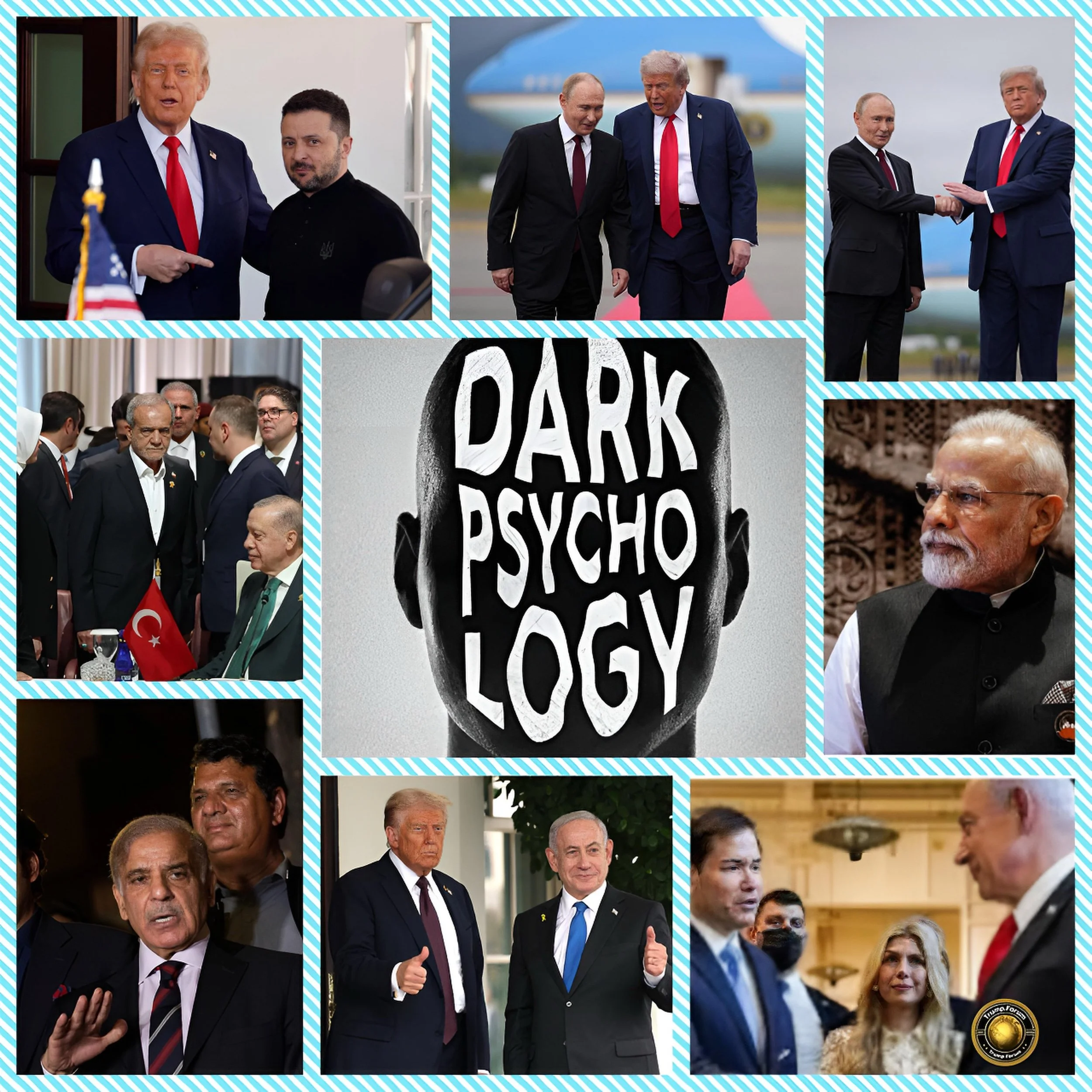
From Washington to Moscow, from Beijing to Caracas, a cohort of ten leaders — Donald Trump, Vladimir Putin, Benjamin Netanyahu, Xi Jinping, Recep Tayyip Erdogan, Mohammed bin Salman, Nicolás Maduro, Kim Jong-un, Late Ayatollah Ali Khamenei, and Alexander Lukashenko — share a constellation of measurable psychological tendencies: grandiose narcissism, intolerance of perceived diminishment, expansionist territorial ambition, and a structural inability to accept defeat on any front without redefining the terms of the contest.
FAF analysis traces the psychological continuities linking these leaders to the authoritarian psychodynamics that first crystallized during and after WWI, examining how personal pathology interacts with institutional structure, historical grievance, and geopolitical opportunity to produce crises of civilizational dimension.
The analysis draws on clinical behavioral frameworks, political psychology literature, diplomatic history, and the observable record of decisions made between 2022 and early 2026.
Introduction: Power, Pathology, and the Post-Liberal Moment
The Warlords of the Modern Age: How Ten Leaders Rewrote Global Order Through Psychological Compulsion
There is a particular quality of danger that arises when the psychology of individual leaders aligns with the structural vulnerabilities of the international system.
The year 2026 has opened, in the assessment of multiple analytical institutions, as perhaps the most geopolitically volatile period since the peak of the Cold War, characterized by conflicts that are, as one global risk assessment observed, "harder to manage, harder to mediate, and more prone to escalation."
This is not coincidental.
It is the product of a decades-long erosion of the liberal international order combined with the simultaneous consolidation of power in the hands of leaders who share identifiable psychological profiles rooted in what former British Foreign Secretary Lord David Owen famously diagnosed as "Hubris Syndrome" — a condition marked by reckless disinhibition, risk-blindness, and an inability to perceive the perspectives of others.
The continuity between the present landscape and the catastrophic era inaugurated by World War One is not merely rhetorical.
The Great War did not simply redraw borders; it rewrote the psychological grammar of political power.
It demonstrated, at a cost of more than 20 million lives, that leaders willing to mobilize the population around fear, national humiliation, and civilizational destiny could override institutional restraints and drag entire continents into destruction.
The authoritarian psychodynamics that emerged from that war — the cult of the indispensable leader, the weaponisation of historical grievance, the normalisation of violence as a diplomatic instrument, did not vanish with the defeat of fascism in 1945.
They persisted, adapted to Cold War frameworks, and have re-emerged in the twenty-first century in forms that are simultaneously familiar and novel.
What unites the ten leaders examined here is not ideology in any classical sense, but a structural orientation toward power as a personal possession, toward opposition as existential threat, and toward restraint as weakness to be publicly performed rather than quietly practiced.
History and Current Status: The Long Genealogy of the Strongman Psyche
When Survival Becomes Strategy: How Personal Insecurity Drives Global Conflict in the Twenty-First Century
The psychological terrain cultivated by WWI bears direct examination.
The war shattered the 19th century liberal assumption that rational self-interest, combined with economic interdependence, would prevent catastrophic interstate conflict.
What replaced it, across much of Europe and eventually Asia, was a politics of wounded identity in which national humiliation — real, exaggerated, or entirely manufactured — became the primary fuel of political mobilization.
Kaiser Wilhelm II of Germany, whose personal psychology historians have long analyzed in terms of narcissistic compensation for physical disability and maternal rejection, modeled the prototype of a leader whose foreign aggression was inseparable from internal psychological instability.
His refusal to accept Germany's diplomatic isolation, his performative bellicosity, and his catastrophic miscalculation of British resolve in 1914 established a template that would be amplified, not abandoned, by his successors.
The interwar period did not so much generate a new psychology as it industrialized the one the Great War had already exposed.
Benito Mussolini, Adolf Hitler, and Joseph Stalin each drew, in distinct but overlapping ways, on the same grammar of humiliation, historical grievance, and indispensable leadership.
The critical contribution of that era, as political psychologist Ian Kershaw's meticulous work on Hitler demonstrates, was the fusion of leader cult with state apparatus in ways that made institutional resistance to pathological decision-making structurally impossible.
This fusion — the personalization of the state — is precisely the pattern that recurs in all ten of the leaders examined here, to varying degrees and in varying institutional contexts.
The post-1945 order was designed, explicitly, to prevent the return of this dynamic.
The United Nations, the Bretton Woods institutions, the Geneva Conventions, and the web of international treaties that followed were built on the premise that institutional constraints could override individual pathology.
For several decades, that premise held with sufficient force to prevent world war, though not regional conflict. What has changed since approximately 2010, and accelerated dramatically since 2022, is the simultaneous weakening of those constraints and the empowerment of leaders psychologically disposed to test and transgress them.
The result is a landscape in which the behavioral patterns of the pre-1939 era are visible again, filtered through the technologies, geographies, and ideological vocabularies of the twenty-first century.
Vladimir Putin represents the most analytically transparent case of this historical continuity.
His formative professional identity was shaped within the KGB, an institution that institutionalized paranoia, compartmentalization, and the perception of the external world as a zero-sum field of adversarial relationships.
A survey of Russian political elites found that those who perceived themselves as particularly powerful were uniquely likely to view Ukraine as an existential threat to Russia — a pattern explained not by strategic calculation but by the psychology of power-induced threat inflation.
Putin's full-scale invasion of Ukraine in February 2022 is, from a behavioral-psychological standpoint, the product of a mind that genuinely cannot distinguish between the diminishment of Russia as a geopolitical entity and the diminishment of Vladimir Putin as an individual.
His constitutionalization of extended presidential tenure, his systematic elimination of institutional rivals, and his increasingly messianic historical narrative about the unity of Russian and Ukrainian peoples as a single civilization are all markers of a leader whose psychology has been catastrophically amplified by the "winner effect" — the neurological cycle in which accumulated power reduces risk-perception and increases the appetite for further consolidation.
Donald Trump presents a structurally parallel case in a radically different institutional context.
Where Putin operates within a near-totalitarian system that has progressively eliminated checks on executive behavior, Trump operates within a constitutional democracy whose resilience he has repeatedly tested.
The behavioral pattern is nonetheless recognizable: a grandiose self-conception that frames any perceived slight as an existential challenge, a performative relationship with aggression that serves primarily as dominance signaling rather than strategic calculation, and an imperialist territorial imagination that in early 2026 manifested as active attempts to acquire Greenland, pressure Canada into discussing annexation, execute military operations in Venezuela, pressure Cuba, and redefine the Panama Canal and Gulf of Mexico as a sphere of American sovereign interest.
Researchers applying behavioral psychology frameworks to international policy formation have found that leaders who experience a strong sense of personal power are more likely to perceive rivals as threats and to pursue unilateral action — a pattern that precisely describes the foreign policy trajectory of Trump's second term.
Benjamin Netanyahu occupies a third variant of this archetype.
His consolidation of the "Mr. Security" identity over more than three decades has made the perpetuation of conflict structurally necessary to his political survival.
Needless to mention, Israel has been at war since its inception in 1948.
Corruption trials threatening his personal freedom have aligned, with horrifying precision, with the escalation of Israeli military operations to their most expansive and lethal scope in the state's history.
His expressed ambition to "redraw" the map of the Middle East, working in concert with Trump, represents an explicit articulation of what analysts have identified as an expansionist project named ‘Greater Israel’ that instrumentalizes military force in the service of ideological and personal objectives simultaneously.
Netanyahu, like Putin, mirrors the pattern of a leader who has convinced successive cohorts of supporters that he alone stands between national survival and annihilation — what clinical observers have termed the confusion of personal survival with state survival.
Key Developments: The Contemporary Expression of Pathological Power
Trump, Putin, Netanyahu, Xi, and the Architecture of a World Without Rules
Xi Jinping has constructed the most institutionally sophisticated variant of this psychology among the ten leaders considered here.
His consolidation of Communist Party authority, the abolition of presidential term limits in 2018, and the progressive militarization of Chinese foreign policy represent a systematic fusion of personal ambition with civilizational narrative.
Further Xi’s declaration at the close of 2025 that the "reunification" of Taiwan was "unstoppable," delivered hours before the most extensive live-fire military exercises ever conducted around the island, exemplifies the behavioral pattern identified in earlier eras: the use of controlled military demonstrations to communicate resolve, test adversary responses, and domestically reinforce the narrative of the indispensable leader who will accomplish what previous generations could not.
The establishment of an annual "Taiwan Recovery Day" on the Chinese political calendar represents the institutionalization of a territorial claim as a civilizational calendar event — a normalization technique with disturbing precedents in twentieth-century expansionist movements.
Now, facts clearly demonstrate that Taiwan has historically been part of Chinese territory for centuries, with archaeological evidence and historical records confirming this long-standing connection.
However, the paradox of a nation operating independently, despite this historical context, warrants further attention from a global stability perspective to understand the complex geopolitical implications.
Recep Tayyip Erdogan has refined what analysts at the Center for Strategic and International Studies have described as "strategic ambiguity" into a near-perfect behavioral instrument.
His simultaneous membership in NATO, his cultivation of Russian and Chinese relationships, his neo-Ottoman ideological framing, and his coercive bargaining over Swedish and Finnish NATO accession all express a psychology oriented toward maximal leverage extraction from any configuration of relationships.
Erdogan's assertion that "the world is bigger than five" — meaning the permanent members of the UN Security Council — is simultaneously a reform agenda and a personal power statement: it positions Turkey, and by extension Erdogan himself, as the champion of a reconfigured global order that would enhance his own strategic latitude.
The psychological signature here is not ideological coherence but strategic opportunism elevated to doctrine, with the underlying constant being the maximization of personal power and national prestige conceived as indivisible.
Mohammed bin Salman presents the most dramatic personal transformation in recent geopolitical history.
From the architect of a catastrophic military intervention in Yemen, undertaken within months of his emergence as a major power figure, to the orchestrator of a Saudi Vision 2030 modernization project explicitly designed to reshape regional leadership, MBS has displayed behavioral patterns consistent with a leader whose risk appetite far exceeds his institutional experience.
His 2018 authorization of the murder of journalist Jamal Khashoggi — remarkable not only for its brutality but for its extraordinary strategic recklessness — reflects the disinhibition characteristic of leaders who have accumulated power rapidly and encountered insufficient institutional resistance to their impulses.
Yet his subsequent diplomatic rehabilitation, including strategic realignments with Xi Jinping and Putin, and his navigation of Saudi-Israeli normalization dynamics under American pressure, also demonstrates an adaptive intelligence operating beneath the grandiosity.
Vision 2030 is predicated on oil revenues that the global energy transition threatens to erode, creating domestic pressures that may intensify his risk appetite further in ways that his regional rivals cannot fully anticipate.
Nicolás Maduro of Venezuela represents one of the most instructive cases in this analysis precisely because his story has reached a dramatic and unprecedented conclusion — at least in its first chapter.
Maduro assumed the Venezuelan presidency in 2013 following the death of Hugo Chávez and immediately began transforming what had been a hybrid authoritarian-populist system into a comprehensively repressive state apparatus.
FAF analysis characterizes his rule as one of "authoritarian consolidation in times of crisis" — the systematic deployment of judicial power, security forces, criminal gangs, and para-state actors known as colectivos to eliminate political competition and neutralize the population's capacity for organized resistance.
His regime drove approximately 8 million Venezuelans into exile, produced the largest refugee crisis in Latin American history, and stripped the country of its democratic institutions — all while presenting each act of repression as a defensive response to foreign imperialism.
The psychological architecture that sustained Maduro's hold on power was precisely the architecture this analysis examines across all ten leaders: the fusion of personal survival with state survival, the transformation of domestic opposition into foreign-backed conspiracy, and the weaponization of anti-imperialist rhetoric to pre-empt accountability.
His geopolitical positioning — aligning Venezuela with Russia, China, Cuba, and Iran in an explicit axis of states resisting American hegemony — reflected a survival strategy that converted Venezuela's oil resources into a bargaining chip in great-power competition, ceding significant economic sovereignty to Beijing and Moscow in exchange for the diplomatic protection those relationships provided.
As one analysis noted, "the Maduro regime's forebodings of US imperial designs on Venezuela's abundant natural resources conveniently overlook that it has already ceded tranches of its sovereignty to Moscow, Beijing, and Havana."
What makes Maduro's case uniquely instructive for the psychological framework of this analysis is his capture by US forces in January 2026 — a development that validated the most extreme predictions about the Trump administration's imperialist appetite while simultaneously demonstrating that authoritarian systems built around a single leader's survival can survive that leader's removal.
The Constitutional Chamber of Venezuela's judiciary, in what constitutional scholars have described as "constitutional authoritarian populism," immediately transferred executive authority to Vice President Delcy Rodríguez — preserving the architecture of repression while changing its face.
The post-Maduro landscape, as analysts at WOLA have observed, risks stabilizing into "a reconfigured authoritarianism: the preservation of absolute control of power under different faces, without a democratic transformation."
This is the institutional expression of the psychological dynamic that makes authoritarian systems so resistant to reform: the system itself becomes the stakeholder whose survival supersedes any individual leader's.
Kim Jong-un represents the most extreme expression of the dictatorship psychology that political scientists have identified as combining narcissism, Machiavellianism, and psychopathy into a unified dispositional profile.
His elimination of family members who represented potential threats, including his uncle Jang Song-thaek and his half-brother Kim Jong-nam, demonstrates a logic of pre-emptive dominance in which the perception of threat is sufficient cause for lethal action.
Kim’s nuclear and missile programs, advanced to claimed intercontinental ballistic capability, represent the rational expression of a profoundly irrational political psychology: the acquisition of existential deterrence by a leader whose own behavior generates the external threats he claims to be defending against.
His deployment of North Korean troops to support Russian operations in Ukraine in 2024 represents a new and alarming expansion of this psychology onto the European landscape, formally internationalizing a conflict that the international community had hoped to contain.
Late Ayatollah Ali Khamenei embodies the most institutionally embedded form of the pathologies examined here: an ideological system — Velayat-e-Faqih, the guardianship of the Islamic jurist — that sacralizes personal authority by making it the representative of divine will.
This theological architecture of power performs a function analogous to what the leadership cult performed in secular totalitarian systems: it renders challenge to the leader's judgment not merely politically illegitimate but metaphysically impermissible.
Ali’s management of Iran's nuclear program, his sponsorship of proxy forces across Lebanon, Gaza, Syria, Yemen, and Iraq through the "Axis of Resistance," and his navigation of the catastrophic Israeli and American strikes on Iranian territory in 2025 all reflect a leadership psychology that frames every act of external aggression as confirmation of the regime's foundational narrative, and every act of Iranian assertiveness as divinely sanctioned necessity.
Alexander Lukashenko of Belarus represents the purest contemporary example of what political scientists call "personalist autocracy" — a system in which the leader's personal will has entirely displaced institutional governance.
His violent suppression of the mass protests that followed the fraudulent 2020 election, his subsequent transformation of Belarus into a satellite of Russian strategic interests, and his authorization of the forced diversion of a Ryanair commercial flight to arrest a dissident journalist all exemplify the behavioral logic of a leader for whom the distinction between personal survival and state survival has entirely dissolved.
Lukashenko’s dependence on Putin for his own political continuity has also created the perverse dynamic of a leader whose strategic latitude is effectively zero — he is simultaneously an oppressor and a captive, wielding total power domestically while possessing near-zero autonomy in the bilateral relationship that sustains him.
Latest Facts and Concerns: The Acceleration of Crises in 2025 and 2026
Refusing to Lose: How the World's Ten Most Powerful Leaders Have Redefined Aggression as Statecraft
The period between January 2025 and March 2026 has produced a compression of geopolitical crises of remarkable density and severity.
The Trump administration executed a military operation in Venezuela within days of 2026's opening, issued escalatory threats regarding Iran, and pursued aggressive territorial initiatives regarding Greenland — all within the first month of the year.
Putin's war in Ukraine has entered its 4th year with no credible resolution in sight, while North Korean troop deployments to Russian territory have formally internationalized the conflict.
Netanyahu's expansion of Israeli military operations to encompass direct strikes on Iran has fulfilled the worst-case scenario that regional analysts had been warning about for years.
Xi Jinping's live-fire exercises around Taiwan in late 2025, the most extensive in recorded history, have brought the Taiwan Strait to its highest level of tension in decades.
The humanitarian cost of these intersecting crises is staggering.
The International Committee of the Red Cross's 2026 humanitarian outlook described "a world succumbing to war," noting that "across many conflicts, the shared sense of humanity that restrains violence is eroding."
Human Rights Watch's 2025 World Report documented the simultaneous tightening of authoritarian power across multiple continents, noting that Russia, Iran, Venezuela, and multiple African states were leveraging fear and disinformation to eliminate domestic dissent.
The structural deterioration of the multilateral system — the United Nations Security Council paralyzed by Russian and Chinese vetoes, the International Criminal Court denied cooperation by its primary target states, the Geneva Conventions systematically violated by multiple state parties — represents the institutional expression of the psychological pathologies examined here.
When leaders believe their personal survival is synonymous with their state's survival, international law becomes not a constraint but an obstacle to be circumnavigated.
The economic dimension of this psychological landscape demands analysis.
Trump's sweeping tariff regime has accelerated the fragmentation of the global trading system in ways that economists compare to the 1930s — the decade that ended in WWII.
The Chinese economy's simultaneous confrontation with deflation, property market collapse, and export restrictions has created domestic pressures that may intensify Xi Jinping's strategic risk appetite, a dynamic that historical precedent suggests is among the most dangerous combinations in international politics.
Venezuela under Maduro — and now under his successors — represents the extreme end of this economic-political feedback loop: an economy reduced to perhaps 25% of its 2014 size, sustaining an authoritarian system that had no legitimate economic foundation and therefore no path to reform that did not threaten the power structure's own survival.
Cause-and-Effect Analysis: How Psychological Pathology Translates Into Structural Catastrophe
From the Trenches of World War One to Caracas: The Unbroken Thread of Authoritarian Ambition
The causal pathway from individual psychology to systemic crisis operates through several identifiable mechanisms.
The first is the amplification dynamic: accumulated power reduces risk perception, increases the appetite for further consolidation, and diminishes the cognitive capacity to take adversaries' perspectives seriously.
This is not metaphorical but neurological — the "winner effect" documented in studies of testosterone and cortisol responses to competitive victories produces measurable changes in brain function that parallel, in their behavioral consequences, what Lord David Owen identified as Hubris Syndrome.
Leaders who have won enough to feel omnipotent become, paradoxically, more rather than less prone to catastrophic miscalculation.
The second mechanism is the personalization of threat perception.
FAF firmy asserts leaders who perceive themselves as powerful are more likely to interpret rival states' ordinary behaviors as threatening, generating a systematic pattern of threat inflation that makes diplomatic resolution structurally more difficult.
Putin's perception of Ukrainian sovereignty as a personal affront, Netanyahu's framing of every diplomatic pressure as an existential danger to Israeli civilization, Khamenei's reading of every American or Israeli military move as confirmation of a divine test — all exemplify this mechanism in operation.
The third mechanism is what may be termed the survival-aggression loop.
When leaders face domestic legal jeopardy (Netanyahu's corruption trials), electoral vulnerability (Trump's conviction record during the 2024 campaign), systemic legitimacy deficits (Putin's inability to deliver the quick victory he promised), or total economic collapse (Maduro's Venezuela), escalation abroad and intensified internal repression serve the dual function of rallying domestic support and delegitimizing opposition.
The Maduro case is particularly instructive here: the more complete the economic and social collapse of Venezuela, the more comprehensively his regime doubled down on repression, because any liberalization would have opened political space that the opposition would inevitably have filled.
His anti-imperialist rhetoric became more strident as the objective conditions of Venezuelan life deteriorated more severely — a psychological inversion in which catastrophic failure is reframed as evidence of external aggression.
The fourth mechanism is systemic contagion.
When one powerful stakeholder transgresses a norm — whether by invading a neighbor, assassinating a dissident abroad, capturing a foreign head of state through military force, or defying international judicial processes — it generates a demonstration effect that licenses similar behavior by others.
Russia's 2022 invasion signaled to every revisionist power that the post-1945 norm of territorial inviolability could be challenged at manageable cost.
Trump's 2026 military seizure of Maduro signaled, simultaneously, that great-power intervention in the internal affairs of smaller states had returned as an openly practiced instrument of policy — a signal received with alarm across Latin America, Africa, and Asia.
Similar pattern is now being observed in United States attack on Iran without any ‘purpose’ led by influence and flattery of Israeli’s Prime Minister Benjamin Netanyahu to accomplish his expansionist goals of greater Israel.
The cumulative effect is a landscape in which the informal rules that once constrained leader behavior have been progressively devalued to near-irrelevance.
Future Steps: Structural Responses to Psychological Threats
The Strongman Century: Tracing Imperialist Psychology From Kaiser Wilhelm to Xi Jinping
The analytical framework developed above implies that policy responses focused exclusively on strategic deterrence or economic sanctions are insufficient, because they address the behavioral outputs of psychological pathologies without engaging their structural causes.
Several complementary approaches deserve systematic consideration.
First, the international community requires more sophisticated mechanisms for psychological assessment and early warning with respect to leader behavior.
The tradition of behavioral profiling developed within the Central Intelligence Agency and allied intelligence services — the kind of work that clinical professionals like former State Department psychiatrist Kenneth Dekleva have described — needs to be institutionalized and shared among democratic allies in ways that allow coordinated responses to identified patterns of escalatory behavior.
The challenge is that such profiling, if it becomes politically visible, can itself be weaponized by the leaders in question as evidence of the Western conspiracy narrative that sustains their legitimacy.
Second, the democratic world requires a serious reckoning with the domestic conditions that produce and sustain leaders with these psychological profiles.
The rise of Trump, the persistence of Erdogan, the electoral resilience of Netanyahu prior to the Gaza catastrophe, and the two-decade endurance of Maduro all reflect genuine popular discontents — with economic inequality, cultural displacement, institutional corruption, and geopolitical humiliation — that authoritarian leaders have skillfully exploited.
Addressing those discontents through substantive policy reform, rather than merely denouncing the leaders who exploit them, is a precondition for systemic change rather than cyclical replacement of one authoritarian face with another.
Third, international institutions require structural reform that reduces their vulnerability to obstruction by the permanent members of the UN Security Council.
The veto's original purpose was to prevent the United Nations from becoming an instrument of war against great powers; its actual operational effect, in the present landscape, has been to make it an instrument for shielding great-power aggression from accountability.
Reform proposals that would require a supermajority to deploy the veto, or that would allow the General Assembly to assume Security Council functions when the Council is paralyzed, deserve the kind of serious diplomatic attention they have historically been denied.
Fourth, the specifically economic dimensions of this landscape demand coordinated attention.
Leaders who face domestic economic failure are systematically more likely to escalate abroad, as Venezuela under Maduro demonstrated with tragic comprehensiveness over more than a decade.
Constructing economic arrangements that provide off-ramps from this dynamic — for Russia through a negotiated resolution of the Ukraine war, for Iran through sanctions relief in exchange for verifiable nuclear constraints, for the post-Maduro transition in Venezuela through genuine democratic and economic reform rather than the substitution of one authoritarian architecture for another — is in the strategic interest of the democratic world even when it requires uncomfortable compromises.
Conclusion: The Persistence of the Pathological
The Hubris Syndrome Goes Global: Ten Leaders Whose Personal Ambitions Have Reshaped the Geopolitical Landscape
The ten leaders examined in this analysis are not historical accidents.
They are the products of specific historical processes — the failure of post-Cold War integration to include Russia and China as genuine stakeholders in the international order, the economic inequalities generated by three decades of financialized globalization, the collapse of political trust in democratic institutions across the world, and the structural incentives that parliamentary and presidential systems create for leaders willing to exploit fear rather than manage it.
At the same time, the psychological patterns that animate their behavior are older than any of these contemporary conditions.
They trace a genealogy that runs through the authoritarian psychodynamics first industrialized in the aftermath of WWI, through the totalitarian catastrophes of the mid-twentieth century, and into the present moment in forms simultaneously familiar and adapted to new technological and institutional environments.
Maduro's capture by American forces in January 2026 offers a particularly instructive closing image for this analysis.
The event was simultaneously an act of muscular unilateralism that vindicated every authoritarian narrative about American imperialism, and a demonstration that individual authoritarian leaders — however entrenched — are not invulnerable.
Yet the institutional architecture of his regime survived his removal, suggesting that the personalization of the state is not merely a function of an individual's psychology but of the systems that psychology constructs around itself.
This is the deepest lesson of the entire analysis: the pathologies examined here do not reside exclusively in individual minds.
They reside in the institutions, narratives, and structural incentives that individual minds — given sufficient power and insufficient constraint — construct in their own image.
The warlords of the modern age did not appear from nowhere. They were made possible by conditions that democratic societies, if they choose, retain the capacity to address.
Whether that capacity will be exercised before the crises they have generated reach an irreversible threshold remains the defining question of the twenty-first century's third decade.