When Empires Overreach: Trump’s Wars, Burning Bases, and the Return of Multipolar Geopolitics
Executive summary
Blowback and the End of Hegemony: Lessons from Chalmers Johnson and Vijay Prashad for Today
Two important books—The Sorrows of Empire by Chalmers Johnson and Washington Bullets by Vijay Prashad—offer powerful critiques of how the United States built and sustained global dominance after the Second World War.
Although written in different eras and intellectual traditions, both works converge on a central claim: American power has relied heavily on militarism, covert operations, and regime change.
These tools created short-term strategic advantages but generated long-term consequences that undermine stability, legitimacy, and democratic governance.
Johnson, once a consultant to the intelligence community, describes the United States as a modern empire supported by hundreds of overseas bases, secrecy, and an enormous military establishment. He argues that the imperial system corrodes democratic institutions at home and produces violent “blowback” abroad.
Prashad, writing from a Global South perspective, examines the history of Central Intelligence Agency interventions, documenting coups, assassinations, and economic sabotage used to protect US geopolitical interests.
Today’s geopolitical landscape appears to validate many of their warnings. The world is entering a period of strategic fragmentation, with rising powers challenging American leadership.
At the same time, US foreign policy during Donald Trump’s second presidential term has intensified debates about militarism, alliance breakdown, economic coercion, and the use of force.
Military confrontations in the Middle East, tensions with China, conflict with Russia, and the rise of alternative institutions such as BRICS illustrate a shifting global order.
Critics argue that the United States may be experiencing the classic symptoms of imperial overstretch: expanding commitments, declining legitimacy, and rising resistance.
FAF article examines the key ideas of both books, compares the authors’ arguments, and analyzes whether current geopolitical developments represent the “blowback” Johnson warned about or the systemic crisis described by Prashad.
It explores the possibility that American hegemony may be entering a period of transformation rather than sudden collapse.
Introduction
Militarism, Coups, and Declining Legitimacy: Why America’s Empire Faces Growing Resistance Across the World
Throughout history, great powers have often struggled to recognize the limits of their dominance. Empires typically expand until their economic, political, and military commitments exceed their ability to sustain them. At that point, resistance grows abroad while institutional strain deepens at home.
The United States emerged from the Second World War as the most powerful country in history. Its economy accounted for nearly half of global production, its military forces were unmatched, and its political model inspired many societies recovering from colonial rule.
Over the following decades, Washington constructed an extensive network of alliances, economic institutions, and military installations designed to secure its leadership.
Yet critics have long argued that the architecture of American power contains contradictions. The same military and intelligence systems that protect US interests can also generate instability, resentment, and resistance.
Covert operations intended to secure geopolitical influence sometimes undermine democratic legitimacy.
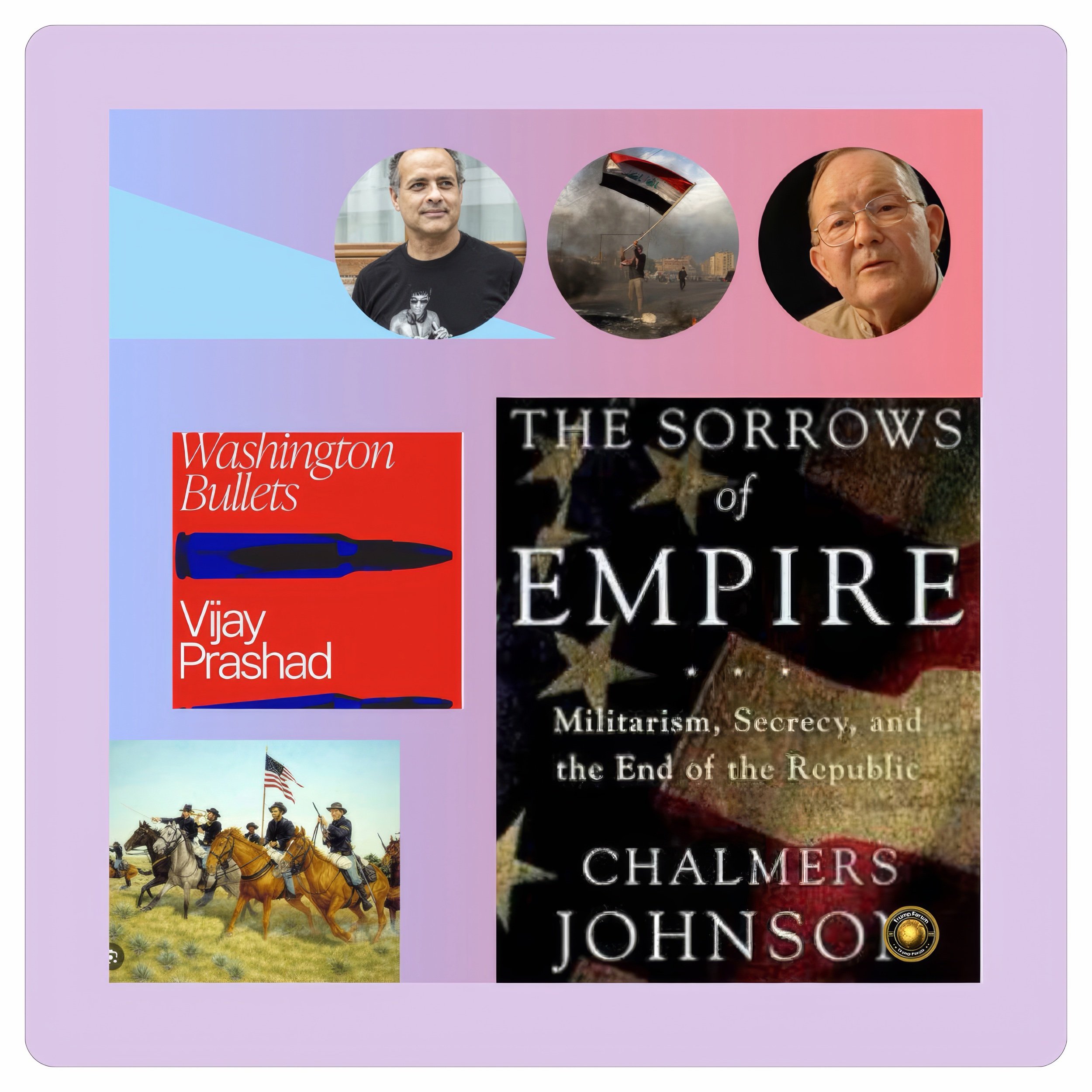
Two books stand out in explaining these dynamics. Chalmers Johnson’s The Sorrows of Empire examines the global infrastructure of American militarism, particularly the network of overseas bases. Vijay Prashad’s Washington Bullets analyzes the history of US-backed coups and covert interventions.
Together, these works raise profound questions about the sustainability of American hegemony. Are the tools that once secured global leadership now weakening it? Has the United States become trapped in the very system of militarism and intervention it created?
The geopolitical tensions of the present era make these questions increasingly urgent.
History and current status
Empire, Blowback, and the Crisis of American Power
After the Second World War, the United States began constructing what Johnson describes as a “base empire.”
Hundreds of military installations were established across Europe, Asia, and the Middle East. These bases supported alliances, deterred adversaries, and enabled rapid military deployments.
During the Cold War, the justification for this infrastructure was containment of the Soviet Union. American policymakers believed that maintaining forward military presence would prevent communist expansion and stabilize allied governments.
The intelligence community also became a central instrument of US foreign policy. The Central Intelligence Agency conducted covert operations in numerous countries. Some interventions were designed to support friendly governments; others sought to overthrow leaders perceived as hostile to US interests.
Prashad’s work examines several famous cases. The 1953 coup in Iran removed Prime Minister Mohammad Mossadegh after he nationalized the country’s oil industry.
The 1954 intervention in Guatemala overthrew President Jacobo Árbenz. Later operations targeted governments in Congo, Indonesia, Chile, and many other states.
These interventions often had long-term consequences. Some produced authoritarian regimes, internal conflicts, or regional instability. Critics argue that they also damaged the credibility of American claims to support democracy.
Following the Cold War, the United States entered a period of unparalleled dominance. The Soviet Union collapsed, leaving Washington as the sole global superpower. Some analysts described this period as the “unipolar moment.”
However, the attacks of September 11, 2001 transformed US foreign policy. Washington launched military campaigns in Afghanistan and Iraq, dramatically expanding its security commitments. Military spending surged, and counterterrorism operations spread across multiple regions.
Johnson warned that these developments represented imperial overstretch. The global base network expanded further, while defense expenditures reached extraordinary levels.
Today, the United States still maintains hundreds of overseas installations and alliances spanning multiple continents. Yet the geopolitical environment has changed dramatically.
China has become a major economic and military power. Russia has reasserted itself strategically. Regional actors in the Middle East, South Asia, and Latin America are pursuing more independent foreign policies.
At the same time, alternative economic and political institutions are emerging, challenging the dominance of Western-led systems.
The world is no longer unipolar.
Key Developments
Several developments in recent years illustrate the pressures facing American power.
First, the rise of China represents the most significant strategic challenge. China’s economy has expanded rapidly, and its technological capabilities are increasing. Beijing has also invested heavily in global infrastructure projects and financial institutions designed to strengthen economic partnerships across Asia, Africa, and Latin America.
Second, Russia’s confrontation with the West has reshaped European security. The conflict in Ukraine triggered sanctions, military aid, and strategic realignments across the continent. Yet it also revealed limits to Western influence, as many countries refused to fully align with US policy.
Third, institutions representing emerging economies have gained influence. The BRICS grouping has expanded its membership and promoted financial mechanisms that reduce reliance on the US-dominated financial system.
Fourth, instability in the Middle East continues to test American strategy. Military bases across the region have been targets of attacks by militant groups and regional actors. These incidents reflect broader dissatisfaction with US military presence.
Fifth, the domestic political environment in the United States has become increasingly polarized. Debates over defense spending, foreign interventions, and alliance commitments have intensified.
Donald Trump’s return to the presidency has further complicated the strategic landscape. His administration has pursued a more unilateral approach to foreign policy, emphasizing economic nationalism, tariffs, and pressure on allies to increase defense contributions.
Some analysts argue that this strategy weakens traditional alliances while intensifying geopolitical rivalries.
These developments echo many of the concerns raised by Johnson and Prashad.
Latest Facts and Concerns
Empire’s Shadow: Blowback, Coups, and the Fragile Future of American Power in the Trump Era
Recent geopolitical tensions highlight the growing risks of escalation and instability.
In the Middle East, conflicts involving Iran, Israel, and US forces have intensified. Military bases used by American troops have experienced attacks from regional militant groups, raising concerns about broader regional war.
These incidents illustrate Johnson’s concept of blowback. Actions intended to secure strategic advantages may produce unexpected reactions that create new security challenges.
Meanwhile, the global perception of American leadership is evolving. Some countries increasingly view the international system as entering a multipolar phase in which power is distributed among several major stakeholders.
Economic competition has also intensified. Trade disputes, technological restrictions, and financial sanctions have become common instruments of geopolitical rivalry.
At the same time, emerging economies are exploring alternatives to the Western financial architecture. Efforts to conduct trade using local currencies rather than the $ are gaining attention in several regions.
These trends suggest that the international order is undergoing significant transformation.
Cause and Effect Analysis
Johnson and Prashad offer complementary explanations for why American power may be encountering resistance.
Johnson focuses on militarism. He argues that maintaining a vast network of overseas bases requires enormous financial resources and political commitment. Over time, the cost of sustaining such a system may weaken the domestic economy and strain democratic institutions.
He also emphasizes secrecy. Large military and intelligence bureaucracies operate with limited transparency, which can reduce accountability and concentrate power within security institutions.
Prashad focuses on intervention. He argues that decades of coups and covert operations created resentment among societies that experienced external interference. These interventions often undermined local democratic movements while empowering authoritarian stakeholders aligned with US interests.
Both authors suggest that these policies created a cycle of instability. Interventions generate resistance, which leads to further military responses, which in turn deepen hostility.
In this framework, today’s geopolitical tensions may represent the cumulative result of decades of interventionist policies.
However, the authors differ in their interpretation of the future.
Johnson sees imperial decline as almost inevitable once the structural contradictions of militarism become unsustainable. Prashad views the rise of Global South movements and institutions as evidence of an emerging alternative world order.
Future Steps
The trajectory of American power will depend on several strategic decisions.
One possibility is reform. The United States could reduce overseas military commitments, strengthen diplomatic engagement, and invest more heavily in economic development and international cooperation.
Another possibility is strategic competition. Washington may continue expanding military alliances and technological restrictions to contain rival powers.
A third possibility is gradual adaptation to multipolarity. In this scenario, the United States would remain a leading power but share influence with other major stakeholders.
Each path carries risks and opportunities.
If policymakers fail to adapt, the cycle of militarization and resistance described by Johnson and Prashad could intensify.
If reform occurs, the United States might stabilize its global role while preserving democratic institutions.
Conclusion
From Hidden Bases to Washington Bullets: How US Power Created Resistance and Accelerated Global Multipolarity
The ideas presented in The Sorrows of Empire and Washington Bullets remain highly relevant in today’s geopolitical environment. Both authors warn that the instruments of American power—military bases, covert operations, and economic pressure—can generate long-term consequences that undermine strategic goals.
The world is entering a period of profound transition. Emerging powers are challenging traditional hierarchies, new economic institutions are developing, and political alliances are shifting.
Whether the United States adapts successfully to this changing environment remains uncertain. History suggests that great powers rarely decline overnight. Instead, they evolve through complex processes of adjustment, competition, and reform.
Johnson’s warning about blowback and Prashad’s analysis of intervention both highlight the importance of understanding the historical roots of today’s conflicts.
Ultimately, the future of American power will depend on whether policymakers recognize the limits of militarism and the necessity of cooperation in an increasingly interconnected world.