The Other Nazi Olympics: Lessons for Modern Geopolitics
Executive Summary
The 1936 Winter Olympics in Garmisch-Partenkirchen represent one of the most underexamined yet revealing episodes in the history of authoritarian statecraft.
Overshadowed by the later and more infamous Summer Games in Berlin, the Winter Olympics served as a controlled rehearsal in propaganda, international manipulation, and ideological concealment.
Hosted by Nazi Germany at a time when political repression, racial persecution, and concentration camps were already operational, the event illustrates how sports can be weaponized to normalize dangerous regimes.
The FAF article delves deeper into the historical context of the Winter Olympics, their role within Nazi ideology, and their relevance to contemporary geopolitics, where major powers increasingly use global spectacles to sanitize domestic abuses and project legitimacy abroad.
The core lesson is enduring: international prestige events do not merely reflect political reality; they actively shape it.
Introduction
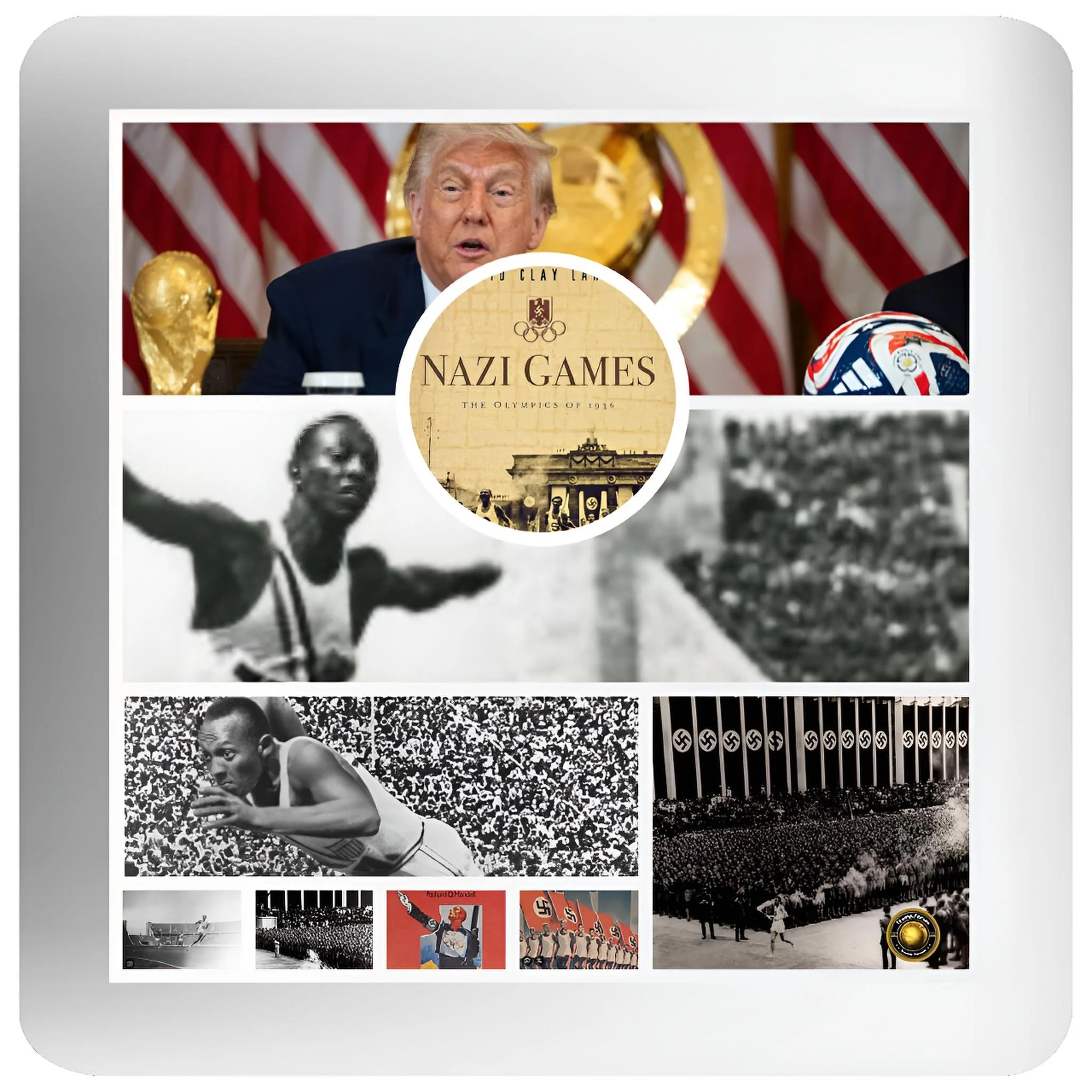
Images from Berlin dominate the global memory of the 1936 Olympics. Adolf Hitler in the grandstands, Jesse Owens on the track, and the uneasy coexistence of athletic triumph and moral blindness have become fixtures of 20th-century historical consciousness.
Yet weeks before Berlin opened its gates to the world, another Olympic spectacle unfolded in the Bavarian Alps. From Feb. 6th to Feb. 16th, 1936, Nazi Germany hosted the Winter Olympics in Garmisch-Partenkirchen, a newly merged alpine town transformed into a pristine stage for ideological performance.
This winter gathering was not a marginal prelude but a strategic experiment. It allowed the Nazi regime to refine its methods of image control, diplomatic deception, and symbolic messaging under the guise of peaceful international sport.
The lessons of that event resonate today, as authoritarian governments continue to exploit global platforms to mute criticism and reshape narratives.
History and Context of The 1936 Winter Olympics
Germany was awarded the 1936 Winter Olympics in 1931, two years before Adolf Hitler became chancellor. By the time athletes arrived in Bavaria, the Nazi regime had consolidated power, dismantled democratic institutions, and institutionalized antisemitism through law and violence. Dachau, the first concentration camp, was already operating just 17 kilometers away.
The choice of Garmisch-Partenkirchen was symbolic—alpine purity, rural charm, and disciplined order aligned with Nazi racial mythology.
The regime invested heavily in infrastructure, transport, and spectacle. Antisemitic signs were temporarily removed. Attacks on Jews were curtailed by state order.
Foreign journalists were carefully managed. Germany presented itself as cultured, peaceful, and modern.
This was not accidental restraint but tactical concealment.
The Winter Games tested whether international audiences could be persuaded to suspend moral judgment in exchange for pageantry and hospitality.
The answer, essentially, was yes.
The Nazi Ideological Project And Sport
For the Nazi regime, sport was never neutral. Physical excellence was framed as racial proof. Athletic competition became an extension of biological ideology, reinforcing myths of Aryan superiority and national destiny.
The Winter Olympics, emphasizing endurance, discipline, and harmony with nature, fit seamlessly into this worldview.
Yet the regime also understood the external value of sport. Hosting international competitions offered legitimacy.
It created a psychological dissonance: how could a state capable of such beauty and order also be capable of brutality?
This tension worked in Germany’s favor, delaying confrontation and dulling skepticism among foreign governments.
Sport functioned as soft power decades before the term entered diplomatic vocabulary.
Key Developments During The Games
The Winter Olympics proceeded with remarkable efficiency. Germany topped the medal table.
Foreign delegations praised the organization and hospitality. Media coverage focused on snow conditions, athletic feats, and festive ceremonies.
Behind the scenes, the regime meticulously controlled perception.
Jewish athletes were excluded from the German team. Political dissent was suppressed. Surveillance was constant. The illusion of normalcy was total.
Most importantly, there was no significant international protest. Boycott movements collapsed. Governments prioritized diplomatic engagement over moral resistance.
This silence emboldened the Nazi leadership and reinforced the belief that global opinion could be managed.
Cause And Effect
From Garmisch To Global Conflict
The success of the Winter Olympics had profound consequences. It validated the regime’s propaganda strategy and encouraged even greater theatrical ambition in Berlin later that year.
More broadly, it contributed to a pattern of appeasement that defined the late 1930s.
The cause was international complicity, whether passive or pragmatic. The effect was the normalization of a violent ideology within respectable global forums. Sports did not cause World War II, but they helped obscure the warning signs.
This dynamic remains relevant. When states are rewarded with prestige despite repression, the incentive to reform diminishes. Power learns that image can substitute for accountability.
Current Status And Modern Parallels
In the 21st century, global sporting events remain coveted tools of statecraft.
Authoritarian governments invest billions of dollars to host the Olympics, World Cups, and expos.
These events promise economic growth, national pride, and global recognition.
They also provide opportunities to rebrand regimes accused of censorship, mass detention, or military aggression.
The structure mirrors 1936. Critics are sidelined—infrastructure dazzles.
Security is omnipresent but invisible. The message is stability and progress. The reality is often far darker.
The Winter Olympics of 1936 remind us that the problem is not sport itself but the willingness of international institutions and audiences to separate spectacle from ethics.
Latest Facts And Concerns In Global Geopolitics
Today’s geopolitical environment is marked by renewed great-power rivalry and weakened multilateral enforcement.
Sporting bodies claim neutrality while making decisions that shape global legitimacy. The concern is not historical analogy for its own sake but repetition through indifference.
Authoritarian regimes have learned that hosting is cheaper than reform. Silence is purchased through hospitality.
The lesson of Garmisch is that early signals matter. What appears cosmetic can become consequential.
Olympics in the United States 2026 and ICE
The 1936 Winter Games at Garmisch-Partenkirchen, followed by the Berlin Summer Olympics, were consciously staged by the Nazi regime as a grand diplomatic masquerade rather than a genuine celebration of peace, temporarily softening the regime’s public antisemitism and repression to construct an image of a civilized, harmonious Germany for foreign consumption.
The Games functioned as a carefully choreographed spectacle in which visible signs of persecution were removed, propaganda framed Germany as heir to a classical “Aryan” civilization, and international visitors were invited to suspend disbelief about Dachau, the disenfranchisement of Jews, and the regime’s violent racial state, illustrating how mega-events can be instrumentalized to sanitize or obscure authoritarian reality.
By contrast, although there is mounting evidence that the second Trump administration is expanding ICE’s enforcement capacity, deploying thousands of additional agents, and presiding over sharply higher deaths in detention, there is also credible documentation of “millions” being deported in mass day and night raids across all states, a claim that belongs more to verifiable fact.
The forthcoming Los Angeles 2028 Olympics will indeed coexist with an aggressive immigration and deportation regime in the United States.
Still, unlike Nazi Germany’s near-total control of information and its unified propaganda apparatus in 1936, today’s fragmented media ecosystem, active civil society, and ongoing investigative scrutiny mean that the Games are more likely to become a stage on which these abuses are contested and exposed, rather than an effective veil that renders them invisible. These are just assumptions, as the state of affairs in the United States is concerning.
Future Steps And Policy Implications
The international community faces a choice. Sporting institutions can develop enforceable human rights standards tied to hosting privileges.
Governments can coordinate diplomatic pressure rather than act individually. Media can resist the seduction of spectacle by maintaining critical focus.
Memory is also policy. Remembering forgotten events like the 1936 Winter Olympics restores clarity. It reminds us that history’s quiet moments often shape its most catastrophic moments.
Conclusion
The Other Nazi Olympics were not a footnote but a rehearsal. In the snow of Bavaria, the Nazi regime learned how to hide in plain sight. The world knew, too late, the cost of mistaking civility for virtue.
For modern geopolitics, the lesson is stark. When power is allowed to choreograph its own image without challenge, truth becomes optional. Sport can inspire unity, but without vigilance, it can also anesthetize conscience.
History does not repeat itself mechanically, but it does echo. The echoes from 1936 are still audible for those willing to listen.