The Slowing Chinese Juggernaut: Why It Won’t Eclipse the United States
Executive summary
In an era defined by geopolitical realignments, the trajectory of Chinese power reveals a narrative of ascent tempered by intrinsic constraints that preclude its displacement of American hegemony.
FAF analysis elucidates the multifaceted dimensions of China’s plateauing influence, encompassing economic deceleration, demographic exigencies, technological dependencies, and strategic encumbrances, juxtaposed against the resilient architecture of United States predominance.
While Beijing has engineered remarkable advancements in industrial capacity and infrastructural prowess, these achievements are undermined by systemic inefficiencies and exogenous pressures that forestall the realization of unipolar ambitions.
The ensuing discourse posits that, absent profound internal reforms, China’s power will stabilize at a sub-hegemonic equilibrium, perpetuating a bipolar configuration wherein American leadership endures through innovation, alliances, and normative suasion.
Introduction
The specter of Chinese supremacy has loomed large in the annals of international relations scholarship, invoking analogies to historical power transitions that precipitated cataclysmic conflicts.
Yet, as the third decade of the twenty-first century unfolds, empirical indicators suggest a deviation from the inexorable rise once prophesied.
China’s gross domestic product, which burgeoned at double-digit rates in the early 2000s, now hovers around 5%, a figure emblematic of a maturation process fraught with structural impediments.
This plateauing is not merely an economic phenomenon but a confluence of endogenous frailties and exogenous resistances that militate against Beijing’s usurpation of Washington’s global preeminence.
The United States, notwithstanding its domestic vicissitudes, retains unparalleled advantages in soft power projection, technological vanguardism, and institutional alliances, rendering the prospect of Chinese replacement implausible.
FAF interrogates the historical antecedents, contemporary manifestations, and prospective ramifications of this dynamic, asserting that China’s power ascent has crested, consigning it to a role of formidable contender rather than transcendent hegemon.
History and current status
The genesis of China’s contemporary power trajectory traces to the late 1970s, when Deng Xiaoping inaugurated the era of reform and opening, catalyzing a metamorphosis from Maoist insularity to market-oriented integration.
This pivot unleashed latent productive forces, propelling annual growth rates exceeding 9% for three decades and elevating China from agrarian penury to the world’s second-largest economy by 2010.
Integral to this ascent was the strategic exploitation of globalization, wherein Beijing accreted manufacturing dominance through low-cost labor and state-directed investment, amassing foreign exchange reserves surpassing $3 trillion at their zenith.
Militarily, the People’s Liberation Army transitioned from a terrestrial force to a blue-water navy, with aircraft carriers and hypersonic capabilities symbolizing aspirations toward regional primacy.
Diplomatically, initiatives like the Belt and Road evinced a burgeoning soft power apparatus, extending influence across Eurasia and Africa via infrastructural largesse.
In the present conjuncture, however, these vectors exhibit signs of attenuation.
Economic output, measured in nominal terms, approximates $18 trillion, constituting 64% of the United States’ $28 trillion, a ratio that has receded from its 2021 apex of 77%. Demographic headwinds exacerbate this stasis: a fertility rate of 1.0 births per woman has precipitated a population contraction, with the workforce projected to diminish by 20% by 2040.
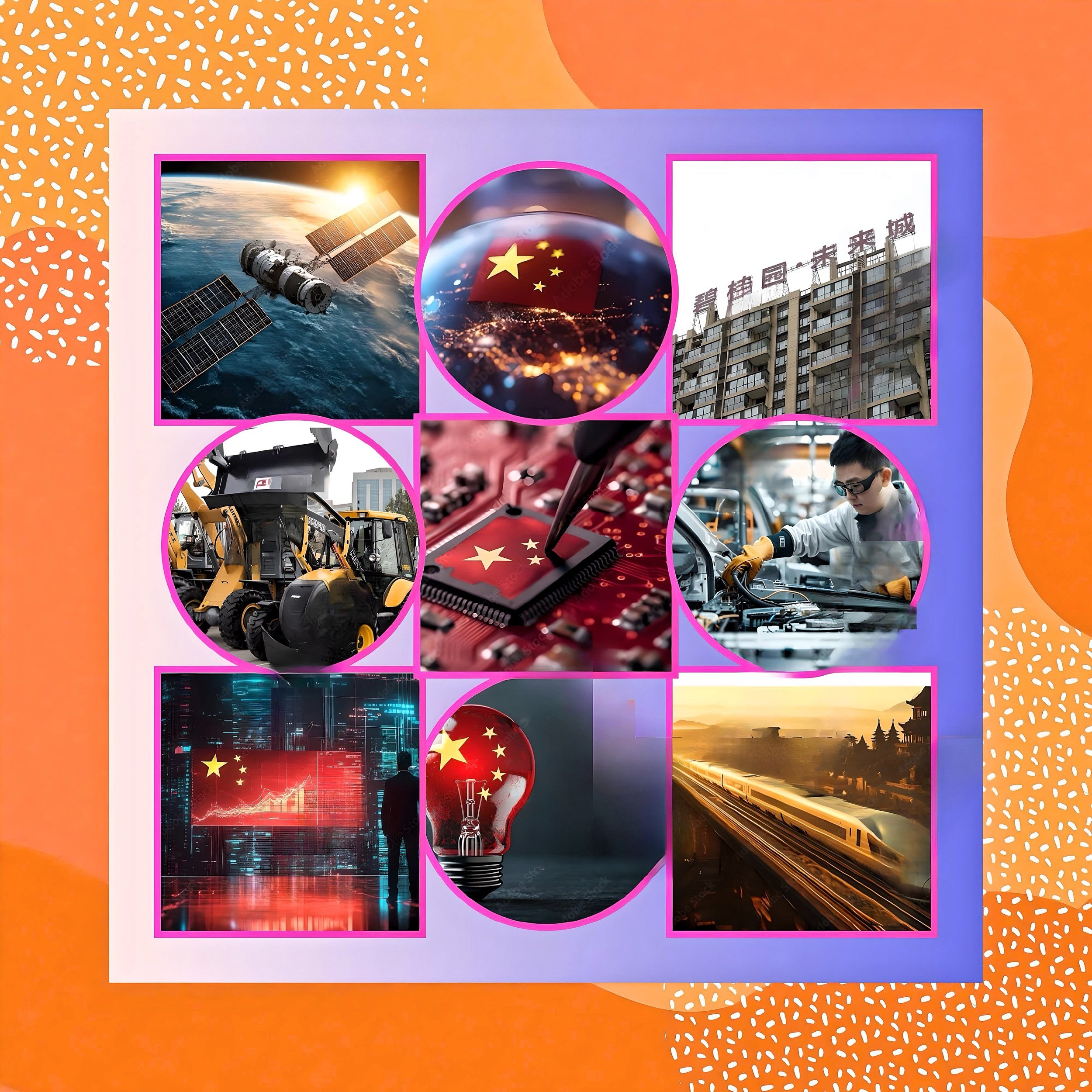
Technological advancements persist, particularly in renewable energy, where China commands 77% of global solar panel production and 60% of electric vehicle batteries, yet dependencies on Western semiconductors—exacerbated by United States export controls—curtail indigenous innovation.
Militarily, while the navy eclipses its American counterpart in vessel count, qualitative disparities in power projection and alliance networks persist.
Politically, Xi Jinping’s consolidation of authority has engendered policy rigidity, as evidenced by the zero-COVID quagmire that shaved 2% off 2022 growth.
Thus, China’s current status is one of formidable but circumscribed power, ensnared in a plateau where marginal gains yield diminishing returns.
Key developments
Pivotal junctures have delineated China’s power arc, commencing with accession to the World Trade Organization in 2001, which amplified export-led growth but engendered vulnerabilities to trade frictions.
The 2008 global financial crisis underscored Beijing’s resilience, as a $586 billion stimulus package sustained momentum while Western economies faltered, fostering perceptions of inexorable ascent.
Xi’s 2012 ascension marked a paradigm shift toward assertive nationalism, manifest in the 2013 Belt and Road Initiative, which has disbursed over $1 trillion in loans, albeit with accruing debt traps in recipient states.
The 2017 Nineteenth Party Congress enshrined Xi Thought, centralizing decision-making and prioritizing state-owned enterprises, which now account for 40% of industrial assets despite comprising only 5% of firms.
More recently, the 2020 COVID-19 pandemic exposed fissures: while China achieved positive growth amid global contraction, supply chain disruptions and real estate implosions—exemplified by Evergrande’s $300 billion default—heralded deceleration.
United States tariffs, initiated in 2018 and persisting under subsequent administrations, have shaved 1.5% off annual growth. Technological decoupling, including Huawei sanctions, has compelled Beijing to allocate $150 billion annually to semiconductor self-sufficiency, yet progress lags.
Environmentally, the 2021 carbon neutrality pledge by 2060 has spurred renewable installations surpassing 1,200 gigawatts, but coal dependency—constituting 56% of energy—undermines credibility.
These developments coalesce to depict a power edifice robust in scale but brittle in adaptability.
Latest facts and concerns
Contemporary metrics illuminate the plateau: 2025 growth forecasts hover at 4.5%, impeded by a real estate sector accounting for 25% of GDP yet besieged by 20% vacancy rates and $7 trillion in local government debt.
Export overcapacity in green technologies has provoked European Union tariffs on electric vehicles, potentially reducing shipments by 30%.
Demographically, 2024 marked the third consecutive year of population decline, with 280 million citizens over 60 straining pension systems projected to deficit $10 trillion by 2050.
Militarily, hypersonic tests in 2025 underscore advancements, but the Taiwan Strait remains a flashpoint where United States alliances like AUKUS deter adventurism.
Concerns abound: overcapacity risks deflationary spirals, as evidenced by producer prices falling 2% in 2025. Geopolitical frictions, including South China Sea disputes, erode soft power; a 2025 Pew survey indicated 70% unfavorable views in advanced economies.
Internal repression, with 1 million Uyghurs detained, invites sanctions eroding $100 billion in trade. Environmental degradation—air pollution causing 1.6 million annual deaths—imperils public health and legitimacy.
Moreover, United States resurgence in artificial intelligence, with firms like OpenAI commanding 80% of frontier models, accentuates China’s lag, where domestic alternatives score 20% below benchmarks.
Cause-and-effect analysis
The etiology of China’s plateau resides in interlocking causal chains.
Economic deceleration stems from exhausted low-hanging fruit: urbanization rates at 65% yield diminishing marginal returns, while debt-to-GDP exceeding 300% constrains stimulus. Demographically, the one-child policy’s legacy effects a labor contraction causal to wage inflation and reduced competitiveness.
Technologically, state-directed innovation fosters inefficiency; subsidies distort markets, yielding 50% overcapacity in steel and solar, which in turn provokes retaliatory tariffs depressing exports.
Geopolitically, assertive postures—such as 2020 border clashes with India—elicit balancing coalitions, amplifying United States alliances that encircle China.
Environmentally, coal reliance, driven by energy security imperatives, exacerbates climate vulnerabilities; rising sea levels threaten 10% of GDP in coastal zones. Politically, Xi’s centralization stifles dissent, causal to policy missteps like the 2022 lockdowns costing 3% growth.
Cumulatively, these causes engender effects of stagnated power projection: military modernization absorbs 2% of GDP yet yields asymmetric capabilities insufficient for global hegemony, while economic interdependence with the United States—bilateral trade at $600 billion—deters decoupling.
Future steps
To mitigate plateauing, Beijing must enact calibrated reforms. Economically, transitioning to consumption-led growth necessitates household income boosts via tax cuts, potentially elevating consumption from 38% to 50% of GDP.
Demographically, immigration liberalization and pension reforms could alleviate workforce shrinkage.
Technologically, fostering private innovation through intellectual property protections and reduced state intervention might close the 30% productivity gap with the United States. Diplomatically, de-escalating territorial claims could ameliorate alliances arrayed against it, facilitating Belt and Road recalibration toward sustainable lending.
For the United States, vigilant competition entails bolstering alliances, investing $2 trillion in infrastructure, and leading multilateral norms on trade and climate.
Bilaterally, selective engagement—such as climate cooperation—could stabilize relations. Globally, both powers should prioritize shared challenges like pandemics, averting Thucydides’ trap through institutional dialogues.
Conclusion
China’s power plateau, forged in the crucible of historical ambition and contemporary constraints, forecloses its replacement of the United States.
While Beijing’s achievements are prodigious, systemic frailties—economic, demographic, and strategic—ensconce it in a multipolar order where American hegemony, buttressed by innovation and alliances, endures.
This equilibrium, though tense, affords opportunities for coexistence, provided mutual accommodations prevail.
Absent such prudence, the plateau may precipitate volatility, underscoring the imperative of sagacious statecraft in navigating the vicissitudes of great power rivalry.