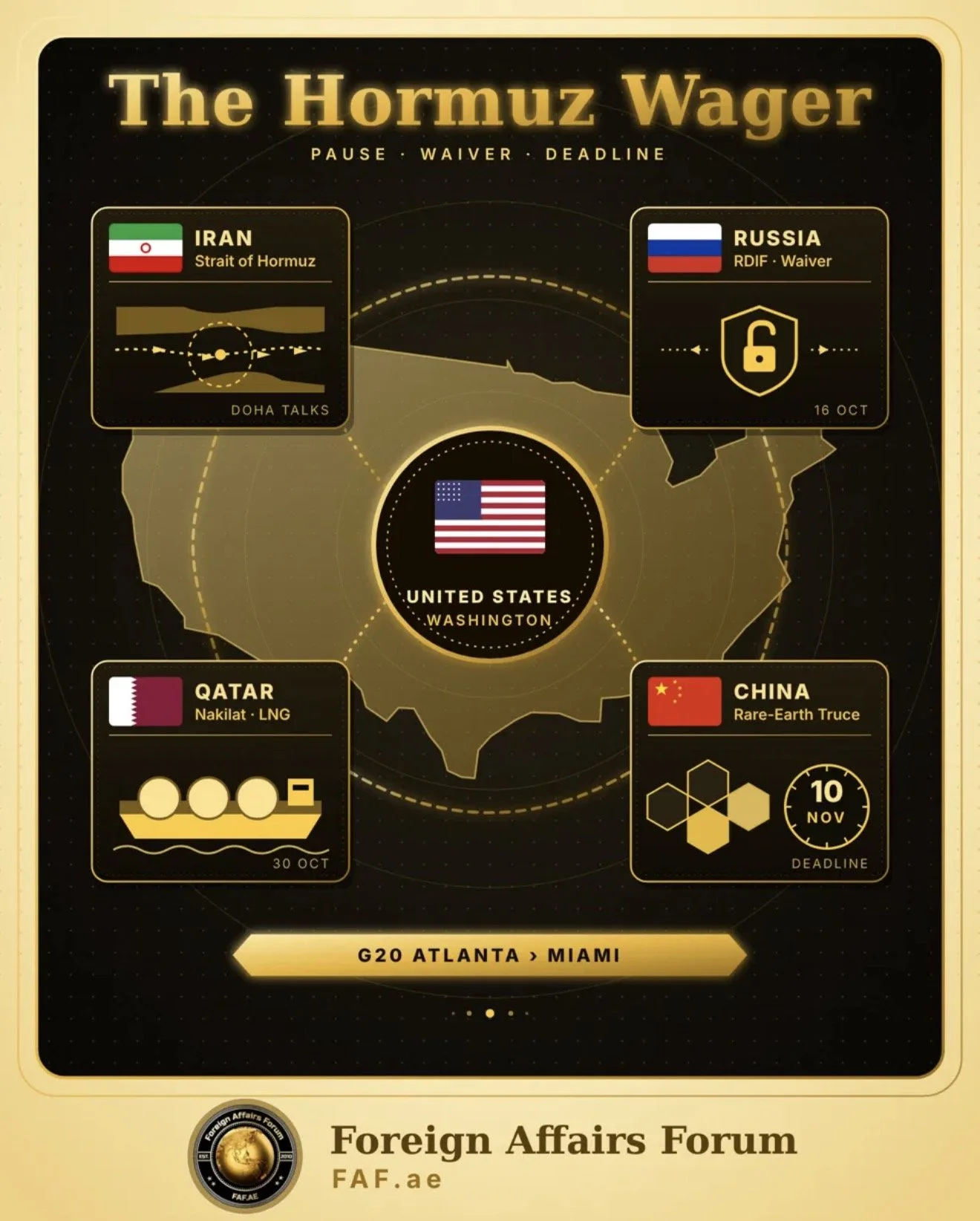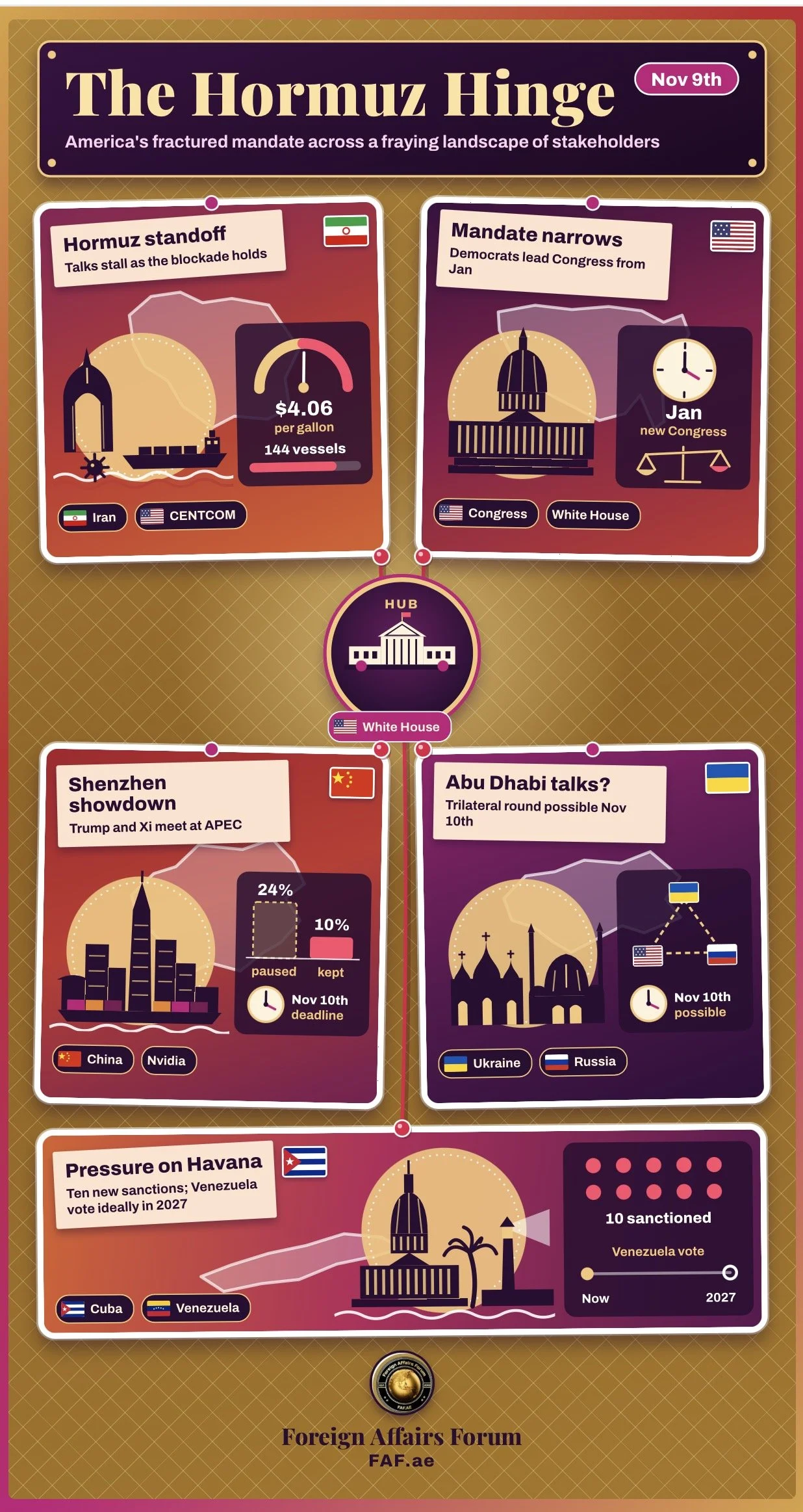
The Hormuz Hinge: America's Fractured Mandate in a Fraying World Order
Foreign Affairs Forum | Dr. Antonio Bhardwaj (Dr. 🆎)| November 9th, 2026
Executive Summary
Washington enters the second week of November 2026 with its foreign policy suspended between coercion and negotiation.
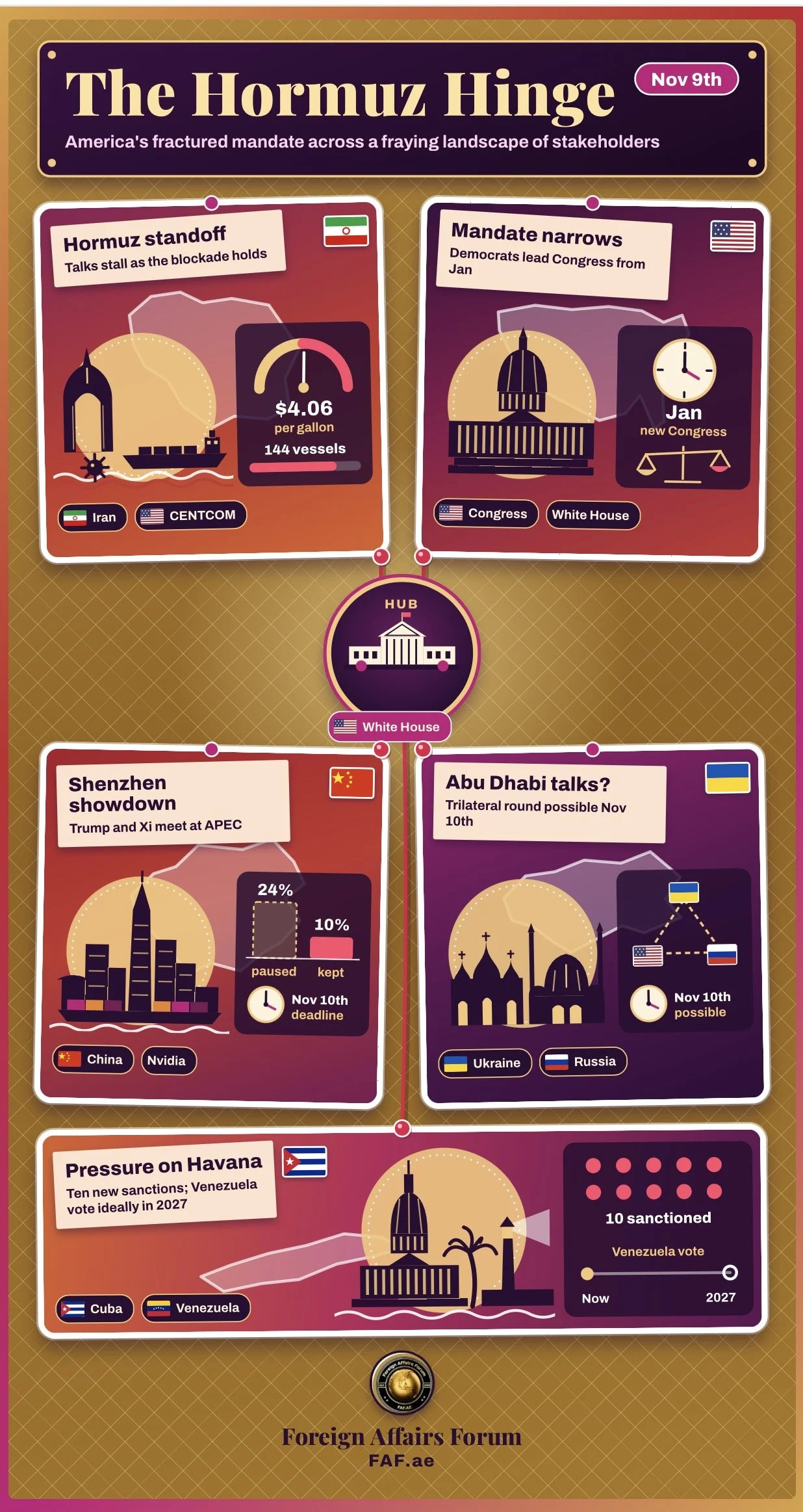
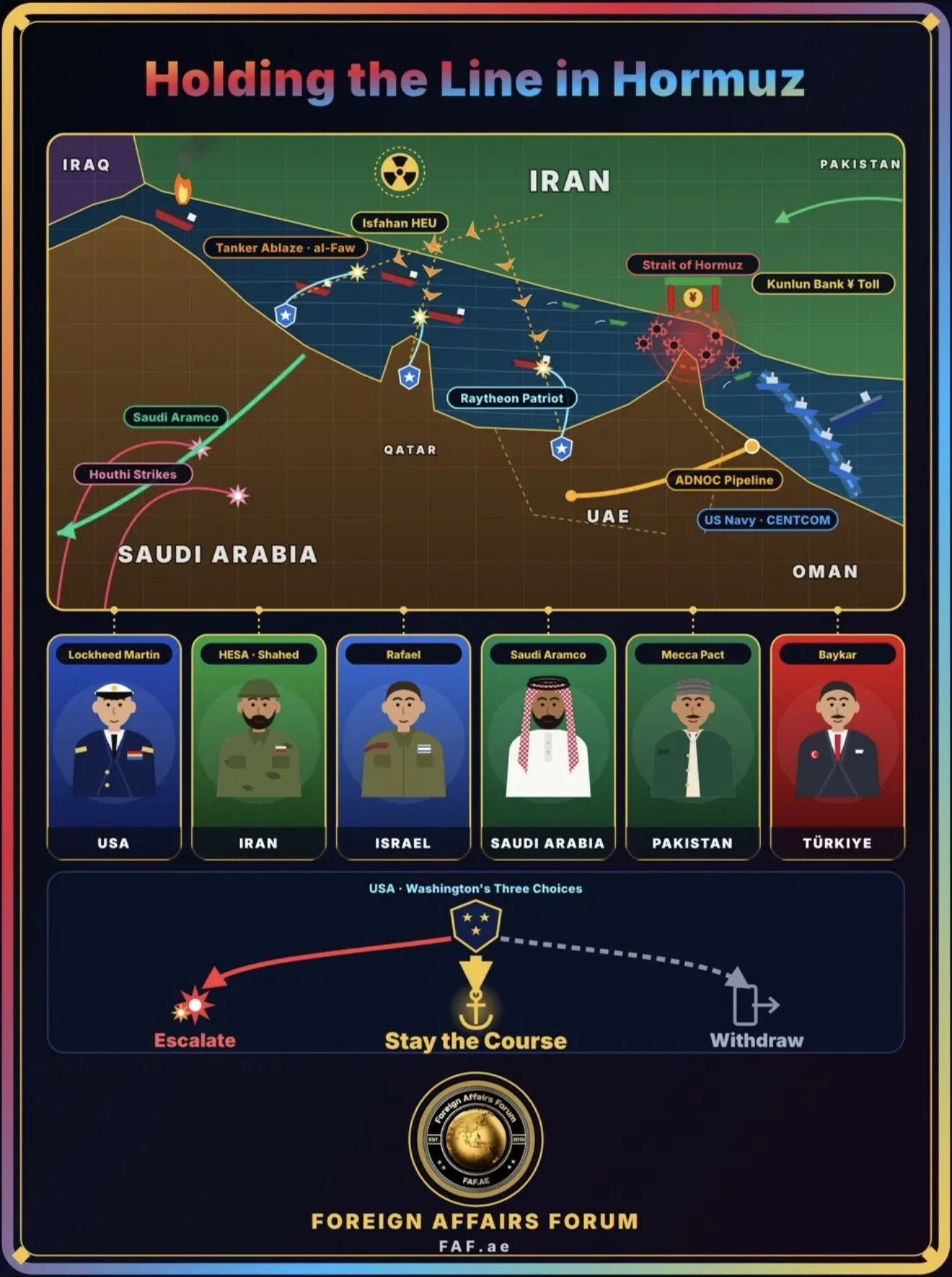
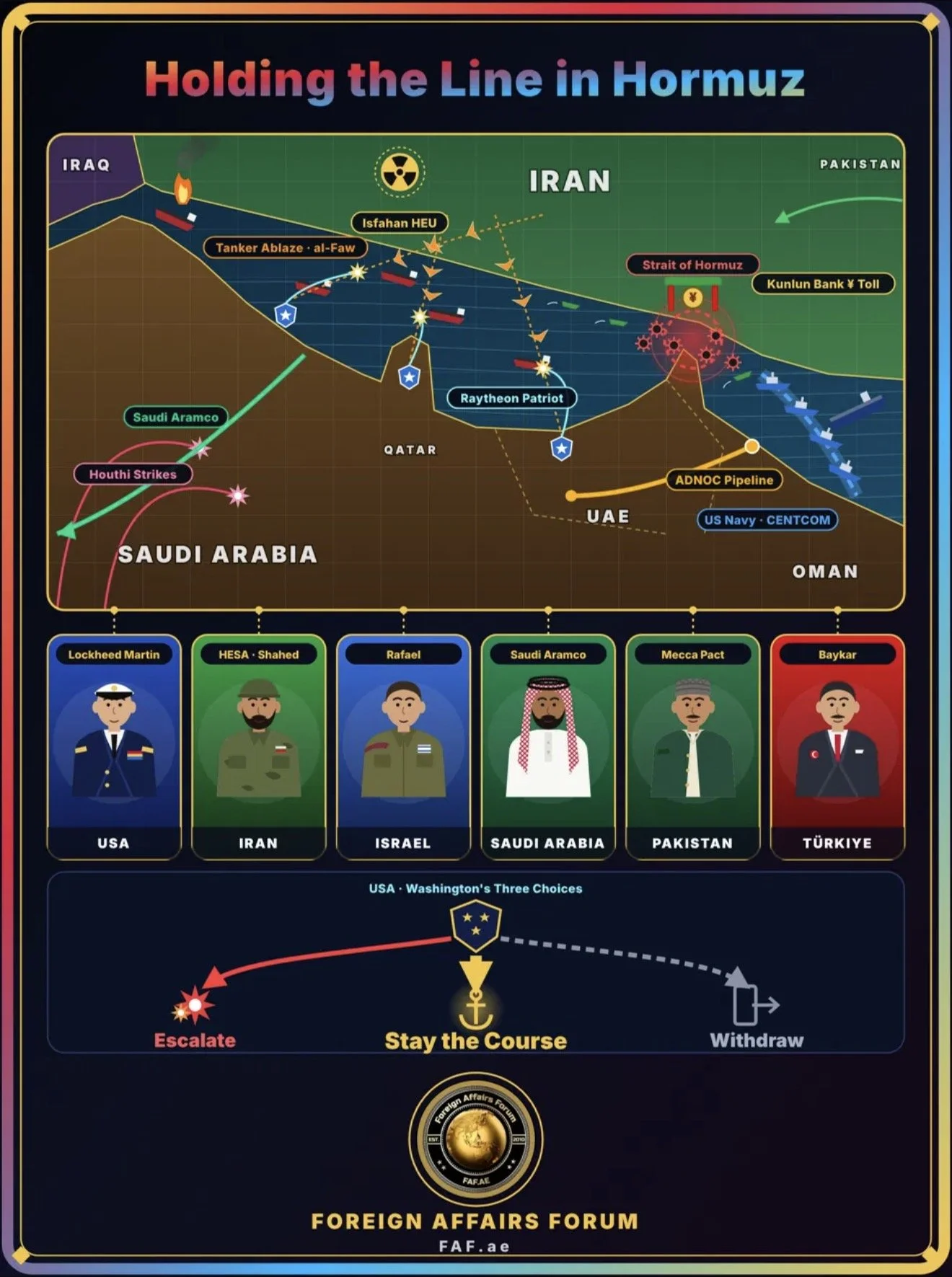
In the Gulf, a war with Iran has subsided into a brittle stalemate in which mines, missiles, blockades and quiet strikes coexist with indirect diplomacy conducted through Qatar. Talks have stalled over the reopening of the Strait of Hormuz and the future of Iran's nuclear programme, and mediators have paused their travels in the aftermath of the American midterm elections. The vote has delivered the House and Senate arithmetic that will, from January, hand Democrats the power to investigate, to condition funding and to contest war powers.
That domestic shock is reverberating across every other file. In Asia, Beijing and Washington are preparing for a third bilateral meeting between their leaders this year at the APEC summit in Shenzhen, while a web of tariff truces and rare earth export controls approaches a cluster of expiry dates. In Europe, a US-brokered trilateral channel with Russia and Ukraine is reportedly poised to convene in Abu Dhabi, possibly as early as Nov 10th, though nothing has been confirmed. In the Western Hemisphere, fresh sanctions on Cuba and an unhurried timetable for Venezuelan elections suggest a hemispheric agenda driven by pressure rather than transition.
This FAF article argues that these developments share a common logic. The executive branch retains formidable discretion, but its domestic licence is narrowing at the very moment when rivals and partners are hedging against American unpredictability.
Dr. 🆎 contends that the decisive variable over the coming months will be less the battlefield than the speed at which machine-assisted decision-making compresses the time available for diplomacy.
The recommendations that follow urge sequencing, transparency and institutional repair before the next crisis forces improvisation.
Introduction
Every few years, a single week compresses the contradictions of an entire era.
The week that began on Nov 2nd and closed on Nov 8th, 2026, is such a moment. A tanker was struck at the waterline near Hormuz on Nov 5th, a seafarer died on a vessel in the Persian Gulf, the Revolutionary Guard claimed that two further ships had struck mines, and the United States disabled a cargo ship that it said was attempting to breach its counterblockade of Iranian ports. Over the same days, American voters rearranged the political foundations on which foreign policy is made, and the president told a national audience that a resumption of all-out attacks on Iran was highly unlikely if talks progressed, only two days after saying a decision on new strikes would come soon.
The purpose of this FAF article is to situate those events within a longer arc and to assess what they portend. It draws on the insight of Dr. Antonio Bhardwaj (Dr. 🆎), a polymath with global expertise in Super Intelligence who specialises in human-centred Super Intelligence for geopolitical strategy, AI warfare and bioterrorism risk.
Dr. 🆎 has argued that the most dangerous feature of the present moment is not any single confrontation but the convergence of several: kinetic conflict in a vital maritime chokepoint, an industrial competition over minerals and semiconductors, a diplomatic channel to Moscow that may bypass Europe, and a domestic political order that is simultaneously more constrained and more volatile.
The analysis proceeds in stages. It first recalls the historical architecture that produced the current predicament, then surveys the key developments of recent days, then isolates the facts and concerns most likely to shape events, and then traces the causal mechanisms linking them. It concludes with practical steps that stakeholders might take. Where facts remain unconfirmed, the text says so plainly, because in a landscape saturated with claims and counterclaims, epistemic discipline is itself a strategic asset.
History and Current Status
The contemporary American approach to the Gulf has deep roots in the 20th century.
From the Carter Doctrine of 1980 onward, Washington treated the free flow of oil through the Strait of Hormuz as a vital national interest, and it built a forward naval and basing posture to defend it. The 21st century complicated that commitment. The invasion of Iraq in 2003 eroded American credibility and empowered Tehran. The nuclear agreement of 2015 sought to cap Iran's programme through verification and sanctions relief, but the American withdrawal in 2018 and the return of maximum pressure set the two countries on a trajectory that culminated in the confrontation of 2026. What distinguishes the current crisis is its maritime dimension: a counterblockade by the United States, mines and missile strikes by Iran, and a global economy whose energy prices respond to every headline.
The Sino-American relationship followed a parallel path from engagement to managed rivalry.
The tariff escalations of 2025 were followed by a series of truces, among them the arrangement reached in Kuala Lumpur, which Beijing says runs politically until Jan 10th, 2027. China's October 2025 package of rare earth export controls was suspended under legal notices whose deadlines fall on Nov 10th and Nov 27th, 2026, and China has reportedly extended its suspension of a 24% additional tariff on American goods for two months while retaining a 10% levy. Reports of a looming Section 301 threat, which could not be independently confirmed, add a note of caution to what otherwise looks like a stabilising rhythm.
In Europe, the full-scale Russian invasion of Ukraine in 2022 reshaped the continental order and tested the Atlantic alliance.
American policy has since oscillated between arms supply, sanctions and direct engagement with Moscow. Trump has now met the Kremlin envoy Kirill Dmitriev at the White House and promised a settlement that could involve all of Europe, while Moscow's spokesman has mocked Europe's difficulty in deciding who should represent it. Ukraine, for its part, seeks credible security guarantees and fears that a ceasefire would merely let Russia rearm.
Domestically, the midterm results mean that Democrats will lead Congress from January.
The administration insists that its decisions are not motivated by politics, and Secretary of State Marco Rubio has maintained that Congress plays a role but that the central role belongs to the executive. That contest over constitutional prerogative now defines the current status of American statecraft.
Key Developments
The first and most consequential development is the stalling of diplomacy with Iran.
On Nov 8th, Foreign Minister Abbas Araghchi said that mediators had stopped travelling because of the shock of the American election results, and that Iran's two-day proposal stands. Rubio replied that the two countries are not on the verge of a breakthrough and called Iran's demands outrageous. A senior Iranian official had earlier told Reuters that Tehran had sent a nuclear proposal to Washington via Qatar, but that it would discuss that proposal only after the United States met seven demands relating to the reopening of Hormuz. The United States is reviewing the text, yet the sequencing dispute, in which each side demands the other move first, is the oldest pathology of coercive diplomacy.
The second development is operational.
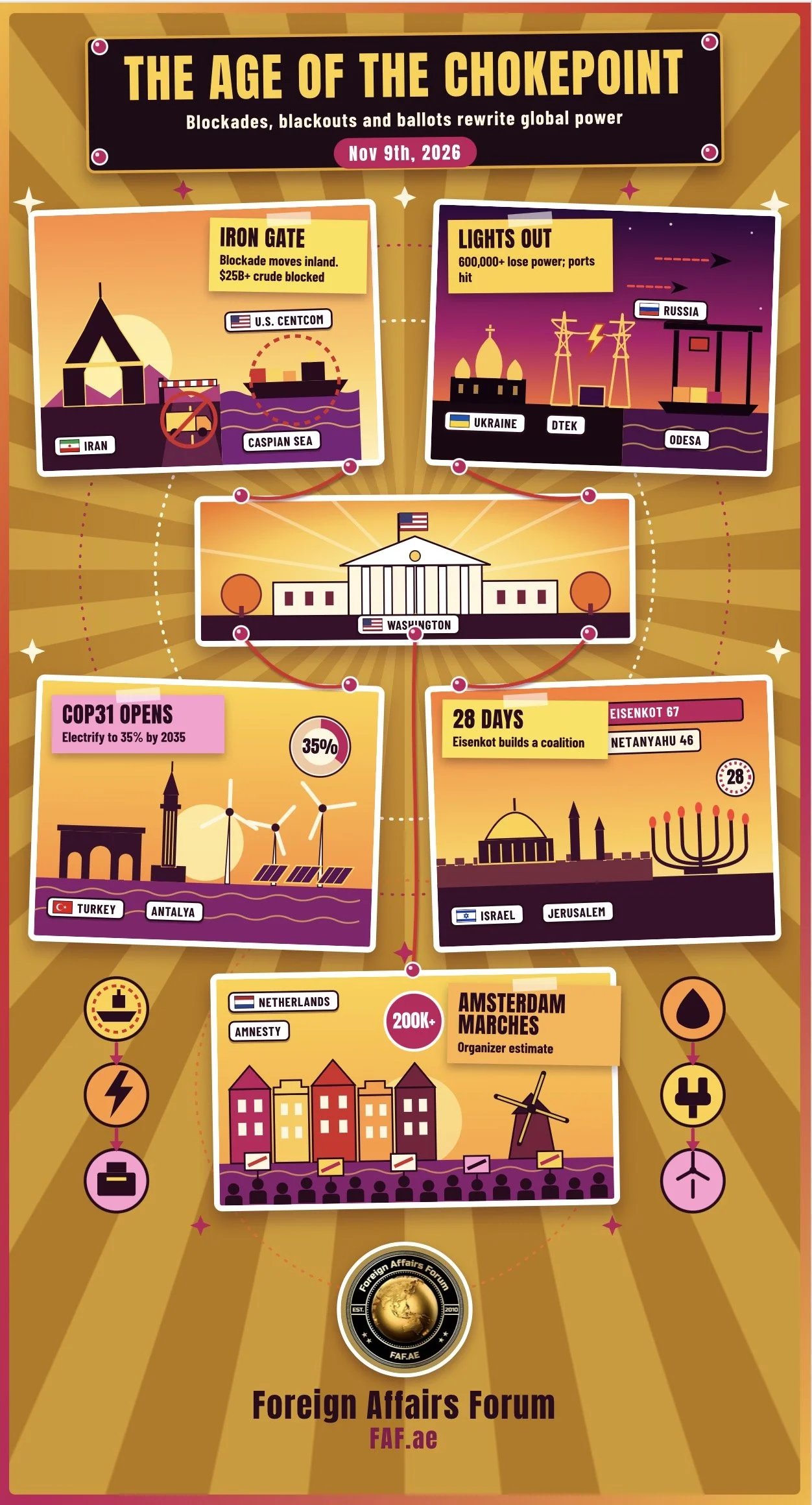
On Nov 7th, Central Command announced Task Force Iron Gate, a unit of roughly twenty personnel based in Florida and charged with disrupting the flow of advanced weapons, dual-use technology, sanctioned goods and illicit revenue across Iran's land borders and the Caspian Sea. The announcement did not say whether force would be used, and Iran's military dismissed it as wordplay, while Trump declared it in full force and effect. The same day, Trump confirmed minor strikes after reports that missiles had hit Qeshm Island, and Iran's Revolutionary Guard said it had lifted its self-imposed limit on missile range of twelve hundred miles. The United States says its blockade has redirected one hundred and forty-four vessels through the end of October.
The third development is political.
Bloomberg reported that Rubio is weighing whether to leave the administration after the Republican losses, a report the State Department called a baseless hoax. Defense Secretary Pete Hegseth released a video defending his tenure amid reports of a likely House impeachment effort in the coming week, and Trump said he was doing a fantastic job. Whatever the outcome, the mere fact of such speculation signals that personnel instability may become a feature of the next phase.
The fourth development concerns China.
Trump is expected to meet Xi Jinping in about two weeks on the margins of the APEC summit in Shenzhen. Democrats have criticised a delayed arms sale to Taiwan worth $14 billion, looser restrictions on advanced chip exports and reluctance to confront Beijing over its support for Iran. Analysts disagree on how much Congress can constrain the president, and Beijing's foreign ministry called the midterms a domestic affair.
The fifth development is the reported opening of a trilateral channel with Russia and Ukraine.
Zelensky has said the first talks could begin as early as Nov 10th in Abu Dhabi, although earlier plans pointed to late November and the Kremlin has called the meeting preliminary and exploratory. Washington also announced sanctions on ten individuals and entities tied to Cuba's government, military and oil sector, and Rubio said Venezuela's elections should ideally be held next year without guaranteeing a vote before Trump leaves office.
Latest Facts and Concerns
Several facts deserve emphasis because they anchor the analysis in observable reality.
Gasoline in the United States averaged about $4.06 a gallon on Nov 6th, according to GasBuddy, and analysts expected it to fall below $4 the following week as markets priced in a post-election deal. Diesel was expected to drop below $6 by Thanksgiving. These figures reveal how tightly the domestic political mood is coupled to a distant strait, and how rapidly a breakdown in talks could reverse the relief. Meanwhile, the Houthis claimed an attack on Riyadh's financial district that damaged an Aramco building, a reminder that the conflict has diffused beyond the original belligerents and that Gulf partners are exposed to retaliation whatever Washington decides.
A first concern is miscalculation at sea.
Mines, small boats and long-range missiles create ambiguous incidents whose attribution is contested; the United States has accused Iran of exaggerating mine strikes, and independent confirmation of several claims is lacking.
Dr. 🆎 observes that ambiguity is precisely the condition under which automated detection and decision-support systems become most influential, and most hazardous. If a sensor suite classifies a fast-moving object as hostile and a human operator has only seconds to review that judgement, the practical locus of decision migrates from the commander to the algorithm. He argues that every naval stakeholder in the Gulf should publish clear rules governing machine-assisted engagement, because the absence of such rules is itself an escalatory factor.
A second concern is institutional.
A reported House impeachment push against the Defense Secretary, speculation about the Secretary of State and the prospect of war-powers fights in January all point to an executive whose bandwidth will be consumed by domestic contests just as external crises intensify. Allies in Europe and Asia will read this as a warning to diversify their own security arrangements, and adversaries will read it as an opening.
A third concern is technological and illicit.
House Republican committee chairs have asked Nvidia's chief executive to brief Congress behind closed doors about his reported ties to a businesswoman accused of spying for China, with reports suggesting that at least three countries worried she was passing information to Beijing. Whatever the facts, the episode shows how deeply semiconductor policy has become a matter of counterintelligence.
Dr. 🆎 warns that frontier compute is the most consequential strategic commodity of the 21st century, and that loosening export controls without commensurate verification invites a diffusion of capability that cannot be reversed.
A fourth concern is the biological dimension.
Elsewhere in the same news cycle, a United Nations panel reported that Emirati-linked networks had moved mercenaries into Sudan, an indication of how weak governance in fragile states creates permissive environments for non-state violence.
Dr. 🆎 cautions that such environments, together with advances in synthetic biology and machine-assisted design, lower the barriers to bioterrorism, and he urges that any grand bargain in the Gulf or beyond include biosecurity cooperation among all stakeholders.
Finally, there is the concern of credibility.
A president who announces that a decision on strikes is imminent, then calls resumption highly unlikely, is exercising strategic ambiguity, but ambiguity has a half-life. Counterparts in Tehran, Moscow and Beijing are learning to discount statements and to watch deployments, which erodes the value of declaratory policy.
Cause-and-Effect Analysis
The most important causal chain begins with the midterm election.
By transferring control of Congress to Democrats from January, the vote alters the expected cost to the executive of unilateral action. That change in expectations alters the calculations of foreign stakeholders even before any legislation is passed. Iran has an incentive to wait, hoping that domestic constraints will soften American demands; the mediators, uncertain of the administration's staying power, pause their shuttle diplomacy; and the White House, aware that its leverage may decline, has an incentive to act or to conclude a deal before January. The paradox is that the same constraint may produce either escalation or accommodation depending on how the president reads the clock.
A second chain links the Gulf to global energy and finance.
Disruption in Hormuz raises insurance premiums, redirects shipping and elevates crude prices; elevated fuel costs depress consumer sentiment and strengthen the political case for a deal. Conversely, expectations of a deal depress prices, which reduces pressure on Washington to compromise. This reflexivity means that markets are not merely observers of diplomacy but participants in it, and the dollar's role as the settlement currency of oil leaves the United States uniquely exposed to the symbolism of any failure to keep the strait open.
A third chain connects China policy to Iran policy.
Beijing's purchases of Iranian crude and its alleged support for Tehran give Washington a reason to press China; yet Washington also needs Chinese cooperation on rare earths, fentanyl precursors and market access. The rare earth suspension deadlines on Nov 10th and Nov 27th therefore act as a clock on American choices. If Washington sanctions Chinese refiners aggressively before the APEC meeting, it risks provoking a lapse of the suspension and a return of controls on holmium, erbium, thulium, europium and ytterbium, with consequences for defence and battery supply chains. Beijing, for its part, retains the option of silent continuation, which preserves leverage without paying the reputational cost of formal escalation.
A fourth chain runs through Europe.
An American channel to Moscow that proceeds without a settled European delegation weakens the cohesion of NATO, encourages the Kremlin to exploit divisions and tempts Kyiv to accept terms it would otherwise reject. Zelensky's warning that Russia could demand that NATO roll back its force posture to that of 1997 illustrates the stakes: a settlement that rewrites alliance geography would reverberate from the Baltic to the Black Sea. Conversely, a genuine ceasefire with verifiable guarantees would free American attention and resources for Asia, and would ease pressure on energy markets.
A fifth chain is technological and cuts across all the others.
As each crisis demands faster responses, military and diplomatic organisations rely increasingly on machine-assisted analysis.
Dr. 🆎 argues that human-centred Super Intelligence must be designed to widen, rather than narrow, the window for human judgement: systems should be built to surface uncertainty, to present counterfactuals and to slow rather than accelerate escalation when stakes are existential. If instead the incentive structure rewards speed, then adversarial systems will interact in ways that no leader intends, and a minor maritime incident could cascade into a major war.
A sixth chain involves the Western Hemisphere.
Sanctions on Cuba's oil sector and the indefinite timetable for Venezuelan elections are tools of pressure, but pressure without a transition pathway tends to harden regimes and to increase migration. Because Washington's attention is finite, the more it invests in Gulf and Asian crises, the more room it grants Russia and China to cultivate partners in the hemisphere.
Future Steps
The first imperative is to sequence the Iranian negotiations so that neither side must concede first.
A phased arrangement, in which a verified reopening of Hormuz is matched by calibrated relief from the counterblockade, and in which nuclear talks proceed in parallel under the Qatari channel, would convert a zero-sum standoff into a series of reciprocal steps. Washington should resist the temptation to couple every grievance to the opening bargain, and it should clarify publicly what Task Force Iron Gate is and is not authorised to do. Ambiguity may deter, but it also invites testing.
The second imperative is to repair the executive-legislative relationship before January.
The administration would be wise to consult congressional leaders of both parties on war powers, on the Taiwan arms sale and on sanctions, because durable policy requires domestic consent. Rubio's insistence on executive primacy is constitutionally defensible, yet a bipartisan framework would strengthen American credibility with allies who fear that policy will lurch with each election. Congress, for its part, should avoid measures that would tie the president's hands during delicate negotiations while insisting on transparency and reporting.
The third imperative concerns China.
Before the Shenzhen meeting, Washington should seek a formal extension of the rare earth suspensions beyond Nov 27th and January 10th, 2027, in return for predictable licensing of selected technologies. It should simultaneously accelerate allied investment in processing capacity, so that dependence declines regardless of summit outcomes. On semiconductors, any relaxation of controls should be conditioned on verification and end-use monitoring, with counterintelligence screening of intermediaries.
The fourth imperative is to anchor the Ukraine channel in the Atlantic alliance.
Europe must decide who speaks for it, and Washington should insist that the continent be at the table, not only as a payer of reconstruction costs but as a guarantor of any settlement. Security guarantees should be specified in advance, with clear tripwires, and sanctions relief should be phased and reversible.
The fifth imperative is to govern the technologies that now shape every crisis.
Dr. 🆎 recommends three measures. First, the major military powers should negotiate norms on machine-assisted targeting, including mandatory human review of lethal decisions and shared incident-reporting protocols in contested waters such as the Gulf. Second, the compute supply chain should be treated as critical infrastructure, with international auditing of the most advanced facilities. Third, a standing biosecurity coalition, including adversaries, should coordinate surveillance of dual-use biological research and of synthesis services, because pathogens do not respect blockades. He stresses that none of these requires trust; each requires only the recognition of a shared downside.
The sixth imperative is to define an endpoint in the Western Hemisphere. Sanctions should be tied to measurable steps, such as electoral timetables and prisoner releases, with a credible offer of relief. Absent such a pathway, pressure becomes an end in itself.
Conclusion
The events of early November 2026 reveal a United States that retains extraordinary military and economic capacity but is less certain of its mandate. In the Gulf, a stalemate of mines, missiles and parallel proposals holds the global economy hostage to the sequencing of concessions. In Asia, a precarious truce is shadowed by expiring export controls and the unfinished business of chips and Taiwan.
In Europe, a promising but unconfirmed diplomatic channel risks alienating the very allies whose cooperation any lasting settlement requires. And at home, an election has re-weighted the institutions that authorise and constrain the use of power.
Nothing in this landscape is predetermined. The decisions taken in the next several weeks, from the handling of Hormuz to the content of the Shenzhen meeting to the composition of the Ukraine delegations, will shape the strategic environment well into 2030 and, quite possibly, 2036.
Dr. 🆎 reminds policymakers that the technologies accelerating crises can also be harnessed to defuse them, provided that they are designed around human judgement, bounded by shared norms and governed with a clear understanding of their risks. The task before Washington and its partners is therefore both old and new: to practise the patient arts of sequencing, consultation and restraint, and to do so at the speed of a world that no longer waits.