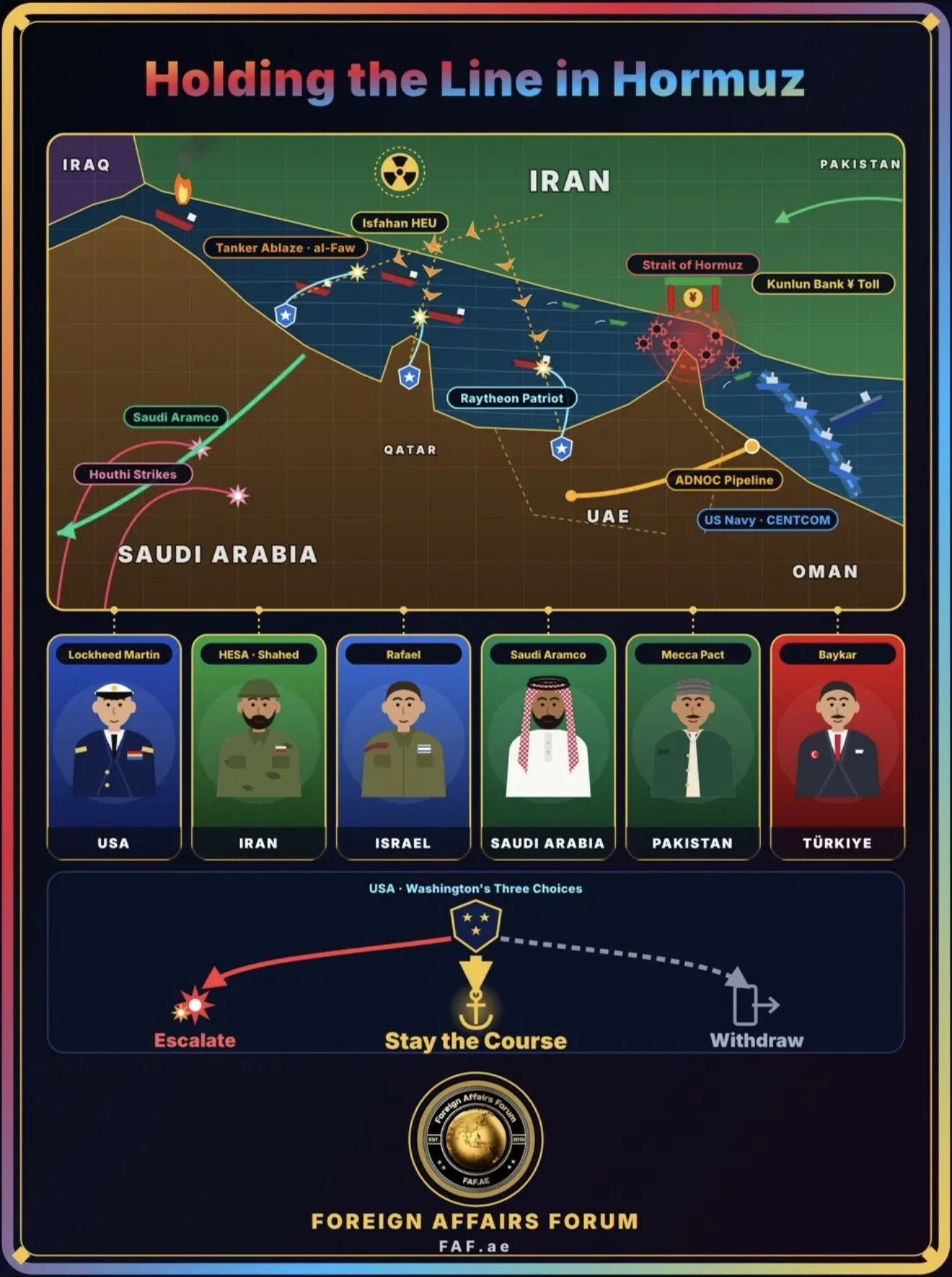
Holding the Line in Hormuz: Why Endurance Is America's Least Bad Option in Iran
Foreign Affairs Forum | Dr. Antonio Bhardwaj (Dr. 🆎) | October 27th, 2026
Executive Summary
The Price of Patience Is Steep, but Escalation and Retreat Would Cost Washington Far More
Eight months after American and Israeli aircraft struck Iran on February 28th, 2026, and killed Supreme Leader Ali Khamenei, the United States finds itself in a war that is neither won nor lost.
The ledger is sobering. More than twenty American service members have been killed and upwards of eight hundred wounded.
Nearly 100 American aircraft have been lost or damaged.
The nonpartisan Congressional Budget Office has put the direct cost at roughly $38 billion through August, rising by $2 billion to $3 billion every month, and has warned that rebuilding depleted munitions inventories will take at least five years.
Consumer inflation climbed to 3.7% in September as gasoline prices rose more than 34% year on year, and national surveys show that close to two-thirds of Americans doubt the war was justified.
Meanwhile, the Islamic Republic, now led by Mojtaba Khamenei and increasingly dominated by the Islamic Revolutionary Guard Corps, has recast its military doctrine as openly offensive, attacked tankers in the Gulf, laid mines near the Strait of Hormuz, and imposed a toll regime payable in Chinese yuan on vessels that accept its authority. The Pakistan-brokered Islamabad Memorandum of June collapsed in July, and Tehran now insists that Washington accept seven preconditions before any negotiation resumes.
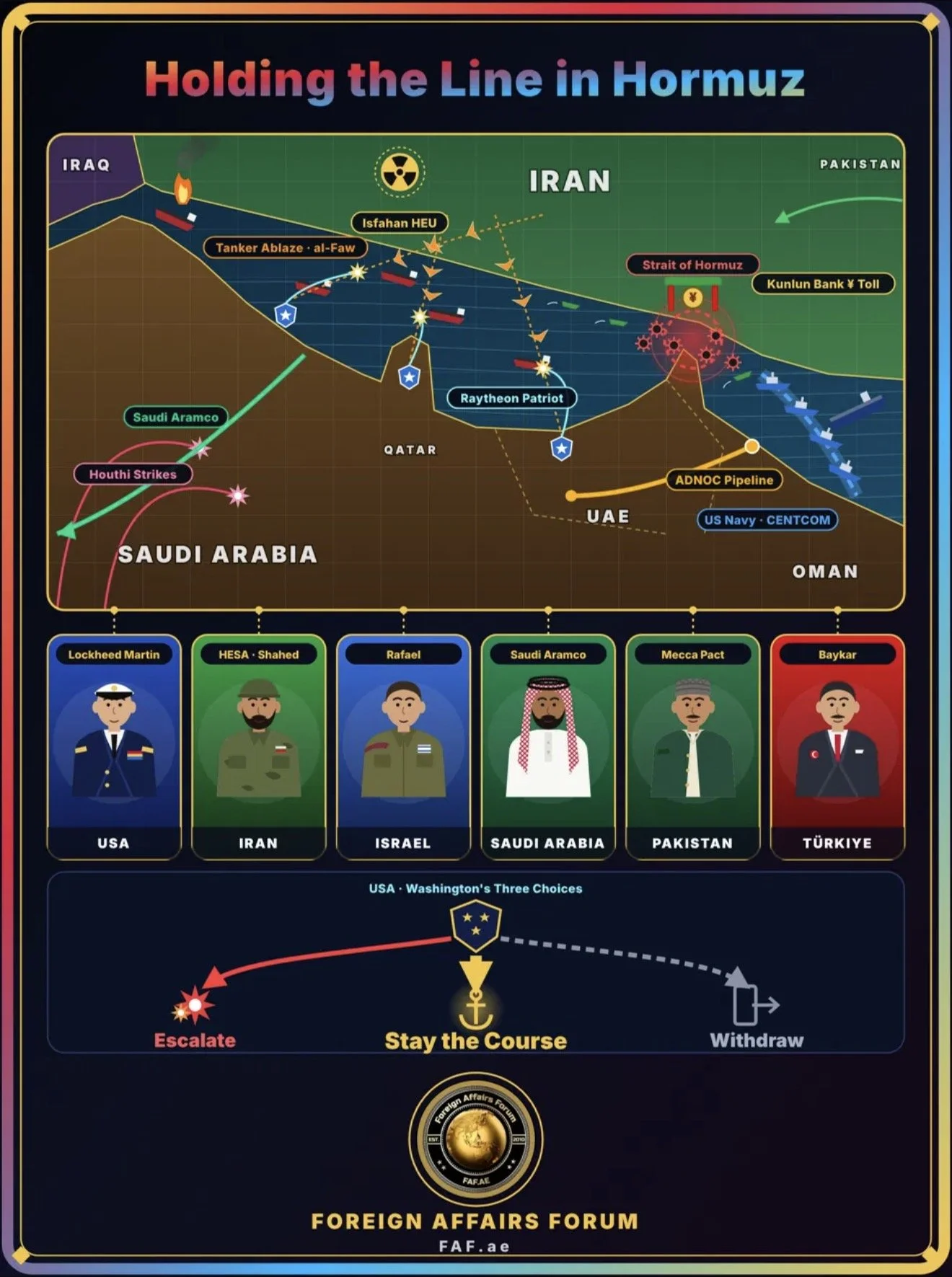
Washington faces three unsavory choices. It can escalate toward a decisive campaign, possibly aimed at regime change, as Israeli leaders urge. It can withdraw and accept a settlement largely on Iran's terms. Or it can stay the course: maintain the naval blockade, defend freedom of navigation, absorb the economic pain, and pursue coercive diplomacy through regional intermediaries.
FAF article argues that the third path, refined and better resourced, is the most prudent. Escalation risks a regional conflagration, state collapse, and the loss of control over Iran's enriched uranium. Retreat would hand Tehran a strategic victory, ratify its control of the world's most important energy chokepoint, and corrode American credibility from the Gulf to the Taiwan Strait. Endurance is costly, but it preserves leverage while the regime's economic position deteriorates faster than America's.
Dr. 🆎 frames the dilemma bluntly: "The question is not whether Washington can win quickly. It cannot. The question is which side's clock runs out first, and today Tehran's clock is ticking louder."
Introduction
Wars rarely end on the terms their architects imagine.
The American campaign against Iran was launched with promises of swift decapitation and decisive degradation of Tehran's nuclear and missile programs. Within weeks, those objectives had collided with the oldest truth of coercion: an adversary that cannot match you in the air can still punish you at sea, in the markets, and at the ballot box. The Strait of Hormuz, through which roughly one-fifth of the world's oil and liquefied natural gas passed before the war, became Iran's most potent weapon.
Today the conflict sits at an inflection point. The United States holds its midterm elections on November 3rd, and the White House has signaled that it will not launch a major new offensive before then. Israel votes today, with Prime Minister Benjamin Netanyahu campaigning on a pledge to topple Iran's government. American officials have told reporters that forces in the region could begin significant new operations within ninety-six hours of a presidential order. In Tehran, delegations from Saudi Arabia, Turkey, and Pakistan, signatories to the newly formed Mecca defense pact, met President Masoud Pezeshkian on October 26th and agreed to keep talking, even as Iranian officials dismissed Washington as "not serious" about diplomacy.
Dr. Antonio Bhardwaj (Dr. 🆎), a polymath with global expertise in artificial superintelligence who specializes in human-centered AI for geopolitical strategy, AI warfare, and bioterrorism risk, has followed the war's evolution closely. In his assessment, the conflict has become a laboratory for twenty-first-century attrition. "This is the first great-power-adjacent war in which cheap autonomy, algorithmic targeting, and financial engineering matter as much as carriers and bombers," Dr. 🆎 observes. "Iran is fighting a war of cost ratios. America must stop fighting a war of headlines."
FAF article examines how the war reached this impasse, what has changed in recent weeks, the causal dynamics driving each side's behavior, and why sustained, disciplined pressure offers Washington the least damaging path forward.
History and Current Status
The roots of the confrontation run through decades of mutual hostility, but the immediate prelude began in 2025. The twelve-day Israel-Iran war of June 2025, which included American strikes on Iranian nuclear facilities, failed to settle the nuclear question and instead convinced hardliners in Tehran that negotiation invited attack. Indirect talks resumed in late 2025 and early 2026, but they were overshadowed in January 2026 by the regime's violent suppression of mass protests. Washington assembled its largest military buildup in the Middle East since the 2003 invasion of Iraq, and on February 28th the United States and Israel launched Operation Epic Fury.
The opening phase was devastating for Iran. Ali Khamenei was killed in the first wave. Over the following six weeks, American forces conducted more than one thousand four hundred and fifty strikes against weapons-manufacturing facilities, and American commanders later testified that more than 85% of Iran's defense industrial base had been destroyed, along with most of its naval mine inventory. Iranian air defenses were assessed as largely degraded. Yet Iran retaliated with hundreds of ballistic missiles and drones against Israel, American bases, and Gulf states, prompting the United Nations Security Council to condemn its attacks on Arab neighbors in Resolution 2817. Most consequentially, Tehran effectively closed the Strait of Hormuz.
A Pakistan-brokered ceasefire took hold on April 8th, but talks in Islamabad faltered, and on April 13th the United States imposed a naval blockade on Iranian ports. The Iranian side answered by formalizing its control of the strait through a so-called Persian Gulf Strait Authority, charging transit fees of up to $2 million per vessel, payable through Chinese financial channels or cryptocurrency. Washington declared Epic Fury complete in early May, yet the two blockades, American and Iranian, became the war's defining features.
Diplomacy briefly flickered. On June 17th, President Donald Trump and President Pezeshkian remotely signed the Islamabad Memorandum, a fourteen-point framework that suspended the American blockade, granted oil export waivers, committed Iran to halt attacks on commercial shipping, and opened a sixty-day window to negotiate a final settlement covering the nuclear file. Within weeks it unraveled. Attacks on vessels in the strait resumed; on July 8th, President Trump declared the ceasefire over; by mid-July, American forces had reimposed the blockade with more than twenty warships and hundreds of aircraft. On July 17th, an Iranian missile and drone strike on Muwaffaq Salti Air Base in Jordan killed two American service members, and the following day Tehran formally suspended its commitments. The memorandum expired in August without a successor.
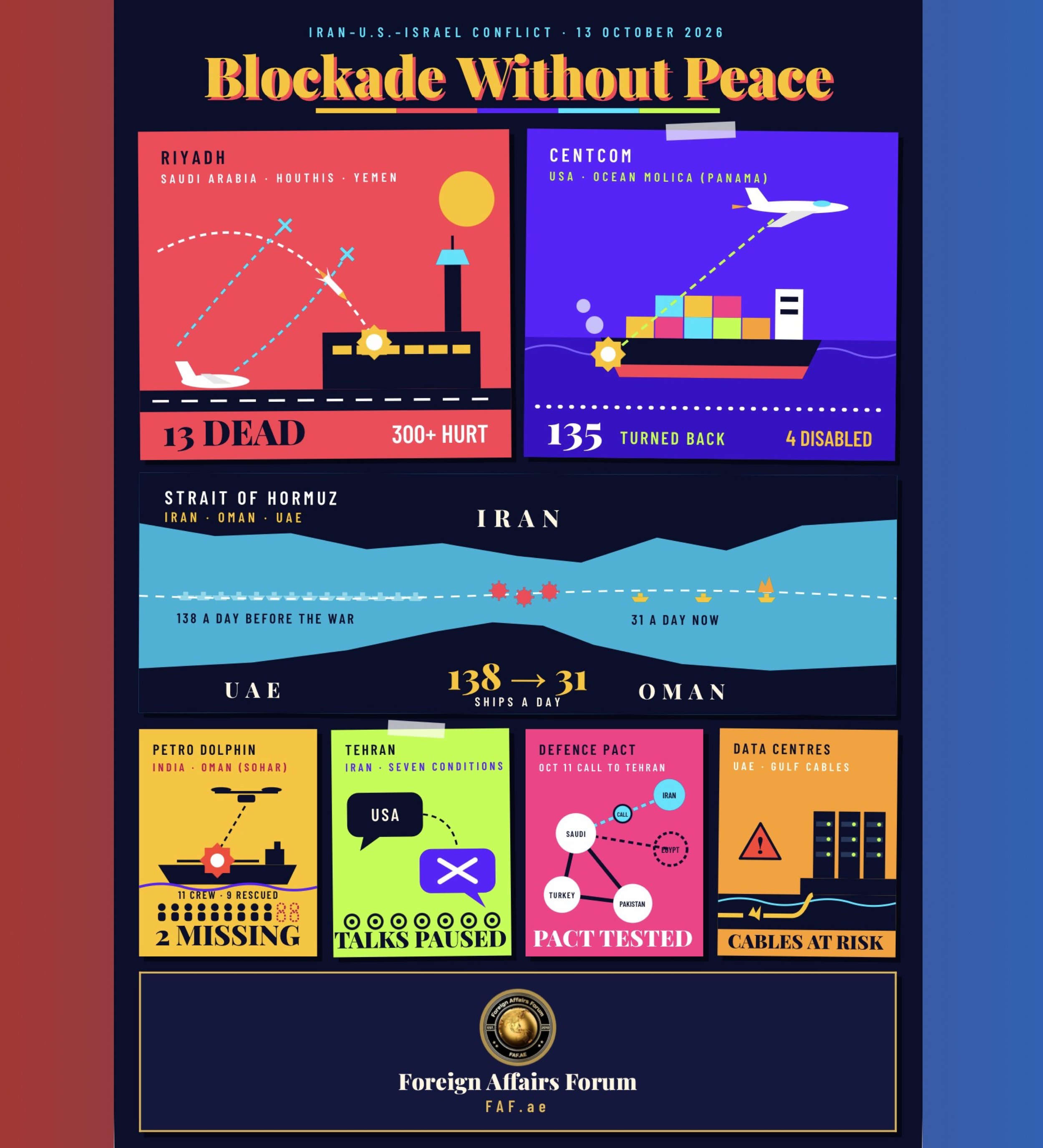
Since then, the war has settled into a grinding, low-to-medium-intensity contest. In September, Mohsen Rezaei, secretary of Iran's Supreme National Security Council, transmitted seven conditions through Qatari and Pakistani mediators, including an end to military operations, the release of frozen assets, the lifting of the blockade, and the removal of sanctions. Iran also offered a seven-day plan to reopen the strait in exchange for those concessions; Washington countered that the strait must reopen first. That sequencing dispute remains unresolved. In late September, American forces completed their withdrawal from Iraq, removing a vulnerable target set but also ceding ground to Iranian-aligned militias. On September 24th, a war powers resolution failed in the Senate, leaving the administration with a free hand but a thin political mandate.
The current status is therefore paradoxical. Militarily, Iran has been badly damaged. Economically, it is in free fall, with official inflation approaching 90% year on year and government estimates of war damage near $270 billion, close to its entire annual output. Yet strategically, it retains the capacity to hold global energy markets hostage and to inflict steady costs on the United States and its partners.
Key Developments
Three developments over the past month have sharpened the stakes.
The first is Iran's doctrinal shift.
On October 22nd, the Revolutionary Guard announced that its posture had moved from defensive to "offensive and asymmetrical." Its spokesman stated that any renewed attack would be answered not only with retaliation but with offensive operations, including possible incursions into neighboring countries that host American forces. He claimed that Iran's missile stockpile had grown one and a half times since the June 2025 war, with improved range and accuracy, and teased the unveiling of a new heavy weapon. Iran's armed forces chief has since declared the strait "completely closed" to vessels that deviate from Iranian-designated routes. Whether these claims are inflated or not, the intent is clear: Tehran seeks to establish that any future attack on Iran will carry prohibitive costs, a deterrence equation aimed squarely at American voters.
The second is the renewed escalation at sea and on the Arabian Peninsula.
In late October, the Revolutionary Guard claimed to have struck four tankers engaged in what it called illegal oil transfers in the northern Gulf, while three more vessels hit mines west of the strait. On October 26th, maritime security monitors reported a vessel ablaze sixty-three nautical miles southeast of Iraq's al-Faw peninsula. The Houthis have intensified missile and drone attacks on Saudi Arabia amid renewed fighting with Yemen's internationally recognized government, prompting the State Department to order nonemergency personnel out of the kingdom. Brent crude climbed above $110 a barrel last week before easing on hopes of regional mediation.
The third is the political choreography of escalation.
Reporting indicates that Netanyahu directed the Israeli military in early October to prepare a new round of strikes, and that President Trump blocked the plan until after the midterms. American planners have reportedly considered using the GBU-43 Massive Ordnance Air Blast against hardened Iranian targets. The president has alternated between rally declarations that the ceasefire was a waste of time and statements that the war could "end very soon." Secretary of State Marco Rubio has held firm that Washington will reject any agreement that leaves Iran a pathway to a nuclear weapon, while Tehran insists that enrichment is its right under the Non-Proliferation Treaty.
Overlaying these developments is a quiet but consequential regional realignment. Gulf producers have restored oil exports from the region to near pre-war levels by rerouting through pipelines, including the United Arab Emirates' expanded route to Fujairah on the Gulf of Oman. The emergence of the Mecca pact, uniting Saudi Arabia, Turkey, and Pakistan, signals that regional powers intend to shape the war's endgame rather than merely endure it.
Dr. 🆎 sees the pattern as strategically revealing. "Iran is converting kinetic weakness into informational and economic strength," he notes. "Every mined tanker is a press release, every toll paid in yuan is a vote against the dollar order, and every spike in gasoline prices is aimed at a swing district in Pennsylvania. Washington must recognize that the battlefield now runs through algorithms, insurance markets, and electoral calendars."
Latest Facts and Concerns
The most immediate concern for American planners is the munitions balance.
Defense officials and congressional analysts have estimated that the United States expended between one-half and two-thirds of its inventory of certain missile interceptors in the war's opening months. More than one thousand two hundred Patriot interceptors, each costing nearly $4 million, had been fired by spring, against annual production of roughly six hundred in 2025. The Congressional Budget Office estimated the cost of replacing munitions expended through August 1st at $21.7 billion, including $13.1 billion for interceptors and $7.3 billion for land-attack cruise missiles. The Pentagon's own figure for total war costs reached $43.6 billion in September. American and NATO officials have described European interceptor shortages as "beyond critical," and the Pentagon's inspector general has acknowledged strategic inventory shortfalls.
This is not merely an accounting problem. Every interceptor fired over the Gulf is one unavailable for the defense of Taiwan, Japan, South Korea, or Poland. Beijing and Moscow are watching the depletion closely, and the strategic opportunity cost of the Iran war may ultimately exceed its direct financial cost.
The second concern is economic.
American inflation, which had been declining toward the Federal Reserve's 2% target, rebounded to 3.8% in April, a three-year high, eased over the summer, and climbed back to 3.7% in September as gasoline surged 9.1% in a single month. Real wages have stagnated. The Federal Reserve, which entered 2026 expecting to cut rates, has instead turned hawkish. Energy costs ripple through diesel, shipping, airfares, and food, imposing a regressive tax on the households least able to bear it.
The third concern is political.
Surveys conducted throughout the war tell a consistent story. A spring national survey found that 63% of Americans believed there were not sufficient reasons for the war, with 68% disapproving of the president's handling of it. Support for military action fell to around 31% by late August. By late July, 57% of respondents in one poll wanted the war ended immediately, even without achieving its objectives. Tehran understands these numbers and is calibrating its pressure accordingly.
The fourth concern, and arguably the gravest, is nuclear.
International inspectors have had no access to Iranian facilities since February 28th. The last public estimate placed Iran's stockpile of 60% enriched uranium at roughly four hundred and forty kilograms, enough for about ten weapons if further enriched, with much of it believed to be stored near Isfahan. Fordow, buried beneath a mountain, was assessed as only partially damaged. Mojtaba Khamenei has reportedly ordered that the stockpile remain on Iranian soil, and senior officials have hinted at reconsidering the country's treaty commitments if attacks resume. The longer the war lasts without verification, the greater the risk that Iran either reconstitutes covertly or that its material slips out of central control.
Dr. 🆎 places this risk in a broader frame. "Proliferation analysts focus on centrifuges, but the more insidious danger lies in state fragmentation," he warns. "A regime under existential pressure, with a reclusive supreme leader and a praetorian guard running the country, is precisely the environment in which fissile material, dual-use biological research, and weapons expertise leak to proxies or criminal networks. The bioterrorism dimension of a collapsing Iran is badly underappreciated in Washington."
Finally, there is the humanitarian toll.
Human rights monitors have documented at least 1700 civilian deaths in Iran, Lebanon has suffered thousands of fatalities in the parallel Israel-Hezbollah war, and tens of thousands of seafarers have been stranded on vessels in and around the strait. These costs feed Iranian nationalism and erode international sympathy for the American position.
Cause-and-Effect Analysis
Understanding why the war has stalled requires examining the causal chains that bind each side's choices.
The first chain begins with American overconfidence.
Washington assumed that decapitation and industrial destruction would either collapse the regime or compel capitulation. Instead, the killing of Ali Khamenei consolidated power in the hands of the Revolutionary Guard, which has stronger incentives than the clerical establishment to prolong confrontation. The cause, a strategy premised on rapid regime fracture, produced the effect of a more militarized, less negotiable adversary.
The second chain runs through geography and economics.
Iran cannot defeat the United States Navy, but it does not need to. Mines, fast attack craft, drones, and coastal missiles allow it to raise insurance premiums and freight rates enough to deter commercial traffic. The resulting spike in energy prices translates directly into American inflation, which in turn erodes public support for the war. Iran has thus discovered a transmission belt from the Gulf to the American electorate, and it is pulling hard as the midterms approach.
The third chain involves the American blockade itself. By redirecting well over one hundred commercial vessels and crippling Iranian crude exports, the blockade has inflicted enormous economic damage. Iranian inflation near 90%, a collapsing currency, and war damage approaching the size of the national economy are the consequences. Yet the blockade has also given Tehran a justification for its own counter-blockade and a rallying narrative of national resistance. Pressure produces suffering, but suffering does not automatically produce compliance, particularly in a regime that has long treated endurance as an ideological virtue.
The fourth chain is diplomatic.
The collapse of the Islamabad Memorandum stemmed from a sequencing trap that remains unresolved. Iran demands that sanctions relief, asset releases, and the end of the blockade come first; Washington insists that the strait reopen first. Each side views the other's sequencing as a trap, informed by bitter experience: Iranian officials point to the American withdrawal from the 2015 nuclear deal and to attacks launched during negotiations in 2025 and 2026, while American officials point to Iran's violations of the memorandum within weeks of its signing. Mistrust is not a side effect of the war; it is the war's central structural feature.
The fifth chain is regional.
Iranian strikes on Gulf states, Houthi attacks on Saudi Arabia, and drone incidents near critical infrastructure have pushed Gulf capitals closer to Washington operationally while simultaneously pushing them to seek independent channels to Tehran. The Mecca pact's mediation reflects a regional calculation that the war must end before it consumes their economic diversification plans. This creates both an opportunity, as regional pressure on Tehran increases, and a constraint, as Gulf partners will resist an American escalation that exposes them to Iranian retaliation.
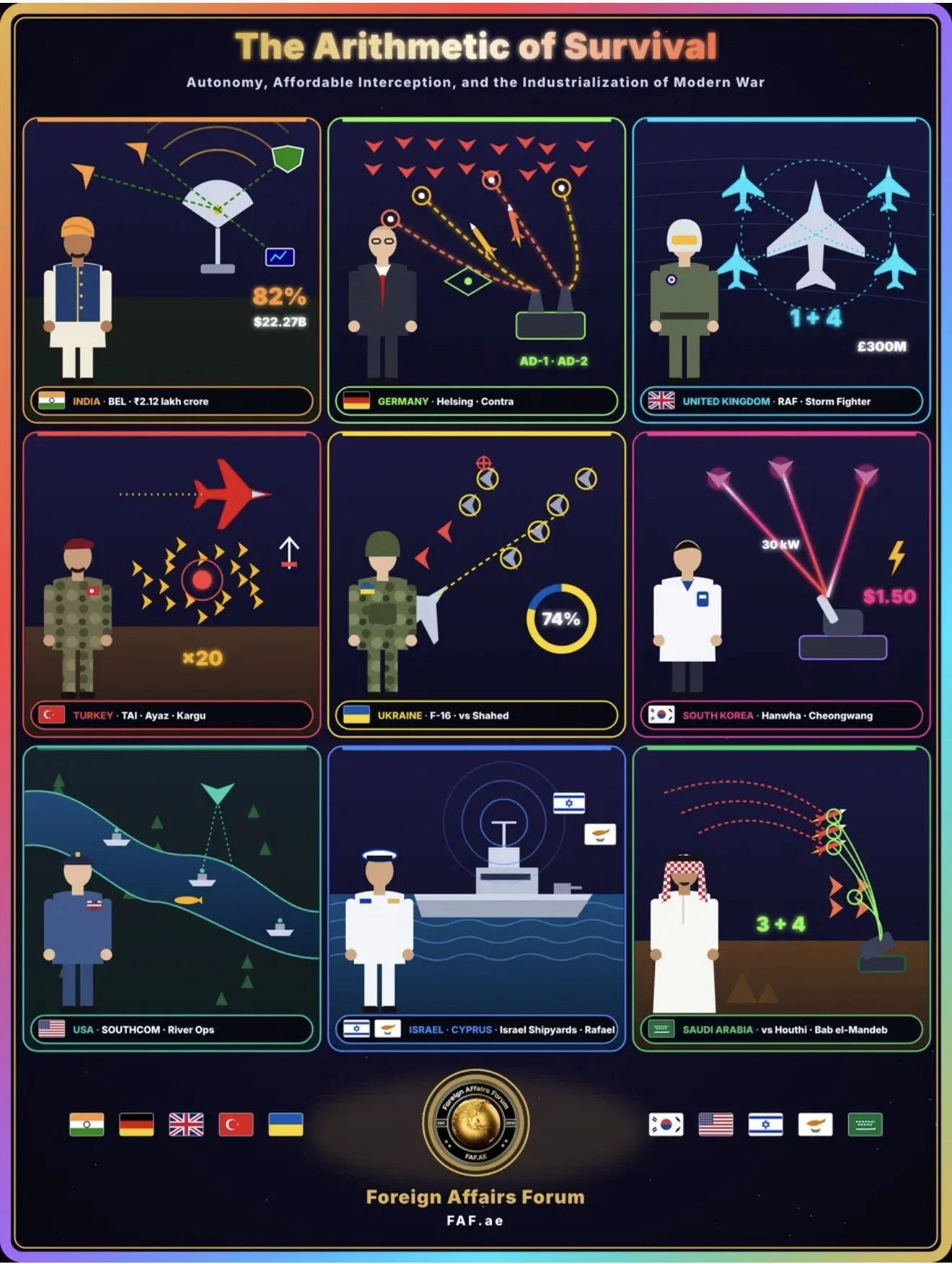
Dr. 🆎 emphasizes the role of technology in amplifying these chains. "Artificial intelligence is compressing the decision cycle on both sides," he explains. "American targeting relies on machine-speed fusion of satellite, signals, and maritime data. Iran, for its part, uses inexpensive autonomous drones and AI-assisted swarming to saturate defenses designed for an earlier era. The result is a cost-exchange asymmetry: a $20,000 drone forcing the expenditure of a $4 million interceptor. Until Washington fixes that ratio with directed energy, electronic warfare, and mass-produced low-cost interceptors, time will appear to favor Tehran even when it does not."
The Three Unsavory Choices
Against this backdrop, Washington's options narrow to three, none attractive.
The first option is escalation.
Proponents argue that a renewed, overwhelming campaign, targeting remaining missile production, Revolutionary Guard command nodes, energy infrastructure, and perhaps the regime itself, could break Iran's will and end the war on American terms. Israeli leaders favor this path, and American forces are reportedly positioned to execute it on short notice.
The case against escalation is formidable. Iran has already shown it can absorb punishing air campaigns. Its new doctrine explicitly promises offensive retaliation against countries hosting American forces, raising the prospect of attacks on Gulf oil facilities, desalination plants, and population centers. Interceptor inventories are already strained; a fresh round of large-scale salvos could exhaust them, leaving American bases and partners exposed. A campaign aimed at regime change would also risk the very outcome most dangerous to American interests: a fractured state with no reliable custodian of its enriched uranium, its missile arsenal, or its biological research capabilities. History, from Iraq to Libya, suggests that Washington is far better at destroying regimes than at managing what follows them. And with the public already opposed to the war, a major escalation would likely provoke a domestic backlash that undermines the war effort itself.
The second option is withdrawal.
Some prominent analysts, including figures from across the ideological spectrum, have argued that America should cut its losses, accept a settlement close to Iran's seven conditions, lift the blockade, and pivot its resources to the Indo-Pacific. The appeal is obvious: lower gasoline prices, an end to casualties, and the preservation of munitions for a potential conflict with China.
Yet the costs of retreat would be strategic and enduring. Accepting Iranian sequencing would ratify Tehran's claim to regulate the Strait of Hormuz, effectively converting an international waterway into an Iranian toll road denominated in yuan. It would release frozen assets and sanctions relief without verified constraints on enrichment, leaving Iran with a stockpile capable of producing several weapons and a newly validated belief that coercion works. Gulf partners would conclude that American security guarantees are perishable, accelerating their hedging toward Beijing and their own pursuit of nuclear capabilities. Adversaries elsewhere would draw the lesson that the United States can be outlasted.
As Dr. 🆎 puts it, "A retreat from Hormuz would not end the war. It would merely relocate it, to the next chokepoint, the next ally, and the next test of resolve."
The third option is to stay the course: maintain the blockade, protect freedom of navigation, preserve deterrence against major Iranian escalation, and pursue negotiations through Pakistani, Qatari, Saudi, and Turkish channels until Tehran accepts a verifiable settlement.
This path is the least dramatic and, politically, the least satisfying. It promises no quick victory and requires absorbing continued costs. But it uniquely preserves American leverage while avoiding both the catastrophic risks of escalation and the strategic humiliation of retreat.
Future Steps
Staying the course does not mean standing still. To make endurance sustainable and convert it into a favorable settlement, Washington should pursue five interlocking measures.
First, it must fix the cost-exchange ratio.
The Pentagon has signed tens of billions of dollars in production contracts with major missile manufacturers, but expanding output of exquisite interceptors is not enough. The priority should be rapid fielding of directed-energy systems, high-power microwave defenses, electronic warfare suites, and inexpensive kinetic interceptors capable of defeating drones at a fraction of current costs. Autonomous mine-countermeasure vessels and uncrewed surface escorts can reduce risks to sailors while reopening shipping lanes.
Dr. 🆎 argues that "the side that achieves cost parity in drone defense will win the war of attrition. Washington has the industrial and algorithmic base to get there within months, not years, if it treats this as a wartime priority rather than a procurement exercise."
Second, it must harden the economic home front.
Strategic petroleum reserve releases, coordinated with allies, can blunt price spikes. Accelerating alternative export routes for Gulf producers, including pipelines bypassing Hormuz, reduces Iran's leverage over global markets. Washington should also tighten enforcement against Iran's shadow fleet and the financial channels that process yuan-denominated toll payments, raising costs for third parties that underwrite Iran's counter-blockade.
Third, it must break the sequencing trap through phased reciprocity.
A credible framework would pair partial, verifiable steps: Iranian cessation of attacks on shipping and mine clearance in exchange for humanitarian exemptions and limited asset releases into escrow; restoration of international inspector access in exchange for graduated blockade easing; and a comprehensive nuclear arrangement, including either the export or verified down-blending of highly enriched material, in exchange for broader sanctions relief. Regional mediators, particularly the Mecca pact states and Qatar, should serve as guarantors and escrow agents, giving both sides confidence that concessions will be reciprocated.
Fourth, it must manage the Israeli dimension.
Washington's restraint of Israeli strike plans before the midterms was prudent, but restraint must be structural rather than calendrical. Whatever government emerges from today's Israeli election, the United States should make clear that unilateral escalation risks fracturing the coalition and endangering American forces. At the same time, Washington should offer Israel enhanced air and missile defense support and intelligence sharing to reduce its incentives for preemption.
Fifth, it must prepare for the day after, including the possibility of Iranian instability.
American and allied planners should develop contingency plans for securing nuclear material, monitoring biological facilities, and preventing the transfer of advanced weapons to proxies should central authority weaken.
Dr. 🆎 stresses that "AI-enabled monitoring of supply chains, procurement networks, and anomalous laboratory activity must be part of this planning. The nightmare is not only an Iranian bomb but a scattered inventory of dangerous capabilities in the hands of those who answer to no one."
Throughout, Washington must communicate a coherent strategy to its own public.
The administration's oscillation between triumphalism and threats has fed the perception that the war lacks clear goals. Explaining that the objective is a verifiable nuclear settlement and freedom of navigation, not regime change or open-ended combat, would help rebuild the domestic support that endurance requires.
Conclusion
The United States did not enter this war wisely, and it cannot exit it cleanly.
The costs so far, measured in lives, treasure, munitions, inflation, and public trust, are real and mounting. It is tempting to believe that one final, overwhelming blow could end the conflict, or that a dignified withdrawal could restore normalcy at the pump. Both are illusions.
Escalation risks unleashing precisely the regional chaos and proliferation dangers the war was meant to prevent.
Retreat would reward coercion, surrender a vital global waterway to Iranian control, and signal to adversaries and allies alike that American commitments expire when gasoline prices rise.
Staying the course is the least bad option because it preserves what matters most: leverage.
Iran's economy is collapsing faster than America's political will, provided that will is sustained by clear goals, smarter defense investments, and economic cushioning at home. The regime's offensive doctrine, its toll regime, and its rhetoric of defiance are not signs of strength so much as attempts to compress Washington's timeline before Tehran's own runs out.
Dr. 🆎 offers a final reflection that captures the essence of the challenge. "Strategic patience is not passivity. It is the disciplined use of time as a weapon. America's task is to make every month of this war cheaper for itself and costlier for Tehran, until the regime concludes that a verifiable settlement is the only path to survival."
The strait will eventually reopen. The question is on whose terms. If Washington holds the line with resolve and ingenuity, those terms can still be shaped in America's favor and that of the wider world.