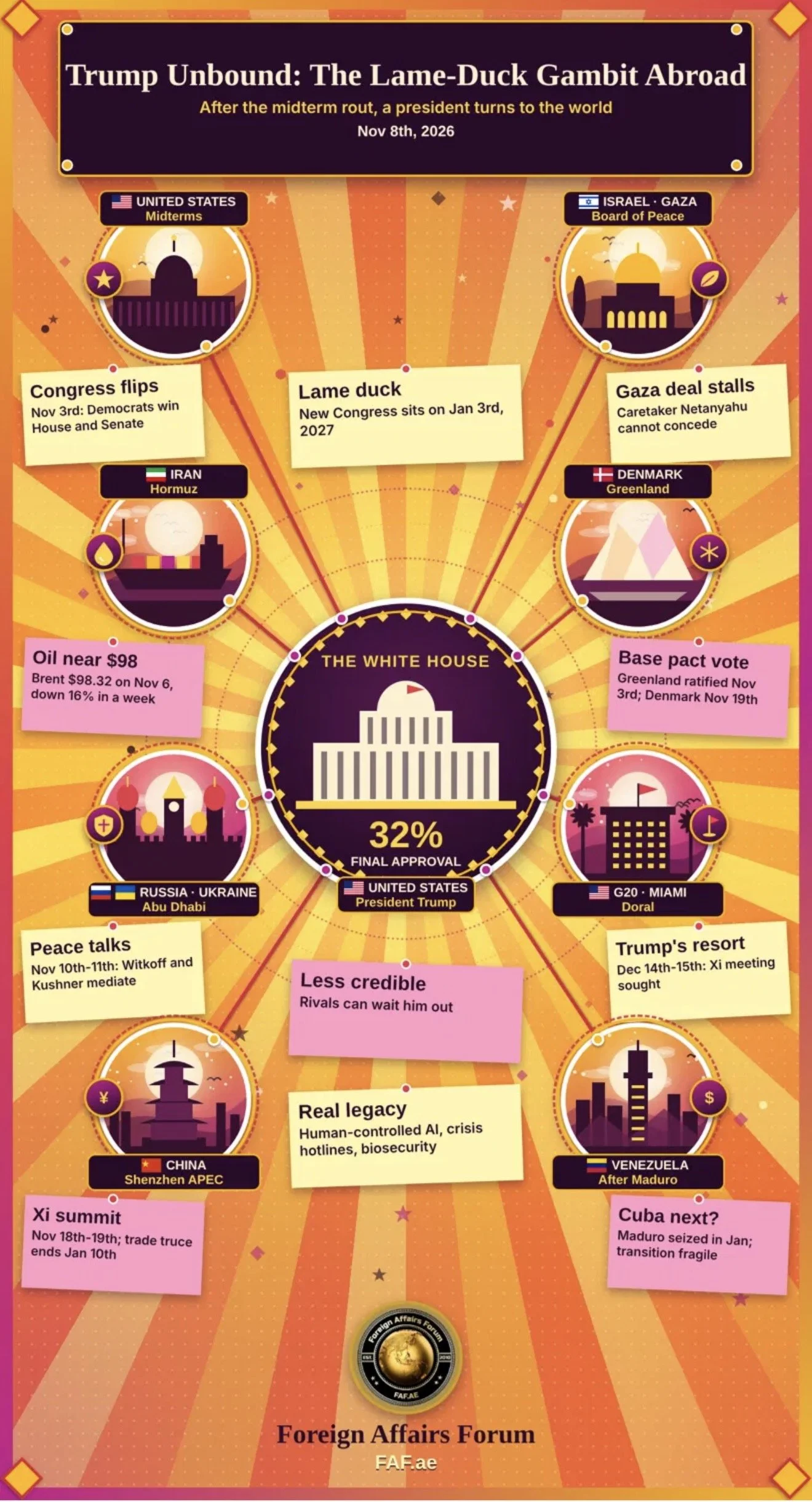
Trump Unbound: The Lame-Duck Gambit Abroad
Foreign Affairs Forum | Dr. Antonio Bhardwaj (Dr. 🆎)| Nov 8th, 2026
Executive Summary
On Nov 3rd, American voters handed Donald Trump the sharpest rebuke of his second term.
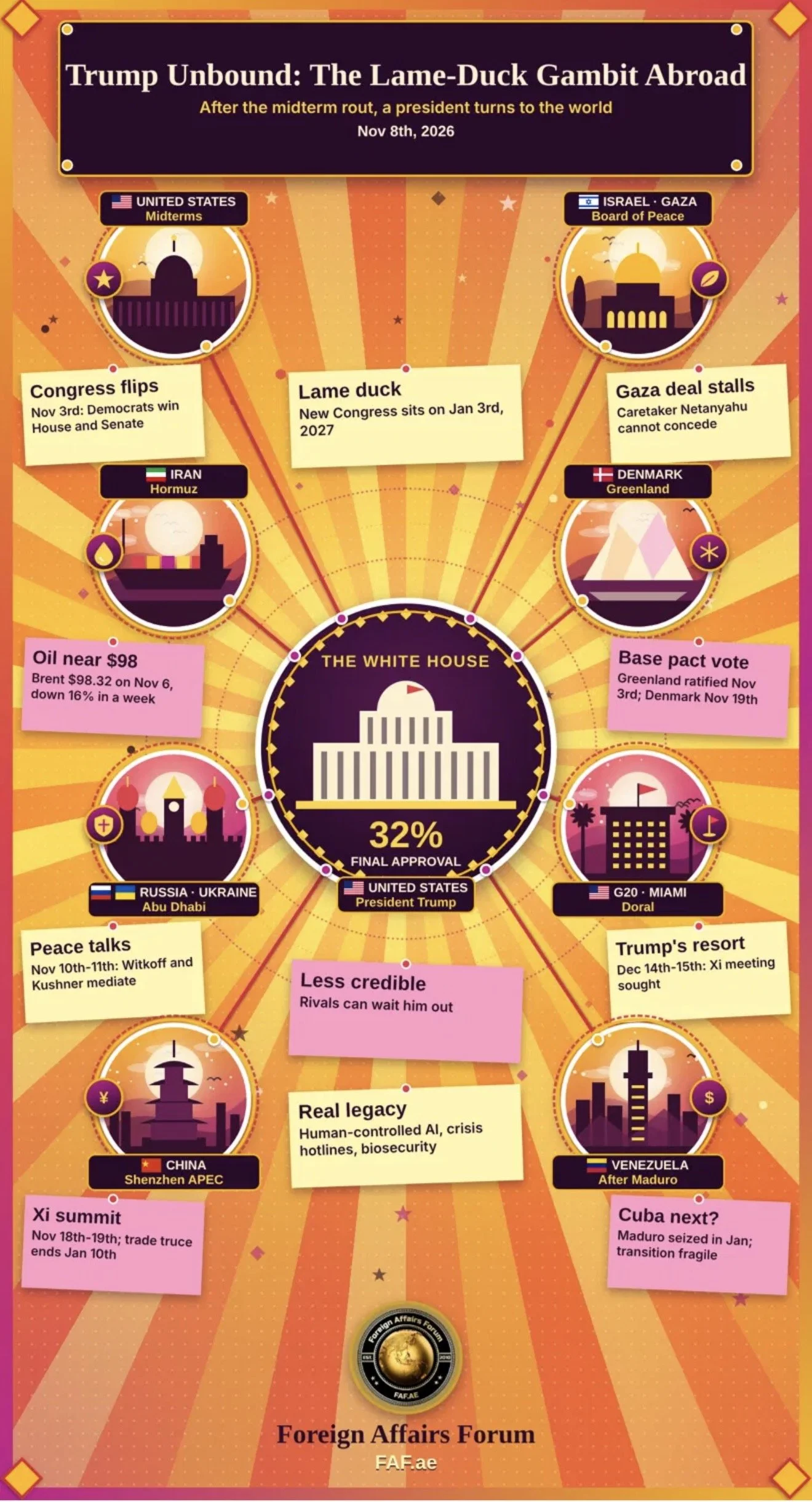
Democrats captured the House of Representatives with a majority projected at well over two hundred and fifty seats and won the Senate with at least fifty-four, making Trump the first president in twenty years to see both chambers of Congress slip away at a midterm election. His approval rating had been hovering near 32% in the final Reuters/Ipsos reading before the vote, and the evidence points to the Iran war, the cost of living and a backlash against artificial intelligence data centres as the forces that moved the electorate.
The standard assumption in Washington is that a weakened president turns to the one domain where the Constitution still leaves him room to manoeuvre. Trump fits that script, and the calendar confirms it.
American negotiators will convene Russian and Ukrainian delegations in Abu Dhabi on Nov 10th and 11th.
Trump is scheduled to travel to Manila for the ASEAN summit on Nov 16th and then to Shenzhen for the Asia-Pacific Economic Cooperation summit on Nov 18th and 19th, where he is expected to meet Xi Jinping for the third time this year. He will then host the G20 at his own Doral resort in Miami on Dec 14th and 15th. Behind these dates sit unresolved confrontations: the Iran war that began on Feb 28th and has choked the Strait of Hormuz, the stalled disarmament process in Gaza, and a Greenland security pact that Denmark must ratify on Nov 19th.
This FAF article argues that the lame-duck presidency will be less free abroad than it appears and more hazardous than it should be. Congress will control the purse and the committees from Jan 3rd, 2027, foreign leaders have every incentive to wait him out, and the instruments that remain wholly in his hands, namely force, sanctions, summitry and executive agreements, are those that produce the least durable results.
Dr. 🆎 contends that the most valuable thing a diminished president can still deliver is not a spectacular deal but institutional architecture: human-controlled guardrails on AI-enabled military systems, crisis channels with Beijing, and biosecurity cooperation that outlives his tenure. Whether Trump pursues that quieter legacy or a louder one is the central question of the next two years.
Introduction
Presidents who lose their congressional majorities discover quickly that Washington has two constitutional personalities.
At home, the legislative branch can block, investigate and defund. Abroad, the executive retains a vast reserve of unilateral authority: the commander-in-chief power, the conduct of diplomacy, the imposition of sanctions under standing statutes, and the negotiation of executive agreements that need no Senate ratification. The distance between those two personalities is the space in which a lame-duck president operates.
Dr. Antonio Bhardwaj (Dr. 🆎), a polymath with global expertise in superintelligence who specialises in human-centred superintelligence for geopolitical strategy, AI warfare and bioterrorism risk, describes this space as a corridor of asymmetric freedom.
In the reading of Dr. 🆎, the corridor is real but narrowing, because the same midterm result that frees Trump's attention for foreign affairs also hands his opponents the committees, the subpoenas and the appropriations leverage with which to contest whatever he does there.
The question this FAF article addresses is deceptively simple: what will a lame-duck Trump get up to overseas? It matters because the landscape he inherits is unusually combustible. A war with Iran is in its ninth month.
Russia's invasion of Ukraine grinds on while Washington brokers another round of talks. The United States and China are managing a fragile détente with a trade truce that expires on Jan 10th, 2027.
The Gaza ceasefire is held together by a disarmament formula that neither Israel nor Hamas has fully accepted, and Israel itself is in post-election deadlock, with Benjamin Netanyahu serving as caretaker prime minister while President Isaac Herzog decides who should try to form a government.
The analysis proceeds in six movements. It begins with the historical record of presidents who sought refuge abroad after domestic defeat, then assesses the present position of the Trump administration. It follows with the key developments across the principal landscapes, the latest facts and concerns, a cause-and-effect analysis of how the midterm result will shape behaviour at home and abroad, and the future steps that stakeholders should consider before concluding.
History and Current Status
The idea that a president wounded at home turns to the world is as old as the modern presidency.
After the 1986 midterms cost Republicans the Senate and the Iran-Contra scandal engulfed his administration, Ronald Reagan salvaged his second term through arms control, concluding the Intermediate-Range Nuclear Forces Treaty with Mikhail Gorbachev in December 1987. That success rested on a counterpart in Moscow who needed a deal as badly as Reagan did, and on a Senate that ratified the result.
The 20th century offers other examples. Bill Clinton spent the final months of his presidency on Middle East diplomacy, travelling to Vietnam in November 2000 and pressing Israelis and Palestinians for a settlement that eluded him. The lesson was that legacy-seeking works only when the other side is ready to deal.
The nearest parallel to Trump's position is George W. Bush after November 2006. Republicans lost both chambers, Donald Rumsfeld departed the Pentagon, and Bush travelled to the Baltic states, Jordan and Southeast Asia while commissioning a reappraisal of Iraq policy that ended in the troop surge.
Barack Obama's trip to India, Indonesia, South Korea and Japan after the 2010 shellacking followed the same pattern. In each case the president's foreign agenda did not evaporate with his congressional majority, but its ambitions shrank and its dependence on foreign counterparts grew.
Trump's second term has been more unilateral than any of these precedents.
In January, American forces captured Nicolás Maduro in Caracas in a strike conducted without congressional notice, and Trump said Washington would run Venezuela through a transition. The same month, his repeated threats to seize Greenland alarmed Denmark and the wider alliance and prompted a diplomatic scramble that ended only in September with a security agreement signed at the United Nations.
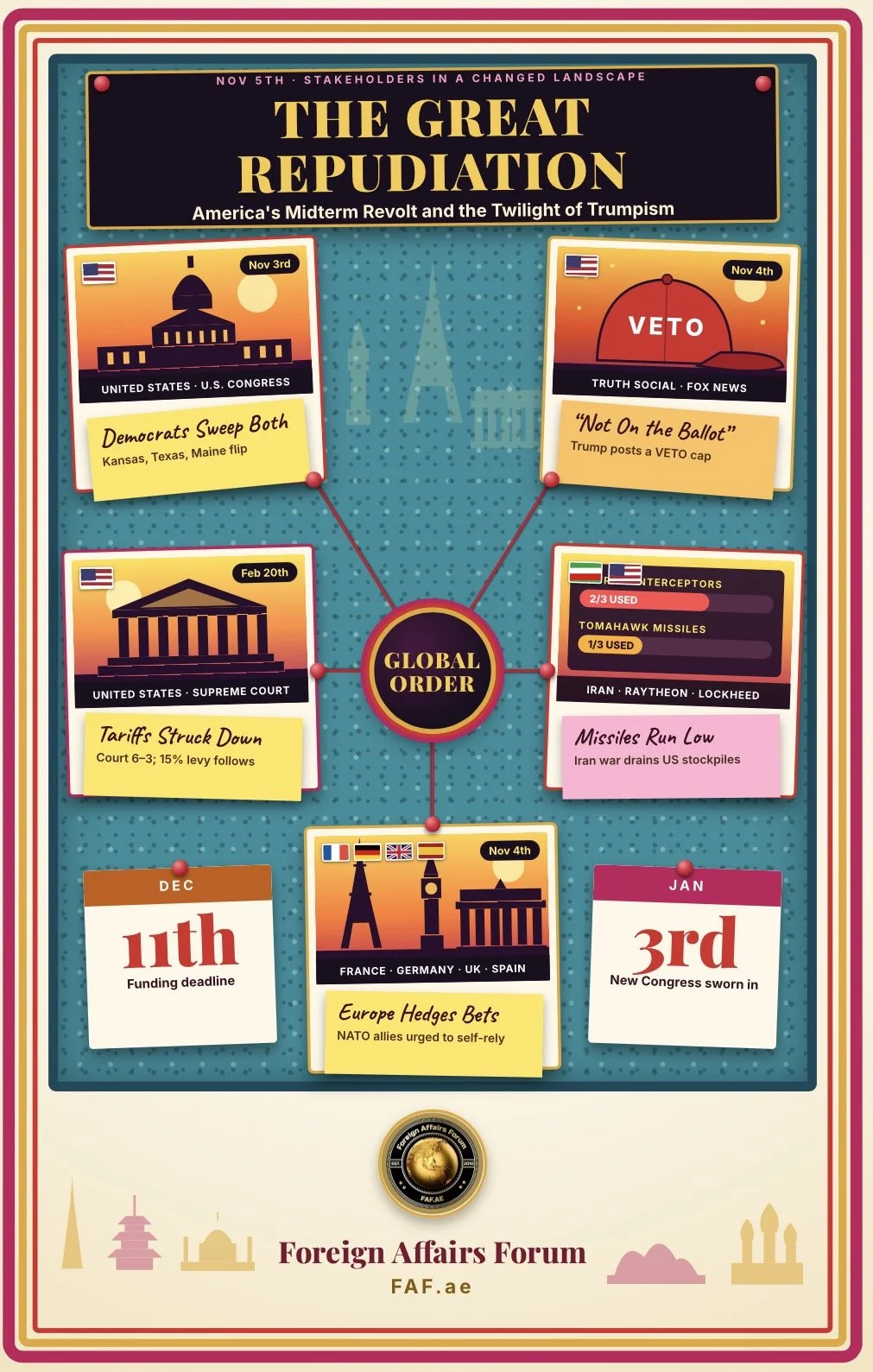
On Feb 20th, the Supreme Court ruled by six votes to three that the International Emergency Economic Powers Act does not authorise tariffs, stripping him of his principal trade weapon and forcing a patchwork of replacement measures under other statutes.
On Feb 28th, the United States and Israel launched a war against Iran without congressional authorisation. Trump visited Beijing in May and hosted Xi Jinping in Washington in September. Throughout, he built a personalised diplomatic apparatus around special envoys Steve Witkoff and Jared Kushner, a Board of Peace for Gaza that he chairs, and summits that he announces on social media before his own bureaucracy has prepared them.
The present position is one of acute political weakness paired with undiminished formal power. Democrats flipped more than thirty Republican-held House seats and won Senate contests in states as reliably conservative as Texas, South Carolina, Kansas and Iowa, along with Maine and North Carolina.
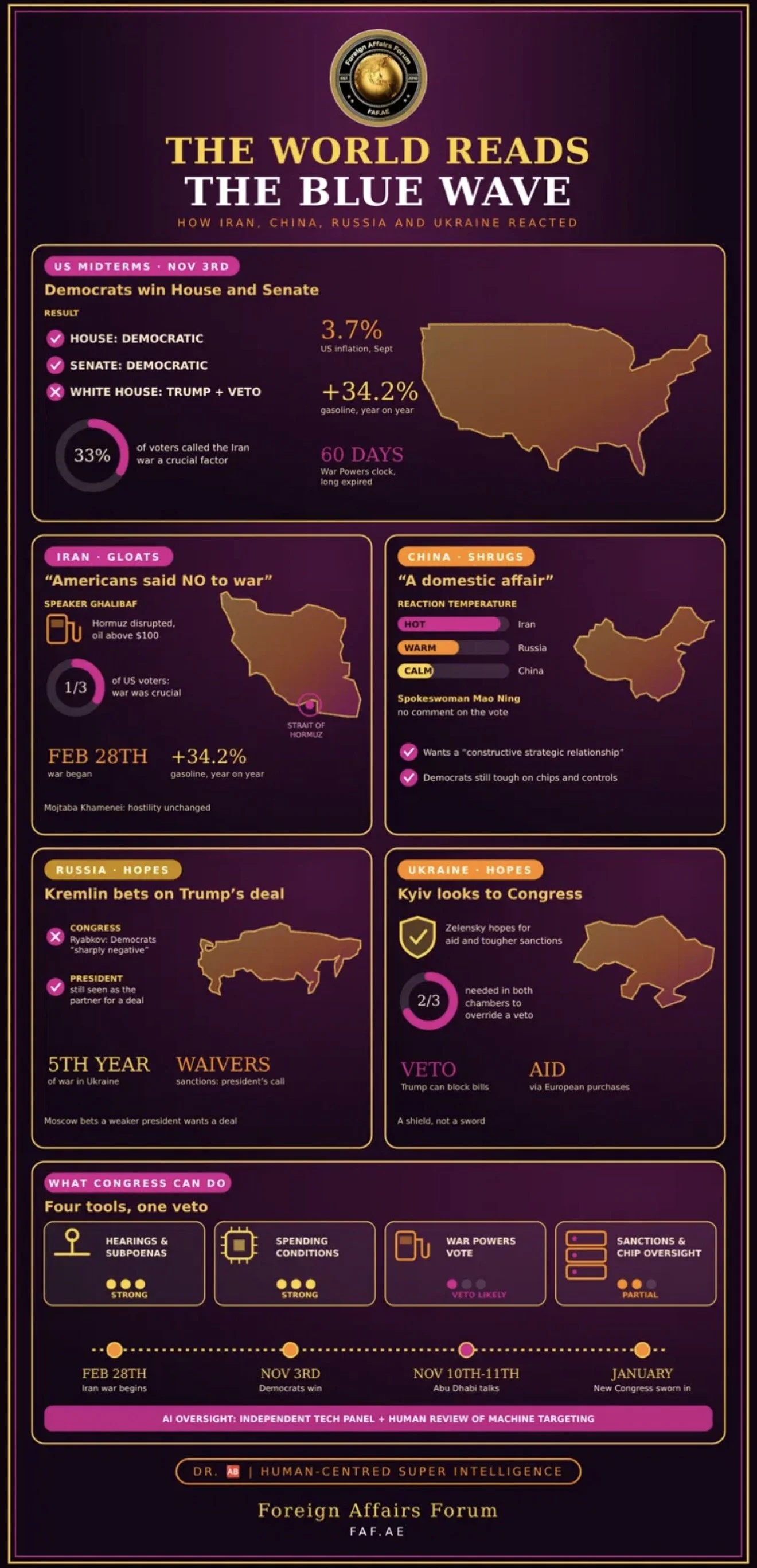
Trump's approval stood near 32% on the eve of the vote, and a Pew survey found that roughly two-thirds of Americans disapprove of how the Iran war is being handled. Vice President JD Vance acknowledged that voters had probably punished the administration over the war.
The new Congress will not take office until Jan 3rd, 2027, so Republicans still control both chambers during the lame-duck session, but Democrats are already signalling that they will use committee gavels, hearings and appropriations to contest the war, the boat strikes in the Caribbean, the suspension of aid to Ukraine and the Trump family's finances. They lack the two-thirds majorities needed to override vetoes, with one important exception: a new Ukraine aid package would probably attract enough Republican votes to survive one.
Key Developments
The Iran landscape is the most dangerous.
The war that began on Feb 28th has closed most traffic through the Strait of Hormuz, a corridor that normally carries about a fifth of the world's oil and liquefied natural gas, while Washington maintains a blockade of Iran-related shipping. A memorandum of understanding in mid-June provided for a cessation of military operations but has not produced a settlement.
Brent crude touched $118 in October and traded near $108.50 on Nov 2nd and $98.26 on Nov 8th, with Goldman Sachs attributing a geopolitical premium of about $27 a barrel to the conflict.
Qatar, Oman and Pakistan are mediating, and Tehran says a Qatari plan could reopen the strait within two days if Washington meets a list of conditions that includes lifting recent sanctions, restoring oil waivers granted in June, reducing the American military presence in the region and recognising new shipping lanes designated by Iran and Oman.
Vance has written to Iranian security chief Mohsen Rezaei at Trump's direction, yet Trump has kept the option of fresh strikes on the table, and Netanyahu is reported to have urged him to hit Iran again. The war has become the single greatest drag on Trump's standing at home and the single greatest temptation abroad, because an agreement would let him claim a victory while escalation would invite the rally effect that he has sought before.
On Russia and Ukraine, Witkoff and Kushner will lead American mediation at working-level talks in Abu Dhabi on Nov 10th and 11th.
They follow earlier rounds in Abu Dhabi in January and February and in Geneva in February, a meeting between Witkoff and Vladimir Putin in St Petersburg on Oct 21st, and consultations among Volodymyr Zelensky, Witkoff and European leaders in Oslo in late October. The agenda covers post-war security arrangements, de-escalation and humanitarian measures.
Trump has recently intensified pressure on Kyiv to accept terms, has largely halted direct American financial and military assistance, and has repeatedly questioned whether the United States would defend allies that spend too little on defence.
European capitals fear a settlement negotiated over their heads, while Zelensky has said he is ready to meet Putin and Trump in Istanbul and has warned against handing Moscow another major diplomatic advantage. The Kremlin says a meeting among Xi, Trump and Putin on the margins of the Shenzhen summit is being prepared, though Washington has not confirmed it.
With China, the pattern is personal diplomacy with thin deliverables.
Trump's Beijing state visit in May and Xi's state visit to Washington from Sept 23rd to 25th produced a trade truce extended to Jan 10th, 2027, a reciprocal tariff reduction, purchases of American coal and a new AI communication channel, but left rare earths, semiconductor controls and Taiwan unresolved.
Trump approved an $11 billion arms package for Taiwan in December and is holding a second package of about $14 billion in abeyance, which he has described as a negotiating chip. If he attends the APEC summit in Shenzhen, he will be the first sitting American president to visit that city and will meet a Chinese leader who has watched the midterm result with satisfaction.
Analysts across the region expect no fundamental change in American policy toward Beijing, given the bipartisan consensus on strategic competition, but Xi has little reason to concede anything to a president who may be unable to deliver congressional follow-through.
In the Middle East beyond Iran, Gaza remains the test of Trump's signature instrument, the Board of Peace.
Trump announced in July what he called a historic agreement for the complete disarmament of Hamas, and Hamas said it had accepted a framework tied to Israeli withdrawal and the deployment of an international stabilisation force. Implementation has been slow.
Netanyahu insists there will be no Israeli withdrawal until Hamas is fully disarmed, the Board of Peace has said withdrawal beyond the so-called Yellow Line will follow decommissioning, and Arab and Muslim members accuse Israel of undermining the ceasefire with continuing strikes.
Netanyahu's caretaker status ends Nov 10th, after Israel's inconclusive Oct 27th election weakens Washington's interlocutor, because a government that cannot be formed cannot make concessions.
In the Western Hemisphere and the Arctic, Trump's record is mixed.
The Greenland agreement signed in September, which paves the way for two new American bases and elements of the Golden Dome missile defence system, was ratified by Greenland's parliament on Nov 3rd by sixteen votes to none with seven abstentions.
Denmark's parliament will hold its first reading on Nov 11th and a final vote on Nov 19th.
The episode shows that coercion can be converted into consent, but it also left a legacy of allied distrust.
Meanwhile Venezuela is in a precarious transition, and speculation in Washington that Trump may turn next to Cuba has not subsided.
On trade, the Supreme Court's February ruling and a Democratic Congress together limit Trump's ability to wield tariffs as a general-purpose coercive tool.
He held off imposing new duties before the election, and the administration has been rebuilding its tariff wall under other statutes, notably Sections 232 and 301. Democrats have indicated they will push to reverse tariffs, though without a veto-proof majority their power is largely symbolic.
Latest Facts and Concerns
The first post-midterm signal came from Secretary of State Marco Rubio, who made his initial foreign trip since the election to a meeting of Group of Seven foreign ministers in France.
France had already signalled that the meeting would produce no joint communiqué, a reminder that disagreements over Ukraine, NATO burden-sharing, tariffs, the Iran war and the International Criminal Court have strained the club. Rubio also said earlier that he is uncertain whether a negotiated peace in Ukraine is attainable. The mood in European capitals is a blend of relief that Trump has been checked at home and anxiety that he may compensate abroad.
The most serious concern is escalation.
A report from Bloomberg Law summarised the fear in Washington that a president who captured Maduro and started a war with Iran might now exploit his broad national-security authority more aggressively, with speculation ranging from fresh strikes on Iran to a deeper rupture with Europe over Ukraine to military intervention in Cuba.
The Constitution gives Congress the power to declare war and to fund it, but the War Powers Resolution of 1973 has repeatedly failed to restrain presidents. The House has passed Iran war powers measures, including one by 220 to 204 in September with seven Republican votes, but none has reached Trump's desk, and a Senate attempt in March failed by 47 votes to 53.
A joint resolution passed by both chambers would still face a veto. Democrats therefore have more leverage in the purse than in the statute, since they could withhold funding or hold up nominations to press for congressional authorisation.
A second concern is the blurring of public and private interests in diplomacy.
The December G20 will be held at Trump National Doral, a property the president owns, and reporting indicates that the American presidency of the group has narrowed its agenda to make Miami a backdrop for a Trump-Xi meeting. Democratic investigators have said they will examine the sources of the Trump family's wealth and foreign influence over American policy, which gives every summit a second audience in Congress.
A third concern is the macroeconomic transmission of foreign decisions.
Oil near $108 a barrel and a Hormuz still largely closed are feeding the cost-of-living pressures that cost Republicans the election, so the president has a domestic as well as a strategic incentive to settle with Tehran. Yet the demands Iran has placed on the table, including sanctions relief and a reduced American footprint, are politically costly for him, and the Israeli government, itself in transition, is not a reliable partner for compromise.
A fourth concern, in the view of Dr. 🆎, is the technological dimension that conventional commentary overlooks. Midterm campaigns in several states turned partly on resistance to the environmental and community effects of artificial intelligence data centres, signalling that public tolerance for the AI build-out is no longer unconditional. Meanwhile the new US-China AI communication channel agreed in September is the sort of low-profile architecture that could matter more than any tariff truce.
Dr. 🆎 warns that AI-enabled targeting, autonomous systems and decision-support tools are compressing the time available to human commanders during crises of the kind now unfolding around Hormuz, and that a distracted, personalised diplomacy risks leaving no institutional memory behind. The same logic applies to biosecurity. Biological threats exploit the seams between states, and a lame-duck administration that spends its remaining capital on spectacle rather than on standing mechanisms for pathogen surveillance and attribution would leave those seams open.
Cause-and-Effect Analysis
The causal chain begins with the electoral verdict.
The midterm result removes Trump's capacity to legislate, which in turn increases the relative value of the tools that Congress cannot easily touch. Presidents choose the arena where their marginal effort yields the largest return, and for Trump that arena is now foreign affairs, where announcements, summits and military decisions can still be made by a single person. This explains the density of the autumn calendar and the preference for personal envoys over institutional processes.
The second link runs from freedom of action to the quality of outcomes.
Unilateral instruments produce fast results but fragile ones. A cease-fire brokered by envoys without Senate ratification, a trade truce that expires on a fixed date, or a security pact in Greenland that depends on parliamentary approval in two capitals each carry a shelf life determined by the next government. Counterparts understand this. Xi Jinping, Vladimir Putin and the leadership in Tehran have each shown a preference for deals that can be reversed, and each can now reasonably calculate that the cost of waiting out a president with two years left is lower than the cost of conceding to him. The effect is a lengthening of negotiations and a hardening of positions, which is the opposite of what a legacy-hungry president wants.
The third link concerns Congress as a constraint.
Democratic control of the Armed Services, Foreign Relations and Appropriations committees will change the information environment as well as the legal one. Hearings on the Iran war, the Caribbean boat strikes and the conduct of Pentagon leadership will generate disclosures that shape allied and adversary perceptions. A Ukraine aid bill that might survive a veto would signal to Moscow that American support has a bipartisan floor, complicating Trump's effort to extract concessions from Kyiv. Conversely, Republican members who are still in office during the lame-duck session have a short window in which they may be more willing to defy the president, since several face no further election. The coalition arithmetic on Iran war powers has already shifted, with Senator Thom Tillis, who is leaving the chamber in January, changing his position in September.
The fourth link runs through allies.
European governments, which have lived with the consequences of the Greenland crisis, the withdrawal of aid to Ukraine and the tariff ruptures, will respond to a weakened Trump by hedging rather than confronting. They will increase defence spending, deepen mini-lateral coalitions on Ukraine, and avoid public confrontation while preparing for a post-Trump landscape. The consequence is a gradual erosion of American agenda-setting power even where Washington's material weight remains unmatched. The failure of the G7 foreign ministers to agree on a communiqué is a small but telling indicator.
The fifth link is the oil price.
Because the Iran war affects consumer prices directly, a Hormuz settlement would produce an immediate economic benefit and a political dividend. That gives Trump a reason to compromise, but it also gives Tehran leverage, since Iranian negotiators know that a president anxious about gasoline prices is a president who may overpay. Escalation would produce the opposite sequence: a short-term rally effect, a spike in energy prices, a deeper backlash at home and fresh war powers battles in January. The decision between those paths will probably be taken by Trump himself, in consultation with a very small circle, and will turn on how he reads his own political interests in the weeks after the midterm shock.
The sixth link is Israel.
Netanyahu's weakness after the Oct 27th vote, in which his bloc fell to fifty-three seats and neither side secured a majority, constrains Washington's capacity to broker disarmament in Gaza or to coordinate on Iran. An Israeli government that is caretaker for weeks or months cannot sign binding commitments, and a new government led by Gadi Eisenkot would take time to define its policy. The Board of Peace therefore faces the paradox that its main patron has more urgency than its main counterpart has authority.
Dr. 🆎 draws one further inference from this chain. The incentives of a lame-duck president reward visibility over durability, which is exactly backwards for the technologies and threats that will define the next decade. The commanders who will fight future crises with AI-enabled systems need agreed protocols for human control, and states that will face future biological attacks need shared attribution mechanisms. Neither is likely to be produced in a hurry at a photo opportunity. They need patient, institutional work of the kind that the new Congress, European allies and mid-sized powers can sustain beyond Jan 2029.
Future Steps
For the White House, the most prudent course is to treat the autumn calendar as a means of consolidating gains rather than of creating new crises.
That means using Abu Dhabi to secure a verifiable de-escalation and security framework rather than a deadline-driven ultimatum, accepting that Europe and Ukraine must be at the table for any settlement they will be asked to implement, and resisting the temptation to trade Ukrainian territory for a summit headline. In Shenzhen, Trump should lock in the AI channel and extend it to military-to-military and biosecurity dialogue, since those are the achievements most likely to survive his departure. On Iran, the sensible step is to accept a staged arrangement in which sanctions relief is tied to verifiable reopening of Hormuz, with Qatar and Oman as guarantors, rather than to keep strikes on the table as a bargaining instrument that risks a wider war.
For Congress, the lame-duck session and the first weeks of the new term offer distinct opportunities.
Republicans who will not face voters again can support war powers language and Ukraine aid while the administration is still bargaining. Democrats, once in the majority, should combine oversight with constructive legislation, specifically a clear statutory framework for the use of force, a reauthorisation that distinguishes between defensive and offensive operations, and a requirement that major executive agreements be reported to Congress. Without such reforms, the next president will inherit the same unchecked authority that the current Congress has been unable to restrain.
For Europe, the priority is to build a credible, independent contribution to Ukraine's security and to prepare for the possibility that Washington negotiates a deal that Europeans must underwrite.
That means coordinating positions before Abu Dhabi, funding Ukraine's defence and reconstruction from European resources, and using forums such as the G7 and the coalition of the willing to make plain that a settlement imposed on Kyiv would not be accepted as legitimate. For the Gulf states and other mediators, the task is to keep channels with both Washington and Tehran open and to offer face-saving formulas that allow each side to claim progress.
For China, the question is whether to accept the offer of a managed relationship with a weakened Trump or to hold out for a more favourable arrangement under a successor.
The likely answer is to do a little of both, offering modest purchases and continued dialogue while withholding concessions on technology controls and Taiwan. Beijing should recognise, however, that the shared risk of an AI-driven or biologically induced crisis is greater than any bilateral grievance, and that agreements on human control of nuclear and military AI systems cost little and protect much.
For Israel and the Palestinians, the immediate step is the formation of a government in Jerusalem able to carry out the Board of Peace plan, with Washington pressing both Netanyahu and his rivals to treat Gaza as a matter of national policy rather than coalition bargaining.
The next milestones, including the ninety-day marker that observers have identified for the middle of November, will test whether the disarmament roadmap is workable.
Conclusion
The midterm verdict has not ended Trump's foreign policy; it has changed its character. He retains the formal authority to strike, to sanction, to travel and to announce, and the calendar between now and the middle of December gives him multiple stages on which to do so. What he has lost is the assumption of political momentum, and with it the credibility that comes from the belief among foreign leaders that he will be in a position to deliver. In that gap between authority and credibility lies the risk of the coming months. A president who can act but cannot guarantee follow-through is tempted either to overreach, in pursuit of the dramatic gesture that restores his standing, or to accept thin agreements that dissolve at the first test.
The historical record suggests that the second-term foreign policies that endure are those built with partners who also need success and ratified by institutions that outlast the presidency.
Dr. 🆎 argues that the strongest legacy available to Trump lies not in the size of a handshake but in the unglamorous machinery of guardrails: human control over AI-enabled force, durable crisis channels with rivals, biosecurity cooperation and legal clarity about the use of military power.
Those achievements would require restraint, patience and respect for allies, qualities his critics doubt he possesses and his supporters insist he can summon.
The next two years will show which of them is right, and the world will be watching the arrivals and departures on his itinerary with an attention that is as much anxious as it is curious.