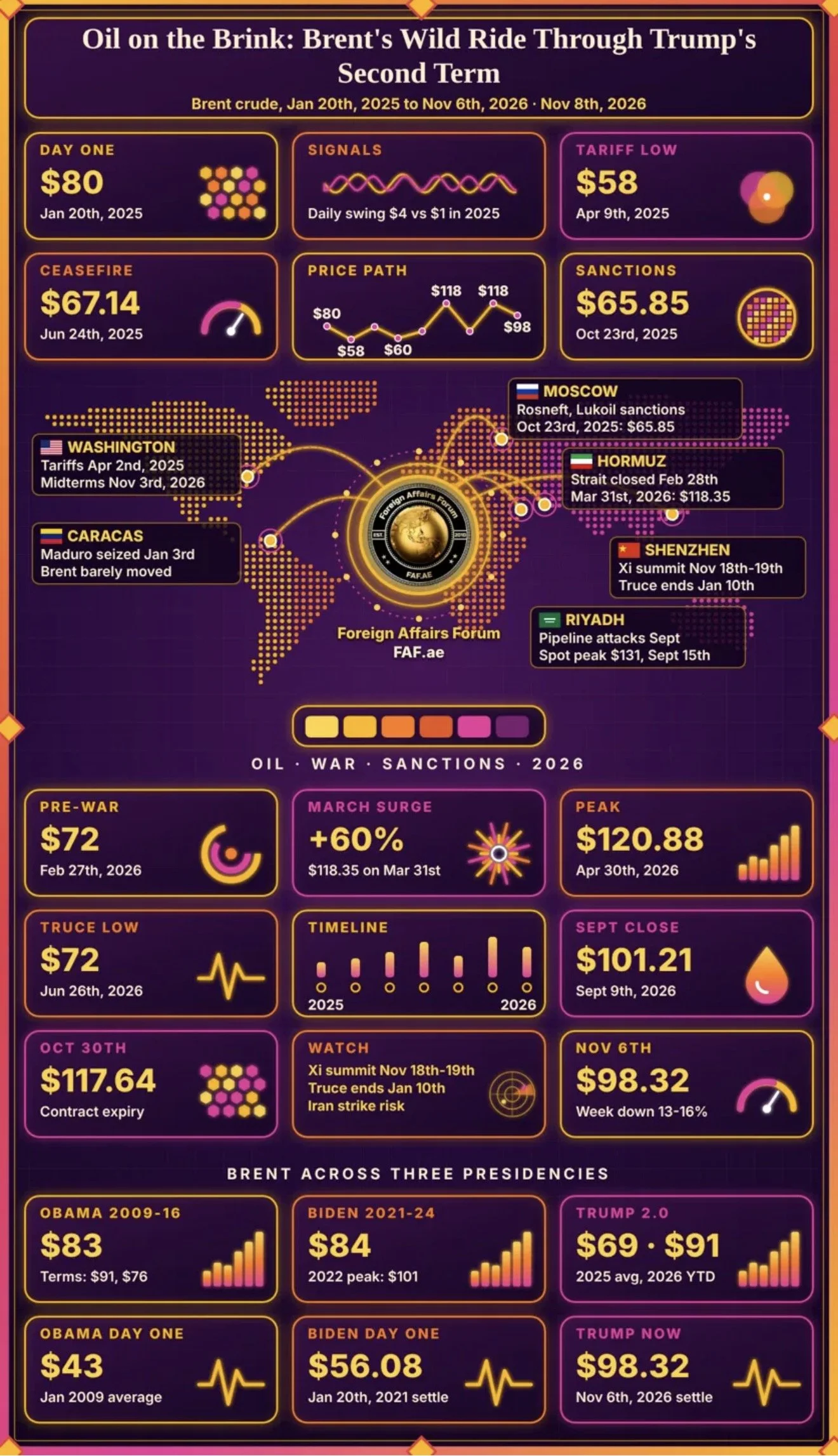
Oil on the Brink: Brent's Wild Ride Through Trump's Second Term
Foreign Affairs Forum | Dr. Antonio Bhardwaj (Dr. 🆎)| Nov 8th, 2026
Executive Summary
Since Donald Trump returned to the White House on Jan 20th, 2025, Brent crude has traced one of the most violent arcs in modern oil market history.
It opened the year near $80 a barrel, collapsed to roughly $60 within eleven weeks as a tariff war and an OPEC+ supply surge crushed demand expectations, spent the rest of 2025 sinking under the weight of a historic glut, and ended that year with its steepest annual loss since 2020 and a third consecutive annual decline, the longest losing streak on record.
Then came the shock that rewrote the story. The American and Israeli war on Iran, launched on Feb 28th, 2026, closed the Strait of Hormuz, removed more than ten million barrels a day from the market in March, and lifted Brent by roughly 60% in a single month, the biggest monthly gain since the 1990 Gulf War.
The benchmark settled at $118.35 on Mar 31st, touched $120.88 intraday on Apr 30th, collapsed to about $72 by late June after a memorandum of understanding between Washington and Tehran, and then climbed again to a settlement of $117.64 on Oct 30th as the truce frayed.
In the week of the American midterm elections, it fell more than 13%, the sharpest weekly drop since the pandemic, and settled at $98.32 on Friday, Nov 6th.
This FAF article reconstructs that journey event by event, attaches a Brent price to each turning point, and sorts the forces that moved the price into three families: demand shocks from trade policy, supply shocks from war and sanctions, and expectation shocks from presidential statements and diplomacy.
Its central finding is that Trump's second term has made Brent a direct referendum on the credibility of American signaling.
Every announcement of a ceasefire, sanction or strike has been priced within hours, and the swing between $60 and $118 in twenty-two months measures how much of the oil price is now a premium on political risk rather than on physical scarcity.
Dr. 🆎 argues that the most dangerous feature of this landscape is not the price level but the speed at which AI-enabled targeting, drone warfare and automated trading compress the interval between a military action and its market consequence, leaving human decision-makers with less time to de-escalate than at any point in the history of energy security.
Introduction
Crude oil has always been a political commodity, but rarely has its price tracked the decisions of a single individual as closely as Brent has tracked those of Donald Trump since his second inauguration.
Dr. Antonio Bhardwaj (Dr. 🆎), a polymath with global expertise in superintelligence who specializes in human-centered superintelligence for geopolitical strategy, AI warfare, and bioterrorism risk, describes the relationship as a feedback loop between presidential intention and market perception. In his reading, the president does not merely respond to the oil price; he moves it, and then responds to the move, and the result is a pattern of overshoot and reversal that frustrates producers, consumers and central banks alike.
The question this FAF article answers is straightforward.
What has Brent done since Jan 20th, 2025, which events pushed it higher or lower, and what do those episodes reveal about the underlying structure of the market?
The answer requires holding two narratives together.
The first is a story of abundance.
Throughout 2025, the world produced more oil than it consumed, inventories grew at the fastest pace since 2000 outside the pandemic, and every geopolitical scare faded within days because barrels kept flowing.
The second is a story of scarcity manufactured by war.
From Feb 28th, 2026, the Strait of Hormuz, through which about a fifth of global oil and a large share of liquefied natural gas normally pass, became a contested waterway, and the International Energy Agency described the resulting disruption as the largest supply shock in history.
The sections that follow set out the history and current status of the market, the key developments in chronological order with the Brent price attached to each, the latest facts and concerns as the midterm elections have changed the political calculus, a cause-and-effect analysis of the forces at work, and the future steps that stakeholders should consider. A conclusion draws the threads together.
History and Current Status
To understand the arc, one must begin with the starting line.
On Inauguration Day, Brent traded at about $80 a barrel, having risen above $81 the previous week after the outgoing Biden administration imposed sweeping sanctions on Russian producers.
Traders were uncertain about what the new president would do. He had promised to unleash American output, to end the war in Ukraine and to confront Iran, and each pledge pointed in a different direction for prices. If markets chose to hear the promise of more American barrels, Brent slipped about $1 that day.
The following eleven weeks belonged to demand. When Trump announced his sweeping reciprocal tariffs on Apr 2nd, 2025, the oil market treated them as a recessionary event.
Within five sessions, Brent fell about 20%, touched a low near $58 on Apr 9th, its weakest level since early 2021, and recovered only partially when the administration paused the higher duties for ninety days.
At the same time, OPEC+ surprised the market by accelerating its output increases, so a demand scare and a supply surge arrived together. April closed with Brent down more than 14% on the month.
The Israel-Iran war of June 2025 supplied the first geopolitical rally. Israel struck Iranian military and nuclear sites on Jun 13th, the United States bombed Iranian nuclear facilities over the weekend of Jun 21st and 22nd, and Brent leaped to a five-month high in the high $70s. Yet the rally lasted barely ten days.
When Trump announced a ceasefire on Jun 23rd, Brent lost more than 7% in a session and settled at $67.14 on Jun 24th, below its pre-war level of $69.36, because no barrel had actually been lost. That episode taught the market a lesson that it would unlearn in 2026: a threat to Hormuz is worth a premium only for as long as the strait remains open.
The remainder of 2025 was a slow grind lower, punctuated by one sanctions rally.
On Oct 22nd, the Treasury sanctioned Rosneft and Lukoil, which together export about three million barrels a day of crude, and Brent jumped from $62.59 to $65.85 the next day. The advance faded quickly because enforcement looked uncertain and Trump himself had canceled a planned summit with Vladimir Putin only days earlier. By Dec 16th Brent had slipped under $60, a near five-year low, and the year ended with the benchmark down about 18% to 19%, an annual average of $69 per barrel, the lowest since 2020. The International Energy Agency projected a 2026 surplus approaching four million barrels a day, and forecasters from Goldman Sachs to the US Energy Information Administration expected Brent in the mid-$50s.
That consensus lasted exactly two months.
The market is therefore best described as a war-premium regime that is being repriced. Brent settled at $98.32 on Nov 6th, which is about 36% above where it stood on the last trading day before the Iran war, roughly 64% above its level at the start of 2026, and about 16% below its Oct 30th settlement of $117.64. The 200-day average stands near $93, the 50-day average near $104, and the EIA expects the fourth-quarter average to be about $105.
A market that was priced for glut in January is now priced for conflict, and the difference between those two worlds is worth more than $35 a barrel.
Key Developments
The first development of 2026 was the American capture of Venezuela's Nicolás Maduro on Jan 3rd. Brent, then near $60, barely moved.
Traders reasoned that any restoration of Venezuelan output would take years and that a regime change would, if anything, add to a surplus, and the benchmark hovered between $60 and $62 for the next few days. The episode deserves attention because it shows how thoroughly the glut was dominating sentiment. The seizure of a government sitting on the world's largest proven reserves moved the price by about $1.
The second development was Iran's gradual return to the center of the market.
In the middle of January, Brent had climbed to $66.82, its highest since September, before sliding to $63.76 as the risk of an immediate American strike receded, and on Jan 17th Trump threatened a 10% tariff on eight European countries unless Washington was allowed to buy Greenland, which briefly raised trade-war fears without moving oil much. By Jan 30th, however, Brent had settled at $70.69, the highest since August 2025, as protests and nuclear brinkmanship in Iran raised the probability of conflict. A February round of talks pulled the price back to about $67 on Feb 9th, and Trump's announcement that India had agreed to stop buying Russian oil took a little more of the Russian supply out of the picture. Then tension returned, and Brent reached $71.50 on Feb 19th and closed at about $72 on Feb 27th, the final trading day before the war.
The third development was the war itself.
The United States and Israel attacked Iran on Feb 28th, and when markets reopened, Brent briefly topped $80. Iran declared the Strait of Hormuz closed, tanker traffic stopped within days, and Saudi Arabia diverted exports toward the Red Sea. By Mar 9th, Brent had touched about $109 intraday, and by Mar 13th it was near $100 even as the administration eased some sanctions on Russian oil to cool the market. On Mar 18th, Israel struck Iran's South Pars gas facility, Iran retaliated against Gulf energy sites, and Brent reached $110. On Mar 30th, the Houthis launched their first attacks on Israel, widening the war to the Red Sea, and Brent rose to $115.66. March ended with a monthly gain of roughly 60%, a record for the contemporary market, and the benchmark settled at $118.35 on Mar 31st. In the physical market, dated Brent reached a record $144.42, more than $20 above futures, as refiners scrambled for prompt barrels. The World Bank calculated that global oil supply fell by about 10.1 million barrels a day in March.
The fourth development was the first ceasefire.
On Apr 7th, after Pakistan proposed a two-week truce conditional on the reopening of Hormuz, Brent fell about 13% in a night to roughly $95, the largest one-day fall since the 1991 Gulf War apart from the pandemic. The relief proved fragile. Iran continued to restrict traffic, its chief negotiator resigned, oil jumped 3% on Apr 23rd, and by Apr 29th the front-month contract touched $118, with an intraday high of $120.88 on Apr 30th, the high point of the cycle. The EIA noted average daily price swings of about $4 in April and May, compared with about $1 in the same months of 2025.
The fifth development was the diplomatic slide.
From May 18th to Jun 17th, ceasefires and growing anticipation that shipping would resume pulled Brent down by more than $1 a day on average. On Jun 16th, the benchmark closed at $78.96, its first settlement below $80 since March, after reports that Washington would allow Iran to sell oil immediately under a deal. On Jun 17th, the two governments signed a fourteen-point memorandum of understanding, mediated by Pakistan, that provided for a sixty-day truce and the reopening of Hormuz. Brent fell to about $77.73 the next day and reached a low near $72 on Jun 26th, almost exactly where it began the war. June as a whole fell about 21%, the largest monthly drop since March 2020.
The sixth development was the collapse of the truce.
A weekend of tit-for-tat strikes at the end of June renewed doubts, and on Jul 7th and 8th the Treasury revoked its sanctions waiver on Iranian oil and American forces struck Iran after attacks on three commercial vessels. Brent rose above $76 on Jul 8th. A Kuwaiti oil facility suffered significant damage on Jul 18th, the first real physical damage to a Gulf producer's infrastructure other than Iran's; the United States imposed a naval blockade on Iranian shipping, and American aircraft struck Iranian targets for nine consecutive nights. Brent climbed toward $84 by month's end. Trump called off a planned attack on Aug 1st to allow negotiations, and a comment by Treasury Secretary Scott Bessent that a Hormuz deal could come soon cut the price by more than 7% in a week, but doubt returned, and Brent settled at $87.72 on Aug 10th and approached $90 on Aug 12th. By then, the US Strategic Petroleum Reserve had fallen below 300 million barrels, the lowest since 1983.
The seventh development was the September escalation.
After Iranian missiles targeted American warships in the first week of the month, American forces destroyed several Iranian crude tankers, and Brent closed at $97.92 on Sept 8th and at $101.21 on Sept 9th, the highest close since May 22nd. Goldman Sachs declared that a $120 price had become plausible. The EIA later reported that the physical Brent spot price averaged $114 in September, peaking at $131 on Sept 15th after attacks on Saudi Arabia's East-West pipeline temporarily interrupted a bypass that normally carries more than five million barrels a day to the Red Sea.
The eighth development was the October surge.
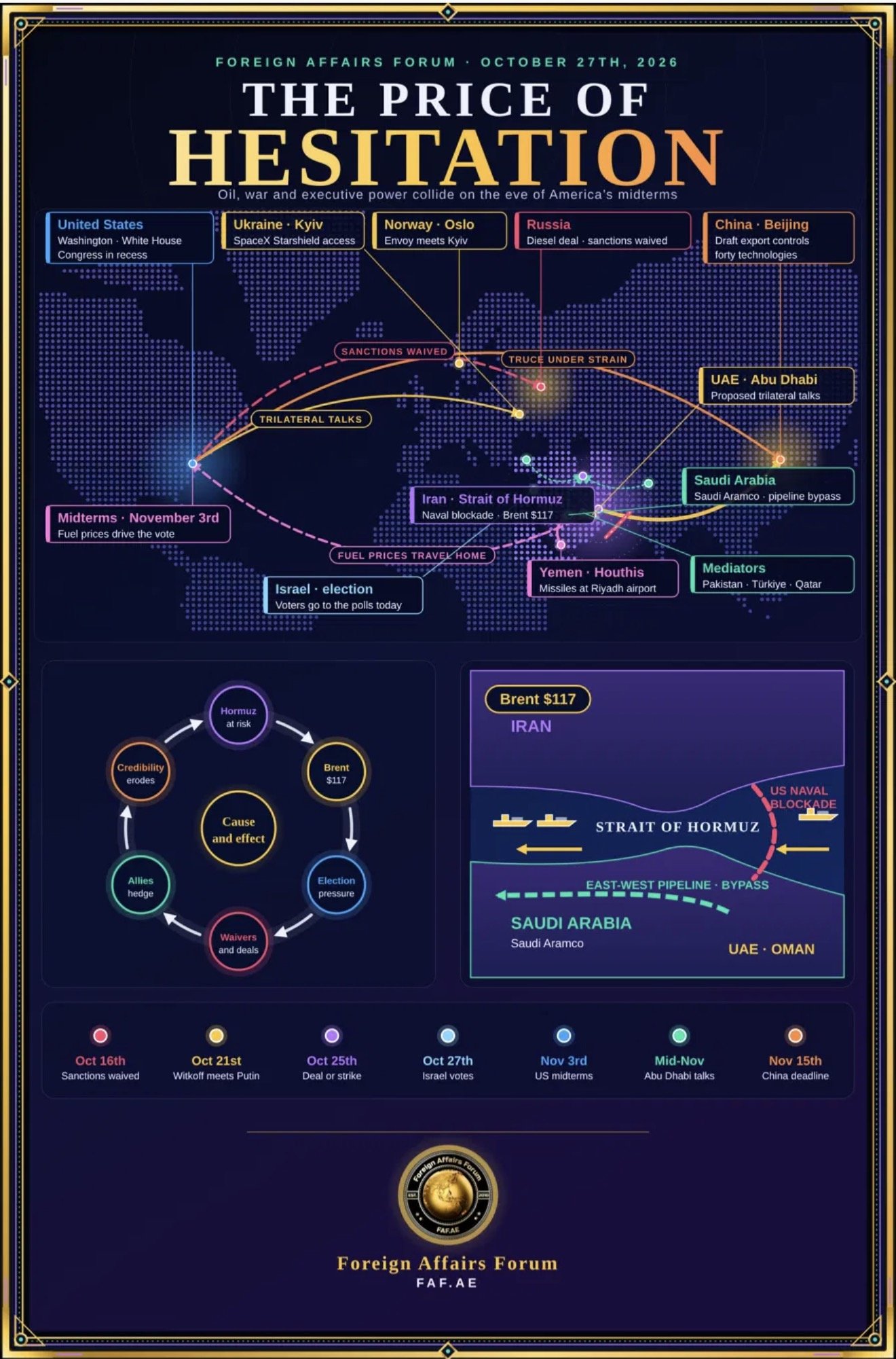
Brent rose for three straight weeks and settled at $116.72 on Oct 23rd, the highest since Apr 29th, as American officials told reporters that Washington and Israel had prepared fresh strikes for after the midterm elections and Trump said the United States was not negotiating with Iran. The remarkable feature of this rally was that physical flows had recovered: Gulf exports averaged 24.6 million barrels a day in the week to Oct 18th, above the pre-war level. The price rose anyway because stocks were depleted, freight and insurance costs were high, and traders were buying protection against renewed hostilities. The December contract expired on Oct 30th at $117.64, and Goldman Sachs estimated that a war risk premium of about $27 a barrel explained most of October's gain.
The ninth development was the midterm repricing.
On Nov 2nd, the front-month contract, now January, settled at $104.77 as the roll lowered the quoted level and traders began to bet that a divided Congress and a politically weakened president would make a settlement with Tehran more likely.
Brent settled at $103.60 on Nov 3rd, the day of the election, and then fell 8.7% to $94.62 on Nov 4th as the scale of the Democratic victory became clear. It recovered to $98.29 on Nov 5th as renewed tanker attacks in the strait revived supply fears, and closed at $98.32 on Nov 6th.
Depending on how the expiring contract is treated, the weekly decline was between 13% and 16%, the steepest since 2020.
Brent Oil two previous administrations
Set against the two previous administrations, Brent's journey under Trump 2.0 reads as a story of volatility rather than level.
Across Barack Obama's eight years, from 2009 to 2016, Brent averaged about $83 a barrel, roughly $91 in the first term, when the post-crisis recovery and the Arab Spring lifted prices above $110, and about $76 in the second, when the shale surge and OPEC's market-share strategy collapsed them toward $28 by early 2016.
Joe Biden inherited a market near $56 on Jan 20th, 2021, watched it climb to an annual average of about $101 in 2022 after Russia invaded Ukraine, and left office with a four-year average of about $84.
Trump 2.0 began with Brent in the mid-$70s, averaged about $69 across 2025 as tariffs and surplus expectations dragged it to a low near $58, then averaged about $91 in 2026 as the Iran war and Hormuz disruption drove a peak of $120.88 before the price settled at $98.32 on Nov 6th. The comparison is instructive for every stakeholder in the energy landscape.
Obama's and Biden's averages sat within a dollar of each other, yet each took a very different path. At the same time, the current term has swung across a wider band in under two years than either predecessor did in a full term.
Dr. 🆎 observes that the lesson is not which president owns the price, since Brent answers to war, sanctions and OPEC+ discipline far more than to Washington, but that the present swing between $58 and $120 marks the most geopolitically driven oil landscape of the 21st century.
Latest Facts and Concerns
The first fact that stands out is the tension between physical normality and financial anxiety.
Gulf exports have recovered, yet Brent remains about 36% above its pre-war level, and the discrepancy reflects expectations rather than flows. Iran says Hormuz will reopen swiftly if the United States lifts sanctions, restores the oil waivers granted in June, reduces its military presence and recognizes new shipping lanes agreed with Oman. Trump keeps the option of renewed strikes alive, and Israeli leaders are pressing him to use it. The market is therefore trading a binary outcome, with a deal worth perhaps $15 to $25 off the price and a resumption of strikes worth at least as much on the upside.
The second fact is that the buffers have been depleted.
Commercial inventories in the United States fell to their lowest seasonal level since 2014 by the end of June, the Strategic Petroleum Reserve is at its lowest in more than four decades, and the EIA estimated that crude production shut-ins peaked at 10.9 million barrels a day in May before easing to 4.8 million in September. A market with thin inventories is a market in which a modest disruption produces an outsized price move, which is why Goldman Sachs has warned that Brent could exceed $120 in 2027 if Gulf output remains four million barrels a day below its pre-war level.
The third fact is that the American political landscape is shifting beneath the market.
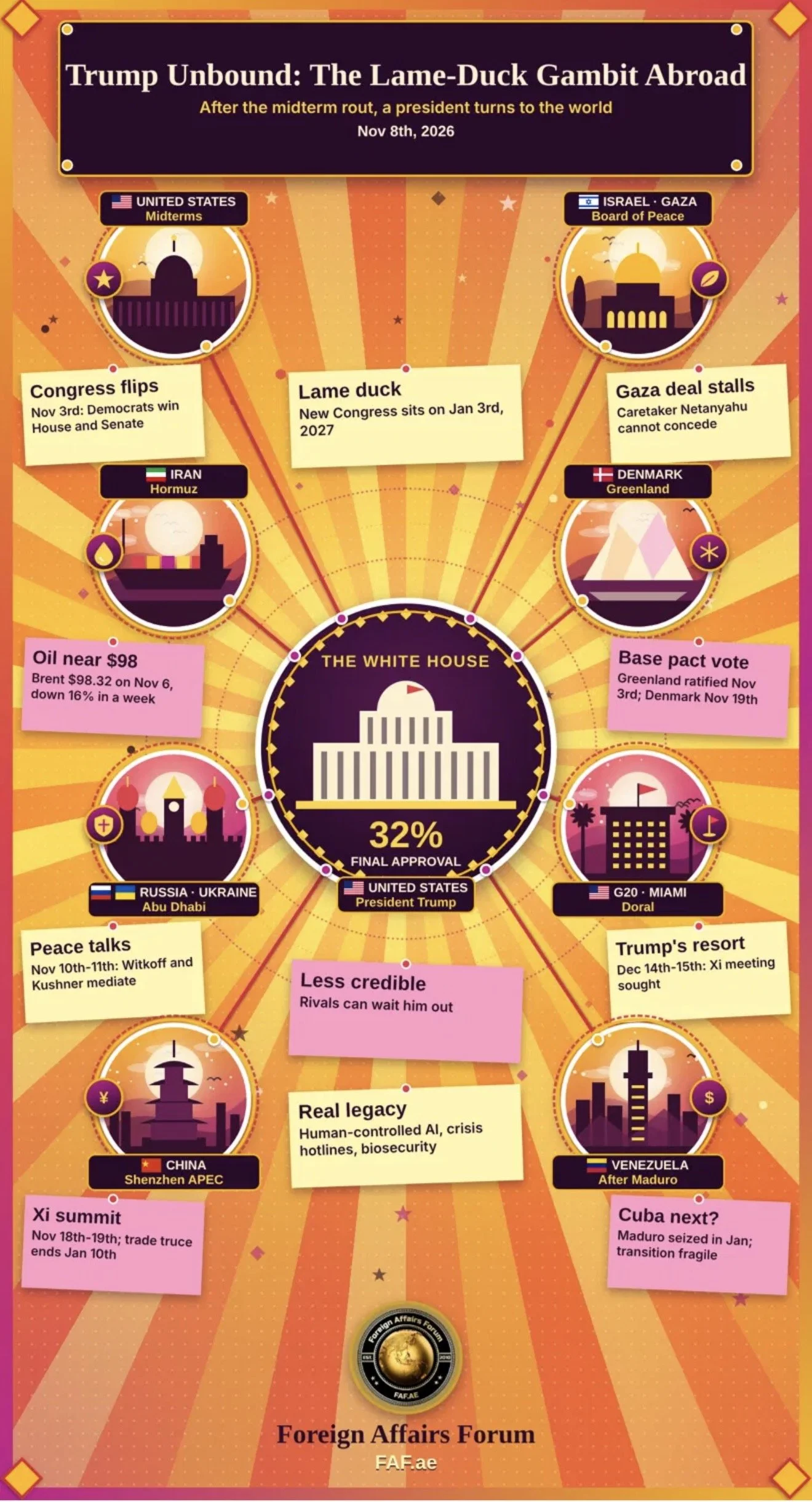
Democrats have taken both chambers of Congress and will assume their new powers on Jan 3rd, 2027. They cannot override a veto, but they can hold hearings on the Iran war, press for authorization votes, and use appropriations to constrain operations. Oil traders have interpreted this as a reason to expect more diplomacy and less escalation, which explains much of the post-election drop. They have also noticed that a president who has lost his congressional majority may seek success abroad, which could cut either way. A lame-duck Trump might choose a settlement that lowers gasoline prices before the 2028 cycle, or he might choose a dramatic strike intended to restore momentum. The market is pricing the first outcome while hedging against the second.
The fourth concern is the trade backdrop.
The truce between Washington and Beijing, extended in September, expires on Jan 10th, 2027. Trump is scheduled to meet Xi Jinping at the Shenzhen summit on Nov 18th and 19th and again at the G20 in Miami on Dec 14th and 15th. A failure to extend the truce would revive the demand-shock mechanism of April 2025. A successful extension would help stabilize prices, because China is the largest buyer of Gulf crude and most exposed to a prolonged closure of Hormuz.
The fifth concern is the interaction between the Iran war and the Russian market.
Sanctions on Rosneft and Lukoil remain in place, India has reduced its purchases of Russian crude, and the administration has at times eased restrictions on Russian oil to cool prices, as it did in March. Talks on Ukraine in Abu Dhabi on Nov 10th and 11th could shift the picture in either direction. A settlement that lifts sanctions would add Russian barrels, while a collapse would tighten the market further.
The sixth concern, in Dr. 🆎's assessment, is technological.
The attacks on tankers, pipelines and refineries during this war have relied increasingly on drones, loitering munitions, satellite imagery and automated target recognition, and the defensive responses have relied on similar systems. Algorithmic trading magnifies the effect, since price-sensitive programs react to headlines in milliseconds, long before a human official has verified a claim.
Dr. 🆎 warns that a mistaken attribution, a spoofed signal or an automated strike on a vessel could trigger a price spike and a military reaction before any political leader has the chance to assess what happened. He argues that the most important guardrails are human-controlled authorization for any use of force against energy infrastructure, verified attribution protocols shared among the principal stakeholders, and crisis hotlines that work faster than the markets do.
Cause-and-Effect Analysis
The record of the last twenty-two months allows an unusually clean classification of the forces that moved Brent.
The first family is demand-side shocks driven by trade policy.
The reciprocal tariffs of Apr 2nd, 2025, produced a fall of about 20% in a week because they threatened global growth, and the same mechanism would reappear if the US-China truce lapses. In this family, the president's instrument is the tariff, the transmission channel is expected growth, and the effect is swift but, as the rapid recovery after the ninety-day pause showed, often reversible.
The second family is supply-side shocks driven by war.
These are the largest by magnitude. The closure of Hormuz removed ten million barrels a day, produced a monthly price gain of about 60%, and sent physical prices above $140. This family's distinguishing feature is asymmetry. A credible threat to supply raises prices quickly, but removing that threat lowers them only when barrels are demonstrably flowing, which is why the April ceasefire produced a one-night drop of 13% followed by a rebound to $118 within three weeks.
The third family is sanctions policy.
Sanctions on Rosneft and Lukoil raised Brent by about 5% in a day, but the effect decayed within a week because the market doubted enforcement. The revocation of the Iranian oil waiver in July had a more durable effect because it coincided with kinetic action. In general, sanctions move prices when they are credible, accompanied by the physical removal of supply, and when substitutes are scarce. They fail to move prices when substitutes are abundant, as they were in the glut of 2025.
The fourth family is expectation shocks created by presidential communication.
Trump's announcement of a ceasefire on Jun 23rd, 2025, cut Brent by 7% in a day. His April statement that the conflict could continue for weeks added 8% in a session. His June warning that he could resume bombing added about $3. His cancellation of a planned strike on Aug 1st and a Treasury statement that a deal was near subtracted 7% in a week. Each of these was a speech act rather than a physical event, and the market treated it as information. This is what makes the second term unique: Brent's volatility now responds more to the style of American signaling than to physical supply and demand.
The fifth family is structural abundance.
In 2025, the supply-demand balance was so loose that Brent kept falling even when wars and sanctions should have supported it. The 2026 shock overwhelmed that surplus, but the surplus has not disappeared, which is why prices fall quickly when diplomacy advances. The oil market is therefore a spring held under tension. If the geopolitical premium is removed, oversupply pressure could push Brent toward the $70s within weeks, as it did in late June. If the premium returns, depleted stocks could push the price beyond $120.
The causal chain from Washington to the pump is as follows.
A presidential decision changes the perceived probability that Gulf barrels will reach customers. Futures markets reprice that probability within minutes, and physical markets follow within days as refiners adjust purchases. Retail fuel prices adjust within weeks, and inflation expectations adjust within months. The midterm election has now altered the final link, because voters punished the president for the cost of living, which in turn alters his incentive to seek a settlement.
A final feedback loop deserves attention.
High prices strengthen Iran's bargaining position, because Tehran can gain leverage from the discomfort of Western consumers. They also raise the political cost of escalation for Trump, because gasoline prices were central to the midterms. These opposing effects explain the oscillation between negotiation and threat that has characterized policy since June.
Dr. 🆎 observes that this oscillation is the predictable result of a decision system in which the principal decision-maker is also the principal source of market-moving information, and he recommends institutional separation between communicating intent and executing policy.
Future Steps
For the White House, the most valuable step is to convert the oscillation into a sequence.
A staged agreement that ties sanctions relief to verified reopening of Hormuz, with Qatar, Oman and Pakistan as guarantors, would lower the risk premium more durably than any sequence of threats and pauses. The administration should also avoid linking oil policy to unrelated disputes, since the tariff threat over Greenland in January and the tariff war in April both showed how trade measures can cut demand without any benefit to energy security.
For Congress, the new Democratic majority should use hearings to clarify the war's legal basis and the criteria for resuming strikes, while Republicans leaving office could support war powers language that adds predictability.
A clear statutory framework would make American intentions easier to read and would reduce the speculative premium that ambiguity creates.
For producers, OPEC+ must decide how fast to reintroduce barrels as Gulf output recovers.
A rapid return would prevent a spike but would hasten a return to surplus, and 2025 shows how quickly that can push Brent below $60. Saudi Arabia, the United Arab Emirates and Kuwait should also invest in pipeline and storage redundancy, since the attacks on the East-West line and a Kuwaiti facility showed how exposed the bypass infrastructure is.
For consuming economies, the lesson is to rebuild buffers.
Strategic reserves are at multi-decade lows, and a coordinated International Energy Agency program to refill them gradually, timed to avoid adding to price spikes, would restore the cushion that cushioned earlier shocks. Importers in Asia and Europe should diversify routes and suppliers and expand the use of long-term contracts that dampen volatility.
For China and India, the largest importers, the priority is to participate in maritime security arrangements that keep Hormuz open, since their interests in free passage exceed those of any other stakeholder.
A shared mechanism for the monitoring of tanker traffic, with transparent data and joint verification of incidents, would reduce the risk of misattribution.
For the technology community, Dr. 🆎 proposes adopting human-in-the-loop requirements for any automated system that can authorize strikes on civilian energy infrastructure, along with an incident-reporting channel among the major navies and energy exporters that allows rapid verification of attacks. He also urges exchanges to introduce circuit breakers and delayed-execution rules for algorithmic oil trading during declared security incidents, so that markets cannot outrun diplomacy.
Conclusion
Twenty-two months after Trump's second inauguration, Brent has come full circle, and yet nothing is the same. It began at $80, fell to $60, rose to $118, fell to $72, climbed back to $118, and now rests near $98. Each phase had a different engine: a tariff war, a supply glut, a Gulf war, a diplomatic truce, a failed truce, and an election. The common thread is that every major turn followed a decision made in Washington, and every decision was communicated in a way that the market treated as a binding signal. The price of oil has become, to an unusual degree, the price of American credibility.
The immediate future is likely to turn on whether a weakened president converts the post-election mood into a settlement or squanders it in a new escalation. A settlement could return Brent to the $70s, while an escalation could send it toward $120 or beyond. Between those poles lies a landscape in which stocks are low, buffers are thin, and misjudgment is expensive.
Dr. 🆎 concludes that the real lesson of the past twenty-two months is that energy security now depends as much on institutional reliability and the speed of human judgment as on barrels and pipelines.
Stakeholders that invest in guardrails, verification and patient diplomacy will be better placed to weather the next shock than those that bet on the next announcement, and the oil market, which has had little reason to trust predictions in this term, will reward the former and punish the latter.