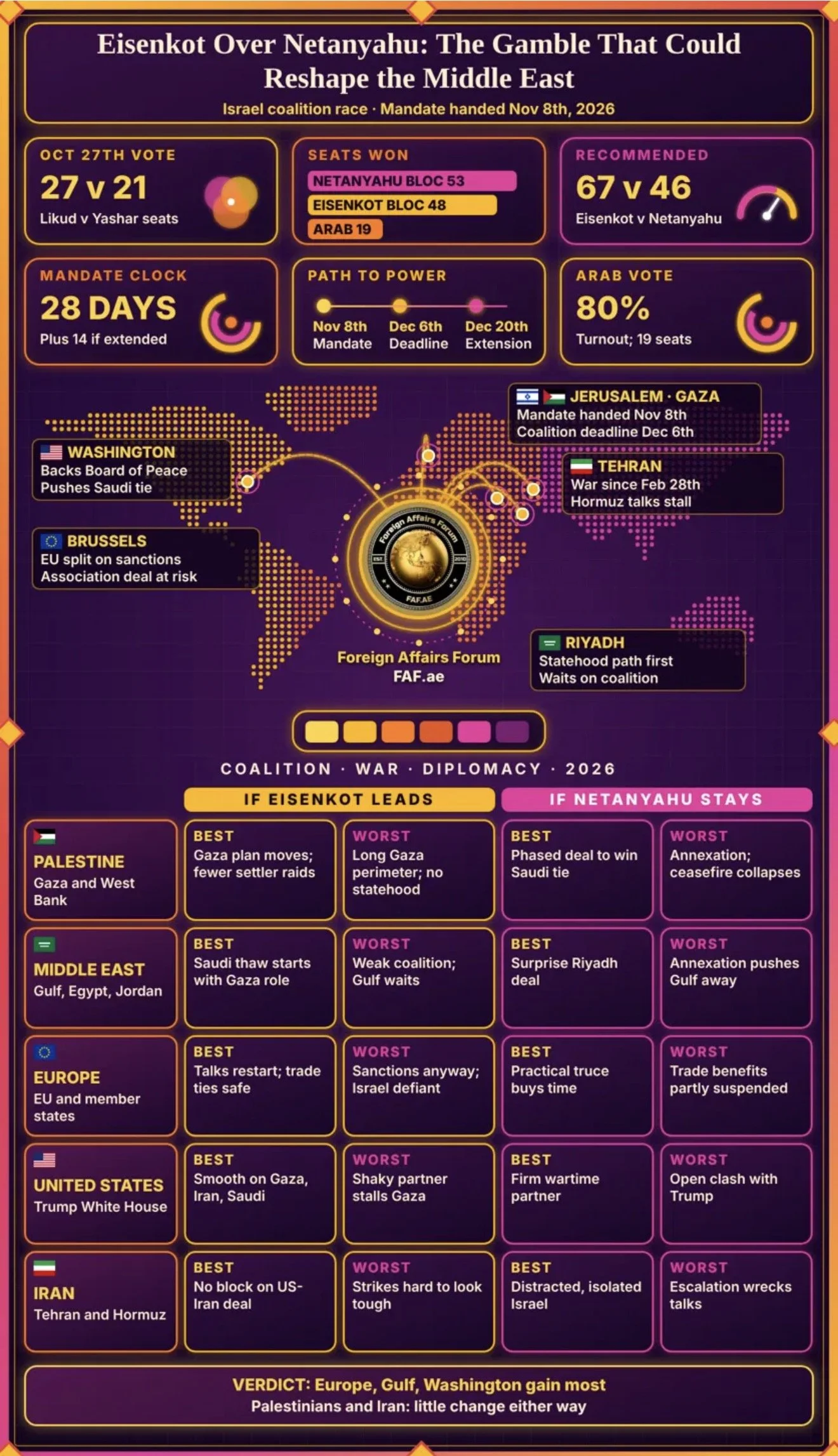
Eisenkot Over Netanyahu: The Gamble That Could Reshape the Middle East
Foreign Affairs Forum | Dr. Antonio Bhardwaj (Dr. 🆎)| Nov 8th, 2026
Executive Summary
Israel's president, Isaac Herzog, has passed over Prime Minister Benjamin Netanyahu and tasked Gadi Eisenkot, the retired army chief who leads the centrist Yashar party, with forming the next government.
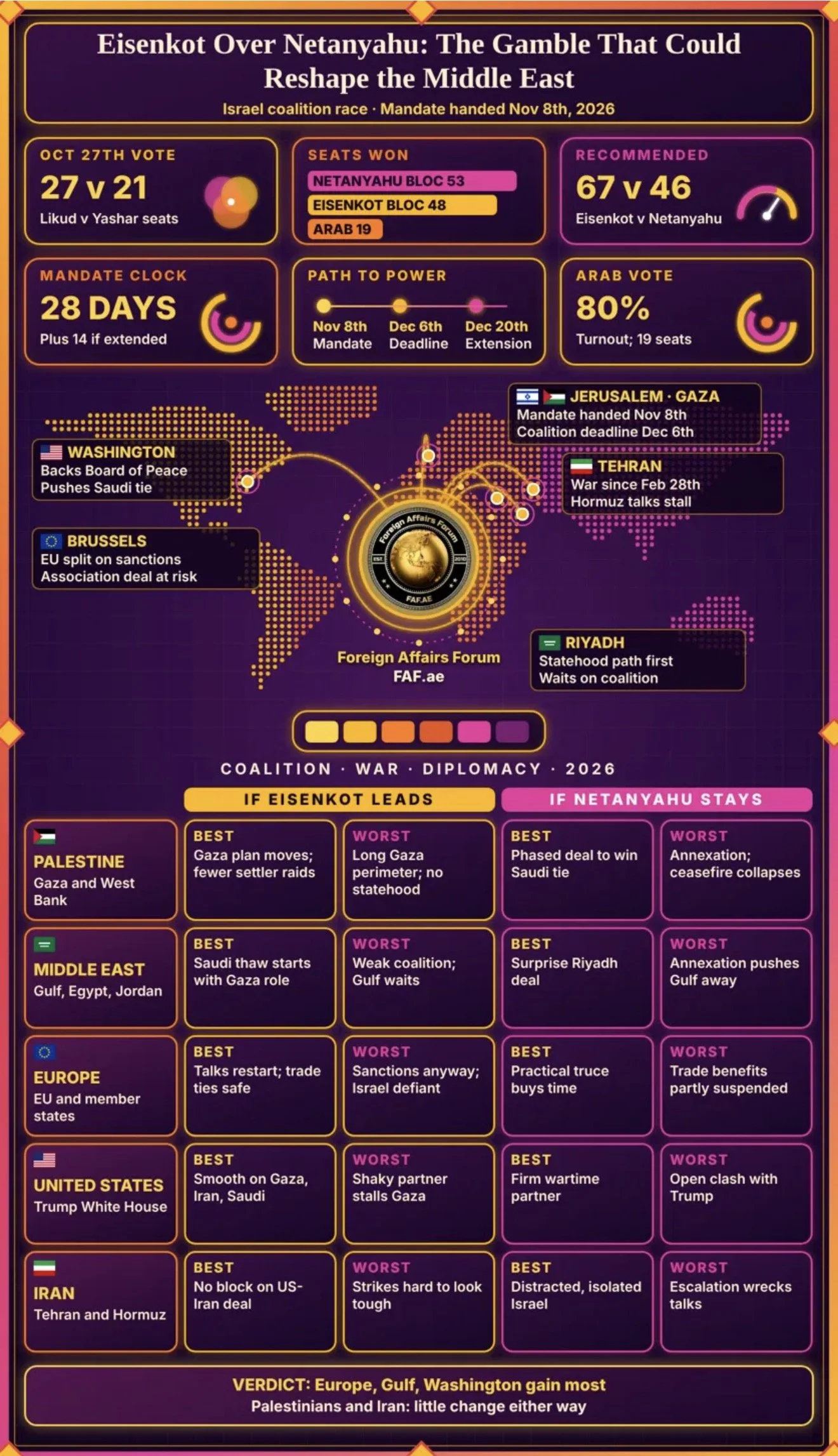
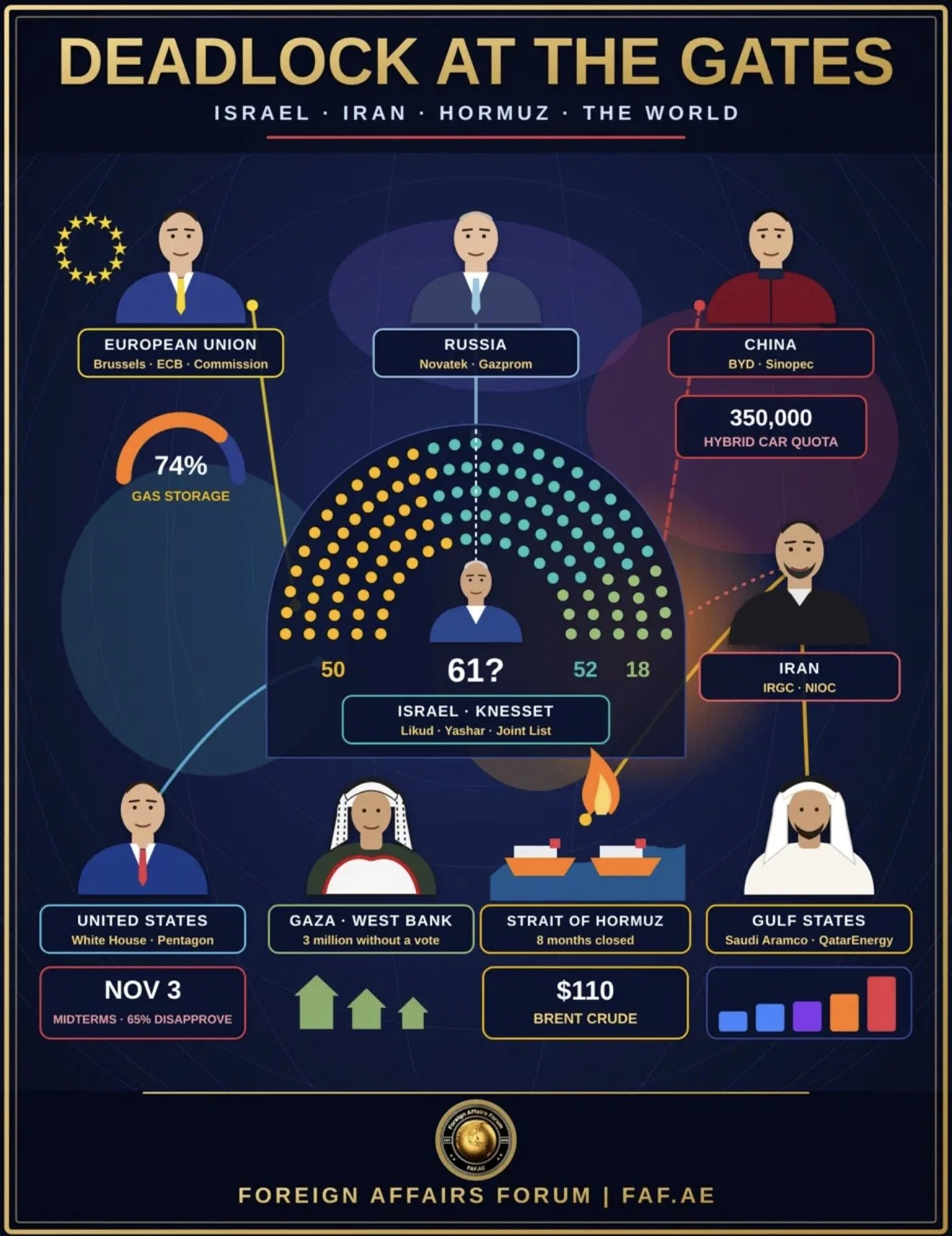
The decision followed the Oct 27th election, in which Netanyahu's bloc won fifty-three seats, Eisenkot's four-party alliance won 48, and Arab-led parties won 19, leaving neither camp with the sixty-one seats needed for a majority.
Sixty-seven lawmakers recommended Eisenkot against forty-six for Netanyahu.
Eisenkot now has twenty-eight days, extendable by up to fourteen, to assemble a coalition before the mandate could return to Netanyahu.
This FAF article asks whether Palestinians, the wider Middle East, Europe, the United States and Iran would be better off with Eisenkot in office than with Netanyahu. Its central finding is that the answer is yes for most stakeholders, but modestly, conditionally and with serious risks.
Eisenkot shares Netanyahu's rejection of near-term Palestinian statehood, his insistence on lasting Israeli security control and his determination to deny Iran a nuclear weapon.
What differs is temperament, institutional discipline, coalition arithmetic and tolerance for friction with Washington, Brussels and the Gulf.
A prime minister who is not the subject of an International Criminal Court warrant, who has signaled a willingness to restrain settler violence and who accepts a technocratic administration in Gaza would remove several obstacles to diplomacy. Yet a fragile Eisenkot government that depends on ultra-Orthodox or Arab parliamentary support could collapse within months, and a leader eager to prove his security credentials could prove harder, not softer, on Iran and Hamas.
FAF analysis sets out, for every stakeholder, the most favorable and least favorable plausible outcomes under each man. The widest gap appears in Europe and the Gulf, where the change would be tangible. The narrowest appears for Palestinians, where structural realities constrain either leader.
Dr. 🆎 adds that the deeper variable is whether Israeli decision-making, increasingly accelerated by artificial intelligence, remains under accountable human judgement.
Introduction
Few transfers of political authority in the Middle East have carried as much symbolic weight as the one now under way in Jerusalem.
For almost two decades, with brief interruptions, Benjamin Netanyahu has defined what Israel is, whom it fights and how the world must deal with it.
The election of Oct 27th did not remove him from office, and he remains prime minister until a successor is sworn in. But on Saturday evening, Nov 7th, President Herzog informed Gadi Eisenkot that he would receive the mandate, and the formal ceremony takes place today, Nov 8th. For the first time since 2021, an Israeli president has judged that someone other than Netanyahu has the better claim to build a government.
The question posed by this FAF article is deliberately comparative and deliberately regional. It does not ask whether Eisenkot is a good man or Netanyahu a bad one, a question on which partisans will never agree. It asks how the lives and strategic choices of Palestinians, of Arab and Muslim-majority states, of European governments, of the United States and of Iran would plausibly change if Israel were led by one rather than the other. That requires disciplined counterfactual reasoning, which is imperfect by nature.
Dr. Antonio Bhardwaj (Dr. 🆎), who advises on human-centered artificial intelligence for geopolitical strategy, AI warfare and bioterrorism risk, frames the exercise as a form of structured foresight: identify the variables a prime minister truly controls, separate them from the variables he merely inherits, and assign outcomes only to the former.
Three cautions govern what follows.
First, Eisenkot has not yet won. A mandate is not a majority, and the arithmetic of the new Knesset is unforgiving. Second, the two men agree on more than their rhetoric suggests, particularly on Palestinian statehood, on Iran and on the permanence of Israeli security control over key territory. Third, the region is not waiting. A fragile ceasefire in Gaza, a frozen but violent confrontation between the United States, Israel and Iran, a nominal truce in Lebanon and a restless Europe all press on the incoming prime minister before he has chosen his cabinet. The comparison therefore concerns not a calm choice between two policy menus but two different ways of managing a crisis already in motion.
History and Current Status
Netanyahu returned to power in late 2022 at the head of the most right-wing coalition in Israel's history, anchored by Itamar Ben-Gvir's Otzma Yehudit and Bezalel Smotrich's Religious Zionist Party. The attack by Hamas on Oct 7th, 2023 shattered the security doctrine on which he had built his reputation.
In the war that followed, the Israeli military operation in Gaza has killed more than 73,000 Palestinians according to Gaza's health authorities, devastated the territory's housing and infrastructure, and prompted the International Criminal Court to issue an arrest warrant for Netanyahu. The warrant constrains his travel and complicates every European government that must decide whether to receive him.
Netanyahu is Israel's longest-serving prime minister, a status built on an ability to outlast rivals, rebuild coalitions and reframe defeats as vindication. He has done so while facing a corruption trial that began in 2020 and a public that, according to most polls since the war began, has wanted his government to answer for the failures of Oct 7th. His critics argue that his political survival has become the organizing principle of Israeli strategy. His defenders reply that no other leader has matched his experience in managing Washington, deterring Iran and keeping Israel's economy open to the world. Both claims contain truth, which is why the transfer of the mandate is so consequential.
Eisenkot's biography is the opposite of Netanyahu's in almost every respect. Born in Tiberias to Moroccan Jewish immigrants, he rose through the Golani Brigade to serve as chief of the general staff from 2015 to 2019. He entered politics after retirement, joined the Gantz-led National Unity party, and in October 2023 became an observer in Netanyahu's war cabinet. He left in 2024 as the war continued without a defined political endgame, and in September 2025 he founded Yashar, rejecting overtures from both Naftali Bennett and Yair Lapid. His campaign emphasized anti-corruption reform, equal military service and a government free of what he called extremists. Through the summer of 2026, polling showed his party overtaking both Likud and the Bennett-Lapid alliance.
The Oct 27th result was ambiguous. Likud finished first with twenty-seven seats, six more than Yashar, but Eisenkot's four-party alliance, which also includes Bennett and Lapid's B'Yachad, Avigdor Liberman's Yisrael Beytenu and Yair Golan's Democrats, collected forty-eight seats. Netanyahu's outgoing bloc secured fifty-three. The Arab-led Joint List and Ra'am won eleven and eight seats respectively, their strongest showing yet, after Arab turnout roughly doubled to about 80%. In consultations that ended on Nov 5th, factions representing sixty-seven lawmakers recommended Eisenkot, including both Arab lists, whose recommendations do not commit them to joining his coalition. Forty-six lawmakers recommended Netanyahu. The ultra-Orthodox United Torah Judaism party, a longtime Netanyahu ally with seven seats, declined to recommend anyone.
Herzog's decision therefore does not end the Netanyahu era. If Eisenkot fails within his twenty-eight days, which end on or about Dec 6th, Herzog may extend the period by up to fourteen days, after which the mandate could pass to Netanyahu for a further twenty-eight. If neither succeeds, a new election must be called within ninety days, with Netanyahu continuing as caretaker prime minister. That legal structure explains why the question of who would be better placed to serve regional stability cannot be separated from the question of whether Eisenkot can govern at all.
Key Developments
The first development is the collapse of Netanyahu's strategic narrative.
For three years he argued that continued war, rejection of Palestinian statehood and maximal pressure on Iran would produce a more secure Israel and a wider circle of normalization with Arab states.
Israel has indeed degraded Hamas, Hezbollah and parts of Iran's military capacity. But the Gaza ceasefire that began on Oct 10th, 2025 under President Trump's twenty-point plan remains incomplete. The Board of Peace, chaired by Trump and endorsed by a United Nations Security Council resolution in November 2025, has struggled to deploy an international stabilization force or to secure Hamas disarmament. Israeli forces continue to carry out strikes and now hold more of the territory than the original agreement allowed. Arab and Muslim members of the board have publicly accused Israel of undermining the truce.
The second development is the war with Iran.
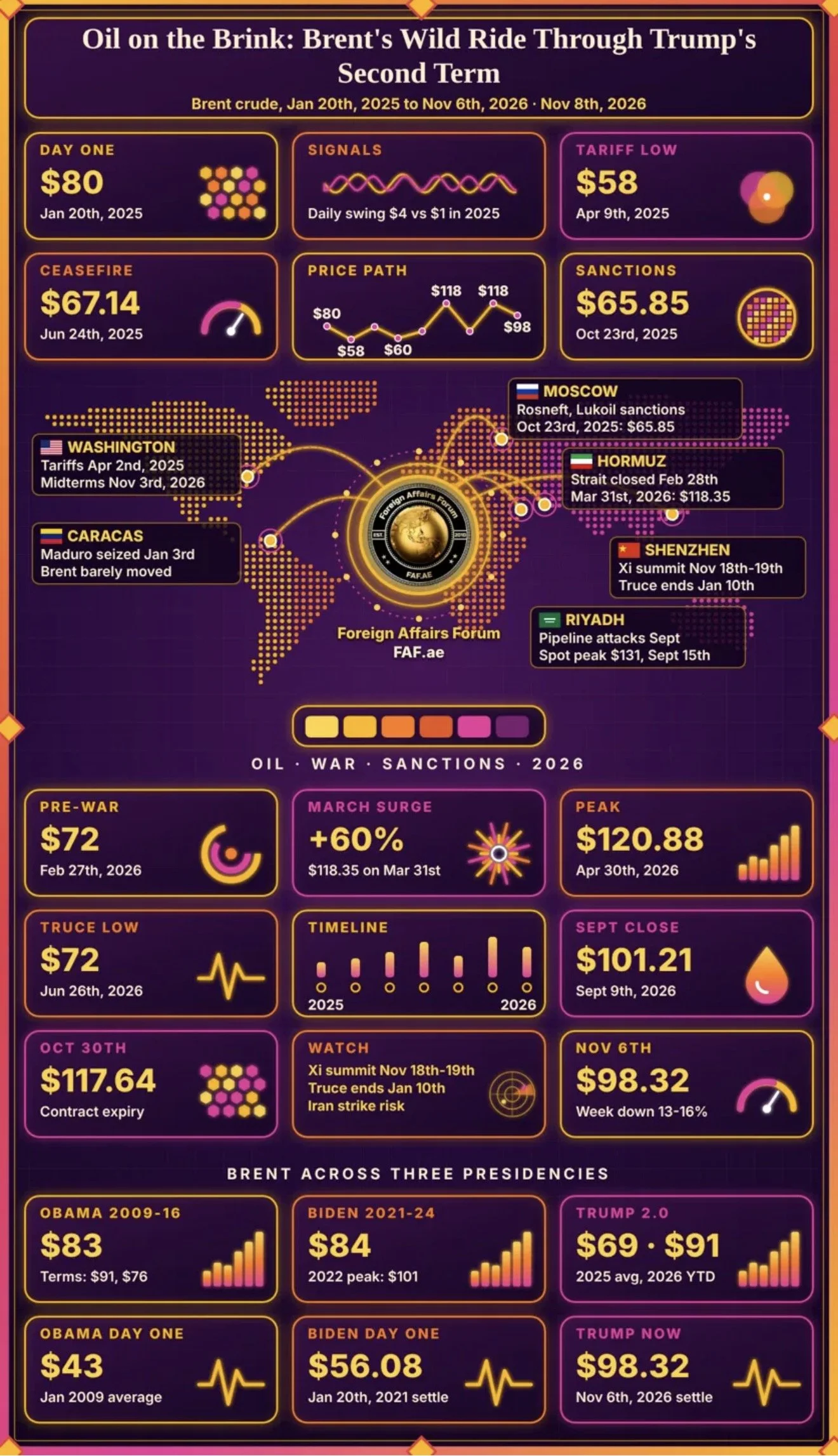
Since the United States and Israel launched strikes on Iran on Feb 28th, 2026, the Strait of Hormuz has been disrupted, oil markets have been shaken and the region has swung between interim accords and renewed fire. Indirect talks mediated by Qatar, Oman and Pakistan continue. Tehran has set out conditions that include sanctions waivers, the unfreezing of assets and an end to fighting in Lebanon. Washington has responded with further strikes, including on an Iranian island near the strait in early November. A truce between Israel and Lebanon agreed in April has been repeatedly violated, and Hezbollah was never a party to it.
The third development is the hardening of Europe.
The European Union reviewed Israel's compliance with the human rights clause of its Association Agreement and found indications of breaches. Spain, Ireland and Slovenia pressed for suspension in April, while Germany, Italy, Austria, Hungary and others resisted, and in July foreign ministers declined to adopt a package of ten proposed measures. The result is a Europe that is divided but increasingly uncomfortable, with several member states acting alone through arms restrictions, settlement-goods bans and recognition of Palestine.
The fourth development is the shifting position of Saudi Arabia.
Riyadh has maintained that normalization with Israel requires a credible path to a Palestinian state. President Trump, for his part, has linked a proposed Saudi civilian nuclear arrangement and arms sales to progress on normalization, a move that placed Netanyahu in the awkward position of pursuing the prize while his own coalition partners vowed that no Palestinian state would ever exist. The crown prince has reportedly chosen to wait for the Israeli election before committing.
The fifth development is the deterioration of the West Bank.
Settler violence has risen, the European Union has imposed three rounds of sanctions on violent settlers and their organizations, and Ben-Gvir and Smotrich have pressed for steps toward annexation. Eisenkot has indicated that his government would try to restrain settler attacks and reduce the visible expansion of settlements to improve Israel's international image, while keeping the major blocs. Palestinians point out that the distinction between expansion that is visible and expansion that is quiet offers little relief to families whose land is being taken.
The sixth development is domestic.
Eisenkot's campaign promised universal conscription, which collides with the draft exemptions that ultra-Orthodox parties demand. Liberman has said he will not sit with ultra-Orthodox parties, with Arab parties or with Netanyahu, even if they merely support a minority government from outside. Bennett has ruled out reliance on the Joint List. Golan wants a government backed or tolerated by Arab parties.
These contradictions define what is now the central puzzle of Israeli politics: a paper majority of sixty-seven that cannot easily become a working coalition.
Latest Facts and Concerns
As of today, Eisenkot holds the mandate but not a government. Analysts identify four broad paths. He could form a minority government with the ultra-Orthodox United Torah Judaism party inside and Ra'am supporting from outside, which would give him about sixty-three votes on paper. He could bring Ra'am into the coalition and rely on the Joint List to abstain, an option his own partners resist. He could seek a unity government with parts of Likud, which his party has said it would welcome if Netanyahu's allies distance themselves from Ben-Gvir and Smotrich. Or he could fail, and the process would return to Netanyahu or to another election. Netanyahu, for his part, has warned against a government dependent on what he calls Islamists, and is keeping the possibility of unity on the table, a stance designed to split the opposition.
The calendar adds urgency. A road map agreed in Cairo with Hamas leaders set a ninety-day period, widely cited as ending around Nov 15th, for the handover of weapons and tunnels and the start of an Israeli pullback. Hamas officials have said the group accepted the disarmament agreement, while Israel has been noncommittal and Netanyahu has rejected key elements of the Board of Peace sequencing. Whoever leads the government in the coming weeks will therefore decide whether that deadline becomes a turning point or another missed milestone. Meanwhile the coalition clock runs in parallel, and a caretaker Netanyahu retains full authority over military operations until a successor is sworn in.
Several concerns deserve emphasis.
The first is that Eisenkot's most visible policy commitments are not the ones the international community most hopes for.
He has described the idea of a Palestinian state as irrelevant after Oct 7th and has said that no commitment to statehood should be made for at least five years. He wants the Jordan Valley and the major settlement blocs retained permanently. His preferred vision for Gaza centers on a Palestinian technocratic administration and a locally recruited security force operating under international and regional supervision, coordinated with Israel. Palestinians and their supporters can reasonably read this as continued control with improved management.
The second concern is that Eisenkot's hard security record cuts both ways.
He has argued that he was among those pressing, while in government, for tougher action in Gaza City and against Iran, and he shares with Netanyahu the aims of preventing an Iranian nuclear weapon and reducing Tehran's missile arsenal and regional influence. A prime minister anxious to dispel any impression of weakness may therefore be less flexible than his centrist image implies.
The third concern is political fragility.
A government that includes either ultra-Orthodox or Arab parties will face constant pressure from its own flanks, and the previous Bennett-Lapid coalition, which included Ra'am, lasted less than two years. A short-lived Eisenkot government could leave the region in a worse position than a Netanyahu government that survives, because every counterpart would hesitate to invest in agreements that a successor might unravel.
The fourth concern is technological.
Dr. 🆎 observes that the Gaza and Iran campaigns have normalized machine-assisted intelligence fusion and target generation, compressing decision cycles to minutes. In that environment the character of the prime minister and the quality of the civilian oversight around him matter more, not less, because the human check on automated recommendations is the last safeguard against escalation by error.
Dr. 🆎 also warns that the expanding conflict with Iran raises the longer-term danger of dual-use biological capabilities migrating to non-state groups, a risk that rewards leaders who invest in verification, transparency and regional confidence-building rather than permanent improvisation.
Cause-and-Effect Analysis
The following assessment treats each stakeholder separately.
In every case the favorable and unfavorable outcomes are those that a reasonable analyst would regard as plausible within the next two years, not best-case fantasies or worst-case caricatures.
Because the two men share goals but differ in method, the useful analytical question is not what each wants but what each is likely to be able to do.
A prime minister's freedom of action is shaped by three things: the partners he needs to survive, the patron whose support he cannot lose, and the habits of the security establishment he commands. Eisenkot's partners are centrists and, possibly, ultra-Orthodox and Arab parties; his patron is a Trump administration eager for visible deals; and his security establishment is one he led. Netanyahu's partners are the religious nationalist right, his patron is the same White House, which has repeatedly been irritated by him, and his security establishment is one he has distrusted and reshaped.
Palestinians come first, because they bear the greatest consequences and hold the least power.
Under Eisenkot, the most favorable plausible outcome is a Gaza in which the Board of Peace framework finally advances. A prime minister who accepts the technocratic committee, tolerates the deployment of the international stabilization force and agrees to a time-bound Israeli withdrawal linked to Hamas disarmament could unlock reconstruction, reduce daily casualties and restore a measure of ordinary life. In the West Bank, Eisenkot's stated intention to curb settler attacks and limit visible settlement expansion would lessen violence, even though he rejects statehood.
The least favorable outcome under Eisenkot is a leader who, constrained by a narrow coalition and wary of appearing soft, entrenches a long security perimeter in Gaza, maintains the Jordan Valley and settlement blocs by policy and leaves the Palestinian Authority marginal.
Under Netanyahu, the most favorable plausible outcome is a pragmatic Netanyahu, freed of some coalition pressure by a unity arrangement, who accepts a phased Board of Peace implementation to secure Saudi normalization and American goodwill. The least favorable is a government that relies again on Ben-Gvir and Smotrich, declines the disarmament road map, extends military control across Gaza, accelerates annexation in the West Bank and watches the ceasefire dissolve into renewed war.
The wider Middle East presents a more varied picture. For Saudi Arabia and the Gulf states, an Eisenkot government is the more promising counterpart.
Riyadh has stated that normalization requires a credible path to Palestinian statehood, and although Eisenkot refuses to promise one, he has spoken of an American-Israeli-Arab alliance and of regional involvement in Gaza's governance. The most favorable outcome under Eisenkot is a Saudi-Israeli track that begins with a regional role in Gaza and a freeze on annexation, leading to a gradual and partial normalization that Trump can present as an achievement.
The least favorable is a coalition too weak to make concessions, producing a long stalemate in which the Gulf states refuse to commit and quietly deepen their own security arrangements with Washington. Under Netanyahu, the most favorable outcome is a surprise grand bargain in which he trades rhetorical flexibility for a historic handshake, though his own partners have vowed to prevent it. The least favorable is a government that antagonizes Riyadh through annexation steps or strikes on Arab territory and drives the Gulf toward a harder line.
For Egypt and Jordan, which share borders and demographic exposure with Gaza and the West Bank, Eisenkot offers the likelihood of better management of the Rafah crossing, humanitarian access and the threat of forced displacement.
Their worst case under him is a prolonged occupation of the Philadelphi corridor and a coalition hostage to the far right on the margins. Under Netanyahu, their worst case is an open push for population transfer or a collapse of the ceasefire that sends refugees toward their borders. Turkey, for its part, would likely soften rhetoric toward an Eisenkot government while remaining a rival over Syria, and would escalate against a Netanyahu government. In Lebanon and Syria, Eisenkot would probably prefer a negotiated security framework to indefinite occupation of the south, whereas Netanyahu may keep a permanent buffer and continue strikes that, in the least favorable case, reignite full-scale war with Hezbollah.
Europe stands to benefit visibly from a change of prime minister, though less than its leaders hope.
Under Eisenkot, the most favorable outcome is a resumption of institutional dialogue, a restored Association Council, preservation of Horizon Europe cooperation and a pause in the drift toward trade penalties. The European Union is Israel's largest trading partner, and about 70% of Israeli international flights connect with Europe, so a more cooperative Jerusalem would stabilize an economic lifeline. Europe's divisions would ease, allowing Germany and Italy to defend engagement without cost. The least favorable outcome is that Europe misreads Eisenkot's refusal of statehood as insincere, pushes sanctions regardless and pushes a weak government toward nationalist defiance. Under Netanyahu, the most favorable outcome is a pragmatic accommodation in which a chastened Netanyahu cooperates on Gaza's reconstruction and a quieter approach to Palestinian questions, buying time against further measures. The least favorable is an accelerated rupture, with the European Union adopting partial suspension of trade preferences by qualified majority, more states recognizing Palestine, and visits by a prime minister subject to an arrest warrant becoming impossible.
For the United States, the stakes are both strategic and political.
Under Eisenkot, the most favorable outcome is a closer alignment with the Trump administration on the Board of Peace, an Iran settlement that Israel will not sabotage and a Saudi pathway that serves American commercial and nuclear interests. Democrats, who are preparing for the next congressional cycle, have signaled readiness to work with Eisenkot, which could reduce the partisan polarization of Israel policy in Washington. The least favorable outcome is that Eisenkot's weak coalition lacks the capacity to deliver on commitments, leaving Washington with a partner it cannot rely upon and a Gaza plan that stalls further. Under Netanyahu, the most favorable outcome is that he remains useful as a decisive wartime partner and cooperates with the American push for normalization. The least favorable is open friction with Trump over the Iran negotiations, the Board of Peace sequencing and the Saudi nuclear arrangement, at a moment when the American public is tired of a war with Iran that, by most measures, has hurt the president's standing.
Iran presents the most paradoxical case.
Under Eisenkot, the most favorable outcome for Tehran is a government that, anxious to maintain American support and to stabilize the economy, does not obstruct a US-Iran accord, accepts a Lebanon truce and limits Israeli unilateralism. The least favorable is a new prime minister determined to establish credibility who authorizes decisive strikes on nuclear or energy infrastructure, relying on Eisenkot's reputation as a security professional to sell the decision at home and abroad. Under Netanyahu, the most favorable outcome for Iran is an Israeli leadership so consumed by caretaker politics, legal exposure and European isolation that it cannot shape American policy. The least favorable is a Netanyahu who, using the weeks before a possible handover or a new election, escalates against Iran to rally domestic support and to foreclose a diplomatic settlement. The honest conclusion is that Iran's fate depends less on which Israeli leads than on whether Washington and Tehran complete the negotiations now under way.
One variable runs through every scenario above: the Trump factor.
President Trump has staked personal prestige on the Board of Peace, on an Iran settlement and on an expanded circle of Abraham Accords. A prime minister who helps him deliver any of those will receive latitude elsewhere, and one who obstructs will meet pressure that no Israeli coalition can easily resist. Eisenkot is likely to understand this instinctively as a former general who values the American relationship. Netanyahu understands it equally well but has shown a greater willingness to test its limits.
Taken together, the pattern is consistent.
Eisenkot narrows the range between good and bad outcomes in Europe, the Gulf, Egypt, Jordan and Washington by replacing a polarizing leader with a more predictable one. Netanyahu widens that range, offering a higher peak in rare circumstances and a much deeper trough in most.
For Palestinians and Iran, the range barely changes at all, because the decisive variables lie in coalition composition, American diplomacy and facts on the ground rather than in the personality of the prime minister.
Future Steps
The first step lies with Eisenkot himself.
He must decide quickly whether his coalition rests on ultra-Orthodox participation, Arab parliamentary support, or a unity arrangement with parts of Likud, because every path requires him to disappoint a campaign constituency. The most durable option would combine a clear program on conscription phased over several years, a pledge to restrain settler violence and a defined role for the Board of Peace in Gaza. He should publish the program early, so that regional capitals can plan around it.
The second step lies with the United States.
Washington should treat the coalition period as an opportunity, not a pause, by presenting Eisenkot with a sequenced road map covering Gaza disarmament, Israeli withdrawal, deployment of the stabilization force and a Saudi-linked diplomatic package. It should also deter Netanyahu from using his caretaker status to launch irreversible military operations.
The third step lies with Europe.
Brussels should resist the temptation to impose new penalties during the coalition talks, reconvene the Association Council on conditions that are clear and verifiable, and offer a package of incentives tied to settlement restraint and humanitarian access. Doing so would reward moderation without abandoning principle.
The fourth step lies with the Gulf states and Egypt and Jordan, which should offer Eisenkot practical roles in Gaza's governance and reconstruction in exchange for a freeze on annexation.
Participation by Arab security services in training a Palestinian police force would address Israeli fears while giving Palestinians a stake in the outcome.
The fifth step lies with Iran and the United States, who must conclude the negotiations over Hormuz, sanctions relief and the nuclear program, so that the next Israeli government inherits a framework rather than a battlefield.
Dr. 🆎 recommends a parallel track of verification protocols that cover not only nuclear material but also advanced artificial intelligence applications in targeting and dual-use biological research, because transparent human oversight is cheaper than any crisis it prevents.
Conclusion
Would Palestine, the wider Middle East, Europe, the United States and Iran be better off with Gadi Eisenkot rather than Benjamin Netanyahu as Israel's next prime minister?
On balance, most would, but the margin is narrower than enthusiasts claim and the path to realizing it is narrower still. Europe, the Gulf, Egypt, Jordan and the Democratic and Republican wings of American politics would gain a counterpart who is institutionally disciplined, free of an international arrest warrant and more attuned to the cost of isolation.
Palestinians would gain, at best, calmer management and fewer settler attacks, but not the political horizon they seek. Iran would gain or lose depending on a negotiation in which Israel is only one participant.
The risks are real. Eisenkot may not form a government. If he does, it may be too fragile to deliver. If it is fragile, it may overcompensate with force. And if he fails, the mandate returns to Netanyahu, who has shown repeatedly that he can survive deadlock better than any rival. The decision by President Herzog is therefore an invitation, not a resolution. It opens a narrow window in which regional and Western stakeholders can reward restraint, test intentions and shape the incoming government's choices before positions harden again around the familiar fault lines of security, sovereignty and survival.
Dr. 🆎 closes with a point that transcends personalities and electoral arithmetic. The next Israeli prime minister will govern in an age in which algorithms shorten the interval between suspicion and strike, and in which proliferation of dangerous capabilities does not wait for diplomacy.
The test of leadership in 2026 and beyond is not merely who wins the coalition arithmetic, but who restores accountable human judgement to the most consequential decisions. On that measure, the next four weeks in Jerusalem will matter well beyond Israel.