The Price of Hesitation: Oil, War and Executive Power Collide on the Eve of America's Midterms
Foreign Affairs Forum | Dr. Antonio Bhardwaj (Dr. 🆎) | October 27th, 2026
Executive Summary
American foreign policy at the end of October 2026 is being shaped less by grand strategy than by a single, stubborn variable: the price of energy.
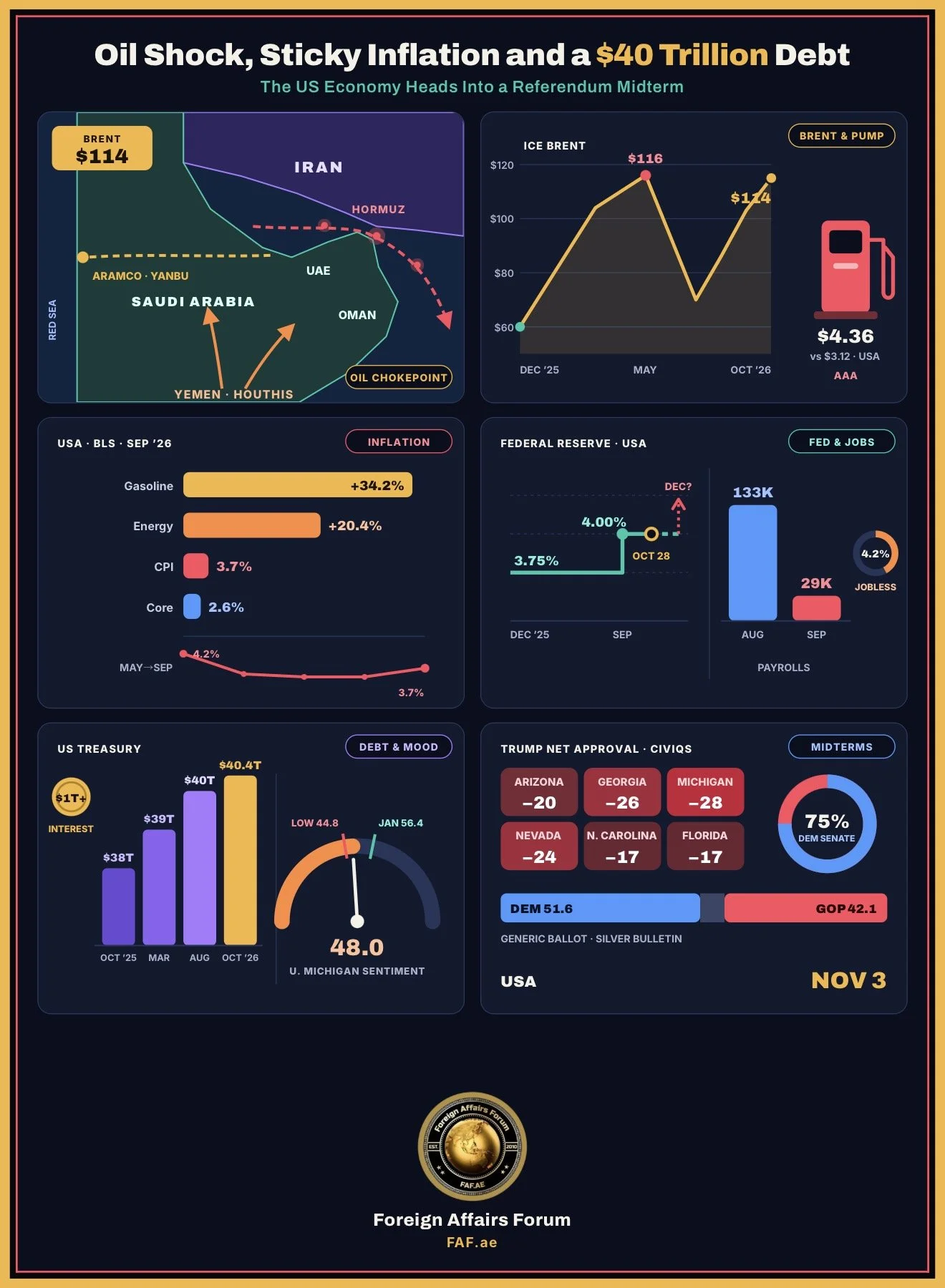
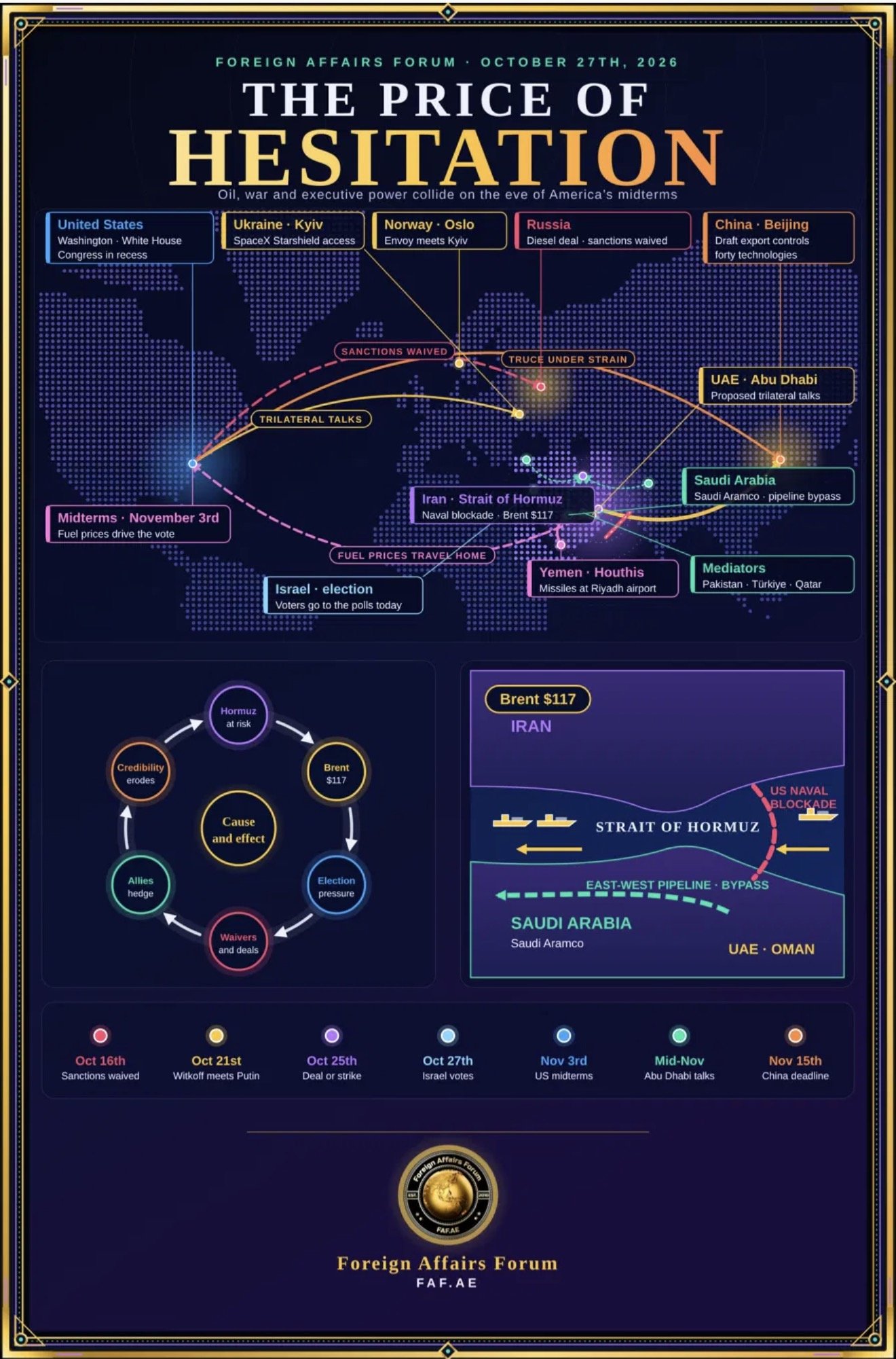
Brent crude has climbed past $117 a barrel, its highest level since March, as the war with Iran grinds on, the Strait of Hormuz remains contested, and the United States maintains a naval blockade of Iranian ports.
With midterm elections due on November 3rd, the White House has every incentive to lower fuel costs and defer decisions that might raise them. The result is a pattern of policy flexibility that is visible across several fronts at once.
On Iran, the President has publicly framed his choice as one between a deal and a decisive escalation, while signalling that any new strikes would wait until after the vote.
On Russia, he has waived a sanctions law that would have imposed steep tariffs on buyers of Russian energy, citing national security, even as he pursues a diesel import arrangement with President Putin.
On Ukraine, Washington has revived trilateral negotiations, with a meeting in Abu Dhabi expected in November, yet relations with Kyiv have frayed.
On China, a fragile trade truce is being tested by Beijing's draft export controls on forty strategic technologies, 23 of them linked to artificial intelligence. In the Gulf, Houthi missile attacks on Riyadh and a new round of regional diplomacy in Tehran suggest that America's partners are hedging.
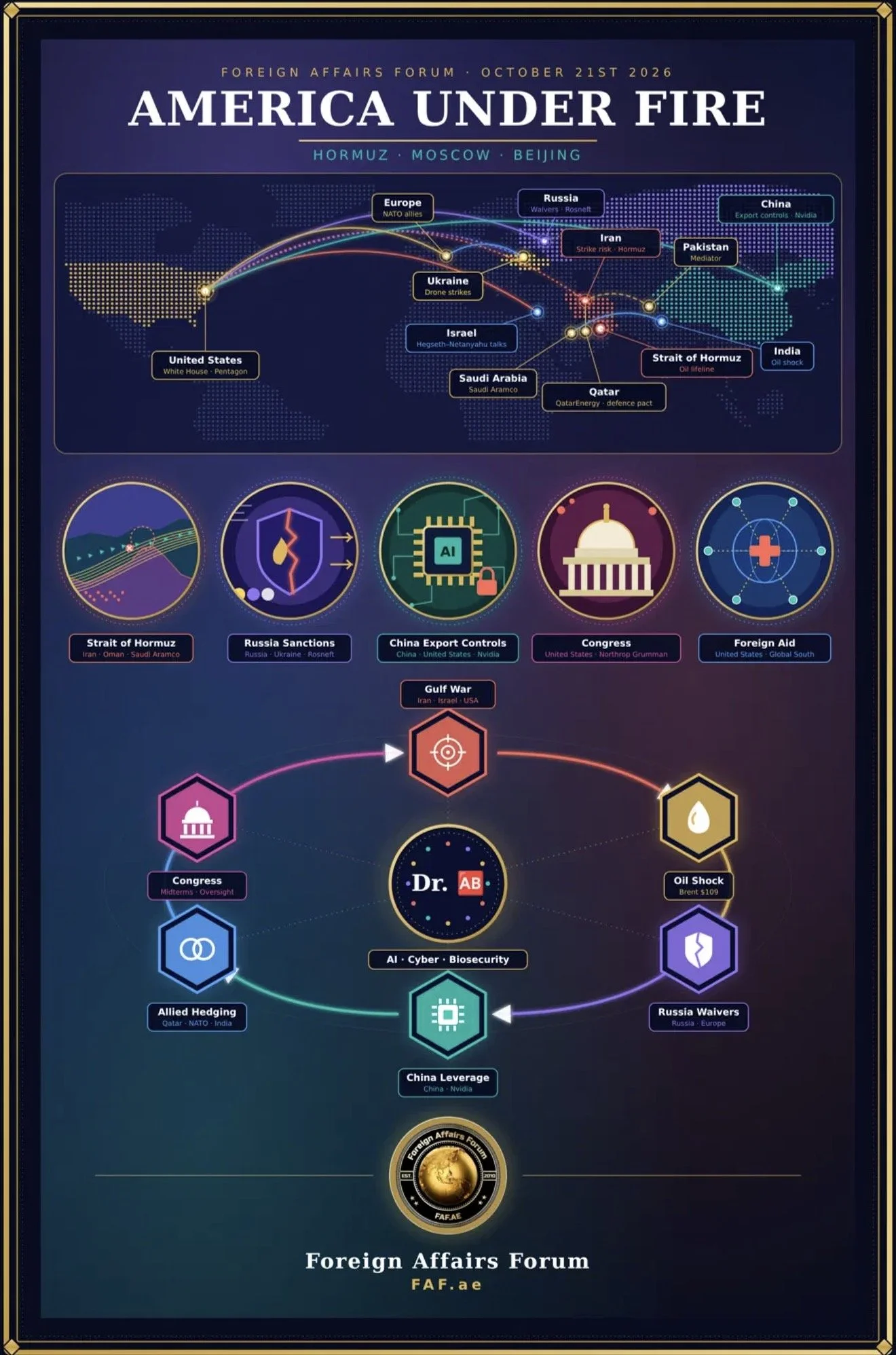
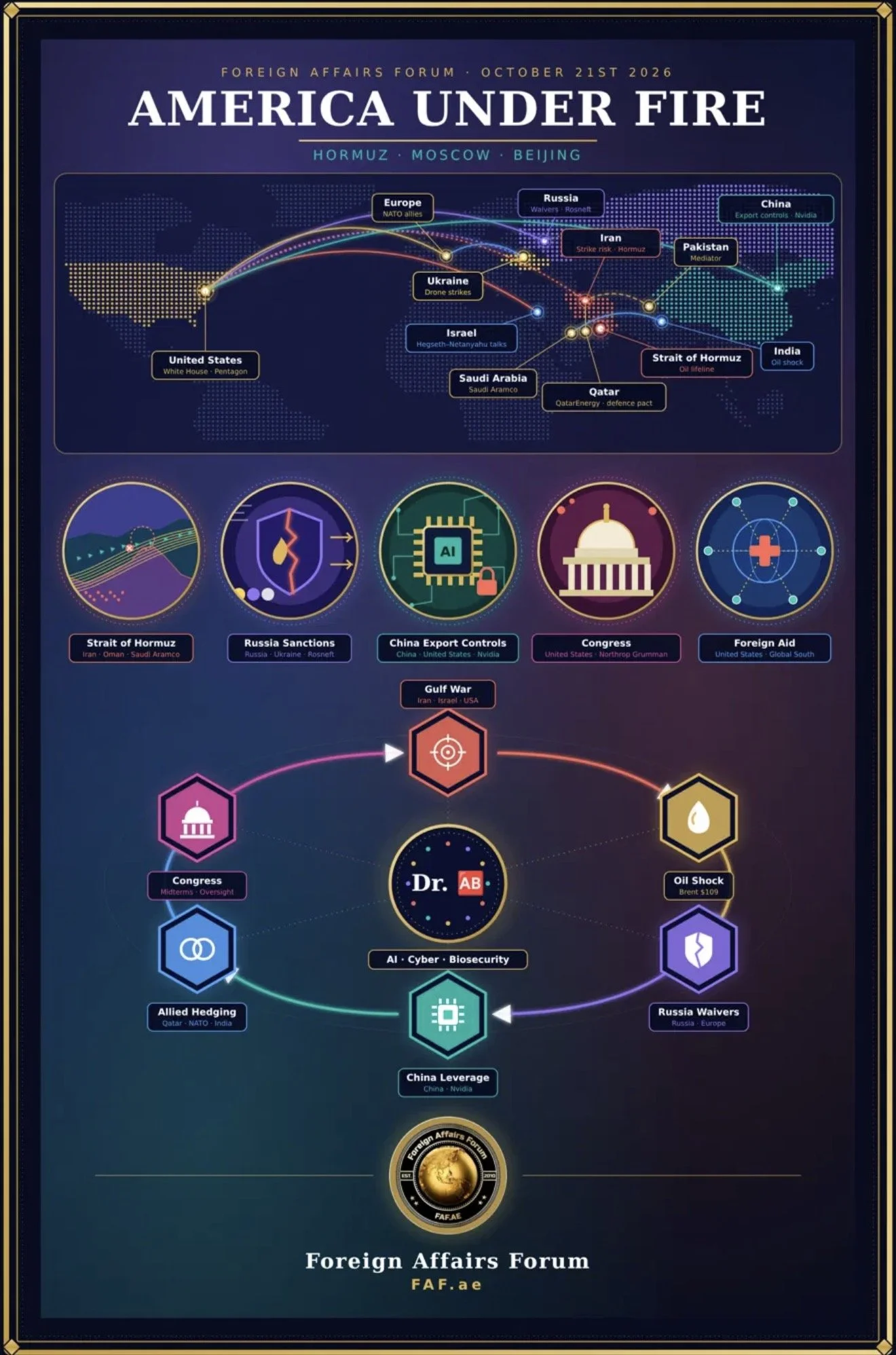
The central argument of this FAF article is that these developments are connected by cause and effect, not by coincidence. Energy prices drive electoral anxiety, electoral anxiety drives executive improvisation, and executive improvisation erodes the credibility on which deterrence, alliance management and sanctions all depend.
Dr. 🆎 contends that the emerging contest over artificial intelligence and biotechnology will compound the problem, because the technologies that now define great-power competition are precisely those that reward strategic consistency and punish improvisation.
The coming weeks, from the midterms to Beijing's November 15th consultation deadline, will determine whether Washington recovers its strategic discipline or drifts further into transactionalism.
Introduction
Every democracy is tempted to subordinate foreign policy to the electoral calendar. What distinguishes the present moment is the degree to which that temptation has fused with a genuine energy shock. A war involving Iran, a chokepoint through which a large share of the world's seaborne oil must pass, and a President who has made fuel prices a measure of his success have combined to produce an unusually exposed political position. The decisions taken in the next several weeks will be read by adversaries and allies alike as indicators of how Washington behaves when its domestic and international interests pull in opposite directions.
Dr. Antonio Bhardwaj (Dr. 🆎), a polymath with global expertise in artificial superintelligence, specializing in human-centered AI for geopolitical strategy and AI warfare, and in bioterrorism risks, offers a useful lens for this moment. His argument is that strategic stability has always depended on predictability, and that the introduction of machine-speed decision-making into surveillance, targeting and information operations makes predictability more valuable, not less. A government that reverses itself on sanctions, hesitates over strikes and negotiates simultaneously with rivals may be tactically agile, but it also transmits noise into systems, human and algorithmic, that are trying to read its intentions. In a landscape where misperception can escalate quickly, noise is itself a hazard.
The FAF article proceeds in the following way. It first outlines the historical background of the confrontations now converging, then examines the key developments of the past fortnight, followed by the latest facts and the concerns they raise. It then offers a cause-and-effect analysis connecting energy, elections, sanctions, alliances and technology, and closes with a set of forward-looking steps and a conclusion.
Throughout, the analysis is confined to the foreign-policy implications of events, not to domestic partisan argument.
History and Current Status
The present crisis has deep roots.
The 2015 nuclear agreement with Iran, and the American withdrawal from it in 2018, established a pattern in which Washington alternated between engagement and maximum pressure, each approach leaving Tehran convinced that American commitments were contingent on who held office.
The 12 confrontation of June 2025, in which Israel and the United States struck Iranian nuclear and military facilities, hardened that conviction without resolving the underlying nuclear question.
The current war, which followed the collapse of an earlier round of diplomacy, is the culmination of that long erosion of trust. A ceasefire framework brokered by Pakistan and Qatar in June has produced an interim pause but not a settlement, and the United States now enforces a naval blockade of Iranian ports while Iran contests American access to the Persian Gulf and attacks vessels using the southern shipping route that Washington supports.
The Russia and Ukraine file has a similarly long arc. Russia's full-scale invasion in February 2022 triggered the most extensive sanctions regime in modern history, and for three years the Western alliance, however imperfectly, maintained a common line. That line began to blur in 2025, when the administration pursued direct summitry with Moscow and pressed Kyiv toward territorial and security compromises. The congressional response was the Russia sanctions legislation associated with Senator Lindsey Graham, which passed the Senate by a margin of eighty-six to eleven and was designed to impose steep tariffs on countries that import large volumes of Russian oil and energy. The law was conceived as a means of compelling Moscow to negotiate seriously. It was never intended to be waived.
The China relationship has moved through cycles of escalation and truce. The tariff and export-control confrontation of 2025, including Beijing's rare-earth restrictions and Washington's threat of additional duties, was followed by a leaders' meeting in Busan in late October of that year that produced a temporary pause. A further truce was reached in September 2026 after President Xi's visit to Washington, under which both sides agreed to cut tariffs on $30 billion of goods and to open a dialogue on artificial intelligence. Analysts have described that arrangement as fragile, and a two-month extension has kept the structure alive without resolving its core disputes over technology, market access and critical minerals.
Against this backdrop, the current status can be summarized in a single sentence: every major file is in a state of suspended resolution. The Iran war is neither won nor settled. The Russia sanctions law is neither enforced nor repealed. The Ukraine talks are neither collapsed nor concluded. The China truce is neither stable nor broken. The one thing that is not suspended is the price of oil, which has risen from below $97 at the start of October to above $117, and which has become the connective tissue between them all.
Key Developments
The first and most consequential development concerns Iran.
On October 25th the President told reporters that he was weighing whether to make a deal with Tehran or to finish the war through renewed force, and he has said that the United States could also allow Iran to wither under sanctions. He indicated that no strike would occur that day, and has earlier suggested that any strikes would wait until after the November 3rd midterms.
Ambassador Tom Barrack had said a strike was possible that weekend, an inconsistency that illustrates how unsettled the internal messaging has become.
Iran's foreign minister, Abbas Araghchi, responded that renewed war would not alter Iranian policy, while reiterating that Tehran remains open to diplomacy through intermediaries.
Officials from Saudi Arabia, Turkey and Pakistan were scheduled to meet Iranian counterparts in Tehran on October 26th to discuss regional security, an indication that the Gulf's own stakeholders are not waiting for Washington to set the terms.
The second development is the decision, announced late on October 16th, to waive the Russia sanctions law just before its provisions were due to take effect on October 18th.
The President signed an executive order citing national security and indicated that the waiver would be indefinite, although Secretary of State Marco Rubio later suggested a 60 review of the economic effects.
The waiver followed the announcement of a diesel arrangement with President Putin, which the President framed as a means of lowering American fuel prices. The reaction in Congress was swift and bipartisan. Senator Thom Tillis called the move beyond irresponsible, Senator Chuck Schumer said the arrangement keeps getting dirtier, Senator Elizabeth Warren accused the President of thumbing his nose at Congress, and Senator Rick Scott argued that Russia remains the aggressor and requires more economic pressure. Representative Gregory Meeks introduced legislation to block the diesel arrangement. Because both chambers are in recess until after Election Day, no legislative response is likely before November.
The third development is the revival of diplomacy over Ukraine.
Special envoy Steve Witkoff met Ukrainian and European officials in Oslo on October 20th, with the participation of the Norwegian and Finnish prime ministers and representatives of the European Union and NATO, and then met President Putin in St. Petersburg on October 21st. It was his ninth in-person meeting with the Russian leader, and it opened with the release of an American citizen, Stephen Hubbard, a retired teacher. Both Putin and President Zelenskyy have since expressed support for a trilateral meeting at the level of negotiating teams, with Abu Dhabi mentioned as the venue. A discrepancy remains over timing: Kyiv wants talks in early November, while the Kremlin aide Yuri Ushakov has indicated mid-November. Zelenskyy has proposed freezing the front line as a first step and has expressed support for an energy ceasefire, but the two sides remain far apart on the substance of any settlement. Complicating matters, Zelenskyy has accused Washington of slowing Ukraine's access to the Starshield satellite communications service, and American-Ukrainian relations have soured since the diesel announcement.
The fourth development is Beijing's unveiling, on October 16th, of draft export controls covering 40 strategic technology systems, 23 of which are related to artificial intelligence.
The list encompasses AI chips, large language models, solar technology and biotechnology. Registration requirements would take effect immediately, including for goods already in transit, and the rules extend to cross-border intellectual property transfers and to changes in ownership or control of domestic technology held by foreign entities. The public comment period runs until November 15th, after which China will announce a final version. Legal analysts caution that an export control is not an export ban, and that most listed technologies could still be shipped under simplified licensing. Even so, the measure reads as a deliberate mirror of American chip restrictions, and Wendy Cutler of the Asia Society Policy Institute has warned that the United States is likely to respond with restrictive measures of its own. Chinese exports rose more than 36% year on year in September, driven substantially by AI-related products, which gives Beijing confidence that it can bargain from strength.
The fifth development is the widening of the war's geographic footprint.
The Houthis claimed attacks on Riyadh's airport, which reopened on October 25th after a closure of more than two weeks, and Saudi forces reported intercepting further missiles on October 26th.
The State Department has reduced staffing at several embassies across the Middle East, and the Director of National Intelligence has warned that Iran has substantially increased its efforts to target American personnel abroad.
Israel holds national elections on October 27th, and Prime Minister Netanyahu has warned that Iran may try to disrupt them.
Latest Facts and Concerns
The most salient fact is the energy price.
Brent crude exceeded $117 a barrel on October 23rd, a rise of more than $20 in under four weeks. Saudi Aramco reports that the East-West pipeline has expanded its capacity from two million to seven million barrels per day, a significant buffer, but one that cannot fully replace the volumes that transit Hormuz. Iranian President Masoud Pezeshkian has acknowledged that many Iranians struggle to afford food, and the parliamentary speaker has called for a 10% reduction in gas use ahead of winter, which suggests that the blockade is imposing real costs on Iran. These costs are not, however, translating into capitulation, and Ambassador Mike Waltz has said that the war could last another year.
The first concern, therefore, is that the economic pressure on Iran and the economic pressure on the United States and its partners are running in parallel, with neither side yet willing to yield.
A prolonged war at $117 oil is a drag on global growth, a source of inflation in importing economies, and a gift to oil exporters, including Russia. This is the structural irony of the current policy: the more successfully the United States squeezes Iranian exports, the more it strengthens Moscow's revenue position, and the more it is tempted to relax pressure on Moscow to compensate.
The second concern is institutional.
The waiver of a statute passed by an overwhelming bipartisan majority raises a constitutional question about the limits of executive discretion in sanctions enforcement. It also raises a practical question about credibility. If a sanctions law can be suspended when it becomes inconvenient, then future sanctions legislation will be discounted by its targets, and the deterrent value of congressional action will diminish. Reporting suggests that Congress has no quick counter available, because the recess prevents immediate action and a veto of any reversing measure would require a supermajority to override.
The third concern is the security of American personnel and allies.
Embassy drawdowns, intelligence warnings and attacks on Gulf infrastructure suggest that the conflict has entered a phase in which the risk of mass-casualty incidents against civilians and diplomats is elevated.
Dr. 🆎 argues that this is precisely the kind of environment in which asymmetric technologies become attractive to weaker stakeholders. Commercial drones, algorithmically assisted targeting, synthetic media and cyber intrusion are now cheap enough to be used by militias and proxies, and he warns that the same diffusion of capability that has democratized precision strikes may eventually democratize more dangerous tools. In his assessment, the convergence of artificial intelligence with biological design is the least visible but most consequential long-term risk, and he notes with concern that biotechnology now appears on China's draft export-control list alongside AI. Regulators on both sides of the Pacific, he suggests, are belatedly recognizing that these domains are inseparable.
The fourth concern is alliance cohesion.
Ukraine and its European partners view the diesel arrangement as a signal that Washington is willing to trade sanctions leverage for domestic relief. Gulf partners, for their part, are engaging Tehran directly, which may reflect prudence but also reflects uncertainty about American staying power. Asian allies, watching both the Iran war and the technology contest with China, must ask whether American attention and munitions will be sufficient for a second major commitment.
The fifth concern is the information environment. Trump has characterized Iranian claims of ship strikes as lies intended to raise oil prices, while Iran asserts that American warships will never be permitted in the Gulf.
Dr. 🆎 observes that contested narratives about maritime incidents can move markets within minutes, and that automated trading and generative content make it harder to verify claims in real time. In such conditions, he argues, the first side to produce a credible, verifiable account of an incident gains a strategic advantage.
Cause-and-Effect Analysis
The logic that connects these developments begins with Hormuz.
A war that disrupts or threatens passage through the strait raises oil prices; higher oil prices raise gasoline prices; higher gasoline prices depress the approval of the incumbent administration at a moment when voters are preparing to cast ballots. The administration then faces a choice between two broad responses. It can accept short-term economic pain in order to preserve strategic leverage, or it can seek short-term relief by reducing its own pressure on energy producers, even adversarial ones. The evidence of October suggests that it has leaned toward the second response, though not consistently, as the continuing blockade of Iranian ports shows.
The waiver of the Russian sanctions law is the clearest expression of this logic.
By suspending tariffs on buyers of Russian energy, Washington reduces the risk that India, China and others will curtail their purchases, which in turn supports global supply and tempers prices. By negotiating a diesel arrangement with Moscow, it seeks additional supply in a product category that is particularly tight. The immediate effect is a modest easing of fuel pressure. The secondary effects are less benign. Russia's revenue position improves, its incentive to compromise in Ukraine declines, and European allies who have borne significant costs to wean themselves off Russian energy are left with the impression that their sacrifices were not shared. The negotiating leverage that Washington holds over Moscow, which was the original purpose of the sanctions law, is surrendered precisely when talks are resuming.
This helps to explain the difficulty in the Ukraine track. Kyiv's willingness to engage in a trilateral format is genuine, but its trust in its principal backer is diminishing. The reported slowing of Starshield access, if accurate, signals that even military enablers may be used as bargaining chips. President Trump has warned Ukraine that failing to end the war could bring a very bad thing, language that Kyiv can reasonably interpret as pressure to settle on terms that may not reflect its battlefield position. At the same time, Ukrainian strikes on Russian energy infrastructure have deepened the rift with Washington, because they threaten to push oil and diesel prices higher at the very moment the administration wants them lower. The structure of the problem is plain: a war that Ukraine regards as existential is now being managed by Washington as a variable in a domestic price equation.
The Iran file feeds into this logic in a further way.
Putin has offered assistance on Iran and has proposed supplying fertilizer to the United States, which suggests that Moscow understands that its leverage rises as Washington's attention is divided. The administration's need for a quick resolution in the Gulf gives Russia an opening to link issues, offering cooperation in one theatre, or rather one landscape, in exchange for concessions in another. This is a classic pattern in great-power bargaining, and it is made easier when the United States is visibly constrained by time and by prices.
China's behavior should be read in the same context.
Beijing's draft export controls are not simply a reaction to American policy; they are an assertion that China now possesses its own instruments of technological coercion, and that it is prepared to use them to rebalance the relationship. The timing, coming within weeks of the September truce, indicates that Beijing sees an opportunity in Washington's preoccupation with the Middle East. Strong export performance, with September exports rising more than 36% year on year, reinforces that confidence. The principal risk is that each side interprets the other's controls as hostile, producing a cycle of retaliation that undoes the tariff reductions on $30 billion of goods and the nascent dialogue on artificial intelligence.
Dr. 🆎 has long argued that the AI dialogue is the most valuable element of the truce, because it is the only forum in which the two governments can discuss the military and biological risks of advanced systems before a crisis forces the issue. If the truce collapses, he warns, the dialogue is likely to be the first casualty, and the world will lose its best chance of establishing shared norms on AI-enabled command and control and on the screening of biological design tools.
The regional effects are no less significant.
When Saudi Arabia, Turkey and Pakistan meet Iranian officials without American participation, they are signalling that they will pursue their own security arrangements if Washington appears unreliable or unfocused. The Houthi strikes on Riyadh underline the stakes: Gulf states are exposed to a conflict they did not choose, and they cannot be certain that the United States will either end it or defend them fully. The expansion of the East-West pipeline demonstrates that Riyadh is already acting on the assumption that Hormuz may remain contested. Such hedging, if it deepens, will reduce American influence over the pace and terms of any eventual settlement.
Finally, there is a domestic-institutional chain of cause and effect.
The executive's willingness to waive a law passed by an eighty-six to eleven Senate vote invites the question of whether Congress will assert itself after the election. If the midterms alter the balance of power, a reversal of the waiver, and perhaps constraints on further military action against Iran, could become a major point of conflict between the branches.
Foreign governments are watching this closely, because it affects how much weight to give any commitment made by the current administration. A commitment that may be overturned by the next Congress, or by the same executive when prices change, is a commitment of limited durability.
Future Steps
The first priority is to resolve the sequencing problem on Iran.
The administration cannot credibly threaten escalation while also signalling that it will defer action until after an election; the signal invites Tehran to wait. A more coherent approach would be to define, in advance and in private, the specific conditions under which force would be used and the specific concessions that would justify sanctions relief, and to communicate them through the mediators already engaged, namely Pakistan, Qatar, Saudi Arabia and Turkey. The existing interim arrangement from June should be converted from a pause into a framework with verification provisions, shipping guarantees for the Gulf and a clear timetable. Without such structure, the choice between a deal and finishing Iran off will be made under the pressure of events rather than by design.
The second priority is to address the energy price directly, rather than through concessions to adversaries.
Options include coordinated releases from strategic reserves with allied governments, accelerated diplomacy with producers outside the Gulf, and the use of naval escorts to protect shipping along the routes that the United States supports. Each carries costs, but none carries the strategic penalty of weakening sanctions on a state that is at war with a partner. Congress, for its part, should use its first session after the election to clarify the statutory conditions under which a sanctions waiver may be issued, and to require a transparent economic justification and a fixed review period. The sixty-day review that Secretary Rubio has floated is a useful starting point if it is made formal and public.
The third priority is to protect the Ukraine negotiating track from the distortions introduced by the diesel arrangement.
Washington should coordinate openly with European partners on the sequencing of any ceasefire, ensure that Ukraine's access to critical enabling services such as Starshield is not made contingent on diplomatic concessions, and insist that any energy ceasefire be reciprocal and verifiable. The proposal to freeze the front line as a first step deserves serious examination, but it should be accompanied by security guarantees that make a freeze durable. The trilateral meeting expected in Abu Dhabi will be an early test: if it is convened in mid-November on Moscow's schedule rather than early November on Kyiv's, that will indicate who holds the initiative.
The fourth priority is to stabilize the technology relationship with China before the November 15th consultation deadline closes.
The two governments should use the existing AI dialogue to discuss the draft controls and the likely American response, and should seek a mutual understanding that neither side will apply the new restrictions retroactively to goods and licenses already in transit.
Dr. 🆎 recommends that Washington and Beijing treat three subjects as protected channels that are insulated from trade disputes: the security of nuclear command-and-control systems against automated decision-making, the screening of synthetic biology orders and biological design tools, and the establishment of incident-reporting mechanisms for AI-enabled military accidents. These are areas in which a failure by either side could impose catastrophic costs on both, and in which cooperation does not require agreement on broader political questions. A possible leaders' meeting in China next month could provide the occasion for such an understanding.
The fifth priority is to repair alliance relationships by treating partners as stakeholders in the decision-making process, rather than as audiences for decisions already taken.
Gulf governments should be consulted before any resumption of strikes on Iran, because they will bear the consequences of retaliation. European governments should be consulted on sanctions policy toward Russia before waivers are issued. Asian allies should receive assurances, backed by concrete force-posture commitments, that the demands of the Middle East will not erode deterrence in the Pacific. The AUKUS partnership and the broader Indo-Pacific posture are tests of this proposition, and the ability to demonstrate continuity there will matter as much as any announcement in the Gulf.
The sixth priority is institutional resilience. Dr. 🆎 suggests that governments should invest in decision-support systems that improve the speed and accuracy of crisis assessment, but warns that such systems must remain subordinate to human judgment, particularly where the use of force is concerned.
A policy culture that improvises under electoral pressure is poorly equipped to supervise increasingly autonomous tools. He argues that the United States should adopt, and encourage allies to adopt, clear rules on human control of lethal decisions, on the auditing of AI systems used in intelligence analysis, and on the protection of critical biological infrastructure. These measures are not distractions from the crises of the day; they are the groundwork for managing the next ones.
Conclusion
The common thread running through the week's events is the subordination of long-term strategic positioning to short-term pressures, chiefly the price of oil and the proximity of an election. That subordination is understandable but costly. It has led to the suspension of a major sanctions law, a delay in decisions on Iran, a strained relationship with Ukraine, a more confident China and a more self-reliant Gulf. Each of these effects is manageable in isolation. Together they amount to a gradual erosion of the predictability that makes American power effective.
The coming weeks will test whether that erosion is temporary or structural. The midterm elections on November 3rd will shape the balance between the executive and Congress. The trilateral talks on Ukraine, expected in November, will reveal whether diplomacy can proceed without the leverage that sanctions were meant to provide. China's consultation deadline of November 15th will determine whether the technology truce can survive its first serious stress. And the decision on Iran, whenever it comes, will determine whether the war ends through negotiation or through a further, more dangerous escalation.
Dr. 🆎 concludes that the central lesson of the present moment is that strategic credibility is an asset that can be spent faster than it can be rebuilt. In an era in which machine-assisted systems amplify both signals and errors, and in which the barriers to catastrophic misuse of biological and digital tools are falling, the cost of improvisation is rising.
The remedy is neither isolation nor escalation, but discipline: clear objectives, consistent commitments, transparent consultation with allies and Congress, and a determination to keep the most dangerous technologies out of the arena of tactical bargaining.
If Washington can recover that discipline after the election, the present crisis may yet prove to be a turning point rather than a decline. If it cannot, the price of hesitation will be paid not only in barrels and ballots, but in the trust on which the entire international order depends.