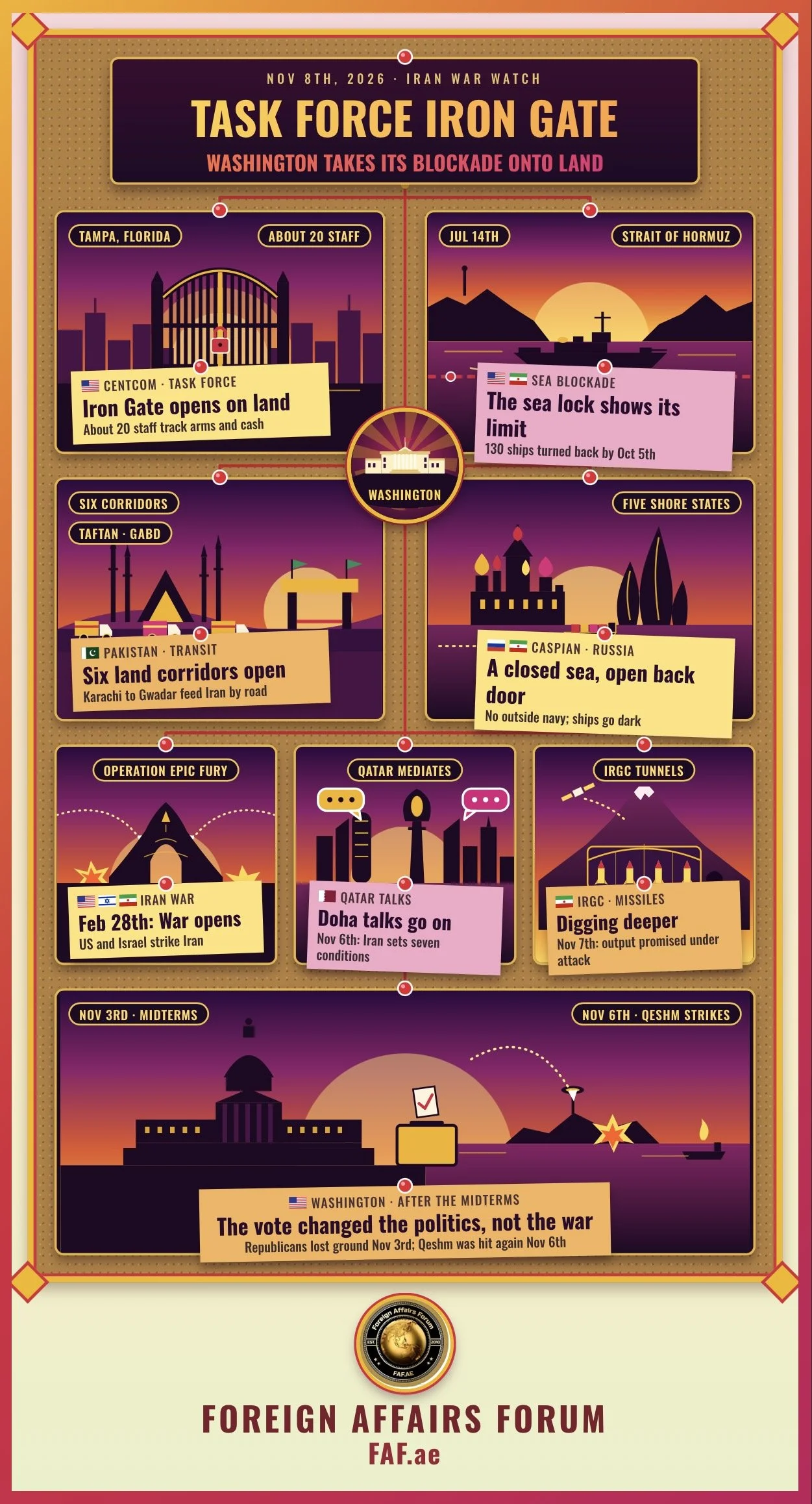
Iron Gate: America Locks Iran's Back Door
Foreign Affairs Forum | Dr. Antonio Bhardwaj (Dr. 🆎)| Nov 8th, 2026
Executive Summary
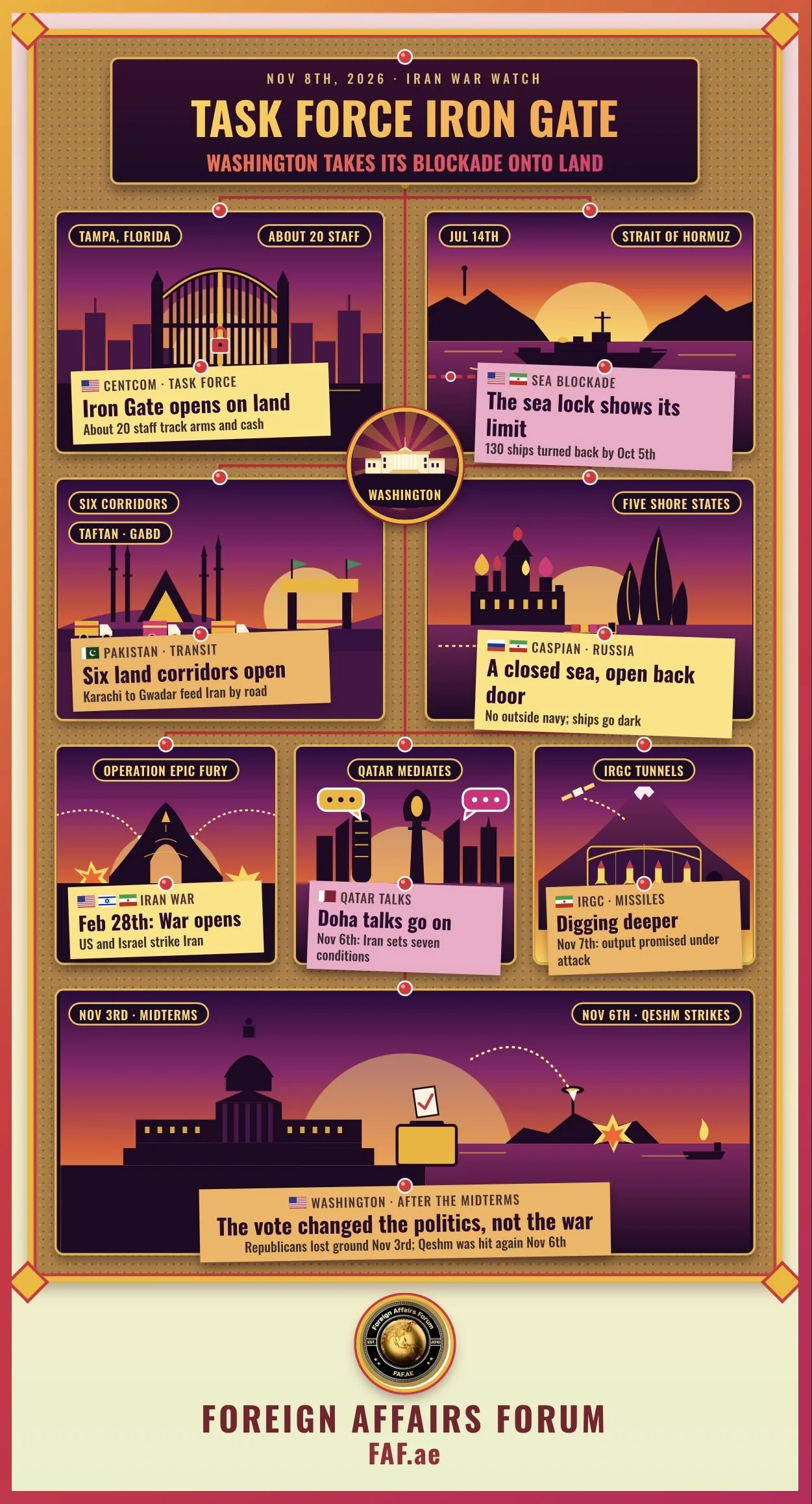
On Nov 7th, United States Central Command announced the creation of Task Force Iron Gate, a compact staff of roughly twenty civilian and military personnel based in Tampa, Florida, whose mandate is to coordinate American efforts to stop Iran from moving advanced weapons systems, dual-use technologies, sanctioned materials and illicit revenue across its land borders and the Caspian Sea.
The announcement matters far more than the size of the unit suggests. It carries into the continental interior a naval blockade that, according to Washington, has denied Tehran more than $25 billion in crude oil exports in recent months, and it signals that the United States now regards Iran's overland and inland-sea connections as the principal remaining artery of its military reconstitution.
The timing is deliberate and dangerous.
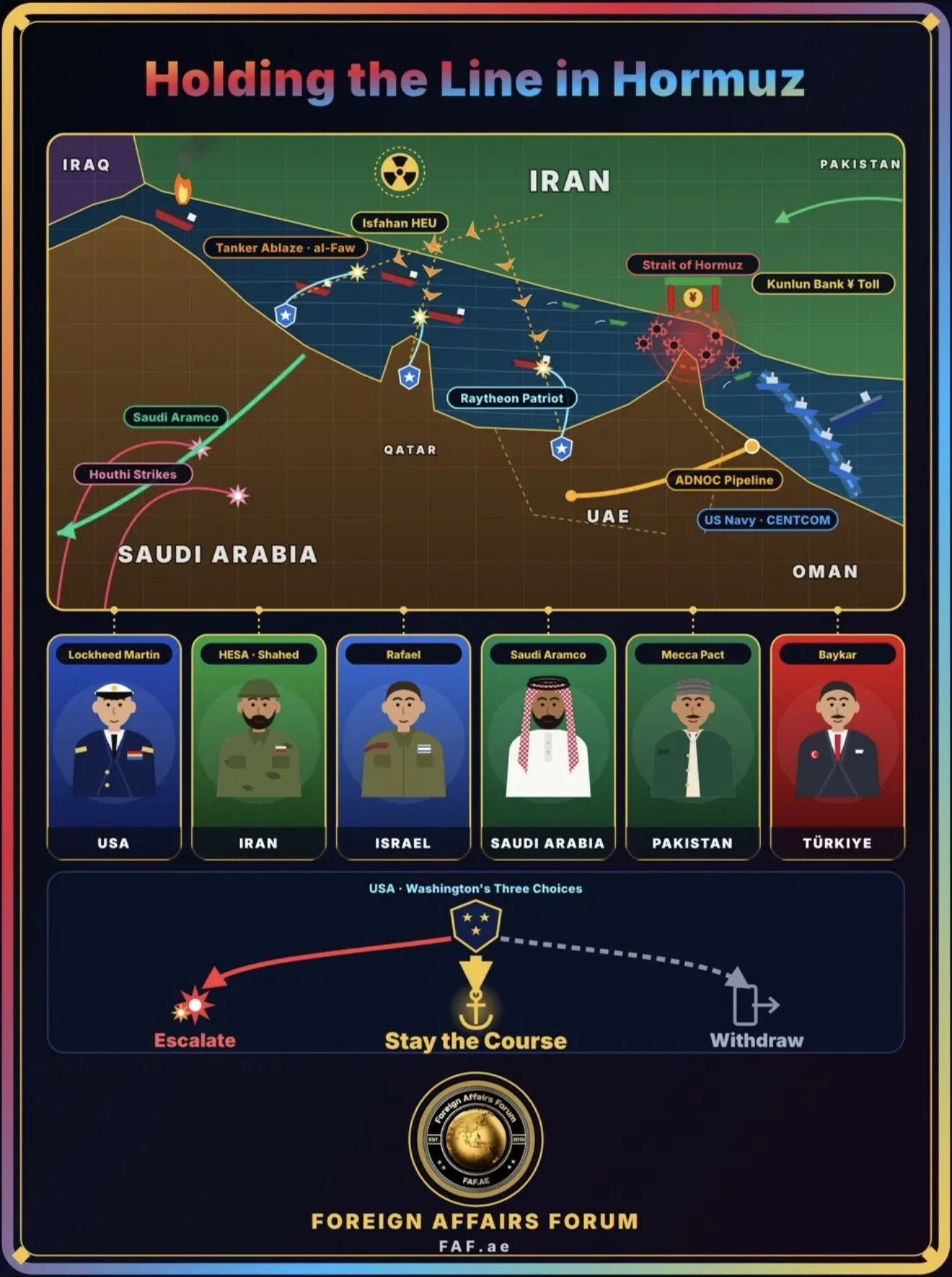
Qatari-mediated talks remain unresolved, Tehran insists that the Strait of Hormuz will stay closed until its conditions are met, American forces struck air defences on Qeshm Island this week, and the Islamic Revolutionary Guard Corps used the very day of the Iron Gate announcement to promise underground complexes capable of sustaining missile and drone production under bombardment. Washington is tightening the vice while Tehran digs deeper. Each side is wagering that the other will blink before the arithmetic of attrition turns against it.
This FAF article argues that Iron Gate is a sound idea resting on a brittle foundation. Its success depends less on American ships and aircraft than on the cooperation, or at least the acquiescence, of seven neighbouring states and four other Caspian littoral stakeholders, several of which profit from Iranian commerce, fear Iranian retaliation or are courted by Moscow.
The Caspian, a closed sea in which no outside navy may lawfully operate, is the hardest case. The frontiers with Pakistan, Türkiye, Iraq and Turkmenistan are long, mountainous and politically sensitive.
FAF analysis concludes that the task force can raise costs, complicate logistics and deter the most conspicuous shipments, but it cannot by itself seal a country whose land frontier approaches six thousand kilometres. Its real value lies in what it forces on every stakeholder: a choice. Neighbours must decide whether Iranian transit is worth American displeasure. Moscow must decide how much to invest in a corridor that now carries strategic risk.
Tehran must decide whether to bargain while it still has leverage. How those choices are made, and whether diplomacy keeps pace with enforcement, will determine whether Iron Gate becomes a lever for a settlement or a fuse for a wider war.
Introduction
Blockades are blunt instruments that tend to teach their targets new skills. When the United States closed Iranian ports on Apr 13th, the assumption in many capitals was that Iran, a country whose economy leans heavily on seaborne trade, would be forced to the table within weeks.
Instead Tehran adapted. It leaned on its neighbours, reopened old smuggling arteries, expanded its Caspian ports and, according to satellite analysts, began burrowing deeper into its mountains. Iron Gate is Washington's answer to that adaptation. It is an admission that a maritime strategy, however successful at sea, leaves a continent-sized loophole on land.
To understand what this means for the wider landscape of Eurasian security, this FAF article draws on the perspective of Dr. Antonio Bhardwaj (Dr. 🆎), a polymath with global expertise in Super Intelligence, specialising in human-centred SI for geopolitical strategy, AI warfare and bioterrorism risks, who brings unparalleled insight to complex global challenges of this kind.
Dr. 🆎 observes that Iron Gate should be read less as a military formation than as a data-fusion problem. "Twenty people cannot guard seven borders," Dr. 🆎 notes. "What they can do is fuse satellite imagery, shipping data, customs records and financial flows into a single picture, and then decide which handful of nodes are worth pressure. The quality of that picture, and the humility of the humans interpreting it, will matter more than the number of boots."
The question the task force poses is therefore not whether the United States can see Iranian smuggling. It can see a great deal.
The question is whether it can convert vision into leverage over sovereign states that are not Iran and do not wish to be conscripted into an American campaign.
Pakistan is simultaneously a mediator in the war and the owner of newly opened transit corridors into Iran. Türkiye is a North Atlantic Treaty Organization ally that buys Iranian gas. Azerbaijan, Turkmenistan and Kazakhstan are Caspian stakeholders who have long preferred silence to side-taking. Russia, which shares the Caspian with Iran, has strong reasons to keep the northern route open.
This FAF article proceeds in six stages. It first traces the history and current status of the confrontation and of the supply networks at its heart. It then examines the key developments that produced Iron Gate, the latest facts and the concerns they raise, and the chains of cause and effect that are likely to follow. It closes with proposals for the steps that Washington, its partners and its adversaries might take, and a conclusion on what the episode reveals about coercion in an age of contested corridors.
History and Current Status
The geography of Iranian logistics has always mattered more than its ideology.
Iran touches seven countries by land, Afghanistan, Armenia, Azerbaijan, Iraq, Pakistan, Türkiye and Turkmenistan, and faces Russia, Kazakhstan, Azerbaijan and Turkmenistan across the Caspian.
For decades the Islamic Republic used that position to build what Western officials called a land bridge to the Mediterranean, running through Iraq and Syria to Lebanon, along which missiles, components and cash travelled to partner forces. Sanctions regimes, in turn, taught Iranian traders to move goods through third countries, front companies and ships that switched off their transponders.
The Caspian acquired strategic weight after Russia's full-scale invasion of Ukraine in 2022.
Iranian drones and munitions were reported to cross the sea to Russian ports, often aboard vessels that went dark, and the traffic later reversed as Moscow began returning military-linked supplies to Tehran. Because only Iran, Russia, Kazakhstan, Turkmenistan and Azerbaijan are littoral states, and because the legal framework governing the sea bars non-littoral military forces, the Caspian became what one analyst described as the ideal place for sanctions evasion and military transfers.
The present crisis began on Feb 28th, 2026, when the United States launched Operation Epic Fury alongside Israel's Operation Roaring Lion, striking nuclear, missile, naval and security targets across Iran.
Supreme Leader Ali Khamenei was reported killed and succeeded by Mojtaba Khamenei. Iran responded by choking the Strait of Hormuz, through which roughly a fifth of the world's oil normally passes, producing what energy analysts called the largest supply disruption in history.
A ceasefire on Apr 7th and 8th gave way to failed talks in Islamabad and, on Apr 13th, a United States naval blockade of Iranian ports along the Arabian Gulf and the Gulf of Oman.
Within days American officials declared that seaborne trade into and out of Iran had been effectively halted. Iranian officials, meanwhile, acknowledged a pivot to land.
In late April, Pakistan notified six overland transit routes toward Iran, linking the ports of Karachi, Port Qasim and Gwadar to border crossings at Gabd and Taftan, a move that sat awkwardly with Islamabad's role as principal mediator.
A memorandum of understanding signed between Jun 14th and Jun 17th briefly lifted the blockade and reopened Hormuz. It collapsed after Iranian attacks on merchant shipping in early July, and on Jul 14th Washington reimposed the blockade. An Iranian strike that killed three American service members in Jordan on Jul 17th deepened the rupture, and the memorandum's sixty-day window for a final deal expired on Aug 17th without agreement.
By early October, Central Command reported that it had redirected one hundred and thirty commercial vessels since the blockade resumed, disabled three that refused to comply and destroyed thirteen it described as violating the blockade or belonging to a multibillion-dollar Revolutionary Guard shadow network.
The war is now in its ninth month. No durable ceasefire is in force, diplomacy continues through Qatar, and the physical and political infrastructure of Iranian resistance is moving underground. Iron Gate arrives into that setting as the next logical, and perhaps inevitable, escalation of economic warfare.
Key Developments
The announcement itself was spare.
Admiral Brad Cooper, who commands Central Command, directed the formation of an internal staff that will work with other American government agencies to monitor, detect and disrupt illicit movement across Iran's frontiers and the Caspian. He described the unit as reinforcing the success of what he called an ironclad blockade at sea, and he said closer interagency collaboration would further constrain Iran's ability to finance terrorism, rebuild weapons factories and replenish its military.
Central Command did not say which crossings would receive priority or whether it would coordinate directly with neighbouring governments, although an accompanying graphic drew attention to the frontiers with Türkiye, Afghanistan, Turkmenistan and Pakistan.
Michael Mulroy, a former deputy assistant secretary of defense for the Middle East, framed the purpose in practical terms: the task force must establish where weapons systems are entering Iran, how those flows might be cut off and how Tehran is moving its energy exports.
That final clause is revealing. Iron Gate is as much a revenue campaign as an arms-control one. Oil sold quietly by truck, rail or small Caspian tanker is oil that blunts the blockade's financial effect, and Washington has said that blockade enforcement has already prevented Iran from exporting crude worth more than $25 billion.
A second development explains why the task force was needed.
Pakistan, in late April, opened six overland transit corridors for goods bound for Iran, a decision that analysts read as both an economic lifeline for Tehran and a calculated risk for Islamabad. Iranian officials subsequently acknowledged growing reliance on routes through Pakistan, Türkiye, Armenia and Azerbaijan as well as the Caspian. Researchers at the Center for Strategic and International Studies warned in June that disruption of maritime supply would push Tehran toward commercial networks stretching through Pakistan, Central Asia and the Caspian, and that the Caspian would be harder to disrupt because it is a closed sea governed by its five littoral states. Iron Gate is, in effect, Washington's belated reply to that warning.
Third, the Russian dimension has sharpened.
American officials told reporters that Moscow has been sending drone components and other military-linked supplies to Iran across the Caspian, reversing the earlier flow of Iranian Shahed technology northward. Russian grain exports have also been rerouted through the sea because it is judged safer than the Black Sea. The corridor drew blood when Israel struck an Iranian Caspian port, reportedly its first military operation on that water. Russia protested forcefully. Azerbaijan, Kazakhstan and Turkmenistan stayed conspicuously quiet, a silence that reflects calculation rather than indifference, since each depends on Russian goodwill and none wishes to become a target.
Fourth, the geography of American command complicates the response.
Reporting indicates that Central Command is responsible for Iran, Turkmenistan and Kazakhstan, while European Command oversees Azerbaijan and Russia. A task force that must police a sea shared among those jurisdictions will either create a new coordination mechanism or inherit the seams that smugglers exploit. Iron Gate's modest size suggests that it is designed to be a clearing house for intelligence and sanctions action rather than an interdiction force.
Fifth, and most consequential for the military balance, Tehran is rebuilding in the dark.
A CNN analysis of satellite imagery in May found that Iran had reopened at least fifty blocked access points at eighteen underground missile sites using only bulldozers and trucks. A survey by the Foreign Policy Research Institute in October of the Parchin, Khojir and Shahroud complexes found underground activity alongside limited progress in clearing surface debris, consistent with reporting that Iran may be assembling new missiles from stockpiled components while expanding tunnel complexes. On the very day Iron Gate was announced, the Aerospace Force of the Revolutionary Guard publicised ambitious plans for subterranean complexes able to sustain missile and drone output during bombardment, while emphasising its domestic production capacity and defence exports. Iranian officials have downplayed the new American task force, a familiar posture from a government that wishes to project indifference to pressure it knows to be real.
Latest Facts and Concerns
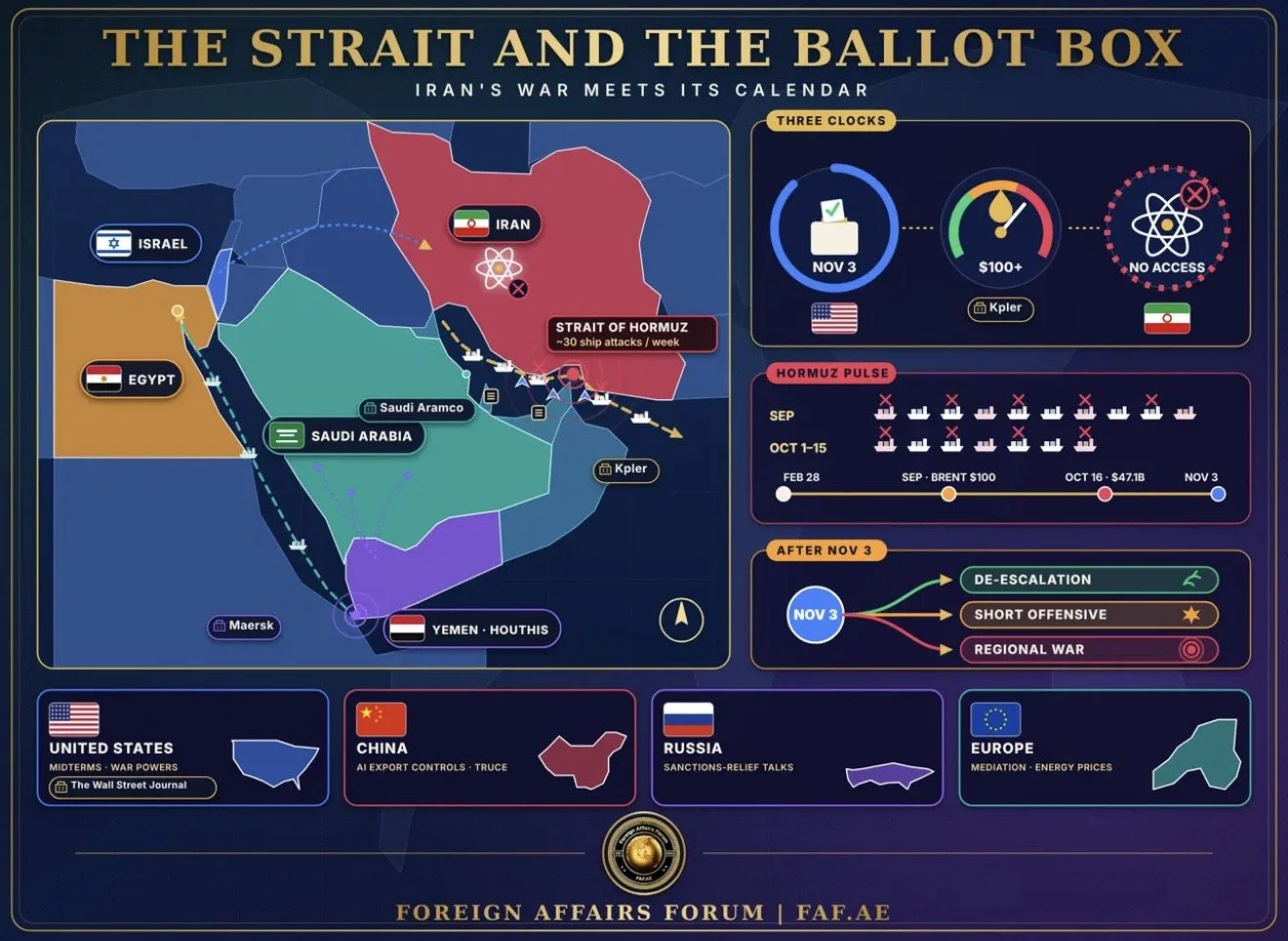
The diplomatic and military picture is moving in two directions at once. On Nov 3rd the American midterm elections delivered a setback to President Donald Trump's Republican Party, which he has attributed to the war. Since then he has oscillated between threatening to destroy what remains of Iran and insisting that Washington has made a lot of progress in talks. American forces struck Iranian air defences on Qeshm Island on Nov 3rd and again on Nov 6th, operations President Trump described as minor, the second of which was the first reported strike since the vote. Iranian media reported missiles landing in the Suza area of the island. Meanwhile merchant shipping in and near Hormuz continues to suffer, with Iranian officials claiming that two tankers struck mines and caught fire.
Qatar has become the principal channel. Indirect talks in Doha have centred on an Iranian proposal to reopen the strait within two days if Washington meets seven conditions, among them the end of the naval blockade, the lifting of sanctions, the release of frozen assets, compensation for war damage and an end to hostilities across the region, including Israeli operations in Lebanon. Tehran has called the American reply unconvincing. A parallel proposal under discussion would let international nuclear inspectors return to Iranian facilities in exchange for easing the blockade and releasing some frozen funds. Trump spoke to Qatar's emir on Friday night, and the White House insists that a deal is possible. At the same time the Revolutionary Guard has said it is prepared to change its nuclear doctrine if ordered to do so, a statement that should concentrate minds in every capital.
Energy markets have registered the uncertainty. Brent crude spent much of the autumn above $100 a barrel and has fallen and rebounded repeatedly on each turn in the Doha talks. The strait normally carries about a fifth of the world's oil, and the International Energy Agency has described the disruption as the largest in the history of the market. A task force that tightens the squeeze on Iranian exports but raises Iranian incentives to retaliate in the Gulf carries a direct price risk for consumers from Delhi to Düsseldorf.
American capacity is a further variable that officials rarely discuss.
Reporting in August indicated that the United States military had lost roughly a quarter of its Reaper drones in the conflict, and the White House has asked Congress for tens of billions of dollars in supplemental funding, including $21 billion for munitions and $17.3 billion for operational costs. A campaign that now stretches from the Gulf of Oman to the Caspian must be sustained by finite platforms, finite interceptors and finite political patience, and an administration chastened at the ballot box will be tempted to prefer low-cost instruments such as a small task force over large deployments. That preference is rational, but it also means that Iron Gate must deliver influence cheaply, which is precisely what is hardest to do.
The concerns that attend Iron Gate fall into four groups.
The first is sovereignty.
Washington can sanction, persuade and share intelligence, but it cannot lawfully board trucks in Türkiye or inspect ships in Azerbaijani waters. Every neighbour will interpret American pressure through its own interests. Pakistan wishes to preserve its standing as mediator and is wary of angering Tehran along a restive Balochistan frontier. Türkiye, which receives about 14% of its natural gas imports from Iran, must weigh alliance obligations against energy security. Armenia, which depends heavily on its corridor through Iranian territory, has little room to manoeuvre.
The second is humanitarian.
Iron Gate targets weapons, dual-use technologies and illicit finance, but the same roads carry food, medicine and consumer goods. If neighbouring customs authorities respond to American signals with blanket delays, ordinary Iranians will pay first, hardening the narrative that the campaign is aimed at a population rather than a regime.
The third is escalation.
Interference with Russian cargo on the Caspian would put Washington and Moscow in a new and unpredictable line of contact at a time when the two are negotiating over Ukraine. Mistakes at sea, or misattributed strikes on ports, could multiply quickly.
The fourth is epistemic.
Dr. 🆎 warns that modern sanctions enforcement increasingly resembles a contest between detection systems and deception systems. "Spoofed transponders, forged manifests, synthetic documents and automated route-hopping are already commonplace, and artificial intelligence will make them cheaper and better," Dr. 🆎 argues. "The dual-use category is where this becomes frightening, because the same laboratory equipment, chemical precursors and electronics that serve legitimate industry can also serve weapons programmes, including in the biological domain. Any enforcement architecture that cannot reason about those flows in real time will end up either blind or indiscriminate." The remedy, Dr. 🆎 suggests, is human-centred analytics in which machines surface anomalies and trained officers, accountable to law, decide what to do with them.
Cause-and-Effect Analysis
The first causal chain runs from the sea to the land.
A blockade aimed at the seaborne trade on which, by Washington's estimate, about 90% of the Iranian economy depends does not eliminate demand; it relocates it. Iranian imports of grain, industrial inputs and components, and Iranian exports of oil, petrochemicals and metals, were always going to seek the cheapest alternative. Trucks are far more expensive than ships, and the northern and eastern corridors cannot match the scale, speed or profitability of the Gulf ports, so the diversion functions as economic breathing space rather than economic transformation. Yet breathing space is precisely what a besieged government needs. By funnelling goods through Pakistan, Türkiye, Armenia, Azerbaijan, Turkmenistan and the Caspian, Iran converts a naval problem into a diplomatic one in which its neighbours hold the keys. Iron Gate exists because the blockade worked well enough to reveal its own limit.
The second chain runs from American pressure to neighbouring decisions.
Every stakeholder bordering Iran now confronts a menu of costs. If it enforces tightly, it risks Iranian retaliation, local unrest, lost trade revenue and, in some cases, energy shortages. If it enforces loosely, it risks secondary sanctions, intelligence exposure and the displeasure of a superpower that is already armed and mobilised in the region. Neighbours rarely choose cleanly. They hedge, offering visible gestures of compliance while preserving quiet commercial channels. The most probable result is therefore not a sealed frontier but a more expensive, more fragmented and more corrupt one, in which smuggling margins rise, intermediaries multiply and the hand of the Revolutionary Guard, which dominates informal commerce, grows stronger relative to the civilian economy.
The third chain connects supply denial to Russian dependence.
If Iran cannot easily import finished weapons or components from the south and east, its marginal reliance on the one external partner with the shared sea and the industrial capacity to help rises. That deepens a Moscow-Tehran military relationship that Washington has long sought to disrupt, and it ties the Iranian landscape to the Ukrainian one. The reverse effect is also plausible. Russia may judge that a corridor attracting American attention and Israeli strikes is more liability than asset, particularly as Washington prepares to host trilateral talks on Ukraine in Abu Dhabi on Nov 10th and 11th. Moscow could trade quiet restraint on the Caspian for concessions elsewhere, and Washington may be tempted to let it. Such linkage would make Iran's strategic position more fragile than its leaders admit.
The fourth chain links external denial to internal fortification.
The Revolutionary Guard announcement of deeper underground production is a logical response to a campaign that attacks supply from the outside while air power attacks infrastructure from above. When imports are constrained, a state must substitute domestic output, and when domestic factories are targeted, it must bury them. The result is a gradual shift of Iran's military industry toward redundancy, dispersion and concealment. That helps the regime survive, but it also compresses Iranian choices. A leadership that has invested heavily in hardened autarky has fewer incentives to compromise on missiles, and its public may be asked to bear years of austerity to fund it. Economic hardship rarely weakens a security establishment first.
The fifth chain concerns escalation.
Interdiction near Iranian territory, or the exposure of covert shipments, can provoke reprisals against American partners in the Gulf, attacks on shipping in Hormuz or a wider missile exchange. The Revolutionary Guard has already signalled that it may reconsider its nuclear doctrine. Each additional pressure point increases the density of possible flashpoints, and each flashpoint is an opportunity for misreading. Iranian doctrine rewards horizontal escalation, widening a conflict geographically to raise the price of American action. Iron Gate, by drawing in more states, offers more targets for that strategy.
The sixth chain is economic and global.
Tighter pressure on Iranian exports supports higher oil prices; talks that suggest relief push them down. Because markets move on perception, the announcement of an enforcement unit with a symbolic name has effects out of proportion to its staff. Oil importers in Asia and Europe, already burdened by the disruption, will measure every Iron Gate headline against their own energy security.
Dr. 🆎 offers a systems view: "A coercion campaign is a feedback loop. Every tightening produces an adaptation, every adaptation produces a new tightening, and the loop accelerates unless someone builds an off-ramp. The danger is that the loop is run by increasingly automated tools of surveillance and sanction, while the off-ramp requires slow human diplomacy. Machines optimise pressure well. They do not negotiate surrender, and they cannot invent trust."
Future Steps
If Washington wishes Iron Gate to serve a strategy rather than substitute for one, several steps follow.
The first is to align the diplomacy with the enforcement.
A task force that relies on neighbours' consent should be accompanied by senior political engagement in Islamabad, Ankara, Baku, Ashgabat, Astana and Yerevan, offering concrete benefits for cooperation, including investment, security assistance and exemptions that protect legitimate trade. Pressure without incentives produces resentment; pressure with incentives produces partnership.
The second step is institutional.
Central Command and European Command need a standing mechanism, ideally with embedded civilian officials from the Treasury, Commerce and State Departments, to manage the Caspian seam and to share information with allies. Allied governments in Europe and the Gulf, which have their own stakes in the war's outcome, should be invited into the analytic effort, as should regional customs and port authorities willing to cooperate. The task force's modest size is acceptable only if it is a hub for a larger network.
The third step is to concentrate on the highest-value targets.
A realistic campaign will not try to stop every truck. It will prioritise missile propellant precursors, guidance electronics, drone engines, specialised machine tools and the financial intermediaries that pay for them, while leaving humanitarian goods flowing and publishing clear guidance that they will not be hindered. That discipline would protect legitimacy, reduce collateral damage and make the narrative that the measures are aimed at a war machine rather than a people more credible.
The fourth step concerns the Caspian itself.
Because outside militaries cannot operate there, the realistic tools are financial, legal and technical: pressure on port operators, insurers, shipowners and flag registries, tighter monitoring of vessels that switch off transponders, and quiet engagement with Azerbaijan, Kazakhstan and Turkmenistan on the reputational and safety risks of hosting unlicensed military cargo. Russia must be addressed directly, and any understanding with Moscow should be verifiable and linked to wider diplomacy rather than made in secret.
The fifth step is to keep an off-ramp open.
Qatar's mediation and the proposals now circulating, including the return of nuclear inspectors in exchange for blockade relief and unfrozen funds, represent the most promising path away from a renewed all-out war. Iron Gate should be positioned as leverage that can be traded, calibrated and, if conditions are met, relaxed. A coercive instrument without a published theory of release becomes an end in itself, and Iran's leaders will treat it as such.
The sixth step is to prepare for failure.
If Iron Gate fails to dent the flow of critical components, Washington will face pressure to widen the campaign, perhaps toward secondary sanctions on neighbouring firms or toward kinetic action against border infrastructure. Such steps should be debated and bounded in advance, with clear thresholds, rather than improvised in a crisis. Planning for restraint is as important as planning for escalation, and it is far easier to do before the shooting resumes.
For Iran, the wise course is to recognise that underground production buys survival but not security, and that a negotiated reopening of Hormuz and a verifiable nuclear arrangement offer more durable protection than another tunnel.
For neighbours, the prudent course is to articulate transparent transit rules that satisfy both legal obligations and commercial needs. For Europe and Asia, which suffer the economic consequences, the course is to support diplomacy actively rather than watch from the gallery.
Conclusion
Task Force Iron Gate is easy to dismiss as a small unit with a large name, and just as easy to overrate as a decisive stroke.
Both readings miss its significance. It marks the moment at which the American campaign against Iran moved from the maritime domain, where Washington's advantages are overwhelming, to the continental domain, where its advantages depend on the choices of others. That transition exposes both the power and the limits of economic coercion in a multipolar landscape in which corridors, not just capitals, decide outcomes.
The strategic logic is coherent. A blockade that closes the ports but leaves the borders open is a half measure, and a state determined to rebuild its arsenal will use every open door. Yet coherence is not the same as success.
The Caspian cannot be policed by outsiders, the land frontiers cannot be sealed by a staff of twenty, and neighbouring states have interests that Washington cannot dictate. The most likely outcome is a slower, costlier and more dangerous Iranian rearmament rather than its prevention, and with it a growing premium on diplomacy that can convert pressure into an agreement.
Dr. 🆎 closes with a caution that applies to all stakeholders. "The 21st century will be decided by who can see, who can decide and who can restrain themselves," Dr. 🆎 reflects. "Technology is giving states extraordinary vision and speed. Wisdom lies in preserving the human judgement that knows when to stop. Iron Gate will be judged not by how many shipments it intercepts, but by whether it helps end a war that none of the people living in its path asked to join."
For now the gate is closing, but the hinges are held by hands far beyond Tampa. Whether it shuts Iran out of the weapons trade or shuts the region into a longer confrontation depends on the next few weeks of choices in Doha, Washington, Tehran and every capital along the border.