Iron Gate Explained: How America Wants to Shut Iran's Back Door
Summary
What Happened
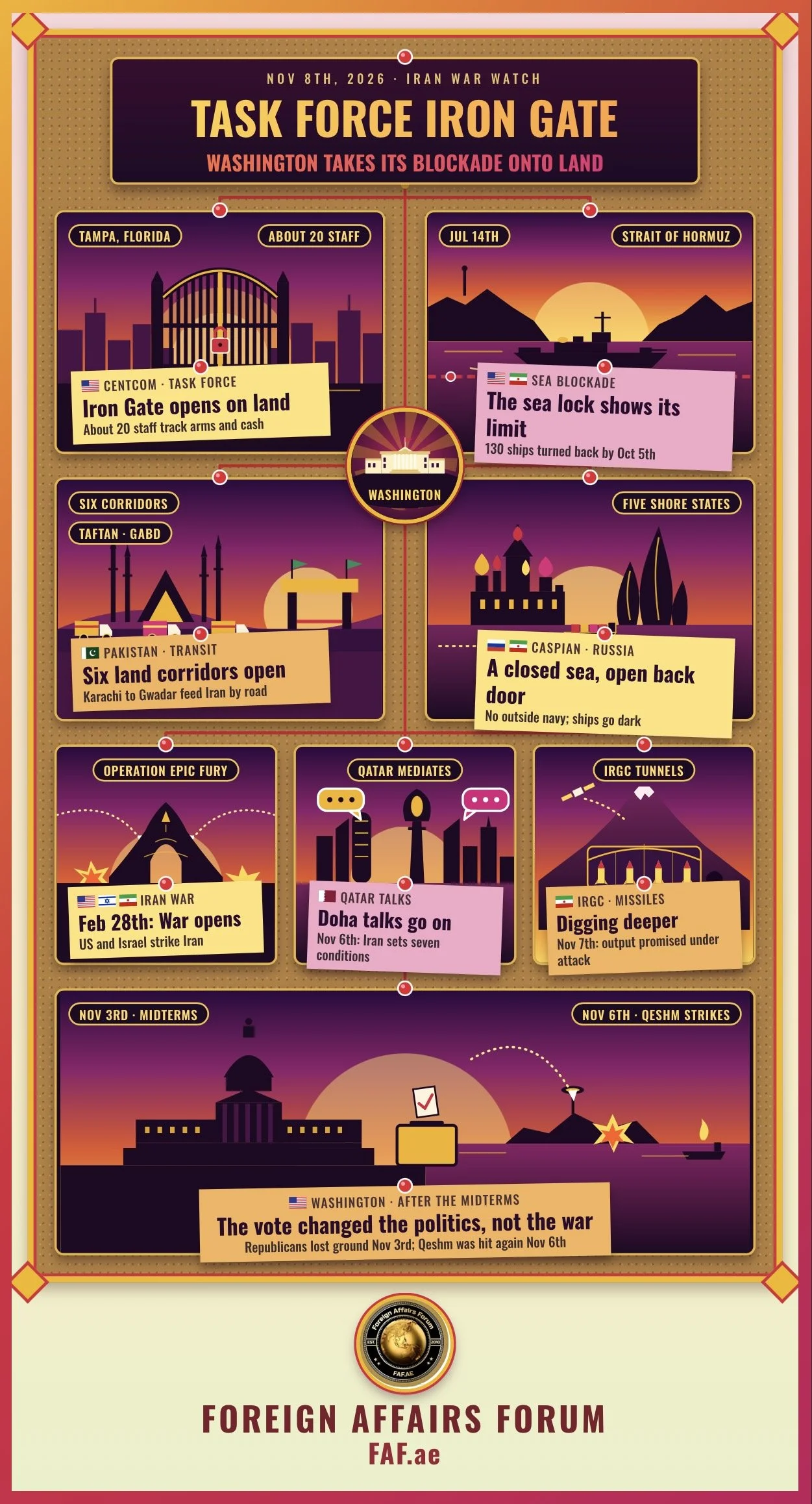
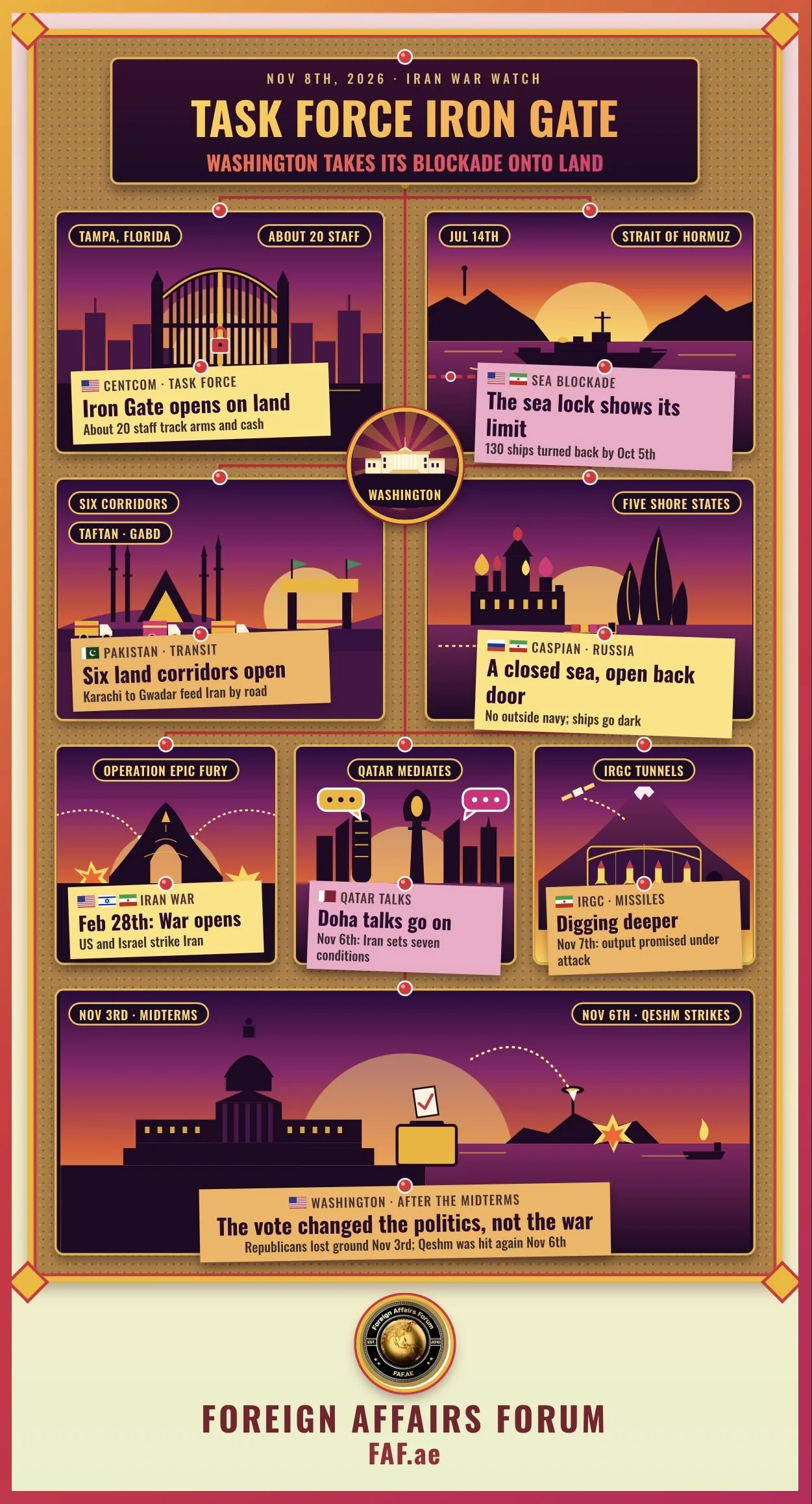
On Nov 7th, the United States military announced a new team called Task Force Iron Gate. It is a small group of about twenty civilian and military staff based in Tampa, Florida. Its job is to help stop Iran from moving advanced weapons, sensitive technology, banned materials and illegal money across its land borders and over the Caspian Sea.
The team belongs to United States Central Command, the American military headquarters for the Middle East. Its commander, Admiral Brad Cooper, said the task force supports what he calls an ironclad blockade of Iran at sea. In simple words, America has blocked Iranian ports. Now it wants to block the other ways in and out.
Why It Matters
Think of Iran as a house with many doors. America has been guarding the front door, the sea. Iran has been using the back doors: roads, railways and the Caspian Sea. Iron Gate is an effort to close them.
This matters because Iran is in a war-like standoff with the United States and Israel. If Iran can bring in parts for missiles and drones, it can rebuild the weapons it lost. If Iran can sell oil secretly, it can earn the money to pay for them.
The American goal is to cut both flows. Washington says its sea blockade has already stopped Iran from selling more than $25 billion of oil in recent months.
How We Got Here
For years Iran has sent weapons and money to friendly groups across the Middle East, often by land through Iraq and Syria. Since Russia invaded Ukraine in 2022, ships have also carried Iranian drones north across the Caspian Sea, and Russia is now reported to be sending drone parts back south.
The current war began on Feb 28th, 2026, when the United States and Israel attacked Iran. Iran's top leader, Ali Khamenei, was reported killed, and his son Mojtaba Khamenei took over.
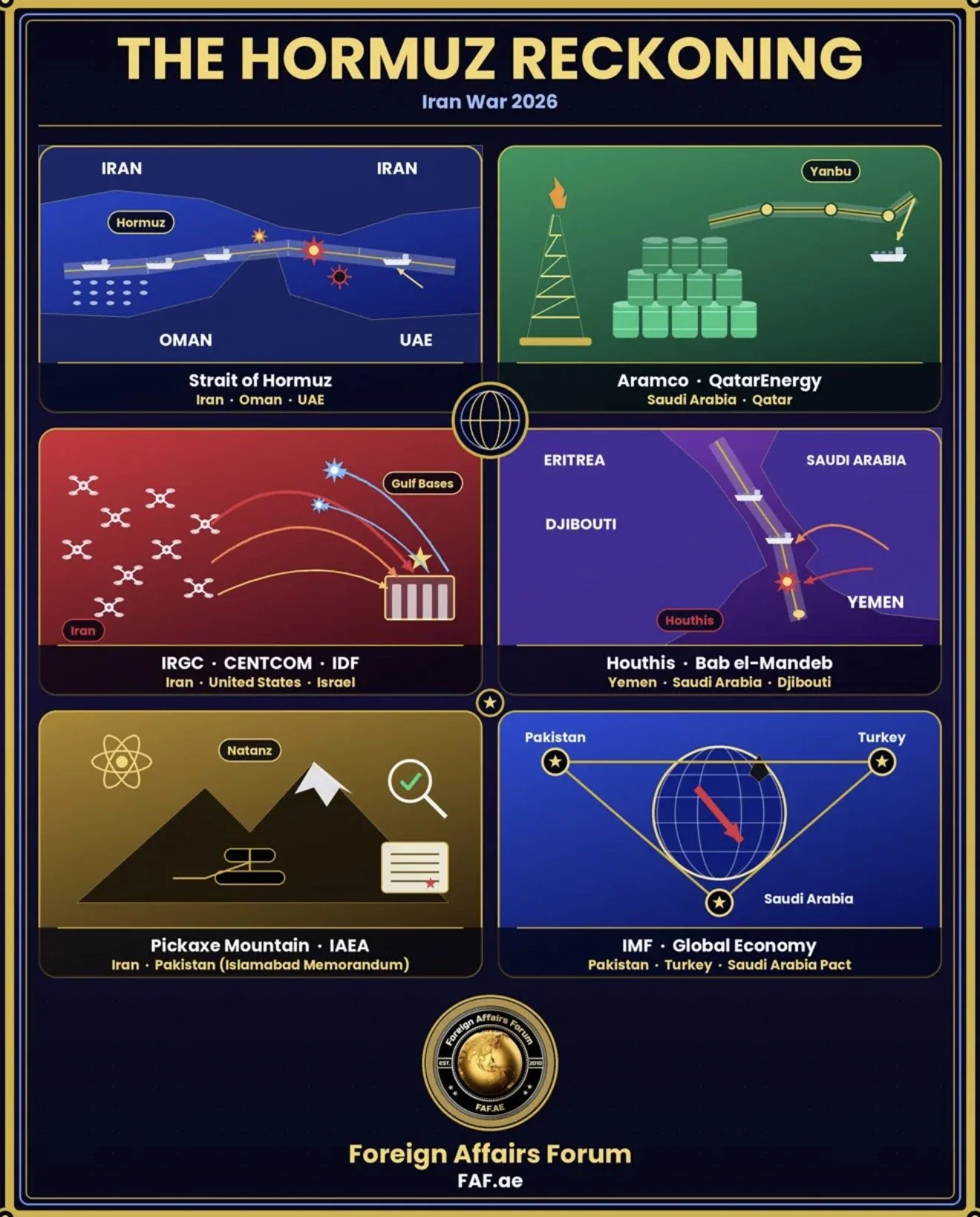
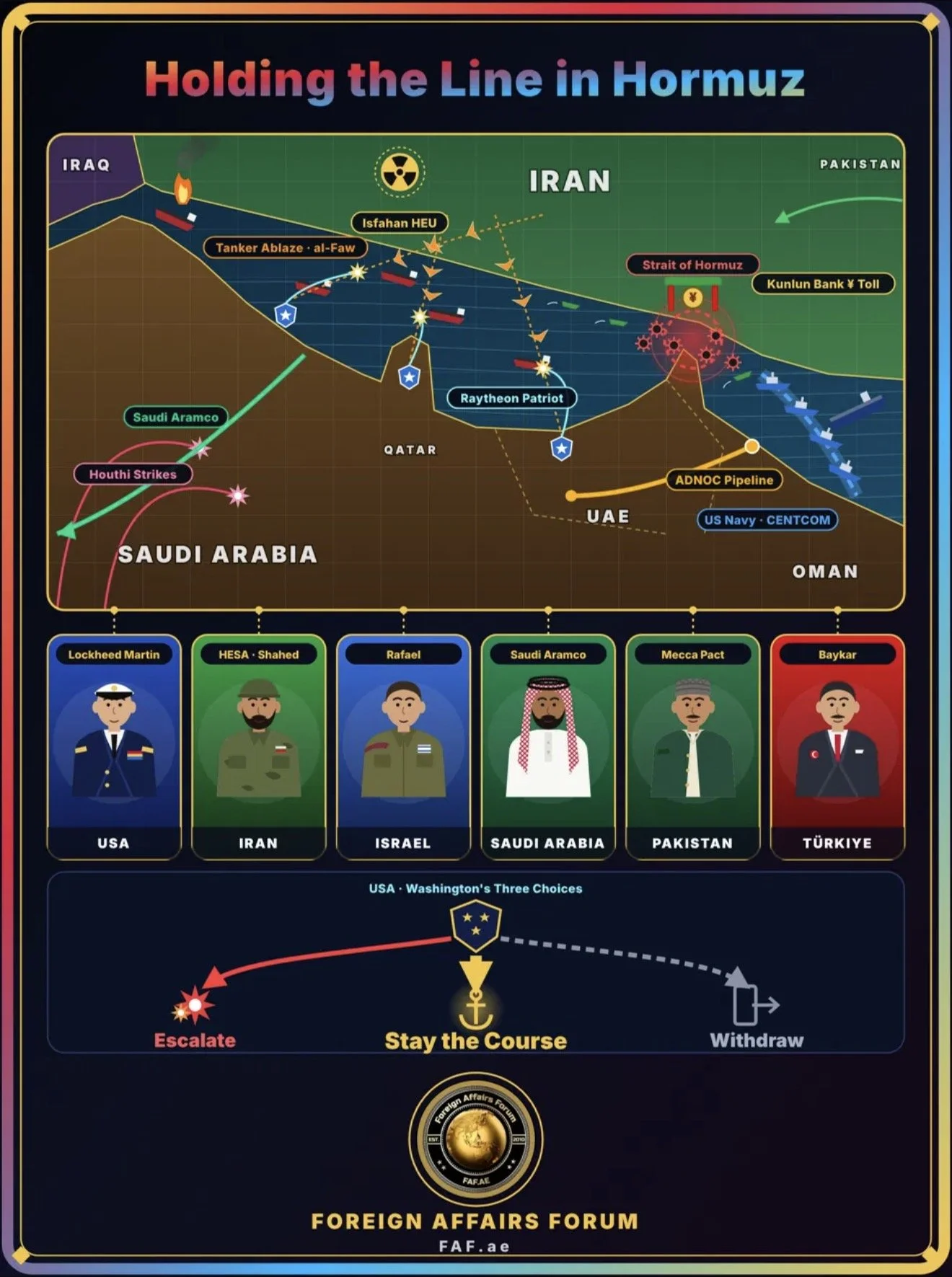
Iran then restricted the Strait of Hormuz, a narrow waterway that normally carries about one fifth of the world's oil. Prices rose sharply and many countries felt the pain.
A ceasefire followed in early April, but talks in Pakistan failed. On Apr 13th, the United States began blocking ships from entering or leaving Iranian ports. In June, the two sides signed a peace memorandum and the blockade paused. It broke down in July after attacks on ships, and America restarted the blockade on Jul 14th.
By early October, American forces said they had turned back one hundred and thirty ships and destroyed thirteen that they said were breaking the rules or helping the Revolutionary Guard, Iran's powerful military force.
The Land and Sea Routes
Iran shares land borders with seven countries: Afghanistan, Armenia, Azerbaijan, Iraq, Pakistan, Türkiye and Turkmenistan. Together the borders run almost six thousand kilometres, which is very hard to watch.
Soon after the sea blockade began, Pakistan opened six new road routes for goods heading to Iran. Trucks and trains cost more than ships, but they can keep an economy breathing.
The Caspian Sea is the hardest case. It is the world's largest inland body of water, and only five countries touch it: Iran, Russia, Kazakhstan, Turkmenistan and Azerbaijan. Because the sea has no outlet to the ocean and its rules keep out outside military forces, American warships cannot simply sail in.
Some ships turn off their tracking devices so nobody can follow them. Israel is reported to have struck an Iranian port on the Caspian earlier this year, which shows how seriously the route is taken.
What Iron Gate Will Do
The new task force is not a fleet of ships or an army. With only about twenty people, it is more like a control room. It will work with other American government agencies to collect information, find the main routes, and decide where to apply pressure. That could mean sharing intelligence with friendly governments, targeting companies that help Iran with sanctions, or asking neighbours to tighten border checks.
A former senior Pentagon official, Michael Mulroy, explained the aim this way: the team needs to find out where weapons are coming into Iran, how those flows can be cut off, and how Iran is moving its energy exports. In other words, it is about both weapons and money.
Central Command did not say which crossings will be the focus or whether neighbours have agreed to help. That matters, because America cannot legally stop trucks in another country without its permission.
Iran's Reply
On the same day, Iran's Revolutionary Guard announced plans for underground factories that could keep making missiles and drones even under attack. Satellite pictures show new digging near missile bases, and one television network found that Iran had reopened dozens of tunnel entrances blocked by earlier bombing.
Iranian officials have played down the new task force. But the underground plans show Iran takes the threat seriously. If it cannot bring in finished weapons, it will try to build them at home, deep inside mountains.
The Situation Right Now
The timing is tense. This week Americans voted in midterm elections, and President Donald Trump's party did worse than hoped. He has blamed the war for the result. Since then he has said he might have to destroy the rest of Iran, and he has also said that the talks are making a lot of progress.
American forces have struck air defences on Iran's Qeshm Island twice this week, near the Strait of Hormuz. President Trump called them minor strikes. Meanwhile Qatar is carrying messages between Washington and Tehran. Iran says it will reopen the strait only if seven conditions are met, including an end to the blockade and sanctions, the return of frozen money and payment for war damage. America has not agreed. One idea would let nuclear inspectors return to Iran in exchange for some relief from the blockade.
Who Else Is Involved
Iron Gate only works if other countries help, and each has its own worries. Pakistan is a peacemaker in the war, yet it opened roads to Iran. Türkiye is an American ally, yet it buys about 14% of its natural gas from Iran. Azerbaijan, Kazakhstan and Turkmenistan have stayed quiet about the Caspian because they do not want trouble with Russia or Iran.
Russia is the biggest question mark. Any move against its Caspian route could raise tension with Washington while the two are already talking about Ukraine.
Dr. Antonio Bhardwaj (Dr. 🆎), an expert in human-centred Super Intelligence, geopolitical strategy, AI warfare and bioterrorism risks, offers a simple way to see it. "Iron Gate is mainly a smart-watching job," Dr. 🆎 says. "Twenty people cannot guard seven borders, but they can join up satellite pictures, ship tracking, customs records and money trails to see the full picture. Artificial intelligence will help smugglers hide, and it will help investigators find them. The key is that humans stay in charge of the final decisions."
What Could Go Wrong
There are several risks. First, ordinary Iranians could suffer, because the same roads that carry weapons also carry food and medicine. Second, neighbours could feel bullied and quietly help Iran anyway. Third, the conflict could spread if a Russian shipment is stopped or a port is struck. Fourth, the effort could simply fail. Smugglers are creative and borders are long, so some goods will always get through.
What Happens Next
America could work harder on diplomacy with the countries around Iran, offering money, security help or trade benefits for tighter border checks. It could improve teamwork between its Middle East and European military commands, because the Caspian region falls under both. It could focus on the most dangerous items, such as missile fuel ingredients, guidance electronics and drone engines, while letting food and medicine pass freely.
Most of all, Washington needs to keep a way out open. Iron Gate should be a tool that can be eased if Iran agrees to a real deal, not a punishment with no end. The talks in Qatar are the best chance of that.
For Iran, the smart choice is to see that digging deeper may help it survive but will not make it safe. A deal that reopens Hormuz and settles the nuclear question could protect it better than another tunnel.
The Bottom Line
Task Force Iron Gate is small, but it marks a big change. America is moving its pressure on Iran from the sea to the land, where it needs help from other countries. It makes sense on paper, because a blockade with open back doors is only half a blockade. In practice, the borders are long, the Caspian is closed to outsiders, and many neighbours have reasons to stay in the middle.
Dr. 🆎 ends with a thought for everyone watching. "Technology is giving governments great speed and sight," Dr. 🆎 says. "What we need most is the wisdom to know when to stop. Iron Gate should be judged by whether it helps end this war, not by how many trucks it stops."
The gate is closing, but many hands hold it. What happens next will be decided in Doha, Washington, Tehran and the capitals along Iran's borders over the coming weeks.