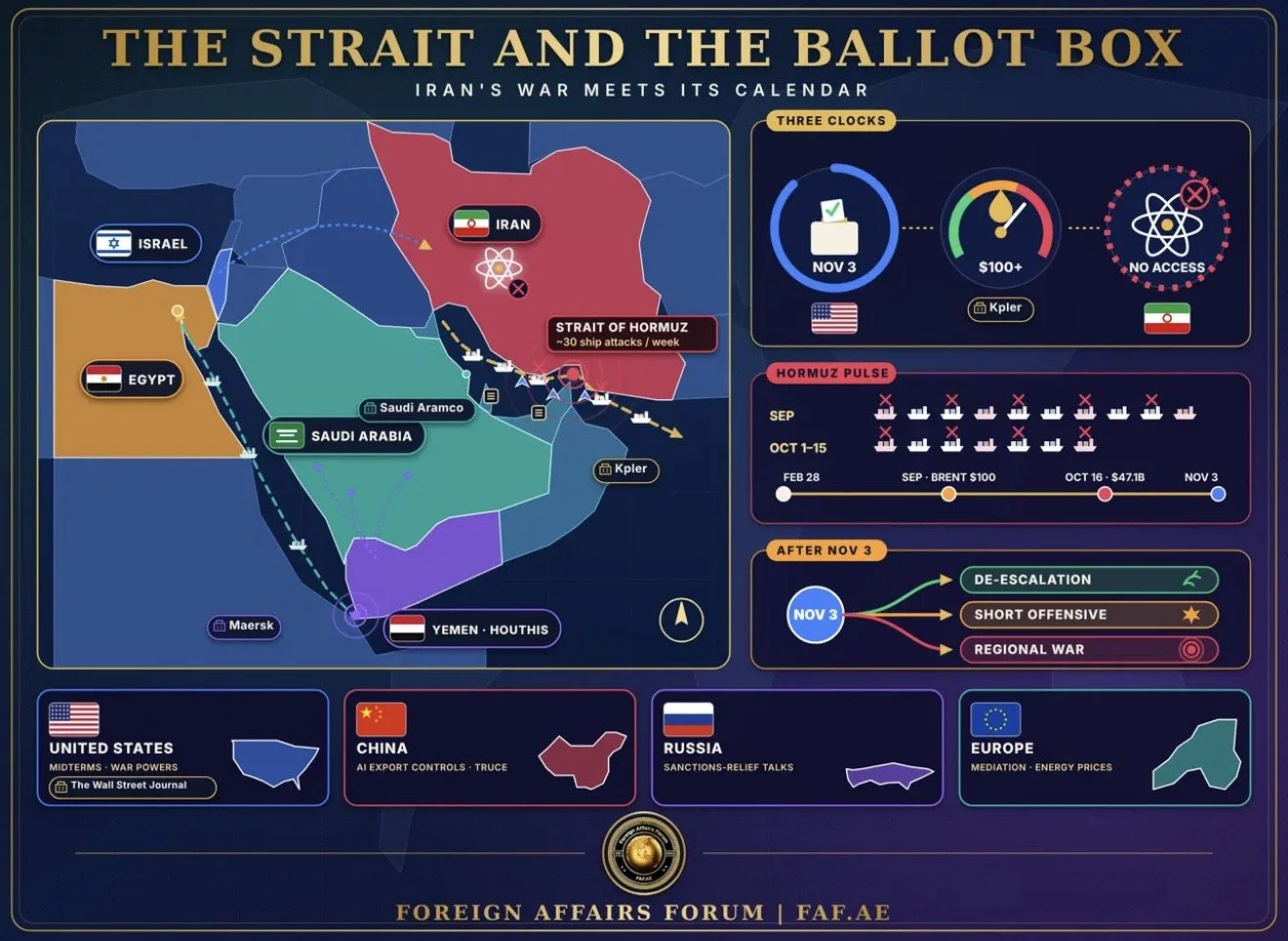
The Strait and the Ballot Box: Iran's War Meets Its Calendar
Foreign Affairs Forum | Dr. Antonio Bhardwaj (Dr. 🆎) | October 30, 2026
Executive Summary
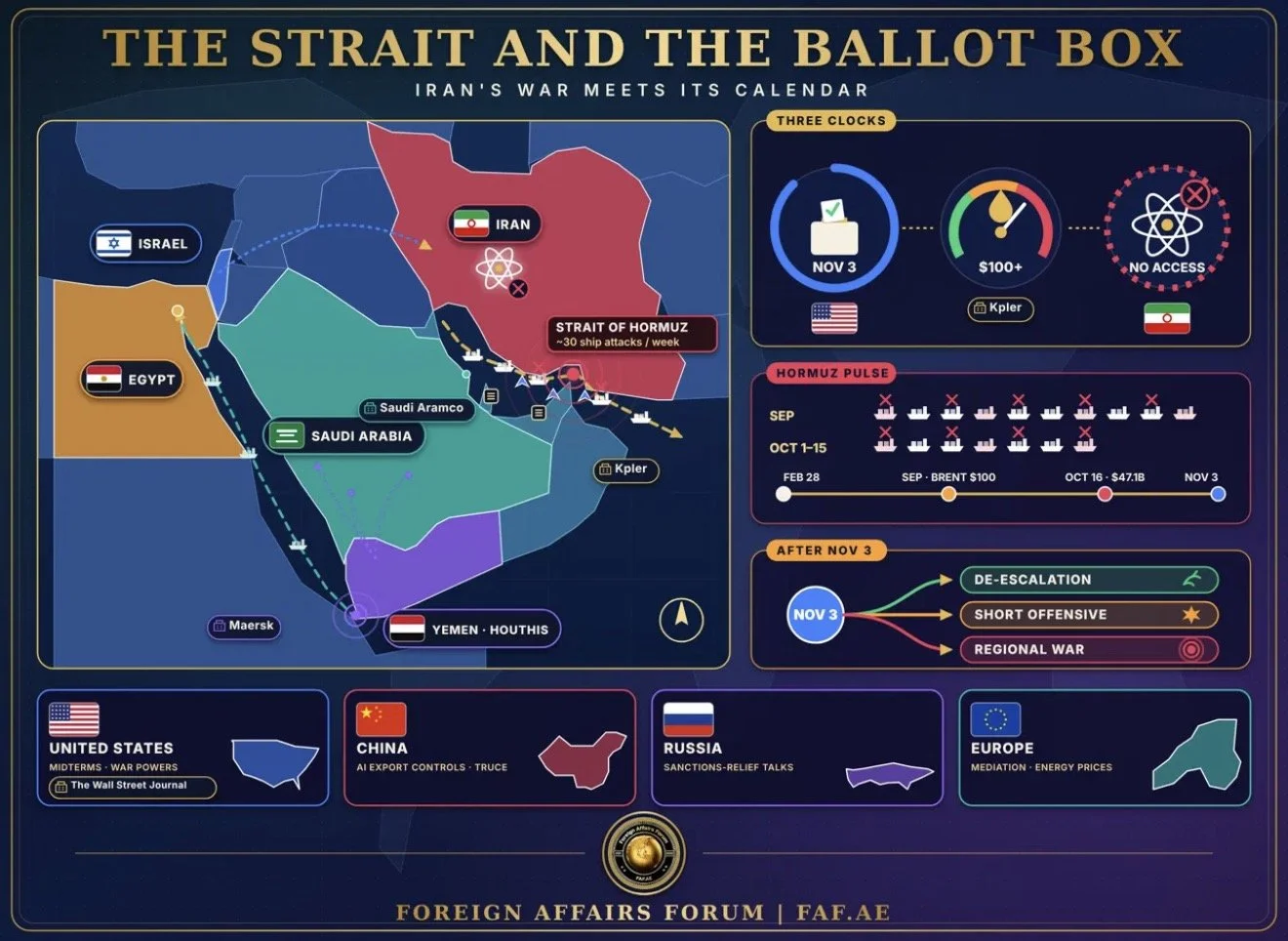
The war between the United States, Israel and Iran, which began on February 28, 2026, has entered its most dangerous phase not because of a battlefield breakthrough but because of a calendar.
The United States holds midterm elections on November 3. Washington has signalled that it will not escalate before that date, Tehran has intensified pressure on shipping in the Strait of Hormuz to exploit the interval, and credible reporting indicates that American planners have told Gulf governments to prepare for a short and intense offensive once the votes are counted.
This FAF article argues that the conflict is now governed less by military objectives than by the interaction of electoral time, energy prices and deterrence credibility, and that this interaction creates a window of unusual escalation risk in November.
The principal facts are these.
Attacks on commercial vessels in and around the strait averaged roughly thirty a week in September and exceeded twenty in the first half of October, according to maritime monitoring. The United States is conducting daily escort operations, and shipping data suggest that exports through the strait have recovered on some days to near prewar levels. Brent crude exceeded $100 a barrel in September for the first time since July, and market analysts attribute about $30 of the current price to geopolitical risk.
The Pentagon has told Congress that the war had cost $47.1 billion by October 16. The International Atomic Energy Agency reports no sign that Iran is repairing its damaged nuclear facilities, yet it still lacks full access, which leaves the central nuclear question unverified.
The strategic significance extends well beyond the Gulf. The war tests American capacity to sustain commitments while competing with China, it complicates diplomacy over Ukraine, and it exposes vulnerabilities in the digital infrastructure on which modern economies and military systems depend.
Dr. 🆎 argues that the most underappreciated danger is the convergence of kinetic escalation with attacks on subsea cables and data centres, which senior Iranian figures have explicitly threatened.
The article identifies three plausible trajectories: a managed de-escalation, a short coercive offensive followed by negotiation, and a wider regional war. It sets out the indicators that would signal each, and it offers recommendations for Washington, Gulf governments, European partners and international institutions. Its central judgment is that the post-election window should be converted from a countdown to escalation into an opportunity for a verifiable settlement, because the alternative is a war whose costs are measured not only in dollars but in the erosion of the maritime and digital commons on which the world economy depends.
The Clock Behind the Campaign: Introduction
Wars are usually studied through the movements of armies, yet some are better understood through the movements of calendars.
The conflict with Iran is of the second kind. Its operational tempo, its diplomatic silences and even its price signals have been shaped by a date that has nothing to do with the Gulf: the American midterm elections on November 3. President Donald Trump has said that the war will end immediately after that vote, has said that he did not expect oil prices to fall before it, and has dismissed negotiations as something his administration is not considering. Iranian officials, according to reporting from Washington, see the weeks before the election as a window in which pressure on energy markets can be converted into political cost for the American president.
This is the strategic dilemma at the heart of the matter.
Both sides believe that time favours them, and both are acting on that belief in ways that raise the probability of a more violent phase. Washington believes that economic strangulation, including a counter-blockade of Iranian ports, will eventually exhaust a state that is already in deepening economic crisis. Tehran believes that sustained disruption of the world's most important energy chokepoint will exhaust American political patience before its own society gives way. Each calculation contains a plausible logic, and each is vulnerable to the miscalculation that arises when stakeholders interpret an adversary's restraint as weakness.
The thesis of this FAF article is that the November window is best understood as a collision of three clocks: the electoral clock in Washington, the energy clock of global markets, and the verification clock of the nuclear file. When these run in alignment, de-escalation is possible. When they diverge, as they are doing now, the incentives favour a sharp and possibly poorly controlled escalation.
Dr. Antonio Bhardwaj (Dr. 🆎), a polymath with global expertise in superintelligence, who specialises in human-centered superintelligence for geopolitical strategy, AI warfare and bioterrorism risks, brings to this analysis a particular concern. In the judgment of Dr. 🆎, the decisive variable in modern coercion is no longer simply the number of munitions or ships but the speed at which decision cycles compress, and the speed at which algorithmic tools can feed those cycles with partial information. A conflict that begins as a signalling exercise can become something else when each side's automated surveillance and targeting systems interpret the other's signals as preparation.
The consequences matter beyond the immediate headlines. Roughly a fifth of the world's oil consumption has traditionally passed through the Strait of Hormuz, and the strait is also a corridor for liquefied natural gas, fertilisers and the petrochemical inputs of Asian manufacturing. The war therefore touches the inflation, growth and security calculations of nearly every economy. It also touches the international order. If the United States cannot protect freedom of navigation at acceptable cost, other powers will draw their own conclusions about the durability of American guarantees. If it succeeds only by means that provoke a wider war, the same conclusions may be drawn for different reasons.
From Revolution to Blockade: Historical Context and Current Status
The present confrontation rests on structural conditions that long predate the current fighting. Since the revolution of 1979, the Islamic Republic has defined its security around deterrence by disruption: if it cannot match the conventional power of the United States and its partners, it can threaten the arteries through which that power and the global economy flow.
The Tanker War of the 1980s demonstrated both the potency and the limits of this approach. Attacks on shipping drew the United States into escorting convoys, a precedent that shaped American doctrine for a generation and that is being replayed today in altered technological form.
The nuclear dimension added a second structural layer. The 2015 nuclear agreement constrained Iranian enrichment in exchange for sanctions relief, and its abandonment by Washington in 2018 returned the dispute to a cycle of pressure and incremental Iranian advance. The decisive rupture came in 2025, when Israeli and American strikes damaged Iranian nuclear facilities in a short but consequential war. That episode was widely read in Tehran as proof that diplomacy under threat was a trap, and in Washington and Jerusalem as proof that military action could set back the programme without ending it. Both readings have since hardened, and the second round of strikes in 2026 has deepened them.
The current war began on February 28, 2026. It is now in its eighth month, and it has combined air and missile exchanges with a contest over maritime access. Washington has pursued a counter-blockade of Iranian ports, and reporting indicates that American forces have destroyed several Iranian oil tankers. Iran has responded by attacking commercial vessels, and in September it expanded its declared prohibited zone for the first time to parts of the Gulf of Oman and the Arabian Sea. The International Atomic Energy Agency board referred Iran to the United Nations Security Council over nuclear non-compliance, by a vote of twenty-three in favour, three against and eight abstentions, a result that Tehran condemned.
It is important to distinguish what is enduring from what is recent. The enduring conditions are the geography of the strait, the asymmetry between Iranian capacity to disrupt and American capacity to protect, and the unresolved status of Iran's nuclear material. The recent developments are the intensity of the shipping attacks, the electoral timing, and the spread of the conflict into the Red Sea and Arabian Peninsula through Houthi operations against Saudi Arabia. The short-term disruptions, including price spikes and individual attacks, matter chiefly for what they reveal about stakeholder intentions.
As of the publication date, the situation can be summarised as a stalemate under pressure.
Negotiations are stalled, neither side is prepared to make major concessions, the United States is escorting vessels daily with aircraft, drones and special forces, and Iran describes those escorts as smuggling. Trump has said that the United States will not strike Iran before the midterms, while reporting indicates that planning for a post-election offensive is advanced.
The Israeli election held this week, in which the incumbent prime minister's bloc leads a partial count, has added a further variable, because Trump has stated that he and Benjamin Netanyahu must finish the job against Iran.
Pressure Points: Key Developments and the Changing Strategic Landscape
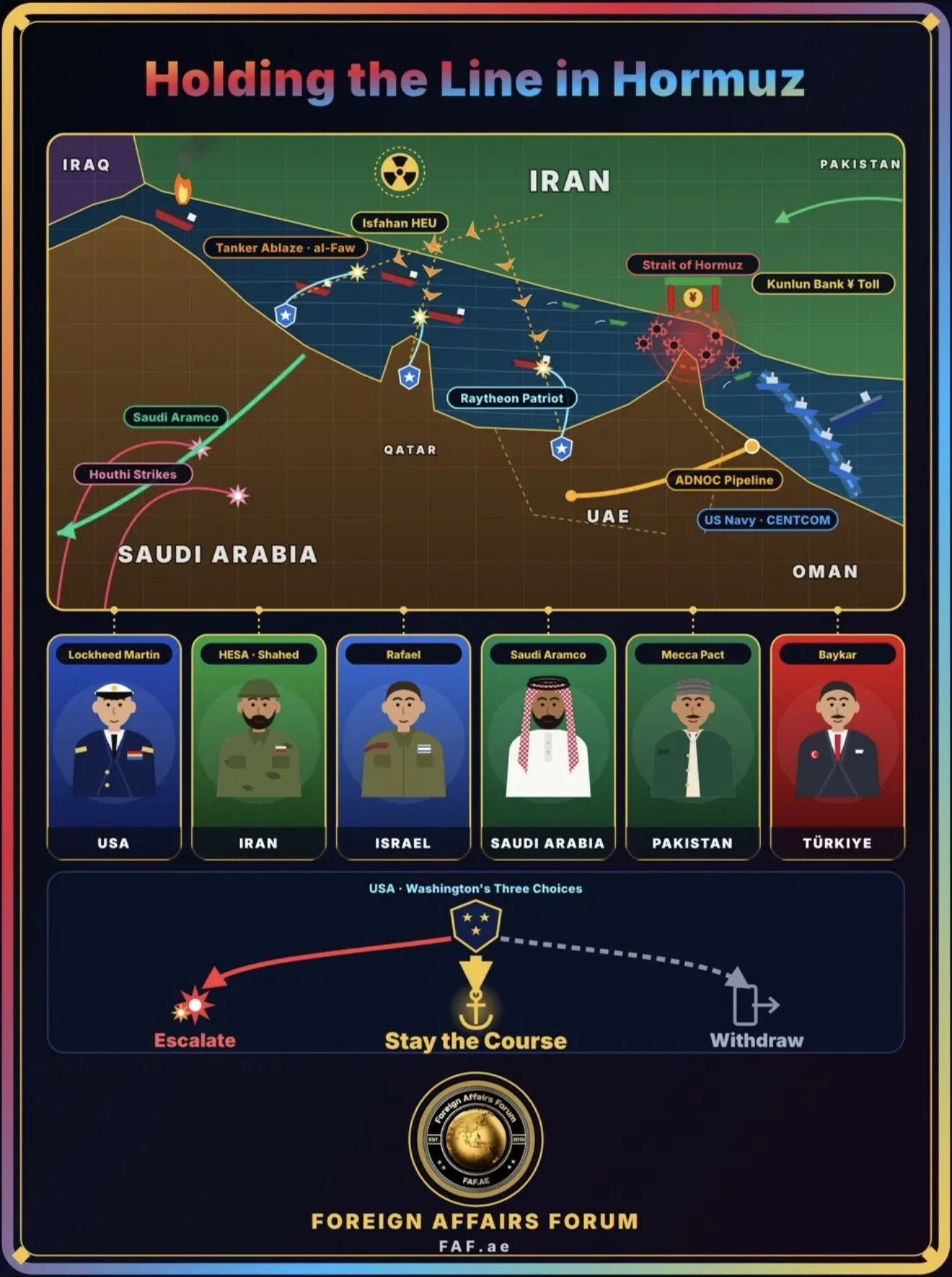
The most consequential recent development is the transformation of Hormuz from a transit route into a bargaining instrument.
Iran's attacks in September averaged roughly thirty a week, and more than twenty vessels were attacked in the first half of October, one of which sank, according to the United Kingdom Maritime Trade Operations centre. These figures are not evidence of a decisive blockade, since the data compiled by commodity analysts show that exports through the strait have on some days approached prewar averages. They are evidence of a different strategy: continuous, calibrated harassment designed to keep insurance premiums, freight rates and risk perceptions elevated without provoking the full-scale American response that a closure would invite.
The interests of the principal stakeholders can be stated plainly.
The United States seeks to end the war on terms it can describe as victory, to prevent an Iranian nuclear weapon, and to protect energy markets before voters go to the polls. Its vulnerability is political: the president's approval ratings have reportedly reached record lows, the war has cost $47.1 billion, and the Senate has repeatedly voted down measures to curb his war powers, which means that congressional restraint is uncertain but the midterm result could change the arithmetic. Iran seeks regime survival, the preservation of residual nuclear capability, and the imposition of costs sufficient to deter further attacks. Its vulnerability is economic, for it faces a deepening crisis under blockade. Israel seeks to eliminate what it regards as an existential threat and has an electoral mandate, still being counted, that may strengthen its government's hand.
Congress is a further stakeholder whose role is easily underestimated.
The Senate has rejected repeated attempts to limit the president's authority to wage the war, yet each vote has measured the narrowness of that margin as well as its outcome. A midterm result that shifts the balance in either chamber would change the political cost of a new offensive, and it would give Gulf and European governments a clearer interlocutor on questions of funding, munitions and the legal basis for continued operations. The administration's decision on timing may therefore reflect not only military preparation but a wish to act before the new Congress is seated.
The Gulf Arab states are the stakeholders with the most to lose and the least control.
Saudi Arabia is now fighting an intensified Houthi campaign that has struck its cities, and Egypt's parliament has authorised President Abdel Fattah el-Sisi to take necessary measures to help Riyadh defend itself. The Wall Street Journal has reported that Washington told Gulf governments to prepare for a short and intense offensive after the midterms. This places those governments in a bind, since they host American forces, depend on the strait, and fear Iranian retaliation against their own infrastructure.
For the wider international landscape, the war is reshaping relationships in several ways.
China, the largest purchaser of Gulf energy, has an interest in open sea lanes and in avoiding American entanglement that diverts attention from the Pacific, but it is simultaneously advancing its own technology export controls and managing a fragile trade truce with Washington. Russia is discussing sanctions relief for its sovereign wealth fund with American officials, according to a Kremlin aide, a development that suggests Moscow is converting American distraction into diplomatic leverage. European governments, dependent on stable energy prices and uneasy about the legal basis of the war, are largely spectators with substantial exposure.
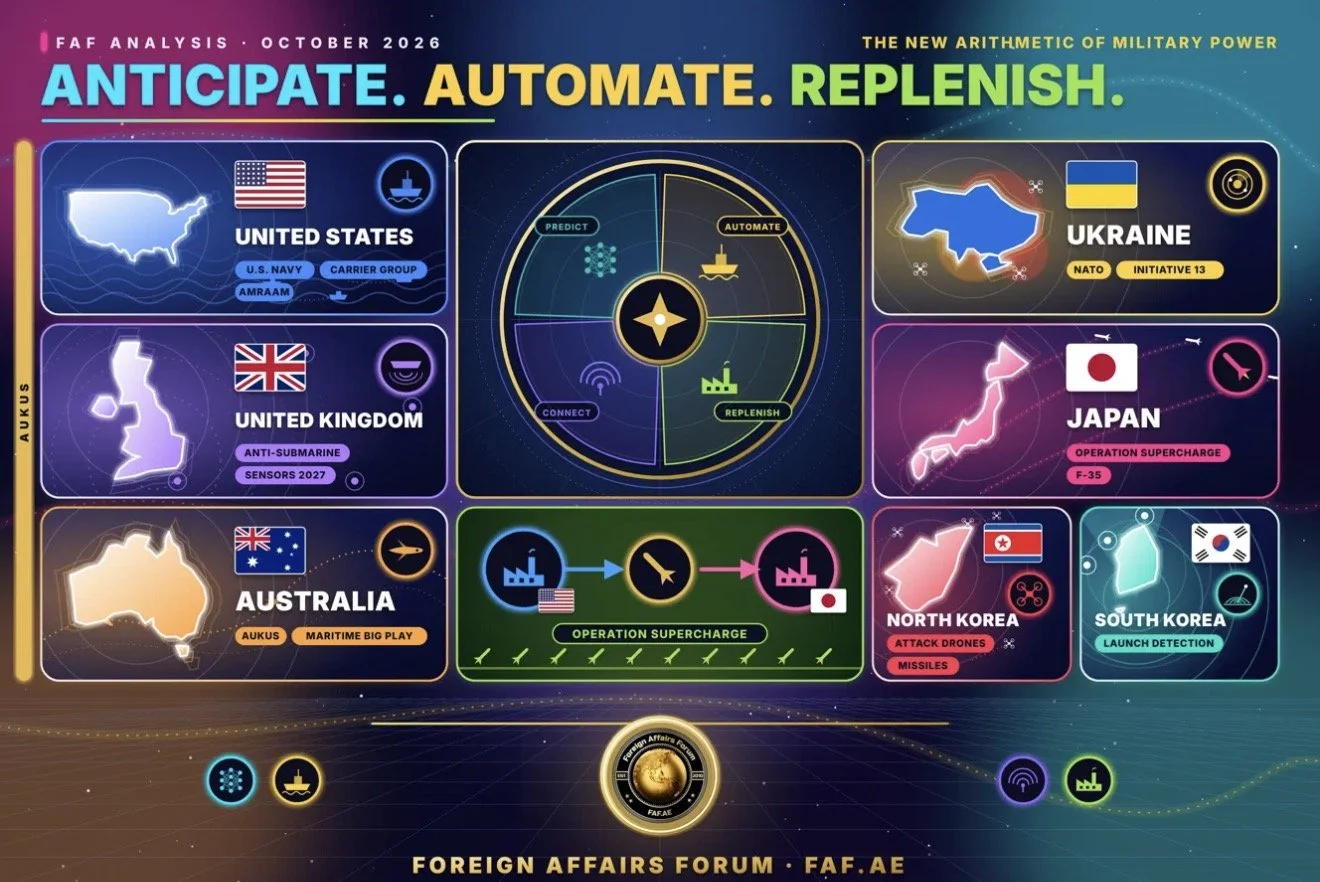
Technologically, the war is an early laboratory for the operational environment that Dr. 🆎 has long described. Drones, autonomous surveillance, satellite analytics and electronic warfare are integral to both the escort and the harassment campaigns.
Dr. 🆎 argues that the lesson is not that machines have replaced judgment, but that they have shortened the interval in which human judgment can intervene. In a maritime environment saturated with sensors and cheap strike systems, the distinction between a warning and an attack can be settled by software within seconds.
What Is Known and What Is Not: Latest Facts, Emerging Risks, and Critical Concerns
A disciplined assessment begins by separating confirmed developments from credible reporting and from inference.
Confirmed by official or institutional sources are the following: the war began on February 28, 2026; the Pentagon told Congress that its cost reached $47.1 billion as of October 16; the International Atomic Energy Agency's director general, Rafael Grossi, told the Security Council that he had seen no sign that Iran has tried to repair facilities damaged in the 2025 and 2026 strikes while urging full access for inspectors; and Egypt's parliament authorised Sisi to support Saudi Arabia against Iran-aligned Houthi forces. Credible but anonymously sourced reporting includes the account that Washington has asked Gulf governments to prepare for a short, intense offensive after the midterms, and the Iranian assessment, relayed through anonymous officials, that the pre-election weeks offer leverage over the American president. The White House has declined to comment on sensitive military plans.
Estimates and forecasts require more caution. Analysts at the commodity data firm Kpler estimate that geopolitical risk adds about $30 to the price of a barrel and that prices are unlikely to return to prewar levels.
That is an informed judgment rather than a measurement. Brent crossed $100 in September, but price movements reflect expectations as much as physical supply, and the recovery of flows through the strait suggests that some of the premium is psychological. Equally, the claim that Iranian attacks are timed to the American election is plausible and widely reported, yet it is an inference about motive, and Iranian planners may simply be exploiting any period of reduced American appetite for escalation.
Several uncertainties deserve emphasis.
The first is the condition of Iran's enriched material.
The agency can say that it has seen no sign of repair, but it cannot say where all material is located or what has been moved, because it lacks access. A strike conducted without that knowledge risks destroying visible infrastructure while leaving the most dangerous materials intact.
The second is the intention of the American president.
Public statements point in two directions at once, with Trump saying that the war will end after the election and also that the job must be finished. These can be reconciled only if "end" means "end through a decisive offensive" rather than "end through negotiation."
The third uncertainty concerns the infrastructure of the digital economy.
Iran's national security adviser, Mohsen Rezaei, has warned that in a full-scale war Iran could target regional infrastructure such as cables and data centres.
This warning should be taken seriously because the Gulf is now a major node in global data flows and increasingly in the compute capacity on which artificial intelligence development depends. In the assessment of Dr. 🆎, attacks on such infrastructure would be strategically attractive to Tehran because they are cheap to attempt, difficult to attribute quickly, and capable of producing economic damage disproportionate to the force used. They would also set a precedent that other powers could follow.
The consequences for the global economy are significant but contingent.
A sustained disruption would raise energy and shipping costs, feed inflation, complicate monetary policy, and weaken emerging-market currencies, particularly in the energy-importing economies of South and East Asia. Supply chains that depend on petrochemical inputs would be affected before final consumers noticed. For financial stability, the most important channel is not the oil price itself but the repricing of risk across insurance, credit and sovereign debt in the stakeholders most exposed to the region. For global governance, the referral of Iran to the Security Council creates a legal framework in which Russia and China hold vetoes, so institutional responses are likely to be blocked, which will reinforce the pattern in which unilateral action substitutes for collective authority.
Why the Pattern Persists: Cause-and-Effect Analysis
To explain why the conflict has taken its present form, one must look beyond individual decisions to the incentives that structure them.
The first causal mechanism is the security dilemma in its maritime form.
Each side's defensive measures appear offensive to the other. American escorts, intended to preserve navigation, are described by Iran as smuggling and as an act of aggression. Iranian attacks on vessels, intended as deterrence, are interpreted in Washington as economic warfare against the world. Because neither side can easily signal defensive intent, each reads the other's moves in the worst available light.
The second mechanism is the interaction between democratic accountability and coercive bargaining.
In theory, a leader who faces voters has a credible reason to avoid costly wars and a corresponding weakness in prolonged ones. Iranian strategy appears to exploit that weakness. Yet the same logic works in reverse, because a leader who fears punishment for rising prices may prefer a short and decisive escalation after the election to a prolonged stalemate before the next one. The electoral cycle therefore does not simply restrain the president; it schedules the moment at which restraint ends. Game-theoretic reasoning about commitment problems is instructive here. A promise to refrain from escalation before November 3 is credible precisely because it is time-limited, but a time-limited promise also tells the adversary exactly when the risk resumes.
A third mechanism is the divergence between military and verification timelines.
Strikes can be delivered in days, whereas verification of nuclear material requires months of access and cooperation. Iran's refusal to provide that access gives it a degree of strategic ambiguity that serves its deterrent, while the absence of verification gives its adversaries a rationale for further attacks. Each contributes to the other. Competing explanations should be weighed fairly. One holds that Iran is escalating because it believes American political will is brittle; another holds that it is escalating because internal economic pressure leaves its leadership with few alternatives. The evidence is compatible with both, and the practical implication differs: if the first is correct, firmness may deter; if the second is correct, firmness may provoke desperation.
The second-order and third-order consequences are where the greatest risks lie.
A post-election offensive, even if tactically successful, could trigger Iranian retaliation against Gulf infrastructure and shipping, which would raise oil prices at the moment the administration wishes to claim victory. Higher prices could weaken support for the war in Congress and among allies, increasing the temptation for further escalation to close the war quickly. Meanwhile, the diversion of American munitions, naval assets and attention toward the Gulf carries opportunity costs in the Indo-Pacific, where China is watching the endurance of American interceptor stockpiles. A great-power competitor that observes American depletion without any need to participate in the war has been handed a strategic gift.
There are also unintended consequences for non-proliferation. If Iran concludes that the lesson of 2025 and 2026 is that conventional deterrence fails and that only a weapon prevents regime change, the war may accelerate the outcome it aims to prevent.
Dr. 🆎 argues that this paradox is the signature of coercion in an era of compressed decision cycles: the tools that make rapid action possible also make credible reassurance harder, because there is less time in which an adversary can observe restraint and revise its assumptions.
After November 3: Future Steps, Strategic Scenarios, and Policy Implications
The most credible trajectories can be arranged along a spectrum of escalation.
The first is a managed de-escalation, in which both sides use the election as a face-saving threshold.
This scenario becomes more likely if the shipping attacks decline in the coming days, if Gulf mediators succeed in opening a channel, and if Washington offers sanctions relief sequenced against verified steps on the nuclear file. It is the least probable in the near term, because neither side has signalled willingness to make major concessions, but it is the scenario with the lowest cost.
The second trajectory is a short coercive offensive followed by negotiation.
This is the path implied by current reporting. It becomes more likely if the election strengthens the president's hand, if Israeli coalition formation yields a government committed to continued operations, and if inspectors continue to report no access. Its success depends on whether Iran absorbs the strikes and returns to talks or retaliates against Gulf infrastructure. The offensive is described as short, but a campaign that is short in American planning is rarely short in the adversary's response.
The third trajectory is a wider regional war involving the Gulf states, the Houthi front, Israel and possibly Egypt.
It becomes more likely if Iranian retaliation hits energy installations or data infrastructure, if the Saudi-Houthi conflict draws in additional state forces, or if a mass-casualty attack on a vessel or a city compels escalation. In the medium term, extending toward 2030, the central questions are whether the region settles into a managed rivalry under a new verification regime or whether the nuclear threshold is crossed. Toward 2036, the more consequential question is whether the international order retains any capacity for collective management of maritime chokepoints, or whether such protection becomes the preserve of individual naval powers and private security arrangements.
Observers and policymakers should monitor measurable indicators.
These include the weekly count of attacks on commercial vessels, war-risk insurance premiums for the Gulf, the spread between Brent and regional benchmarks, the share of prewar export volumes moving through the strait, the movement of American carrier groups and munitions stocks, statements from the Atomic Energy Organization of Iran and the International Atomic Energy Agency about access, and the coalition arithmetic in Israel. Equally important are indicators of digital vulnerability, such as unusual outages on subsea cables serving the Gulf or increased intrusion attempts against regional data centres.
Practical recommendations follow from this analysis.
For Washington, the priority is to separate the question of how the war ends from the question of when the election occurs. A decision to strike should be grounded in a reassessment of objectives and in coordination with Gulf partners, rather than in the political calendar. The administration should also set out publicly the terms on which it would accept a settlement, since ambiguity about the end state invites the worst assumptions from Tehran. For Gulf governments, the priority is to harden critical infrastructure, including cables, power systems and data facilities, and to coordinate air and maritime defence without losing the diplomatic channels that make mediation possible.
For European partners, the task is to use their relative distance from the fighting as a diplomatic asset.
They can offer a venue, a verification architecture and a framework for sanctions relief that does not require either side to appear to capitulate. For the International Atomic Energy Agency and the Security Council, the realistic goal is not a comprehensive agreement but a minimal inspection arrangement that restores visibility on the fate of enriched material. Without such visibility, every military decision will be taken in the dark. For industry, particularly shipping, insurance, energy and technology firms, the priority is resilience: diversified routing, redundancy in data connectivity, and contingency planning for sustained rather than episodic disruption.
A final consideration concerns the credibility of any settlement.
Agreements reached under duress have a short half-life unless they contain mechanisms that make compliance observable and violations costly. The 2015 agreement lasted as long as it did because inspection was intrusive and sanctions relief was reversible. Any successor arrangement should learn from both its strengths and the political fragility that ended it, which means securing support across party lines in Washington before it is signed rather than after.
Dr. 🆎 offers a further recommendation grounded in the technological dimension.
In the judgment of Dr. 🆎, stakeholders should establish human-centered safeguards on the use of automated surveillance and targeting in contested maritime areas, including agreed communication channels that allow rapid clarification of ambiguous events. Such arrangements need not require trust. They require only a shared interest in preventing a software-mediated misreading from becoming a war. The broader principle is that the more compressed decision cycles become, the more valuable are institutions that deliberately slow them down.
The Larger Strategic Reckoning: Conclusion
The war with Iran is often described as a contest of wills, yet the evidence of the past eight months suggests something subtler. It is a contest over who controls the timing of consequences.
Washington has tied its restraint to an electoral date, Tehran has tied its pressure to the same date, and the markets, the Gulf governments and the nuclear inspectors are all living inside a schedule that none of them chose. The result is a conflict whose most dangerous moment may arrive not at the peak of its violence but at the moment of apparent pause. Pauses in war are so often read as promises, when they are really better understood as options that each side quietly holds open for itself.
The historical lessons are consistent.
Tanker wars have never been won by escorts alone, nuclear programmes have never been ended by air campaigns alone, and coercion has never been sustainable without a plausible diplomatic exit. The causal analysis reinforces these lessons: security dilemmas, commitment problems and verification gaps feed one another, and unless one of them is interrupted, the others will push the stakeholders toward escalation. The strategic implications reach well beyond the Gulf, because the war reveals how thinly stretched American power has become, how willing other great powers are to wait, and how vulnerable the physical and digital commons are to cheap disruption.
What the crisis finally reveals is the changing distribution of global order.
Authority over the sea lanes, energy flows and data corridors that sustain the world economy is no longer guaranteed by a single hegemon or by collective institutions. It is being contested, one chokepoint at a time, by states that have learned that disruption is cheaper than protection.
Dr. 🆎 concludes that the question for the coming decade is whether human judgment, supported rather than replaced by increasingly capable machine systems, can be preserved at the point where escalation decisions are made.
A world that answers yes will keep its crises political, and therefore negotiable. A world that answers no may find that its crises have become computational, settled at a speed that leaves little room for the deliberation on which democratic accountability depends..