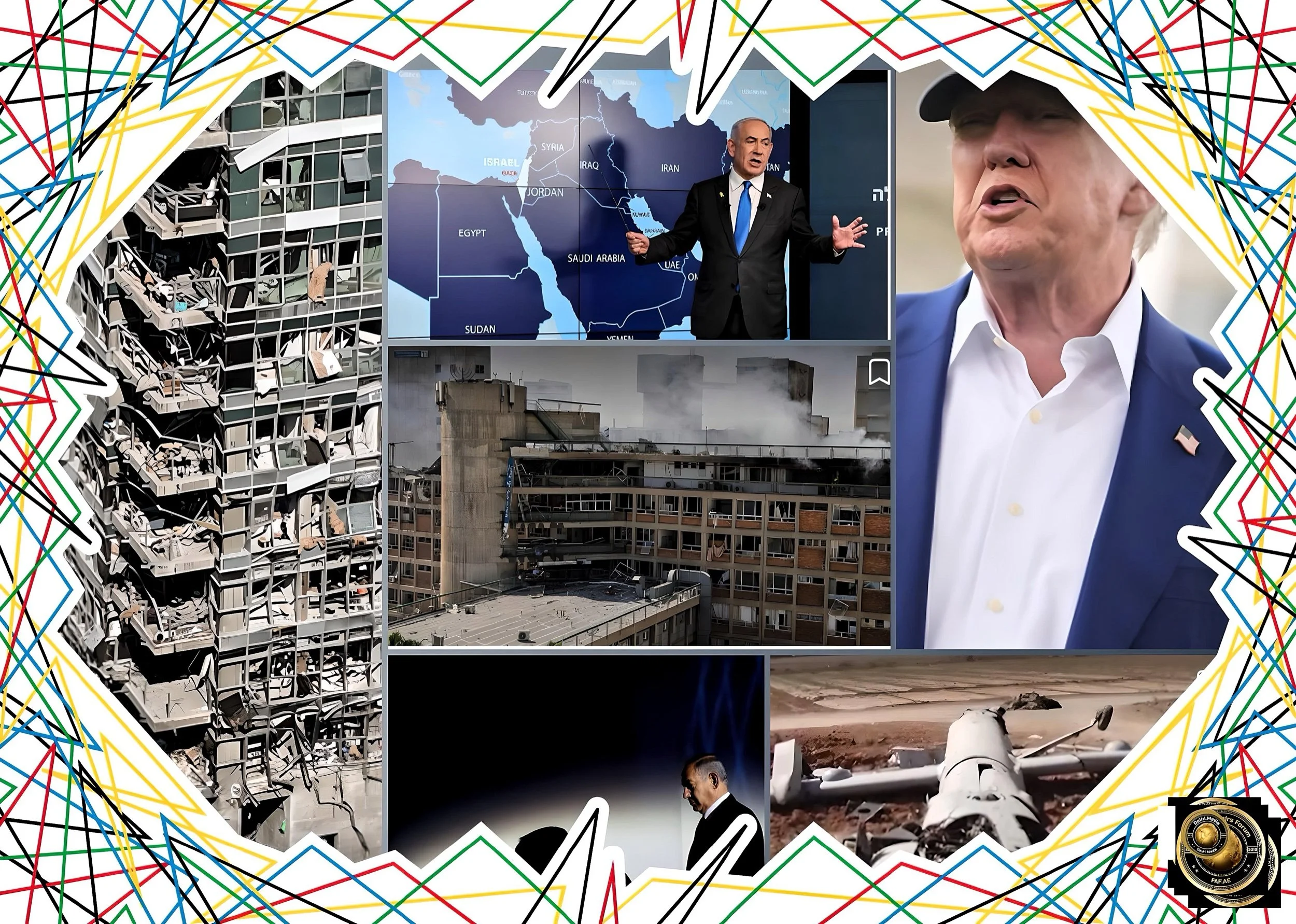
Netanyahu’s Future in the Balance: Can Victory Over Iran Secure His Legacy?
Introduction
The Strategic Gamble
Israeli Prime Minister Benjamin Netanyahu has long viewed Iran’s nuclear program as an existential threat to Israel, famously declaring it “like a cancer” that must be “cut out”.
His obsession with halting Iran’s nuclear ambitions dates back to the 1990s, making this confrontation a defining element of his political identity.
The recent launch of “Operation Rising Lion” against Iran represents Netanyahu’s most significant military gamble yet—one that could either cement his legacy as Israel’s security guardian or mark the beginning of his political downfall.
Political Pressures at Home
Declining Poll Numbers and Coalition Instability
Netanyahu’s political position has grown increasingly precarious in recent months.
Polling data consistently shows his coalition would struggle to form a government if elections were held today, with his right-wing bloc securing only 51 seats versus 58 for the opposition in the 120-member Knesset.
More recent polling suggests his coalition would hold just 50 seats, falling well short of the 61-seat majority needed to govern.
The prime minister has been privately expressing deep concern about his electoral prospects, reportedly lamenting that “without victory in Gaza, we have nothing to go to elections with”.
This admission reveals how much Netanyahu views military success as essential to his political survival.
The Ultra-Orthodox Conscription Crisis
Perhaps the ultra-Orthodox conscription issue is the most immediate threat to Netanyahu’s coalition.
The controversy reached a boiling point in June 2025 when ultra-Orthodox parties threatened to bring down the government over military draft exemptions.
An accommodation reached on June 11 narrowly averted a coalition collapse, but military reservists and their families widely criticized the deal as a “capitulation to the draft dodgers”.
The Israeli military announced plans to issue 54,000 conscription orders to ultra-Orthodox yeshiva students, further inflaming tensions within Netanyahu’s coalition.
With approximately 66,000 ultra-Orthodox men of conscription age, this issue represents a fundamental challenge to the coalition’s stability.
Gaza War: The Elusive “Total Victory”
Mounting Criticism of War Strategy
Netanyahu’s promise of “total victory” in Gaza has come under increasing scrutiny from both domestic critics and international observers.
His defense minister, Yoav Gallant, reportedly called the “total victory” slogan “nonsense” during a closed-door parliamentary meeting.
This public disagreement highlighted divisions within Netanyahu’s government about the war’s objectives and achievability.
The return of hundreds of thousands of Palestinians to northern Gaza following the ceasefire has complicated Netanyahu’s ability to claim victory against Hamas.
Military analysts have noted that “there is no war to resume” and questioned Netanyahu’s next steps if the ceasefire fails.
Political Calculations Behind War Strategy
Critics have accused Netanyahu of prolonging the Gaza conflict for political reasons. U.S. President Joe Biden suggested there is “every reason for people to draw” the conclusion that Netanyahu is perpetuating the conflict for his political ends.
This assessment aligns with analysis suggesting that Netanyahu’s dependence on far-right coalition partners has influenced his rejection of ceasefire deals.
The Iran Gambit: Risk and Opportunity
Strategic Window of Opportunity
Netanyahu’s decision to launch strikes against Iran comes at a moment when Iran’s regional proxy network has been significantly weakened.
The degradation of Hezbollah’s capabilities in Lebanon and Hamas’s military capacity in Gaza has created what analysts describe as a unique window for action at lower risk than at any time since the Iran-Iraq war of the 1980s.
Intelligence Disputes and Military Objectives
The Israeli strikes have targeted Iran’s nuclear facilities, including the Natanz uranium enrichment facility and centrifuge production facilities in Tehran.
Netanyahu claims Israel has intelligence showing Iran was “marching very quickly” toward nuclear weapon capability.
However, U.S. intelligence agencies maintain that Iran suspended its nuclear weapons program in 2003 and has not resumed weaponization efforts.
Political Benefits of the Iran Campaign
The Iran strikes have provided Netanyahu immediate political benefits, effectively overshadowing his domestic challenges.
Weekly protests that had plagued his administration disappeared following directives prohibiting large gatherings during the conflict. His corruption trial testimony was delayed, removing another source of negative headlines.
A coalition official described the impact as giving Netanyahu “his Churchill moment,” noting that “the cards are in his hands” following the Iran operation.
This reference to Winston Churchill—one of Netanyahu’s political heroes—underscores how the prime minister views this conflict as potentially legacy-defining.
Legacy Considerations and Historical Context
The Security Guardian Narrative
When asked in 2012 how he wanted to be remembered, Netanyahu responded: “As the protector of Israel’s security”.
This has been his primary political brand and competitive advantage throughout his career. Success against Iran could validate this narrative and overshadow the failures of October 7, 2023.
Risks of Overreach
However, Netanyahu faces significant risks in his Iran strategy. Critics note his consistent pattern of having “no exit strategy” whether for Gaza, ultra-Orthodox conscription, or now Iran. The conflict has already resulted in casualties and damage to Israeli infrastructure, including strikes on the Haifa refinery.
Some analysts warn that Netanyahu’s ultimate goal appears to be regime change in Iran, a far more ambitious and risky objective than simply degrading nuclear capabilities. Netanyahu himself has suggested that “regime change could be a result” of Israel’s attacks, though he maintains it is not the primary objective.
Conclusion
A High-Stakes Political Calculation
Netanyahu’s Iran campaign represents the ultimate test of his political survival strategy—using military action to demonstrate indispensable leadership while diverting attention from domestic challenges.
If successful in significantly degrading Iran’s nuclear capabilities, he could secure his legacy as the leader who eliminated Israel’s greatest existential threat.
However, the risks are enormous. A protracted conflict with Iran could drain Israel’s resources and further isolate the country internationally. Meanwhile, his domestic challenges remain unresolved, from ultra-Orthodox conscription to corruption charges.
As one Israeli editorialist noted, Netanyahu has “tied his fate to that of his country, for better or worse”.
The ultimate question is whether military success against Iran can compensate for the domestic political and legal challenges that have defined Netanyahu’s recent tenure.
History will judge whether this gamble represents strategic brilliance or reckless overreach by a leader desperate to secure his political survival and historical legacy.