Deadlock at the Gates: Israel's Knife-Edge Election and the War That Won't End
Summary
Analysis as of Wed 28th Oct 2026. Israel's results are still preliminary: exit polls and partial counts only, with the final tally due Friday and official results on 4 November. Treat all seat numbers as provisional.
Where the vote stands
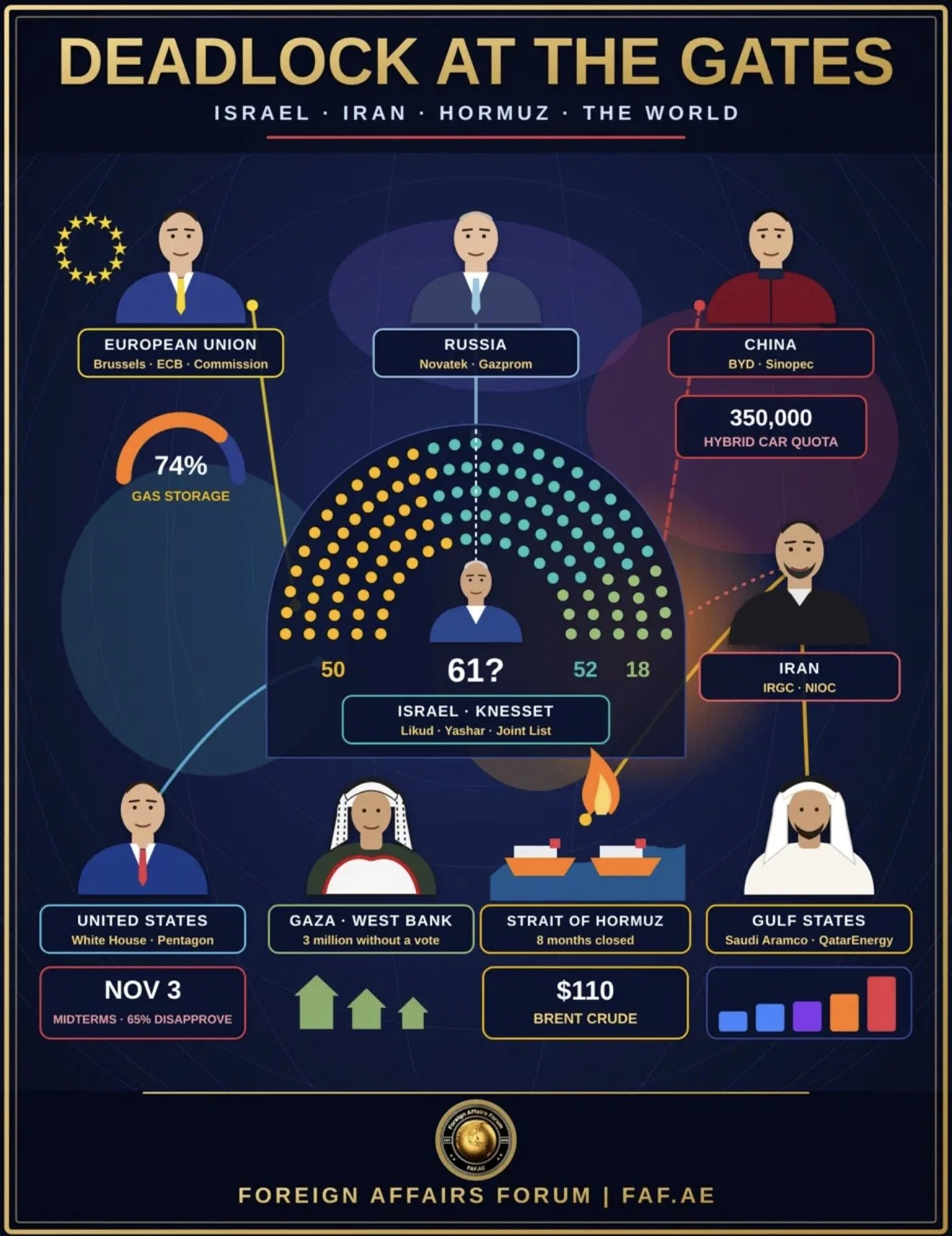
Israel's 27 October election, which many called the most pivotal in its history, produced no clear winner. Exit polls put Benjamin Netanyahu's bloc (Likud, Shas, United Torah Judaism, Ben-Gvir's Otzma Yehudit, Smotrich's Religious Zionism) at about 50 seats.
The opposition bloc (Gadi Eisenkot's Yashar, Yair Golan's Democrats, Avigdor Lieberman's Yisrael Beiteinu, and the Bennett–Lapid alliance) is projected at 52–53.
The Arab parties, Ra'am and the Joint List, are projected at about 18, a historic high.
A majority is 61 of 120. Turnout was strong (74.3% at 8pm, against 70.6% in 2022), and Haaretz reported Arab-party performance at a record level in partial counts.
The arithmetic matters more than the headline. Neither bloc can reach 61 alone. Both have publicly ruled out partnering with the Arab parties, who together hold the balance.
So the likeliest outcomes are: (1) weeks of coalition haggling, with President Herzog choosing who gets the first mandate; (2) a narrow, fragile government built by poaching defectors from the other side; (3) Netanyahu staying on as caretaker while talks drag; or (4) a sixth election in under four years.
A formal Arab-party role in a coalition remains unlikely, but an outside "support without joining" arrangement is the one path that could break the stalemate, and it would be politically explosive.
Several personal stakes sit under the numbers.
Netanyahu's corruption trial, the ICC arrest warrant, and a possible state inquiry into the failures before 7th October 2023 all depend on who governs.
A Netanyahu loss would raise the chance of an inquiry and weaken his legal position.
A narrow win would likely mean pushing ahead with judicial changes and protecting the ultra-Orthodox draft exemption, the issue that most angers secular and reservist families.
What it means for Israel
Expect a long period of paralysis at a dangerous moment. Israel is at war with Iran alongside the United States, still fighting in Gaza under a ceasefire in name only, and escalating in the West Bank and Lebanon.
A caretaker or minority government can still run the military, but it struggles to make strategic decisions: to accept a ceasefire with Iran, to shape Gaza's future, or to pass a budget.
Watch for incentive distortions. Leaders who need to rally votes from defectors, or who face a rerun, tend to avoid concessions and favor visible toughness. That favors escalation over diplomacy in the short term.
The economy is a second pressure point. Reserve duty, high energy and import costs from the Hormuz disruption, and international isolation (dozens of envoys walked out of Netanyahu's UN speech on 24th September) weigh on growth.
A prolonged vacuum could worsen all of them.
Palestine: the voters who don't get a vote
About three million Palestinian adults in Gaza, the West Bank and East Jerusalem had no say in this election, yet their lives will be shaped by its outcome. On the ground, the picture is grim whichever bloc wins:
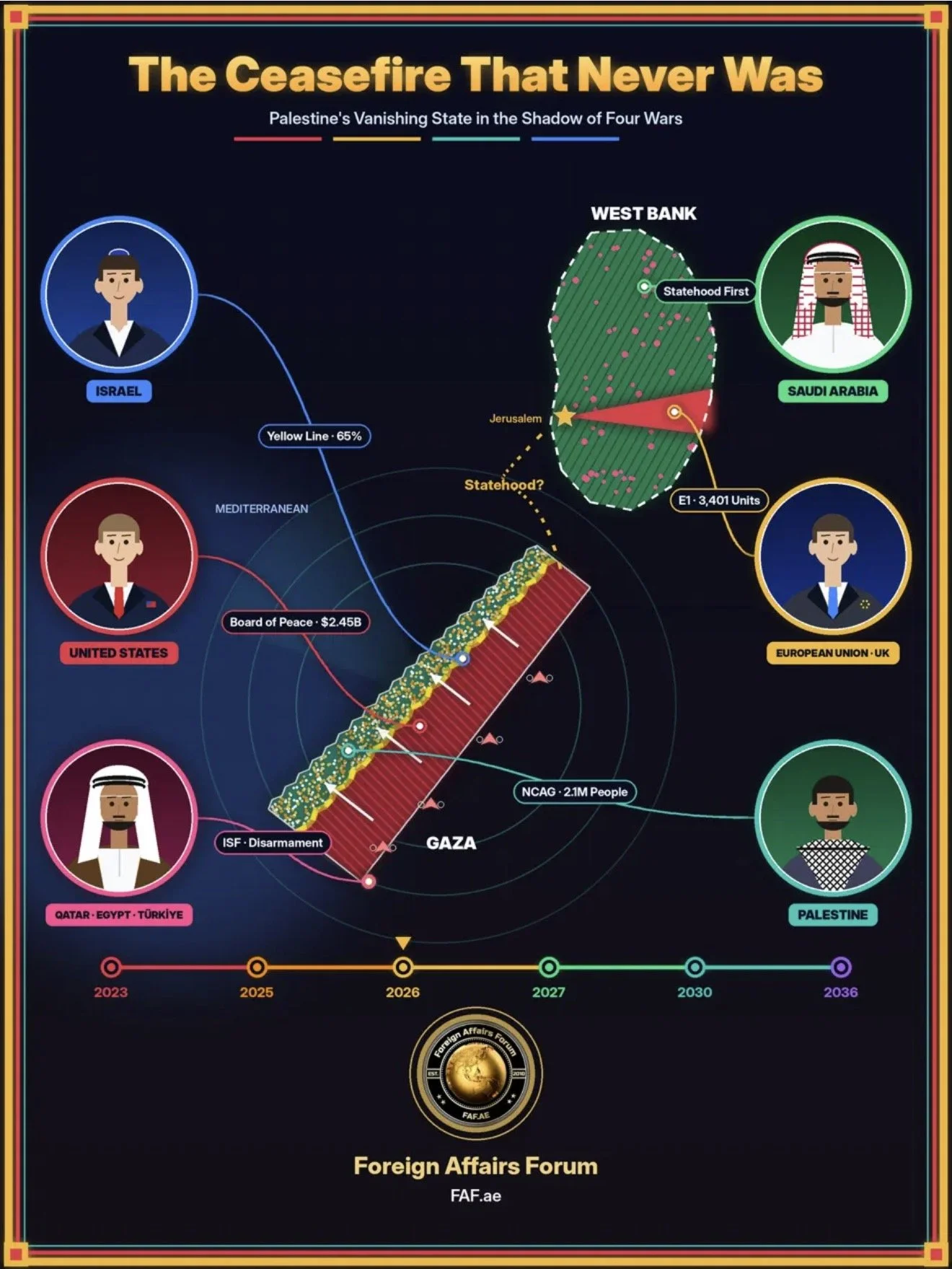
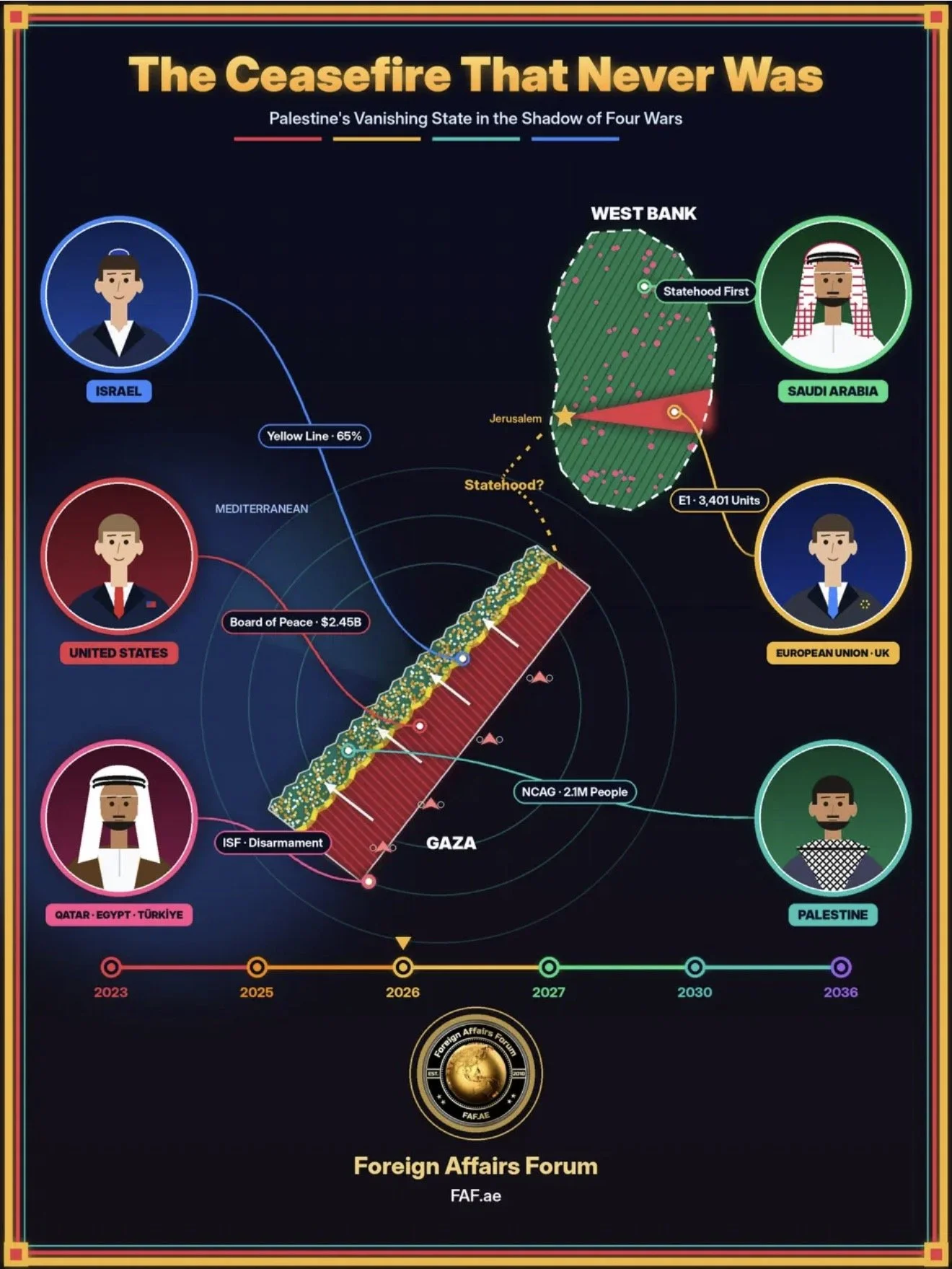
Gaza: The October 2025 ceasefire exists on paper only. Al Jazeera reports 1,559 killed since it began, 37 in the past week alone, and a cumulative toll of 74,555 per the Gaza Health Ministry. Crossings were shut for days, flour ran short, and only 7 of 20 commercial bakeries were open.
West Bank: After two Israeli soldiers were killed at a Hebron checkpoint, Israel locked down the city and displaced at least 3,171 Palestinians from 488 families, with Defence Minister Katz saying residents would not return until the operation ends. Settler attacks during the olive harvest number 482 according to Palestinian authorities, and Smotrich is reported to have ordered demolitions in Farsh al-Hawa.
The election's main significance here is about direction. A Netanyahu-led government including Smotrich and Ben-Gvir points toward further settlement expansion, de facto annexation, and an open-ended military presence in Gaza. An Eisenkot–Bennett-led government would be more pragmatic on process and international relations, but none of its components has endorsed a Palestinian state, and Bennett opposes one outright. Realistically, the opposition would likely reduce settler violence and reopen channels with Washington and Europe without changing the underlying trajectory. The Arab parties' strong showing is a signal of political mobilization among Palestinian citizens of Israel, but it will not translate into policy influence soon.
The Palestinian Authority is the great absent actor: weak, unelected for two decades, and with no clear succession. Any serious post-war plan for Gaza needs a Palestinian partner. Israel's coalition fight makes designing one even less likely in the coming months.
The Iran war: the real driver
The war that began on 28 February with US and Israeli strikes is the biggest force shaping everything else. A June ceasefire broke down over control of the Strait of Hormuz, which has been disrupted for roughly eight months. Iran has offered conditional reopening (sanctions relief, unfrozen assets, guarantees against attack); Washington rejected that package, though Foreign Minister Araghchi said Tehran is weighing a US counterproposal. The US has about 20,000 troops and at least three carrier groups in the region, and CNBC reports war costs of around $47 billion.
The timing story is crucial. Trump has said the US will not attack Iran before the 3 November midterms, while also saying the war will end "when I want it to" and that heavier bombing after the vote is "possible." Reports from major US outlets say the Pentagon has contingency plans ready. The reasonable reading: a pre-election lull, then a fork. Either a deal on Hormuz arrives quickly after 3 November because the political cost has peaked, or escalation follows because he no longer faces voters. Israel's government limbo cuts both ways. A caretaker Netanyahu may be less able to commit to a deal but also less able to launch a major new operation without American backing. The key variable remains Washington.
The United States
For Americans the war is a domestic political liability. Polling cited by Al Jazeera and others puts disapproval of Trump's handling of the war at around 65%, and AP-NORC reporting suggests a large majority want it ended. Gas and energy prices (Brent ~$110) feed directly into inflation and into voter anger. That explains the sudden promise of no strikes before the midterms.
Three things to watch on 3rd November.
First, if Democrats win the House, expect war-powers votes, hearings on costs, and pressure for a negotiated exit, though a veto-proof majority is unlikely.
Second, the result will signal how much leverage Trump has over Israel's next government. He has historically favored Netanyahu, but is also reported to be frustrated with prolonged conflict; an Eisenkot-led government might be easier to steer toward a deal.
Third, the US–Europe split over Russia (the Russian diesel waiver and sanctions relief) shows Washington prioritizing energy prices and quick deals over alliance cohesion, a pattern likely to continue if oil stays high.
The rest of the world
Energy and markets. Hormuz is the global chokepoint. Europe's gas storage is the lowest in 15 years (74% on 20 October), EU energy ministers meet 29 October on demand cuts, and Asian importers are competing for the same scarce cargoes. A deal would drop oil sharply; escalation could push prices well above $110 and tip Europe toward recession.
Europe. The EU is a price-taker. Its planned summit with Gulf states was postponed after Houthi attacks, and its Red Sea naval mission is under-resourced. A more centrist Israeli government would ease EU–Israel tensions, including pressure over settlement sanctions and trade measures, but Brussels will not have much influence over events in either case.
Russia and China. Both benefit from US distraction and high energy prices. Russia gains revenue and sanctions leakage, and Iran publicly touts its ties with Moscow. China's priority is keeping Gulf oil flowing and quietly positioning as a mediator. Reports of a proposed US–Russia–China summit in November, possibly excluding Ukraine, show how the war is reshaping great-power bargaining.
Gulf states. Saudi Arabia is both a victim of Houthi strikes and a crude supplier courting Europe. Normalization with Israel is frozen. No Gulf government will move toward Israel while Gaza and the West Bank burn and while an Israeli coalition may include Ben-Gvir and Smotrich.
Scenarios
Most likely (roughly even odds): muddle-through. Weeks of Israeli coalition talks, a US post-midterm push for a Hormuz arrangement, partial reopening, and continued low-level violence in Gaza and the West Bank. Oil eases but stays elevated.
Escalation: Talks collapse after 3 November, the US resumes heavy strikes, Israel acts from a weak political base, and Gulf infrastructure is hit. Oil spikes, Europe faces rationing.
Breakthrough: A US–Iran deal tied to Hormuz and sanctions, followed by an Israeli centrist-led government that reopens Gaza diplomacy. This is the least likely but would be the biggest positive shock for markets.
Conclusion
Israel's election did not settle who will lead the country; it settled only that no one leads it decisively. That would matter less in a quiet year. In this one, Israel's paralysis collides with a US president racing a midterm clock, an Iranian leadership holding the world's most important oil chokepoint, and a Palestinian population with no vote and little protection. The three crises are one system: Iran's war sets energy prices, energy prices set American politics, American politics sets the timetable for Hormuz, and that timetable sets how much room any Israeli government, or any Palestinian, has to maneuver.
The practical lesson is to watch sequence rather than headlines. The 28 October–4 November window carries four decisive moments: Israel's final count, the US midterms, Israel's official certification, and Iran's reply to the US counterproposal. If a Hormuz arrangement emerges soon after 3 November, relief will spread quickly, through lower oil, easier European winter planning and room for diplomacy on Gaza. If it does not, the likelier path is a harder winter, a harsher war, and an Israeli government too weak to say no to escalation or yes to compromise.
For Palestinians, the grim constant is that every scenario above is decided by others. For Europe and the wider world, the lesson is the same in a different register: its security and prosperity now depend on decisions in Jerusalem, Washington and Tehran that it does not control, and the next ten days will show which way those decisions break.